
Quick Answer
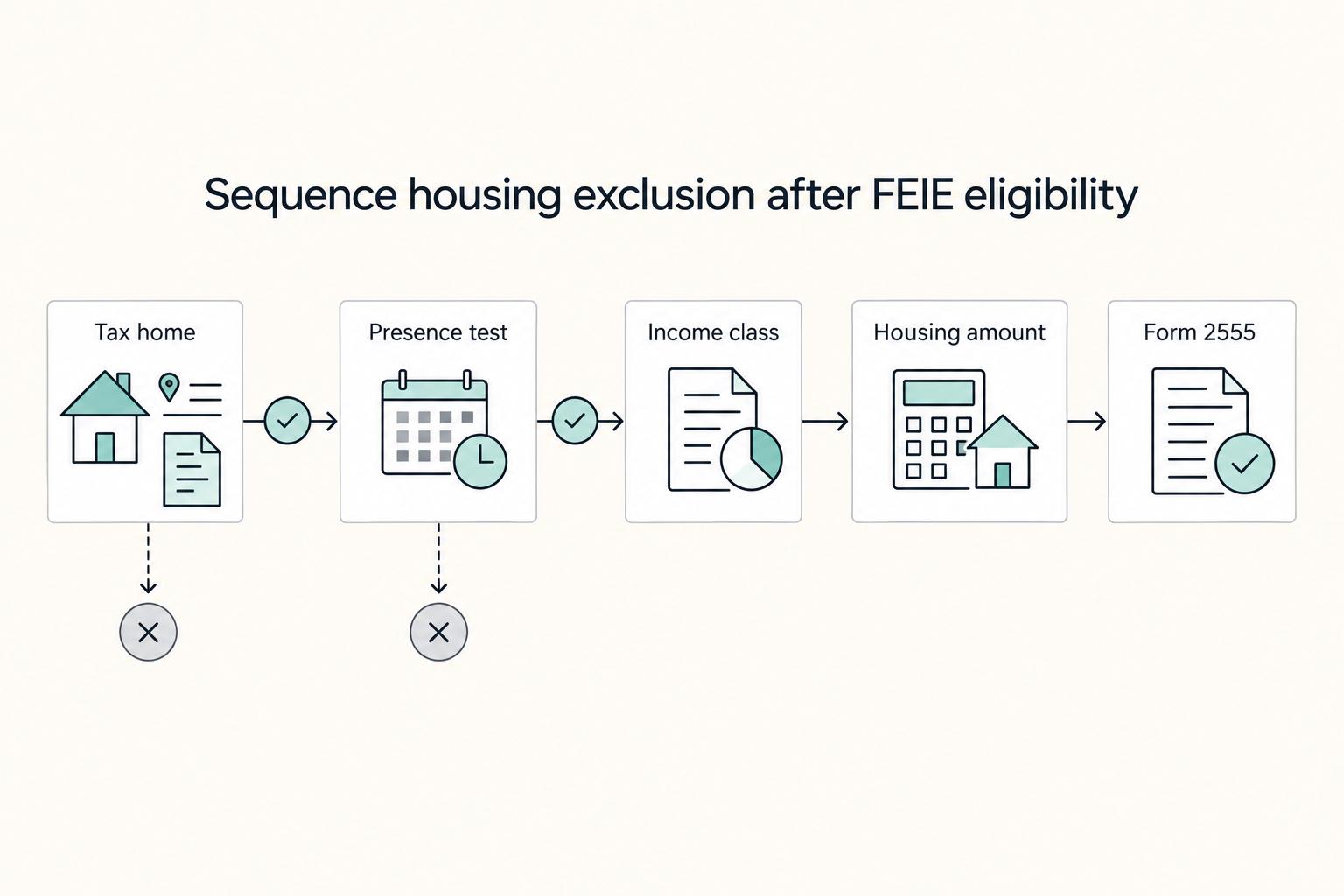
The foreign housing exclusion is best handled with a compliance-first sequence, not ad hoc math. First confirm eligibility, then classify income correctly, then calculate the foreign housing amount on Form 2555, and finally validate records and cross-form checks. This approach helps US expats avoid common filing errors, keep claims defensible, and know exactly when to escalate to a tax professional.
You can run this foreign housing exclusion decision in one sitting#
You can work through this foreign housing decision in one focused pass if you keep the order right. Most filings do not fail for lack of effort. They fail on sequence. A common mistake is filling out Form 2555 before confirming eligibility, classifying income correctly, or checking housing costs against current IRS rules.
Use this five-gate playbook to keep your U.S. expat tax filing defensible.
| Gate | What to confirm first | Safe default if facts are unclear |
|---|---|---|
| Eligibility | Your tax home is in a foreign country, and you qualify under the Bona Fide Residence Test or the Physical Presence Test (330 full days in 12 consecutive months). | Do not claim yet. Lock dates and residency records first. |
| Classification | Use the foreign housing exclusion for employer-provided amounts. Use the foreign housing deduction for self-employment earnings. | Split income streams conservatively and escalate if classification overlaps. |
| Calculation | Compute the foreign housing amount as foreign housing expenses minus the base housing amount. | Run the worksheet twice and pause if your FEIE period does not match your expense period. |
| Records | Keep proof that supports each input you plan to report on Form 2555. | If a number lacks documentation, exclude it until you can substantiate it. |
| Escalation | Identify ambiguity early (mixed income, partial-year moves, unclear limits). | Ask a qualified tax professional before filing. |
The mindset is simple. Safe defaults beat aggressive interpretations. If IRS guidance leaves room for judgment, choose the path you can document clearly and explain in plain language. Keep the claim bounded by reality. You cannot exclude or deduct more than your foreign earned income for the year.
Treat this framework as the right order, not a license to reuse old thresholds. IRS limits can change, and Form 2555 instructions can receive post-publication updates. Confirm current-year limits in IRS materials before you file. If your travel timeline is messy, start with 183-Day Rule Explained: Stop the Tax Myths Before They Cost You. Then return to this five-gate flow.
Build the mental model before you touch Form 2555#
Use this filing order on Form 2555: clear FEIE eligibility, classify income, then calculate your foreign housing amount. This section pins down the terms and sequence so you can stop second-guessing and start executing.
Use plain language and keep the labels straight so you do not lock in errors early.
- Foreign Housing Exclusion applies to housing costs paid with Employer-Provided Amounts.
- Foreign Housing Deduction applies to housing costs paid with Self-Employment Earnings.
- Foreign Housing Amount equals qualifying housing expenses minus the Base Housing Amount.
If you blur these terms, you create classification errors early and carry them through the return.
| Decision layer | What it means | What to do |
|---|---|---|
| Eligibility first | Housing benefits sit on top of FEIE logic for most filers. You need foreign earned income, a foreign tax home, and qualification under bona fide residence or physical presence rules. | Confirm eligibility before you classify any housing costs. |
| Classification second | Foreign housing exclusion and foreign housing deduction follow income type, not preference. | Route employer-paid amounts to exclusion, self-employment amounts to deduction. |
| Calculation third | You figure the housing amount before you figure FEIE on Form 2555. The base housing amount uses 16% of the maximum exclusion amount with a 365-day divisor (366 in leap year). | Run the housing worksheet first, then complete FEIE lines. |
| Mixed-status caution | Most filers do not claim both paths in one year. Mixed-status years can create both. | If income type changes during the year, separate periods and document your logic. |
Before filing, run this script and keep it in the same folder as your Form 2555 workpapers.
- Define each income stream as employer-provided or self-employment.
- Match housing costs to the correct stream.
- Compute the foreign housing amount.
- Enter Form 2555 in sequence (housing first, FEIE second).
- Flag ambiguity early and escalate before submission.
If you move countries, leave payroll, and finish the year on client contracts, you can still stay compliant. Split periods cleanly, apply one rule set to each income type, and keep your documentation aligned. As of 2026, keep one more default in place: confirm current IRS Form 2555 instructions and updates before you file, because thresholds and implementation details can change.
Do you clear the eligibility gate before doing any math?#
Clear eligibility first: confirm your Tax Home, then pass either the Bona Fide Residence Test or the Physical Presence Test before you calculate any housing numbers. Treat this as a go/no-go gate. If it fails, stop. Do not run housing costs, FEIE, or foreign housing amount math yet.
In U.S. expat tax work, sequence protects you. Tax Home means your principal place of business, employment, or post of duty. From there, run one eligibility path: bona fide residence or physical presence. Do not treat foreign tax residency labels as a shortcut to FEIE eligibility. Also do not assume leaving the United States automatically ends state tax residency exposure.
| Eligibility check | What to confirm | Risk if you skip it |
|---|---|---|
| Tax Home | Your work base sits in a foreign country for the period you want to claim. | You may fail the gateway even with strong travel day counts. |
| Bona Fide Residence Test | You can show real residence facts, not just time abroad. | One year abroad alone does not lock qualification. |
| Physical Presence Test | You have 330 full days in foreign countries within a 12 month period. | Day counting errors can break FEIE and housing benefit claims. |
| Filing window control | Your selected 12 month period covers 365 days (366 in leap year) and can cross tax years. | You can misstate claim periods on Form 2555. |
Treat records as risk control, not admin. Form 2555 asks for explicit dates, so build a date-backed file before you file.
- Travel log with entry and exit dates.
- Residence timeline tied to where you actually lived and worked.
- Support that maps qualifying periods to planned housing costs.
Safe default for mixed-year moves: claim only periods you can prove with tax-home facts and the test you are using (physical presence or bona fide residence). If facts sit in a gray area, exclude that slice for now and escalate later.
If you move midyear, then spend a long block back in the U.S. for client work, split the year into clear segments and run eligibility by segment. If day counting still feels messy, review 183-Day Rule Explained: Stop the Tax Myths Before They Cost You before finalizing your Form 2555 draft.
Should you claim exclusion or deduction as a business of one?#
Classify compensation first, then choose the housing path: employer-provided amounts go to the foreign housing exclusion, and self-employment earnings go to the foreign housing deduction. Eligibility is only step one. This gate is about keeping your Form 2555 workflow defensible by tying every housing claim to how you were paid.
Use this decision table before you enter any housing costs.
| Income pattern | Housing treatment | Form workflow | Safe default |
|---|---|---|---|
| Employee compensation only | Claim foreign housing exclusion on employer-provided amounts. | If you qualify, use Form 2555 to figure FEIE and the housing exclusion path. | Keep employer-paid and reimbursed amounts clearly documented. |
| Self-employment income only | Claim foreign housing deduction on self-employment earnings. | If you qualify, use Form 2555 for FEIE and housing deduction; if net earnings are at least $400, compute and attach Schedule SE for self-employment tax. | Include all self-employment income when figuring net earnings. |
| Mixed employee and self-employment year | You may have both paths only if you were both during the same tax year. | Split compensation by source, then map each part to the correct Form 2555 treatment; complete Schedule SE where required. | If you cannot separate compensation cleanly, pause and escalate. |
Two rules prevent the most common errors:
- Do not classify by preference. Classify by how you got paid.
- Do not assume FEIE or housing benefits erase self-employment tax. They can reduce regular income tax, but they do not reduce self-employment tax.
If your net self-employment earnings are at least $400, you still compute that liability on Schedule SE and attach it to your return.
Run this check before filing.
- Tag each payment as employer-provided or self-employment earnings.
- Map related housing costs to that same tag.
- Complete Form 2555 using that mapping.
- When Schedule SE applies, compute it on total net self-employment earnings.
- Confirm you do not claim a foreign tax credit or deduction on income you exclude.
If you start the year on payroll, then move to direct client contracts, treat it as a mixed-income case. Split the year by compensation source, document each segment, and escalate to a tax professional if contracts, reimbursements, or payroll records overlap in ways you cannot prove cleanly.
How do you calculate your foreign housing amount without guessing?#
Calculate your foreign housing amount in a fixed order on Form 2555: qualifying housing expenses first, base housing amount second, final difference third. Keep the timing aligned with your FEIE qualifying period so the return stays coherent.
| Reference | Value | Note |
|---|---|---|
| Base housing amount method | 16% of the maximum exclusion amount ÷ 365 days | Use 366 in a leap year |
| Full-year housing expense limit for most locations (2025) | $39,000 | 30% of $130,000 |
| Daily limit reference | $106.85 per day | Use if your qualifying period is shorter |
Foreign Housing Amount is your total foreign housing expenses for the year minus your Base Housing Amount. The base housing amount ties to the FEIE maximum and uses a daily method. It is 16% of the maximum exclusion amount divided by 365 days (366 in a leap year). If you claim the foreign housing exclusion, calculate it before you calculate the Foreign Earned Income Exclusion.
| Step | What to do on Form 2555 | Why this prevents errors |
|---|---|---|
| 1 | Identify qualifying housing costs for your qualifying period only. | You avoid pulling in costs from non-qualifying days. |
| 2 | Compute the base housing amount using the FEIE-linked daily method. | You keep the base calculation aligned with IRS rules. |
| 3 | Subtract base housing amount from total qualifying housing costs. | You get the correct foreign housing amount. |
| 4 | Apply the housing expense limit worksheet for your location. | Limits vary by location, so one blanket cap can misstate your claim. |
| 5 | Carry results through the housing sections of Form 2555 (Parts VI, VIII, and IX), then finish FEIE. | You keep the return sequence and totals coherent. |
Use a location-limit checkpoint every time. For 2025, most locations use a full-year housing expense limit of $39,000 (30% of $130,000). If your qualifying period is shorter, use the daily limit reference of $106.85 per day. Location caps can differ, so confirm current IRS limits for the filing year before you submit.
Run this validation routine before filing.
- Confirm your qualifying period first, then use that same period for housing math.
- If you use multiple location worksheets, keep total worksheet days at or below total qualifying-period days.
- Recheck arithmetic from worksheet totals to Form 2555 entries.
- Verify the same day-count logic appears across your FEIE and housing sections.
- Escalate if period dates, location caps, or housing cost timing do not reconcile.
If you have housing costs in more than one location during your qualifying period, build separate location worksheets. Keep day counts under control. Merge totals only after both worksheets pass your validation checks.
Which housing costs qualify and which get rejected?#
Claim only housing costs that are reasonable, non-lavish, and tied to your FEIE-qualifying period, then reject everything outside that lane. Clean math is useless if the inputs are wrong. This section is your filter before anything touches Form 2555.
Treat this as a gate, not a suggestion. The IRS allows core housing costs such as rent, certain utilities, insurance, lease fees, furniture rental, residential parking, and household repairs. It also rejects personal spending and ownership costs that many filers mistakenly include. Classify first, then calculate.
| Cost type | Usually qualifies | Usually rejected |
|---|---|---|
| Housing occupancy | Rent, nonrefundable lease acquisition fees | Cost of buying a house, cost of improving a house |
| Utilities and services | Utilities other than telephone charges | Pay television, domestic labor |
| Home support | Real and personal property insurance, household repairs, residential parking | Mortgage principal, depreciation on the house |
| Furnishing and living items | Rental of furniture and accessories | Buying furniture or accessories, meals |
| General standard | Costs that are not lavish or extravagant | Lavish or extravagant housing costs |
Timing matters. A cost can look valid by category and still fail by period. Include expenses only for periods where you meet the tax home test and either the bona fide residence test or the physical presence test for FEIE-linked eligibility. For risk control, tie each expense to the qualifying period under those tests.
Use this quick worksheet before you populate Form 2555.
- List each housing cost line by line.
- Tag each line as qualify, reject, or review.
- Mark whether the expense date falls inside your FEIE-qualifying period.
- Record the rejection reason for every rejected line.
- Carry only qualify lines into your foreign housing amount workpaper.
If you relocate, sign a lease, pay utilities, and buy new furniture in the same month, separate the categories. Your lease and eligible utilities may qualify, but your furniture purchase does not. That one distinction can keep your housing deduction or exclusion clean when the IRS reviews your filing logic.
How do you make the claim audit-ready with clean records?#
Build a Form 2555 file that ties every housing line to a payment trail and your FEIE qualifying period, then run FBAR and Form 8938 checks in the same review cycle. Once you have qualified costs, your job is to make the claim easy to prove. Treat this as operations, not paperwork.
Build your Form 2555 evidence stack#
Use one checklist per tax year and store records in month order so you can reconcile quickly.
| Record set | What to keep | What it proves |
|---|---|---|
| Form 2555 core file | Draft and final Form 2555 workpapers, FEIE qualification timeline notes, employer information, income documentation | You followed a repeatable method for FEIE and housing calculations |
| Housing costs support | Lease, rent invoices, utility bills (excluding phone), insurance invoices, and housing expense receipts | Each claimed housing cost fits allowed categories and stays reasonable, not lavish or extravagant |
| Proof of payment | Bank statements, card statements, transfer confirmations, landlord receipts | You paid the expense and can tie amount and date to the claim |
| Qualifying period support | Travel log, entry and exit records, address history, employer or client location records | Claimed days align with your qualifying period |
If a document cannot answer what, when, who paid, and why it qualifies, move that line to review or reject. That standard keeps weak claims out of your final numbers.
Run cross-form controls in the same close process#
Form 8938 and FBAR solve different compliance problems. Form 8938 does not replace FBAR, and you file FBAR with FinCEN, not with your IRS return. When aggregate foreign account values exceed $10,000 at any point in the year, add an FBAR checkpoint to your close calendar, with the April 15 due date and automatic extension to October 15.
| Form/check | Key point | Filing note |
|---|---|---|
| Form 2555 | Link account statements, housing payments, and Form 2555 workpapers | Organize by year, country, and month |
| Form 8938 | Form 8938 does not replace FBAR | Determine whether Form 8938 applies |
| FBAR (FinCEN Form 114) | Add an FBAR checkpoint when aggregate foreign account values exceeded $10,000 at any point in the year | File with FinCEN; April 15 due date with automatic extension to October 15 |
If you move between countries and open a new local account while you claim FEIE and housing benefits, keep the workflow reconciliation-friendly. Link account statements, housing payments, and Form 2555 workpapers in one folder tree by year, country, and month.
If you need a companion check for your residency timeline, use 183-Day Rule Explained: Stop the Tax Myths Before They Cost You. Use it to pressure-test your dates before you file.
If you want a deeper dive, read Opening a Bank Account in Europe as a Non-Resident.
What is your one-sitting checklist and escalation threshold?#
Run this checklist in order: lock eligibility, route income correctly, compute Form 2555, then clear cross-form checks before filing. By this point you have the gates and the math order. This section turns it into a repeatable close process.
Run the one-sitting checklist#
Use this order once, then run a second pass to catch mismatches.
| Step | Decision rule | Output |
|---|---|---|
| 1. Confirm eligibility first | Verify Tax Home in a foreign country and pass either the Bona Fide Residence Test or Physical Presence Test. Complete Form 2555 Part II or Part III, not both. | A clear eligibility memo and the correct residency-test section selected. |
| 2. Route income by source | Classify compensation into Employer-Provided Amounts and Self-Employment Earnings before you choose a housing path. | Exclusion path, deduction path, or a mixed-income allocation note. |
| 3. Compute in filing order | Calculate Foreign Housing Amount as total foreign housing expenses for the year minus the base housing amount, then compute the housing benefit before FEIE. Draft Form 2555 entries and run a second-pass tie-out to your workpapers. | A reconciled Form 2555 draft with math and period checks completed. |
| 4. Run cross-form sanity checks | Determine whether FBAR (FinCEN Form 114), Form 8938, or both apply. For FBAR, check whether aggregate foreign account values exceeded $10,000 at any point, then calendar the April 15 filing with automatic extension to October 15. | A yes or no filing matrix and a calendar of due dates. |
If you move between countries and split your year between payroll and consulting work, this structure keeps your housing logic stable even when your facts change midyear. For a broader compliance calendar, use the digital nomad tax guide.
Set your escalation threshold before you file#
Escalate to a qualified tax professional immediately if any of these appear:
| Trigger | Issue | Action |
|---|---|---|
| Location-based housing limit is unclear | You cannot confirm the correct location-based housing limit for where you incurred housing costs | Escalate to a qualified tax professional immediately |
| Mixed income cannot be allocated cleanly | You have mixed income and cannot allocate housing treatment cleanly between exclusion and deduction | Escalate to a qualified tax professional immediately |
| Residency timeline may change FEIE eligibility | Your residency timeline sits near filing deadlines and could change FEIE eligibility | Pause filing and escalate |
Use this rule: if one unresolved input can change eligibility or calculation order, pause filing and escalate.
Use the framework, file conservatively, and keep proof ready#
Use this five-gate workflow each filing cycle to keep your Form 2555 decisions conservative and traceable. At this point, you are not chasing tactics. You are running a repeatable close process where each Form 2555 input has a clear rule, a clear period, and a clear document trail.
Run the five gates every time#
- Eligibility gate: Confirm you qualify to use Form 2555 before you calculate housing amounts.
- Classification gate: Keep the amounts and periods used in the form clearly separated so each entry is traceable.
- Calculation gate: Figure the foreign housing exclusion before FEIE, and complete the parts used for housing computations (Parts VI, VIII, and IX).
- Records gate: Keep required travel-period details and complete entries. Enter
N/Awhere an item does not apply so your filing stays complete. - Escalation gate: Stop and escalate when location-based housing limits or required inputs are unclear, since rules vary by filing facts.
Safe defaults help in IRS workflows because they are easier to defend. Use the current Form 2555 page for the latest instructions and updates, and work from the Form 2555 instructions plus Publication 54, chapter 4. Use the location worksheet in the instructions before finalizing numbers, since housing limits vary by location. Keep housing expenses inside the rules: they may not exceed your total foreign earned income for the taxable year.
If your facts change during the year, keep each period and computation traceable instead of forcing one shortcut across the whole return. If you choose the foreign housing exclusion, figure it before FEIE and claim the full amount you are entitled to.
Gruv can support this operator workflow, where enabled, by keeping cross-border records traceable and reconciliation-ready across FEIE planning, Form 2555 workflows, and related compliance operations.
Frequently Asked Questions
Who can claim the foreign housing exclusion vs the foreign housing deduction?
Use compensation type as a starting decision rule on Form 2555. The Foreign Housing Exclusion is tied to Employer-Provided Amounts, and the housing deduction is figured in Part IX of Form 2555. If you have multiple income types, evaluate each amount under the correct Form 2555 path.
Do I need to pass FEIE tests before I can claim foreign housing benefits?
Yes. Start with the Tax Home test, then pass either the Physical Presence Test or the Bona Fide Residence Test before you claim housing benefits. For FEIE timing, the physical presence path uses 330 full days in 12 consecutive months, while bona fide residence requires an uninterrupted period that includes a full tax year.
How is the foreign housing amount calculated on Form 2555?
You calculate Foreign Housing Amount by subtracting the Base Housing Amount from your qualifying housing expenses. On Form 2555, if that subtraction is zero or less, you stop that part of the housing computation flow (and Part IX for that path). Keep your housing-expense period aligned with periods where you meet the tax home test and either the physical presence or bona fide residence test.
What housing expenses qualify and which expenses are excluded?
For Form 2555, qualifying housing costs include items like rent, utilities other than telephone charges, and real or personal property insurance. Excluded costs include domestic labor, pay television, buying furniture or accessories, and meals. If a cost is unclear, review it carefully before you include it.
What happens if my housing costs are below the base housing amount?
If your subtraction result is zero or less, you do not have a positive housing amount for that path. Form 2555 then tells you to stop that part of the housing computation flow. That result does not automatically decide every other part of your return, but it does end that housing-claim branch.
How do location-based housing limits change what I can claim?
The housing expense limit changes by location, so your claim can change even when your income and housing costs look similar. For 2025, most locations used a default cap of $39,000 before location-specific adjustments. Verify the current IRS location limit before you finalize numbers, and do not assume last year’s cap still applies.
When should a freelancer stop DIY filing and hire a tax professional?
Escalate when one unresolved issue can change eligibility or filing path. Common triggers include unclear FEIE timing, uncertainty about how to apply the Form 2555 housing paths, or questions about location-based limits. Also escalate if required Form 2555 information remains incomplete, since missing detail can lead to disallowed benefits.
Try a related tool
Researched and edited by the Gruv editorial team. Gruv builds cross-border billing, payouts, and finance-operations software for global businesses.
Sources
Educational content only. Not legal, tax, or financial advice.
Related Posts

Digital Nomad Taxes in 2026 With a Defensible Filing Plan
With digital nomad taxes, the first move is not optimization. It is figuring out where you may be taxable, where filings may be required, and what proof supports that position.

183-Day Rule Tax Myths That Trigger Residency Filing Mistakes
If you are a mobile freelancer or consultant, start here: the "183 day rule tax" idea is not a single universal test. It is a shortcut phrase people use for different residency rules that do not ask the same question. If you mix federal and non-federal residency logic, you can create filing risk even when your travel calendar looks clean.

Opening a Bank Account in Europe as a Non-Resident
If euros arrive on time, reconcile cleanly, and remain usable without constant support tickets, you have solved the real problem. The search phrase "open european bank account non resident" usually means one thing in practice: protect cashflow. Start there, not with prestige features.