
Quick Answer
Yes. The netherlands 30 percent ruling can still improve take-home pay in 2026, but only if you manage deadlines and evidence from day one. File the joint employer-employee request within 4 months of your first working day to protect early payroll treatment. Then check your return assumptions: from 1 January 2025, new returns cannot elect partial foreign tax liability, so asset reporting and transition status should be reviewed before filing.
Treat the Expat Scheme as a Managed Compliance Asset#
Treat this as a managed compliance asset, not a payroll perk. Official pages now refer to the expat scheme, formerly the 30% ruling. The key operational change is that from 1 January 2025 you can no longer elect partial foreign tax liability in your return. Transition relief still runs through 2026 for some people who were already using the scheme before 2024. That makes your cohort, filing timing, and asset profile worth checking early.
For 2026 planning, official government content says the tax-free reimbursement remains 30% in 2025 and 2026 for eligible employees in paid employment (loondienst). For 2027, official pages are not fully aligned. One says 27% from 1 January 2027, another still shows a 30/20/10 structure, and one amendment page says the effective date is not yet final. Verify the current position before you model later-year cash flow.
| Aspect | Passive benefit mindset | Managed asset mindset |
|---|---|---|
| Core decision | "HR will handle it." | "I will verify eligibility, deadlines, and contract terms." |
| Main risk | Late filing, wrong asset assumptions, missed threshold checks | More upfront admin, fewer downstream surprises |
| What you do | Wait for payroll outcomes | Build an evidence pack and track rule triggers |
Your first checkpoint is simple but strict. You must be in paid employment, loondienst, not self-employed, and your facts must support eligibility. In practice, that means checking specific expertise, the residence-distance history test in the 24 months before your first workday, and the right 2026 salary threshold for your case, including €36.497 for certain under-30 master graduates versus €48.013 generally.
A practical way to manage the process is to break it into four phases:
- Before signing: decide whether the offer is structured well enough to support the scheme. Evidence: contract terms and salary figures.
- At application: decide how fast you can file. If the request is not filed within 4 months after your first workday, do not assume day-one treatment.
- During the 5-year term: decide how you will document assets, status changes, and employer changes so compliance stays defensible.
- Before expiry: decide how you will handle any reimbursement-percentage changes that may apply after 2026 and any changed Box 2 or Box 3 exposure.
This article follows that sequence, from pre-sign checks through expiry planning, with clear points where specialist advice is worth paying for. If you want a deeper dive, read the digital nomad tax guide.
Phase 1: Maximizing Your Leverage Before You Sign the Offer#
Before you sign, the real question is not whether the package looks attractive. It is whether the employer, contract, and process can support a clean application. If ownership, assumptions, or downside handling are vague, pause.
Run a go/no-go screen on the employer#
Start with execution quality, not headline salary. This is a joint employer-employee application, so someone needs clear ownership of the process.
- Process readiness: If your move also involves immigration steps, confirm who owns that track and what the employer can document.
- Recent filing experience: Ask who handled similar applications recently, internal HR or an external advisor, and who reviews submission quality.
- Single accountable owner: Name one person for timeline, document collection, submission coordination, and payroll follow-through.
Red flags: vague answers on prior filings, no written timeline, "we'll sort it out after you start," or no clear answer on advisor costs and delayed-approval handling.
Negotiate protection clauses into the contract#
This is the point where written terms matter most. If the application is delayed or denied, you want the contract to say what happens next instead of leaving it to a later discussion. Use plain-language checklist clauses:
- Employer and employee will submit the application jointly.
- Filing ownership and process: define who owns each step and who reviews submission quality.
- Submission timing commitment: set a written filing timeline.
- Delayed approval handling: state whether payroll corrections will be made where permitted.
- Denial fallback: define gross salary, bonus, relocation support, and any clawback outcome.
- Advisory and document costs, including translation or legalization: define payer split.
Compare the offer with and without ruling protections#
For 2026 planning inputs, the source materials state a 30% tax-free wage component, a €262,000 salary base cap, and a €78,600 allowance cap. Use those as modelling inputs, not promises.
| Decision point | Offer without ruling protections | Offer with ruling protections |
|---|---|---|
| Net-pay model inputs | Gross salary only, assumptions not documented | Gross salary, expected 30% component, payroll start month, cap check (€262,000 / €78,600) |
| Delay or denial scenario | Financial impact left open | Written fallback for salary, bonus, relocation support, and correction process |
| Execution ownership | Split across recruiter, HR, and payroll without a lead | Named owner, advisor role confirmed, document list agreed |
| Policy-change downside | No sensitivity view | Separate sensitivity case for a possible 2027 policy change |
Build a pre-sign evidence checklist#
Before accepting, collect the evidence you may need later, grouped by source.
| Category | What to collect |
|---|---|
| Belastingdienst | Joint-application ownership note, payroll assumptions, signed offer terms, confirmed start date |
| Immigration steps, if relevant | Documented ownership of immigration tasks and required employer documentation for your route |
| Eligibility evidence | Records showing where you lived and worked before recruitment and before your start date |
| Compensation evidence | Fixed-pay terms and payroll assumptions used in your model |
| 2026 cap check | Confirm your model accounts for the €262,000 salary base cap and €78,600 allowance cap |
If each item is documented, move to Phase 2. If any item is still unclear, stop and get specialist review before signing. Related: The Best Budgeting Methods for People with Irregular Income.
Before you sign, document your move dates and residency timeline in the Tax Residency Tracker so your eligibility checks are easier to verify later.
Phase 2: Navigating the Application Process and Avoiding Pitfalls#
Once the offer is signed, treat this as a filing project. It is a joint employer-employee request to the Belastingdienst. Both sides sign, and the 4-month clock starts on your first working day if you want first-day applicability.
Build the submission file before anyone opens the form#
Incomplete requests are a common failure mode, and in practice your working deadline is earlier than the legal edge. The Tax Administration states that all requested attachments must be included, and incomplete requests are not processed. Build the full pack first, then submit. Use this pre-submission checklist:
| File section | Key items |
|---|---|
| Identity | Signed personal-data statement, required payroll identity fields, identity and address evidence, BSN if already assigned |
| Employment | Signed employment details, confirmed first working day, employer payroll and wage-tax details, salary terms mapped to the specific-expertise route, 2026 planning inputs: €48,013 generally and €36,497 for the under-30 master's route |
| Residency-history proof | Records showing where you lived before the Dutch role and evidence for the 150-kilometre and 16-of-24-month conditions |
| Qualification evidence | Education and experience evidence required by the route you are using and any route-specific support tied to age or education category |
Confirm the currently accepted evidence types against the live form flow before you file. Before submission, keep one chronology sheet with the contract signature date, relocation date, registration date, and first working day. If those dates do not line up, fix the timeline before filing.
Make ownership and checkpoints explicit#
You need a formal decision, a beschikking, before the scheme is applied. A shared tracker helps because many mistakes happen at handoff points between you, HR, payroll, and any advisor.
| Responsibility | Owner | Deadline checkpoint |
|---|---|---|
| Complete the joint request and collect both signatures | You + HR | Before submission, no unsigned version in circulation |
| Reconcile contract data, first working day, and salary-route inputs | HR + payroll + you | Before filing, confirm threshold route and date alignment |
| Assemble and verify every attachment required by the live form flow | You + HR or tax advisor | Several business days before filing, freeze a final attachment pack |
| Submit to Belastingdienst and store proof of receipt | HR or tax advisor | No later than 4 months after start date for first-day applicability |
| Track decision progress and payroll implementation | HR + payroll | Monitor the stated 8-week response timeline and document payroll handling |
Once approval arrives, add one annual payroll check. Each year the employer must choose between applying the Expat Scheme and reimbursing actual extraterritorial costs.
Control the failure modes#
Treat each common failure as something you can spot early. That keeps the process cleaner and gives you a chance to fix weak evidence before filing.
| Failure mode | What triggers it | How to prevent it | What to do if it happens |
|---|---|---|---|
| Late filing | No single owner, late document chase, or waiting for one more item | Set an internal filing date ahead of the legal deadline. Confirm the current filing-window edge rules after verification. | Quantify the impact immediately and get written payroll handling guidance. |
| Incomplete request | Attachments assumed instead of validated against the current form flow | Run a final attachment check and store one indexed submission pack | Send missing items quickly and update the tracker to prevent repeat gaps |
| Weak residency proof | Gaps in records for the distance and lookback conditions | Build a month-by-month address evidence trail before filing. Confirm the current rule-test interpretation after verification. | Pause, rebuild the evidence pack, then file. |
| Unclear recruitment or contract chronology | Conflicting dates across offer, relocation, registration, and employment records | Reconcile one master timeline before submission | Stop filing and get specialist review before your employer submits |
If your recruitment timeline, residency proof, or contract chronology is unclear, pause the submission and get specialist review first. We covered related timing issues in The Netherlands DAFT Visa for American Entrepreneurs.
Phase 3: The 5-Year Plan to Defend Your Ruling and Global Assets#
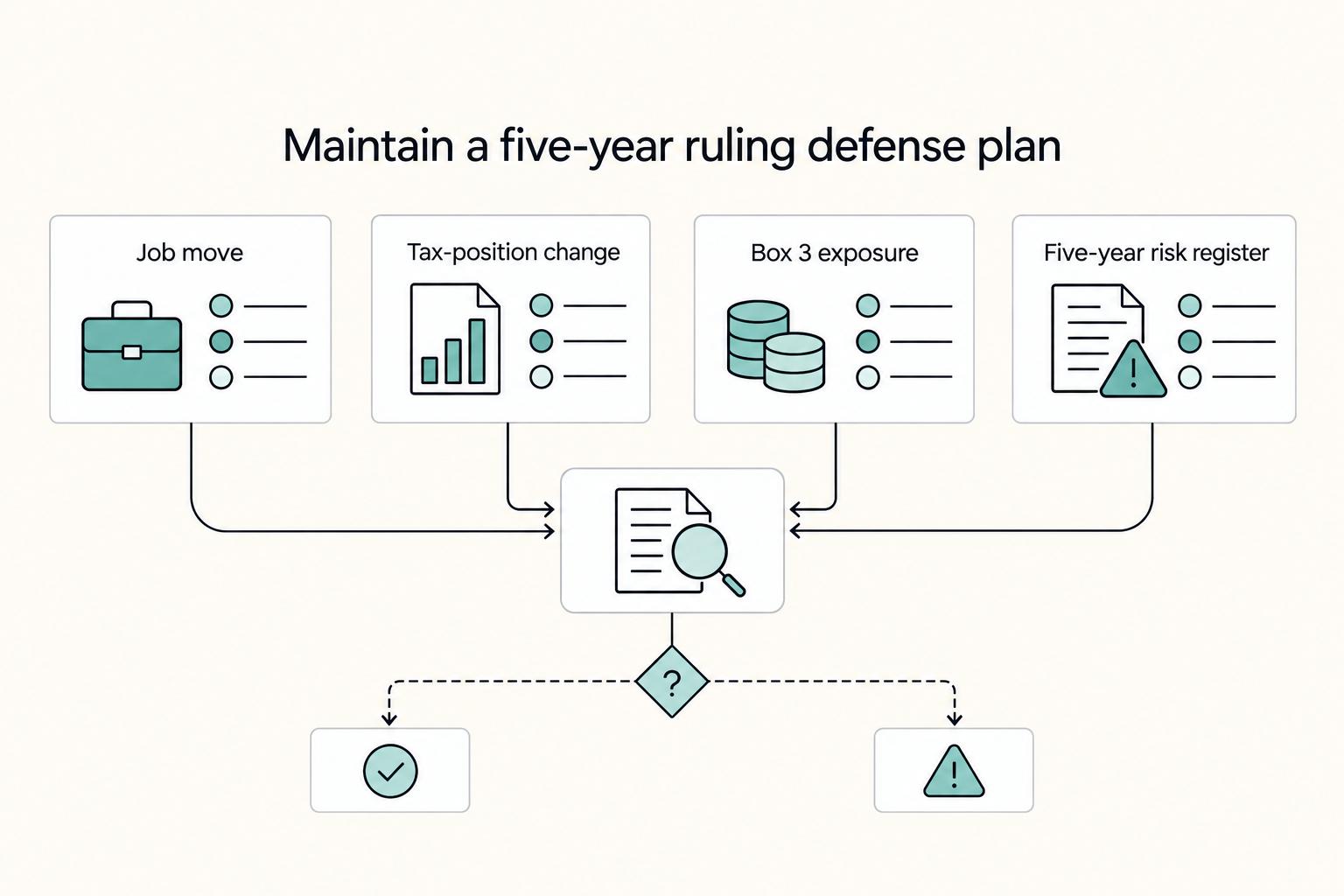
After approval, the job changes. You are no longer trying to get the scheme. You are trying to keep the position defensible for up to 5 years, while making sure payroll assumptions and tax-return treatment do not drift apart.
The tax position changed, and not for everyone in the same way#
Start with the current baseline. From tax return year 2025, you can no longer opt for partial foreign tax liability in your tax return. Under the old partial status, Box 2 and Box 3 were treated as foreign-taxpayer boxes even while you lived in the Netherlands. Box 3 reporting was limited to specified Dutch assets.
If you are not in a verified transitional case, plan for potentially broader Box 3 exposure. Box 3 covers savings and investments, and the notional-return method uses fixed percentages. For 2025, the published percentages are 1.37% for bank balances, 5.88% for investments and other assets, and 2.70% for debts.
Some people can still use a transition path, but only under specific conditions. If you used the Expat Scheme before 2024, partial foreign tax liability can still apply through tax return 2026. Transitional-law cases may still choose partial non-resident status up to and including 31 December 2026. Confirm your transition status before filing. Do not assume you are covered just because your ruling is active today.
Put Box 3 on a yearly control cycle#
You do not need a complicated model here. You need a yearly routine that can stand up if anyone asks how you arrived at the return.
- Asset inventory: Map each holding to Box 3 categories, bank balances, investments or other assets, and debts, or record why it is out of scope.
- Valuation process: Reconcile your return inputs to statements before filing. From 2025 onward, actual return is included in the Box 3 return. The June 2024 Supreme Court direction cited by the Belastingdienst means actual return is used when it is lower than notional return.
- Documentation hygiene: Keep one organized file set for statements, valuation support, debt support, and any assumptions used.
- Advisor checkpoint triggers: Escalate before filing if classification is unclear, valuation is hard to support, your actual-return position differs materially from notional, or you may still be in a transitional partial-status case.
Treat a job move as a continuity event#
A job move is a re-application event with deadline risk, not routine admin. The new employer must file a new application, and continuity depends on timing. Confirm the current timing rule after verification.
| Scenario | Continuity risk | Required actions | Immediate next steps |
|---|---|---|---|
| Job change within allowed window | Lower, but not automatic | Start with the new employer within 3 months, have the new employer submit a new application, and make sure the application is submitted within 4 months after the new start date | Lock contract signature and start date, assign filing owner, and store proof of submission |
| Job change outside allowed window | High | Do not assume continuity, treat status as at risk until reviewed | Quantify payroll and tax impact and get written tax advice before first payroll run |
For transitional-law cases, the same 3-month concept is explicit: there is no interruption for this transitional law if a new employer is found within 3 months. Keep one date log for resignation date, last day, new start date, and application date.
Risk register for the years after approval#
The main post-approval risks are usually predictable. Catch them before payroll year-end or a job change turns them into a retrospective problem.
| Risk | What can go wrong | Your control | Escalate to a tax professional when |
|---|---|---|---|
| Salary continuity | If wage falls below the indexed standard, the scheme can lapse retroactively from 1 January and earlier returns may need adjustment | Run a year-to-date threshold check before year-end payroll closes | Your expected annual wage is close to the applicable threshold, including the 2026 €48,013 general route or €36,497 eligible under-30 route |
| Leave-related wage volatility | Leave can affect how the income-standard test is applied | Pre-test annual wage outcomes before leave periods | Leave periods materially affect the annual wage test and treatment is unclear |
| Employer change | "3 months" is misunderstood as automatic continuity | Treat the move as a new application with controlled dates and ownership | There is any employment gap, delayed contract signing, start-date uncertainty, or filing ownership conflict |
For a step-by-step walkthrough, see Taxes in the Netherlands for Expats and Freelancers.
Phase 4: Planning Your Strategic Exit to Avoid the Tax Cliff#
The end of the scheme should not be a surprise that shows up on a payslip. It is a planned transition. The Expat Scheme decision is valid for a maximum of 5 years. It can end earlier when employment ends, based on the wage period of your last working day. It can also lapse retroactively from 1 January of a year if salary drops below the indexed standard.
Check these documents now, in one sitting:
- your decision letter, for the maximum validity window
- your employment contract, for end date and change clauses
- a recent payslip, for how payroll is currently applying the facility
If you are in an eligible pre-2024 transitional case, run a separate deadline check. Partial foreign tax liability can continue only through 2026 for qualifying cases, so do not budget 2027 as if that treatment still applies.
Run the exit drill well before expiry#
Model from gross pay, not current net pay. For 2026 planning inputs, for an employee younger than AOW age, payroll tax bands are 35.75% up to €38,883, 37.56% from €38,883 to €78,426, and 49.50% above €78,426. Use this mini-checklist:
| 2026 taxable pay band | Payroll tax rate |
|---|---|
| Up to €38,883 | 35.75% |
| €38,883 to €78,426 | 37.56% |
| Above €78,426 | 49.50% |
- recalculate monthly take-home with zero tax-free reimbursement
- if salary is €262,000 or higher, use the 2026 max tax-free reimbursement of €78,600 (for full-year use) rather than a flat 30% assumption
- confirm with payroll whether this year uses the fixed Expat Scheme method or tax-free reimbursement of actual extraterritorial costs, since an annual choice is required from 2023
- add a resident-tax scenario for savings and investments if you plan to stay in the Netherlands after expiry
Compare your exit options#
The right exit plan depends less on tax theory than on how long you expect to stay, how flexible your employer is, and whether your spending has already adjusted to ruling-era net pay.
| Option | Effort | Timeline | Upside | Downside | Who it fits |
|---|---|---|---|---|---|
| Compensation renegotiation | Medium | Start well before expiry | Can directly help offset lower net pay | Depends on employer budget and your leverage | Staying with the same employer |
| Pension or long-term savings buffering | Medium | Start as early as practical | Can build a buffer while disposable income is higher | Less short-term cash flexibility, tax and portability review may be needed | Planning longer-term residence |
| Spending and investment rebalance | Low to medium | Start now | A lever you control personally | Lifestyle cuts can be difficult | Anyone with lifestyle creep during the ruling period |
| Relocation or no-change path | High | Start early and map key dates | Lets you decide with numbers instead of assumptions | Immigration, payroll, and tax timing complexity | Unsure about staying Dutch resident after expiry |
Budget like a long-term Dutch resident#
Use conservative post-expiry assumptions by default. From 1 January 2025, people generally cannot newly choose partial foreign tax liability in the return, and resident Box 3 reporting can include assets and debts inside and outside the Netherlands.
For 2026 planning, use these inputs:
- Box 3 tax rate: 36%
- tax-free Box 3 allowance: €59,357 for a single person or €118,714 with a fiscal partner
Stress-test housing against post-ruling net income, not today's net:
- social rent max increase (2026): 4.1%
- middle-rent max increase (2026): 6.1%
- private-sector max increase (2026): 4.4%
Your contract and segment rules still determine the actual increase, but these are practical stress-test ceilings.
Escalate when the case is not straightforward#
Some cases are straightforward. Others usually get expensive when you wait too long. Get professional advice early if any of these apply:
- cross-border assets
- fiscal-partner income complexity
- entity or company income
- uncertain relocation timing
- you or your partner hold at least 5% in a company, with possible Box 2 substantial-interest impact
This month, do three things:
- confirm your exact expiry date and payroll stop point
- build one gross-to-net model with no facility applied
- list assets, partner items, and entity interests that need specialist review
Related: Can Digital Nomads Claim the Home Office Deduction?.
From Expat Perk to Strategic Asset: Taking Control of Your Financial Future#
The ruling is temporary and deadline-driven, so the practical move is to manage it like an active compliance file, not a passive payroll perk.
What you control:
- Pre-offer diligence: confirm the specific-expertise route, the salary threshold for your category, and recruited-from-abroad conditions, including the 150 km and 16/24 months lookback.
- Application execution: confirm the application is filed within 4 months of your first working day if you want full-start treatment. Late filing can shorten the effective period.
- In-term risk management: keep your decision letter, contract, payslips, and annual payroll handling records together. The employer must handle the scheme again each year during the 5-year maximum term.
- Exit planning: model your post-ruling payslip early. If you change employers, treat it as a new compliance event. The new employer must file a new application, and continuity is tied to the 3-month switch window.
Use this review cycle each quarter, and again before filing or changing jobs:
- Monitor: salary and bonus structure, contract dates, employer changes, and Box 2 or Box 3 position if partial foreign tax liability is part of your history.
- Document: one file with the decision letter, application proof, latest payslip, contract updates, and current asset snapshot.
- Escalate: job change, employment gap, mixed Dutch and foreign income, large investment assets, or uncertainty about the €262,000 cap effective 1 January 2026.
Rule checkpoints to verify at each review:
- From 1 January 2025, new returns cannot elect partial foreign tax liability.
- Some pre-2024 users may still have transitional treatment through 2026.
- Official pages still differ on later-year mechanics, so verify the current version before making decisions. One still describes 30/20/10, while another states 30% in 2025-2026 and 27% from 2027.
This pairs well with our guide on A Deep Dive into France's 'Crédit d'Impôt Recherche' (CIR) Tax Credit.
If your income, assets, and payouts span multiple countries, talk to Gruv to confirm a compliant, audit-ready workflow for your setup.
Frequently Asked Questions
What happens to your Box 3 position if you have the ruling?
Do not assume ruling status automatically settles your Box 3 treatment. Compare your latest return position, ruling decision letter, and current asset and debt list, then verify the current Box 3 treatment before filing. Problems often start when payroll assumptions drive the filing position, or when status changes after expiry, transfer, or relocation are missed.
Is the Netherlands 30 percent ruling ending?
The practical question is which rules apply to your own start date and current status, not the headline wording. Check your decision-letter validity window and any amendment history, then verify your current position against up-to-date official guidance. Do not rely on a colleague's terms, older commentary, or a vague summary that ignores your own decision letter language.
How do transitional-status scenarios differ?
The answer depends on whether you are a new applicant, an existing holder, or a transfer case. What changes most is what you need to verify next. Use this table to sort your case before you model payroll or filing assumptions. | Scenario | Likely treatment | Your immediate action | Who should escalate to a professional | |---|---|---|---| | New applicant | You can apply only if all listed conditions are met | Check paid-employment status, recruited-from-abroad facts, border-region distance/lookback facts, and the relevant specific-expertise threshold | Cross-border assets, complex residence history, or variable compensation | | Existing holder | Continued use depends on your current facts still matching the approved conditions | Reconcile decision letter, payroll setup, and return position line by line | Anyone relying on assumptions that are not confirmed in current official guidance | | Transfer case | Older secondary guidance says a new employer-employee application is needed; verify current official rules | Confirm old end date, new start date, and proof of the new application | Employment gaps, immigration changes, or disputed payroll treatment |
Can you keep the ruling if you change employers?
A job move is not automatic continuity, and you should treat the transfer as a fresh compliance event. Put your old contract end date, new contract start date, decision letter, and new application evidence in one file. Older secondary guidance says the new employer and employee must submit a new application, so verify current official requirements before relying on transfer timing. Common break points are employment gaps, a new employer that does not apply with you, or payroll applying the facility before approval.
How should you think about the net-pay effect?
This is a Box 1 payroll mechanics question, not a guaranteed net-pay percentage. Review your payslip, contract, and decision letter together to see which pay elements are treated under the facility, then confirm the relevant threshold for the specific-expertise test. Errors often come from counting the tax-free allowance toward the threshold, assuming all pay components are treated the same, or missing payroll changes after contract updates.
What salary threshold, cap, or transitional treatment applies to you?
Your category and year-specific rules determine the result, and the specific-expertise test uses salary excluding the tax-free allowance. Confirm category, including any special researcher or medical-training route, plus age and degree status where relevant. Then verify the currently applicable threshold and any cap or transitional treatment in up-to-date official guidance. Do not use outdated indexed figures, the wrong category, or older terms as if they still apply automatically.
Can you use the facility through your own BV?
The scheme is tied to paid employment by an employer, so BV versus sole proprietor depends on whether a real employer-employee structure exists. Verify the employment agreement and payroll reality, then confirm that your recruited-from-abroad and border-region distance and lookback conditions still hold under current guidance. Also review prior-use history, including the five-year checkpoint for earlier users returning after time abroad. If you have cross-border assets, mixed BV and foreign income, or a job change with immigration impact, escalate early to a qualified professional before payroll or filing locks in the wrong treatment.
Try a related tool
Researched and edited by the Gruv editorial team. Gruv builds cross-border billing, payouts, and finance-operations software for global businesses.
Sources
Includes 3 external sources outside the trusted-domain allowlist.
- business.gov.nl/staff/employing-staff/the-expat-scheme-30-pe...trusted
- business.gov.nl/amendments/30-percent-ruling-compensation-do...trusted
- federalregister.gov/documents/2026/02/03/2026-02131/exercise-of-...trusted
- oecd.org/content/dam/oecd/en/publications/reports/202...trusted
- taxation-customs.ec.europa.eu/system/files/2016-09/risk_management_guide_f...trusted
- belastingdienst.nl/wps/wcm/connect/en/individuals/content/comin...external
- belastingdienst.nl/wps/wcm/connect/bldcontentnl/belastingdienst...external
- eastwing.nl/en/knowledge-base/uncategorized/what-are-the...external
Educational content only. Not legal, tax, or financial advice.
Related Posts

Digital Nomad Taxes in 2026 With a Defensible Filing Plan
With digital nomad taxes, the first move is not optimization. It is figuring out where you may be taxable, where filings may be required, and what proof supports that position.

Can Digital Nomads Claim the Home Office Deduction?
Claim the deduction only when your facts and records can carry it. With the home office deduction for digital nomads, the real decision is usually a three-way call: claim it, do not claim it, or pause and get help because your file is not ready.
The Best Budgeting Methods for People with Irregular Income
Budgeting with irregular income works better when you separate "money arriving" from "money you're allowed to spend," then run the same transfer routine each cycle.