
Quick Answer
Draft the governing law, forum, and enforcement path as separate clauses, then align them with where recovery is realistically possible. In US-Asia contracts, arbitration is often preferred because New York Convention award recognition is broader than cross-border court-judgment recognition, but only when the clause is complete: institution, seat, rules, language, and final resolution wording. If assets are mainly in China, reassess law and forum for that collection path and verify current treaty status before signing.
Why This "Boring" Clause is Your Most Important Shield Against Disaster#
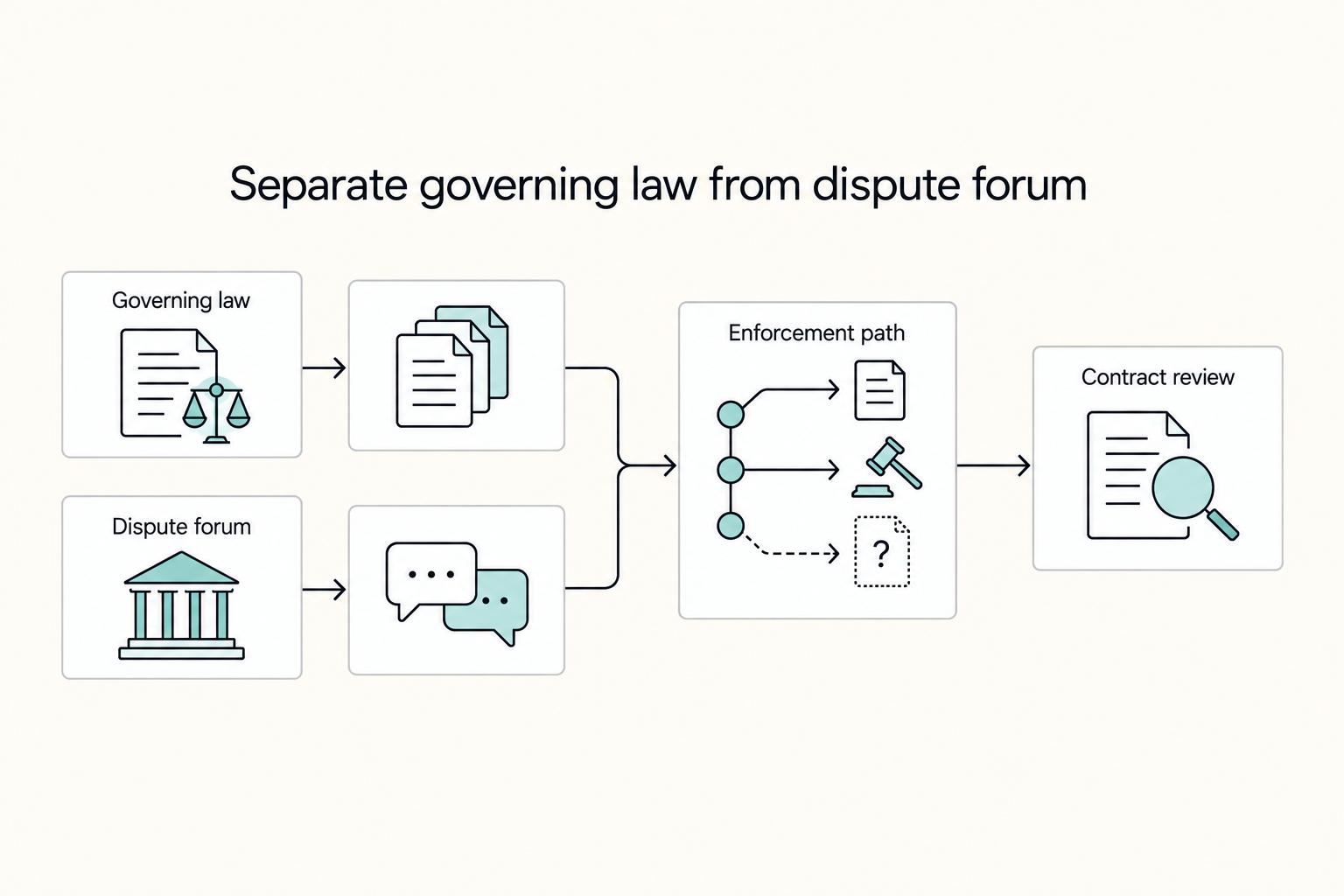
In a cross-border contract, this clause set often determines whether you can enforce your rights in practice, not just on paper. You need to make three separate decisions and draft each one clearly: governing law, jurisdiction or venue, and the enforcement mechanism.
The key point is simple: these choices are related, but they are not interchangeable. A governing law sentence does not pick the court, and a court clause does not decide which legal rules interpret the contract.
| Component | What you decide | What can go wrong if vague | What to state clearly in your clause |
|---|---|---|---|
| Governing law | Which legal system governs contract rights and obligations | Default conflict-of-law rules can produce different answers across states, creating uncertainty before the core dispute is even addressed | Name the governing legal system in plain terms |
| Jurisdiction / venue | Which forum decides disputes, and for court litigation, where the case can be filed | A law-only clause does not select a court, and a vague forum clause weakens certainty | State court versus arbitration. If court, make it exclusive and name the court and place clearly |
| Enforcement mechanism | How the result will be recognized and enforced across borders | A paper win may still be hard to enforce. Mixed or inconsistent court and arbitration language can create uncertainty and enforcement risk | State one dispute path clearly and verify enforceability in relevant countries |
For U.S. drafting context, venue is the judicial district where a civil action may be brought. If your contract only says it is governed by the laws of a place, you still have not said which court hears the case or where filing belongs.
You should also treat enforcement as a separate design choice. Court judgments and arbitral awards do not share the same cross-border enforcement framework. For court litigation, the Hague Choice of Court Convention is built around certainty and effectiveness of exclusive choice-of-court agreements. For arbitration, the New York Convention provides the recognition and enforcement framework, with refusal limited to the listed Article V grounds. In U.S. federal law, written arbitration provisions in covered contracts are valid, irrevocable, and enforceable.
Before signing, verify current treaty status from live treaty sources, not old templates, and keep a record of what you checked. Then work in this order: choose the legal rulebook first, then align forum and enforcement to match it.
The Rulebook: Choosing a Governing Law That Protects You#
Choose governing law only after verification, not by habit. A universal default for home law, client law, or neutral law, including Singapore, is not supported here. Treat each as a deal-specific choice. On this record, the rationale remains unverified.
Do not assume enforceability outcomes, negotiation effects, or collection mechanics are established for any governing-law choice.
Compare options before you lock language#
| Option | When it fits | Main enforcement risk | Negotiation impact |
|---|---|---|---|
| Your home law | Unknown from provided excerpts | Unknown from provided excerpts | Unknown from provided excerpts |
| Client's law | Unknown from provided excerpts | Unknown from provided excerpts | Unknown from provided excerpts |
| Neutral law (such as Singapore law) | Unknown from provided excerpts | Unknown from provided excerpts | Unknown from provided excerpts |
Verify which governing-law option fits your deal before locking in language.
Verify source status before you rely on any rationale#
Do not build a clause rationale on stale or inaccessible material. Keep a dated note for each authority you rely on.
| Source | Status detail |
|---|---|
| eCFR for Title 19 | Authoritative but unofficial, up to date as of 3/20/2026, last amended 3/11/2026 |
| DFARS Part 252 | Shows revision metadata, including Change 11/10/2025 and Effective Date 11/10/2025 |
| Congress.gov | Shows H.R.7148 became Public Law 119-75 on 02/03/2026 |
| UW Law PDF | Verify with the relevant authority |
For now, treat the governing-law rationale as unresolved unless it is tied to current authority and the enforcement path for this deal.
Confirm substantive governing-law outcomes and dispute-mechanism options with a qualified adviser before finalising your clause.
The Enforcement Engine: Why Arbitration is Non-Negotiable#
If you care about getting paid after a dispute, enforceability matters more than a paper win. In cross-border freelancer contracts, arbitration is usually the stronger enforcement path than court litigation.
A court judgment can still work, but from the U.S. side there is no general bilateral or multilateral treaty in force with other countries for routine enforcement of court judgments. In practice, recognition abroad often depends on the foreign court's domestic law and comity approach. That means you can win in court and still face a second fight before collection can begin where the client or assets are.
Why the enforcement path points to arbitration#
Arbitration starts from a different baseline under the New York Convention framework. Contracting states recognize arbitral awards as binding and enforce them, and current coverage is broad for US-Asia work. Verify current Convention coverage before you rely on it.
This is not automatic enforcement in every case. Refusal is still possible on specific grounds, usually raised by the resisting party. But compared with cross-border court litigation, arbitration offers a more standardized enforcement structure across Convention states.
The Convention framework also supports the arbitration agreement itself. Courts can be required to refer parties to arbitration when the clause is invoked. That helps at two stages: keeping the dispute in the agreed process, then enforcing the award later.
Court judgment versus arbitral award#
| Issue | Court judgment | Arbitral award |
|---|---|---|
| Enforceability across borders | Often depends on local recognition law, comity, and reciprocity in the enforcing forum | Backed by a Convention-based recognition and enforcement structure in contracting states |
| Procedural control | Process is tied to the court forum handling the case | You can set institution, seat, rules, and language in the clause |
| Challenge/defense scope | Recognition and enforcement can vary by forum procedure | Convention text allows refusal only on specified grounds raised by the resisting party |
| Collection practicality | May require a separate recognition battle before collection | Can be better positioned for cross-border collection when drafting and procedure are clean |
Clause components to lock before signing#
The institution matters less than clause completeness. Use SIAC or HKIAC as supported US-Asia starting points, and make sure the clause is complete:
| Component | What to specify |
|---|---|
| Governing law | Name the substantive law for contract interpretation |
| Arbitration institution | Name SIAC or HKIAC explicitly |
| Seat | Specify the legal seat of arbitration |
| Rules | Identify the institution's rules and confirm the intended version |
| Language | Set the arbitration language |
| Award finality | State that disputes are finally resolved by arbitration |
Incomplete drafting can trigger procedural fights before anyone reaches the payment issue.
That arbitration-first approach still has an important exception, and it usually turns on where recovery is actually possible. If your client is in a politically unstable region, A deep dive into the 'force majeure' clause when your client is in a politically unstable region may also help.
Strategic Adaptation: The China Exception#
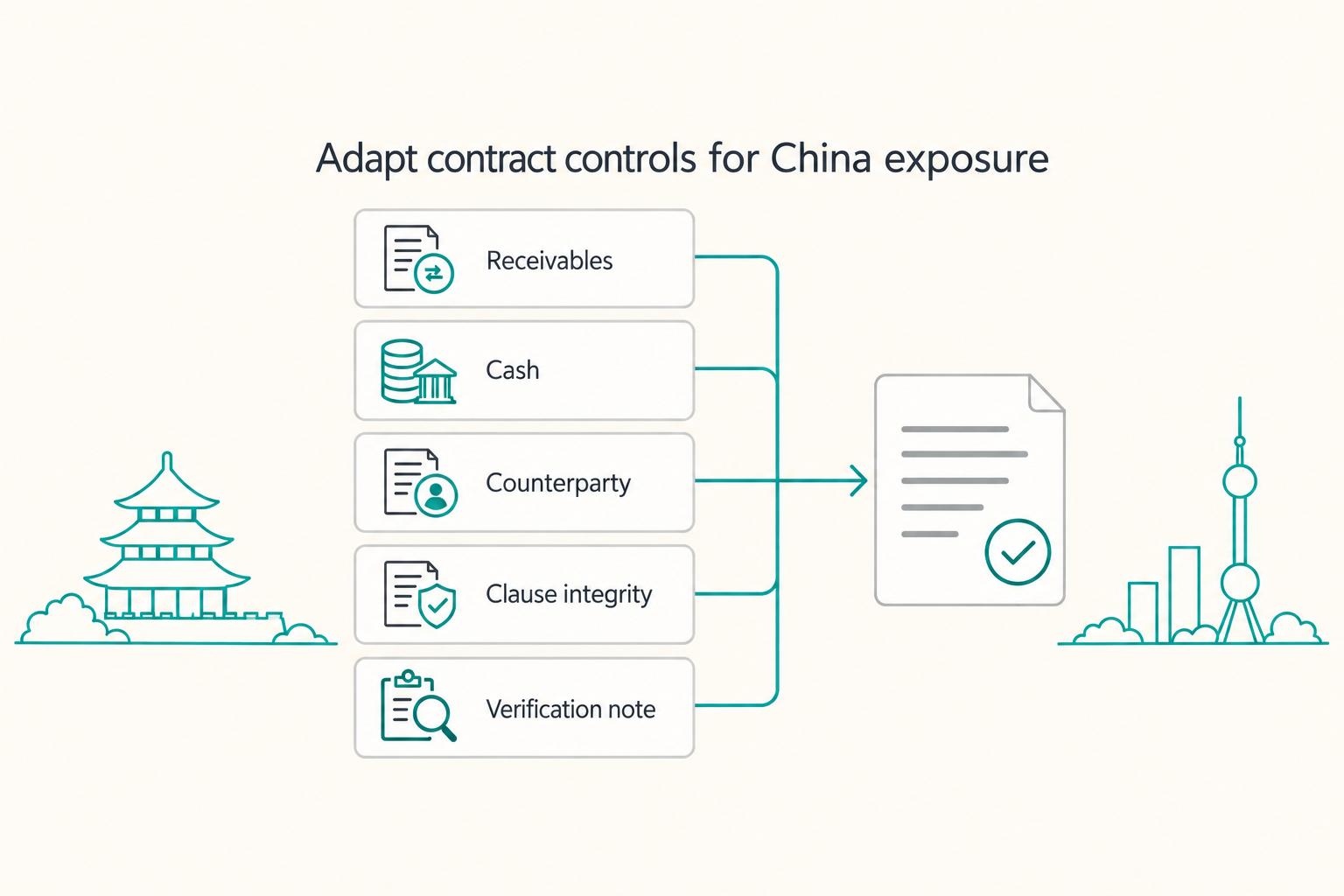
Use the same dispute-planning approach, but let recoverability guide the clause. If collection is likely tied to mainland China, choose law and forum based on where enforcement is most likely to happen, not on abstract forum preference.
Before you finalize governing-law and forum terms, run a quick diligence check on where recovery is most realistic.
Check recoverability first#
Start with the recovery picture, because a clean clause aimed at the wrong enforcement path can still leave you exposed. A weak or missing governing-law clause can also trigger protracted, expensive disputes over which law applies. Use the checklist below as a practical planning aid, not a formal legal test.
- Receivables: Which entity receives customer payments related to this project?
- Cash: Where is cash likely held if a payment dispute happens?
- Counterparty: Does the signing entity match the contract party and invoice entity?
- Clause integrity: Is governing law explicit, and is forum explicit, so you avoid a threshold fight over what rules apply?
- Verification note: Document any verification steps your legal team requires.
| Asset profile | Law + forum direction | Enforcement upside | Primary tradeoff |
|---|---|---|---|
| Recoverable assets or counterparties mainly outside mainland China | Neutral or commercially developed governing law with a neutral dispute forum | Keeps a commercially familiar structure while planning for cross-border enforceability | You still need to monitor whether value later shifts onshore |
| Mixed or unclear asset picture | Pause and verify the asset map before locking law/forum | Reduces the risk of signing a clean-looking clause that points to the wrong recovery path | Slower deal cycle and more front-loaded diligence |
| Practical recovery target appears to be only inside mainland China | Consider onshore Chinese law/forum options | Better aligns clause design with the jurisdiction where enforcement may need to occur | Lower perceived neutrality, plus added concern that outcomes may be shaped by policy objectives |
Treat onshore and neutral-law routes as conditional tools, not ideology. In negotiation, explain the China-specific adjustment as a mutual recoverability and clarity choice so you reduce friction while protecting both sides.
Once you decide your enforcement path based on where enforcement is most likely needed, turn it into clean draft language with the Freelance Contract Generator.
The Human Element: How to Negotiate with Confidence#
Treat this negotiation as shared risk management. You are asking for a fair rulebook and a usable dispute path, not home-court advantage. Keep the conversation on clarity both sides can rely on if the relationship breaks down.
A comparative-law mindset helps. Do not stop at clause wording alone. Compare the legal systems and contract data points around the clause, including how the dispute path would work in practice, so you can spot where terms that read neutral may function differently across systems.
Before debating sentence-level edits, confirm what kind of commitment you are negotiating. Using the RL32528 framing on forms of international commitments, check whether the term is actually in the binding contract or sitting in a non-binding document such as a proposal, portal term, or side communication.
Pick the framing that matches the moment#
| Outcome focus | What you say | When to use it | Main risk |
|---|---|---|---|
| Fairness | "Let's use neutral governing-law and dispute terms so neither side starts with built-in advantage." | First proposal | Can sound abstract if the client is focused on immediate delivery |
| Predictability | "Let's make law and dispute path explicit so we do not argue about process if a problem appears." | Legal review stage | Weak if either law or forum remains vague |
| Enforcement practicality | "Let's align the clause with a dispute path that is realistically workable." | After you confirm which commitment type and documents are binding | Can sound adversarial if phrased too bluntly |
| Deal speed | "If we lock this language now, we can reduce late redlines on process terms." | End-stage procurement pressure | Speed framing can invite shortcuts in wording quality |
Script set you can actually use#
First proposal: "I'm proposing neutral governing-law and dispute terms so both sides have a fair, predictable structure if something goes wrong. I'm not asking for home advantage, just clear terms we can both rely on."
If the client insists on home-law preference: "I understand the preference for familiar law. My concern is practical: in a cross-border contract, we need terms that are clear and workable for both sides, not just familiar to one side."
If you need a fallback: "If full neutrality is not workable, let's still make each part explicit and internally consistent. I want to avoid language that looks settled but leaves room to fight over process later."
Red flags and your next move#
Many negotiation problems show up as ambiguity, document conflict, or misplaced terms. Use the next question to expose the problem before you sign.
| Watch for | Ask next | Pause signing when |
|---|---|---|
| Vague wording like subject to local law or courts of competent jurisdiction | Which law applies exactly, and which forum handles disputes? | Either point is implied instead of written |
| Conflicting terms across the master agreement, SOW, PO, or portal terms | Which document controls if terms conflict? | Precedence is missing or inconsistent |
| Governing-law and dispute language placed only in non-binding documents | Which signed document contains the binding terms? | The binding text is not in the executed contract |
Confidence here comes from preparation: explicit clause language, consistent document hierarchy, and confirmed binding status before signature. For a step-by-step walkthrough, see A deep dive into the 'Waiver of Jury Trial' clause in contracts.
Conclusion: Your Contract is Your Castle - Build Strong Walls#
Treat these terms as one risk-control package, not separate edits. Before you sign, make sure the governing law, dispute path, and likely collection path are all explicit and aligned with where recovery would realistically happen.
Keep your expectations practical. In Delaware Chancery case C.A. No. 2022-0175-JTL decided June 30, 2025, a Hong Kong investor sued Delaware defendants, most claims failed, and the only successful claim led to nominal damages. The record was heavy, with 3 trial days, 810 exhibits, 8 depositions, 76 stipulations, and 6 live witnesses, and lost electronic communications triggered a sanctions-related burden shift. The operational point is straightforward: clear drafting helps, but disciplined documentation can matter just as much once a dispute becomes real.
Pre-signature check#
Before you accept terms, confirm the following:
- Law: Governing law is named clearly, in its own sentence.
- Forum mechanism: The draft clearly states whether disputes go to arbitration or court, and any key forum details are stated rather than implied.
- Enforcement practicality: You have checked where reachable assets are likely to sit and whether your clause package matches that collection reality.
- Evidence hygiene: Final contract versions, scope changes, approvals, invoices, and key communications are stored in a durable system that will survive staff changes and auto-delete settings.
If recovery may depend mainly on assets in one foreign jurisdiction, pause before reusing your standard wording and re-check current local enforceability assumptions for that specific asset picture.
This pairs well with our guide on A guide to the 'Common Law' vs. 'Civil Law' systems for international contracts.
If you want a practical review of how your contract terms map to real cross-border payment operations and coverage, contact Gruv.
Frequently Asked Questions
What is the best governing law for a contract with a Chinese company?
Start with the asset map, not a preferred law. If collectible assets are outside mainland China, a neutral law may still be workable. If assets appear limited to mainland China, align governing law and arbitration drafting with that enforcement path, including clearly named local arbitration wording (for example, CIETAC), subject to current enforceability checks where you expect to collect. In the draft, confirm asset location in writing and state governing law and arbitration institution explicitly.
Should you choose arbitration or litigation for an international contract?
In many US-Asia contracts, arbitration is a common default when cross-border enforcement matters because the New York Convention is designed around recognition of arbitration agreements and enforcement of foreign or non-domestic awards. That still is not automatic, since refusal can be sought on specific grounds. In the clause, name the institution, seat, and final-and-binding effect when your chosen rules or model clause support that language.
What is the difference between governing law and the seat of arbitration?
Treat them as separate controls. Governing law addresses the contract’s substance, while the seat is the arbitration’s legal home and is chosen separately. Write them in separate sentences so no one later argues that choosing one law also chose a court forum or seat.
Is English law or Singapore law better for Asian contracts?
Do not assume one is always better. The stronger test is practical fit: expected enforcement location, chosen seat, and whether the full clause package stays clear and internally consistent. Avoid half-choices like naming a law without a clear seat or forum, because unclear wording can delay or compromise dispute resolution.
Can you just use the law of your state, like California?
You can, but only after you check how enforcement would work where assets are likely located. A familiar home-state court clause may still leave a collection gap because cross-border court-judgment recognition is not uniform. The HCCH 2005 Choice of Court Convention entered into force on 1-X-2015, and its status table showed 39 Contracting Parties as of 27-XI-2025. Do not pair state law with a vague court clause and assume enforceability is covered. If you need help separating these pieces cleanly, see How to Write a Jurisdiction and Choice of Law Clause.
Try a related tool
Researched and edited by the Gruv editorial team. Gruv builds cross-border billing, payouts, and finance-operations software for global businesses.
Sources
- acquisition.gov/dfars/part-252-solicitation-provisions-and-c...trusted
- congress.gov/crs-product/RL32528trusted
- congress.gov/bill/119th-congress/house-bill/7148/texttrusted
- courts.delaware.gov/Opinions/Download.aspxtrusted
- dau.edu/sites/default/files/tools/CPRG-Volume-5.pdftrusted
- ded.uscourts.gov/sites/ded/files/opinions/10-192_0.pdftrusted
- digitalcommons.law.uw.edu/cgi/viewcontent.cgitrusted
- ecfr.gov/current/title-19/chapter-I/part-10trusted
Educational content only. Not legal, tax, or financial advice.
Related Posts

Germany Freelance Visa Application Path for Freiberufler and Gewerbe
Choose your track before you collect documents. That first decision determines what your file needs to prove and which label should appear everywhere: `Freiberufler` for liberal-profession services, or `Selbständiger/Gewerbetreibender` for business and trade activity.

Write Jurisdiction and Choice of Law Clauses You Can Enforce
Treat this clause package as an enforcement tool, not boilerplate. If governing law, court authority, and filing location do not fit how the deal actually works, you can end up fighting about procedure before you ever reach the unpaid invoice, IP misuse, or scope breach.
How Freelancers Should Choose Governing Law and Jurisdiction in International Contracts
Treat these two clauses as core risk controls before you sign, not fine print. In cross-border work, they determine which legal rules apply, where disputes are heard, and how predictable enforcement may be if things go wrong.