
Digital professionals face significant financial risk from political instability, as generic contracts fail to protect against non-payment when a client's country is in crisis. To mitigate this, you must proactively architect your contract to guarantee payment by mandating funds from a stable jurisdiction, defining specific digital risks in your force majeure clause, and using milestone-based payment structures. This strategic approach transforms your contract into a powerful tool that secures revenue and provides control, allowing you to work confidently with international clients.
What 'Force Majeure' Means for a Digital Business#
In a digital services contract, force majeure is a contract-defined concept, not a catch-all for events that make work harder or less profitable. Whether it applies usually turns on the clause language and the specific facts.
The phrase literally means "superior force," but the legal effect comes from your contract language and how that language is interpreted. Before you invoke it, run this practical check:
- Clause threshold: What standard does the clause set (for example, prevention or another trigger), and do your facts meet it?
- Causation: Can you connect the event directly to the missed delivery, access loss, or payment-route failure?
- Notice: What notice process does the contract require, including timing, format, and recipient, and have you followed it exactly?
- Mitigation: What reasonable alternatives did you try first, and what evidence shows those efforts?
If performance is still possible but commercially disrupted, related doctrines such as impracticability or frustration of purpose may be more relevant than classic force majeure. Those doctrines are distinct and depend on the contract wording and governing law.
| Disruption scenario | Likely classification | Verify before deciding |
|---|---|---|
| Government connectivity shutdown | May qualify only if covered events include this type of government or network disruption and performance was actually prevented | Outage records, provider notices, and timeline evidence showing delivery was prevented |
| Sanctions-related payment block | May be force majeure or may fall outside force majeure, depending on clause text and available lawful alternatives | Bank or payment rejection evidence, sanctions notices, and whether another lawful payment path existed |
| New legal or compliance ban | May qualify if the change directly makes contracted performance unlawful under the clause framework | The legal text, effective date, and which services are affected |
| Critical platform outage | May qualify or may be excluded, depending on whether third-party failures are included | Platform status evidence, fallback options, and whether service could continue another way |
What controls the outcome#
The outcome usually turns on drafting details and interpretation: the defined events, the governing-law clause, and any carve-outs, including whether already-due payment obligations are treated separately. Boilerplate wording often leaves major gaps, so read the exact clause, not the heading.
Before you invoke#
Start by assembling an evidence pack: the signed contract, exact clause text, event timeline, notices or screenshots, and mitigation records. Then cross-check the notice and performance requirements before you send anything.
If sanctions, cross-border compliance, or local public-order rules are involved, screen the counterparty against the OFAC sanctions list and get local legal review in the relevant jurisdiction before making a definitive legal claim. Once you know what counts as clause-level prevention in your contract, the next step is making sure your payment clause does not collapse the moment conditions worsen. Related: What is a 'Force Majeure' Clause and Do You Need One?.
Architecting Your Contract to Guarantee Payment#
Your payment clause should make non-payment hard to excuse and easier to enforce. In practice, build it in this order: payment source, payment trigger, payment rail, and enforcement path.
1) Lock the payment source first#
This is a core control point. Do not stop at "client will pay." Name the paying legal entity, require payment from an account in that entity's legal name, and list permitted currencies and permitted jurisdictions.
Set a lawful fallback rule from day one. If the primary rail is unavailable because of bank disruption, compliance restrictions, or sanctions issues, define how the parties will move to a pre-agreed lawful alternative rail where legally permitted. Avoid language like "any available method."
Before signing, confirm in writing:
- Exact payer legal entity name
- Account-origin country
- Primary rail and backup rail the client can actually use
If those details are not confirmable, treat that as risk, not admin noise.
2) Tie payment timing to objective trigger events#
Subjective payment triggers can create preventable disputes. Use rule-based triggers, not vague phase language. "On completion" is disputable. Delivery plus objective acceptance criteria is typically easier to enforce.
A practical sequence looks like this:
- Kickoff invoice triggers on countersignature and required onboarding inputs.
- Milestone invoices trigger on delivery of named outputs to a named channel.
- Acceptance occurs by written approval, or by expiry of a defined review window without a rejection tied to stated criteria.
- Include a suspension right for late payment after the contract notice steps are followed.
Also define when payment is deemed made by rail, for example the EFT date, so "finance is processing" does not delay the due-date clock.
3) Choose payment holding method by risk profile#
The right holding method depends on trust, project size, and how much release friction you can tolerate. Pick the method that matches the risk, not the one that sounds most formal.
| Method | Use when | Main upside | Main tradeoff |
|---|---|---|---|
| Direct pay | Repeat work, lower-risk counterparty, low release friction needed | Fastest operations, lowest third-party cost | Higher collection risk if approvals stall or funds movement is disrupted |
| Escrow | First engagement, larger milestones, lower trust, higher dispute sensitivity | Neutral third party holds funds until agreed conditions are met | Fees, release friction, and delay risk if release instructions are vague |
| Split method | Medium-risk projects where speed matters early but later invoices are larger | Balances quick kickoff with tighter protection on later stages | More drafting and operational complexity |
Escrow helps only if the release instructions are clear. It does not remove dispute risk by itself, and the Cornell escrow overview is a useful reminder that the real control sits in the release terms.
4) Close the clause gaps that usually cause losses#
Many losses come from a few predictable drafting gaps. The fix is to remove the loopholes before they become a collections problem.
| Clause area | Weak drafting | Stronger drafting direction |
|---|---|---|
| Setoff | Client can net invoices against any alleged counterclaim | Fees payable without setoff, deduction, or counterclaim, to the extent permitted by governing law |
| Sanctions disruption | No plan if a rail is blocked or becomes unlawful | Parties cooperate to reroute through a lawful alternative rail and provide updated payment instructions promptly; require documentary proof of rejected or blocked transfers where applicable |
| Notice mechanics | "Notify promptly" with no channel or recipient | Name notice recipients and channels for non-payment, deliverable rejection, sanctions events, and force majeure; require notice without delay where applicable |
| Late payment | Generic penalty language disconnected from governing law | Insert a jurisdiction-matched late-payment remedy and due-date mechanics, with placeholders for local-law terms |
| Enforcement path | No cross-border recovery path | State forum or arbitration path clearly; for cross-border enforcement planning, align with an award-recognition framework where relevant |
Red flags to remove now#
Fix these before you sign:
- "Payment due on completion" or "when client is satisfied"
- No named currency, no named rail, or no lawful fallback rail
- No requirement that payment comes from the client's own verifiable account
- Open-ended approval windows with no objective rejection standard
- No suspension right for non-payment
- No anti-setoff wording
- No jurisdiction-matched late-payment remedy or enforcement path
Payment protection works best when it fits the actual disruption path, which is why cross-border work can need more than one catch-all clause.
For a step-by-step walkthrough, see How a US Freelancer Should Draft a Governing Law Clause with an Asian Client.
The 'Political Risk' Clause Your Contract is Missing#
Do not rely on one generic force majeure sentence for cross-border digital work. Split this section into two lanes: force majeure for events that prevent or materially impede performance, and a separate destabilization/hardship trigger for risk spikes that justify renegotiation while performance may still be possible.
That split is practical, not academic. Boilerplate force majeure language can be read narrowly in some jurisdictions, including New York, and event naming can decide whether relief is available. Draft for the actual risks in your deal, then pressure-test each event for foreseeability and whether its effects could reasonably be avoided or overcome.
Split the clause into two lanes#
Use force majeure for true blockage. Use destabilization or hardship for a fundamental shift in contract balance, while keeping in mind that higher burden alone does not automatically excuse performance and a renegotiation request does not by itself allow withholding performance.
| Event category | Define it as | Default response path | Evidence checkpoint |
|---|---|---|---|
| Connectivity disruption | Shutdowns, throttling, or platform blocking affecting required tools or channels | Continue with safeguards if workable; pause and renegotiate if degraded; invoke force majeure only when performance is prevented or materially impeded | Outage notices, access logs, provider messages |
| Sanctions or payment blockage | Blocked counterparties or transfers, or legal prohibition on the agreed rail | Move to a lawful backup rail; pause and renegotiate if reroute is possible but delayed; force majeure only if lawful payment or performance cannot proceed | Bank or compliance rejection records, sanctions screening results, blocking-report workflow details, including applicable deadlines such as 10 business days where relevant |
| Legal or compliance change | New mandatory rules that restrict the contracted method of performance, including data-transfer constraints | Continue only with a lawful workaround; otherwise pause and renegotiate scope, location, or method; force majeure if performance becomes unlawful or materially impeded | Text of rule change, compliance or counsel summary, impacted obligations |
| Security-related operational disruption | Events, including ransomware, that halt required operations | Continue with containment if delivery can continue; pause and renegotiate if recovery is feasible; force majeure if operations remain blocked despite reasonable mitigation | Incident summary, affected systems, recovery estimate |
If the work depends on cross-border data flows, state clearly that mandatory rules can still control performance even if the contract language says otherwise.
Build the clause in modules#
A workable clause usually needs clear modules. Each one should do a specific job rather than repeat broad labels:
- Definitions: force majeure = prevention or material impediment; destabilization or hardship = material risk shift that upsets deal balance without automatic excuse.
- Trigger conditions: event must affect a named obligation; avoid broad labels like "political unrest" without operational detail.
- Notice requirements: prompt notice after learning of the impediment, including impact, expected duration, and supporting records.
- Mitigation duties: the affected party should attempt reasonable workarounds, such as alternate channels, lawful payment rails, or sequencing changes.
- Payment treatment: specify how amounts for completed or accepted work are handled, recognizing mandatory law can still control what is lawful.
- Renegotiation and escalation path: in hardship scenarios, allow renegotiation and define escalation (including court) if no agreement is reached within a reasonable time.
- Restart or termination path: review at a defined number of days or when conditions change; define restart steps and a termination route if no lawful or practical restart is available.
Drafting pitfalls to avoid#
The common failure mode is not that the clause is missing. It is that the clause is too vague to operate when the facts get messy.
- Ambiguous triggers that invite argument
- No evidence standard tying the event to a specific missed obligation
- No clear payment treatment for already-earned fees
- No clear handoff from temporary pause to exit decision
If those four points are not explicit, the clause is still too vague to protect you when conditions turn. Good drafting helps only if your records are ready before trouble starts.
You might also find this useful: How to Write a 'Force Majeure' Clause That Covers Pandemics and Geopolitical Events.
Your Pre-Crisis Checklist: 4 Steps to Take Before Instability Hits#
Before instability starts, set up proof and continuity so you can show what obligation was affected, what mitigation you attempted, and how you gave notice. Without that record, contractual protection can be harder to enforce.
1 Lock a notice communication plan#
A written communication plan helps you deliver and document notices if normal communication is disrupted.
- Owner: You and the client's day-to-day contact.
- Action: Agree in writing on who sends and receives contractual notices, plus backup contact details if normal communication fails.
- Evidence: Keep a dated contact record with names, roles, notice responsibilities, and backup contacts in your contract folder or project memo.
Document how blocked communications are escalated, and log each notice attempt.
2 Build an evidence file before you need it#
If you wait until a dispute starts, the timeline will already be harder to prove. Maintain the file while work is normal, not after the disruption.
- Owner: You, or one named admin.
- Action: Maintain an incident log that ties each event to a specific contract obligation, when you learned of it, expected impact, mitigation attempts, and notice sent.
- Evidence: Save originals where possible: system notices, access logs, screenshots, sent emails, and formal notice text.
Store records in an independent repository you control. Timestamp entries at capture and align them to your contract's notice language. For force majeure, the key is impact on performance, not hardship alone.
3 Map critical dependencies before disruption#
Continuity planning is stronger when you can see where performance depends on a single client, platform, payment route, or vendor.
- Owner: You.
- Action: Keep a dependency map of key obligations, delivery dependencies, and payment routes, and mark single points of failure.
- Evidence: Maintain one current dependency sheet reviewed before renewals or major new work.
Where no practical fallback exists, record the risk and adjust scope, timing, or terms before work starts.
4 Keep independent control and test recovery#
Backups are not enough if you cannot restore the files, regain access, or send notices when your normal tools fail.
- Owner: You and anyone who controls core tools.
- Action: Maintain independent repositories for contracts, deliverables, working files, and notice records; document credential ownership; and keep recovery steps current.
- Evidence: Keep a current repository inventory, admin-access list, credential-recovery notes, and a dated restore test record.
Use a short recovery drill:
- Restore one live project from your own repository.
- Confirm access to contract, invoice, and evidence files from a second device.
- Verify account recovery if one credential owner is unavailable.
- Confirm you can still send contract notices if your normal stack is down.
Backups only count if restore works in a real project scenario.
If you want a deeper dive, read Germany Freelance Visa: A Step-by-Step Application Guide.
Before you send your next agreement, draft a cleaner force majeure and payment-protection clause set with this freelance contract generator.
From Anxious to in Control: Securing Your Global Business#
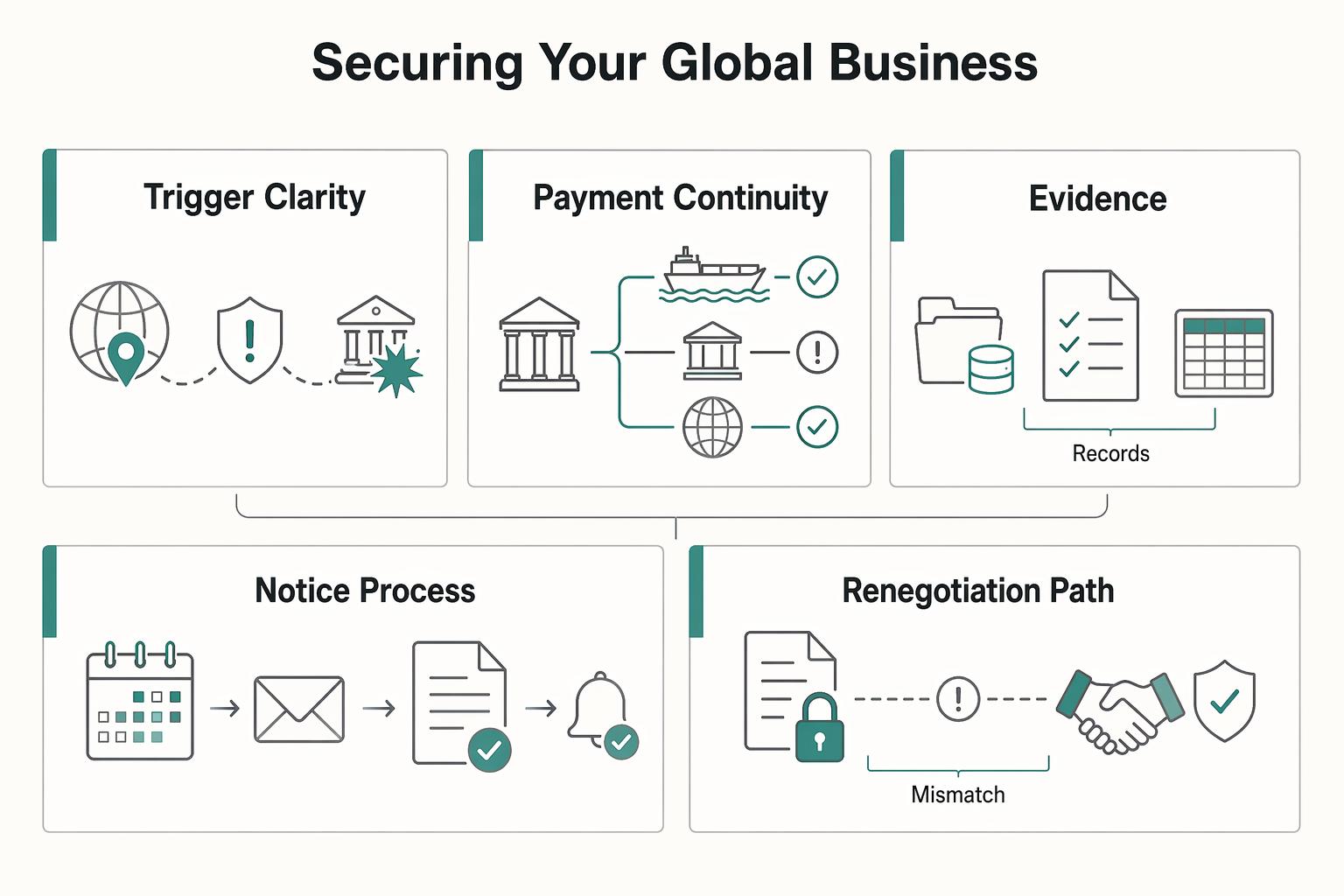
The practical takeaway is straightforward: run your contract as a proof-and-payment tool, not just a scope document. In force majeure and political-instability scenarios, control comes from enforceable wording, timely notice, and records that show which obligation was affected, why, and for how long.
Because force majeure is largely contract-defined in cross-border work, boilerplate is weak protection. A defensible clause ties specific triggers to specific consequences and plans a lawful fallback payment route if one rail, bank, or jurisdiction path is blocked.
| Decision area | Reactive posture | Controlled posture |
|---|---|---|
| Trigger clarity | Uses one broad disruption label | Defines specific trigger categories and links each one to the affected obligation and remedy |
| Payment continuity | Blends payment risk and performance risk into one issue | Separates payment continuity from performance excuse, keeps payment obligations explicit, and defines a lawful fallback route |
| Evidence discipline | Starts gathering proof after conflict starts | Maintains a live file with clause text, notice trail, rejection records, compliance messages, and external disruption signals |
| Notice process | Waits until non-performance is obvious | Sends notice when an impediment and its impact become clear, since delay can still create exposure |
| Renegotiation path | No defined route before performance is fully blocked | Includes a structured pause, amendment, or termination path when risk rises but work is still possible |
Operating standard#
Use this as your operating standard, not a one-time drafting exercise:
- Before signing: map each trigger to a specific obligation, confirm governing-law and notice mechanics, and confirm your fallback payment route is lawful.
- During delivery: keep an event log and refresh external risk signals from official advisories when conditions materially change.
- When disruption appears: open an invocation file immediately with clause text, affected milestones, failed transfer records, compliance messages, and mitigation options you proposed.
Apply one escalation rule consistently: pause only the affected work when performance or payment is illegal, actually blocked, or not achievable through a lawful workaround. Amend terms when work remains lawful but payment friction, compliance constraints, or country conditions materially raise risk. Seek jurisdiction-specific legal review when sanctions scope, asset-freeze exposure, controlled-entity risk, or enforceability is unclear.
We covered this in detail in How to Handle a 'Liquidated Damages' Clause in a Contract.
If you want a more controlled setup for invoicing clients and receiving cross-border payments with clear status tracking, see Gruv for freelancers.
Frequently Asked Questions
What specific wording should I use in a force majeure clause for political risk?
Focus on specificity over generic terms. Instead of 'civil unrest,' list the digital-first events that actually stop your work: 'government-mandated internet shutdowns,' 'sanctions blocking agreed-upon payment rails,' or 'new data localization laws making performance illegal.' The goal is to remove all ambiguity about what constitutes a trigger event for your specific business.
How can I ensure I get paid if my client's country becomes unstable?
Your contract should create a two-part financial firewall:
- Mandate Jurisdiction: Require payment from a client's bank account in a stable country (e.g., USA, UK, Singapore) to bypass local capital controls.
- Minimize Exposure: Use an upfront deposit (30-50%) and milestone-based payments to ensure you are never owed a large sum for work already delivered.
Can sanctions be a force majeure event for a digital service contract?
Yes, but with a critical condition: the sanctions must make performance—specifically, getting paid—impossible through the agreed-upon channels. If your contract states payment will be made via a specific platform and new sanctions block it, you have a clear case. This is why your contract must name the payment method and currency. The burden of proof is on the party invoking the clause.
What's the difference between a force majeure and a 'destabilization' clause?
This is a critical distinction. Think of it as the difference between a smoke detector and a fire alarm. A Force Majeure clause triggers when performance is impossible, excusing a party from their obligations. A Destabilization clause is a proactive tool that triggers when performance becomes significantly riskier, allowing you to pause work and renegotiate terms before the situation becomes impossible.
What should I do first if I think a political event will impact my contract?
Act with methodical speed.
- Consult Your Contract: Immediately review the notification clause.
- Gather Evidence: Start a log documenting the event with credible news sources.
- Communicate Clearly: Open a written line of communication with your client, stating the facts and citing your agreement.
Is political risk insurance a good idea for a solo professional?
Generally, no. This insurance is designed for large corporations with physical assets. For a solo digital professional whose primary risk is non-payment, the cost is typically prohibitive. A meticulously architected contract is a far more effective and accessible form of protection.
Researched and edited by the Gruv editorial team. Gruv builds cross-border billing, payouts, and finance-operations software for global businesses.
Sources
- caloes.ca.gov/wp-content/uploads/Recovery/Documents/FEMA-P...trusted
- csrc.nist.gov/Projects/ransomware-protection-and-responsetrusted
- digitallibrary.un.org/record/535517/files/A_CN.9_SER.C_DIGEST_CISG...trusted
- ecfr.gov/current/title-31/subtitle-B/chapter-V/part-5...trusted
- ecfr.gov/current/title-48/chapter-1/subchapter-H/part...trusted
- federalregister.gov/documents/2025/01/16/2025-00592/securing-the...trusted
- federalregister.gov/documents/2025/07/16/2025-13277/notice-of-of...trusted
- fema.gov/sites/default/files/documents/fema_pa_pappg-...trusted
Educational content only. Not legal, tax, or financial advice.
Related Posts

Germany Freelance Visa Application Path for Freiberufler and Gewerbe
Choose your track before you collect documents. That first decision determines what your file needs to prove and which label should appear everywhere: `Freiberufler` for liberal-profession services, or `Selbständiger/Gewerbetreibender` for business and trade activity.
Do Freelancers Need a Force Majeure Clause in Client Contracts?
If you do cross-border client work, this clause is not filler. It is a risk-control tool for moments when an extraordinary event directly prevents performance. Whether it works depends on your wording and the governing law in the contract.
How to Write a 'Force Majeure' Clause That Covers Pandemics and Geopolitical Events
Before finalizing clause language, cross-check your draft against the [Norton Rose Fulbright force majeure Q&A](https://www.nortonrosefulbright.com/en/knowledge/publications/849d7568/q-and-a-on-covid-19-related-force-majeure-claims), a neutral [force majeure clause pattern library](https://afterpattern.com/clauses/force-majeure), and the [Kutak Rock force majeure FAQ](https://www.kutakrock.com/-/media/files/news-and-publications/publications/2020/04/kutak-rock--force-majeure-faqs.pdf).