
Quick Answer
Start with residency classification, then jurisdiction mapping, then method selection. For tax in czech republic freelancer cases, the low-risk sequence is to verify day presence, permanent-home indicators, and double-taxation treaty interaction before deciding how income is treated. After that, choose your filing path only once current-year rules are confirmed, and keep one evidence pack with invoices, payments, identifiers, and correction notes so your final position is defensible.
Start Here if You Want Low-Stress Compliance in the Czech Republic#
The lowest-stress path is simple: make decisions you can defend later, not shortcuts you may have to explain away. The goal is a clear residency position, a filing method that fits your facts, and records that match what you report.
This article is for freelancers working as OSVC in the Czech Republic, especially with cross-border income or mobility. In common local usage, OSVC refers to independent self-employment under a trade license (zivnostensky list). If you invoice foreign clients or move during the year, treat compliance as a year-round discipline.
Start with treaty awareness. If two countries could tax the same income, read the treaty text and technical explanation directly instead of relying on summaries. For U.S.-Czech cases, both documents are listed as 1993 texts on the IRS treaty page, and that page shows a last reviewed date of 08-Aug-2025.
Keep a compact evidence file from day one so your position stays consistent:
- A dated timeline of where you lived and worked during the year.
- Practical indicators of contractor independence, including control of your own schedule.
- Practical indicators that you use your own resources, such as laptop, software, and workspace.
- Core income and expense records that support what you later file.
One common failure mode is misclassification. Czech enforcement may assess the material reality of the relationship, not only the contract label. If the setup looks like hidden employment, Svarcsystem penalty risk can follow.
Set expectations early. Thresholds, contribution bases, and filing deadlines can change, and non-official summaries can lag. Before final annual decisions, verify current-year values with official Czech sources.
If you want a deeper dive, read Prague Digital Nomad Guide for 2026 Moves in the Czech Republic.
The Terms That Actually Decide Your Tax Outcome#
Before you calculate anything, lock down the terms. Each one can change paperwork, payment setup, or the records you need to keep.
| Term | Meaning in article | Practical note |
|---|---|---|
| Tax residence | Part of your tax-compliance context | Write your residency position before choosing a tax path, especially in multi-country years |
| OSVC / zivnostnik | Self-employment under a Czech trade license (zivnostensky list) | For visa context, the article points readers to The Czech Republic's Zivno (Trade License) Visa for Freelancers |
| Standard regime (Bezny rezim) | Monthly advances, then annual settlement | Includes a tax return and insurance overviews |
| Pausalni dan (flat tax) | Simplified route where first-band setup can bundle income tax, health insurance, and social security into one payment | Private advisory examples for 2026 cite 9,984 CZK monthly and 119,808 CZK annually |
| rodne cislo | Czech birth number | Practical tax use depends on Tax Office assignment and registration, not on rodne cislo alone |
| DIC | Czech tax identification label (danove identifikacni cislo) | Verify assignment and registration status before filing |
| VCP number | For foreigners without rodne cislo | Once assigned, it typically stays the same |
- Tax residence: write your residency position before choosing a tax path, especially in multi-country years.
- OSVC / zivnostnik: self-employment under a Czech trade license (zivnostensky list). For visa context, see The Czech Republic's Zivno (Trade License) Visa for Freelancers.
For calculation paths, do not treat labels as interchangeable:
- Standard regime (Bezny rezim): monthly advances, then annual settlement, including a tax return and insurance overviews.
- Pausalni dan (flat tax): a simplified route where first-band setup can bundle income tax, health insurance, and social security into one payment. Private advisory examples for 2026 cite 9,984 CZK monthly (119,808 CZK annually).
- Tradeoff to note: under pausalni dan, income may not be formally declared in the usual way, which can make mortgages, business loans, or leasing harder.
You will also hear 60/40 method and real expenses method. This article does not define them in detail here, so confirm current official rules before you choose.
Identifier terms also matter:
- rodne cislo: your Czech birth number.
- DIC: the Czech tax identification label (danove identifikacni cislo).
- VCP number: for foreigners without rodne cislo; once assigned, it typically stays the same.
- Practical checkpoint: tax use depends on Tax Office assignment and registration, not on rodne cislo alone.
Use this quick check before your next invoice cycle:
- If a term affects your compliance position, write and keep your residency logic first.
- If a term changes payment structure, compare admin burden and proof implications, not only monthly cash flow.
- If a term concerns identifiers, verify assignment and registration status before filing.
Decide Whether You Are a Czech Tax Resident This Year#
Residency is an early decision each year because it sets filing scope before you get into method or filing mechanics. If you are treated as a Czech tax resident, scope generally includes worldwide income. If you are treated as a non-resident, base scope is Czech-source income.
| Factor | What article says | What to keep |
|---|---|---|
| Day count | Being present in the Czech Republic for 183 or more days in a calendar year is one stated path to residency | Calendar-year day count and the travel log behind it |
| Permanent home base | Another stated path is having a permanent place of residence there, such as owned or rented accommodation | Home-base facts in your residency note |
| Visa status | A long-term visa alone does not automatically make you a Czech tax resident | Keep visa status separate from your residency conclusion |
| Treaty check | If your facts point to more than one country, check the relevant double taxation agreement before filing | Treaty check result in your residency note |
| Final conclusion | Before preparing your income tax return, write a short residency note for your records | Day count, home-base facts, treaty check result, and your resident or non-resident conclusion |
Start with verifiable facts. One stated path to residency is being present in the Czech Republic for 183 or more days in a calendar year. Another is having a permanent place of residence there, such as owned or rented accommodation. In mixed-country years, do not rely on one signal as the whole answer.
Use this order of operations:
- Confirm your calendar-year day count and keep the travel log behind it.
- Confirm whether you had a permanent home base in the Czech Republic during that period.
- Do not use visa status as a shortcut: a long-term visa alone does not automatically make you a Czech tax resident.
- If your facts point to more than one country, check the relevant double taxation agreement before filing.
For treaty checks, use the official full list on portal.gov.cz, then verify whether treaty provisions could override your domestic residency analysis. For a practical walkthrough, see How to Legally Avoid Double Taxation: A Freelancer's Guide to Tax Treaties.
Before preparing your income tax return, write a short residency note for your records: day count, home-base facts, treaty check result, and your resident or non-resident conclusion for that tax year. If facts changed mid-year, update that note before submission.
Do not file on autopilot just because last year looked similar. Cross-border income can involve different rules and deadlines across countries, and incorrect handling can create immigration downside if freelance income supports your residence-permit process.
Map Which Income Is Taxable in the Czech Republic#
Map each income line by source and timing before you total anything, then test jurisdiction in a fixed order. Clean math on top of the wrong jurisdiction decision is still a bad filing.
Split income into practical buckets first, for example Czech clients, foreign clients, and platform payouts. Then tag each line by period so mixed-country years are handled explicitly, especially in first- or last-year situations where residency and taxing country can change.
Use one rule for every line item: if two countries could tax the same income, pause and check the relevant treaty under bilateral (double-taxation) agreements before final treatment. For U.S.-Czech cases, the IRS treaty page lists both the Income Tax Treaty PDF (1993) and the Technical Explanation PDF (1993), so review those documents before locking your position.
Do not assume a foreign client means non-Czech tax. If your facts support Czech tax-resident treatment, that shortcut can break compliance. The reverse risk also exists: if Czech-living indicators are not met, tax may be due in another country on global income.
| Income type | Taxable jurisdiction to test first | Treaty relief path | Working documentation to retain |
|---|---|---|---|
| Czech client services | Start with your resident or non-resident status, then test whether Czech tax can apply | Check treaty if another country could tax the same income | Contract, invoice, delivery date, bank receipt |
| Foreign client services | Do not assume non-Czech tax; start with residency status, then test both countries' potential claims | Review the relevant bilateral treaty text and technical explanation before final allocation | Client contract, invoice, payment record, residency note |
| Platform payouts | Test by your residency status and whether two countries could tax the same payout | Apply treaty analysis where platform income could be taxed in two places | Platform statement, payout report, bank credit, work log |
| Transition-year income | Test period by period in first or last year in the Czech Republic | Recheck treaty interaction before finalizing return treatment | Date-stamped timeline, travel log, contract and payment dates |
Before drafting the return, create a one-page mapping memo that mirrors this matrix: each income line, first-jurisdiction test, treaty-check result, and attached documentation. If one line still has two plausible outcomes, resolve it before you file.
Choose the Tax Method That Fits Your Real Operating Pattern#
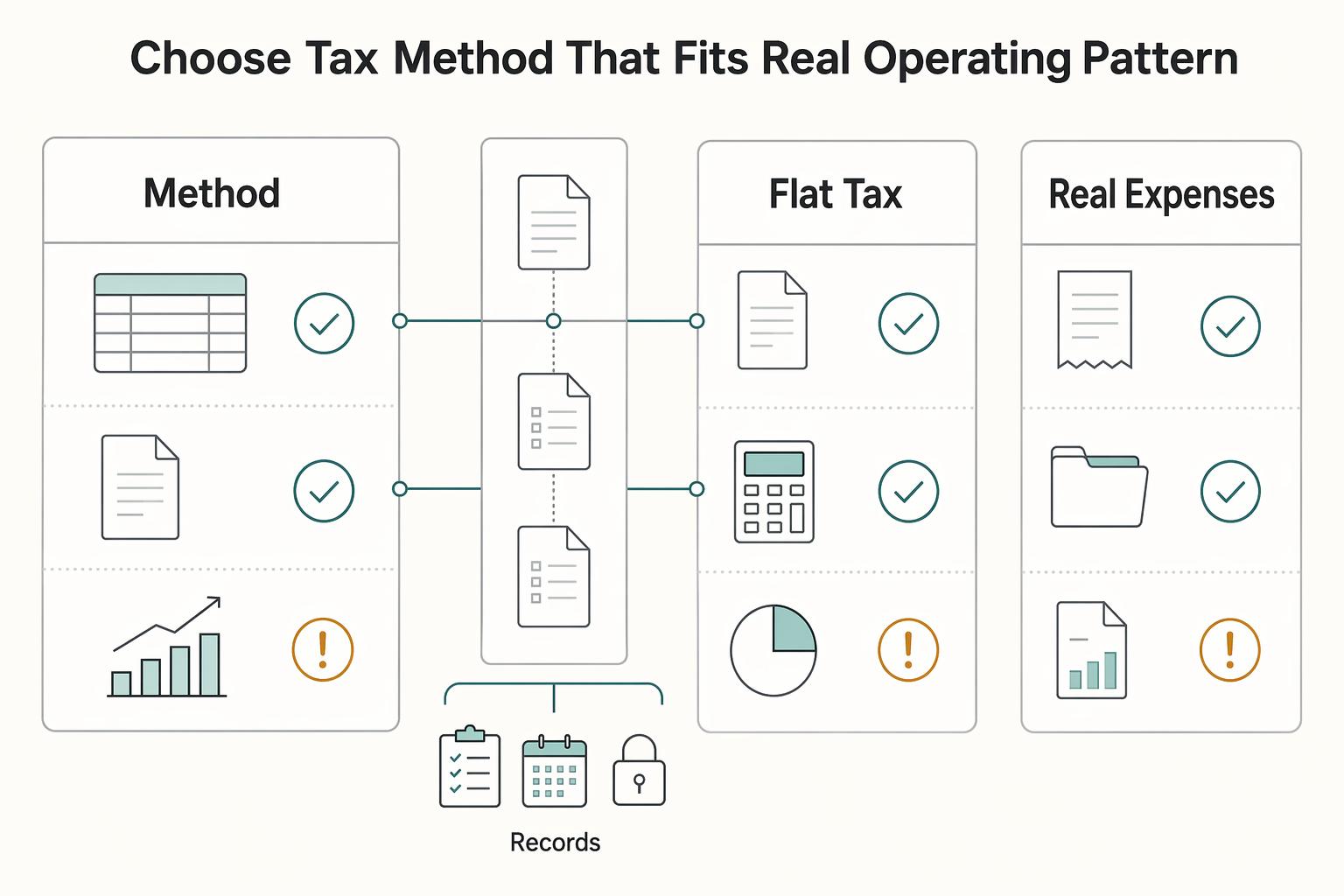
Choose the method you can defend all year with clean records, then optimize cost second. Compare the 60/40 method, flat tax scheme, and real expenses method side by side, and commit only after you verify current-year rules for your profile.
Use this section as a decision structure, not a substitute for official rule checks. This section covers compliance context, not detailed method mechanics, rates, or eligibility thresholds, so treat method assumptions as provisional until verified.
| Method label | Admin load to test | Predictability question | Downside risk if chosen too fast |
|---|---|---|---|
| 60/40 method | Confirm what records are still required and how often they must be updated | Does it stay simple with your real client and income pattern? | Late corrections if assumptions do not match official rules |
| Flat tax scheme | Confirm eligibility and ongoing obligations for your exact profile | Is it still workable after all conditions are checked? | Treating it as universal can create avoidable rework |
| Real expenses method | Confirm documentation standards before year-end pressure | Does detailed tracking justify the added admin overhead? | Weak evidence can undermine your position during review |
If your records suggest your cost structure changed materially, run a draft comparison of real expenses versus 60/40 before deciding. Do not assume one method wins in every case. If records are incomplete, fix evidence quality first and rerun the comparison.
Before locking your annual plan, run this checkpoint against current official Czech rules:
- Confirm current-year method eligibility for your exact profile.
- Confirm what proof must be retained for your chosen method.
- Document why you picked this method over the other two.
- Set a mid-year review date in case your facts change.
If these four items are not complete, delay final method selection and keep bookkeeping neutral until they are.
Set Up Registration and IDs Before You Send More Invoices#
A practical sequence before you send more invoices is: confirm OSVC status, confirm your taxpayer identification number, then assess whether you need a VAT identification number (DIC). This reduces avoidable record cleanup later.
Start with OSVC (zivnostnik) confirmation, because it establishes your self-employed trade license status. Most foreigners may need a criminal clearance report during registration, so collect it early. Some guidance cites processing in about 2 days, but timelines can vary, so build buffer time.
Next, verify your taxpayer identification number in every core record. In this context, it is commonly the personal identifier (rodne cislo), which is 9-10 digits. Keep the same number consistent across tax, invoicing, and bookkeeping records.
Then assess DIC based on your VAT position. A VAT identification number is mandatory for VAT payers, so whether you need one immediately depends on your VAT status. One cited reference point is CZK 2,000,000 turnover over 12 consecutive months for non-VAT payers, and current-year rules should be rechecked before acting.
Issuing invoices is a legal obligation, so keep your ID setup and invoice process aligned. Cited practice includes issuing invoices within 15 days and storing them for 10 years.
| Item | Verify now | Where used in your records |
|---|---|---|
| OSVC / zivnostnik status | Registration is complete and matches your legal identity details | Documents self-employed business status in your tax and bookkeeping files |
| Taxpayer identification number | Same 9-10 digit identifier appears in tax and invoice records | Keeps tax and invoice records tied to the same taxpayer identifier |
| DIC decision record | Written note on whether VAT payer status applies this year | Shows why VAT-related fields are present or absent in supporting documents |
| Invoice control evidence | Issue timing and storage process are documented | Keeps issuance timing and retention duties documented |
If you are on a Zivno (Trade License) Visa timeline, plan this setup alongside your immigration document schedule. Keep tax residence analysis separate: a long-term visa alone does not automatically make you a Czech tax resident, and a stay of 183 or more days in a calendar year is one cited residency condition to monitor.
Before you lock DIC-related decisions, run a quick scenario check with the VAT Reverse Charge Checker and store the result in your compliance file.
Build a Filing Calendar You Can Actually Run#
Build your filing calendar now, not at year-end. A monthly close plus quarterly checks is a practical way to keep your return logic consistent and defensible.
Two areas need explicit checkpoints through the year: tax residence and filing method. Residence can change how income is taxed, a long-term visa alone does not set Czech tax residence, and treaty rules may change how domestic residence rules apply. Method fit can also drift if your facts change.
| Period | What to do | Why it matters |
|---|---|---|
| Every calendar month | Close bookkeeping for the prior month, confirm invoices are complete, and log missing records immediately | Freelancers self-declare income, so monthly gaps turn into filing risk later |
| January planning window | Recheck whether your filing mode still matches your situation. If you are in the flat-rate regime, verify current-year opt-in or opt-out timing (typically by January 10th) before you act | In this regime, payer status and monthly obligations can continue, including zero-income months, unless you properly change status |
| End of each quarter | Run a short residence and method review: days present, cross-border changes, and whether treaty treatment may apply | Quarterly checks catch changes before year-end pressure forces rushed assumptions |
| Pre-filing build phase | Start return preparation early and reconcile it to your monthly closes before submission | Early reconciliation is the easiest way to catch classification or record mismatches |
| Submission window | Confirm current-year deadlines and filing route directly with the Tax Office before submission | This section does not set official filing dates, so verify timing before you file |
The common failure mode is the annual catch-up sprint. Under deadline pressure, records get rebuilt with mixed residence logic or outdated method assumptions. Keep one rule: run a rolling quarterly check, fix issues in-quarter, and carry corrected logic into the next monthly close.
Keep a Document Pack Ready for Taxes Permits and Lenders#
Keep one document pack that is return-ready first, then reusable for lender and permit files. The goal is simple: totals, dates, and counterparties should match across records so you are not rebuilding files under deadline pressure.
A practical baseline pack includes:
- Filed tax returns (usually from the last 2 full years, though 1 full year sometimes works) with submission confirmation.
- Trade license or business registration records.
- Bank statements.
- Supporting records that reconcile declared revenue and deductions.
| Document artifact | What to keep | Why it matters in review |
|---|---|---|
| Tax return file evidence | Return copies plus submission confirmation | Shows what was filed, not only drafted |
| Trade/business registration | Trade license or business registration records | Confirms business activity status |
| Bank statements | Statements that align with declared income timing | Helps lenders cross-check cash flow |
| Revenue and deduction support | Records that explain declared revenue and deductions | Helps explain affordability calculations |
For lender review, risk perception can increase when income is volatile or deductions are high. Plan for a two-year evidence trail, even though one full year sometimes works. Some banks may also use reduced recognized income models, such as 50% of declared revenue or a flat-rate expense model, so clean records can materially affect affordability analysis.
For tax- and permit-related files, apply the same evidence discipline, but do not assume one official checklist covers every case. This article does not establish official Czech Tax Office or permit evidence standards, so verify current requirements directly before submission.
Handle Mixed Cases Without Guessing#
In mixed cases, use a period-first approach: classify first, calculate second. If you have both employment and OSVC income, or you moved in or out during the year, keep those facts explicit before drafting the income tax return.
Use your document pack in separate tracks, such as salary records, freelance invoices, and payment evidence, then test each material income line on its own path. In practice, that means checking whether local law alone applies, or whether local law plus a treaty path both need review under double taxation agreements.
Split the year before calculations#
If your residency may have changed during the year, map periods first, then choose calculation logic for each period, then draft.
- Build a month-by-month timeline of where you lived and what type of income you earned.
- Label each income line as employment or OSVC before treatment choices.
- Assign a provisional status by period and flag uncertainty.
- Decide whether local law only, treaty review, or both should be tested for each line.
This keeps one annual total from masking mixed facts that may need different treatment logic. The full Czech residency analysis, specific Czech classification rules for employment plus OSVC, and a required Czech period-splitting method are not established, so treat this as a workflow aid rather than a legal rule.
Run a treaty checkpoint before final submission#
Before final submission, verify every material income stream: local law only, or local law plus treaty review. If a line may touch both, record why you chose the final treatment and what you ruled out.
For Czech treaty review, check the listed Income Tax Treaty PDF and the listed Technical Explanation PDF (both shown as 1993 entries), and treat the IRS page last reviewed date (08-Aug-2025) as a prompt to verify current treaty documentation instead of relying on memory. The IRS page also points to the U.S. Treasury treaty documents page for further treaty information.
Cross-border files can carry uneven compliance burdens across countries and contexts, so judge your process by whether each income line is traceable from classification to final treatment. If uncertainty remains, pause and get a cross-border review before filing. You can apply the same checklist while reading How to Legally Avoid Double Taxation: A Freelancer's Guide to Tax Treaties.
Avoid the Mistakes That Trigger Penalties and Permit Risk#
The highest-risk mistake is filing from assumptions instead of a documented logic trail. In Czech freelancer cases, this often shows up as key decisions made without a written basis. Make each material choice traceable to the country-specific rules that apply before you finalize numbers.
That matters even more in a tighter compliance environment. 2026 guidance points to more checks, larger fines, and closer worker-classification scrutiny. If your contractor setup looks like employment in practice, authorities may reclassify it, with potential tax, wage, and benefit arrears plus possible legal action. Clean math does not offset weak classification logic.
Compliance obligations can span tax law, employment law, corporate governance, and consumer protection. In the Czech context, authority-facing registration choices can carry legal consequences beyond initial paperwork, so cross-file consistency is a core control.
Red Flags Before Submission#
- A material filing or registration choice is made without a written rationale.
- Core records (return draft, invoice records, payment records, and supporting forms) are inconsistent.
- Work conditions read like employment, while reporting treats all income as freelance without explanation.
- A correction was made in one record, but dependent records were not updated.
If one red flag appears, stop and resolve it before you file.
Correct Early and Communicate Clearly#
- Freeze the draft and log exactly what changed, why, and which record supports the correction.
- Add a dated correction note so the change history is explicit.
- Apply the same correction across all dependent records.
- If the discrepancy changes your filing position, escalate early and align the update across every authority-facing file.
Aim for a coherent, auditable file, not a perfect narrative. That reduces avoidable penalty and compliance exposure from preventable inconsistencies.
Know Exactly When to Bring in a Professional#
Bring in professional help before you file when your case is cross-border, permit-sensitive, or still uncertain after you review your documents. If the downside includes business residence permit disruption, do not wait for a Tax Office query to clarify your position.
The trigger is unresolved uncertainty, not panic. When two countries may tax the same income, treaty relief is case-specific and depends on treaty details. Relief claims may also require proof, including residency evidence and proof of tax already paid, so document readiness is a real pre-filing checkpoint.
Escalate Before Filing When Any Trigger Appears#
| Trigger | What is unresolved | Article note |
|---|---|---|
| The same income may be taxed in two countries | You are unsure which treaty relief route applies | Treaty relief is case-specific and depends on treaty details |
| You moved mid-year | You cannot clearly map your residence timeline for filing logic | Bring in professional help before filing when your case is still uncertain |
| Your filing or reporting obligations are unclear | How your work was invoiced or reported is not clear | Escalate before filing when obligations are unclear |
| Your tax file will also support a business residence permit process | Records must stay consistent | Use an immigration-aware advisor when permit continuity is part of the risk |
| You cannot assemble the proof needed for a relief claim | You do not have the proof needed before finalizing your draft | Relief claims may require residency evidence and proof of tax already paid |
Choose the advisor by problem. Use a cross-border tax specialist for double taxation agreement and treaty interpretation issues. Use an immigration-aware advisor when permit continuity is part of the risk, and coordinate both when needed so they review the same figures and timeline.
If you cannot confidently interpret and apply the relevant treaty documents, escalate. The treaty listing includes the Income Tax Treaty PDF and Technical Explanation PDF, both shown as 1993 entries, and the page review date (08-Aug-2025) is a reminder to verify current context instead of relying on memory. If you want a refresher before your advisor call, start with How to Legally Avoid Double Taxation: A Freelancer's Guide to Tax Treaties.
Bring a Complete Brief to the First Meeting#
- Residency timeline by month, including move dates and work-location changes.
- Method used for your self-employment tax calculations and why you chose it.
- Draft figures by income stream and country, including tax already paid.
- Core document pack: invoices, payment records, draft filings, identifier records, and Tax Office correspondence.
- Unresolved questions ranked by financial or permit impact.
If one unresolved issue can change filing treatment, pause submission and get advice first. EU authorities exchange tax information regularly, so inconsistent cross-country positions are more likely to surface. The goal is to file once with a position you can defend.
Your Next Steps for a Compliant Year#
Lock three decisions before filing season gets busy: your tax-regime choice, your expense-method choice, and your annual verification routine. This turns your plan into a filing position you can explain and defend.
Start now by writing a short method note for the year: which regime you chose, which expense method you will use, and why. Keep that note with your draft return materials, and if your facts change mid-year, update it before filing.
Choose One Method With Written Rationale#
If you are filing as OSVC (zivnostnik), treat method selection as a formal decision. The standard regime and pausalni dan have different compliance and reporting consequences. One cited 2026 example shows first-band pausalni dan at 9,984 CZK per month (119,808 CZK annually), while a standard-regime estimate shows roughly 9,026 CZK monthly advances before any additional annual income tax settlement.
Do not choose on payment alone. A cited downside of pausalni dan is reduced formal income visibility, which can limit access to mortgages, business loans, or leasing. For expense treatment, the 60/40 method and real expenses method are presented as mutually exclusive, so document why your choice fits your records.
Build a Calendar and Evidence Pack Before Deadlines Crowd You#
- Set internal checkpoints now for bookkeeping close, draft preparation, review, and submission readiness.
- Confirm current-year deadlines directly with the Tax Office before each major filing step.
- Keep required filing artifacts together, including tax return materials and insurance overviews where applicable.
- Store your method rationale, invoices, payment proof, and correction notes in one evidence pack so updates stay consistent.
Re-verify Rules Every Year#
Do not reuse last year's assumptions without checking updates. Tax legislation can change frequently, and one cited 2026 context highlights mandatory digital filings and increased minimum contribution requirements. Make verification annual: confirm current rules with official guidance, then document what changed and what did not.
Decide early, document each decision, and verify annually. That sequence lowers error risk, keeps your compliance file coherent, and makes professional escalation faster when a year gets more complex.
If your facts can change mid-year, keep a dated log in the Tax Residency Tracker so your filing position stays consistent and defensible.
Frequently Asked Questions
Do freelancers in the Czech Republic pay the base rate or the higher rate, and how should you verify which one applies?
Some private guides describe two rates, 15% and 23%. Verify your current-year treatment with Czech tax authorities before filing. If your income is cross-border, check the relevant double tax agreement and confirm what proof documents are required.
What is the **60/40 method**, and who is usually a poor fit for it?
Treat the 60/40 method as one possible calculation path, not a default. There are no clear-cut eligibility or poor-fit rules to lean on, so avoid assumptions. If your case is uncertain or cross-border, confirm the method choice before filing.
Is the **flat tax scheme** always better than the **real expenses method**?
No. There is no universal always-better answer in the supported material. Choose the method you can document clearly and defend if reviewed.
How does **tax residence** work for digital nomads living part-year in the **Czech Republic**?
Tax residence determines scope: Czech residents are taxed on worldwide income, while non-residents are taxed only on Czech-source income. A stated indicator is 183+ days in a calendar year, but a long-term visa alone does not establish Czech tax residence. If two countries can tax the same income, you are still subject to the tax rules of your country of residence, and a double tax agreement may reduce or remove double taxation.
When should you file an **income tax return**, and where should you confirm this year’s deadlines?
Confirm this year’s filing deadlines directly with Czech tax authorities, because exact current-year dates should not be assumed without checking. Do the same for required proof documents if your filing includes treaty relief or cross-border elements.
Can tax mistakes affect a **business residence permit** or **partnership visa** outcome?
Tax mistakes can create real risk in permit processes, but they do not automatically mean refusal or cancellation. Treat this as a caution and verify requirements directly with authorities.
Try a related tool
Researched and edited by the Gruv editorial team. Gruv builds cross-border billing, payouts, and finance-operations software for global businesses.
Sources
- europa.eu/youreurope/citizens/work/taxes/double-taxati...trusted
- irs.gov/businesses/international-businesses/czech-re...trusted
- open-research-europe.ec.europa.eu/articles/5-16trusted
- taxation-customs.ec.europa.eu/system/files/2017-10/20170815_appendix_1_cou...trusted
- taxation-customs.ec.europa.eu/system/files/2022-12/221208%20DG%20GROW%20re...trusted
Educational content only. Not legal, tax, or financial advice.
Related Posts
The Czech Republic's Zivno (Trade License) Visa for Freelancers
This guide is for execution: make the early decisions in the right order so you do not lose time on the wrong path. You do not need more theory. You need a plan you can use from your first document to your submission timing.
Prague Digital Nomad Guide for 2026 Moves in the Czech Republic
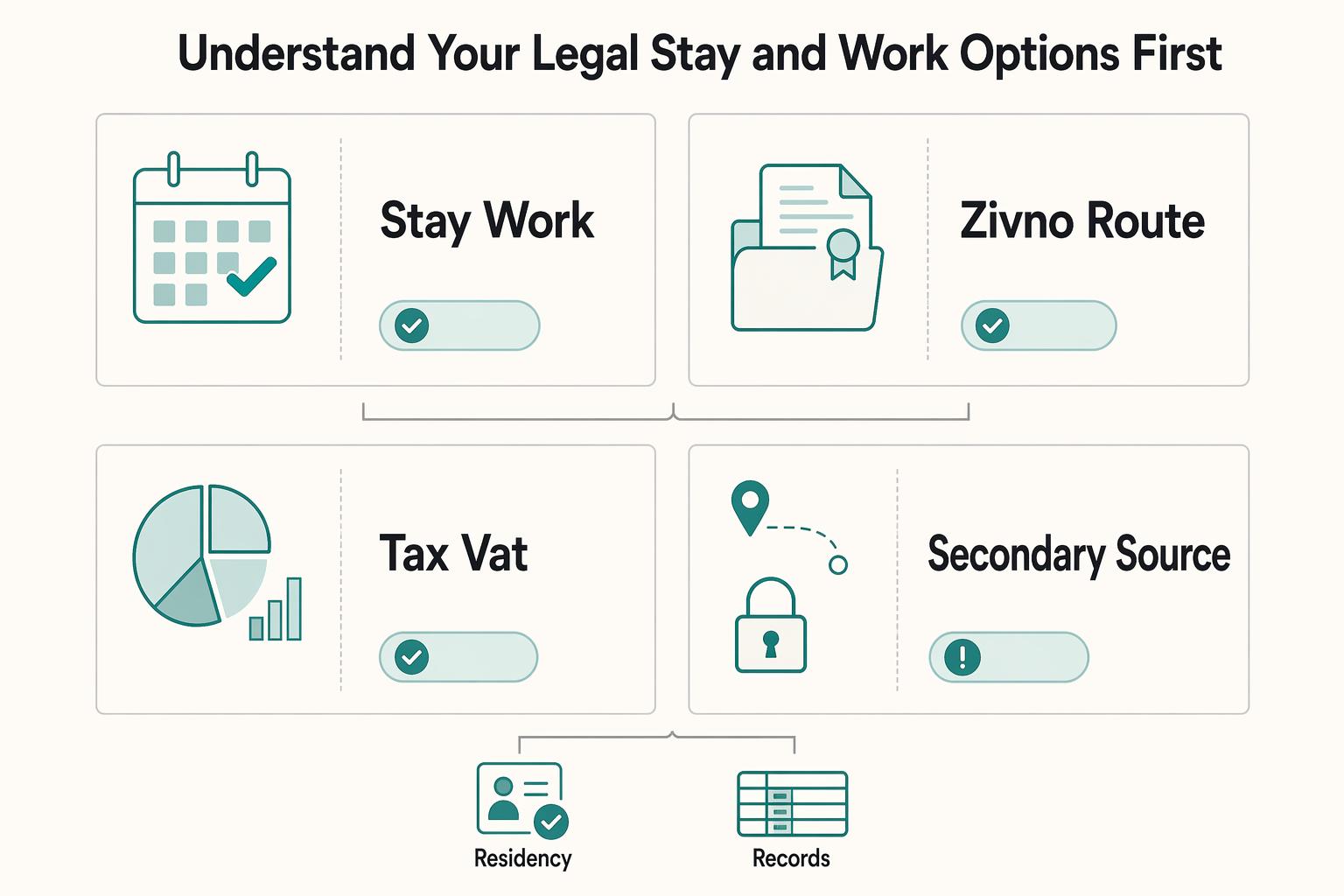
**If you want to move to Prague in 2026 as a remote professional, separate stay or work authorization from tax or VAT admin, and verify both before you spend.** Start with sequencing, not spending. Before you pay for housing, flights, or any fixed annual commitment, set up a two-lane tracker from day one:

How Freelancers Can Legally Avoid Double Taxation With Tax Treaties
Classify the tax problem before you touch a return. If your income is mostly personal service fees across borders, this guide fits. If your issue is C corporation profits and shareholder dividends, you are solving a different problem.