
Quick Answer
A U.S. CTR is a financial institution’s report of cash transactions over $10,000 in a business day, including known same-person aggregation. Freelancers do not file the bank’s CTR, but business cash receipts may require their own Form 8300. Covered foreign accounts can separately require FBAR. Keep the events, records and deadlines distinct.
What a CTR means for a freelancer receiving payments#
A U.S. Currency Transaction Report (CTR) is a financial institution’s report of cash transactions over $10,000 in a business day. Cash means physical currency here: a $12,000 electronic client transfer is not itself a cash transaction for this rule. The institution handles its CTR; it may ask you for identification and transaction details.
A freelancer can still have a separate filing duty. Receiving reportable cash in a trade or business can require IRS/FinCEN Form 8300. Holding or controlling foreign financial accounts can raise FBAR obligations. Neither is satisfied just because your bank reports a cash deposit.
The practical problem is matching the rule to the event. Receiving client cash, depositing that cash, and holding money in a foreign account are different events. Keep an invoice-to-settlement trail, then check the reporting duty attached to each event.
This guide explains U.S. rules and a recordkeeping workflow. For transactions or accounts involving another country, check that jurisdiction separately; location abroad does not by itself remove a U.S. citizen’s obligations.
Use this sequence as you read:
- Identify the event: cash receipt, bank cash transaction, electronic payment, or foreign-account holding.
- Assign the filing duty separately from the bank’s reporting role.
- Capture invoice, payer, receipt, fees, settlement and conversion records.
- Put legal filing and provider response deadlines on a calendar; escalate uncertain scope promptly.
FinCEN’s CTR FAQ explains aggregation: institutions combine cash transactions they know are by or on behalf of the same person during one business day. Cash-in and cash-out totals are considered separately, rather than offset against each other.
For example, $6,500 and $4,000 in known same-person cash deposits in one business day total $10,500 for the bank’s cash-in calculation. A $2,000 cash withdrawal does not reduce that total to $8,500. This is an illustration of reporting, not a payment schedule to use to avoid it.
You should leave with three things: a decision sequence, a documentation checklist, and clear talk-to-a-professional-now triggers. If you want a quick term refresher before the deeper sections, read What is FinCEN? A Guide for Freelancers and FinTech Users.
Start with the core terms you cannot afford to mix up#
The similar names conceal different reporting events. Use the table to identify which question you are answering before selecting a form or gathering documents.
| Term | Meaning in this article |
|---|---|
| BSA | U.S. legal framework for specified reporting, recordkeeping and anti-money-laundering duties. |
| CTR | Financial institution report of qualifying physical-currency transactions. |
| Form 8300 | Trade or business report of qualifying cash receipts; distinct from the bank’s CTR. |
| FBAR | FinCEN Report 114 for covered foreign financial accounts of U.S. persons. |
| SAR | Covered institution report of suspicious activity under its applicable rules. |
| AML | Anti-money-laundering controls; duties depend on the activity and regulated role. |
Read the rule’s subject as well as its threshold: financial institution, business receiving cash, and U.S. person with a foreign account are different categories. A freelancer may fall within more than one category, but ordinary client invoicing does not make you a financial institution.
For an ordinary 2025 FBAR, the due date is April 15, 2026, with an automatic extension to October 15, 2026; no extension request is needed. These annual dates are unrelated to the cash-receipt deadline for Form 8300.
A special FinCEN notice extends reporting to April 15, 2027 for the narrow signature-authority-without-financial-interest groups whose deadlines were previously extended. It covers their 2025 signature authority and earlier extended years. It is not a general extension for freelancers or every person with signature authority.
Use current primary guidance for the specific report. A summary that discusses FBAR account balances cannot establish CTR cash aggregation or Form 8300 cash-receipt duties.
Separate institution duties from freelancer duties#
When you deposit cash, the bank handles its assigned CTR reporting. When your business receives cash, you must separately check Form 8300. Keeping accurate records supports both processes but does not replace a filing.
| Event | Who handles the reporting question | What to keep or do |
|---|---|---|
| Cash transaction at a bank | Bank assesses and files its CTR. | Provide accurate identification and transaction context; retain receipt and bank entry. |
| Cash received for business services | Business assesses Form 8300. | Track related receipts and the filing deadline; retain the required report and statement. |
| Covered foreign financial accounts | U.S. person assesses FBAR, subject to exceptions. | Track account location, interest or authority, values and filing dates. |
| Provider compliance request | Provider handles its assigned reporting; customer responds to the actual request. | Retain the notice, response, transaction records and any restriction or resolution. |
This split is practical because it aligns responsibility with control. You do not control an institution's filing mechanics, but you do control invoice quality, payer identity capture, transaction references, and reconciliation timing. Focus your effort where your actions change outcomes.
For FBAR, first establish whether you are a U.S. person with a financial interest in or signature authority over reportable foreign accounts, subject to applicable exceptions. A foreign client or foreign-currency invoice alone does not establish this; the account’s location and your relationship to it matter.
FinCEN Report 114 applies when the aggregate value of covered foreign accounts exceeds $10,000 at any time during the calendar year. See the IRS FBAR overview. Assess the aggregate across accounts, rather than treating $10,000 as a separate allowance for each account.
Ask a provider to identify its document request, response deadline, and any account restriction in writing. Ask your advisor to identify your own reporting duties using the relevant rule. Store both answers with the account records so operational requirements and legal duties remain distinguishable.
Use forum posts to identify questions, then verify jurisdiction and role before changing payment handling. A freelancer thread from another country cannot settle your U.S. reporting duty.
Choose payment rails with compliance friction in mind#
Pick the rail that gives you the clearest evidence trail, not just the fastest checkout. When you compare options, treat documentation quality as a core requirement.
| Rail | Speed and fee friction | Audit traceability | Practical fit |
|---|---|---|---|
| Bank transfer to a business bank account | Confirm bank-transfer fee and timing details before invoicing. | Depends on whether both sides can retain matching transfer references and statement lines. | Validate with a sample payment before using it at volume. |
| Online payment platform, for example PayPal | Cost context can change by transaction type and market treatment. | Depends on how consistently transaction IDs, settlement lines, and payout records are retained. | Useful when you can keep a complete end-to-end record trail. |
| Cash, then deposit to a business bank account | Confirm cash-handling fee and timing details before invoicing. | Depends on your same-day invoice, receipt, and deposit records. | Choose deliberately with receipt controls and a cash-reporting assessment. |
For platform payments, record the actual fee, any conversion, and the net settlement rather than estimating them from another account’s pricing. Check the provider’s current terms for your account market and transaction type before quoting a client.
A quick scenario check helps. For PayPal, capture every transaction ID and payout line at settlement. For bank transfer workflows, confirm that transfer references are captured consistently before volume grows.
Before you switch rails for a client, test the record trail with a sample payment. Confirm what appears in the sender confirmation, what lands in your receiving account, and which ID ties both sides together. If that linkage is weak, fix it before volume grows.
Use this checkpoint whenever you add or change a rail:
- Confirm in writing what records your provider expects during reviews.
- Capture settlement evidence immediately, including transfer reference or platform transaction ID, receiving account line, and FX context if present.
- Reconcile weekly so unmatched entries are resolved while details are still fresh.
Convenience features do not resolve reporting questions. Check the payment’s actual form and destination; electronic receipt, cash handover, and a later payout can have different documentation and reporting consequences.
Build a payment evidence pack you can defend later#
Use one repeatable evidence pack for every payment so you can explain who paid, what was paid, and how funds reached your account without reconstructing history under pressure.
| Artifact | Details to keep |
|---|---|
| Invoice | invoice ID, issue date, service period, currency, amount, and client legal name |
| Payment confirmation | platform transaction ID or bank transfer confirmation from the sending event |
| Currency conversion record | rate used, capture time, and rate source |
| Client identity context | the counterparty details relied on at invoicing and receipt |
| Receiving record | the exact line from your business bank account or platform payout report |
Keep the sequence fixed:
- Issue the invoice.
- Receive funds.
- Capture payment confirmation immediately.
- Log FX context if conversion is involved.
- Reconcile to bookkeeping in the same week.
Execution quality comes from consistency. Use the same file naming pattern for every payment record, keep invoice and settlement references in one place, and avoid storing key proof only in inbox search. If you can find every record quickly, your process is doing its job.
Use one checkpoint on every incoming payment: each settled amount should tie to one client invoice and one settlement event, whether it came through PayPal or another payment rail. If one deposit maps to multiple invoices, document the split on the same day. If one invoice maps to multiple partial settlements, log each settlement reference in the same record.
Keep fees and conversion context with the transaction. For example, an invoice for $2,000, a $60 provider fee, and a $1,940 bank payout reconcile as $2,000 = $60 + $1,940. Record the gross receipt and fee separately so the net payout is not mistaken for a second client payment or a $60 underpayment. These are illustrative figures, not a provider tariff.
Handle cash clients without creating blind spots#
Cash can be legitimate. FinCEN’s cash-reporting explanation says a CTR does not mean the customer did anything wrong. Provide accurate identification and the real business purpose instead of treating a reporting request as an accusation.
For a U.S.-connected trade or business, receiving more than $10,000 in reportable cash in one transaction or related transactions generally requires Form 8300. The IRS overview covers scope and filing. A transaction entirely outside the United States is an exception under the instructions; check territorial and local rules separately.
Use one fixed intake set for every cash handover:
- Invoice with invoice ID, client legal name, service period, amount, and currency.
- Receipt at handover with date, amount, and payer details.
- Same-day ledger entry linking receipt to invoice ID.
- Deposit note linking physical cash to the later bank deposit reference.
At handover, confirm the invoice ID and amount, issue the receipt, and record the ledger entry that day. If Form 8300 applies, collect the required payer and on-behalf-of details securely using the official form instructions. Avoid placing tax identifiers in shared invoice folders.
Reconcile cash receipts to later deposits. A bundled deposit needs a receipt-by-receipt breakdown; a receipt deposited in parts needs links to all deposit references. Keep the actual receipt date: depositing the money later does not reset a Form 8300 deadline.
The Form 8300 instructions treat transactions between a payer (or its agent) and the recipient within 24 hours as related; transactions farther apart also count when you know or have reason to know they form a connected series. For cash installments on one or related transactions, track the applicable 12-month total. File within 15 days after the payment that takes reportable cash over $10,000; a weekend or legal-holiday deadline moves to the next business day.
Check the business cash receipt before the bank deposit#
Suppose a U.S. freelance studio receives $7,000 in currency and then $4,500 in currency two weeks later for the same project. The related receipts total $11,500, and the later payment crosses the Form 8300 threshold. The studio assesses filing from that receipt date, even if it deposits the money later. If both are later deposited in one bank business day, the bank separately assesses its CTR; that bank report does not replace the studio’s form.
The IRS reference guide explains that cash includes U.S. and foreign currency. Personal checks and bank wire transfers are not cash for Form 8300. Certain cashier’s checks, money orders, bank drafts and traveler’s checks of $10,000 or less can count in designated transactions or when used to avoid reporting; do not classify them only by the word “check.” Review the actual instrument and applicable exception.
For a required Form 8300, plan the separate written customer statement by January 31 of the following year. Include the business contact details, aggregate reportable cash and notice that information was furnished to the IRS. Retain the form for five years from filing, together with the supporting records and statement. Save the actual form plus its confirmation; the confirmation alone is insufficient.
Check the filing method too. From January 1, 2024, the IRS generally requires electronic Form 8300 filing when you must file at least ten other information returns in the calendar year, with applicable waiver or exemption rules. Form 8300 itself is excluded from that count. Fewer other returns does not remove the cash-reporting duty; electronic filing can still be chosen.
Run monthly compliance hygiene that prevents year-end panic#
A monthly close is an internal control, not a universal legal requirement. Do not wait for month end to assess a cash receipt or a provider deadline. Put time-sensitive filing and response dates in a separate calendar as soon as the event occurs.
Use one checklist in the same order each month:
- Reconcile each invoice to its receipt and settlement line, including SWIFT credits and platform payouts.
- Verify key references match across records: invoice ID, payer name, and settlement ID.
- Flag unmatched items immediately: missing memos, split payments, unexplained FX differences, unidentified cash entries.
- For foreign-currency transactions, store the conversion-rate source with the transaction record.
Keep exceptions in one queue until closed. Assign an owner, opened date, and next action to each item. By month end, resolve each unmatched entry or carry it forward with a documented reason. If an exception remains open after one full close cycle, consider escalating to a tax or compliance advisor before the next filing period.
For a reportable FBAR account, determine its separate maximum calendar-year value and convert that value using the Treasury exchange rate for the last day of that calendar year. If unavailable, use another verifiable rate and identify its source. FinCEN’s maximum-value guidance requires U.S. dollar values rounded up to whole dollars; a negative computed maximum is reported as zero.
For example, a converted maximum of $15,265.25 is entered as $15,266. Keep the unrounded calculation and supporting statements. The FBAR year-end conversion method is separate from the actual transaction conversion used to reconcile an invoice; do not substitute one rate for the other.
Keep the report year, ordinary due date, extension basis, and actual filing confirmation together. If relying on the narrow signature-authority notice, document how you meet its category rather than applying its date to every account.
These controls make payments explainable; they do not establish tax compliance by themselves. Income reporting, foreign-account reporting, and cash reporting answer different questions even when they use some of the same records.
Know the escalation triggers and stop guessing#
Escalation should be rule-based. When a trigger appears, move to evidence review immediately instead of relying on instinct.
Investigate these issues promptly:
- Repeated transaction activity that does not match normal contract patterns.
- Client identity details that conflict across invoices, payment notes, and account profiles.
- Requests to split or describe transactions to avoid reporting, or unexplained splits that need investigation.
- Any compliance notice from your bank or payment platform requesting more documentation.
Collect the real transaction timeline before changing anything. A legitimate milestone or installment is not automatically unlawful structuring. Deliberately splitting or arranging cash transactions to evade reporting is prohibited, including with legally earned money. Do not agree to alter the payment pattern for that purpose.
When a provider requests documents, assemble invoice IDs, payer context, settlement references, and relevant FX notes. Follow any actual restriction and response deadline. Avoid discretionary account changes during review, but do not assume that every information request freezes all transactions. If the facts cannot be reconciled, escalate before arranging a replacement route.
The older prepaid-access proposal is not the current endpoint: FinCEN issued a final rule in 2011. Covered providers and sellers have assigned reporting and recordkeeping duties, and providers have registration duties. Using a payment platform to receive your own service fees is different from operating or selling a covered prepaid-access program.
If a client has already paid and the provider is reviewing the payout, record the receipt and the held payout separately. Check the existing payment’s status with the provider before seeking another payment. A delayed payout does not by itself mean the client’s invoice remains unpaid.
Escalation quality matters as much as escalation speed. When you hand off, include the timeline, the open question, what has been verified, and what remains unresolved. A clean handoff can reduce advisor back-and-forth and improve the chance of a clear next action.
Escalate unresolved identity, reporting-scope, or transaction-purpose questions with the timeline and documents attached. Preserve the real facts and relevant deadline; do not rewrite receipts to make a payment look less reportable.
Verify country and program rules safely before acting#
Country of residence alone is insufficient. A U.S. citizen abroad can still have FBAR duties; a non-U.S. person does not acquire an FBAR duty merely by invoicing a U.S. client. Separately check whether a cash transaction has the U.S. connection described in Form 8300 guidance.
For each obligation, identify the legal person, reportable event or account, jurisdiction, period, and deadline. If the source is a proposal, check whether a final rule replaced it. Older summaries can describe a proposal after a final rule takes effect.
Use a three-step verification sequence#
| Step | Check |
|---|---|
| 1 | Read current official regulator guidance for the report and jurisdiction; check its scope and effective date. |
| 2 | Check your provider’s actual document requests and operating restrictions; keep them distinct from legal duties. |
| 3 | Ask a qualified local advisor to resolve unclear legal application and track the deadline while doing so. |
Treat forum threads as leads, not conclusions#
Use forum threads to find questions, not final answers. Single-thread takes can mix countries, filer categories, or timelines, which can produce the wrong conclusion for your case.
Keep a one-page verification log#
Keep a one-page record of what you verified, where, and when.
- Decision question.
- Country and program assumption used.
- Regulator page, provider policy page, and check date.
- Current conclusion, open issue, and next owner.
- Advisor handoff note and documents shared.
Keep your records audit-ready with Gruv where supported#
Use your billing and payout tools, including Gruv where available for your account, to preserve a traceable record path. Confirm the actual supported records and export fields before relying on a product for an evidence pack.
Check whether your account can retain transaction references, balance movement, conversion details, payout status history, and reconciliation exports. A dashboard or monitoring feature does not submit your Form 8300 or FBAR unless a separately confirmed service actually performs that duty.
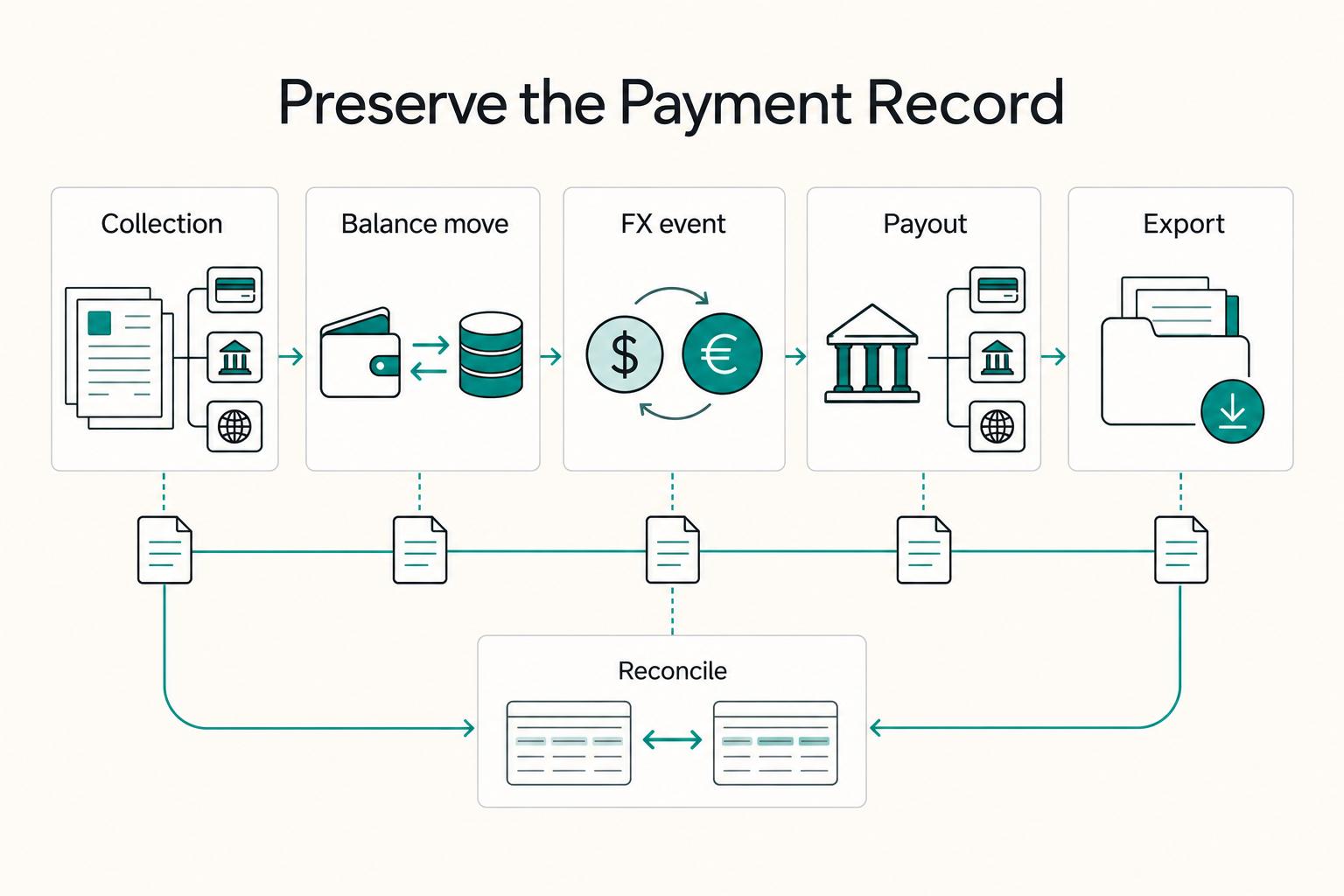
Keep the operating posture simple: configure controls to preserve traceability at every payment step, then validate that records can be exported and reconciled without manual reconstruction. If a trail breaks between collection and payout, resolve that break before scaling volume.
Map controls to daily execution#
Keep one record path per payment and update it at each step:
- Link collection records to the related payment or invoice reference.
- Track each balance movement with related transaction context.
- Capture FX events as part of the same trail.
- Apply policy gates before payout release where configured, and keep status history.
- Run and archive reconciliation exports on a consistent cadence.
When the payout trail is incomplete, investigate and follow any authorized approval gate before release. Check your contract and provider instructions before withholding money or changing routes. Keep a paid client invoice separate from the status of your provider payout.
Confirm market and program coverage first#
Confirm the account’s supported currencies, destination countries, payout methods, and export fields directly in current documentation or with support. Do not assume a currency count or a named network proves that your particular transaction is supported.
Before relying on a route, test availability and record capture for the exact market and program. Document a fallback, its fees, timing, and evidence fields. If a payment is already pending or held, resolve its status before switching routes to avoid collecting or paying twice.
Apply product steps after compliance basics are done#
Choose the fields you must preserve, then check whether the product can supply them. Keep filing calendars and required government reports alongside the payment workflow; an export is supporting evidence, not the filing itself.
Put the reporting decision beside the payment record#
For each receipt, identify what actually happened: electronic payment, cash handover, later deposit, or movement within a foreign account. That classification determines which reporting questions need attention.
Keep the invoice, receipt, fees, conversion, payout status, and bank entry connected. This supports review while leaving the institution’s CTR and your possible Form 8300 or FBAR duties distinct.
Assign a deadline owner when a report is required. Do not rely on the next monthly close to catch a 15-day cash-reporting deadline, and do not treat a payment export as proof that a government form was submitted.
Your next step is to run one evidence-pack cycle on your next invoice batch:
- Save payer identity details when you issue the invoice.
- Capture settlement proof when funds arrive, including channel reference.
- Record conversion inputs and outputs in the same file.
- Reconcile to your ledger and account statement within the week.
- Test the trail end to end: can a reviewer follow the payment without missing context?
After that cycle, review what was hard to capture and tighten your process around those weak spots. Small fixes now prevent larger disputes later.
If the facts or reporting scope remain unclear, seek qualified advice with the complete payment packet and deadline attached. Keep What is FinCEN? as a term reference; use the linked official sources for the reporting decision.
Frequently Asked Questions
What is a Currency Transaction Report (CTR) in plain language?
A CTR is a U.S. financial institution’s report of cash transactions over $10,000 in a business day, including known same-person aggregation. It is not an annual income tax return or a report automatically triggered by a large electronic transfer.
Does a freelancer personally file a CTR, or does a bank/provider file it?
The covered financial institution files its CTR. A freelancer receiving business cash must separately assess Form 8300, and a U.S. person with covered foreign accounts must assess FBAR. The bank’s filing does not discharge those separate duties.
What is the difference between a CTR and a Suspicious Activity Report (SAR)?
A CTR concerns reportable cash activity under the institution’s rules. A SAR concerns suspicious activity identified by a covered institution under its applicable rules. They can address different events; the same transaction can be relevant to both. A freelancer’s ordinary invoicing role does not create an institution’s SAR filing duty.
What records should I keep for international payments through SWIFT or PayPal?
Keep the invoice, client identity context, payment reference, gross amount, fees, conversion record if any, and receiving statement or payout line. Map partial receipts and bundled payouts explicitly so each invoice can be reconciled without counting a payout as new client revenue.
If my country is not the US, how should I treat FinCEN guidance?
FinCEN guidance covers U.S. obligations. Residence abroad does not automatically remove those obligations: U.S. citizens can still be FBAR filers. Check your legal status, account relationships and locations, transaction facts, and applicable exceptions, then assess other countries’ rules separately.
What should I do when rules from my bank, tax advisor, and online forums conflict?
Start with the applicable law and official regulator guidance. Ask a qualified advisor to explain how they apply to your facts; treat provider notices as operational requirements that can be additional to legal duties. A provider policy does not override the law.
Watch
CTR, SAR, FBAR: What Freelancers Should Know
Try a related tool
Researched and edited by the Gruv editorial team. Gruv builds cross-border billing, payouts, and finance-operations software for global businesses.
Sources
Educational content only. Not legal, tax, or financial advice.
Related Posts

Digital Nomad Taxes in 2026 With a Defensible Filing Plan
With digital nomad taxes, the first move is not optimization. It is figuring out where you may be taxable, where filings may be required, and what proof supports that position.

What Is FinCEN for Freelancers and FinTech Users
If you are asking **what is fincen**, focus first on the decision in front of you. FinCEN, the Financial Crimes Enforcement Network, is tied to FBAR filing through FinCEN Form 114 when foreign financial accounts create reporting duties. By the end, you should know whether to act now, gather records, or escalate.

The Freelance Payment Penalty: A Modeled Audit of Platform Fees, FX Spreads, and Payout Delays
The money rarely disappears through a single, easy-to-spot fee. The real loss is stacked. A marketplace takes its commission, a processor adds a charge for international cards, a bank or payment company converts the currency at a spread, a platform holds the funds before release, and a wire sheds a little to intermediaries on the way in. Each layer looks defensible on its own, but the worker feels the combined result as a smaller deposit and a later payday.