
Quick Answer
Choose screened or assisted sourcing when it closes a real screening-capacity gap, and a broad marketplace when you can evaluate candidates against a bounded brief. Compare paid trials using the same acceptance test, internal review effort, fees, rights, and payment terms. Job feeds for freelancers curate opportunities, not the candidates a buyer hires.
How curated marketplaces and open platforms differ#
Skip the usual ranked-list mindset. The useful decision is which hiring model fits your next role: a curated freelance platform, a curated listing service, or an open platform. Choose based on risk, speed, and cost control, then verify before you commit budget.
A quick definition helps: a freelance marketplace is an online venue where clients and service providers meet. Curated talent platforms usually offer a smaller, more selective pool than mass platforms. Curated listings are not the same as talent vetting, so confirm what screening actually happens.
Use the hiring model to decide who performs screening, then test the candidate against your role. Provider screening descriptions establish a process to inspect, not a promise that every candidate will fit your project. Compare delivered work, your review effort, and the contract and payment path on the same scope.
Before approving spend, run three checks on any option:
- Confirm trust terms in writing: escrow terms, review signals, and dispute-handling steps.
- Ask what screening means on that platform: who screens, what is verified, and whether checks are refreshed.
- Separate visible fees from internal effort: interviewer time, trial revisions, and restart time after mismatch.
One rule runs through the article. If role failure would be expensive, pay for stronger early filtering and clearer dispute terms. If budget pressure is highest, use broader access and tighten your own gate before paid work. The common mistake is chasing low posted rates, then losing time sorting weak matches and rerunning trials.
By the end, you should be able to pick one primary model for your next hire. You should also have a backup channel and a short list of checks that must pass before contract approval.
At a Glance Comparison for Curated vs Open Hiring#
Start by matching the model to your team's screening capacity: curated options cut early filtering, while open platforms give you breadth but shift more vetting work to your team.
Use this table to choose a model, not to declare a winner. Platform names are examples, not endorsements.
| Decision | Screened talent/matching service | Job or lead feed for freelancers | Broad marketplace/service listings |
|---|---|---|---|
| What is filtered | Candidates or matching pool; inspect actual method | Opportunities, not your buyer-side shortlist | Platform access and any particular screened tier; buyer evaluates fit |
| Buyer screening effort | Role-specific checks remain even after provider screening | Not a substitute for a talent-sourcing service | Proposal/listing review and candidate assessment |
| How to compare speed | Time to a qualified candidate and accepted trial | Useful for a job seeker’s lead workflow | Time from brief to qualified candidate and accepted trial |
| Price visibility | Quote and service terms for the selected engagement | Subscription or access cost for the job seeker | Task price plus checkout, contract, and payment fees |
| Useful fit | Teams wanting assisted sourcing for a defined role | Freelancers seeking client or job opportunities | Buyers able to assess a broad pool or bounded service |
| Main failure | Assuming provider screening replaces project review | Mistaking listing quality for candidate vetting | Choosing a price without acceptance and payment controls |
If role failure is expensive, start with curated matching, then verify the screening evidence before paid work. If budget pressure is the hard limit, start open, cap review time, define acceptance criteria up front, and move to paid trials only after a strict shortlist gate. If your broader acquisition plan also includes agency lead generation, see How to Use Clutch.co to Generate Leads for Your Agency.
What Each Model Actually Means in Practice#
Toptal describes a screened talent network, while YunoJuno combines a freelancer marketplace, sourcing, and management services. Upwork and Freelancer.com support broad marketplace sourcing; Fiverr also offers service listings and differentiated offerings. SolidGigs and FlexJobs primarily help job seekers find opportunities. They are not equivalent buyer-side talent-vetting services.
| Model | Examples | How described here |
|---|---|---|
| Screened talent or assisted sourcing | Toptal; YunoJuno selected services | Inspect the candidate-screening and matching method for your purchased route |
| Broad marketplace or service listings | Upwork; Freelancer.com; Fiverr | Inspect the selected tier, engagement type, and payment terms |
| Opportunity/lead feeds | SolidGigs; FlexJobs | Primarily a job-seeker channel; not equivalent buyer-side candidate assessment |
Use one practical test: where does quality control happen first? Open marketplaces are broad-access first, so you usually do more sorting after proposals arrive. Curated networks are positioned around a narrower, selected pool. Curated listings are typically about access to opportunities, not the same thing as vetted candidate assessment.
A platform can combine open access, screened tiers, managed matching, and payment administration. Evaluate the particular service you are purchasing rather than assigning the whole brand to one permanent category. Ask whether the screening applies to your candidate, role, and selected plan.
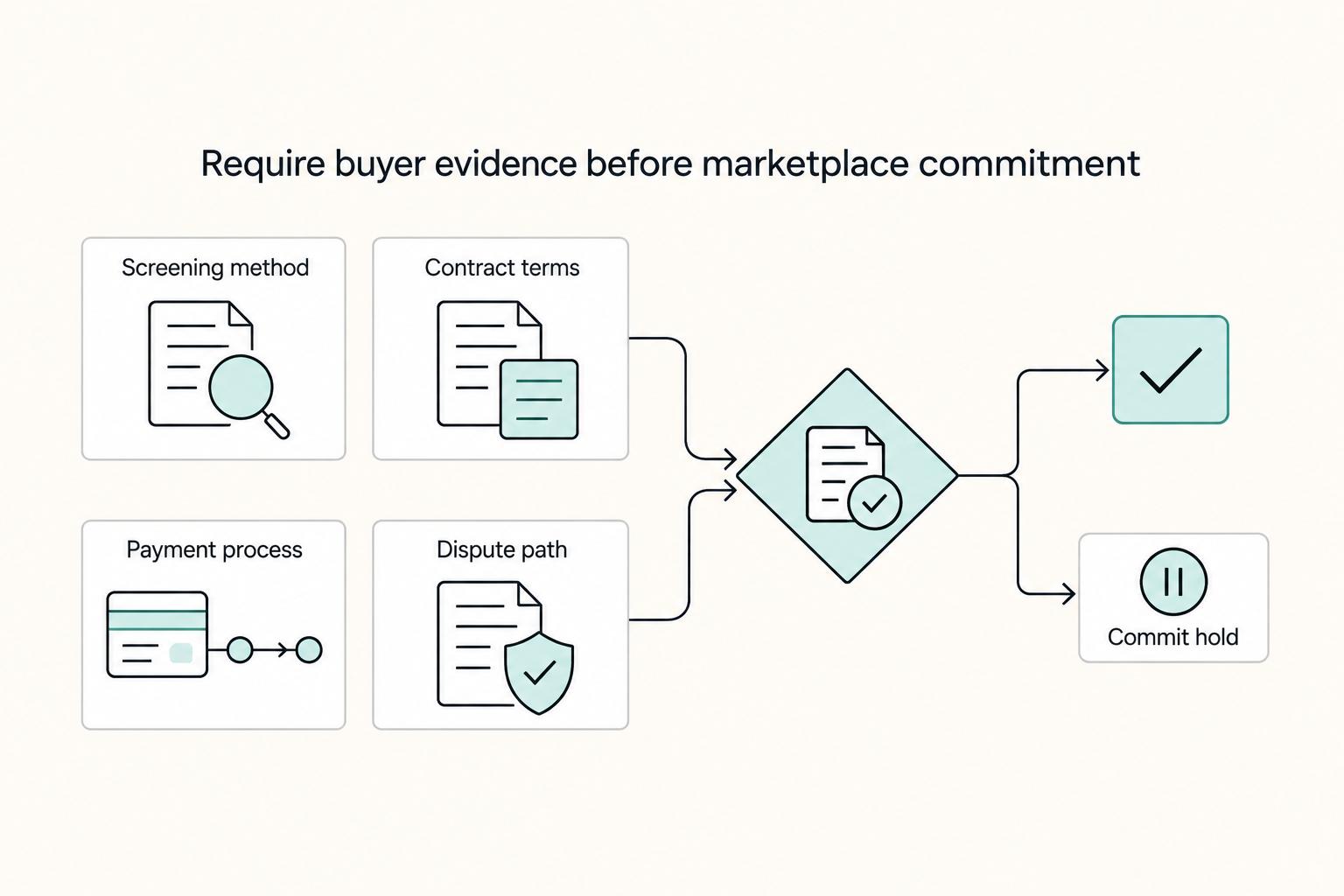
Before you approve budget, confirm these four terms in platform docs and contract language:
- Screening: what is filtered before you see candidates versus what your team must filter.
- Verification: which identity, credential, or work-history claims are checked, and how recent those checks are.
- Matching: whether you receive open bids, a guided shortlist, or listings you still evaluate yourself.
- Dispute handling: who decides scope, quality, or payment conflicts, and what remedies apply.
If role failure is expensive, choose the model that reduces first-round sorting, then get written answers on all four checks before paid work.
The Tradeoffs Competitor Roundups Skip#
The biggest tradeoff many roundups miss is simple: who carries the filtering work. They often rank unlike options side by side as if they do the same job, which is easy to scan and easy to misread when hiring risk is high.
| Operational cost | How it shows up |
|---|---|
| Internal interview time | Spent triaging weak-fit applicants |
| Paid trial assignments | Fail and force a second search |
| Restart delays after mismatch | Manager attention pulled from delivery |
Use one decision rule. If role failure is expensive, pay for stronger early filtering and accept a narrower funnel. If budget pressure is the hard limit, use broader access and plan for more internal screening before paid trials.
“Pre-qualified” and “pre-vetted” need a written definition. A portfolio review, identity check, live skills assessment, and reference check answer different questions. Your own role-specific review still matters, including whether the candidate may share the sample and whether it reflects their contribution.
Those hidden costs are usually operational, not headline rate: internal interview time spent triaging weak-fit applicants, paid trial assignments that fail and force a second search, and restart delays after a mismatch, with manager attention pulled from delivery.
Before you commit budget, ask for a short written definition of the filtering promise: what "pre-qualified" means, what is checked before introduction, and whether support stops at matching or extends into recruiting, compliance, and payroll coordination.
Recommendation: run one controlled test brief across two channels and score both against the same acceptance criteria. Keep the scorecard simple: screening hours, trial pass rate, and days to a usable contributor. If you're hiring for content work, read How to Create a Content Calendar for Your Freelance Business.
Scenario Recommendations for Real Buyer Profiles#
Choose channels by failure cost and your team's screening capacity, not by list rank.
| Buyer profile | Start here | Add this second | First checkpoint | Common failure mode |
|---|---|---|---|---|
| Solo freelancer sourcing leads | One open marketplace plus direct outreach | A second channel only after quality is consistent | Track qualified replies and booked calls, not total applications | Treating high application volume as real pipeline |
| Small team shipping product work | One channel for critical roles with a written role brief and trial scope | One open marketplace for overflow work | Confirm acceptance criteria before any paid trial | Overflow work becomes core work without tighter review |
| Finance-minded, risk-sensitive buyer | Pause open bidding for sensitive scopes until controls are documented | Run a limited test only after controls are in place | Confirm screening criteria, approval gates, NDA, and access boundaries before posting | Fast hiring without documentation creates rework |
| Team hiring long-term remote contributors | Compare two channels with the same scorecard | Keep one open marketplace as a benchmark | Measure retention, handoff quality, and restart time after a miss | Choosing on hourly rate and absorbing turnover costs later |
Use the actual sourcing route. Upwork proposals and Fiverr service listings produce different first-contact and contracting workflows, and each has its own payment and dispute terms. Do not infer lower rates, stronger quality, or safer payments from the platform’s category. Price a defined task and inspect the selected contract route.
Require one evidence pack before interviews: portfolio links, recent similar deliverables, a communication sample, and trial acceptance criteria. If a candidate cannot map prior work to your scope in writing, end the process early.
The Buyer Due Diligence Checklist Before You Commit#
Before you commit, require written evidence and pause the decision if key items are missing. Treat this as a pre-contract gate so approvals rest on verifiable detail, not momentum.
Use one short checklist in your review meeting, and apply the same standard to every option so you compare risk and fit consistently.
| Check area | What to request in writing | Pass signal | Red flag |
|---|---|---|---|
| Screening | Method, candidate-specific checks, and refresh date | Evidence applies to this candidate and role | Generic acceptance-rate headline only |
| Trial scope | Deliverable, acceptance checks, revision limits and payment | Both parties agree before work starts | Unpaid productive work or shifting criteria |
| Rights and access | NDA where needed, background IP, usage/ownership terms, data permissions | Rights and least-privilege access fit intended use | Assuming payment or NDA alone transfers all rights |
| Payment and disputes | Funding, submission/review clocks, fees, remedies and escalation | Known obligations and an owned review deadline | Assuming screening guarantees refund or unlimited payment hold |
Checklist-based diligence is usually cheaper than cleaning up avoidable surprises later. Weak diligence can look acceptable early, then fail under delivery pressure when hidden risks surface.
For finance-minded teams, the larger cost is often rework and cleanup, not just rate. If compliance obligations apply, pair this step with your GDPR for Freelancers: A Step-by-Step Compliance Checklist for EU Clients before contracts are finalized. If you need a simple next step after the review, browse Gruv tools.
A 14 Day Test Plan to De-Risk Platform Choice#
Use a short, controlled pilot to compare channel types with the same task and scoring method. Treat 14 days as a decision aid, not proof of long-term performance.
| Days | Action | What to log | Red flag |
|---|---|---|---|
| 1-2 | Run the same brief for one test role and one fixed-scope task on one curated option and one open option. | Time to first qualified response, clarifying questions, and brief-comprehension score | Scope changes between channels, so results stop being comparable |
| 3-7 | Assess proposals, permitted portfolio samples and communication with one shared rubric; do not demand free productive work | Brief adherence, communication quality, revision behavior, and turnaround reliability | Scoring rules change mid-test |
| 8-11 | Commission a bounded paid trial only after signed scope, acceptance criteria, payment terms, access and rights are agreed | First-pass quality, quality after revision, and manager review hours | Trial starts before acceptance criteria are approved |
| 12-14 | Run a decision review based on total cost-to-success. | Quality consistency, manager time spent, restart risk, and spend | Final choice is driven by profile polish or lowest rate alone |
Keep one evidence packet per candidate: proposal, rubric score, revision notes, communication sample, and pass/fail against acceptance criteria. Set go/no-go rules before day 1 so the final decision follows evidence rather than preference.
Cross-Border Ops Checks Most Hiring Guides Ignore#
Before a paid cross-border trial, identify the actual contracting parties, worker-status path, deliverable, payment route, tax treatment, and data-access permissions. A platform may administer payment without becoming the employer or taking over every legal responsibility. Buying freelance services does not automatically require the buyer to register for OSS.
| Cross-border check | Decision before paid work | Evidence |
|---|---|---|
| Contracting and status | Who engages the freelancer and how the worker is classified | Entity names, scope, authority and status assessment |
| Tax and invoice | Applicable supplier/buyer treatment and responsibility for deductions | Invoice details, tax decision and required payee documents |
| Rights and data | What may be shared, produced and used | Agreed IP/background-material terms and access approvals |
| Payment route | Currency, fees, acceptance, release and dispute clocks | Funded milestone/order terms and later payment reference |
For an illustrative trial, commission one API integration against a sandbox for USD 500, due on an agreed date. Acceptance requires the documented request and response behavior, error handling, a handoff note, and one agreed revision round. Keep production credentials and customer data out of the test. Record who accepts it and the deadline for reviewing the submitted work.
On Upwork fixed-price milestones, funding, platform submission, and the review clock matter: the client has 14 days to approve or request changes after submission, with automatic release if no action is taken. That contractual clock is separate from this guide’s illustrative hiring-pilot schedule. Do not assume all providers hold funds until an explicit approval.
Before continuing, retain the signed scope and amendments, accepted-delivery record, fee and tax breakdown, invoice or platform receipt, and payment reference. Resolve an unknown payment outcome through the platform before paying the same obligation again. Follow platform rules for payment and any conversion or off-platform engagement; a new provider should not be used to bypass them.
Conclusion#
Keep the final decision simple: choose your channel mix by risk tolerance, required speed, and total cost-to-success, not platform popularity. If role failure would delay delivery, pay for stronger early filtering. If budget pressure is highest, accept more internal screening and protect quality with tighter acceptance criteria.
| Checkpoint | What to confirm |
|---|---|
| Evidence-pack quality | Portfolio proof, reference-check method, communication sample, and replacement terms documented before scaling spend |
| Delivery reliability | Brief adherence, revision behavior, and turnaround consistency from the paid trial task |
| Cost-to-success | Contract price plus manager screening time, interview time, and restart risk after mismatch |
| Risk signals | Data-access boundaries and approval gates documented before sensitive work starts |
Use the 14-day schedule as an illustrative comparison window, not a mandatory hiring deadline. Review the same brief and rubric across both channels, extend for genuine dependencies, and record the final decision. The trial’s payment, review, and dispute clocks follow the selected contract, not the pilot’s calendar.
For an illustrative cost comparison, an open-channel trial costs USD 500 plus a USD 40 platform charge and four manager hours valued at USD 75: USD 840 of combined spend and internal time value. A curated-channel trial costs USD 700 plus one manager hour at USD 75: USD 775. If both pass the same acceptance test, the lower posted rate did not yield the lower total. These are invented assumptions, not platform prices; include taxes, failed trials, and restart effort separately when relevant.
For teams comparing channels such as Upwork or Fiverr against a curated option, trust is earned through repeatable checks, not labels. Verify claims, keep your scorecard consistent, and avoid hard assumptions where public outcome data is still unclear.
Frequently Asked Questions
What is a curated freelance marketplace?
A curated talent marketplace screens or selects some candidates before introduction or listing, often with assisted matching. The depth and recency of screening vary by service. It does not guarantee suitability, ownership rights, or payment protection; inspect the process and selected contract terms.
Curated marketplace vs open platform: what is the practical difference?
The practical difference is who performs the first filtering and how candidates are introduced. A curated network may narrow the pool before you see it; a broad marketplace usually gives more direct choice. Both require role-specific review, agreed acceptance, and a clear payment and dispute path.
Are curated job listings like SolidGigs the same as curated talent networks like Toptal?
No. SolidGigs describes itself as a lead-generation tool for freelancers, and FlexJobs screens job listings for job seekers. Toptal describes screening freelance talent before joining its network. Curating an opportunity is different from assessing the person you plan to hire.
Is a curated freelance marketplace worth it for small teams?
It can be, especially when manager time is tight and role failure is expensive. It may be less attractive when budget is the hard cap and your team can handle heavier screening internally. Use your trial scorecard, not the category label, as the final rule.
When should finance-minded teams avoid open bidding on platforms like Upwork or Fiverr?
Pause any sensitive hire until scope, acceptance, approvals, NDA or processing terms where needed, and access boundaries are documented. These requirements apply to curated candidates too. Open sourcing can work when you have capacity for screening and a bounded paid trial; it is not itself a reason to skip or reject a channel.
Should freelancers use FlexJobs-style curated listings or broad platforms first?
Start with the channel where you can send focused proposals consistently and back them with clear portfolio proof. Broad platforms can offer volume, but they can also consume time while you filter for fit. A practical setup is one primary channel plus a secondary channel reviewed weekly.
Can a hybrid approach outperform choosing only one platform model?
It can. Some teams use curated channels for critical roles and open channels for overflow or narrower tasks. The hybrid works best when both channels are scored with the same rubric and reviewed on total cost-to-success, not headline rate.
Try a related tool
Researched and edited by the Gruv editorial team. Gruv builds cross-border billing, payouts, and finance-operations software for global businesses.
Sources
Includes 8 external sources outside the trusted-domain allowlist.
- fiverr.com/legal-portal/legal-terms/payment-terms-of-se...external
- flexjobs.comexternal
- help.fiverr.com/hc/en-us/articles/360010558038-How-Fiverr-wo...external
- solidgigs.comexternal
- support.upwork.com/hc/en-us/articles/360000980507-Review-and-pa...external
- support.upwork.com/hc/en-us/articles/211063748-How-Fixed-Price-...external
- toptal.com/top-3-percentexternal
- upwork.com/legalexternal
Educational content only. Not legal, tax, or financial advice.
Related Posts

GDPR Compliance Checklist for Freelancers Working With EU Clients
Start by separating the decisions you are actually making. For a workable **GDPR setup**, run three distinct tracks and record each one in writing before the first invoice goes out: VAT treatment, GDPR scope and role, and daily privacy operations.

Build a Freelance Content Calendar That Survives Client Work
If your publishing keeps slipping, the problem is often not a lack of ideas. It is that the plan breaks the moment client work shifts. A **freelance content calendar** should give you a usable schedule for what you plan to write, produce, and publish, plus enough structure to decide what moves when the week gets crowded.

How to Use Clutch.co to Generate Leads for Your Agency
If you want Clutch to produce qualified pipeline, aim for better-fit conversations and cleaner conversion, not instant volume.