
Quick Answer
Define the assets, licensee, permitted uses, exclusivity, channels, territory and term before quoting. Separate production fees from licensing or ownership-transfer terms, and exclude rights you cannot grant in third-party materials. Price new uses only when they exceed the agreed scope. For creator-handle ads, specify delegated access and revocation as well as content permission.
Set Usage Rights and Expansion Pricing With a Repeatable System#
Before quoting creative work, identify the asset, authorized user and intended use. A production fee pays for making it; the rights schedule determines how it may be used, and an ownership transfer is a separate decision.
You are not trying to win a single clause. You are building a system you can run from the first scope call to signed paperwork, so the deal stays clean when the scope shifts.
Start with the actual commercial request. A three-month social campaign, a permanent company logo and an exclusive product illustration need different rights packages; one narrow default will not fit all three.
Before you discuss fees, write a short pre-negotiation brief with the issues you expect to negotiate, the commercial outcome you want, and your fallback positions.
Then define Usage Rights by channel, territory, and term so nobody has to guess later. If a client wants ownership, review Work for Hire vs. Assignment of Rights: A Freelancer's Guide to Owning Your IP before you trade away control.
Scope Matrix you can run before every proposal#
| Rights line | Proposed campaign baseline | Expansion trigger | Commercial rule |
|---|---|---|---|
| Organic usage | Client posts on owned channels for a defined term | Client asks for longer term or more channels | Consider an added licensing fee for each expansion |
| Paid amplification | Excluded from base scope | Client wants paid ads | Treat as additional usage and approve in writing where required |
| Whitelisting | Excluded from base scope | Client requests delegated creator-handle advertising permissions | Treat as additional usage and add fee plus controls |
| Sponsored content reuse | Limited to agreed campaign context | Client wants repurposing in new campaigns | Route through a change order |
| Territory and term | Named geography and fixed duration | Client asks for broader territory or longer run | Increase fee in line with expanded rights |
One page checklist for cross border client work#
| Item | Detail |
|---|---|
| Rights grant, duration, and territory | Confirm in one place |
| Local formalities for licensing or assignment | Check written form and any registration requirement where required |
| Scope, pricing, and change rules | Align in the same contract stack |
| Paid amplification and whitelisting changes | Log approvals |
| Final rights language | Consider holding launch until both sides sign |
If a client suddenly asks to run your influencer content as sponsored ads in additional markets, do not improvise. Trigger your risk gate, issue a scoped change order, adjust the licensing fee, and keep the deal moving without losing control.
Build the Mental Model Before You Negotiate#
Separate permission, ownership, and confidentiality from the start, then negotiate usage rights from that structure.
A negotiation gets messy when the same word is doing three jobs. Clean deals start with clean labels. Put permission, ownership, and confidentiality in separate buckets, then handle usage from that structure so later expansion requests are easier to manage.
Usage permission, copyright ownership and possession of a delivered file are different things. Under U.S. law, the author generally owns copyright initially, subject to exceptions such as qualifying work made for hire. A nonexclusive license can leave ownership with the creator; an exclusive license transfers the defined exclusive right. State which grant is intended.
Separate permission from ownership#
| Term | What it does | What you should negotiate |
|---|---|---|
| Usage Rights | Grants permission to use work in defined ways | Scope of use, duration, and limits |
| Nonexclusive image license | Permits specified use while leaving ownership with the rights holder | Assets, term, territory, edits, permitted users and renewal |
| Assignment or exclusive grant | Conveys all or a defined exclusive right under applicable law | Scope of transfer, exclusions, retained rights, price and formalities |
| Work for Hire | Can shift authorship to the hiring party in qualifying cases | Confirm if it applies and require express signed writing for commissioned treatment |
Price a defined nonexclusive license, an exclusive grant and an assignment as different choices. Also inventory third-party materials: stock images, fonts, music and collaborators may require separate permissions. You cannot grant more than you own or are authorized to sublicense; specify excluded assets and who obtains client-side licenses.
Align your SOW, NDA, and rights language#
Your Statement of Work (SOW) should define the actual work, deliverables, and approvals in plain terms. Your NDA should define what information is confidential and who is bound to protect it. Your rights clause should then match both documents.
| Document | Should define | Quick check |
|---|---|---|
| SOW | The actual work, deliverables, and approvals in plain terms | Names deliverables and intended use |
| NDA | What information is confidential and who is bound to protect it | Defines covered confidential information and obligations |
| Rights language | Should match both documents | Matches the same scope and limits |
Before you send a draft, run this quick check:
- SOW names deliverables and intended use.
- NDA defines covered confidential information and obligations.
- Rights language matches the same scope and limits.
When a client asks for reuse and full ownership together, separate the requested uses from the ownership decision. Offer a license or an assignment with clear treatment of pre-existing tools, source files, third-party components and your retained portfolio permission.
What Should a Safe Scope Matrix Include?#
A safe Scope Matrix separates usage rights by channel, territory, audience, edit permission, and termination terms so every expansion becomes an explicit negotiation decision.
This is where your legal model becomes deal controls. A Scope Matrix is not a summary paragraph. It is a set of switch settings you can point to when someone asks for "just one more use."
Write one line per use case, naming the asset/version, licensee, authorized users, permitted acts and limits. Define nonexclusive versus exclusive rights, sublicensing and affiliate/agency access. If ownership transfer is requested, address it expressly rather than burying it in a usage table.
Build the matrix by channel use case and limits#
| Matrix line | Define in the contract | Trigger a change order in the SOW |
|---|---|---|
| Organic Usage | Brand can post on owned channels for named campaign contexts | New channel, new campaign context, or longer term |
| Paid Amplification | Brand can run paid ads only on listed platforms and assets | Any new ad objective, platform, or added creative set |
| Partner-handle permissions (whitelisting-style access) | Client can run ads from a partner handle only with approved permissions | New handle access, broader permissions, or extended run |
| Territory and audience | Approved countries or regions and target audience scope | Expansion to new regions or audience groups |
| Derivative edits and reuse | State if client may crop, rework, or repurpose sponsored content | Any unapproved edit, remix, or reuse request |
| Termination and renewal | Define rights end date, renewal terms, and post-term usage rules | Renewal request or holdover usage after campaign end |
Specify permitted crops, translations, edits, remixes and new derivative assets. Their distribution must also fit the license. Obtain any necessary third-party and personality permissions separately; a copyright license does not automatically authorize a person’s likeness, music recording or trademark in every campaign.
Control scope creep with risk gates#
| Action | Trigger |
|---|---|
| Add a jurisdiction note | When local campaign rules create exceptions |
| Route every expansion request through one documented SOW change order path | Expansion request |
| Require written approval | Before any paid amplification or partner-handle access launch |
| Tie renewal to updated commercial terms and updated termination language | Renewal |
| Choose duration deliberately | A campaign may suit a fixed term; a logo may need enduring licensing or ownership |
If a client approves organic usage and then asks to boost influencer content as ads in new regions, the matrix gives you the answer. Flag the paid amplification and territory expansion, issue a change order, and keep the negotiation controlled.
How Do You Price Usage Rights Without Guesswork?#
Price usage rights as expanding business value, not as extra creative effort, then tie every expansion to a predefined fee rule.
Use the matrix to quote the requested rights. An expansion beyond the agreed grant needs approval; a use already covered by a broad license does not automatically create a new fee. Long-term or perpetual licensing can be intentional without transferring all copyright.
Use a two-part structure in your SOW. Part one covers base production for creating the asset. Part two covers licensing tiers for how the client uses that asset.
Price term, media, commercial reach and any exclusive restrictions using the actual opportunity and foregone future use. No universal licensing multiplier applies. Some projects, such as a logo, may need enduring rights or assignment; a temporary campaign tier would create an avoidable mismatch.
Build pricing tiers inside the SOW#
| Line item | What the client buys | What increases price | Contract control |
|---|---|---|---|
| Base production | Creation of deliverables | Added deliverables or revisions | SOW deliverables section |
| Organic usage license | Posting on approved owned channels | Added channels, territories, or longer term | Rights schedule in SOW |
| Paid amplification license | Running ads with your content | Expanded campaign scope or longer term | Separate paid usage tier |
| Whitelisting license | Ad access through creator-facing handle permissions | Broader account access or longer runtime | Separate permission and fee line |
| Renewal or overuse | Continued or expanded use after initial term | New term or out-of-scope use | Pre-agreed change-order clause with updated price |
Hypothetical offer: $2,000 production plus $500 for three final images used nonexclusively on the named brand’s organic Instagram and website for three months. Add $800 for paid Meta placements for the same term and $400 for restricted creator-handle ad permission: total $3,700. These are example prices, not market rates. State territory, start date, approved edits, any agreed ad-spend cap and whether renewal replaces or extends the existing term. A $300 quoted one-month extension is a separate line; assignment and exclusivity are excluded unless expressly purchased.
Set remedies before launch#
Pre-agree how to handle an expansion request, unapproved use and expiry. A new paid tier requires the authorization specified in the contract; it is not an automatic cure for an infringement. Document the live asset, channel, date and requested remedy, then use the agreed notice and dispute process.
Then align Indemnification and Limitation of Liability so both sides understand who covers defined losses. Clarify which damages or caps apply to available remedies, since carve-outs and limits vary by contract and jurisdiction.
If a client starts with sponsored content for organic posting and then wants paid campaigns from your handle, you usually do not need to renegotiate from scratch when tiers are pre-agreed. Trigger the paid tier, issue a change order, and attach the updated fee and term before launch. Want a quick next step on the paperwork? Try the SOW generator.
Which Clauses Protect You When Scope Creep Starts?#
Protect your upside by pairing a narrow rights grant with termination, liability, forum, data, and dispute clauses before scope expands.
Pricing rules only work if the contract puts the deal back on the rails when someone tries to drift. Your clause stack should do the same job as your scope matrix. Keep permissions narrow by default, and make expansion explicit.
Build a clause stack that matches your pricing model#
| Clause | What to define now | Why it matters when scope shifts |
|---|---|---|
| Rights grant plus Termination | Who can use the work, where, for how long, and how rights end or renew | Stops quiet overuse and forces a formal renewal decision |
| Limitation of Liability plus Indemnification | Damage caps and exclusions, then who compensates whom for defined losses or claims | Keeps risk allocation balanced instead of one sided |
| Governing Law plus Jurisdiction | Which law governs interpretation and which forum hears disputes | Reduces cross border ambiguity before conflict starts |
| Dispute Resolution sequence | Informal resolution first, then arbitration or court, with clear sequencing and notice terms | Prevents process chaos from vague dispute language |
| NDA plus DPA | Confidentiality duties, plus required processing terms where a controller-processor relationship applies | Protects sensitive information and covers required processor contract terms |
| Force Majeure plus delivery adjustment | Which events outside party control trigger relief and how delivery obligations adjust | Prevents timeline shocks from turning into automatic liability fights |
A few operator rules matter in practice. Draft Indemnification and Limitation of Liability together because one clause can neutralize the other if you draft them in isolation.
Keep governing law and forum clear for cross-border deals, while recognizing mandatory rules may still apply. Where the parties have a controller-processor relationship under applicable data law, use the required processing contract; an NDA alone does not supply those terms. Not every campaign or personal-data use creates that relationship.
When a client asks for broader usage rights and immediate paid rollout in a new market, this stack keeps you from negotiating in a panic. Push the request through termination and renewal logic, document scope instructions in writing, and use the dispute sequence if the deal starts to wobble.
How Do Cross Border Deals Change the Negotiation?#
Cross-border deals require you to localize ownership, usage rights, and enforcement terms country by country before you sign.
Cross-border work is where casual templates start to break. The same clause can behave differently depending on the country, the formalities, and the enforcement reality. Treat each country as its own operating environment and pressure-test your rights language before signature.
IP rights stay territorial, so enforcement and remedies can change across jurisdictions. Start by checking whether your planned Work for Hire and Assignment of Rights language works in the target country. Rules for authorship and transfer do not always travel cleanly.
U.S. commissioned work-made-for-hire treatment requires both an eligible statutory category and the parties’ express signed agreement; inserting the label alone is insufficient. Employee work within the scope of employment is the other route. Copyright transfers generally require signed writing, and some author grants have statutory termination rights. Check the actual jurisdiction and work before promising irrevocable ownership.
Map rights and enforcement before signature#
| Deal area | What to confirm early | Why it changes negotiation |
|---|---|---|
| Work for Hire and Assignment of Rights | Local validity rules, required writing, and transfer mechanics | You avoid unenforceable ownership assumptions |
| Usage scope | Territory, field of use, and term for each market | You reduce unintended expansion across regions |
| Formalities | Whether local practice expects registration, translation, or specific form language | You reduce execution risk at signature and in disputes |
| Governing Law and Jurisdiction | Which law governs and where claims will be heard | You influence enforcement cost and process predictability |
| Rights evidence | Who stores signed approvals and scope changes | You keep a clear record when conflicts appear |
Align commercial controls with legal controls#
Separate production invoice milestones from rights activation and expiry. If the agreement makes the license effective on full payment, state that expressly and arrange a workable preview/review permission before activation. For creator-handle advertising, identify the account, permitted ad actions, launch approval and revocation process; avoid sharing passwords when the platform provides delegated permissions.
Keep a dispute log and a policy gate checklist so your Jurisdiction and Dispute Resolution terms can operate in practice, not just on paper.
For a post-launch paid expansion, check the actual license and third-party clearance limits. If the new use is outside the grant, approve a scoped amendment with asset list, fee, effective date and permissions before activation. Broader use does not always require an ownership transfer.
Use This Negotiation Script and Red Flag Checklist Before You Sign#
Use a clear license script first, then force every scope expansion through a written change order so you protect copyright and keep deal terms clear.
At this point you have the structure. Now you need words you can reuse when the call speeds up and the client wants a quick yes. The goal is simple: lock scope in plain language, then tie any expansion to paper and price.
Use a two line script that sets scope before price#
Start every client conversation with terms that separate image licensing from ownership transfer. Keep your script short, specific, and reusable.
- “This quote includes a nonexclusive license to the named assets for these channels, territory and dates. Assignment, exclusive rights and third-party materials are addressed separately.”
- “I can quote paid placements or creator-handle advertising as an approved amendment defining the fee, assets, term and delegated permissions.”
Use the script as the proposed deal position, then check the signed grant for exclusivity, assignment and work-made-for-hire provisions. An informal conversation cannot override an executed broad grant by itself. Keep approved amendments with the SOW and identify the authorized signers.
Run this red flag checklist before signature#
Before you sign, check the draft for three issues that commonly create negotiation and enforcement problems.
| Red flag | Why it creates risk | What to require before signing |
|---|---|---|
| Undefined full rights or unpriced indefinite/exclusive use | You can accidentally grant broad reuse without a clear end point or clear boundaries | State the permitted acts, users, media, territory and duration; agree renewal or any intentional perpetual grant |
| No Governing Law, no Jurisdiction, and no Dispute Resolution path | You increase uncertainty when a dispute starts, especially across borders | Name governing law, forum, and a clear dispute path (for example arbitration, mediation, or court) |
| Broad Indemnification obligations with weak or missing Limitation of Liability | You can take open ended financial exposure if claims arise | Tie indemnity scope to specific risks and set a liability cap that matches the deal size and risk |
Resolve ambiguous grants, account permissions and unpriced exclusivity before signing. Accept a perpetual or broad license only deliberately, with the permitted uses and economics stated. For creator-account ads, record permission removal at expiry, takedown or archive treatment, allowed residual posts and any remaining payment obligations.
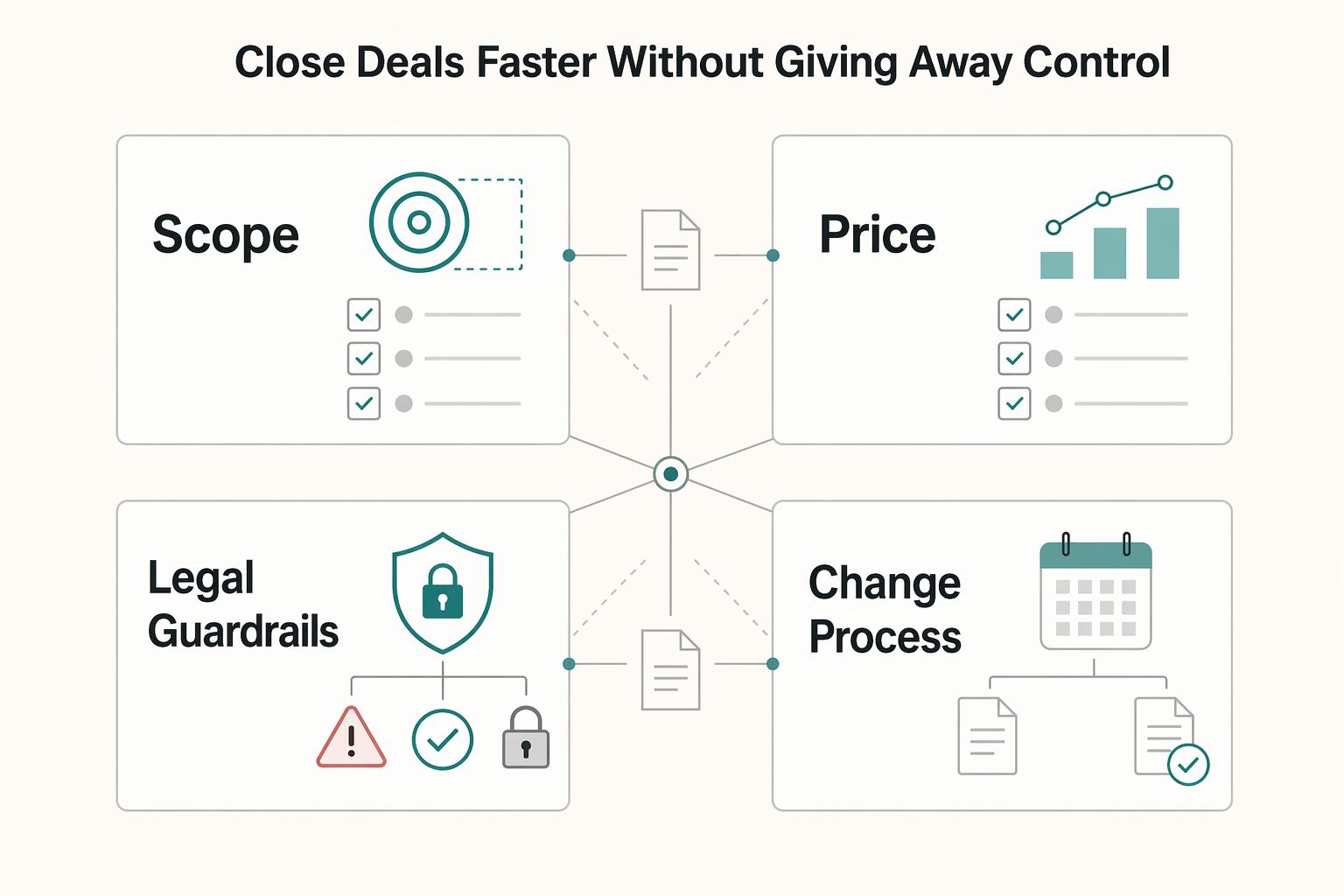
Close Deals Faster Without Giving Away Control#
Use a repeatable playbook: define usage scope, price expansions, set legal guardrails, and route scope changes through written change orders.
This is a practical default, not a universal formula, but it helps reduce repetitive negotiation loops and keeps your decisions consistent across deals. In usage-rights work, consistency lowers ambiguity, protects control over what was actually approved, and makes post-launch expansions easier to process without reopening core terms.
| Step | What to lock | Why it helps speed with control |
|---|---|---|
| Scope | Channels, territory, duration, and media types for Usage Rights | Clear scope reduces ambiguity and late rewrites |
| Price | Base production fee plus expansion fees for additional usage | Expansion requests map to predefined pricing paths |
| Legal guardrails | Ownership, copyright, liability limits, and dispute path | Core legal risk is set before last-minute pressure |
| Change process | Written change orders in the SOW | Expansions can be approved with a documented trail |
Use these default rules in every deal:
- Identify whether the client needs nonexclusive use, exclusivity or ownership, and state the grant clearly.
- Check signed-writing formalities for transfers and commissioned work-made-for-hire eligibility under the applicable law.
- Price the actual uses and retained restrictions; broad or perpetual licensing can be intentional.
- Record amendments through the agreed approval process, including authorized written or electronic signatures where valid.
When late requests expand use across channels or markets, apply the same matrix and checklist, issue a scoped written change, update fees, and confirm local formalities before approval. Baseline IP standards exist internationally, but implementation and formal requirements can vary by country. Keep the system fixed, then localize where needed. Before signature, run your clauses through a consistent intake process such as Freelance Client Onboarding Checklist.
Frequently Asked Questions
What should a usage rights clause include to be enforceable and practical?
Identify the assets, licensee, permitted uses, exclusivity, channels, territory, duration, edits and sublicensing. State when the grant starts and what happens at expiry. Separate copyright from file delivery and third-party permissions. For a U.S. exclusive grant or assignment, address signed transfer formalities; applicability elsewhere requires the relevant local rules.
What is the difference between organic usage, paid usage, and whitelisting?
Organic use is unpaid posting on the agreed channels. Paid use includes advertising placements and boosting. Creator-handle advertising, sometimes called whitelisting or partnership ads, adds permission to advertise using the creator’s identity. Define the actual delegated access, assets, term and revocation controls separately; a usage license is not unrestricted account access.
How do I renegotiate if a client asks for expanded rights after launch?
Do it in two steps. First, restate the current licensed scope in writing so both sides anchor on the same baseline. Second, issue a written change order that adds the new channel, territory, duration, or media type and updates fees in the SOW. If you need speed, keep a prewritten expansion script and a standard approval workflow so the paperwork stays simple. If the expansion turns into a rights dispute, use How to Handle a Cease and Desist Letter as your escalation checklist.
Which rights should I never grant by default as a freelancer?
Avoid undefined full rights, unpriced exclusivity and unrestricted sublicensing or account access. A temporary license is useful for a campaign, while a logo may need enduring rights. Choose deliberately and document any ownership transfer or exclusive grant under applicable formalities; broad or perpetual licensing is not automatically an assignment.
How should governing law and jurisdiction be handled in cross-border contracts?
Specify the governing law, agreed forum and dispute sequence, including notice and any urgent-relief route. Those clauses guide interpretation and where proceedings occur, but do not necessarily displace mandatory copyright, consumer or other applicable rules in every country.
When should I require arbitration versus court-based dispute resolution?
Compare cost, ability to obtain urgent relief, location, enforceability and appeal limits for the likely dispute. Arbitration can offer a contract-defined private process, but confidentiality is not automatic; specify it where required and lawful. Do not assume arbitration is always faster or cheaper than court.
How do termination, indemnification, and limitation of liability work together in a usage rights deal?
Termination addresses the contract and what rights survive or end; a fully paid license may survive if the terms say so. Indemnity allocates specified claims and defense responsibilities, while a liability limit defines covered exposure and carve-outs. Read them together, including treatment of third-party materials and the client’s own edits.
Try a related tool
Researched and edited by the Gruv editorial team. Gruv builds cross-border billing, payouts, and finance-operations software for global businesses.
Sources
Includes 1 external source outside the trusted-domain allowlist.
Educational content only. Not legal, tax, or financial advice.
Related Posts

Work for Hire vs Assignment of Rights for Freelancers
A freelance agreement is not just about price and scope. It decides who controls the rights in the work. If the ownership language is loose, rights can move earlier than you expect, cutting down your control once the work is delivered or used.

How to Copyright Your Creative Work as a Freelancer
In the United States, copyright protection generally begins when original human-created expression is fixed, such as saving an illustration or written draft. You do not need a client contract or registration to create that protection. Client ownership and registration are separate questions: decide which rights the client receives, record who created the work, and register an accurate claim using the appropriate procedure.

The Freelance Payment Penalty: A Modeled Audit of Platform Fees, FX Spreads, and Payout Delays
The money rarely disappears through a single, easy-to-spot fee. The real loss is stacked. A marketplace takes its commission, a processor adds a charge for international cards, a bank or payment company converts the currency at a spread, a platform holds the funds before release, and a wire sheds a little to intermediaries on the way in. Each layer looks defensible on its own, but the worker feels the combined result as a smaller deposit and a later payday.