
Quick Answer
Verify rights authority before choosing a Creative Commons label. For creative commons for freelancers, check whether the deliverable is work made for hire, assigned to the client, or still owned by you; only the rights holder can grant public permissions. Then match intent to a license such as CC BY 4.0, and use CC0 only when unrestricted third-party reuse is explicitly approved in writing. Publish only with a dated record of contract terms, approver, and final metadata.
Using Creative Commons Without Colliding With Client Agreements#
Creative Commons can widen how work is shared, but your signed client contract can determine whether you can grant public permissions for that work. For freelancers using Creative Commons, the first check is ownership: who holds copyright, and who has authority to license this specific asset.
Creative Commons licenses are standardized copyright licenses that let people reuse work under stated conditions. They are used globally across photos, writing, music, and other media. In paid client projects, that does not remove contract risk.
If a deliverable is treated as work made for hire, the employer is considered the author even when you created the asset. Review the contract before you pick a license.
Use this pre-publish check:
- Agreement check: read the signed agreement for ownership and permission terms.
- Work-for-hire test: confirm whether the deliverable is defined as work made for hire.
- Stop rule: if terms are unclear, pause publication until rights are clear.
Pause there.
Treat the pre-publish check as a gate, not a formality. A fast license choice made before ownership is clear can create avoidable problems later. The easiest time to catch a contradiction is before the asset is public.
A practical habit is to write a one-line rights summary for each asset before release. Include the current rights holder, proposed license label, and the contract section that supports that choice. If any one of those three items is unclear, hold publication. If your baseline paper is too loose to support that summary, tighten the next version with the freelance contract generator.
This article follows that contract-first sequence so your licensing choices stay defensible. For a deeper ownership primer, see Work for Hire vs. Assignment of Rights: A Freelancer's Guide to Owning Your IP.
Define the legal terms before you pick any CC option#
Before you choose any CC option, lock down the roles. A Creative Commons license is a public copyright tool. Your client contract is a private agreement. Make sure they point to the same rights holder.
Copyright applies automatically when a work is created and gives exclusive rights to the rights holder. CC licenses can allow reuse without one-off negotiation, but only within license terms and only when granted by the copyright owner or another authorized rights holder.
Confirm these roles in writing:
- Licensor: the party granting permission to the public.
- Rights holder: the party that owns copyright at publication.
If your contract transfers ownership or gives the client control of rights, you may not be able to apply a public license yourself.
Treat language about revocation as a risk check, not an assumption. Confirm what your agreement allows before publication.
For CC labels, use plain shorthand internally, then verify against the official license text before release:
BYNCNDSA
Add one more step that keeps teams aligned: capture these terms in the same asset note where you track approval. That way, the person uploading the file, the person checking contract language, and the person approving publication all reference the same labels and role assignments.
One practical review standard helps here: we want 100% label match across the contract file, the metadata, and the upload screen, and we want 0% publication when ownership is still unresolved. When we audit the asset note, we compare the approver, we compare the label, and we compare the upload metadata before anyone clicks publish. If you are still cleaning the project brief, start with the SOW generator, then keep a 2025 or 2026 approval note with the exact label you plan to publish.
A common miss is treating authorship and licensing authority as the same thing in every case. They are often aligned, but not always. Contracts can change who can authorize public reuse. Use a simple rule: if the contract gives control to the client, pause and confirm authority before publishing under your own name.
When language is ambiguous, do not guess and do not patch around uncertainty with a vague internal comment. Pause and resolve it in writing. The delay is smaller than the cost of correcting a public license decision later.
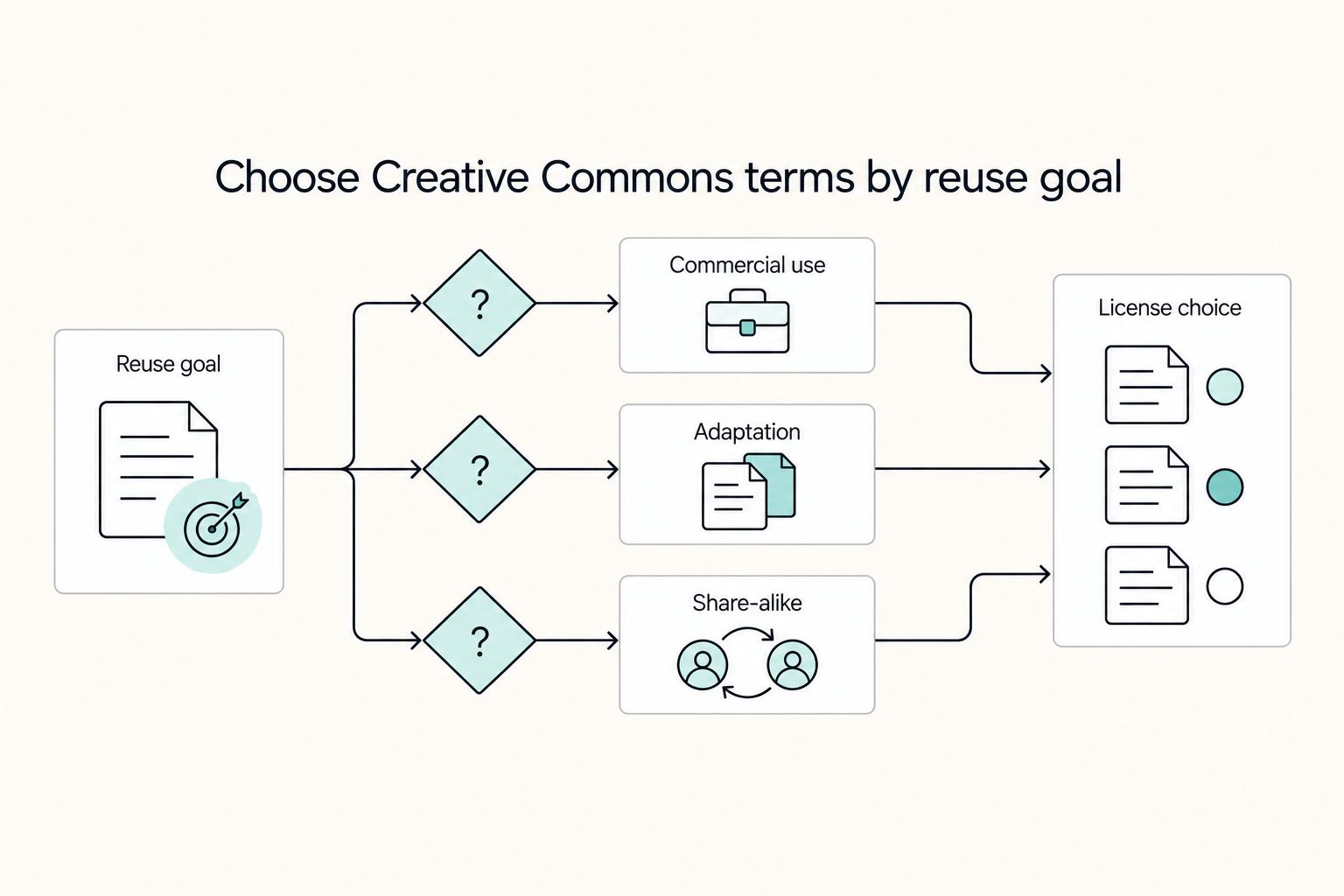
Choose a license with a fast decision tree#
Once your reuse goal is clear, use a short written decision tree instead of gut feel. Creative Commons terms are standardized, so your job is to match one to the real use of the asset.
Run one fast pass:
- Goal: state the reuse goal in one sentence.
- Commercial use: decide whether commercial use should be allowed.
- Adaptations: decide whether adaptations should be allowed.
- Sharing conditions: decide whether downstream sharing needs extra conditions.
- Decision note: pick the best-fit option and record why.
This makes the decision easier to defend and can cut repeat permission requests later. Commercial concerns are common, but concern alone is not a license strategy. Pick the option that matches your intent, document the choice, and move forward.
You can make the decision tree easier to apply. Write two short lines for each asset before final selection:
- Intent line: what you want people to be able to do with this work.
- Boundary line: what uses or changes you do not want to allow.
If those two lines contradict each other, you have found the issue early. Refine the goal first, then return to license selection.
Another practical step is to store your final decision in consistent language. Do not switch between shorthand and full license names across documents. The cleaner your wording, the easier it is to verify what was actually authorized.
When a project includes multiple assets, repeat this pass asset by asset. A single project can contain items with different intended reuse terms. One blanket label for the whole project is often where mistakes begin. If you want a quick next step, Try the SOW generator.
What each CC license changes in paid client work#
In paid client work, the difference between CC options is how much reuse you pre-approve and which conditions you attach. Match that choice to what you promised the client before delivery.
| License | Grounded practical meaning in client work |
|---|---|
CC BY 4.0 | Allows reuse, sharing, adaptation, and commercial use, with attribution to the original creator. |
CC BY-SA 4.0 | Keeps broad reuse and requires adapted versions to be shared under the same terms. |
CC BY-NC 4.0 | Allows use but not for money-making purposes. In practice, commercial versus noncommercial can be fuzzy, so escalate unclear cases before release. |
CC BY-NC-SA 4.0 | Combines NC and SA conditions; specific paid-client outcomes aren't established here, so review fit case by case. |
CC BY-NC-ND 4.0 | Specific paid-client effects for this option aren't established here, so treat it as a case-by-case legal and rights-holder review item. |
For execution, keep one wording standard across client-facing records and record final approval in writing.
The table gives direction, but release quality depends on consistency around it. The same license label should appear in internal notes, metadata fields, and publication copy. Mixed labels can create confusion even when the intent was correct.
When you are deciding between two nearby options, document the tradeoff in one sentence tied to project reality. For example, if collaboration and adaptation are expected, note that clearly. If downstream commercial use is the concern, note that clearly. A short written reason can help prevent drift when someone revisits the asset months later.
Use a quick contradiction check before publish:
- License label in metadata matches the label in client approval.
- Label in client approval matches the label in project records.
- Project records match the terms in force on the publish date.
If any of those lines fail, pause and correct them before release. This is less about perfection and more about reducing avoidable disputes caused by preventable mismatch. If the client-side language still feels vague, compare it against the structure in the freelance contract generator before you publish.
Use CC0 only when giving up control is intentional#
Use CC0 only when unrestricted reuse is the goal. Creative Commons describes CC0 as its route for dedicating work to the public domain, where others can copy, modify, distribute, and use the work commercially without asking permission.
In paid client work, that can move you away from the default position that new work is generally copyrighted when created, including when published online. If your publishing process depends on approval gates or downstream control, CC0 is often a poor fit.
Before publishing under CC0, run this check:
- Confirm the current rights holder for the asset.
- Record why unrestricted reuse is acceptable for this deliverable.
- Get written client sign-off acknowledging broad third-party reuse.
- Save final asset metadata and the approval record.
If attribution or brand visibility matters, pause and compare alternatives before choosing CC0. It is not established that Public Domain Mark and CC0 are equivalent, so verify the exact label against your intended publishing terms before release.
The practical decision rule is simple: use CC0 when unrestricted third-party use is not a side effect but the intended outcome. If your team still expects publication controls after release, that is a warning that CC0 may not match project goals.
Use one review prompt before sign-off: what would concern you if an unknown third party reused this asset tomorrow in a way that remains within this grant? If the answer includes control expectations, approval expectations, or attribution expectations, stop and reassess.
Keep the record specific to the exact asset. Do not rely on a project-level statement alone. The approval should tie to the file that is being published and to the exact label applied at upload.
Align CC terms with work-for-hire and assignment language#
Avoidable disputes can arise when contract language and public license language point in different directions. Before you publish under Creative Commons, confirm that both documents align on who is granting permissions.
Treat this as legal alignment, not wording cleanup. Copyright outcomes are context-specific, and the cited federal FAQ says its guidance is primarily U.S. law and advises professional counsel for specific cases. If the deal is cross-border or the language is ambiguous, do not assume a template carries cleanly.
Open licenses follow a some-rights-reserved model that can allow others to use, share, and modify work without prior permission. That is why a pre-release contract review is important.
Do a clause-by-clause pass and confirm what each clause says about:
work-for-hireassignment of rightsclient IPand any exclusivity language- any sublicensing language
If terms conflict across documents, pause publication and resolve the mismatch in writing first. For a deeper ownership comparison, see Work for Hire vs. Assignment of Rights: A Freelancer's Guide to Owning Your IP.
One practical review sequence is to start with signed ownership language, then check exclusivity and client IP terms, then confirm any sublicensing language. End by checking the actual label planned for publication.
Where ambiguity exists, mark the exact line that creates uncertainty and request a written clarification tied to that clause. Generic sign-off messages are not enough when rights language is in question.
Treat cross-document consistency as part of the release check. If the proposal, SOW, and final agreement use different ownership wording, identify which signed terms control and request legal clarification before publishing.
Keep these contract clauses consistent with your license choice#
Keep the contract set consistent with your license choice to reduce late-stage disputes. Creative Commons licenses are standard-form permissions issued by the copyright owner, and contract terms should align with the same scope.
| Clause | Review focus |
|---|---|
| Termination | Define what ends, what survives, and how that interacts with rights already granted. |
| Limitation of Liability | Confirm this clause does not conflict with the license grant and related rights language elsewhere in the same contract set. |
| Indemnification | Confirm this clause does not conflict with the license grant and related rights language elsewhere in the same contract set. |
| Governing Law | Confirm this clause does not conflict with the license grant and related rights language elsewhere in the same contract set. |
| Jurisdiction | Confirm this clause does not conflict with the license grant and related rights language elsewhere in the same contract set. |
| Dispute Resolution | Confirm this clause does not conflict with the license grant and related rights language elsewhere in the same contract set. |
If your contract also uses irrevocable or non-revocable language, make it explicit what ends at project close and what survives. Give termination language extra scrutiny. Some agreements that transfer broad copyright interests can still be subject to later author termination rights, and "in perpetuity" wording does not automatically remove that risk in every context. In some cases, termination timing can be very long-term, including thirty-five, fifty-six, or seventy-five years.
Use one verification pass across the signed contract set:
Termination: define what ends, what survives, and how that interacts with rights already granted.Limitation of Liability,Indemnification,Governing Law,Jurisdiction, andDispute Resolution: confirm these clauses do not conflict with the license grant and related rights language elsewhere in the same contract set.
If any clause conflicts with your license choice, pause release and resolve it in writing first.
When teams move quickly, a common miss is reading clauses in isolation. Read them as a combined set. A clause that looks fine on its own can conflict with another clause once public licensing enters the picture.
Use practical red flags during review:
- Assuming "in perpetuity" wording eliminates termination risk in every context.
- Survival language that is unclear about rights already granted to the public.
- Different clauses describing different scopes for the same rights grant.
Capture final outcomes in plain language in your approval record. If the intent is that a specific public grant is allowed, write that in the same record where release is approved. A short documented decision now prevents long threads later about what anyone thought the contract meant at the time.
Set portfolio publishing rules clients can approve quickly#
Portfolio approvals can move faster when each asset has one pre-publish record that shows ownership, publication permission, and sign-off status in one place.
If you want approvals to move faster, you need a review pack that your client can scan in under 5% of a normal project cycle and still see the core facts: who owns the work, which label you chose, and why you believe the release is safe. That is why a short scope summary from the SOW generator can be useful before you ask for final permission.
| Field | Required detail |
|---|---|
| Asset and rights holder | Asset identifier, deliverable name, and current rights holder. |
| Public rights label | The exact public rights label planned for that sample. |
| Attribution fields at upload | Creator credit line and rights label. |
| Contract status | Exclusivity and assignment on the planned publish date. |
| Approval reference | Sign-off date and approver name. |
That single record helps prevent avoidable rights confusion. A 2015 copyright policy submission notes that ownership information for many online photos can be separated from the work, fragmented, or unavailable, and ownership transfers may go unrecorded. If ownership is unclear, treat the asset as blocked until the rights holder is confirmed.
For each asset, capture:
- Asset identifier, deliverable name, and current rights holder.
- The exact public rights label planned for that sample.
- Attribution fields at upload, including creator credit line and rights label.
- Contract status for exclusivity and assignment on the planned publish date.
- Written client approval reference, including sign-off date and approver name.
Make upload fields required so attribution is completed before publication, not after. A reported agency case describes a demand tied to portfolio reuse even though the client had licensed the underlying image, so portfolio context can still create risk.
If assignment or exclusivity is active, hold publication until written client approval is in the asset file. This keeps review concrete and can speed approval because clients review a complete evidence set, not a vague request. For deeper ownership language, see Work for Hire vs. Assignment of Rights: A Freelancer's Guide to Owning Your IP.
Treat the portfolio record like a release file, not a note. It should answer three questions quickly: who owns this, what rights apply, and who approved this exact use.
A practical internal handoff can be one short checklist completed in order:
- Confirm rights and contract status for the planned publish date.
- Confirm the exact public label that will appear with the sample.
- Confirm attribution fields are completed before upload.
- Confirm approval details are attached to the same asset record.
If one item is missing, the asset stays on hold. This sounds strict, but it can reduce back-and-forth and help clients approve faster because the request is specific and reviewable.
Add cross-border checks before public release#
Before public release, do a legal-fit check for cross-border publication. If the fit is unclear, pause.
A January 2025 paper on China-EU digital art licensing describes legal complexity in cross-border copyright agreements and notes unauthorized-use concerns as online dissemination expands. Treat that as a risk signal, not a universal rule. If the parties operate across different legal systems, confirm your release plan and license terms are workable before release.
Use one checkpoint block in the asset record:
- Cross-border snapshot: record where each party operates and where the content will be published.
- License alignment check: record the selected Creative Commons license and confirm the intended use is clearly documented.
- Clarity check: confirm key licensing terms are clear enough for both sides to interpret the same way across legal systems.
- Escalation rule: if cross-border uncertainty is material, hold release and request local counsel review.
Keep practical guides in the right role. They are useful for understanding open licenses, and they include responsibility disclaimers about how information is used. Use them for orientation, then document counsel sign-off for cross-border publication decisions.
Add one practical communication test during review: can both sides restate the key cross-border terms and license choice in plain language and reach the same interpretation? If not, the wording is still too vague for a cross-border release.
Also confirm that your publication note and contract note are updated together so decisions are documented at release time.
If cross-border uncertainty remains unresolved, the right move is to hold release and escalate, even if the content is ready. Publication speed is never worth publishing into unclear legal exposure.
Avoid the common failure modes that create rights disputes#
Rights disputes often start with one contradiction: your private agreement says one thing, and your public license label says another. If you are licensing freelance client work under Creative Commons, treat that contradiction as a stop signal before release.
The conflict is simple. Traditional copyright framing is often treated as all rights reserved and associated with restrictive terms. Open licenses are some rights reserved and can allow others to use, share, and modify work without prior permission. If your deal language still assumes tighter control, reconcile that in writing before publication.
Common failure modes to catch early:
- Publishing with an open license label while agreement language still reflects tighter control.
- Applying a public license without documenting what reuse and sharing are intended.
- Selecting an attribution-based option while credit details are incomplete at publish time.
- Assuming the public license replaces the private agreement instead of keeping both coherent.
Use one pre-publish contradiction check for every asset:
- Confirm the chosen license label matches the current signed agreement and approval record.
- Compare public license language with restrictive agreement terms before publication.
- Record reuse and attribution expectations in writing.
- Verify that credit fields and metadata are completed in the publishing process.
- Save a dated evidence set with agreement version, license choice, approver, and final metadata snapshot.
Keep cross-border risk in view. The U.S. Copyright Office's April 2019 analysis notes international variability in moral-rights protection, so terms that seem clear in one jurisdiction may not translate cleanly in another.
It helps to run this contradiction check twice: once before internal approval and once just before publication. That second pass catches last-minute edits to metadata, labels, or agreement attachments.
A common practical miss is update drift. Someone updates the license in one place but not another, or a new agreement version is signed after the initial review and the publish note is not refreshed. Build a habit of checking dates and version references in the final pass.
Another avoidable failure mode is weak attribution handling. If your selected license uses attribution framing, confirm the actual credit line and license name in the same place you verify ownership and approval. Do not assume defaults are correct.
When in doubt, hold release for clarification. A short delay with clear documentation is easier to manage than a public correction after permissions are challenged.
Build an evidence pack before you publish#
Treat the evidence pack as a release requirement, not optional admin. In freelance client work, the practical safeguard is a complete dated record of what was chosen, who approved it, and what was published.
| Evidence pack item | What it includes |
|---|---|
| Dated license record | Selected license terms and final asset metadata. |
| Agreement set | Signed documents and the ownership or rights terms relevant to publication. |
| Approval checkpoints | Written approval for release, including any limits or carve-outs on use. |
| One-page checklist | Ownership, license type, attribution fields, jurisdictional context, and attachment completeness. |
Copyright guidance often used by teams says copyright law is complex and situation-based, can change with policy, legislation, and case law, and is primarily framed around U.S. law. It also advises professional counsel for specific cases. Your record should log timing, jurisdiction context, and whether counsel review was requested for higher-risk matters.
Use one standard template every time. Document-review commentary to the U.S. Copyright Office highlights three common delay drivers: incomplete filings, hand coding, and human error. It also notes that electronic forms can help ensure required attachments are included. Build your pack to reduce those risks before anything goes live.
Practical pre-publish evidence pack:
- Dated license record: selected license terms and final asset metadata.
- Agreement set: signed documents and the ownership or rights terms relevant to publication.
- Approval checkpoints: written approval for release, including any limits or carve-outs on use.
- One-page checklist: ownership, license type, attribution fields, jurisdictional context, and attachment completeness.
If any core item is missing, hold publication until the pack is complete.
The pack should also be easy to audit later. Keep records together by asset so a reviewer can validate ownership, contract alignment, approval, and metadata without searching across disconnected files.
A practical sequencing rule:
- Complete contract and ownership checks.
- Complete license selection and rationale.
- Complete approval and attribution fields.
- Capture final metadata snapshot on the day of publication.
This order keeps the highest-risk questions first and avoids doing final publish prep for an asset that is not yet cleared.
Make version control explicit in your records. If contract language, approval details, or metadata changes, update the record date and keep the prior version. This protects you from confusion when someone asks what was approved at a specific point in time.
If counsel review is requested for a higher-risk case, note request status and decision date in the same record. That keeps escalation visible and prevents accidental release while review is still open.
Conclusion#
Use a contract-first sequence: verify ownership, choose licensing terms that match your goal, then run a final publication check.
Before release, confirm ownership for the exact asset in the signed agreement. Copyright protection applies once original work is created and fixed in tangible form, and freelancers are typically the default rights holder unless rights were transferred by agreement. If a transfer exists, treat your licensing authority as changed until the contract text confirms what remains with you.
Run one pre-publish checklist and complete every line:
- Record who currently owns the asset and which contract version proves it.
- Confirm usage rights and payment terms are clearly stated in the signed agreement.
- Confirm the selected licensing terms align with that agreement and the intended use.
- Keep an evidence file with creation records, drafts, and client communications tied to the asset.
For cross-border work, do not assume one country's practice applies everywhere. Legal treatment varies by region. One cited Brazil example describes automatic protection, while U.S. and UK examples describe added litigation advantages when formal registration is in place. Log jurisdiction context early and publish only when your records are complete.
If you need a final release rule, use this one: no clear ownership, no publication. No clear contract alignment, no publication. No complete evidence pack, no publication. That discipline keeps decisions defensible and keeps avoidable disputes out of your client relationships.
Done well, this is not heavy process for its own sake. It is a practical way to keep permission decisions clear, make approvals easier, and keep published work aligned with the agreements that govern it. To confirm what is supported for your specific country or program, Talk to Gruv.
Frequently Asked Questions
Which Creative Commons license should a freelancer choose first?
A practical starting point is BY when broad reuse is intended but creator credit is still required. CC licenses are permissions issued by the copyright owner, and BY allows copying, sharing, adaptation, and commercial use when attribution is given. For contract-specific decisions, verify terms separately with qualified legal counsel.
Can freelancers use Creative Commons for client work without breaching contracts?
Creative Commons licenses are public permissions issued by the copyright owner and may let reuse proceed without separate negotiation when terms are followed. Whether that avoids contract breach risk depends on your specific contract terms, so contract interpretation should be verified separately with a qualified adviser.
What is the practical difference between CC0 Public Domain Dedication, CC BY 4.0, and CC BY-NC 4.0 for paid projects?
BY is clearly described in detail: broad reuse is allowed if attribution is given. For CC0 and BY-NC, treat them as higher-verification choices and confirm official legal text before publishing.
Is Creative Commons licensing non-revocable after publication?
Do not treat non-revocability as settled without verification. One source claims CC BY 4.0 grants are irrevocable for recipients, but verify official legal text and seek legal review when stakes are high.
Can a client still demand exclusivity if I already published work under a CC license?
Possibly, but exclusivity outcomes are not determined by a CC label alone; outcomes depend on specific contract terms and jurisdiction. Review the contract and consult a qualified adviser if exclusivity is in dispute.
Does a Creative Commons license replace a freelancer services contract?
Creative Commons is a licensing framework for reuse permissions, not a substitute for a freelancer services contract. A CC license does not replace contract analysis.
How do attribution and commercial-use rules affect portfolio publishing across countries?
Attribution is the clearest rule here because BY requires credit to the original creator. Commercial-use limits under NC should be treated carefully across countries and confirmed with the relevant authority.
Try a related tool
Researched and edited by the Gruv editorial team. Gruv builds cross-border billing, payouts, and finance-operations software for global businesses.
Sources
Includes 1 external source outside the trusted-domain allowlist.
- copyright.gov/policy/moralrights/full-report.pdftrusted
- docs.house.gov/meetings/JU/JU03/20130516/100830/HHRG-113-JU...trusted
- law.stanford.edu/wp-content/uploads/2015/04/Copyright-Office-...trusted
- thc.texas.gov/public/upload/preserve/museums/files/Copyrig...trusted
- prathambooks.org/on-usage-of-creative-commons-licensesexternal
Educational content only. Not legal, tax, or financial advice.
Related Posts

Work for Hire vs Assignment of Rights for Freelancers
A freelance agreement is not just about price and scope. It decides who controls the rights in the work. If the ownership language is loose, rights can move earlier than you expect, cutting down your control once the work is delivered or used.
Best Digital Nomad Cities for Safety and Stability in 2026
Treat this as a relocation decision, not a travel mood. The fastest way to make a good call is to run every city through the same three checks in the same order: shortlist signal, stay feasibility, and day-to-day work readiness. Stick to that order and you avoid most expensive mistakes before money leaves your account.
Digital Nomad Tax Residency in Thailand for 2026
Low-stress compliance in Thailand comes from early decisions and clean records, not last-minute cleanup. Most costly problems start as small assumptions about visas, day counts, and money movement that stack up over time.