
Quick Answer
Yes, run governance as ongoing proof that your LLC is separate from you. Keep Articles of Organization, a signed Operating Agreement, and a dated folder with filing confirmations and correction notes. Use dedicated business accounts, document owner draws, and run a monthly trace check from contract to invoice to payment to books. Before each return, tie net earnings to Schedule SE and confirm Form 8832 status still matches your filing path. Recheck FinCEN BOI scope before taking CTA action.
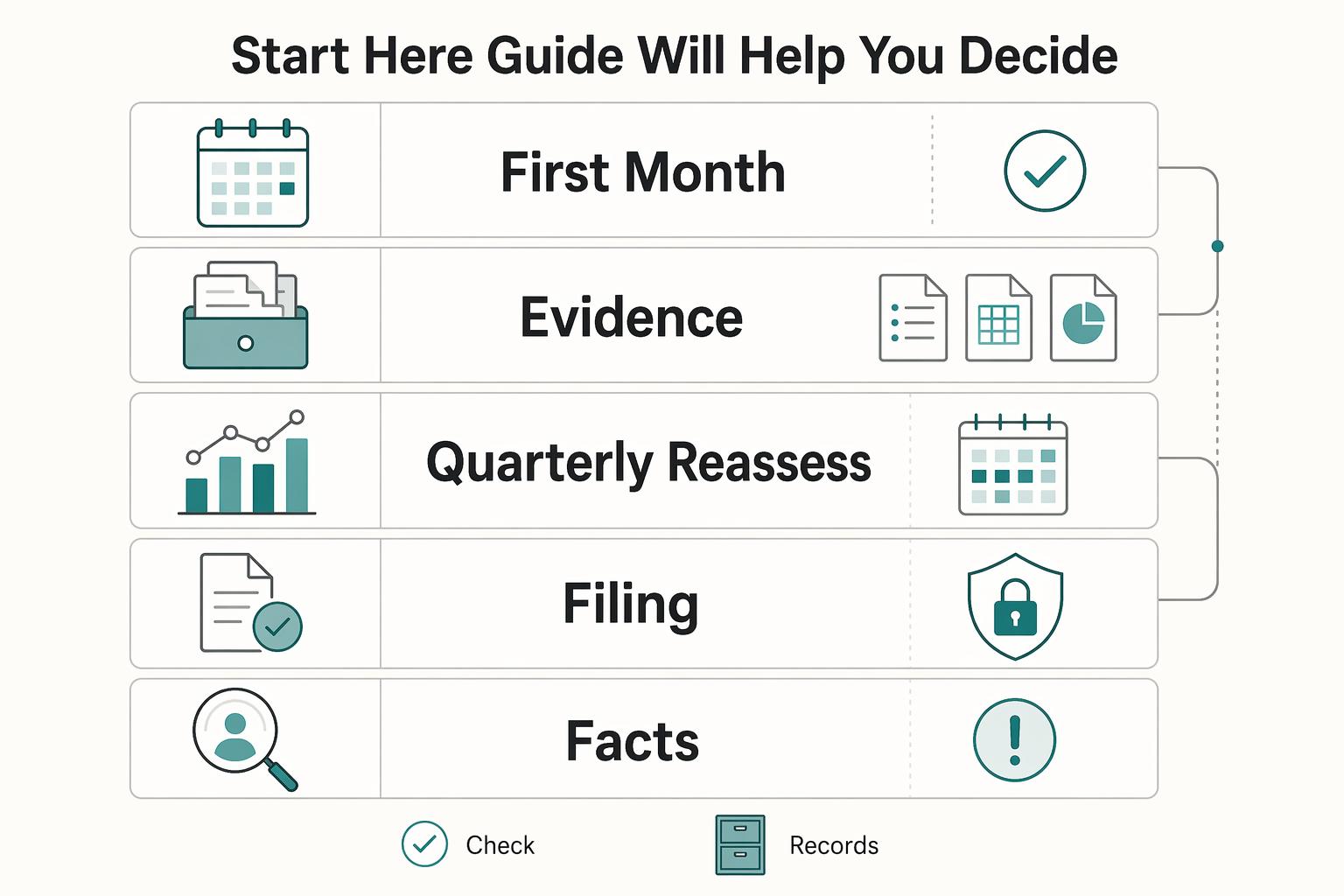
Start Here and What This Guide Will Help You Decide#
Treat this as a decision map for running a single-member LLC as an ongoing business, not a one-time filing checklist.
An LLC is a business structure created under state law, and a single-member LLC has one owner. For federal income tax, a one-member LLC is generally treated as disregarded from its owner unless Form 8832 is filed to elect corporate treatment. The same LLC can still be treated as separate for employment tax and certain excise taxes.
State obligations differ, so confirm requirements in each jurisdiction where you form or do business. Texas shows why that matters. Franchise-tax guidance includes LLCs, including single-member LLCs, as taxable entities, and says entities formed in Texas or doing business there must file and pay franchise tax. Treat that as a Texas rule, not a national rule.
Start with one practical step: create a dated governance folder and keep every filing confirmation, decision note, and correction record in one place. That habit makes later reviews faster and your record easier to explain if questions come up.
Use this cadence:
- First month: set your governance baseline and choose your tax treatment path.
- Monthly: review records and account separation for consistency.
- Quarterly: reassess tax and compliance assumptions if activity changes.
- Annually: complete required filings and confirm records, tax treatment, and operations still align.
- When facts change: check implications with counsel and a CPA before deadlines.
If you want a deeper dive, read Sole Proprietorship vs. LLC: The Definitive Guide for Global Freelancers.
What Corporate Governance Means for a One-Owner LLC#
For a one-owner LLC, governance helps show the company is being treated as its own entity. That usually comes down to consistent behavior and records. You need two lenses because they answer different questions.
| Lens | Core question | Practical implication |
|---|---|---|
| Legal separateness under state law | Is this LLC being treated as distinct from the owner? | Keep clear boundaries, clean records, and consistent business conduct to support separateness under state law. |
| Federal tax classification | How does the IRS expect activity to be reported? | Classification follows member count and elections, so filing choices need to match current facts. |
For federal income tax, an LLC with one member is generally treated as a disregarded entity unless it files Form 8832 to elect another classification. With at least two members, default treatment is partnership unless a corporate election is made. Even when income tax treatment is disregarded, a one-member LLC is still treated as separate for employment tax and certain excise taxes.
A common problem is treating those lenses as interchangeable. You can have tax reporting that is correct while separateness records are weak, or clean records with tax choices that no longer match ownership or elections. Either mismatch can create cleanup and compliance friction.
Risk is fact-specific. Veil-piercing outcomes vary by jurisdiction, and tax classification alone does not resolve liability questions. Legal commentary on one-member LLC creditor cases also notes that some remedies may go beyond traditional charging-order or veil-piercing theories. The practical goal is to avoid contradictions in your own record.
To keep those two lenses aligned, use a repeatable cadence:
- Maintain one dated evidence folder with formation records, tax classification elections, and filing confirmations.
- Review business account activity monthly and correct personal-business mixing quickly.
- Before each filing deadline, confirm member count and election status still match the return form you plan to file.
- If ownership or tax strategy changes, check early whether
Form 8832timing needs CPA review.
A practical way to run this is with a short pre-deadline check note. Write the date, the current member count, the current classification choice, and the return form you will file. Save it with the period records. This turns a mental check into evidence and helps when one change affects classification or separateness before the next deadline.
Build the Legal Foundation Before You Operate#
Complete your formation record and internal documents before you start normal operations. For a one-owner LLC, that is the baseline for clean governance from day one.
| Item | Keep |
|---|---|
| Formation document | Filed formation document (Articles of Organization) |
| Operating Agreement | Current signed Operating Agreement |
| State-specific steps | Proof of any required state-specific post-formation steps |
| Contact details | Current contact details snapshot aligned with the state record |
Start with your formation filing, such as Articles of Organization. Keep the filed copy, then confirm your state record matches the legal details used in your business documents.
Do not assume post-formation steps are identical everywhere. Some states require additional actions before normal operations. Published examples include New York publication for six consecutive weeks in two newspapers followed by a Certificate of Publication. Another example is New Jersey's requirement to file a Business Registration form within 60 days of formation. Use these as reminders to verify your own state's process, not as universal rules.
Keep an Operating Agreement even if your state does not require one at formation. It governs internal structure and gives you a consistent reference point for documenting decisions and owner actions.
Before launch, run one verification checkpoint. Compare your filed state record, your Operating Agreement, and your current contact details line by line. Fix mismatches before routine operations begin.
This is also the right time to standardize naming. Your LLC legal name should appear the same way across your records. Minor naming drift can create avoidable confusion later.
Your evidence folder should include:
- Filed formation document (
Articles of Organization) - Current signed Operating Agreement
- Proof of any required state-specific post-formation steps
- Current contact details snapshot aligned with the state record
If any item is missing, pause launch tasks and close the gap first. You might also find this useful: A Guide to the Best States for Forming an Anonymous LLC.
Separate You from the Business in Daily Operations#
Your daily standard is simple: run the LLC as a distinct entity in how money moves and how records are kept. For a one-owner company, that separation keeps later questions manageable.
An LLC is a statutory entity, and its internal structure is governed by your Operating Agreement. Your day-to-day execution should reflect that setup. Treat the checklist below as practical control discipline, not a universal legal mandate.
- Start operations through dedicated business channels, then keep revenue and expenses on that same business path.
- Keep business spending on separate business accounts and cards.
- Avoid mixing personal and business activity. If a correction is needed, document what happened and how you fixed it.
- Record owner draws and reimbursements with clear memo descriptions.
- Keep names and references consistent across contracts, invoices, payments, and ledger entries.
Make routine activity traceable in your records. Keep signed contracts, invoices, and applicable tax intake files linked to the related client or payee and payment entry.
When a transaction lands in the wrong place, do not leave it unresolved until quarter-end. Correct it promptly, note the reason, and keep the support in the same period folder. A fast correction with dated notes is usually easier to track than a later cleanup with no timeline.
Run a recurring spot check. Confirm each sampled transaction can be traced from agreement to invoice to payment to books. If something does not reconcile, fix it promptly and confirm owner-payment treatment still aligns with your Operating Agreement.
Choose Tax Treatment and IDs with Clear Decision Rules#
Pick one documented tax-and-ID approach for the full filing cycle so your return package and internal records stay consistent.
If you are evaluating a tax-treatment change, confirm timing and filing requirements with your CPA using current IRS instructions before you file. For identifiers, avoid ad hoc choices. Keep a short log of which identifier is used on recurring documents, who approved the approach, and when any change took effect.
Keep a simple record of the chosen approach, the forms it affects, and the effective date. Then use the same approach across invoices, intake paperwork, bookkeeping records, and return preparation unless you intentionally change it and document that change.
| Return form or schedule | Governance record to keep with it | Why this matters |
|---|---|---|
Form 1040, 1040-SR, or 1040-NR (as applicable) | Year-end close packet, owner draw summary, preparer notes | Keeps owner filing tied to business books and documented decisions; confirm current attachment requirements in the latest IRS instructions |
Schedule SE (Form 1040) | Net-earnings workpaper, draft-to-final tie-out, final filed copy | Schedule SE is used to figure tax due on net earnings from self-employment |
| Other attached schedules (if applicable) | Income/expense ledger export and support files used for preparation | Improves traceability from reported amounts to source records |
Before you file, run one hard checkpoint. Reconcile the net earnings amount feeding Schedule SE to finalized books, then confirm you used the latest Schedule SE instructions. Schedule SE information is also used by the Social Security Administration to determine benefits, and this tax applies regardless of age or whether you already receive Social Security or Medicare benefits.
If you work with a preparer, keep the final tie-out in writing. The goal is a clean line from books to return, with no unexplained differences left for next year.
Handle CTA Reporting Without Guesswork#
Treat BOI readiness as a governance task, not a last-minute filing task. Confirm scope first, then file only if your entity is in scope under current definitions.
| Situation | Current guidance |
|---|---|
| U.S.-created entity | current FAQ language points to exemption |
| Foreign-formed and U.S.-registered entity | BOI deadlines apply |
| Foreign-formed and U.S.-registered entity registered before March 26, 2025 | April 25, 2025 |
| Foreign-formed and U.S.-registered entity registered on or after March 26, 2025 | 30 calendar days |
In plain terms, the Corporate Transparency Act is the framework, beneficial ownership information (BOI) is the reporting topic, and FinCEN is the agency named in the filing requirements. Because FinCEN says some FAQ guidance has not yet been fully updated, confirm current FinCEN instructions before acting.
FinCEN's FAQ says it published an interim final rule on March 26, 2025. That rule revised the reporting-company definition to entities formed under foreign law and registered to do business in a U.S. state or tribal jurisdiction. In that same FAQ set, FinCEN says U.S.-created entities and their beneficial owners are now exempt from BOI reporting under the CTA.
Use this split as your decision rule:
- U.S.-created entity: current FAQ language points to exemption.
- Foreign-formed and U.S.-registered entity: BOI deadlines apply.
- Deadline anchor from FinCEN FAQ: April 25, 2025 for companies registered before March 26, 2025, and 30 calendar days for companies registered on or after March 26, 2025.
If intake forms or summaries conflict with this split, recheck the current FinCEN FAQ and instructions before filing.
Keep a short BOI checklist in your governance folder. Include:
- Scope note: domestic-created or foreign-formed and U.S.-registered
- Date note: registration date and applicable deadline rule
- Entity and ownership snapshot: current facts used for scope determination
- Instruction record: dated copy of the exact FinCEN page used
- Outcome record: filing confirmation or written note explaining why no filing was required
FinCEN also says some FAQ guidance has not yet been fully updated, so do not rely on old screenshots or stale summaries. Update the scope note whenever ownership facts, registration facts, or filing posture changes so your BOI position stays current instead of being copied forward from an earlier period.
Protect the Liability Shield by Avoiding Common Red Flags#
Your liability shield depends on day-to-day separateness. LLC protection is not absolute; it depends on operating the company as a real entity distinct from you.
The corporate veil is the legal distinction between owner and company. Courts can disregard it when an LLC is treated as a sham or misused. Standards vary by state, but courts generally look at whether your records and behavior show a genuinely separate business.
Routine slippage can still create risk. Commingling is a major red flag, and weak documentation makes it harder to show owner and company were handled separately. Documentation quality can change how clearly separateness is demonstrated.
| Situation | Company A | Company B | Why risk differs |
|---|---|---|---|
| Client payments | Deposits go to the business account and tie to invoices | Some payments hit a personal account first | Mixing funds weakens separateness evidence |
| Owner transactions | Draws and reimbursements are logged with dates and memos | Cash transfers have no support | Unclear records blur owner vs company activity |
| Governance records | Core records are maintained as decisions happen | Records are recreated after problems appear | Incomplete records make separateness harder to show |
Use this monthly red-flag check:
- Business revenue deposited into a personal account
- Personal expenses paid from a business account
- Owner cash transfers with no supporting records
- Records that are inconsistent or hard to trace to the LLC
When you find a red flag, log the issue, correct it, and keep the correction trail with the same month. That gives you a clear sequence: what happened, when it was fixed, and how you prevented repeat errors.
Run one quarterly spot check. Pick a few transactions and confirm the agreement, invoice, payment, and ledger all point to the same entity identity. The goal is consistent separation over time, not one isolated cleanup.
Complete Your First 30 Days in the Right Order#
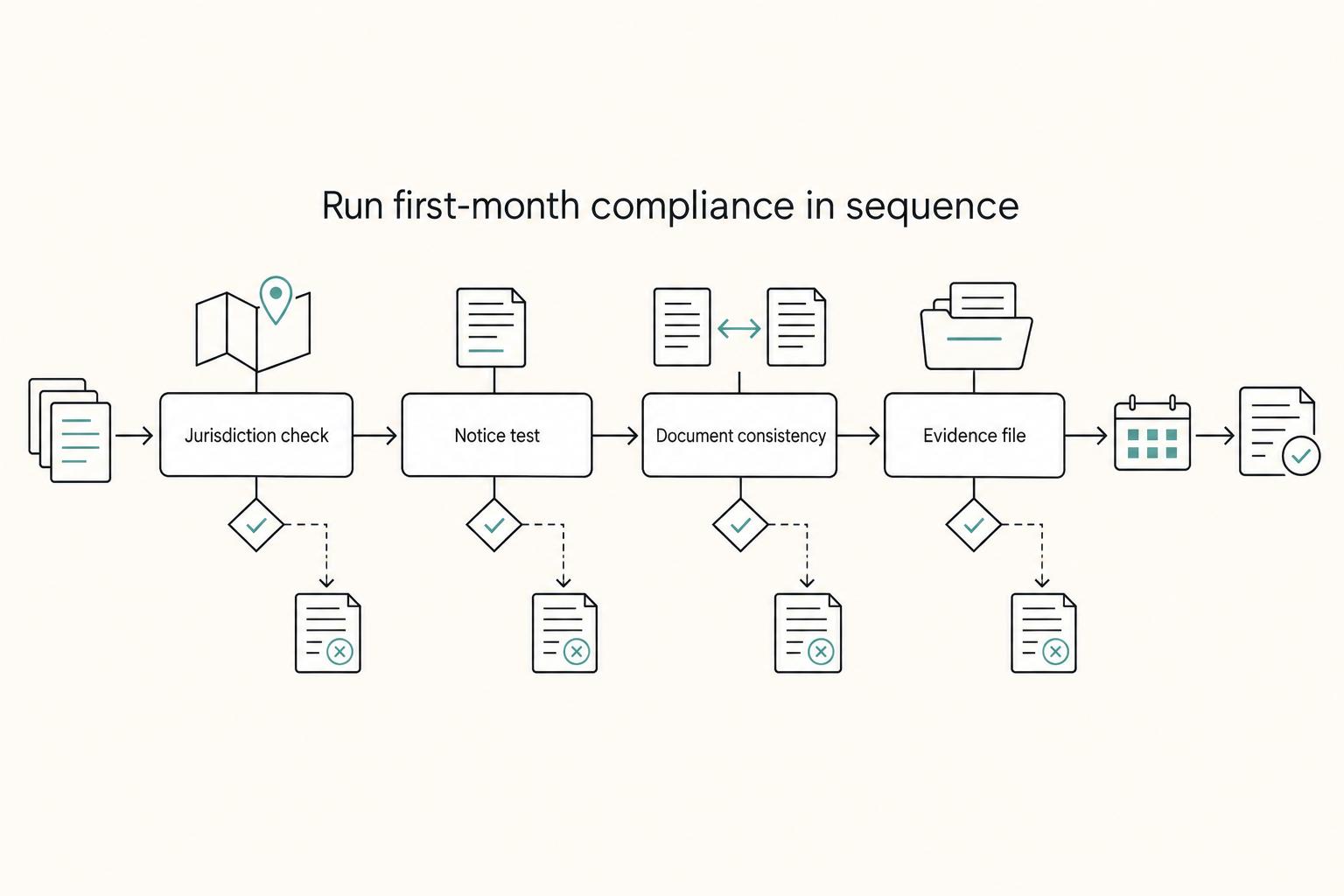
In the first 30 days, build records in sequence: legal identity first, then tax and contract identity, then money separation, then compliance tracking. The goal is clear, dated support from day one.
| Week | Focus | Tasks |
|---|---|---|
| Week 1 | lock legal identity records | Confirm your formation filing status, verify registered agent details where applicable, and finalize your operating documents with signatures and date. |
| Week 2 | standardize tax and contract identity | Set up tax identity details where needed, and make sure invoices and contract signature blocks consistently use the LLC legal name and signer capacity. |
| Week 3 | separate money and document owner pay | Use dedicated business financial channels, document how owner pay is recorded, and lock a folder structure for agreements, invoices, payment proof, and bookkeeping exports. |
| Week 4 | build a compliance calendar with BOI checks | Add state report and tax deadlines, plus BOI review points. |
Treat this as a practical baseline, not a claim that every step is legally required in every state. Public startup checklists are informational and can age quickly, so keep dated notes of what you verified in your state records and current FinCEN guidance.
- Week 1: lock legal identity records. Confirm your formation filing status, verify registered agent details where applicable, and finalize your operating documents with signatures and date. Save these together in one folder.
- Week 2: standardize tax and contract identity. Set up tax identity details where needed, and make sure invoices and contract signature blocks consistently use the LLC legal name and signer capacity.
- Week 3: separate money and document owner pay. Use dedicated business financial channels, document how owner pay is recorded, and lock a folder structure for agreements, invoices, payment proof, and bookkeeping exports.
- Week 4: build a compliance calendar with BOI checks. Add state report and tax deadlines, plus BOI review points. Keep a dated CTA note. FinCEN says its March 26, 2025 interim final rule revised reporting-company scope; current FAQ language says U.S.-created entities are exempt, while covered foreign reporting companies follow either the April 25, 2025 deadline or a 30-calendar-day filing window based on registration timing and effectiveness notice. FinCEN also says some FAQ guidance is not yet fully updated, so recheck before filing changes or corrections.
At the end of each week, run a five-minute file check. Confirm every completed task has dated proof in the folder. This helps avoid month-one gaps where tasks are done but evidence is missing.
By day 30, you should have an evidence packet, not just completed tasks: formation records, identity templates, first-month transaction trail, and a dated compliance calendar. Related: Hiring Your First Subcontractor: Legal and Financial Steps.
Run a Monthly Quarterly Annual Governance Cadence#
Use a repeating monthly, quarterly, and annual review schedule, then close each cycle with a signed owner memo.
What Each Review Cycle Should Cover#
- Monthly: Reconcile account activity, review new contracts, check for personal-business commingling, and archive key records in a dated batch.
- Quarterly: Recheck tax posture against current operations. For federal income tax, a one-owner LLC is generally treated as a disregarded entity unless you elect corporate treatment on
Form 8832. If it remains disregarded and individually owned, make sure records are ready to map toForm 1040orForm 1040-SRschedules (C,E, orF), and confirm the owner SSN or EIN details are consistent for federal income tax reporting. - Annual: Reconfirm that current operations still match your federal tax treatment, refresh the Operating Agreement when facts changed, and audit the governance folder for complete, dated records.
Disregarded applies to federal income tax treatment, not everything. A single-member LLC can still be treated as a separate entity for employment tax and certain excise taxes, so use quarterly and annual reviews to catch issues early.
If a cycle review finds a mismatch, fix it in that same cycle and document the correction. Waiting until year-end increases rework and makes the timeline harder to reconstruct.
Close Each Period With a Signed Memo#
At the end of each monthly, quarterly, and annual cycle, create a one-page owner memo: what you reviewed, what changed, what you corrected, and what needs follow-up. Sign and date it, then store it with that period's records. If a period has major changes but no memo, treat that as a gap and backfill while details are still fresh.
Keep the memo format consistent so older periods are faster to review and missing information is easier to spot.
Upgrade Your Governance When the Business Grows#
When complexity increases, upgrade governance in that same quarter instead of waiting for year-end.
The trigger is not company size alone. It is operational complexity that can create preventable errors if your record-keeping stays at a simpler level.
Trigger Points for Upgrading Controls#
Move up control depth when any of these appears:
- First subcontractor, where payout approval can no longer rely on memory
- Larger client concentration that starts shaping cash timing
- Cross-border receipts or access to foreign financial accounts
- More counterparties or payout paths that make reconciliation harder
When one trigger appears, update your review checklist immediately and carry that update into the next monthly cycle. This keeps the response practical and timely instead of theoretical.
Add Cross-Border Tax Visibility Early#
When cross-border activity starts, add a dedicated review track for potential FBAR (FinCEN Form 114) and Form 8938 checks.
Form 8938 is used to report specified foreign financial assets when total value exceeds the applicable threshold. These assets can include foreign financial institution accounts and certain non-U.S. investment assets, and thresholds are not one-size-fits-all. IRS guidance references $50,000 for certain filers, with higher thresholds in other filing situations. For certain specified domestic entities, instructions reference $50,000 at year-end or $75,000 at any time during the year. Treat these as filing checkpoints, not blanket rules.
Form 8938 is attached to the tax return. If no income tax return is required for the year, Form 8938 is not required. Filing Form 8938 also does not remove a separate FBAR obligation when FBAR is otherwise required.
Put the threshold decision in writing each period. Even when the result is no filing, the dated note shows how you reached that call.
Deepen Control Evidence as Volume Scales#
As payment volume or counterparty count grows, raise evidence quality: keep approval logs for non-routine payouts, track exceptions, and maintain reconciliation support with dated reasons for adjustments. Keep records audit-ready by linking transactions to contracts, invoices, and counterparties, then storing period-close exports by cycle.
Close each upgraded cycle with a signed owner memo stating what changed, what checks were run, and what follow-up remains. For cross-border activity, include a threshold snapshot so the filing decision for that period is clear and traceable.
Put Governance on a Calendar and Keep It Boring#
Governance works best when it is repeatable. One practical objective is to show, over time, that your LLC is operated as a separate business, not a personal extension.
Set an initial baseline, then run a fixed monthly, quarterly, and annual cadence without skipping cycles. Keep it simple enough to execute during busy weeks.
Run the Same Close Cycle Every Time#
Use one cadence and avoid reinventing it:
- Monthly: reconcile accounts, archive key records, and confirm personal and business activity are not mixed.
- Quarterly: review tax posture and identifier usage across records, then confirm compliance assumptions still match current facts.
- Annual: update your Operating Agreement if facts changed, confirm core company records are current, and complete a full governance-folder review.
End each cycle with a signed owner memo that states what changed, what was reviewed, and what is still open. If you want this to stay manageable, schedule review dates in advance and keep the same memo template each time. Consistency is what makes governance easy to maintain and easy to prove.
Keep CTA and BOI Checks Current, Not Copied Forward#
For BOI, check current FinCEN scope each cycle instead of copying old notes. FinCEN states that U.S.-created entities and their beneficial owners are now exempt from BOI reporting requirements, and that U.S. persons are exempt from providing BOI. FinCEN also states the revised reporting-company definition is limited to entities formed under foreign law and registered to do business in U.S. jurisdictions.
If that foreign-registration fact pattern applies, use the listed timing rules. Entities registered before March 26, 2025 had an April 25, 2025 deadline. Entities registered on or after March 26, 2025 have 30 calendar days to file an initial BOI report. FinCEN also warns that older guidance can conflict and should be disregarded where it does, so confirm you are using the current rule set during each review.
If ownership, cross-border activity, or filing posture changes, run an out-of-cycle review promptly and document the decision. As the business grows, reassess ownership-structure choices with a qualified professional before major changes, then fold that guidance back into your calendar.
Frequently Asked Questions
Do single-member LLCs really need corporate governance if there is only one owner?
Even with one owner, governance helps show the business is operated deliberately and consistently. Keep decisions and records organized so company operations are clear over time. The practical test is whether an outside reviewer can follow what you did without guessing.
Which governance documents are legally required, and which are strongly recommended?
Required items depend on your filing context. Recommended items are the records that make decisions and controls easy to verify later. Treat required as whatever applicable official guidance says is mandatory, keep those current first, then maintain internal decision records for day-to-day governance. If you are unsure, resolve the required set first and treat the rest as supporting evidence.
How do I reduce the chance of veil piercing in day-to-day operations?
Use consistent operating habits and keep clean records of what you decided and when. Focus on ongoing discipline, not one-time cleanup. No single action guarantees protection, so the goal is a reliable pattern of documented business conduct. Commingling and unclear signature capacity can create avoidable risk.
Is my LLC separate from me for tax purposes if it is a disregarded entity?
For federal tax classification, a disregarded entity is not treated as separate from its owner. The IRS says a one-member LLC is classified that way by default unless it files Form 8832 to elect otherwise. For an individual owner, activity is generally reported on the owner's return schedules, and trade or business net earnings are generally subject to self-employment tax.
Should I use my SSN or my LLC EIN on tax and vendor forms?
Do not assume one identifier is correct for every form. In a disregarded setup, activity generally flows to the owner's return, but each form's instructions still control what to enter. Use one consistent approach across filings and vendor paperwork after confirming instructions for your case. If your approach changes, record the change date and where it applies.
Do I need an EIN before filing a BOI report under the CTA?
There is no blanket rule that every single-member LLC must have an EIN before any BOI-related step. FinCEN says U.S.-created entities are now exempt from BOI reporting requirements, and the revised reporting-company scope is focused on certain foreign-formed entities registered in U.S. jurisdictions. FinCEN also notes some FAQ guidance is not fully updated, so confirm current instructions before acting. An EIN field by itself is not proof that your entity is in scope.
How often should I review and update my governance records?
Review on a fixed cadence and again whenever the business changes in a meaningful way. Keep each review traceable so updates are easy to verify later. If you make a tax-classification election change, note that the IRS generally limits another classification change for 60 months after the election's effective date. The key is consistency: recurring review plus immediate out-of-cycle updates when facts change.
Try a related tool
Researched and edited by the Gruv editorial team. Gruv builds cross-border billing, payouts, and finance-operations software for global businesses.
Sources
Educational content only. Not legal, tax, or financial advice.
Related Posts

Sole Proprietorship vs LLC for Global Freelancers in 2026
For most freelancers in 2026, the practical default is still simple: use the simplest structure you can run cleanly, then formalize when risk actually rises. If your work is still in validation mode and the downside is contained, a sole proprietorship is often the practical starting point. When contract exposure, delivery stakes, or dispute risk starts climbing, forming an LLC deserves earlier attention.

Hiring a Subcontractor for the First Time Without Costly Surprises
**Start with a risk-control sequence, not an ad hoc handoff.** As the Contractor, your goal is simple: deliver cleanly, control scope, and release payment only when the work and file are complete.
Best States for Anonymous LLCs for Solo Professionals
Start with compliance durability, then use privacy as a tie-breaker. If you are looking for the **best states for anonymous llc**, ask a simpler question first: which setup can you keep clean, current, and defensible while you run the business?