
Quick Answer
Identify human and generated elements, verify source and tool permissions, and grant only rights you control. A license or signed assignment cannot create copyright in unprotected output. Define use, acceptance, payment and grant timing at file level; ordinary commissioned photos are not automatically work made for hire.
Start with a contract-first view of AI photo work#
Before producing AI-involved photo work, agree what files the client receives, which rights you control and what use is permitted. Keep copyrightability, source permissions, likeness/privacy concerns and commercial payment terms separate. A signed contract can allocate duties between you and the client; it cannot create copyright in unprotected material or clear somebody else’s rights.
A common failure mode starts before anyone shoots or edits: rights, responsibilities, and AI use get left implied. If the client assumes full ownership and you assume a narrower license, the dispute is already built into the engagement.
Describe AI involvement accurately without treating the label as a legal verdict. A client may receive a human-shot photograph, generated elements and a human-composed final image in one package. Identify those contributions before promising ownership, exclusivity or an unrestricted right to upload the source files into another model.
This guide uses U.S. copyright rules. The Copyright Office’s AI initiative separates digital replicas, output copyrightability and generative-AI training. Its current page lists Parts 1 and 2 as published and Part 3 as a May 9, 2025 pre-publication report. Those reports address different questions; training litigation is not a reason to treat every photographer’s authorship as unknown.
Use U.S. guidance as a working baseline, not a universal answer. Treat cross-border assumptions as risks you need to verify in the contract.
By the end, you should have:
- decision rules for classifying the image and rights model
- clause priorities for ownership and risk allocation
- a pre-delivery checklist you can run before final delivery
Keep the rights schedule with the scope and approved-file record, so the client can see what was purchased and what still requires permission.
Define the three image buckets before you quote the job#
Define the image bucket before you price the work or promise rights. Ownership disputes often start with a simple mismatch about what was actually delivered.
Use three working buckets in your SOW:
- AI-generated works: prompt-led outputs generated by a model
- AI-assisted edits: human-shot photos edited with AI features
- Human-created edits: human-led edits where software is a tool, not the creative driver
These are workflow labels, not statutory categories or a percentage test. The relevant question is what human-authored expression remains in the delivered asset and what rights you own or have permission to use.
Under the Office’s Part 2 analysis, assistive AI use does not disqualify human-authored work. Prompts alone generally do not supply authorship of the output; human expression retained in it, or sufficiently creative modifications or arrangement, can support protection in those contributions. The generated parts do not become protected simply because they sit inside a protected photograph or composite.
A simple quoting rule helps:
- If the final asset is mostly prompt-generated, do not default to promising exclusive ownership or clean title.
- If the final asset is source photography with assistive AI edits, document the creation chain clearly.
Keep original captures, layers or edit history, prompts where relevant and the people responsible for creative choices. Also check source licenses and the tool terms that applied when you uploaded or generated material. Owning a photo does not automatically authorize using another person’s supplied photo, confidential client asset or likeness in the same way.
Put the bucket label in both places every time:
- SOW: "Deliverable classification: AI-generated / AI-assisted / human-created edit"
- Invoice notes: repeat the same label so the commercial record matches the contract
Use the same asset IDs and rights schedule across the estimate, SOW, invoice and delivery note. If a generated element replaces a previously promised original photograph, record the change and obtain approval rather than leaving the original rights description unchanged.
For a dispute example involving ownership and termination, see The Friday the 13th Copyright Case.
What the U.S. baseline says and what it does not#
Use the Office’s current report page for status and its registration guidance for applications. Output copyrightability concerns human authorship; permission to use inputs and possible infringement are separate questions. A file can contain protectable human work and still require a source license or a model release for its intended use.
The Office’s initiative began in 2023 and received over 10,000 public comments. That policy record helps explain the distinctions, but it is not a clearance decision for a particular client image. Assess the actual file and permitted use rather than using the existence of a report as proof of ownership.
What is known right now#
| Report part | Status | What it covers | Contract relevance |
|---|---|---|---|
| Part 1: Digital Replicas | Published July 31, 2024 | Digital technology used to realistically replicate a person's voice or appearance | Helps you spot likeness-related risk, which is separate from output copyrightability |
| Part 2: Copyrightability | Published January 29, 2025 | Copyrightability of works created using generative AI | Most relevant when you are deciding how far ownership, exclusivity, or assignment language can go |
What is still unresolved#
As checked on October 5, 2026, the Office’s page still labels Part 3 as pre-publication and says a final version will follow. It concerns generative-AI training. Keep its report status distinct from the already published Part 2 copyrightability analysis.
Keep these questions separate when advising a client:
- Is the output copyrightable?
- Does the image raise digital-replica concerns?
- Is there separate risk tied to model training?
Blurring those into one answer is how freelancers overpromise "full ownership" when only part of the risk picture is covered.
What freelancers should do with this baseline#
Apply the U.S. baseline to the relevant human contributions and grants, then check the laws of intended publication markets. Contract wording is evidence of the parties’ deal; it does not decide a nonparty’s copyright, likeness or privacy claim.
For cross-border use, identify the publication markets, client and photographer entities, any models or subjects, and the enforcement route. Choosing U.S. governing law for the contract does not make U.S. copyrightability or publicity rules control every foreign use.
Related: AI and Copyright: Legal Implications of Using AI Content in Client Work.
Decide ownership terms before production starts#
Decide ownership before production starts, not at delivery. In AI-touched photo work, unclear ownership terms create avoidable risk, especially when a client expects full title but authorship and registrability may later be questioned.
Pick one ownership path in the contract#
Choose a license or a signed assignment of rights you actually own. Work made for hire is a separate statutory status: employee work within the scope of employment can qualify, while commissioned freelance work requires a qualifying statutory category and an express written agreement signed by the parties. Ordinary standalone commissioned photos do not qualify simply because the client pays or the contract uses that phrase. If a qualifying work-for-hire arrangement is intended, settle it before production; it is not a later transfer triggered by final payment.
| Client need | Includes | Rights path |
|---|---|---|
| Full downstream control | Reuse, edits, resale, sublicensing, and transfer | Price for assignment if title will transfer |
| Broad commercial use | Defined channels or campaigns | Retain ownership and grant scoped usage rights |
| Internal or limited marketing use | Without exclusivity | Retain ownership and grant scoped usage rights |
In the U.S., copyright in protected work generally begins with its author, subject to work-for-hire and other applicable rules. An assignment or exclusive license needs the required signed writing; delivery of a file and payment alone do not establish it. Specify the actual files, human contributions and rights included, plus retained background work and third-party restrictions.
If the client cannot explain why they need outright ownership, do not default to it.
Price control differently from permission#
Use a simple rule: if the client needs full downstream control and you plan to transfer title, price for assignment. If not, retain ownership and grant scoped usage rights.
For generated material without protectable human authorship, there may be no copyright to license or assign. Offer the agreed deliverable and contractual use permissions only to the extent you have authority. A promise that you will not reuse a file binds you under the contract; it does not give the client copyright exclusivity against unrelated people. Check third-party rights separately.
Make transfer conditional, not assumed#
For a license or assignment, state when the grant takes effect and what limited review use is allowed beforehand. Illustrative payment terms: a $2,000 project includes a $500 advance and a $1,500 final balance after the agreed acceptance event. The advance is credited, not charged again. Identify the files and human-authored rights covered by any signed assignment effective on full payment; do not include rights you lack or promise that this timing changes work-for-hire status.
Define acceptance separately: named reviewer, exact versions, a review period and permitted defect grounds. State what happens if feedback is late rather than assuming silence equals acceptance. Keep the invoice, advance credit, payment confirmation and file list with the signed grant. A review copy should carry the agreed evaluation permission, not an implied promise of unrestricted publication.
Define only the rights you can grant#
Where title is uncertain, state which human-authored rights are licensed and which generated or third-party elements are excluded or governed by their own terms. If you cannot obtain necessary permission for an element, replace it or exclude the requested use. A narrower license cannot cure infringement or give you authority over someone else’s material.
For example, your human-shot portrait may remain protected while its generated background is not independently protected. License the rights you control in the photograph and any qualifying human composition, disclose the background’s treatment and confirm the permitted use of the subject’s likeness. Do not promise exclusive copyright in every pixel or imply that a model’s commercial-use terms settle all third-party claims.
Compare the ownership structures in Work for Hire vs. Assignment of Rights.
Set licensing boundaries clients can approve without legal ping-pong#
Once ownership is set, scope is usually the next failure point. In AI photo work, disputes often turn on what the client was actually allowed to do.
A practical way to scope permission is to map it to the Section 106 rights bundle, especially reproduction and derivative works. If your contract does not clearly say who can copy, edit, adapt, or pass files downstream, key risk points stay open.
Use the rights bundle as your checklist#
Define licensing boundaries in plain English by answering three questions:
- Where can the asset appear?
- Who can edit or adapt it?
- Can the client sublicense or transfer use downstream?
Approval delays often start here. A request for "social use" can expand into paid media, regional edits, or partner distribution unless those actions are named up front.
Copyright scope is only one part of clearance. Check identifiable subjects, releases and intended advertising uses, plus trademarks or an implication of endorsement. Permission from the copyright owner of a photo does not necessarily authorize using the depicted person as a simulated spokesperson. A client approval also does not supply a missing third-party permission.
Offer a clear approval menu#
License tiers are commercial options, not legal defaults. A compact table gives clients something concrete to approve without repeated legal rewrites.
| Use case | Where it may appear | Duration | Territory | Exclusivity |
|---|---|---|---|---|
| Internal use | Internal decks, intranet, training, investor or sales materials not distributed publicly | Defined term or ongoing internal use if intended | Named client entity or offices | Set nonexclusive unless expressly upgraded |
| Paid media | Sponsored social, display, search, pre-roll, or other paid placements listed in the order | Campaign dates or stated term | Named markets | If exclusive, limit by channel, asset, and term |
| Merchandising | Physical goods, packaging, point of sale, or product-related promo items | Product run, launch window, or sell-through period | Named sales regions | Make exclusivity explicit and intentionally priced |
| Resale rights | Redistribution, relicensing, white-label use, stock-style resale, or transfer to third parties | Set a separate term | Territory must be named | Exclusive or transferable rights should be stated expressly |
The labels matter less than the boundaries under them. "Paid media" should not silently include packaging, and "internal use" should not silently allow affiliate distribution.
Before signature, verify the table against the real plan: media channels, named affiliates, retailer list, and whether outside teams will crop, localize, animate, or otherwise adapt assets.
Write approval language around risky publication#
Agree which changes need another approval. You may require review for a new brand campaign, third-party edits, material alterations or a simulated likeness. Use that process for uses outside the original permission or specified high-risk changes; do not invent a second mandatory approval for every use already licensed.
Set clear triggers for additional approval, such as:
- paid brand-campaign deployment
- edits by third parties
- materially altered derivatives
- uses involving named stylistic references or simulated likeness concerns
That last trigger matters in AI contexts where realistic replicas of voice or appearance can create endorsement-style confusion. Keep records for this stage: approved asset list, approved-use summary, approver name and date, and edit permissions.
Put a hard stop on silent scope creep#
Treat "all media, worldwide, perpetual" as a negotiated business choice, not default boilerplate. Those terms are not automatically invalid, but they expand duration, territory, and reuse all at once.
Use a simple rule: no bundled expansion language unless it is separately negotiated, priced, and tied to the actual use case. If broad scope is truly needed, isolate it as its own line item and state whether it includes edits, affiliates, agencies, and sublicensing. If not, strike it and keep the narrower grant.
Keep the approved-use schedule attached to the delivered-file list so an agency or affiliate can check its permission without reconstructing an email thread.
Handle style mimicry requests without inheriting avoidable claims#
Clarify a named-style request before accepting it. Broad visual ideas or style are not themselves copyright ownership, but a resulting image can reproduce protected expression, a recognizable character, a logo or a person’s likeness. Review the actual references and output, not just whether a brand or artist appears in the prompt.
Section 102 separates unprotected ideas from protected expression, while Section 106 includes rights in reproduction and adaptation of protected work. Fair use under Section 107 is fact-specific. Replacing a named reference with neutral words does not make a closely copied output lawful or give permission to upload an unlicensed reference image.
Use named-style wording as an escalation trigger#
A brief naming a particular artist, studio, character or existing image merits clarification of what the client wants and whether the references are licensed. Names of generation tools such as DALL-E or Midjourney do not, on their own, identify a protected artistic style or establish infringement.
This is not the same as saying those prompts are automatically infringing. It means you should clarify the actual visual goal and restate it in neutral, observable terms.
Replace imitation language with art-direction language#
Use a simple rule: translate "style of X" into concrete visual attributes, then keep a basic record of your independent choices: prompt revisions, reference board, composition, lighting, texture, crop, and post decisions.
| Named-style wording | Art-direction wording |
|---|---|
| Studio Ghibli | Hand-painted animation feel |
| Midjourney look | Dreamlike color transitions and soft edges |
| DreamStudio style | Highly detailed fantasy environment with cinematic depth |
Run one approval checkpoint before release#
Compare the proposed output with the supplied references for copied composition, distinctive characters, protected details, logos and identifiable people. If the concern remains, change or replace the asset, obtain necessary permission or decline that part of the brief. A documented art direction is useful evidence, not a clearance certificate.
Revision rounds can drift toward closer imitation. Requests like "push it closer" or "make it more like that movie" are your signal to pause and rewrite the direction.
Set a clear refusal line#
Set your own service boundary. If a client insists on a closely copied image or unlicensed source and you cannot clear the intended use, decline that deliverable and follow any existing contract’s change or termination process. A policy against named-style imitation can also be a commercial choice; it is not proof that every style reference is illegal.
A practical response is: “I can deliver the palette, lighting and mood you need, using references we have permission to use. I cannot promise clearance for a close copy of this image. Let’s agree a different composition or obtain the required permission.”
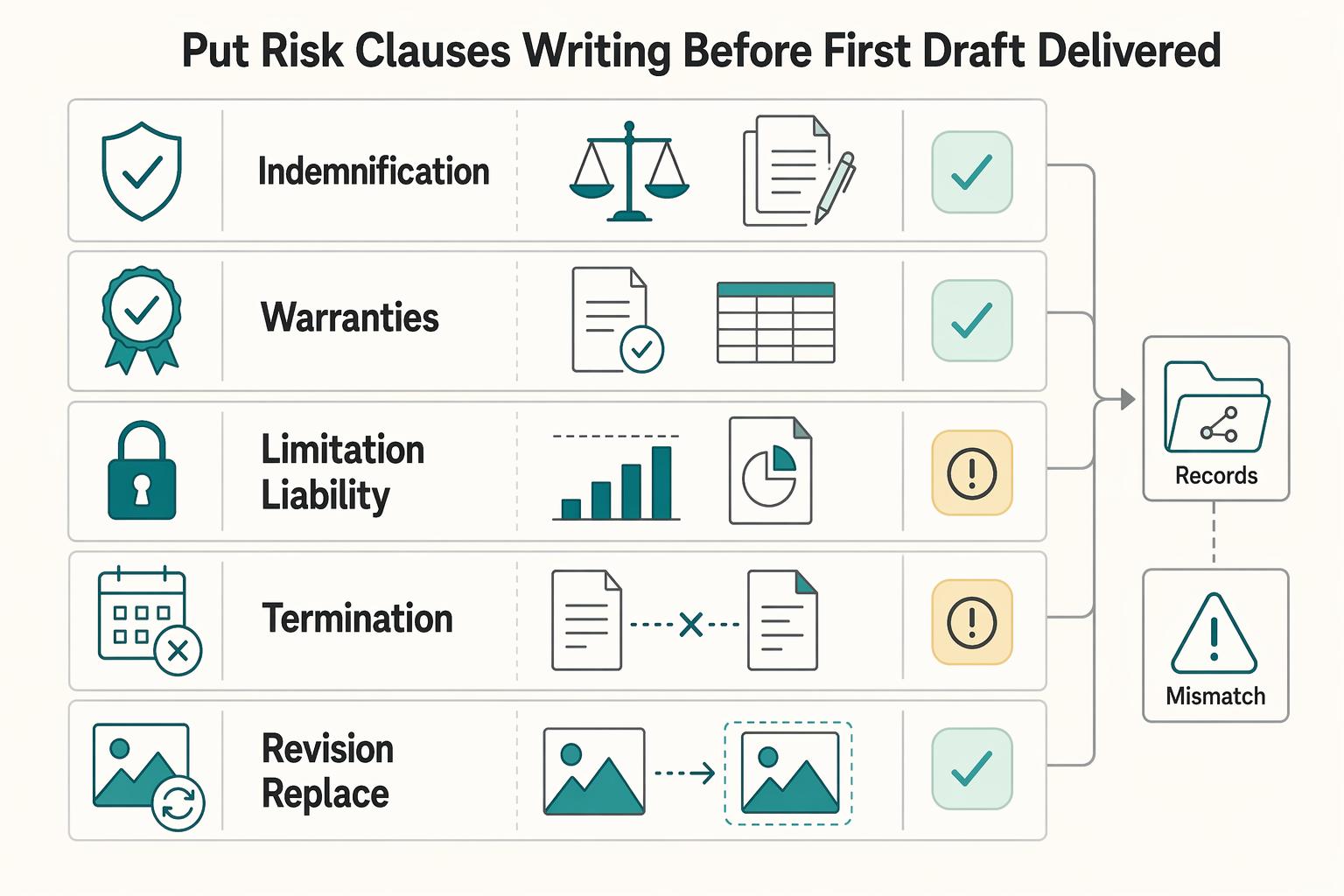
Put the risk clauses in writing before the first draft is delivered#
Put the risk split in writing before you deliver anything. U.S. AI copyright guidance is still developing, so your contract should allocate risk based on what you control, not on assumptions that the law is fully settled.
Check the risk clauses against the source-material schedule, tool disclosures and client responsibilities. If the client supplies a restricted reference or changes the approved file before publication, address those actions expressly. Separate contractual allocation from claims a copyright owner or depicted person may bring.
| Clause | What it should do | What to resist |
|---|---|---|
| Indemnification | Cover breaches you control, such as your own breach, unauthorized materials you supplied, or failure to follow agreed process terms | Broad promises to cover all claims tied to deliverables, including third-party model behavior or unknown training data |
| Warranties | Limit promises to facts you can verify, like authority to contract and ownership or licensing of disclosed source materials | Blanket promises that output is always noninfringing, copyrightable, or registrable |
| Limitation of Liability | Negotiate a defined aggregate cap and applicable exceptions, including how indemnities interact with it. | Uncapped exposure or exceptions that effectively remove the cap |
| Termination | Define triggers, notice, cure (if any), and treatment of drafts, approved assets, and unpaid fees | Silence on post-termination use, takedown, or payment obligations |
| Revision or replace remedies | Provide an agreed response process for a challenged asset, with prompt notice and revision, replacement, withdrawal or refund where appropriate. | Terms that jump straight to broad damages without a cure step |
| Approval language | Record exact files and uses, then allocate responsibility for client-controlled publication and alterations expressly. | Vague approvals with no file IDs, channels, or use record |
Narrow indemnification to what you control#
Negotiate indemnities for defined conduct and claims, including unauthorized source material or breach of agreed warranties. Identify client-supplied inputs and downstream alterations separately. Include notice, cooperation, defense control and settlement consent; a limitation to your own breaches is a proposed allocation, not a universal legal entitlement.
Treat broad language like "any claim arising from the deliverables" as a red flag. With AI-assisted work, that can shift risk to you for unsettled issues around model training and fair use. Read indemnity together with the SOW, tool disclosures, and client input terms so client-supplied prompts, references, and downstream edits are carved out where appropriate.
Keep warranties modest and liability capped#
Offer factual warranties about authority and the sources or permissions you can verify. Avoid promising universal registration, noninfringement or exclusive copyright for generated material. Disclosure of a tool does not automatically remove your responsibility for using unlicensed inputs or breaching the agreed process.
Define the fee base, aggregate cap, excluded losses and any carve-outs. For an illustrative cap equal to the $2,000 project fee paid or payable, $500 paid so far does not reduce that base to $500. Check whether indemnities sit inside the cap and whether mandatory law limits the proposed restriction. An agreed cap allocates risk between the parties; it does not cap a nonparty’s claim against either of them.
Define termination and what survives it#
Termination terms should answer use-rights questions before a dispute starts. Set triggers, notice, and cure, then state what each side keeps, what must stop, what must be removed, and what fees remain due.
State what happens to draft evaluation access, rights already granted, client source files and amounts earned or still refundable. Distinguish cancellation before the final grant from termination after a license or assignment has taken effect. Do not assume termination automatically revokes a paid license or reverses an assignment; define permitted outcomes and preserve any continuing confidentiality or legal-retention duties.
Record approval and allocate publication responsibilities#
Approval should confirm exact files and intended use, not just "approved." Require written sign-off tied to version IDs, variants, channels, and any use limits you flagged.
Allocate client-controlled publication, unapproved alterations and expanded uses in the contract, while retaining your agreed responsibilities. Sign-off is evidence of what the client accepted; it does not automatically transfer every legal risk, bind outsiders or excuse your own breach.
Set the advance and balance alongside your rights schedule using The Best Ways to Ask for a Deposit or Upfront Payment.
Choose Governing Law and venue terms for cross-border clients#
For cross-border work, set Governing Law, Jurisdiction, and Dispute Resolution explicitly. Pick one law, one forum you can realistically use, and one escalation path you can afford if the deal breaks down.
Separate the law governing the agreement from laws affecting copyright, privacy, likeness or advertising in the countries of use. Check whether the selected dispute route is practical where the parties and relevant assets are located. A report on U.S. AI policy does not decide those cross-border questions.
State the governing law on purpose#
If you leave governing law unstated, you can create an early conflict over which rules apply. A short, explicit Governing Law clause can be safer than silence.
Use a practical test: choose a law both sides can predict and use, not just one that looks strongest on paper. If a client asks for its home law, weigh that concession against deal value and enforcement reality.
Pair jurisdiction with actual usability#
A forum only helps if you can actually use it. If attendance, local counsel, language, notice, or enforcement burdens are unrealistic, the clause may be hard to use in practice.
Name the actual client entity, address and notice recipient. A chosen forum need not be in the client’s home country, but both sides should understand its cost, jurisdiction and likely enforcement route.
Set the dispute sequence before there is a dispute#
Define an order of operations up front instead of relying on a vague promise to "work it out":
- Written dispute notice identifying the files, approvals, invoices, and alleged breach.
- A short negotiation window between named business contacts.
- Mediation if agreed, then the chosen court process or arbitration for the defined disputes.
- If arbitration is chosen, identify courts only for the agreed enforcement or interim-relief role; do not create a contradictory second merits route.
For arbitration, define seat, rules, language, appointment process and notices as appropriate. Distinguish the legal seat from where a hearing happens. For court litigation, name the actual court jurisdiction or agreed venue clearly enough to use.
Match the clause to the deal size#
For smaller deals, optimize for speed and cost with a short, usable dispute path. For larger deals, tighten evidence and escalation requirements so the record is clear.
In practice, one major protection is documentation quality: clear entity names, clear use scope, and clear approval records tied to exact assets.
Keep an evidence file for every AI-involved project#
If AI touched the work at any point, keep one evidence file from kickoff to delivery. Your position is stronger when you can clearly show human authorship, source permissions, client approvals, and the rights granted.
| Record | What to keep | Why it matters |
|---|---|---|
| Prompt history | Prompt text, date, tool, and selected output for each generative step | Helps show what came from a tool |
| Edit history | Meaningful human changes | Helps show human authorship |
| Source image provenance | Underlying photos or other assets, who supplied them, and what permission covered use | Makes the permission trail easy to verify |
| Client approvals | Approvals tied to exact files | Makes approvals traceable to publication decisions |
| Final license terms | What usage rights were granted | Shows the rights model and delivered usage scope |
For a mixed-work registration, describe the human-authored contribution and exclude more-than-minimal generated content in the applicable claim limitation. Do not list the AI system as an author. Keep the application consistent with the delivered work; prompt history documents the process but does not by itself establish authorship of generated expression.
For each source image or reference, record who owns it, who supplied it and the permission covering editing, model upload and intended publication. Check the tool’s applicable terms for input retention, training use, output rights and confidentiality. Obtain the client’s approval for permitted uploads, and substitute another tool or asset if its terms conflict with the project.
Keep rights paperwork with the creative record. Store ownership terms in the same project record as production evidence, not in a separate legal folder no one checks. Keep the signed version of the structure that applies: work for hire, assignment of rights, or a license with specific usage rights. That way, if a dispute starts, one folder shows the rights model, the approved asset, and the delivered usage scope together.
Make approvals traceable to publication decisions. Approval language should identify the exact file and the approved use. If the record does not tie approval to the published asset and use, your position can weaken.
Missing approval records can create avoidable disputes because they make it harder to show who authorized what, when, and for which use.
For a separate publishing example, How to Claim Copyright for a Self-Published Book explains the registration workflow; assess a photographic mixed work on its own facts.
Run a pre-delivery legal check before sending finals#
Before you send finals, confirm that the legal label, rights terms, and delivery scope all match what you are actually handing over.
Review the human and generated contributions in the actual final file. If an assistive edit changes into a substantially generated scene, update the disclosed process and rights schedule. The workflow label alone cannot decide copyrightability or permission to use underlying material.
Run this pre-send check:
- verify the classification still matches the final: AI-generated, AI-assisted or human-created edit
- confirm ownership and usage-rights language matches that bucket across contract, delivery note, and invoice
- re-check Indemnification, Limitation of Liability, and Termination against the actual delivery
- get final written client confirmation tied to exact filenames and intended channels or scope
Review the actual exported image as well as prompts and references. Check close copying, identifiable people, brand details, versions and captions. If a concern remains, change the asset or resolve the permission before the relevant publication rather than relying on a neutral prompt or a client’s approval alone.
Related reading: What is the 'Berne Convention' for International Copyright?.
The Freelance Contract Generator can help assemble a starting draft. Fill in the actual asset schedule, grant, payment and review terms; generating text does not clear source rights or establish copyrightability.
Use client scripts that reduce friction and protect you#
Use short, factual scripts that tie each request back to the rights already approved, then close by asking for written confirmation of licensing boundaries.
Use a clean disclosure script. For AI involvement, state process and scope, not legal certainty. "These finals include AI-assisted editing as described in our agreement. Your approved usage rights stay limited to the licensed channels, term, territory, and edit permissions already listed."
If a final includes generated elements, disclose them at file level and describe the rights you control. For example: “The portrait uses my original capture with a generated background; the rights schedule identifies the grant and the excluded elements. Please confirm this version and the listed campaign use.”
Use a pricing script for scope creep. When clients ask for broader rights, move straight to a priced upgrade instead of informal permission. "Happy to expand the license. If the request goes beyond the current approval, I can send revised pricing today."
Check the request against the approved boundaries before responding: channel, territory, duration, exclusivity, and third-party edit or reuse rights.
Use a risk script for style imitation. If a client asks for "in the style of" a living artist or a distinctive studio look, redirect to safer alternatives before drafting. "I can build a similar mood through palette, lighting, framing, and texture, but I don't take direct style-mimicry instructions. I can propose an alternative art direction and document your approval in writing."
This is a risk-control step, not a legal guarantee. End each script the same way: "Please confirm in writing that these files will be used only within the agreed licensing boundaries for the listed filenames and channels."
Make your next AI photo contract harder to dispute#
Before handoff, check the actual final files against the agreed asset schedule, source permissions, rights grant and billing event. Keep the evidence with the contract so a later reviewer can distinguish a missing approval from an unauthorized use or an unpaid balance.
Payment for files is not by itself a copyright transfer. State any assignment in the required signed writing and limit it to rights you own. Where the engagement qualifies as work made for hire, initial ownership follows that status; where an element has no copyright, no assignment clause can create it.
Update the template before the next proposal. Add the clause stack to your standard contract now, then use it on your next quote.
At minimum, state:
- the asset type being delivered
- whether the client gets a written ownership transfer or a license with defined usage rights
- when rights take effect
- who can edit, repost, sublicense, or reuse the asset
- what counts as approval, and who gives it before publication
Then check document consistency. If your proposal, contract, invoice notes, and approval emails describe different rights, you create dispute risk yourself.
Keep the approval trail tied to the actual use. One avoidable failure pattern is weak records: one version is approved, another version is published, and scope gets disputed.
Retain captures, edit history, relevant prompts, permissions, approved versions and the signed grant. If ownership is uncertain, define the deliverable and any rights or contractual permissions you can actually give. Replace an element you cannot clear rather than treating a license fallback as a cure.
If you later pursue U.S. registration for a mixed work, your documentation matters. The U.S. Copyright Office has published guidance examples for works that contain generative AI material.
Recheck the intended publication countries when the campaign expands. Additional markets, third-party edits or a simulated likeness can require permissions beyond the original photo grant, even when the client has already paid for the files.
For an unresolved permission or unfamiliar cross-border claim, get a specific decision on that issue before making the disputed promise. Keep unaffected project steps moving under the agreed terms; do not let a vague statement of uncertainty replace the rights analysis.
Pair this article with your standard contract and use one repeatable pre-delivery check: confirm the asset bucket, confirm the rights language, and confirm written approval for intended use before sending finals.
Use the SOW Generator to organize the scope and asset schedule, then confirm the actual grant, use limits, approver and payment event before signing.
Frequently Asked Questions
Can a photographer copyright an AI-generated image?
Under the U.S. Copyright Office’s approach, wholly generated expression without human authorship is not protected. Human-authored expression retained in a mixed image or qualifying creative modifications may be protected separately. Prompts alone generally do not establish authorship of the generated output, so describe the actual contribution accurately.
Does using AI editing tools automatically forfeit copyright?
No. Assistive AI use does not automatically remove protection from your human-authored photography. Check what was generated or changed in the final and keep that scope distinct. For registration, describe the human work and disclose or exclude generated material as required.
Who owns images delivered to a client when AI tools were used?
Protected work generally starts with its author in the U.S., subject to work-for-hire and other applicable rules. A signed assignment or exclusive license can transfer rights actually owned; a nonexclusive license permits defined use. Generated material without copyright has no copyright title to transfer, and client payment does not by itself supply ownership.
What contract clauses matter most for AI image work with clients?
Define deliverables and AI involvement, source/tool permissions, the rights grant, permitted channels and edits, acceptance, payment and grant timing. Add applicable warranties, indemnity procedures, liability limits, termination outcomes and client publication duties. Match the terms to actual rights instead of promising exclusive ownership of every generated element.
What should I do if a client asks for style mimicry?
Clarify the visual goal and inspect the references and output. Style ideas are not automatically protected, but copying expression or using unlicensed inputs can create claims. Replace close imitation with independent composition, obtain necessary permissions or decline that deliverable; changing the prompt wording alone is not a cure.
How should I handle Governing Law and Jurisdiction in cross-border photo contracts?
Name the governing law for the agreement and choose a practical court route or a specified arbitration process. Consider notice, cost, language and enforcement. That choice does not override applicable copyright, likeness or privacy rules in every publication market or bind third-party claimants.
Try a related tool
Researched and edited by the Gruv editorial team. Gruv builds cross-border billing, payouts, and finance-operations software for global businesses.
Sources
Educational content only. Not legal, tax, or financial advice.
Related Posts

Work for Hire vs Assignment of Rights for Freelancers
A freelance agreement is not just about price and scope. It decides who controls the rights in the work. If the ownership language is loose, rights can move earlier than you expect, cutting down your control once the work is delivered or used.

AI Content Copyright Issues in Client Work Contracts
Before using generative AI for client work, establish whether the client permits it, which materials may enter the tool, and what rights the final files must carry. A contract cannot create copyright in expression that does not qualify for protection, and a version history does not by itself establish authorship or freedom from infringement.

The Best Ways to Ask for a Deposit or Upfront Payment
Tell the client what is due before work begins, how it applies to the total fee and what happens if the project changes or stops. Include those terms in the quote or scope agreement so the deposit request arrives as part of the proposed deal.