
Quick Answer
Yes-if you perform service or labor while physically in the United States on B-2, you can face working on tourist visa consequences that begin at admission and can carry into later immigration steps. A visa or ESTA approval does not guarantee entry, and mismatches between your declared purpose and your records can trigger deeper scrutiny. The safest response is to classify activities before travel, keep a truthful timeline, and pause delivery work until your permission clearly fits what you are doing.
You're not trying to "game the system"-you're trying not to blow up your move#
Treat this as a permissions decision, not a loophole hunt. You run a business of one, so the objective is simple: make the trip boring, defensible, and repeatable. Start by classifying what you plan to do while you are physically in country. If the plan includes labor, client delivery, or ongoing execution, your authorization status matters before you book anything expensive.
If your paperwork says tourism but your behavior reads like a work sprint, that mismatch can create risk for later U.S. immigration processes. The goal is to remove that mismatch early, while you still have options.
Start with the U.S. example (because the internet fixates on it)#
The U.S. is a useful reference point. USCIS treats unauthorized employment as a compliance issue, and says it can bar adjustment of status in covered cases, including unauthorized employment before or after filing and during prior U.S. stays, with exceptions for some categories.
Now separate entry category from work authorization. USCIS says filing adjustment of status by itself does not authorize employment. If someone works while adjustment is pending, they must maintain valid employment authorization and comply with its terms. That distinction is what most online takes blur. Entry category answers "why are you here." Work authorization answers "are you allowed to do labor here."
The clean distinction to hold onto#
Hold this line under pressure: unauthorized employment is service or labor performed for an employer within the United States without authorization, or outside the authorized scope or period.
In practice, if your trip plan includes doing regular work while you are in the United States, treat it as a permission question you resolve before travel.
Remove improvisation before the port of entry#
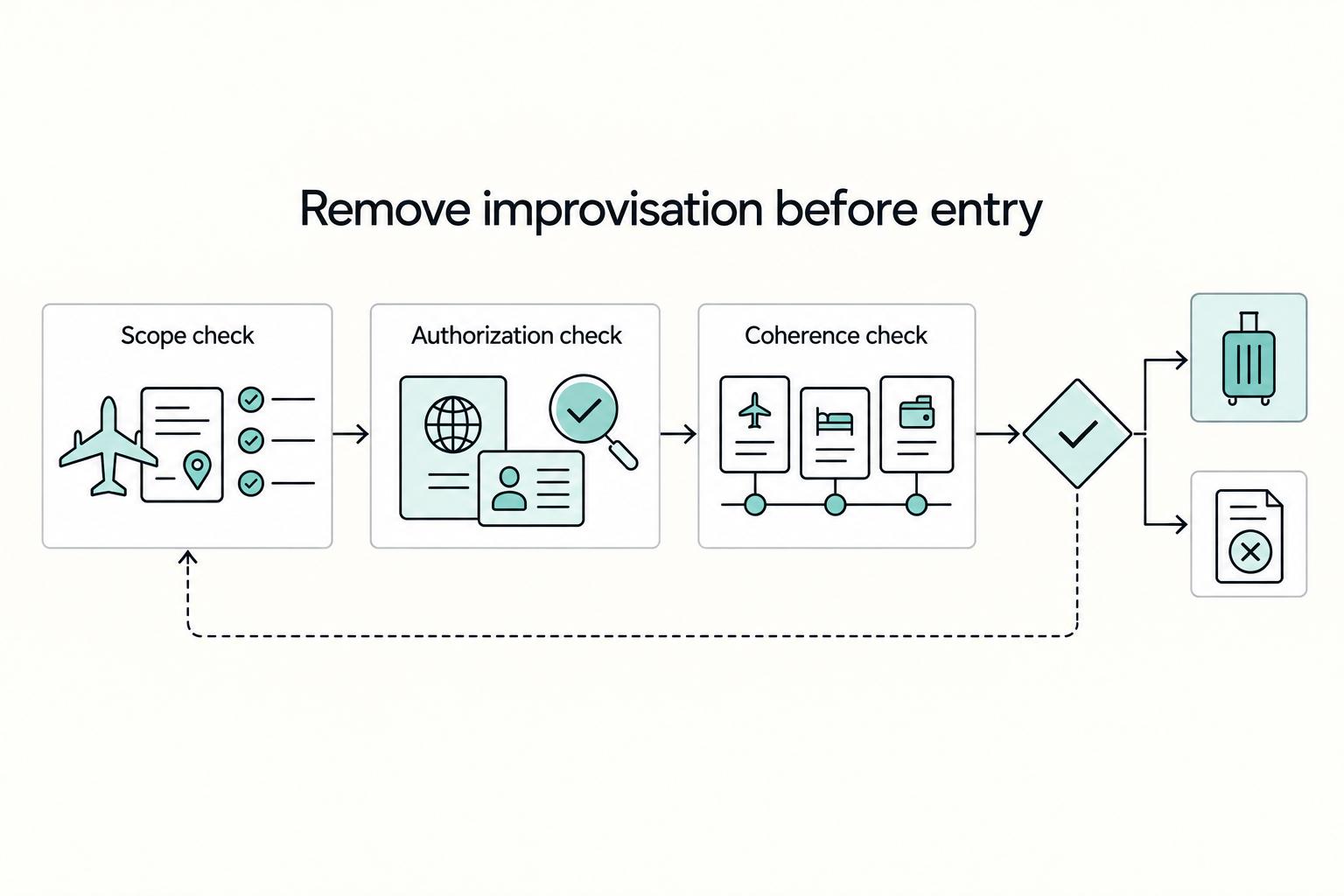
Before you fly, remove any part of the plan that depends on ad hoc explanations. If these three checks do not line up, fix the plan first.
| Check | Question |
|---|---|
| Scope check | Will you perform service or labor during the stay? |
| Authorization check | If asked, can you show valid work authorization when your activity requires it? |
| Coherence check | Do your calendar, messages, and stated purpose tell one consistent story? |
A useful standard is this: if a neutral reviewer could read your trip plan and immediately understand your permitted category, you are probably on solid ground. If that reviewer would need context, qualifiers, or spin, simplify and reclassify before departure.
Related: How to Adjust Status from a K-1 Visa to a Green Card.
The definition that matters here: what "work" means when you're physically in-country#
Use this plain test first: while you are physically in country, are you performing service or labor for an employer there? If yes, treat it as an authorization question before travel, not a wording exercise at the border.
The U.S. framing is a useful anchor. USCIS describes unauthorized employment as service or labor performed for an employer within the United States by someone not authorized to accept employment, or by someone who exceeds authorized scope or period. The practical takeaway is simple: labels like "remote," "foreign client," or "offshore pay" do not by themselves answer the authorization question.
The U.S. distinction that actually matters#
This can affect more than your current trip. USCIS says unauthorized-employment bars can apply to conduct during previous periods of stay in the United States, not only the most recent entry.
For green card planning, keep this checkpoint clear: filing adjustment of status does not itself authorize employment. If you are employed while adjustment is pending, USCIS requires valid employment authorization and compliance with its terms.
Truthfulness risk is separate from activity risk#
Some activity patterns still need separate analysis. The USCIS guidance covered here defines unauthorized employment and adjustment-related checkpoints, but it does not classify every visitor-scope scenario by activity label.
Operational rule: describe the trip as it really is, and use this table as triage, not legal clearance:
| Planned in-country activity | Service/labor signal from this section | Why |
|---|---|---|
| Sightseeing, visiting friends/family, personal events | No clear service/labor signal | No service or labor for an employer is apparent |
| Meetings, conferences, exploratory calls, consultations | Confirm with the relevant authority | Activity-by-activity visitor classifications are not documented here |
| Strategy calls plus active delivery management | Mixed signal | Discussion can overlap with execution activity |
| Coding, design, client delivery, support shifts, quota-carrying sales work | Clear service/labor signal | Ongoing labor and deliverables are involved |
| Running day-to-day operations from inside the country | Clear service/labor signal | Resembles ongoing in-country service or labor |
If you want a side by side on visitor status versus work-appropriate pathways, read digital nomad visa vs tourist visa. For a non-work residence option, see A Guide to Spain's Non-Lucrative Visa.
The 10-minute decision framework: pressure-test your plan for border questions (U.S.)#
Use this before booking: confirm that your declared purpose, planned activities, and proof all match. At a U.S. port of entry, consistency usually matters more than persuasion. A visa or ESTA approval does not guarantee admission. Plan for routine verification, not improvisation. If your trip only works when details are softened or renamed, treat that as a category mismatch.
Four tests to run before you book#
Answer these in writing:
- Permission test: Will your plan involve hands-on client delivery or operational ownership while physically in the United States?
- Purpose test: Can you explain the trip in one plain sentence without changing facts mid-answer?
- Activity test: Does your calendar stay in visits, meetings, or consultation, or does it move into active delivery and execution?
- Proof test: If asked for basics, can you show a consistent itinerary, stay details, timing, and onward plan without contradictions?
If any answer is unclear, pause and reclassify before booking. If the plan is execution-heavy, pause and get case-specific advice before booking. For a side by side, see digital nomad visa vs tourist visa.
One practical watchpoint applies to Visa Waiver Program travel. A Federal Register notice published on December 10 described proposed ESTA expansion and opened a 60-day public comment period, including five years of social media handles, phone numbers used in the past 5 years, and email addresses used in the past 10 years. The cited material does not treat this as final law, and says rollout could come in phases only after later review and approval.
| Label | What your plan looks like | Next move |
|---|---|---|
| Lower scrutiny risk | Clear visitor purpose, consultative activity, and matching proof | Proceed with a simple, consistent document pack |
| Medium scrutiny risk | Mixed signals, blurry calendar, or hard-to-explain activity shape | Remove unclear activity or postpone until the plan is clean |
| Higher scrutiny risk | Deliverables, shifts, client execution, or day-to-day operational ownership | Stop and re-plan under a work-authorized path |
This is an operational screen, not legal advice. Its purpose is to flag a bad fit before you travel. Need the full breakdown? Read A Guide to Portugal's D7 Visa for Passive Income Earners. Before you lock flights, use the Visa Guide for Digital Nomads to pressure-test whether your planned activities match your intended in-country status.
Consequences, translated into real life (not just legal theory)#
The real consequences often start as an entry and travel problem, then expand into legal and business friction. In the U.S. framing, the first decision point is admissibility at the port of entry, and issues there can lead to added scrutiny later.
Immediate outcomes#
At arrival, the core risk is escalation from routine screening into a more formal review. CRS R43356 identifies secondary inspection, inspection outcomes, and I-94 Arrival/Departure Records within that process, so a normal arrival can become a longer, enforcement-linked one.
| What happens now | Business impact | What it affects next |
|---|---|---|
| Secondary inspection | Possible delays, missed connections, and urgent rescheduling with hosts, teams, or clients | More detailed questioning about purpose, timing, and activities |
| Review of trip details and records, including I-94 context | You may need to clarify stay timing, onward plans, and purpose alignment | Any mismatch between your explanation and records can be harder to resolve |
| Adverse admissibility outcome | The trip can stop that day or require immediate re-planning | You may need a different visa path, new bookings, or legal guidance before trying again |
The practical check is simple: your I-94, itinerary, and stated purpose should match cleanly. This is where risk can compound. A border issue can lead to slower, more skeptical review on future entries, and related applications may receive closer review too.
Medium-term outcomes#
That creates operational cost, not just stress. A House hearing dated 06/04/2003 explicitly linked visa approval backlog to small-business impact. The evidence is historical, but the planning takeaway still applies: extra review can delay start dates, client commitments, and travel timelines. If status problems start stacking, address them directly and read what to do if you overstay your visa.
Long-tail outcomes#
The longest-tail consequence is reduced predictability. Even when a future trip is legitimate, you still may not be able to count on a smooth entry process.
That is why this is an operational risk, not just a legal concept. The next step is prevention: choose the right path early, build a clean document pack, and know when to stop and reclassify your plan. For a step-by-step walkthrough, see A Deep Dive into Mexico's 'Residencia Temporal' Visa for Remote Workers.
How people actually get flagged (and why "I'll just be careful" isn't a plan)#
Specific immigration screening triggers are not established, so do not treat online trigger lists as settled fact. Use this section as a self-audit, not as a claim about what officers always look for.
Category mismatch#
The approved sources here do not verify category-based trigger rules. For your own planning, if the trip only works after you rename the same activity, treat that as a stop signal and reassess before booking. Write down what you will actually do, then check whether your chosen path still fits that description. If it does not, compare alternatives early, including digital nomad visa vs tourist visa, instead of relying on softer wording.
Itinerary mismatch#
The approved sources here do not provide itinerary-based trigger criteria. As a planning check, your stated purpose, dates, lodging, and return plan should read like one coherent story without patches. If you need repeated caveats to make it make sense, pause and redesign before travel.
Digital and document mismatch#
The approved sources here do not provide device or document inspection trigger criteria. Do not try to hide, scrub, or stage materials to make a weak plan look clean. Keep ordinary records consistent with your stated purpose, and vet guidance quality before you rely on it. Prefer official .gov pages with https and lock signals, and remember that database inclusion alone is not endorsement.
Consistency over time#
The approved sources here do not provide evidence about repeat-travel enforcement patterns. What you can control is planning consistency: keep your core description and supporting logic stable, and update it only when facts actually change.
| Signal to self-audit | Why it matters | How to reduce risk |
|---|---|---|
| You need multiple versions of your trip purpose | Multiple versions can signal unresolved plan logic | Keep one plain purpose statement and align the category to it |
| Your plan needs heavy explanation to sound coherent | Repeated caveats often indicate internal gaps | Rework dates, lodging, and return plan so they match the stated purpose |
| Your records and your stated purpose do not match | Mismatch weakens clarity and credibility of the plan | Keep documents truthful and consistent; fix plan design, not presentation |
| Your story changes across similar trips | Frequent reframing can indicate unresolved planning gaps | Use a stable narrative and update it only when facts actually change |
Keep your core description and supporting logic stable unless the facts truly changed. This pairs well with our guide on A Guide to Greece's Digital Nomad Visa and Its 50% Tax Break.
Before travel: pick the category before you book#
Pick the category before you book. If your plan only works after you rename or soften what you will actually do, pause and verify the category first.
Step 1. Use a plain yes-or-no gate in the U.S. context#
Use a plain yes-or-no gate in the U.S. context. Can you describe this as a visitor trip without depending on ongoing deliverables while you are physically in country? If not, do not assume tourist status is the right fit. If it is still unclear, pause, write down the real activities, and compare alternatives first, including digital nomad visa vs tourist visa.
Step 2. Map the trip to real activities#
Map the trip to real activities, not airport-friendly wording. This is a screening step, not a legal permission list. If you cannot explain the trip in one plain paragraph without hedging, the plan is not ready.
| Actual plan | Screening signal | Verification trigger | Next action |
|---|---|---|---|
| Vacation, family visit, personal travel | Purpose is personal and time-bound | Any required ongoing output while in country | Verify the category on official government sources before booking |
| Meetings, conferences, exploratory conversations | Agenda is informational or relationship-focused | Execution, servicing, or delivery becomes the core activity | Verify the category on official government sources before booking |
| Client work, production, scheduled output, hands-on tasks | Deliverables are central to the trip | Category remains unclear after official-source review | Pause and confirm the correct status before you lock the itinerary |
Step 3. Verify with authoritative sources before you lock the itinerary#
Verify with authoritative sources before you lock the itinerary. For the U.S., start with Title 8, Part 214 - Nonimmigrant Classes on eCFR. Check page currency stamps before relying on text. A current example shows "up to date as of 4/06/2026" and "last amended 4/03/2026," which helps you catch version drift early.
Use FederalRegister.gov carefully. The site states its prototype view is not the official legal edition, and it can point to newer documents, for example a newer final rule dated 01/14/2021 on a 10/08/2020 page. For legal research, verify against an official edition before you rely on a single page. If you are already in recovery mode, start with what to do if you overstay your visa.
Before and at the border: keep your story and records consistent#
Once you pick a status, shift from persuasion to verification. Your spoken summary and your records should tell the same plain story. Important boundary: tourist-visa work rules, required border documents, and interview scripts are not defined here, so treat this as a consistency checklist, not legal authority.
Step 1. Build a small claim-to-proof pack for the facts you state#
Build a small claim -> proof pack for the facts you may state. Keep it lean and easy to verify.
| Claim you may make | Optional record to keep for consistency |
|---|---|
| "I am staying at this place for this period." | Accommodation confirmation with matching dates |
| "I am here for this length of time." | Return or onward itinerary that matches your stated stay |
| "I can cover this trip." | Funding records consistent with your trip length and plan |
| "This is my trip purpose." | Materials that match that purpose, for example itinerary or event details |
Run one fast consistency pass: lodging dates, travel timeline, stated purpose, and funding should align. If the plan only works after renaming what you are actually doing, pause and re-check status choice with digital nomad visa vs tourist visa. If timing is already drifting, use what to do if you overstay your visa early.
Step 2. Use short, truthful answers to basic trip questions#
For personal prep, use short, truthful, direct answers to basic trip questions. Keep each answer focused on what was asked, then stop.
For example:
- "Tourism and personal travel for eight days. I return next Saturday."
- "I am visiting for a short personal trip and leaving Sunday."
- "I am attending an event this week and returning Friday."
This is a clarity rule, not an official script. Concise answers are easier to keep consistent with your own records.
Step 3. Run the pre-border checklist before departure and before inspection#
Run this pre-border checklist twice: once before departure and once before inspection.
- Can I explain the trip in 2 to 3 plain sentences?
- Do lodging, timeline, purpose, and funding all support one narrative?
- Would extra detail make my own timeline less clear?
- Am I tempted to patch or relabel part of the plan?
- If asked for a basic fact, can I quickly find the matching record?
Watch for two failure modes: overexplaining and story patching. Both can increase inconsistency risk.
Step 4. Use clean, current source material in your prep notes#
Use clean, current source material in your prep notes. In the U.S. context, CBP is U.S. Department of Homeland Security Customs and Border Protection.
A useful quality benchmark is provenance. ACPD states its report was researched and verified by ACPD staff with State Department collaboration, and it identifies underlying data sources. Apply that same check to any rule page you rely on: issuing agency, update timing, and whether you are reading the current text.
During the stay: stay inside the permission scope-and know your "stop work" triggers#
A clean entry story is not enough. While you are in country, keep your real activity aligned with your stated visitor purpose, because risk can grow through gradual scope drift.
If your activity shifts, pause first, verify the lawful path for the new activity, and continue only when it is clearly compliant.
Daily rule#
A tourist-status legal definition of unauthorized employment is not given here, so treat this section as a conservative risk-control playbook, not legal advice. In practical terms, be cautious when your in-country activity stops matching your visitor purpose and starts looking like ongoing service, labor, or operations.
Conservative stop-work cues#
Use these as practical self-audit cues, not statute-defined tourist visa triggers from the cited sources.
| Pause cue | What changed in real life | Immediate action |
|---|---|---|
| Deliverable drift | You are logging hours, producing output, or handling ongoing execution while physically in country | Pause activity, verify permission for the actual activity, then resume only if compliant |
| Sales/ops drift | You moved from meetings or planning into active revenue or operating work | Pause activity, verify permission for the actual activity, then resume only if compliant |
| Story drift | Your calendar, messages, or files no longer match your stated trip purpose | Pause activity, verify permission for the actual activity, then resume only if compliant |
| Timeline drift | Your stay is extending beyond your original plan | Pause activity, verify status and timeline risk, then resume only if compliant |
If scope changes mid-trip, use this sequence#
- Scope changed: name the new activity plainly.
- Stop the activity: do not keep working while you sort it out.
- Confirm the lawful path for that activity and location.
- Resume only when the activity and permission match.
If timing is already slipping, use what to do if you overstay your visa. If activities are shifting beyond visitor scope, re-check status fit with digital nomad visa vs tourist visa.
Documentation hygiene during the stay#
When you re-check rules, use current, category-correct sources. The State archive explicitly says its content is not updated and points readers to current State.gov information, and eCFR is labeled authoritative but unofficial. Also confirm you are reading the right program, since Title 22 Part 62 is Exchange Visitor Program text, not a tourist-status rule. For U.S. travel, DHS rule text indicates departure processing can occur at airports, land ports, seaports, or other authorized points, with photos and potentially other biometrics for non-exempt travelers.
| Reference | What it says here | Checkpoint |
|---|---|---|
| State archive | Content is not updated | Use current State.gov information |
| eCFR | Labeled authoritative but unofficial | Use current, category-correct sources when you re-check rules |
| Title 22 Part 62 | Exchange Visitor Program text | Not a tourist-status rule |
| DHS rule text | Departure processing can occur at airports, land ports, seaports, or other authorized points | Photos and potentially other biometrics can apply to non-exempt travelers |
Keep your records and timeline consistent throughout the trip so your real activity, stated purpose, and documents do not drift apart. We covered this in detail in A Guide to Getting a Long-Stay Visa in France.
If you already worked on a tourist visa: damage control without compounding the problem#
If this already happened, the practical sequence is simple: stop the activity, preserve the facts, and choose one lawful next step before any new filing, travel, or interview.
Stop now and stop editing the story#
Stop the activity that may be outside visitor permission. Do not keep delivering work, invoicing, or meeting project deadlines while you sort this out.
Then keep one truthful version of events. Inconsistency across interviews, forms, and later filings can create additional risk, so do not rewrite calendars, relabel activities, or build a post hoc narrative.
Build a private factual timeline#
Create one internal legal-prep record in neutral language. Make it detailed enough that counsel can reconstruct what happened without guessing. Include:
- dates of entry, stay, and departure
- locations where you were physically present
- activities performed, described plainly
- deliverables, deadlines, and meetings
- payment facts (payer, amount, method, invoice, date)
- what you stated at entry, in applications, or in official interviews
Keep supporting records together: travel records, accommodation records, calendars, invoices, payment confirmations, and relevant message threads.
Verify from official policy sources, not summaries#
For U.S. matters, start with the USCIS Policy Manual. USCIS describes it as its centralized policy repository, says officers use it in decision making, and states that updated Policy Manual content prevails over conflicting older AFM or policy memo content. The cited page is marked current as of February 3, 2026.
Do not treat policy text as a guaranteed case result. USCIS also states the manual does not remove adjudicatory discretion and does not create legally enforceable rights or benefits. If someone cites FederalRegister.gov, confirm whether the item is a Proposed Rule and verify against an official Federal Register edition before relying on it.
Pick one lawful path and pressure-test it with counsel#
If your timeline also slipped, work through corrective steps in what to do if you overstay your visa. If the core issue is choosing the right status for future travel, use digital nomad visa vs tourist visa.
| Decision point | Practical question for counsel |
|---|---|
| Status strategy | Based on what I actually did, should I pause travel, apply from abroad, or wait before any new filing or entry attempt? |
| Future eligibility impact | Could this history affect a later visa, admission, or immigration benefit in my category, and which facts matter most? |
| Disclosure consistency | Where might this trip need to be disclosed again, and how do we keep wording accurate and consistent across processes? |
This is the most defensible damage-control posture: one path, one factual record, one truthful account. Related: Working Remotely in Latin America Without Visa Guesswork.
The operational layer competitors miss: money + records can surface inconsistencies (and how to go "audit-ready" once you're legal)#
Get lawful status first, then tighten operations. Records are not a substitute for resolving status, but once you are on lawful footing they help reduce contradictions.
If your status decision is still open, solve that first with digital nomad visa vs tourist visa. If timing also slipped, handle that directly in what to do if you overstay your visa.
Build a compact, truthful work packet#
Use one private packet per client or engagement. The goal is simple: the same facts should match across contract, invoice, payment, and location records.
| Record | What it should include | Cross-match rule |
|---|---|---|
| Contract / SOW | Legal party names, scope, effective dates, amendments | Party names and dates should match invoices and payment records |
| Invoices | Service period or milestone, currency, description, billed party | Description and period should match contract scope and actual timeline |
| Payment proof | Amount, date, currency, payer account or entity | Payer and amount should match invoice; keep an explanation for any mismatch |
| Location log | Where you were physically present during work periods | Dates should align with travel and entry-exit history and deliverable timing |
| Change trail | Messages or emails for scope, timing, payer, or delivery changes | Changes should be documented when they happened, not reconstructed later |
Run one quick monthly spot check: pick one invoice and trace it end to end without guessing.
U.S. tax/admin filings are record signals, not status decisions#
If U.S. filings apply to you, treat them as consistency records and reconcile them with your other records.
| Item | Record signal it creates | Verification note |
|---|---|---|
| Tax filing records | Dated filing trail for periods you reported | Confirm current filing rules and whether they apply to your facts |
| Account/asset reporting records | Additional account or asset disclosures, if required | Confirm current rules and thresholds before relying on this in reconciliation |
| Income reporting records | Record that income was reported for tax purposes | Confirm current filing rules for your facts before relying on this in reconciliation |
If sanctioned jurisdictions or blocked person risk is in scope, keep a separate compliance note. OFAC's FAQ for GL 46B, 51A, and 52 shows condition-based limits, including commercially reasonable payment terms and jurisdiction or person restrictions. That is another reason contract and payment records should stay internally consistent.
Run a monthly control loop#
- Status check: confirm your current permission still matches what you are doing in country.
- Scope check: compare actual work performed to permitted activity scope.
- Record reconciliation: reconcile contract, invoice, payment, and location entries line by line.
- Drift correction: fix naming, date, scope, or payment-route gaps immediately, with a contemporaneous note.
That is the play once you are legal: keep records boring, consistent, and defensible.
The safe play: decide fast, document cleanly, and choose a visa path you can defend#
Treat this as an operations checklist: classify the activity, verify the rule source, keep one consistent record set, and escalate early when facts are ambiguous.
- Classify the trip honestly (low / medium / high).
Low: the trip still makes sense if all client or employer activity stops. Medium: your purpose, calendar, or messages can be read two ways. High: the trip only works if you keep delivering services or staying actively available to clients. If you land in medium or high, stop defaulting to tourist status and compare visa options in digital nomad visa vs tourist visa.
- Verify status from an official source before you rely on it.
FederalRegister.gov says it is not the official legal edition, and each document page links to the official PDF on govinfo.gov. Use that PDF as your checkpoint when a rule or notice affects your plan, and do not rely on FederalRegister XML text alone for legal certainty. If you are reading the 12/29/2025 item (90 FR 60864), re-check its current status and any later actions. The 09/25/2020 item points to a 07/06/2021 withdrawal notice.
- Build one clean, consistent fact file.
Keep a dated timeline, a short purpose statement, lodging and return details, and matching engagement records. Do one end-to-end consistency check so dates, tasks, invoices, payments, and messages tell the same story.
- Escalate early when stakes are high or facts are messy.
If your case affects repeat travel, relocation, or later filings, get counsel before you improvise. If overstay is part of the situation, use what to do if you overstay your visa as a planning resource and keep your timeline and records organized.
If you want a deeper dive, read The 2026 Global Digital Nomad Visa Index for 50+ Countries.
If your facts are still borderline after you classify activities and clean up documents, contact Gruv for help designing a traceable money flow and recordkeeping setup.
Frequently Asked Questions
Can I work remotely on a tourist visa if my employer is outside the country?
Not in the U.S. B-2 context. B-2 is not a work category, and the core test is your physical location plus the activity you perform there, not where your employer is based. Even if admission is granted for up to six months, that stay length is not work permission. If your trip includes real delivery work, use digital nomad visa vs tourist visa before you travel.
What happens if you get caught working on a tourist visa?
Consequences can be serious. In the U.S. B-2 context, discovered unauthorized work can lead to visa cancellation, possible future entry problems, and in some cases removal proceedings and deportation. Next step: stop the work, keep your account factual, and organize a dated record set with entry history, work timeline, invoices, and payment records before getting legal advice.
How do immigration officers know you worked?
There is no single detection checklist. A practical risk point is inconsistency: if your stated purpose is tourism but your records suggest service work while you were physically in the U.S., that mismatch can trigger closer review. Before future travel, check one engagement end to end so dates, location, tasks, and payments align.
Is it illegal if I'm only answering emails or taking a few calls?
There is no safe number of emails or calls. Use the same lens as the rest of this article: where you are physically, what activity you are actually doing, and which permission category covers that activity. If those communications are part of ongoing delivery or client service, treat it as work related and pause until you confirm your status allows it.
Does volunteering count as work on a tourist visa?
It can still create risk. In the U.S. material behind this article, volunteering can raise red flags when the role is one a paid U.S. worker could have filled. Next step: get the role details in writing and confirm the activity fits your permission category before you participate.
Can I attend meetings or conferences on a tourist visa?
There is no blanket meetings-or-conferences rule. What they do make clear is that B-2 is not work authorization. If your role shifts from attending into producing or executing work, stop and reassess before continuing.
Can I change from B-2 to a work-authorizing status after I enter the U.S.?
Sometimes, but it is not automatic and not permission to work while pending. The grounded checkpoint here is employer sponsorship plus a USCIS petition, and working during a pending change is generally treated as unauthorized employment that can lead to denial. If this is your path, line up sponsor, filing strategy, and timing first, and keep work paused until you have work-authorizing status.
Will this affect future visa or residency applications?
It can. In this U.S. B-2 context, unauthorized work is described as a future-entry risk, and working while a status change is pending can lead to denial of a work-visa application. Residency impacts are case-specific. If you also overstayed, handle that track directly in what to do if you overstay your visa and keep all later disclosures factual and consistent.
If I already worked while on a tourist visa, what is the first practical step?
Stop the activity that may be outside your permission category. Then create a plain, dated timeline of entry, locations, tasks performed, who paid you, and what documents already exist. That file helps you avoid the bigger follow-on risk: inconsistent facts later.
Try a related tool
Researched and edited by the Gruv editorial team. Gruv builds cross-border billing, payouts, and finance-operations software for global businesses.
Sources
- commdocs.house.gov/committees/intlrel/hfa27480.000/hfa27480_0.htmtrusted
- congress.gov/crs-product/R43356trusted
- congress.gov/event/114th-congress/house-event/LC46223/texttrusted
- ecfr.gov/current/title-8/chapter-I/subchapter-B/part-...trusted
- federalregister.gov/documents/2020/09/25/2020-20845/establishing...trusted
- federalregister.gov/documents/2020/10/08/2020-22132/strengthenin...trusted
- justice.gov/sites/default/files/pages/attachments/2016/0...trusted
- ofac.treasury.gov/faqs/addedtrusted
Educational content only. Not legal, tax, or financial advice.
Related Posts

Digital Nomad Visa vs Tourist Visa for Staying Legal Abroad
A tourist visa may look like the simpler way to start a trip, but it is usually the wrong choice if you plan to keep working while abroad. In many places, tourist status is for leisure and does not authorize remote work, so this is a visa-compliance decision, not just a travel convenience decision.

The 2026 Global Digital Nomad Visa Index for 50+ Countries
Start with legal fit, not lifestyle filters. The practical order is simple: choose a route you can actually document, then decide where you want to live. That single change cuts a lot of wasted comparison work and stops you from falling in love with places that were never a real filing option.
What to Do if You Overstay Your Visa
If you think you stayed past your allowed period, move in sequence, not in panic. This is a U.S.-focused explainer, and the first anchor is your Form I-94 admit-until date, not the [visa sticker expiration date](https://travel.state.gov/content/travel/en/us-visas/visa-information-resources/visa-expiration-date.html).