
Quick Answer
Route client receipts to the LLC account and document money moving between the owner and company. When a mixed transaction appears, identify its purpose and choose the proper reimbursement, contribution, distribution, compensation, or loan treatment before posting a correction. Keep the original record and supporting documents. Commingling can support a veil-piercing argument, but the legal test depends on the jurisdiction and the wider facts.
Start here if you invoice clients through an LLC#
If you invoice clients through a Limited Liability Company (LLC), separate client payments, owner money, and business spending from day one. Commingling starts when funds that should stay separate get mixed. Your first job is to lock down where invoices point and where money lands.
This guide is built for real operating conditions: uneven payment timing, reimbursements, and everyday spending choices. The goal is practical transaction judgment you can use right away.
Fix the payment path first#
Start with the money coming in. Put the LLC, not your personal name, as the pay-to entity on invoices, then confirm the receiving account matches that entity. A quick review of your invoice template, payment link, and deposit account can surface obvious gaps.
Client payments should go to the LLC bank account, not a personal account. For a fast audit, compare recent invoices with recent deposits and confirm they match at the entity and account level.
If you are not handling client trust funds in a law-firm trust-account model, keep it simple. Maintain clear separation so your records show what belongs to the business and what belongs to you.
Treat a dedicated business account as a core control#
A separate business bank account is one of the simplest ways to stop commingling before it starts. A dedicated business checking account, paired with its own business card, gives you a clear control point before money gets spent.
If client money still routes into a personal account, treat that as a priority red flag. Fix account routing first, then add policy language you can enforce in day-to-day operations.
Using one familiar account can feel easier in a tight week, but mixed spending weakens the case that the LLC operates separately. In a creditor dispute, that record can work against you.
Before you get into reimbursements, owner draws, or tax treatment, use these rules as your baseline:
- If a client pays for business work, invoice under the LLC and deposit to the LLC bank account.
- If a charge is for the business, start with a business account or business card.
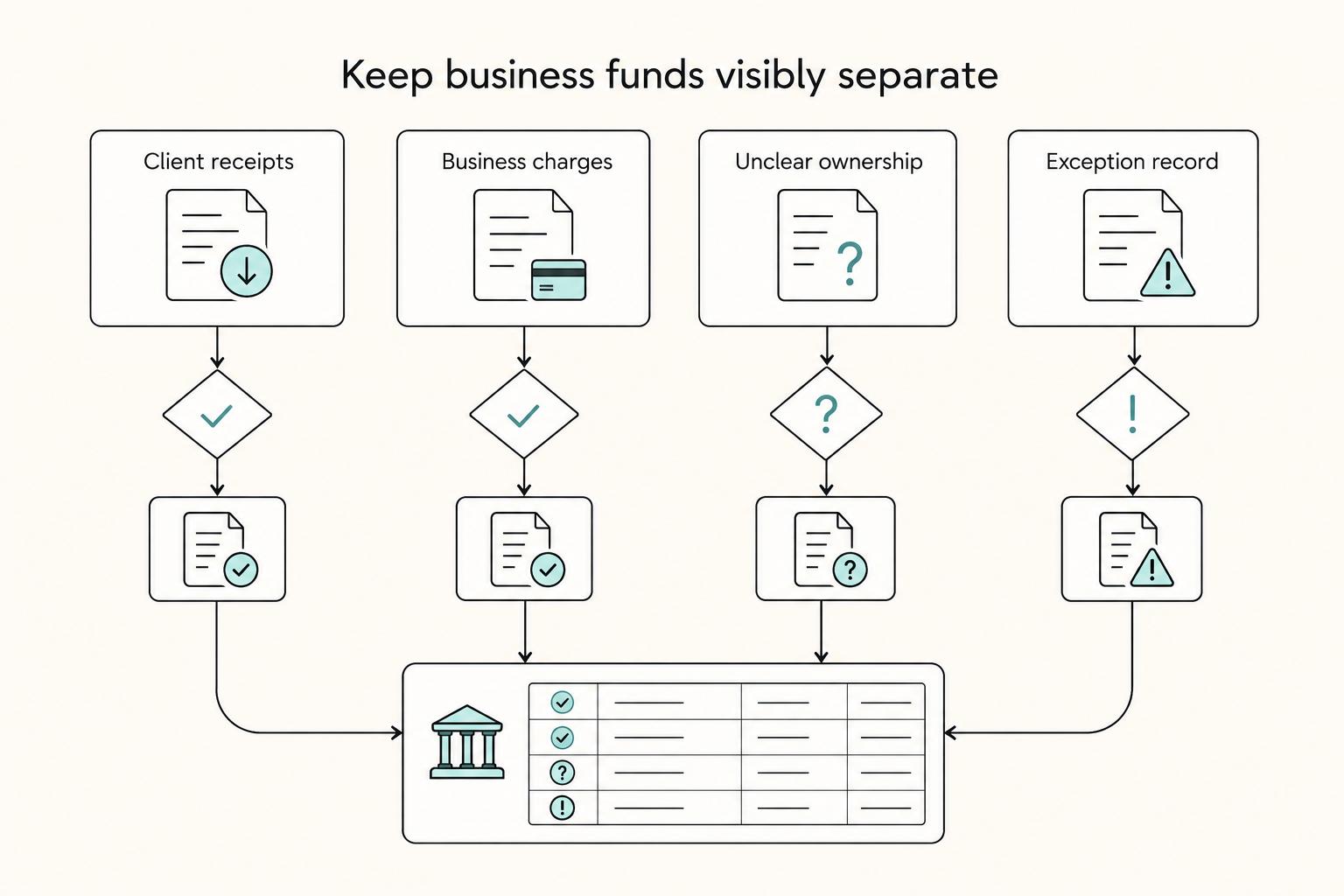
- If ownership is unclear at a glance, flag and document the transaction immediately.
That baseline carries through the rest of the guide. Next, it helps to separate true commingling from problems that only look similar on the surface.
If you want a deeper dive, read Sole Proprietorship vs. LLC: The Definitive Guide for Global Freelancers.
Commingling funds has a precise meaning and a few dangerous lookalikes#
Commingling means mixing personal and business funds so transactions are not clearly separated in your records. Common examples are business income deposited into a personal bank account and personal bills paid from a business operating account.
For this guide, treat your personal account and your business operating account as a hard boundary. Crossing that line without documentation and cleanup counts as commingling behavior, including using personal funds for business costs without a clear paper trail.
The dangerous lookalikes are usually the transactions you tell yourself you will clean up later:
- Paying a business expense on a personal card without documentation and a reimbursement trail
- Undocumented transfers or reimbursements between personal and business accounts
- Using one card or account for both personal and business spending
When you find a mixed item, fix it right away. Identify it, reclassify it, and reimburse the account that covered the cost when needed. That keeps tracking clear, strengthens deduction support, and can reduce audit risk and pressure on your liability protection.
Why LLC protection weakens when money trails are messy#
Messy money trails weaken LLC protection because they turn a bookkeeping problem into evidence someone else can use against you. Repeated mixing makes it easier to argue the company is an alter ego, not a truly separate business with its own limited liability.
Veil-piercing rules depend on the jurisdiction and facts. Commingling can be one factor in an alter ego claim, but it does not automatically make the owner liable. For example, Delaware case law considers commingling alongside other factors and requires fraud or injustice connected to misuse of the entity form.
In practice, judges usually want to see whether the LLC looks like a real entity with its own assets, liabilities, and financial history. The checks are often straightforward:
- Separate bank accounts were maintained
- Personal use of business funds was avoided or clearly handled
- Owner-related transfers were documented
- Financial records were complete enough to follow without guesswork
A creditor must satisfy the applicable legal test; a messy bank feed alone is not enough to assume personal liability. Keep records that explain the entity’s assets, obligations, and owner transactions so those facts can be assessed.
Here, commingling is not just a bookkeeping issue. When records do not clearly separate personal and business activity, that gap can become court-facing evidence.
The biggest risk is usually a repeated pattern, not a single mistake. An occasional error may not automatically destroy protection, but consistent or careless mixing can create the evidence creditors need. If a transaction blurs ownership, fix it quickly and preserve the trail so the separation story stays defensible.
This pairs well with our guide on Can an LLC Pay for a Member's Health Insurance?.
Where commingling usually starts for freelancers and small teams#
For freelancers and small teams, commingling often starts with routine shortcuts, not a dramatic event. Common entry points are business income deposited into personal accounts, personal use of business cards, personal payment of business costs without documentation, and transactions that are not clearly separated in records.
| Starting point | What happens | Cleanup focus |
|---|---|---|
| Client money lands in a personal account first | Business income is deposited into a personal bank account | Document the deposit and any related transfers so the activity can be followed |
| Personal spending sneaks onto the business card | Personal purchases appear on a business credit card | Remove personal costs from business-expense categories; determine repayment, distribution, compensation, or a genuine loan treatment based on the LLC’s tax classification and facts |
| Urgent business bills go on personal cards without a trail | Personal funds are used for business costs without a documentation trail | Document the business cost and whether the owner is reimbursed, makes a capital contribution, or advances a genuine loan |
| Unlabeled transfers make everything harder to reconstruct | Business and personal transactions are not clearly separated in records | Record the purpose and support for each transfer |
Client money lands in a personal account first. Depositing business income into a personal bank account creates a commingling problem at the start of the revenue trail. If it happens, document the deposit and any related transfers so the activity can be followed.
Personal spending sneaks onto the business card. Remove personal purchases from business-expense categories and document how the owner settles them. A distribution, compensation, or genuine loan may have different consequences depending on the LLC’s tax classification. Relabeling a charge does not make it deductible.
Urgent business bills go on personal cards without a trail. Save the invoice, business purpose, and payment record. Record whether the LLC reimburses the owner or treats the advance as a contribution or genuine loan. The IRS expense guidance distinguishes business deductions from personal costs; the account used is only part of the record.
Unlabeled transfers make everything harder to reconstruct. When business and personal transactions are not clearly separated, the record gets harder to reconstruct and financial clarity drops. Record the purpose and support for each transfer so outside reviewers, including investors or creditors, can follow what happened.
For a walkthrough, see A Guide to Setting Up a Business Bank Account for a New LLC.
Transaction classification rules before you book anything#
Classify first, then book. Most cleanup problems start when something gets posted on guesswork and someone tries to repair the record later.
A bank feed shows cash movement, not meaning. Your books should show who paid, who benefited, and what support you kept.
| Transaction type | Treatment before posting | Keep with the entry | Do not post yet if |
|---|---|---|---|
| Owner-funded business expense | Determine the business cost and record either a reimbursement payable, owner contribution, or genuine loan, as appropriate | Receipt or invoice, business purpose, and the reimbursement, contribution, or loan record | Receipt is missing or business purpose is unclear |
| Personal expense paid by the business | Remove it from deductible business expenses and determine owner repayment, distribution, compensation, or genuine loan treatment | Statement line, note that it was personal, reclassification record | You cannot tell whether the charge was personal, mixed, or business |
| True business expense | Post to the normal business expense category | Vendor, receipt or invoice, business purpose if not obvious | Counterparty is unknown or item appears mixed-use |
| Owner/personal transfer pattern | Keep it out of business expense categories and classify it as a personal/owner transaction in your records | Transfer record and memo (for example, "owner personal transfer") | There is no support for classifying it as a business expense |
Default treatment for common mixed cases#
If personal funds paid a business cost, keep the receipt and a short business-purpose note. Record both the cost and how the owner funded it. Reimbursement is one option; a documented contribution or genuine owner loan can also explain the funding. Choose the treatment that matches the facts and the LLC’s tax classification.
If the business paid a personal cost, remove it from business-expense categories and determine how it will be settled. Owner repayment, a distribution, compensation, or a genuine loan have different consequences. Do not invent a loan after the fact merely to make the books balance.
Even a true business expense needs a basic clarity check. If another reviewer cannot tell why the charge belongs to the business, hold it for review. Mixed or unclear records make performance harder to track and can hurt credibility with creditors or investors.
Items to pause and escalate#
Some charges are too mixed for a quick judgment. Common examples are mixed-use software, travel bundles, and family phone plans. When treatment is unclear, escalate for review instead of guessing. This matters most when a classification choice could turn personal costs into business deductions and increase audit risk.
A useful escalation note is short: statement line, receipt or contract if available, who used the item, and why it may be mixed.
Your do-not-post-yet rule#
Keep a review bucket and pause any item when:
- the receipt is missing
- the counterparty is unknown or does not match the description
- the business purpose is unclear
A temporary hold is better than locking a bad classification into month-end reports.
What a clean record looks like#
A clean record is traceable. For owner-paid business costs, follow the original charge, business purpose, and chosen funding treatment: reimbursement, documented contribution, or genuine loan. Link any later repayment to that record.
For business-paid personal charges, you should be able to show when the issue was found and how it was reclassified. If you cannot explain the transaction clearly and support it with a receipt, memo, or statement line, do not finalize the posting.
How to correct accidental commingling in five steps#
When commingling has already happened, work through the cleanup in sequence. Find every mixed transaction and classify it. Then post the correction with support, confirm the records are clearly separated, and put controls in place so it does not repeat.
| Step | Focus | What to capture or confirm |
|---|---|---|
| Step 1 | Isolate every suspect transaction | Capture what was paid, which account paid, who benefited, and what support you already have |
| Step 2 | Assign a provisional class | Distinguish business costs, owner advances, personal costs, distributions, compensation, and genuine loans; check the LLC’s tax classification before final treatment |
| Step 3 | Post corrections and reimbursements, then attach support | Keep the receipt or invoice plus a short note explaining the business purpose |
| Step 4 | Verify that separation is now clear in the records | Confirm the corrected period is traceable from the original transaction to the correction and the attached support without guesswork |
| Step 5 | Lock in prevention controls | Keep business and personal spending separate, and pause unclear items until they are documented and classified |
Step 1: Isolate every suspect transaction#
Build one list from the accounts involved in business activity, including any business and personal accounts that touched the period you are fixing. For each suspect line, capture what was paid, which account paid, who benefited, and what support you already have.
Step 2: Assign a provisional class#
Classify each item before posting corrections. Distinguish business costs paid by the owner, personal costs paid by the LLC, contributions, distributions, compensation, and genuine loans. The IRS explains that an LLC may be taxed as a disregarded entity, partnership, or corporation; that classification affects which treatment is appropriate.
Step 3: Post corrections and reimbursements, then attach support#
Post the supported correction and attach the original receipt or invoice plus the purpose note. If the agreed treatment is reimbursement, pay from the business account and link the payment to the owner’s original charge. If it is a contribution or genuine loan, retain that funding record instead.
Step 4: Verify that separation is now clear in the records#
Do not stop at the journal entry. Review the corrected period and confirm business and personal activity are no longer blurred together. A clean result should be traceable from the original transaction to the correction and the attached support without guesswork.
Step 5: Lock in prevention controls#
The last step is prevention. Keep business and personal spending separate, and pause unclear items until they are documented and classified.
Related reading: How to Set Up a Solo 401(k) for Your LLC.
The monthly evidence pack that protects you in disputes and audits#
Once you have cleaned up mixed transactions, close each month with one evidence pack. This exact folder is not itself a legal requirement. It does give you a practical way to respond to an Internal Revenue Service (IRS) Information Document Request and to show that the business was operated as a separate entity.
The standard is simple: if someone asks what happened in a given month, you should be able to answer from the file, not from memory.
Build one folder per month#
Keep one folder with the records that explain cash movement and corrections:
- bank statements for LLC accounts
- card statements for business cards used that month
- reimbursement log for business costs paid personally and repaid by the company
- owner-transfer log for money moving between owner and company
- correction journal summary for reclasses, reimbursements, and cleanup entries
This aligns with examination focus areas listed in IRS audit material, including Information Document Requests, Books and Records, Cash Records, and Sources of Receipts.
For owner transfers, record the direction, originating account, beneficiary, and purpose, such as owner draw, reimbursement, or capital contribution. For corrections, keep a trace from the original transaction to the correcting entry and approval.
Keep an exception register on one page#
Add a one-page exception register for items that were unclear, corrected late, or still open. Use: date, account, issue, classification, approver, and closure date.
If an item is still unresolved at month end, keep it open on the register instead of forcing a weak classification. A useful internal rule is this: if a transaction cannot be explained in two sentences with documents, it is not closed. Review the register before the next close. Recurring exceptions can point to a control problem, not just a one-off.
Tie every receipt of money to the deposit trail#
Income should be easy to follow from invoice to deposit. Link each invoice or receipt record to the related bank deposit or payout record so reporting and cash reconciliation stay aligned.
Batched processor deposits are one place the trail can break. When one payout covers multiple invoices, often net of fees, save the payout detail in the same monthly folder and map it to the underlying invoices.
A monthly evidence pack can help establish what belonged to the LLC and how owner transactions were handled. It supports the factual record in a dispute; it does not guarantee a result or replace the jurisdiction’s veil-piercing test.
For more on separation in disputes, see What is the 'Corporate Veil' and How Does an LLC Protect It?.
Banking and payment setup choices that reduce commingling risk#
The most reliable way to reduce fund mixing is clear account separation. Funds that should not mix should land in business-owned accounts, and each dollar should stay traceable from payment to deposit.
A practical baseline is simple:
- separate accounts for client-held funds and operating funds where that structure applies
- clear routing rules so receipts land in the intended business account
- a strict rule that client receipts do not go to a personal bank account
This is an operating control, not a universal legal requirement for every industry or LLC. It's meant to avoid preventable process errors, including accidental use of the wrong account.
Start with hard account boundaries#
Set invoice instructions, payment links, and payout settings so funds route to the intended account. Then run a quick trace test on a recent payment. The invoice, processor record, payout, and bank deposit should all align to an explainable destination.
Cross-border receipts need traceable business inflows#
If you accept international payments, apply the same separation and traceability standard. If one payout covers several invoices, keep records that map each invoice to that payout so the final deposit is still easy to explain.
Choose evidence-friendly tools, then redesign bad flows#
Use tools that preserve a clear transaction history and support account separation, not just balance snapshots. Software built to support stronger separation controls is useful because process mistakes are often operational, not intentional.
If money keeps moving back and forth between owner and business accounts just to operate, treat that as a process warning and simplify the flow so boundaries stay clear. For related guidance, see Hiring Your First Subcontractor: Legal and Financial Steps.
The red flags judges and creditors care about most#
In a dispute, intent helps less than the record. Judges and creditors may focus on whether your files show real separation between you and the business, or a recurring mix of personal and business money.
That matters because veil-piercing and creditor-rights disputes are established legal topics, and outcomes are not automatic. When funds are mixed, a judge could still rule against the owner. The practical question is whether issues were corrected and documented, or left unresolved.
Patterns are harder to explain than corrected mistakes#
There is no universal numeric trigger here, but mixed funds can give creditors more room to argue the business was not kept meaningfully separate.
Unresolved repeat mixing and weak correction records can weaken your explanation. If a personal charge appears, document repayment, reclassification, and support. If similar charges keep appearing, tighten controls immediately.
A useful checkpoint is to review recent business checking and business card activity for charges a neutral outsider would question. For each one, confirm there is a clear explanation, supporting document, and correction entry if needed.
Inconsistency hurts credibility quickly#
Inconsistent treatment makes the books harder to explain. If one owner-paid tool is reimbursed, another is treated as a contribution, and a third is left uncategorized, record why the treatments differ. Apply one documented rule to recurring transactions with the same facts.
That does not mean every classification error leads to veil piercing. It does mean you should stop ad hoc treatment. Set one treatment with your CPA for each recurring scenario, then apply it consistently.
Missing evidence gives the other side room#
Missing approvals or backup do not automatically prove anything, but they weaken your explanation. A creditor may use those gaps in negotiations or litigation.
The evidence pack that matters most is practical and specific:
- bank or card statement showing the transaction
- receipt or invoice
- short memo stating business purpose or owner-transfer reason
- correction record, reimbursement record, or owner distribution note
- who approved it, if anyone besides you is involved
If you cannot explain a transaction in two sentences and point to those documents, treat it as an open risk. Mixed funds can also look like a trust problem to creditors, which may make future borrowing harder even before a court decision.
Cross-border and tax edge cases to flag early#
If your LLC touches foreign accounts, cross-border payments, or multi-country ownership, separate business and personal funds from the start. That can make it easier to determine whether Form 8938, FBAR, or both may apply and to support your reporting at year-end.
Form 8938 reports specified foreign financial assets above the applicable threshold. For an unmarried individual living in the United States, the threshold is more than $50,000 at year-end or more than $75,000 at any time during the year. Other filing statuses, residence abroad, and specified domestic entities have different rules. Form 8938 accompanies the annual return and does not replace an FBAR when that separate filing is required.
Messy ownership trails can create avoidable risk. If business receipts land in a personal foreign account, or money moves between personal and LLC accounts without a clear purpose note, the record can be harder to support. Form 8938 asks whether foreign deposit or custodial accounts were closed during the tax year, and whether foreign assets were acquired or sold. Unclear records may require your CPA to reconstruct what happened after the fact.
Before year-end, confirm that:
- each foreign financial account is labeled as personal, business, or jointly held
- each account has statements plus opening and closing records and transfer explanations
- any account closure, or foreign asset acquisition or sale, is documented in the same monthly evidence pack
One more edge case: certain specified domestic entities can have Form 8938 filing obligations for tax years beginning after December 31, 2015. Because filing treatment can depend on facts and entity classification, confirm final treatment with a qualified attorney and CPA before classifying or filing.
A 30-day checklist to lock this down#
Treat the next 30 days as a focused internal cleanup sprint, not a court-validated legal standard. Stop new mixing first, clean up recent exceptions next, document your money-handling rules after that, then test whether one month of records stands on its own.
| Week | Main focus | Key actions |
|---|---|---|
| Week 1 | Stop new mixed transactions | Set hard boundaries between personal and business payment rails, and fix invoice instructions, saved autopay settings, and recurring vendor charges that still point to a personal account or card |
| Week 2 | Clear recent exceptions | Flag transactions that are hard to explain, attach the evidence you have, and add a short note on what changed |
| Week 3 | Write money-handling rules | Publish written rules for how money moves, be explicit about who can transfer funds and how approvals work, and keep the operating agreement aligned |
| Week 4 | Run a mock audit | Compare statements and ledger entries, confirm unusual transactions are explainable from the file alone, and fix anything that fails that test |
Week 1. Start by setting hard boundaries between personal and business payment rails, and stop creating new mixed transactions. Route new client receipts and new business spending only through the business paths you are keeping.
Check every live payment path right away: invoice instructions, saved autopay settings, and recurring vendor charges. If anything still points to a personal account or card, fix it now so old settings do not keep creating fresh exceptions.
Week 2. Work through recent activity line by line and clear exceptions. Flag any transaction that is hard to explain from the record itself, including undocumented owner transfers, personal charges on business accounts, business expenses paid personally, or unexplained transfers between accounts.
For each exception, attach the evidence you have and add a short note on what changed. Avoid broad, vague catch-all corrections that leave the trail unclear.
Week 3. By this point, you should have a better sense of where the process is breaking down. Publish written rules for how money moves, even if you are the only owner. Be explicit about who can transfer funds and how approvals work in your setup.
Keep your operating agreement aligned with the transfer and approval rules you actually use. Retain consent records when a transaction requires owner approval, and make the accounting entry traceable to that authorization.
Week 4. Finish by running an internal mock audit on one recent month. Compare statements and ledger entries and confirm that unusual transactions are explainable from the file alone.
Fix anything that fails the trace test, then make this part of the monthly close. A cleanup plan works when it changes recurring payment instructions and approval habits, rather than repeatedly correcting the same exceptions.
If Week 1 keeps failing because client payments still land in personal rails, set up dedicated business receiving details with Virtual Accounts.
Keep the promise simple#
Keep the operating rule simple: separate business and personal money, classify mixed items quickly, and keep enough records that another person can follow what happened.
This is about durable separation, not perfect-looking books. If you wait and try to reconstruct transactions later, details can get harder to verify and your explanation can get weaker.
Separation first, perfection second. The file should answer the basics without guesswork: whose money, what purpose, and how the exception was resolved. Separate accounts can help because they reduce ambiguity before it starts.
Fast classification is the control. When a mixed transaction happens, document it while the context is still fresh. If key details are missing, mark it unresolved until you can support the entry.
For each exception, keep a compact evidence trail:
- date, amount, and account used
- supporting document such as a receipt, invoice, or card record
- short purpose note showing whether it was business or personal
- correction or reimbursement note
- reviewer or approver note when multiple people touch the books
One exception can close, a pattern keeps growing. A documented one-off can often be closed. Repeated undocumented mixing usually creates more cleanup work.
Keep the process simple: run business inflows and spending through business channels, close exceptions quickly, and retain monthly records that show what changed and why.
If you want help designing a cleaner collect-to-payout flow with policy controls and audit-ready records, talk to Gruv.
Frequently Asked Questions
What is commingling funds for an LLC?
It means mixing personal and LLC money in ways that blur ownership. Common examples are depositing business income into a personal account or using a business card for personal purchases. If a transaction is not clearly personal or business, treat it as a separation issue.
Can commingling pierce the corporate veil?
A single mistake does not automatically pierce the corporate veil. The bigger risk is a pattern of not respecting financial separation, which can support an alter ego argument. If that argument succeeds, personal assets can be exposed.
Is commingling mainly a tax issue or legal issue?
It is both. Legal exposure can affect limited-liability protection, and tax/bookkeeping still require proper cleanup. A practical order is to identify and reclassify mixed transactions, then finalize treatment with your CPA.
What should I do first if I already commingled funds?
Identify each mixed transaction and its purpose before posting corrections. Determine whether the appropriate treatment is reimbursement, contribution, distribution, compensation, or a genuine loan. Keep the original transaction, receipts, and purpose notes linked to the correction so the books explain both the cost and the funding.
Do I need a separate business bank account for an LLC?
A dedicated business bank account is one of the clearest separation controls, and opening one quickly is practical risk reduction. That said, legal requirements are not framed the same way in every jurisdiction. Separation is much harder to defend when business and personal activity run through the same account.
How much commingling is too much?
There is no universal numeric cutoff. Repeated, unexplained mixing makes the record harder to defend than a documented correction, but personal liability depends on the applicable legal test and the wider facts.
What if my country rules differ from US examples?
Treat local law as controlling. Use U.S. examples here as cautionary context, not as a substitute for local legal or tax advice. This matters because commingling standards can vary by jurisdiction and can be especially strict in some industries.
Try a related tool
Researched and edited by the Gruv editorial team. Gruv builds cross-border billing, payouts, and finance-operations software for global businesses.
Sources
- bia.gov/sites/default/files/dup/assets/as-ia/ieed/bi...trusted
- courts.delaware.gov/Opinions/Download.aspxtrusted
- courts.delaware.gov/Opinions/Download.aspxtrusted
- govinfo.gov/content/pkg/CHRG-111shrg57887/html/CHRG-111s...trusted
- irs.gov/businesses/corporations/do-i-need-to-file-fo...trusted
- irs.gov/forms-pubs/about-form-8938trusted
- leginfo.legislature.ca.gov/faces/billCompareClient.xhtmltrusted
- nycourts.gov/reporter//files/bv/157AD3d.pdftrusted
Educational content only. Not legal, tax, or financial advice.
Related Posts

Sole Proprietorship vs LLC for Global Freelancers in 2026
For most freelancers in 2026, the practical default is still simple: use the simplest structure you can run cleanly, then formalize when risk actually rises. If your work is still in validation mode and the downside is contained, a sole proprietorship is often the practical starting point. When contract exposure, delivery stakes, or dispute risk starts climbing, forming an LLC deserves earlier attention.

Hiring a Subcontractor for the First Time Without Costly Surprises
Hiring your first subcontractor works best when you can describe the job, review the result and afford the coordination time. Agree on scope, authority and payment terms before handing over client work, then pay according to those terms.
What is the 'Corporate Veil' and How Does an LLC Protect It?
An LLC can protect your personal assets in most routine business-liability situations, and that protection is strongest when you treat the business as a real legal entity separate from yourself. In practice, that means claims and debts are often contained at the company level, not your personal accounts. That protection is not absolute. If you personally guarantee an obligation, or if you run the LLC in a way that erases the separation, your personal assets can still be exposed.