
Quick Answer
Use a rolling timeline first: Colombia residency analysis centers on a 365-day window, with 183 days as the critical line and entry and departure days included. If that window crosses tax years, treatment can attach in the second year, so calendar-year totals alone are unreliable. For colombia tax residency, also test Article 10 non-day triggers before filing and keep foreign residency proof ready if DIAN requests it. Then validate current-year UVT-linked filing mechanics, including whether Form 160 applies.
How Tax Residency Works in Colombia#
Living in Colombia is manageable when you treat tax residency as a classification decision early, then maintain it as facts change. The biggest failures rarely come from one dramatic event. They come from avoidable shortcuts: estimating days from memory, using visa language as a tax answer, or waiting until filing season to map cross-border income.
Start with the baseline test: aggregate 183 days of presence within 365 consecutive days, including non-continuous stays. The timing of that count matters. If the threshold is completed in the second year of the rolling period, residency treatment can attach there. That can happen even when many days were in Year 1.
That single call drives reporting scope. PwC's Colombia summary separates non-resident treatment, generally focused on Colombian-source income, from fiscal resident treatment, which can extend to worldwide income reporting. If classification is wrong, later choices on reporting, relief, and supporting records are built on a weak base.
Use this sequence as your operating order:
- Classify status with a rolling day count and a year-mapping check.
- Build evidence that can support your position if DIAN asks, including foreign fiscal-residency proof when relevant.
- Escalate early when day count, non-day triggers, and income facts point in different directions.
The baseline logic here follows OECD framing for cross-border conflicts and PwC Worldwide Tax Summaries for Colombia-specific treatment. If you want the core residency framing directly, review the OECD Colombia residency note. As a date anchor, the referenced PwC Colombia residence page was last reviewed on 23 January 2026.
Treat filing mechanics as year-specific verification work, not a copy of last year. Decrees can change tax thresholds and related limits by year, and filing details can shift. Use this article to narrow decisions and reduce risk early, then confirm current-year mechanics before submission. If you need a fast pre-check, run your dates through the tax residency day counter.
Key Terms You Need Before You Decide#
First distinction: tax residency and visa status are separate decisions. Tax residency in Colombia is a tax-law classification. A visa, including a Colombian digital nomad visa, is immigration status. Immigration status alone does not settle fiscal residency.
Fiscal residence test in Colombia: the core legal references are Article 10 of the Estatuto Tributario and Chapter 3 of Decree 1625 of 2016. A key time test is 183 days within a 365-day period, with continuous or split stays and entry and departure days counted. If that 365-day window crosses fiscal years, treatment can be assigned to the second year.
Worldwide income principle: once residency applies, reporting scope can expand to worldwide income, including income earned outside Colombia. This is often where people discover their original filing assumptions were too narrow.
Foreign tax residency evidence: the key issue is proving tax residence in another country when the tax administration requests proof.
Second-year impact: if your decisive 365-day window crosses two fiscal years, classification may not follow your intuition from calendar-year travel totals. You need a rolling timeline first, then a filing-year mapping.
Use this checkpoint before moving on:
- Log every entry and exit date in a rolling 365-day tracker.
- Mark whether each tested window crosses fiscal years.
- Tag each income stream by country and service period so scope testing is easier later.
- Keep foreign residency evidence accessible in case the tax administration requests it.
When facts are mixed, do not jump to conclusions from one metric. Day count, proof obligations, and other residency criteria should be tested together before filing. For broader context, read Digital Nomad Taxes in 2026 With a Defensible Filing Plan.
How the Day Count Actually Works in Colombia#
The day-count test is based on a 365-day period, not just one calendar year. Days are measured across that 365-day window, so split travel can add up faster than expected.
The legal anchors are Article 10 of the Estatuto Tributario and Chapter 3 of Decree 1625 of 2016. In practical terms, the key question is whether physical presence reaches the 183-day line in that window.
Counting discipline matters because stays can be continuous or discontinuous, and entry and exit days are included. Borderline cases can turn on small counting differences across multiple trips.
If the tested 365-day window spans more than one fiscal year, the second-year rule can apply. That can create a mismatch: presence concentrates in Year 1 while taxpayer treatment lands in Year 2.
You may also see wording differences such as "183 days" versus "more than 183 days." If your totals sit near the line, treat that as a risk signal and move from informal estimates to strict records.
Use this near-threshold control list:
- Maintain a trip ledger with arrival date, departure date, and counted days.
- Reconcile your ledger against passport stamps and travel confirmations.
- Recalculate after each border movement instead of waiting for month-end.
- Keep a snapshot of each recalculation date so you can show how the position was formed.
- If totals are close, confirm treatment for the relevant filing year before submission.
A simple discipline helps: one canonical ledger, one owner, and immediate updates after travel. Rebuilding a year from old emails and card statements can create avoidable mismatches. You might also find A Guide to the EU's DAC7 Directive for Digital Platforms useful, and if you want a direct next step, try the tax residency day counter.
Cases Where You Can Become Resident Without Crossing the Day Count#
For Colombian nationals, crossing the day threshold is not the only path to resident treatment. Nationality-linked non-day rules can still apply, and this is where many expensive corrections begin.
| Item | Article text | Type |
|---|---|---|
| Family residency | A significant other or underage children deemed tax residents in the fiscal year | Trigger |
| Income source | 50 percent or more of income deemed Colombian-sourced | Trigger |
| Assets administered | 50 percent or more of assets administered in Colombia | Trigger |
| Assets possessed | 50 percent or more of assets deemed possessed in Colombia | Trigger |
| Foreign residency proof | A request from the tax administration for proof of residency in another country that is not satisfied | Trigger |
| Tax haven residency | Tax residency in a jurisdiction deemed a tax haven by the Colombian government | Trigger |
| Income from country of domicile | 50 percent or more of income is derived from your country of domicile | Exception |
| Assets in country of domicile | 50 percent or more of assets are held in your country of domicile | Exception |
Under Article 10 of the Estatuto Tributario and Chapter 3 of Decree 1625 of 2016, those nationality-linked triggers include:
- A significant other or underage children deemed tax residents in the fiscal year.
- 50 percent or more of income deemed Colombian-sourced.
- 50 percent or more of assets administered in Colombia.
- 50 percent or more of assets deemed possessed in Colombia.
- A request from the tax administration for proof of residency in another country that is not satisfied.
- Tax residency in a jurisdiction deemed a tax haven by the Colombian government.
Proof requests matter. If the tax administration asks you to prove residency in another country and you fail to provide evidence, that is itself a listed trigger, even if your day count appears favorable.
Two stated exceptions can prevent residency under these nationality-linked triggers:
- 50 percent or more of income is derived from your country of domicile.
- 50 percent or more of assets are held in your country of domicile.
When a non-day trigger could apply, treat the file as high risk and document facts early:
- Family residency facts for the relevant fiscal year.
- Income-source mapping tied to the same period used in your filing position.
- Asset administration and possession records organized by jurisdiction.
- Foreign residency proof prepared before any request arrives.
Do not wait for a formal request to start assembling this material. The practical advantage is speed and consistency when questions come, not after.
Split-Year Scenarios and the Right Decision in Each#
Split-year cases are usually cross-year classification questions, not isolated calendar snapshots. When facts span fiscal years, a conservative approach is to map one continuous timeline and then decide what treatment to support in each year.
| Scenario | Common mistake | Right decision |
|---|---|---|
| Arrive late in Year 1 and continue working in Year 2 | Assuming the arrival year alone settles the analysis | Build one continuous timeline across both years and identify where risk likely increases |
| Leave early in Year 2 after long presence in Year 1 | Treating departure as a clean reset | Re-map both years together before filing either year |
| Frequent in-and-out travel across both years | Relying on calendar-year summaries only | Maintain a running timeline and revisit it as facts change |
Keep host-country and home-country facts in separate tracks from day one. That split helps organize where work was performed and which country-specific position may need support first.
Use this sequence when facts span two fiscal years:
- Build a running timeline of where work was performed and when facts changed.
- Map that timeline to each fiscal year to see where compliance risk concentrates.
- Flag when the work period appears to move from under six months to over six months, since risk can increase over time.
- Escalate for written advice when the likely position depends on narrow factual differences.
A practical control is versioning. Save each pre-filing timeline snapshot with date and assumptions so your position stays consistent across years.
What Changes Financially Once You Are a Colombian Tax Resident#
If your residency treatment changes, your reporting posture may also change, so plan across foreign-client freelance revenue, consulting income, and locally paid income together until current-year local rules are confirmed. We recommend one reconciliation ledger so you can track your position across both countries without rework.
The next risk is double-tax overlap. Relief may exist through domestic mechanisms, but relief is never automatic. Eligibility, timing, and record quality drive the outcome.
For U.S. filers, foreign tax credit mechanics are specific. According to IRS Topic 856 and the IRS Foreign Tax Credit guidance, a credit or itemized deduction may be available when the same income is taxed by the U.S. and another country or U.S. possession. Only certain foreign taxes generally qualify, the IRS applies qualification tests, and if you exclude income, you generally cannot claim a credit on that excluded income.
Before you rely on any relief path, keep this minimum evidence set:
- Invoice-level ledger with service dates, payer country, and amounts.
- Proof of foreign tax paid, such as withholding records, assessments, and payment proof.
- Filed returns and workpapers showing whether a credit, deduction, or exclusion was used.
- Residency documentation for each country for the exact tax year at issue.
The practical objective is alignment: same income period, same jurisdiction labels, and consistent treatment across all returns. A common source of disputes is mismatched periods and inconsistent classification language across files.
However, these foreign tax credit excerpts are U.S.-focused and do not establish Colombia-specific residency scope, UVT thresholds, or treaty outcomes. Therefore, before you file, we recommend that you confirm current-year Colombian filing rules, forms, and deadlines separately.
The Evidence Pack That Protects You if DIAN Asks Questions#
Your filing position is only as strong as the records that support it. Build your evidence pack around the tests DIAN may challenge, not around the documents that are easiest to collect.
Use Article 10 of the Estatuto Tributario and Chapter 3 of Decree 1625 of 2016 as the map. Your records should support the 183-day test over a 365-day period. They should include entry and exit days and show whether that timeline shifts treatment into the second year.
Organize one folder per tax year and sort by claim:
- Day-count timeline evidence supporting entry and exit dates.
- If relevant for Colombian nationals, records tied to non-day triggers such as family residency status and the 50 percent tests.
- Evidence of tax residence in another country, ready if requested.
- If relying on exceptions, keep exception proof adjacent to the related trigger records.
A consistent cadence prevents gaps and keeps the file usable under time pressure:
- Capture and file records throughout the year.
- Reconcile day-count and non-day trigger evidence before filing.
- Archive annually with a short summary note explaining any major classification choice.
Before filing, run one verification pass: confirm the 183-day and 365-day timeline first, then test non-day assertions against the same year file. If your conclusion depends on foreign residency status, make sure that evidence is complete and retrievable before any DIAN request arrives.
Filing and Reporting Items to Verify Before You Submit#
You should verify filing scope each year. Residency status is a starting point, but UVT-linked triggers and reporting duties still need current-year confirmation.
| Item | What to verify | Article note |
|---|---|---|
| Residency position | Reconfirm your 183-day and 365-day position for the filing year in scope | The count can span two calendar years |
| Non-resident filing exposure | Recheck whether Colombian financial or investment activity creates filing exposure if you are treated as non-resident | Some foreign non-tax residents may still need to file when specific financial or investment transactions occur in Colombia |
| Foreign assets valuation | Revalue foreign assets as of January 1 and compare with the current-year UVT threshold | The declaration is based on assets held as of January 1 |
| Form 160 | Confirm whether Form 160 applies, then align valuation date and records to the same year | Cited guidance describes it as a reporting requirement tied to assets abroad above 3,580 UVT and includes a 2022 COP example of 136,054,320 COP |
| Return alignment | Verify that scope decisions used in the return match your residency documentation | Filing scope should be verified each year |
The baseline used here is physical presence above 183 days in any 365-day period, and that count can span two calendar years. In split examples, days in one year can still affect treatment in the later filing year.
Exposure can also appear when residency is unclear. Expat guidance notes that some foreign non-tax residents may still need to file when specific financial or investment transactions occur in Colombia. Classification still comes first, but transaction-based exposure should be tested for the same year.
Form 160, the Annual Declaration of Assets Abroad, is described here as a reporting requirement rather than a tax and is tied to assets abroad above 3,580 UVT. The same guidance includes a 2022 COP example of 136,054,320 COP. It also states the declaration is based on assets held as of January 1, so that COP figure should be treated as year-specific context.
Use this pre-submission check:
- Reconfirm your 183-day and 365-day position for the filing year in scope.
- Recheck whether Colombian financial or investment activity creates filing exposure if you are treated as non-resident.
- Revalue foreign assets as of January 1 and compare with the current-year UVT threshold.
- Confirm whether Form 160 applies, then align valuation date and records to the same year.
- Verify that scope decisions used in the return match your residency documentation.
When one old UVT conversion, one missing asset valuation, or one uncertain residency assumption carries the entire position, stop and get a local year-specific review before submission. If you are comparing jurisdictions, Hungary's White Card for Digital Nomads: A Complete Guide can help as a contrast, and the digital nomad tax guide can help you map your broader cross-border workflow.
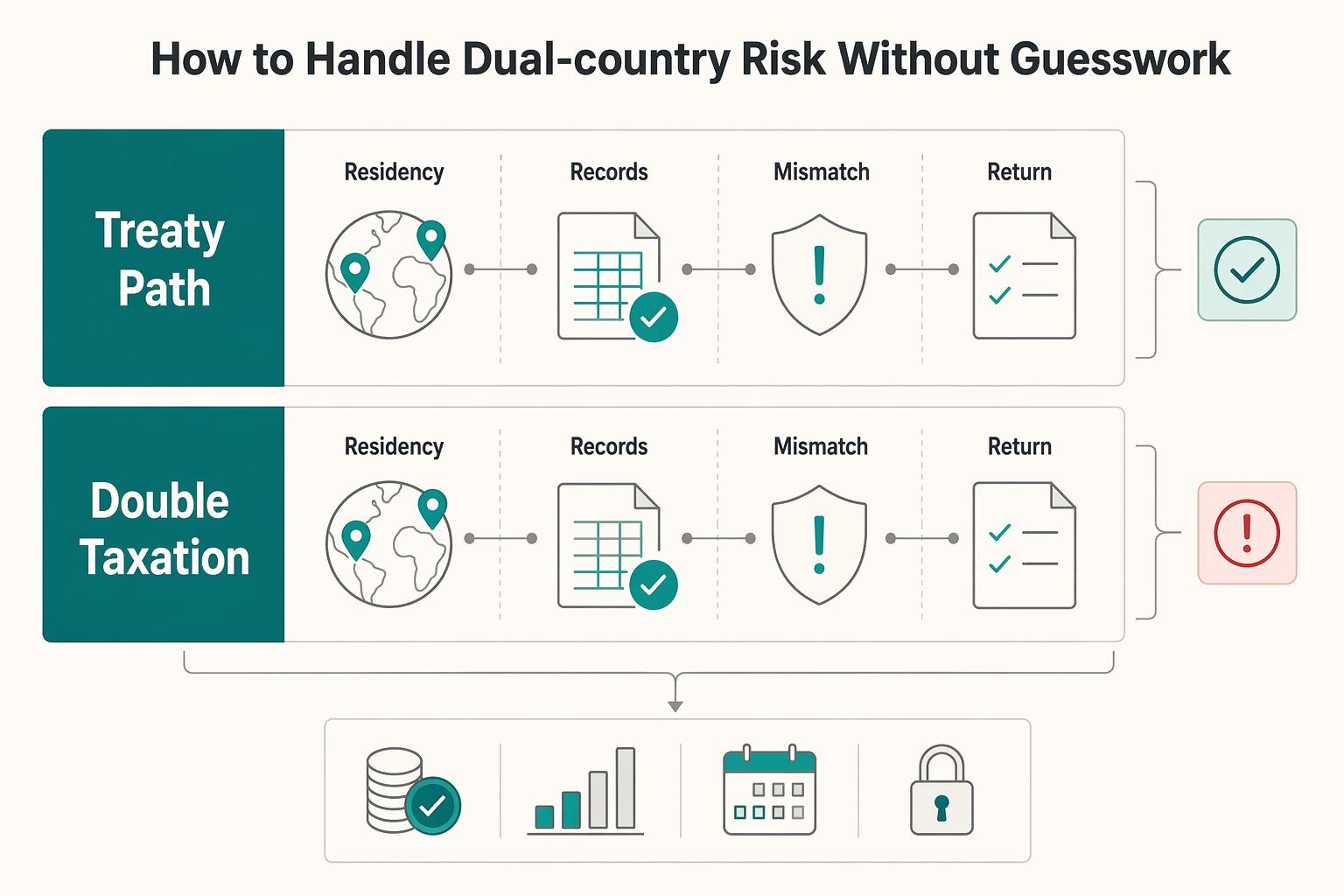
How to Handle Dual-Country Risk Without Guesswork#
Dual-country risk is manageable when you choose a relief route before filing and confirm your records can support it. The practical split is no-treaty path versus treaty path, followed by confirmation of foreign tax credit eligibility.
| Path | What it can do | Where it breaks |
|---|---|---|
| No treaty path | Relies on domestic rules in each country, including possible credit or deduction relief where allowed | Relief is limited by eligibility rules, filing mechanics, and documentation |
| Double taxation treaty path | Uses treaty provisions where a treaty exists and applies to your facts | Treaty relief is not automatic and depends on eligibility and filing support |
For U.S. filers, foreign tax credit relief is conditional. If the same income is taxed by the U.S. and another country, a credit or itemized deduction may be available, and a credit can reduce U.S. tax liability. Under IRS Topic 856, the foreign tax must meet qualifying tests to be creditable.
Execution details matter:
- Form 1116 is filed by income category, so unlike categories cannot be blended into one calculation.
- The 2025 instructions require Part IV lines 25 through 32 even when filing only one Form 1116.
- Corporations use Form 1118.
Common breakdowns are predictable:
- Incomplete records supporting a foreign tax credit claim.
- Claiming a credit for taxes tied to income that was excluded.
- Mixing categories on Form 1116.
Use one decision rule for dual-country conflicts. If residency treatment is unclear across jurisdictions, get a written cross-border tax position before filing.
Common Mistakes That Trigger Expensive Cleanup#
Expensive cleanup usually comes from process gaps and delayed assessments, not one dramatic error.
First mistake: treating one status label as the whole tax analysis. Residency analysis and treaty documentation should be handled as separate workstreams. Keep those files separate and write down your filing position before return preparation starts.
Second mistake: relying on a single screen in mixed cross-border facts. Tax exposure can shift when residency status changes or treaty relief is lost, so test the full fact pattern early.
Third mistake: building records too late. If a tax authority asks for support and your file is fragmented, delays and rework follow quickly. Added cost often appears in reconstruction work: matching dates, correcting labels, and revising filing positions after the fact.
Fourth mistake: assuming treaty relief is automatic. Treaty treatment can fail on execution, and a failed claim can materially change exposure. For U.S. matters, IRS IRM 21.8.4 addresses certification for reduced treaty rates, Form 8802 is the application route for U.S. residency certification, and the process includes payment validation and processing time limits.
Use this pre-filing check:
- Keep status records, residency analysis, and treaty documentation in separate folders.
- Do not rely on a single screen when facts are mixed.
- Reconcile your evidence pack before filing, not after.
- Start treaty certification early enough to clear processing time limits.
- Keep one short memo per filing year stating your classification logic and supporting records.
Clarity today is cheaper than correction later, and a concise written position backed by matching records reduces disputes and rework.
Your 30-Day Compliance Checklist Before and After You Cross Residency Risk#
Use this 30-day window to lock your residency position and the records that support it. Start when your rolling days approach 183 or immediately after crossing that point.
| Week | Focus | Key actions |
|---|---|---|
| Week 1 | Day-count classification | Track presence against the 183-day test within a 365-day period, count entry and departure days, and keep a dated snapshot of each recalculation |
| Week 2 | Non-day trigger review | Review facts under Article 10 of the Estatuto Tributario and Chapter 3 of Decree 1625 of 2016 and test listed triggers for Colombian nationals |
| Week 3 | Evidence-readiness check | Build and reconcile the evidence file for your Colombia position and any foreign position, and prioritize foreign tax residency proof status |
| Week 4 | Filing-scope alignment | Confirm what is in scope for the filing year and verify that your residency conclusion, scope map, and any relief approach describe the same income periods and jurisdictions |
- Week 1: Day-count classification. Track continuous and discontinuous presence against the 183-day test within a 365-day period, counting entry and departure days. Recalculate the rolling window regularly, not only year-to-date totals. If a 365-day window spans two fiscal years, flag the second year because taxpayer treatment can attach there. Keep a dated snapshot of each recalculation so your final filing position has a documented timeline.
- Week 2: Non-day trigger review. Review facts under Article 10 of the Estatuto Tributario and Chapter 3 of Decree 1625 of 2016. For Colombian nationals, test listed triggers, including whether a significant other or underage children are deemed tax residents and whether 50 percent or more of income is Colombian-sourced. If day count and non-day triggers point in different directions, escalate before filing and consider specialist input.
- Week 3: Evidence-readiness check. Build and reconcile the evidence file for your Colombia position and any foreign position. Prioritize foreign tax residency proof status because failing to provide requested proof appears in the listed trigger set. Run a quick access test: can you produce the key records immediately, with names and dates that match the position you plan to file.
- Week 4: Filing-scope alignment. Confirm what is in scope for the filing year based on your residency conclusion and facts. Verify that your residency conclusion, scope map, and any relief approach all describe the same income periods and jurisdictions.
Two practical controls make this month easier:
- Ownership control: Set one owner for timeline updates and one owner for supporting records, even if both roles are you.
- Final review control: Schedule one final review before submission to confirm that calculations and supporting records tell the same story.
Meanwhile, if your facts are mixed or cross-border treatment is unclear, get specialist support before filing. A short written position now is usually easier than correcting residency, reporting scope, or relief claims later. If you want a second review before submission, Talk to Gruv.
Conclusion#
In Colombia, tax residency is a classification decision backed by records, not determined by immigration status alone. The working legal map is Article 10 of the Estatuto Tributario and Chapter 3 of Decree 1625 of 2016. Test physical presence across a 365-day window, include entry and departure days, and map cross-year windows carefully because treatment can attach in the second fiscal year.
Do not rely on day totals alone when facts are mixed. Article 10 includes non-day triggers for specific patterns. They can include, for Colombian nationals, cases where 50 percent or more of income is deemed Colombian-sourced, and cases where requested proof of foreign tax residency is not provided. A complete travel log helps, but it is not enough by itself when non-day tests apply.
Use this sequence now:
- Recalculate your 183-day and 365-day position, including entry and departure days.
- Re-run Article 10 and Decree 1625 checks against current facts.
- Confirm foreign tax residency evidence is complete and quickly retrievable.
- Verify filing-year reporting scope, including whether Form 160 may apply and how current-year UVT treatment is handled.
- Align your relief path with the same income periods and jurisdiction labels used in your returns.
One final caution: some guidance uses "183 days" while other guidance uses "more than 183 days." If your count is close to that line, confirm the filing-year interpretation in writing and keep that rationale in your year file. You can also rerun your final numbers in the tax residency day counter before you lock your filing memo.
If your case spans multiple countries, obtain qualified cross-border advice before filing rather than correcting residency, reporting, or relief issues later. To confirm what is supported for your country or program, Talk to Gruv.
Frequently Asked Questions
When do you become a tax resident in Colombia?
This section does not establish Colombia's residency day-count or non-day tests. Determine residency using the current Colombian rules for the filing year, and get written advice when your facts are close to a threshold.
Do entry and exit days count toward the 183-day rule?
Keep a dated travel log and verify the counting method under current Colombian guidance before filing.
What happens if my 365-day period crosses two fiscal years?
This section does not support a definitive cross-year residency outcome. Build one rolling timeline, then confirm the filing-year effect under current local rules.
Can I be treated as resident even if I do not cross 183 days?
Possibly, but this section does not provide supported criteria to decide that. Do not rely on travel totals alone without checking the applicable residency rules.
Does Colombia tax worldwide income after residency starts?
Residency can change reporting scope, but this section does not define Colombia's scope rules. Settle classification first, then align records and filings with the relief path you plan to claim.
What documents should I keep in case DIAN asks for proof?
Keep organized records that support the position you file and any relief you claim. Include a clear timeline, consistent identity and jurisdiction details across records, and proof of foreign taxes paid or accrued when claiming foreign tax relief.
How do double taxation treaty and foreign tax credit relief differ in practice?
Treaty relief and bilateral arrangements are intended to reduce double taxation between countries. A foreign tax credit is a domestic mechanism that may reduce double taxation when the same foreign-source income is taxed by two jurisdictions and eligibility rules are met. For U.S. filers, individuals, estates, and trusts use Form 1116, corporations use Form 1118, and relief is not automatic; qualifying tests still apply and some foreign taxes do not qualify.
Try a related tool
Researched and edited by the Gruv editorial team. Gruv builds cross-border billing, payouts, and finance-operations software for global businesses.
Sources
Includes 1 external source outside the trusted-domain allowlist.
- irs.gov/individuals/international-taxpayers/foreign-...trusted
- irs.gov/taxtopics/tc856trusted
- legislation.gov.uk/ukdsi/2017/9780111160183/pdfs/ukdsi_97801111...trusted
- oecd.org/content/dam/oecd/en/topics/policy-issue-focu...trusted
- medellinadvisors.com/tax-residency-and-obligations-for-colombian-...external
Educational content only. Not legal, tax, or financial advice.
Related Posts

Digital Nomad Taxes in 2026 With a Defensible Filing Plan
With digital nomad taxes, the first move is not optimization. It is figuring out where you may be taxable, where filings may be required, and what proof supports that position.

Hungary White Card Guide for Digital Nomads: Eligibility, Documents, Fees, and Timeline
Treat this like an audit, not a hope-and-pray submission. Your job is to decide whether your real-world setup fits the permit logic, pick the right filing route, then build one evidence pack that stays coherent even if someone reviews it line by line.
EU DAC7 Directive for Freelancers Using Digital Platforms
Treat the EU DAC7 Directive as an execution problem, not a theory exercise. Your job is to do three things early: identify which income channels need review, set up one record routine you can actually maintain, and escalate complex cross-border cases before they turn into year-end guesswork.