
Quick Answer
Choose your legal stay route before you spend: compare Thailand Elite and the BOI-administered LTR path, then run a 30-14-7 document cadence with a dated evidence pack. Keep flights and first housing flexible until required files are marked ready. In Chiang Mai, use the first 72 hours to complete TDAC timing checks, test your primary connection plus one backup workspace, and delay long leases until real work blocks pass.
Start Here and Plan Backward From Your Move Date#
Set the move date first, then plan backward from the decisions that can block legal stay or interrupt paid work. That order removes most avoidable chaos because it forces you to solve the high-impact risks before you spend money on comfort or convenience.
Pick one base city before you start optimizing lifestyle details. Switching cities in week one usually creates more friction than flexibility. It adds decision fatigue, scatters your setup work, and makes it harder to tell whether a problem comes from the city, the neighborhood, or your own routine. A stable base gives you a cleaner ramp for legal admin, housing checks, and work continuity. Chiang Mai is often treated as a practical first base because many people can get operational quickly. Familiar work spots like Punspace, CAMP, and Yellow help, and Nimman is a common landing area.
Keep the sequence strict:
- Legal stay route first. Confirm what you are actually eligible for before paying any nonrefundable costs. Community guides may mention visa-exempt entry, possible extensions, and tourist-visa timing, but treat those as placeholders until you verify nationality-specific rules through official Thai channels.
- Documents second. Build one evidence pack early and keep it current. Store required files together, date each version, and log what you submitted and when so follow-up requests are easier to answer.
- Arrival setup third. Choose your first neighborhood, primary workspace, and connectivity backup before you arrive. Stability first, comfort second.
Create one simple decision log with three columns: assumption, last verified date, next commitment affected. That habit stops old information from driving new payments. If a key assumption is stale, recheck it before you book.
Add commitment gates to the same log. Typical gates are flight purchase, first housing payment, and any long-lease decision. A gate passes only when legal-route clarity and document readiness both pass review. If a gate fails, move the timing or switch to reversible options instead of forcing the plan forward under pressure.
Apply the same discipline to money and lifestyle assumptions. Published cost and quality-of-life estimates vary a lot, so plan with ranges and fallback options, not one fragile monthly number. Also check life outside work. Some expats report weekend dissatisfaction when they choose a location only around work logistics. If you plan backward from the move date and keep each gate tied to something verifiable, the next decisions get much cleaner.
That is why the terms in the next section matter. This is not glossary work for its own sake; you need working labels that keep each decision consistent.
Related: Thailand's Long-Term Resident (LTR) Visa for Professionals.
Understand the Terms Before You Book Anything#
Treat these terms as planning controls, not definitions for their own sake. If the labels are vague, planning gets inconsistent fast, and the expensive corrections come later.
- Legal stay path: your working label for a still-unverified route and the proof you expect to keep. It is not a legal conclusion until current rules are confirmed through official channels.
- Relocation timeline: the ordered sequence from pre-departure planning through your first weeks after arrival. In practice, this usually spans months.
- Operational setup: your practical base for living and work, including accommodation, food, transport, and phone or internet continuity.
- Verification checkpoint: a dated recheck before commitment so old information does not drive new payments.
Use legal stay path as a gate, not a footnote. If your route is unclear, keep bookings flexible and early commitments short. Do not lock long leases or rigid flights while eligibility is still uncertain.
Treat the relocation timeline as dependency order. You do not need perfect visibility into everything at once. You need the next critical item confirmed before the next deposit leaves your account. That shift alone lowers pressure and preserves fallback options.
Keep operational setup practical and testable. One source describes Chiang Mai as a major remote-work destination in Southeast Asia and frames Nimman as a common first stop. That can reduce setup friction, but fit risk still matters. Some expats also report difficulty building friendships and limited weekend options, so include those checks early instead of discovering them after a long commitment.
Make checkpoints explicit. Date each assumption, tie it to one decision, and flag older inputs for recheck priority. Once these terms are doing real work, the next step is straightforward: pick the legal route that you can actually support with evidence now.
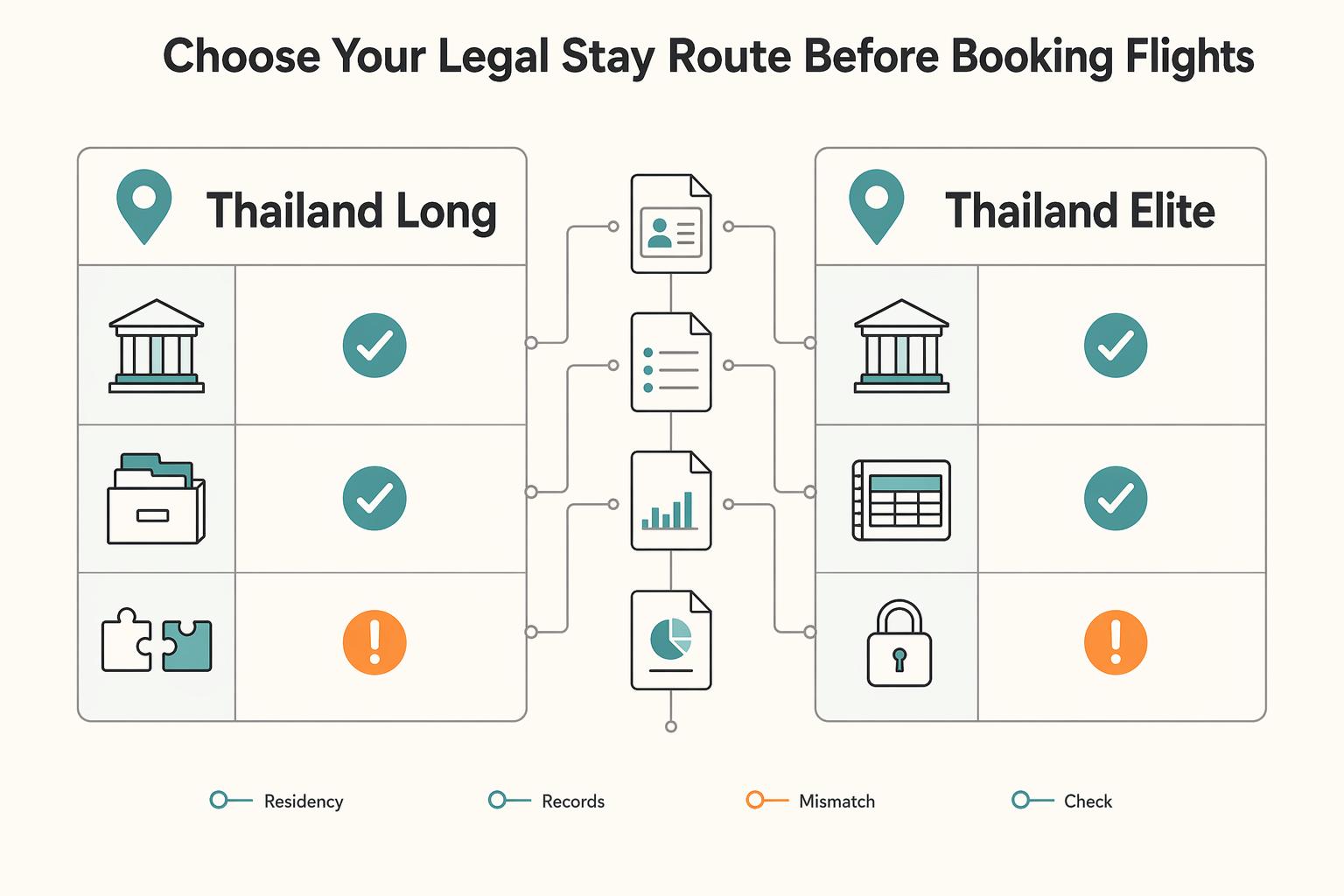
Choose Your Legal Stay Route Before Booking Flights#
Choose your legal stay route before you pay for flights or long housing. The best option is the one you can document now, not the one that sounds best in a summary guide.
Use this first-pass comparison:
| Route | What is clearly supported | Core tradeoff to test | What to verify before paying deposits |
|---|---|---|---|
| Thailand Long-Term Resident (LTR) Visa | Described as a 5-year visa with a 5-year renewal, launched in 2022, administered by BOI, with multiple categories and dependents. | Longer duration can reduce repeat admin, but qualification is strict and category dependent. | Current category criteria, accepted proof list, and whether you fit one category without exceptions. |
| Thailand Elite Visa | Identified as one of the three routes in the same comparison set. | Included in the comparison, but this section has no verified tier, fee, or processing detail. | Current package options, costs, and required steps from official channels before any nonrefundable commitment. |
If you are screening for LTR, test documentation burden first. A July 2025 comparative brief included example markers for some categories, including assets or investment, age or pension, and qualifying alternatives like health insurance coverage at $50,000 or $100,000 in a Thai bank for 12+ months. Use those as screening markers only, not as authority to book. Then recheck live criteria before you pay.
Use the Global Digital Nomad Visa Index for context, not as approval logic for Thailand. Rankings compress details that decide real outcomes. The same 2025 comparison also noted that a previously cited $80,000 income requirement for one LTR path was removed, which is exactly why date-stamped verification matters right before payment.
Run one pre-booking checkpoint and save it:
- Set a dated legal checkpoint before flight payment.
- Write your target route and category in one line.
- List required documents and mark each as
ready,pending, orunavailable. - If any required item is
unavailable, change route or move timing. - Save the checkpoint result with a timestamp so everyone involved is working from the same version.
Apply the same rule to housing. If route eligibility is still unclear, avoid long leases and keep your first stay flexible until legal status is stable. In practice, most relocation stress comes from stacking two risks at once: uncertain legal status and irreversible spend. Separate those, and the move gets much easier to manage.
For category-level detail, review Thailand's Long-Term Resident (LTR) Visa for Professionals. You might also find this useful: our digital nomad visa index for 50+ countries.
Build the Document Checklist on a 30-14-7 Day Timeline#
Use a 30-14-7 cadence to keep document work visible and current. It is a planning method, not a Thai legal requirement, and it helps surface missing proof before you lock expensive commitments.
| Checkpoint | Focus | Actions |
|---|---|---|
| 30 days out | Build your core file set and storage map | Collect identity files, travel-plan records, financial-capacity proof, and route-specific support documents; check passport validity and blank pages; maintain an index with document, version date, and planned submission point. |
| 14 days out | Recheck status and preserve flexibility | Confirm submission status and re-verify that assumptions still match current official guidance; update the evidence pack instead of keeping parallel versions; keep arrival timing and first-week commitments flexible. |
| 7 days out | Freeze only after final legal recheck | Lock flights and near-term accommodation only after a final rules recheck and document audit; if a material item is still unclear, delay the freeze rather than traveling on assumptions. |
Keep one reality check in front of every checkpoint: Thailand digital nomad visa is an informal label, not a single visa class. Requirements can change quickly. Track both document readiness and fresh verification through official Thai e-visa channels or your nearest Thai embassy or consulate.
30 days out: build your core file set and storage map.
Collect identity files, travel-plan records, financial-capacity proof, and route-specific support documents in one reusable folder structure. Check passport validity and blank pages early. Maintain a short index with document, version date, and planned submission point, and mark missing items as active risk. Remove duplicates and outdated scans now so the same file is not submitted in two versions later.
At this stage, focus on completeness over polish. The point is to see what is missing while you still have time to request, replace, or reformat documents without forcing the whole move to slip.
14 days out: recheck status and preserve flexibility.
Confirm submission status and re-verify that assumptions still match current official guidance. If anything has changed, update the evidence pack instead of keeping parallel versions in different folders. Keep arrival timing and first-week commitments flexible in case appointments, processing, or logistics move.
This is also the right point to check whether your plan still fits the route you chose. A common failure mode is choosing a visa label first and then forcing life decisions around it later, even after the evidence no longer fits cleanly.
7 days out: freeze only after final legal recheck.
Lock flights and near-term accommodation only after a final rules recheck and document audit. If a material item is still unclear, delay the freeze rather than traveling on assumptions. The closer you get to departure, the more expensive a last-minute correction becomes.
Maintain a separate backup folder with key proofs and a dated contact log. When follow-up requests come in, response speed matters. If your stay starts looking more like repeat long-term living than a one-off trip, recheck route fit before making another long commitment. The paperwork should support the life you are building, not lock you into an outdated plan.
If you want broader city context, read Bangkok Digital Nomad Guide for 2026 Long-Stay Moves. If you want to turn this paperwork cadence into one working checklist before nonrefundable spend, use Visa Cheatsheet for Digital Nomads.
Execute a First 72 Hours Arrival Sequence in Chiang Mai#
Treat the first 72 hours as risk reduction, not lifestyle optimization. Your goal is simple: stable entry, stable internet, and a repeatable work block by day three.
Keep entry documents easy to access before departure and on arrival. TDAC is required within 72 hours before arrival, submission is free through the official Thai Immigration website, and entry checks may include random proof-of-funds checks of 10,000 THB per person or 20,000 THB per family. Because requirements can shift, keep a dated note of your latest official verification.
Day 1: activate connectivity and test backup before work starts.
Set up a local SIM early and test tethering with your real call and file-sync routine. Local SIM pricing is often around 150-800 baht, while roaming can run about $10-15 per day. AIS is a practical coverage-first option, but confirm signal quality in your actual building. A provider can be solid in the city and still underperform in one apartment or on one floor.
Day 1-2: validate your base area during work hours.
Walk likely routes in Nimman or your planned neighborhood at the same times you will actually move between housing, food, and work. Do one morning pass and one late-afternoon pass so your plan reflects real conditions, not a quiet midday impression. You are checking for friction: noise, travel time, building access, and how easy it is to switch locations without blowing up your day.
Day 2: test one backup workspace before you need it.
Run a real work block from a fallback location, including one call and one upload. Confirm fit in person instead of assuming a venue will be suitable when pressure is high. If the first backup fails, choose a second one the same day. Do not leave your fallback untested because the primary setup seems fine.
Day 3: lock a one-week rhythm before adding fixed spend.
Set fixed blocks for work, meals, transit, and admin, then pressure-test that pattern. Extend accommodation or add larger monthly costs only after the routine works without daily improvisation. By this point, you should know whether the area supports your real schedule, not just whether it looked good online.
Do not mistake activity for stability. If your tests are incomplete, keep commitments short and finish the checks first. Once the first 72 hours are under control, the next priority is month-one admin and money, because that is where small misses turn into bigger constraints.
Stabilize Month One Admin and Money Operations#
Stabilize cash flow first. Month one is where small admin misses turn into payment delays, and payment delays quickly narrow your housing and work options.
For international clients, run invoicing and payout steps with explicit status tracking, not ad hoc chat confirmations. Keep one primary payout route and one backup route. Store invoice IDs, approvals, and payout records together so problems are solved from evidence instead of memory. In practice, the people most surprised by delayed payments usually had warning signs sitting in scattered messages or half-saved records.
Run one monthly checkpoint on the same date:
- Match each invoice to delivery proof, such as an approval message or accepted milestone.
- Save a payout evidence pack with invoice, scope or contract record, payment confirmation, and requested client tax documents.
- If you keep a Thailand day-count log, update it from entry and travel records, and treat any residency or tax implications as uncertain until you verify them with a qualified local professional.
- Review unpaid invoices by age and trigger your delay process automatically.
- Date-stamp policy notes. If guidance is archived, inaccessible, or not recently verifiable, treat it as uncertain until confirmed.
Put this checkpoint on your calendar and keep it non-negotiable in month one. If a task misses the slot, complete it within the same week so admin debt does not compound. This is not bureaucracy for its own sake. It keeps your delivery options open when client timing shifts.
Set and test two escalation paths in your first month in Chiang Mai: one for delayed payments and one for documentation requests. For delays, define a fixed sequence of reminder, resend with records, secondary contact, and contract-based stop rule. For documentation, send only what was requested first, then route follow-ups through one controlled folder and changelog to reduce version-conflict risk.
Once money and admin are stable, neighborhood choice becomes much easier to judge. You can evaluate an area on how it supports work, not on how urgent your setup still feels.
Pick the Right Neighborhood Based on Work Style and Constraints#
Start with Nimman if your first priority is setup speed. It is often presented as a practical launch area for new arrivals because many day-to-day needs sit close together. Keep Santitham as a real alternative, and decide from observed workdays, not assumptions.
One Chiang Mai guide explicitly prefers Nimman, but neighborhood fit is still personal. The useful test is not whether an area is popular. It is whether it supports the kind of workweek you actually run. A place that feels convenient for three casual days can become expensive, noisy, or socially flat over a longer stay.
Run a short trial stay before you take a longer lease, then compare notes against the same criteria:
- Reliability for calls and focused work.
- Access to backup work spots.
- Day-to-day spending trend.
- Weekend and social fit for long-stay sustainability.
Watch mismatch early. A convenient hub can increase spending pressure over time, and some expats in Chiang Mai report weak weekend engagement or difficulty making friends. Keep the area where work stability and off-hours sustainability both hold up in practice. That answer may be different for your first month than for a later, longer stay, and that is fine.
Decide Coworking Versus Cafes With Clear Rules#
Use coworking for reliability-critical work and cafes for lower-risk blocks. That split gives you predictability where it matters and flexibility where it does not put delivery at risk.
In Chiang Mai, coworking is usually more consistent for internet and calls, but consistency is never automatic. A popular place is not automatically a call-safe place, and a quiet cafe at noon may be useless during your actual client window. Decide from repeatable checks and recent observations.
Use this weekly rule set:
- For call-heavy or client-facing days, book coworking first and treat cafes as secondary.
- For mostly asynchronous deep work, mix coworking and cafes only if delivery quality stays stable.
- Before each week starts, scan recent Google reviews for internet-related comments on shortlisted coworking spaces.
- On first use of any venue, run one full block with a real call and a real upload.
- Log date, time window, and pass or fail so patterns are visible.
- Keep two approved options for each day type: one call-safe option and one deep-focus option.
The log matters more than most people expect. After a couple of weeks, you will usually see clear patterns around noise, seating, upload reliability, and how much friction each venue adds to your day. If performance slips, shift more hours back to coworking until output is stable again.
Do not confuse availability with reliability. Chiang Mai is often described as a remote-work hub with many options, but the only options that count are the ones that still work during your real deadlines. That same mindset applies to connectivity more broadly, which is why redundancy should be in place before you need it.
Build Connectivity Redundancy Before It Becomes a Problem#
Set redundancy before it is urgent. Use fixed-location Wi-Fi as your primary path and a local 5G SIM or eSIM as backup so one outage does not stop delivery.
Connectivity is necessary, but it is not enough by itself. A 2026 Thailand study of 325 international digital nomads and workationers found connectivity is non-negotiable but has limited influence on overall satisfaction on its own. That matches how this works in practice. Protect delivery first, then treat neighborhood fit, schedule, and cost as separate choices.
Treat any single mobile connection as one backup path, not a guaranteed fix. A dual-SIM or eSIM-capable phone can reduce failover time because you can switch quickly without swapping physical SIMs. That matters when the issue is not a full outage but unstable call quality or a building-specific problem that only shows up during busy hours.
Test connection performance on arrival and during real working windows at both your home base and backup venue. Keep one simple log:
- Run one live call test and one real upload test at each location you rely on.
- Repeat during your busiest client window each week.
- Record whether failures were speed drops, call instability, or full outages.
- Keep one backup venue ready, ideally a coworking option that may have backup power or on-site IT support.
- Retire any location that repeatedly fails in critical work blocks.
Set one switch rule now so you are not deciding under pressure: if your primary location cannot support core tasks in a session, switch immediately to backup data or a backup venue. The mistake is usually not that the first connection fails. It is that people wait too long to move because they hope the problem will clear on its own.
Once your work can survive a connectivity issue, budgeting becomes more honest. You can see what you actually need to spend to stay reliable.
Set a Budget Range With Trigger Points, Not One Number#
Use a budget range with pre-set triggers, not a single monthly number. A single target hides risk, especially when housing and workspace choices shift your real spend.
Treat published figures as directional, not universal. One shared estimate places monthly living costs around $1000 to $1500. Apartment examples run from very basic units near US$100 to US$1000 or more for larger homes with western-style kitchens. One example building shows under $200 short term and under $150 on a one-year lease. These are anecdotal snapshots, not market averages. One cited city rating is explicitly based on personal experience from a one-month stay.
Use the range to plan tradeoffs rather than pretending uncertainty is gone:
| Scenario | What it looks like in practice | Who it fits |
|---|---|---|
| Lean | Basic housing, tight discretionary spend, careful paid-workspace use. | Variable income or delayed client payments. |
| Standard | Mid-range setup with room for regular coworking and normal social spend. | Mostly stable income with fewer weekly tradeoffs. |
| Buffer-heavy | Extra headroom for rent, workspace, flight, or admin spikes. | High but uneven income, or a longer runway target in Southeast Asia. |
If your plan works only in a best-case month, it is too tight. Check whether fixed costs still leave room for your actual work cadence and recovery. If not, adjust your setup before committing further. A budget is useful only if it tells you what to do when reality starts drifting.
Set personal trigger rules before longer commitments:
- Choose an action threshold for sustained overspend against your housing-plus-workspace band, then adjust housing or workspace setup.
- If timing is flexible, arriving before October may improve apartment choice.
- If you start with a short rental for flexibility, set a decision date to switch to a longer lease if it lowers monthly burn.
Track runway in months, not just monthly totals. If two consecutive months land above your planned band, act immediately instead of waiting for a perfect month to correct itself. Small adjustments made early are usually less disruptive than major resets after fixed costs accumulate.
Keep fixed commitments separate from discretionary spend so runway stays visible. Put rent, utilities, core connectivity, and baseline workspace in fixed. Keep networking, cafes, weekend trips, and upgrades in discretionary. If pressure appears, cut discretionary first, then redesign fixed costs. This keeps your plan responsive without making every week feel like a reset.
A budget that survives real life makes it easier to be selective about community. You can say yes to the right things without letting social momentum wreck your work rhythm.
Build Community Without Losing Work Consistency#
Build community in a way that protects delivery consistency. Start with one recurring professional touchpoint, then add more only after two stable work weeks.
Meeting people may not be the hard part. One widely shared guide reports over 6,000 remote workers in Chiang Mai in October 2025, which suggests strong community density but is not an official count. Treat that figure as directional. Some recommendations are based on individual stays, and some posts disclose affiliate links, so use them as leads to verify, not as automatic decisions.
Use a simple weekly structure:
- Keep one fixed professional touchpoint each week, such as a coworking meetup or small industry event.
- Add a second event only after two straight weeks of planned delivery.
- Cap first-month social plans at two weeknights so mornings stay predictable.
- Track each event outcome as useful contact, concrete learning, or no signal, then drop low-signal events quickly.
Choose workspace by task, not hype. Use quieter coworking windows for deep focus and social windows for introductions. Punspace Wiang Kaew is one concrete option, but no single space fits everyone. A practical balance is focused work near your weekday base plus one off-screen evening to reset.
Use named events selectively. Join when audience fit is clear and you can define one goal in advance. Apply the same filter to online forums: check post date, check for recent Thailand context, and confirm the advice fits your legal and work constraints.
The common failure mode is overload. When delivery, travel logistics, and legal admin collide in the same week, extra events can push deadlines off track. Set an if-then rule now: if deadlines slip or admin tasks miss dates, pause new social events for seven days and keep only your single recurring touchpoint. That still leaves room to build a network, but it stops the social side from quietly taking over your month.
Avoid the Most Common Relocation Mistakes#
The expensive mistakes are usually not dramatic. They are ordinary decisions made too early and with too little verification. Keep commitments reversible until budget reality, housing function, and work continuity all pass real-world checks.
- Long lease before housing is work-ready: Do not commit to a long apartment contract from photos alone. Read reviews carefully, ask specific internet questions, and avoid rushed bookings before taking on longer terms.
- Following generic best-area advice: Nimman is a common starting point for new arrivals, but that is not enough to choose. Test your setup against your actual work cadence, then keep only what supports consistent delivery.
- Using stale budget assumptions: Recheck current day-to-day costs before each major booking checkpoint, including groceries, transport, coworking, rent, and healthcare. If actual spend drifts, adjust housing or workspace before adding another fixed commitment.
- No workspace fallback: Assume your first setup can fail because of spotty Wi-Fi or noise. Pre-select at least one backup option and verify current hours, pass terms, and availability yourself.
If deadlines or sleep start slipping, treat pace as a burnout warning. Pause new commitments and stabilize one base before optimizing further. Most relocation problems get cheaper to solve when you catch them early and keep the next decision small.
Wrap Up and Your Next Three Actions#
Keep the sequence simple and strict: legal-stay decision, document checkpoints, then arrival setup. That order lowers rework when plans shift close to departure and gives you a clean way to stop, adjust, or move forward at each stage.
- Confirm your legal-stay decision, then lock only reversible bookings.
Write a one-page note with your primary route, fallback route, and a go or no-go date for paid commitments. If you are still comparing routes, keep flights and first housing refundable. One firsthand account describes DTV as supporting stays of up to five years, but treat third-party summaries as directional until you verify current official terms. Do not base your plan on remote work under a tourist visa, which one source describes as common but technically not legal.
- Time-box your 30-14-7 checklist and run one verification checkpoint before departure.
At 30 days, gather route-related documents and mark gaps. At 14 days, recheck route assumptions against current documents and booking terms. At 7 days, lock only commitments that still pass review. Keep a dated log of what changed and what action you took so final-week decisions stay clear.
- Pre-select one neighborhood, one primary workspace, and one backup path in Chiang Mai.
Choose a practical first base and a backup, then test both against your real routine after arrival. One long-stay guide suggests Nimmanhaemin as a temporary base while apartment hunting. Build slack into housing timing: Nov-Feb is described as peak season, and one long-stay account reported waiting a couple of weeks for a preferred apartment. Test multiple cafes and coworking options in your first week before committing.
If any one of these three actions fails, do not force the rest forward. Move dates, switch to reversible options, or simplify month one so legal, housing, and work risk do not stack.
Treat this as an execution loop, not a one-time checklist. Recheck assumptions when money or legal exposure changes, and keep decisions reversible until the next checkpoint clears. Small dated checkpoints keep this relocation manageable when rules, costs, and timelines shift close to your departure date.
After you land, lock in a repeatable client billing routine so cash flow stays steady during month one: Free Invoice Generator.
Frequently Asked Questions
Is Chiang Mai still a strong base for remote professionals in 2026?
For many remote professionals, yes. Chiang Mai is widely described as a long-running remote-work hub, and internet is often strong enough for online work, with real variation by location and provider. Treat it as a high-potential base, not an automatic fit for every routine.
How much does it realistically cost to live in Chiang Mai each month?
No single fixed monthly total applies for 2026, so plan with ranges rather than one number. One published budget was based on a five-month stay and later noted the same lifestyle would likely cost more now, which makes older totals risky as planning anchors. Recheck rent, transport, coworking, groceries, and healthcare before each major commitment.
Which area is better for remote work routines, Nimman or Santitham?
There is no one-size winner between the two areas. Test your real cadence in both, including call-heavy and deep-focus blocks. Keep the area that best supports consistent output and a sustainable daily routine.
Should I work from coworking spaces or cafes in Chiang Mai?
Both are common, and options are generally plentiful. Punspace and CAMP are commonly cited for reliable Wi-Fi, but you should still test conditions during your actual working hours before relying on any single spot.
What should I complete before departure versus after arrival in Thailand?
No universal official before/after checklist applies to every situation, so keep plans flexible. Before departure, confirm your legal-stay route and gather required documents; if you plan to work remotely, do not assume tourist-visa work is legal. After arrival, test internet during real work windows and confirm your housing and at least one backup workspace can support your workflow.
How do I compare the Thailand Elite Visa and Thailand LTR Visa for a long stay?
Treat them as different routes, not interchangeable labels. LTR is described as category-based, BOI-administered, and strict on qualification, with a 5+5-year structure for approved cases. Elite is presented as a separate long-stay option in the same comparison set. Compare based on what you can document and your tolerance for eligibility risk, then verify current official requirements before paying.
What is the minimum setup I need in the first 72 hours to avoid work disruption?
No universal minimum 72-hour setup sequence applies to every situation. Keep setup minimal and testable: one stable primary connection, one backup work location, and a housing setup where you can complete a real call and upload without interruption. By day three, set a repeatable work block and a clear fallback rule so problems do not force rushed decisions.
Try a related tool
Researched and edited by the Gruv editorial team. Gruv builds cross-border billing, payouts, and finance-operations software for global businesses.
Sources
Includes 5 external sources outside the trusted-domain allowlist.
- belaroundtheworld.com/chiang-mai-digital-nomad-guide-thailandexternal
- coworkingdays.com/digital-nomad-guides/chiang-mai-remote-work-...external
- esim.holafly.com/digital-nomad/where-stay-chiang-maiexternal
- manvsclock.com/chiang-mai-digital-nomad-guideexternal
- punta.app/digital-nomad-guides/chiang-mai-thailand/fre...external
Educational content only. Not legal, tax, or financial advice.
Related Posts

Bangkok Digital Nomad Guide for 2026 Long-Stay Moves
This guide is for remote professionals planning a long stay in Thailand. It puts legal and operational decisions first, then lifestyle choices.

Thailand's Long-Term Resident (LTR) Visa for Professionals
For a long stay in Thailand, the biggest avoidable risk is doing the right steps in the wrong order. Pick the LTR track first, build the evidence pack that matches it second, and verify live official checkpoints right before every submission or payment. That extra day of discipline usually saves far more time than it costs.

The 2026 Global Digital Nomad Visa Index for 50+ Countries
Start with legal fit, not lifestyle filters. The practical order is simple: choose a route you can actually document, then decide where you want to live. That single change cuts a lot of wasted comparison work and stops you from falling in love with places that were never a real filing option.