
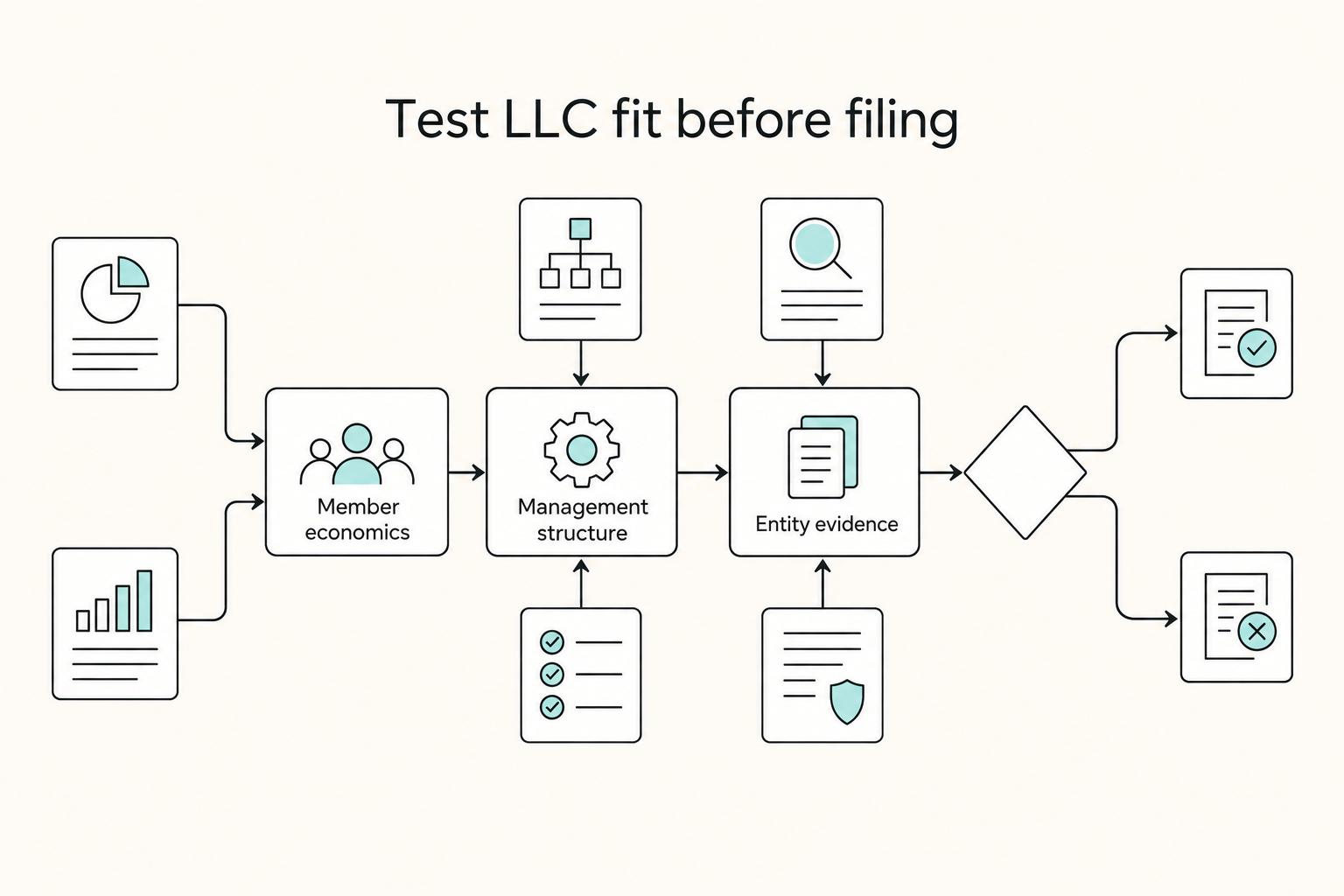
Quick Answer
Verify fit, tax classification and payment eligibility first. Engage the Cayman provider, prepare the prescribed registration facts and signed statement, pay the applicable fee and obtain registration evidence. Then align the LLC agreement and bank authority, maintain books and ownership records, and calendar registry, economic substance and applicable tax-cooperation filings.
Decide whether a Cayman LLC solves your operating problem#
A founder needs more than a registration certificate: the entity must work for client contracts, banking, payouts and tax reporting. Prepare the formation pack, authority controls and recurring compliance record around the actual international business. Regulated activities need their own licensing assessment.
Start with your actual activity, owner tax residence and customer/payment routes. Separate established formation rules from decisions that depend on your circumstances. An offshore address does not decide where the business is managed or where its income is taxed.
Write the fit decision first, obtain provider and bank requirements, then prepare the formation and governance records together. After registration, set up books, ownership records and a compliance calendar. Use the certificate as evidence of legal formation, not as evidence that every bank or regulator has approved the business.
What is established, and what depends on your facts#
Use this distinction in the decision note:
| Established starting point | Decision requiring your facts |
|---|---|
| Separate legal entity with member interests | Whether this form improves your client, investor or payment arrangements |
| A Cayman registered office and registration process | Which provider/service scope you will use |
| Recurring registry and reporting work | Your activity, tax classification and applicable additional filings |
Keep confirmed and unresolved points together in one short decision note. If you cannot explain what is confirmed and what still needs review, pause before paying filing fees or opening accounts.
Working terms for formation and operations#
These documents serve different purposes:
- Registration statement: the prescribed Cayman formation filing.
- LLC agreement: internal economic and governance terms.
- Authority record: resolutions and mandates showing who approves and signs.
- Compliance calendar: task, trigger, owner, reviewer, deadline and proof.
What a Cayman LLC is#
A Cayman LLC has a separate legal identity and member interests rather than share capital. Its management can rest with members or managers. The General Registry’s LLC page distinguishes this form from a company under the Companies Act; do not use the two forms interchangeably.
The LLC is formed under the Limited Liability Companies Act. Cayman law governs its agreement. Contract flexibility makes that agreement central to economics, decision-making and exits, so a Delaware template needs a Cayman-specific review.
The Registry states that Cayman has no income, capital gains or other direct taxation. Government and provider fees still apply, and tax in an owner’s residence or a country where the business operates can remain due. “Tax neutral” is not a personal exemption or an automatic pass-through classification.
Limited liability concerns liability arising solely from member or manager status. Contribution commitments, personal guarantees and other obligations need separate review. Keep entity and personal accounts distinct, and record the capacity in which you sign each contract.
If you have used a Delaware LLC#
| Area | Cayman LLC question | Operational consequence |
|---|---|---|
| Member economics | What contributions, allocations and distributions have you agreed? | Keep the agreement and books aligned; do not assume ownership percentage answers every question. |
| Tax classification | How do relevant countries treat this foreign entity? | A domestic U.S. LLC default is not the Cayman answer. |
| Authority | Do members or appointed managers run the business? | Match approvals and signing powers to the bank mandate. |
Agree both the economic rules and the operating authority. A member’s profit entitlement does not by itself tell a bank who may sign. Keep the agreement, resolutions and actual bank mandate aligned.
Test fit before paying formation costs#
A Cayman LLC may suit negotiated ownership economics or a member/manager structure serving a real cross-border purpose. For a solo services business, compare that benefit with recurring provider costs, reporting and banking friction. Home-country tax classification must be assessed separately; the LLC label does not promise pass-through treatment.
For a single straightforward income stream, a local structure may achieve the same contracting and liability goals with fewer cross-border tasks. If a joint venture needs different contribution, voting or distribution terms, document why those terms justify the extra administration.
For example, a solo consultant invoicing three overseas clients should ask each payment provider whether it accepts Cayman LLCs owned and managed from the consultant’s country. Obtain the required onboarding documents and permitted currencies before filing. A legal entity that cannot receive the expected client payments does not solve the consultant’s operating problem.
| Decision area | Benefit of LLC agreement flexibility | Cost of that flexibility |
|---|---|---|
| Member economics | Agree contributions and distribution arrangements | Drafting and ongoing books must reflect the actual terms. |
| Management | Appoint managers and define reserved decisions | Maintain resolutions and bank permissions as personnel change. |
| Payment access | Use an entity the provider can accept | Formation does not guarantee onboarding or local account availability. |
Ask what changes if you do not use Cayman. If the answer is only an assumed tax saving, obtain the actual entity and owner tax analysis before spending money.
Write a one-page fit memo: business objective, alternative structure, expected annual costs, banking evidence, reporting responsibilities and the tradeoff you accept. Resolve a dependency that would prevent operations before committing to it.
Compare entity forms against the same operating needs#
Compare ownership and governance, tax classification, service-provider obligations and payment access. Investor preference is a question for your actual investors, not something an unrelated public offering can establish.
A Cayman LLC, a Cayman exempted company and a Cayman exempted limited partnership use different interests and governing arrangements. A Delaware LLC is a U.S. entity with its own state and federal treatment. Compare the form you will actually register, rather than treating all four as offshore-company substitutes.
| Form | Ownership/governance starting point | Question to resolve |
|---|---|---|
| Cayman LLC | Member interests; LLC agreement and member/manager authority | Does contractual economics/governance justify the provider and reporting work? |
| Delaware LLC | U.S. state entity with an operating agreement | Do U.S. entity status and relevant federal/state duties fit better? |
| Cayman exempted company | Corporate share structure and constitutional documents | Do the actual investors/transaction require a share-based vehicle? |
| Cayman exempted limited partnership | General and limited partners under a partnership arrangement | Is the general-partner responsibility and partnership model suitable? |
For partnership structure, the Registry’s ELP page identifies general and limited partners. A general partner bears liability if partnership assets are insufficient. Compare that responsibility with the LLC member model. For Delaware, verify the current state fee and annual-tax instructions directly rather than importing Cayman’s filing calendar.
Treat use-case fit as a test. If you run a solo services model, simpler administration may matter more. A joint venture, IP holding setup, or transaction-specific SPV may justify more customized terms.
Before you file, complete one written checkpoint across three maps:
- Banking map: account jurisdiction, onboarding documents, signatories, and likely friction points.
- Payout map: who pays the entity, in which currencies, and whether platforms constrain routing.
- Reporting map: entity-level filings and any owner-level reporting that may apply where you live.
Ask a bank or payout provider for a written eligibility response tied to the proposed entity, activity and owner residence. Conditional approval is still conditional: record what remains to be checked after registration.
Use the table to identify questions, then compare quotations and actual onboarding responses. Provider acceptance, required signatories and client contracting requirements can decide fit more directly than a generic jurisdiction ranking.
Prepare a coordinated formation and onboarding pack#
Once you narrow the entity choice, treat pre-formation paperwork as one coordinated pack. Contradictions usually creep in when drafts are built in isolation.
The Cayman registration statement is a formation filing, not an SEC securities-offering registration statement. Section 5(2) of the LLC Act prescribes its fields. Keep those facts aligned with the LLC agreement, ownership information and bank application. Provider identity/source-of-funds documents are additional onboarding requirements, not substitutes for the statutory filing.
Document control matters as much as document content. Keep one current draft per file, track who updated it, and note the date and reason for each change. A common source of pre-filing friction is mismatched versions sent across advisors, banks, and internal reviewers.
Pre-filing inputs to draft and align#
Prepare the following facts and documents. Distinguish statutory filing fields from the additional operating pack:
| Pack item | What to prepare |
|---|---|
| Statutory name and office | Name, any applicable dual/translated name, and Cayman registered office |
| Initial members | Names and addresses of members holding interests |
| Business and year-end | Nature of business and financial year-end |
| Duration and declaration | Term if not unlimited; prescribed public-in-Cayman business declaration |
| LLC agreement | Economics, management, approvals, changes and exit terms |
| Ownership/KYC onboarding | Provider-requested identity, ownership chain, business purpose and source-of-funds evidence |
| Authority and records | Approvals/signatories, bank mandate, storage and compliance owners |
Draft governance and onboarding documents in parallel. If the provider’s application describes a different business from the registration statement, resolve the discrepancy rather than submitting both versions.
Verification checkpoint before submission#
Run one consistency pass before submission:
- Check the statutory statement fields against the current form and actual business.
- Match member/manager details and economic terms to the agreement and onboarding information.
- Confirm signing approvals, registered-office arrangements, submission responsibility and evidence storage.
A useful check is to ask someone who was not involved in drafting to read only the final pack. Ask them to explain who can approve what, who signs, and where records live. If they hesitate, your documents may still be too ambiguous for clean execution.
Register the entity and retain formation evidence#
Treat filing as a control point, not a formality. Run the sequence cleanly, keep proof at each step, and do not treat preparation as completed formation.
Engage a suitable licensed Cayman provider for the registered office and agreed formation service. Request a written scope covering government fees, provider fees, ownership-information work and recurring filings. Settle name, members, activity, financial year-end and duration before authorizing the signed statement.
A practical order of operations:
- Authorize the final signed registration statement, registered-office arrangements and the applicable government fee.
- Submit the formation filing through the agreed provider process and keep submission/receipt evidence.
- Obtain the certificate of registration, check its effective date, then complete operating and onboarding actions against the authority records.
Under section 5(4), registration takes effect on filing and the Registrar issues a certificate reflecting that date. Obtain and archive the official evidence before representing the LLC as registered. Payment to an adviser or a prepared draft alone does not establish registration; bank activation and any required licence are separate milestones.
Keep your tracker simple and visible. At minimum, capture submission date, current status, the person who verified status, and the location of each stored artifact. This reduces confusion when multiple people are involved and helps avoid assumptions based on partial updates.
First-week evidence folder#
Create one audit-ready folder in week one and keep these items together:
- Pre-registration checklist and approvals
- Formation and registration submission package plus submission record
- Issued registration certificate
- Final signed LLC agreement
- Member and manager authority matrix used for approvals and signing
- Initial compliance notes, including ownership and reporting responsibility assignments
Before the LLC signs client contracts or changes payment instructions, confirm the effective registration date and authorized signatory. If authority or classification is unclear, resolve that specific issue with the provider or adviser; do not rely on a folder being marked “complete”.
Verify the certificate name and registration number against the agreement, invoice details and bank application. If an onboarding request fails, keep the rejection reason and decide whether a different verified provider or a different structure addresses it before moving money.
Related: What is FinCEN? A Guide for Freelancers and FinTech Users.
Make the LLC agreement usable for actual decisions#
The agreement should answer who can commit the LLC, who receives its economic benefits and what happens when someone enters or leaves. Conyers’ LLC memorandum explains that the agreement is not filed with the Registrar and that management defaults to members acting by majority in number unless the agreement provides for managers. Have Cayman counsel adapt the terms to your facts.
Use this drafting agenda with counsel; it is an operating specification, not a ready-to-sign agreement:
- Member contributions and economic entitlements: cash, assets or services; allocations; distribution decisions.
- Management and signing: member or manager powers, reserved decisions and evidence of approvals.
- Changes and exits: admission, transfers, withdrawal, disputes, succession and winding-up arrangements.
- Records and controls: financial information, bank mandates, conflict handling and changes to the agreement.
For example, two founders may agree that a manager can sign routine client contracts while new debt, a changed bank mandate and admission of a member need member approval. Set any value limits in the actual agreement and resolutions, then test them against bank permissions. An internal limit that has never reached the bank is not a practical money-control safeguard. For a broader structure comparison, see Sole Proprietorship vs LLC.
Profit allocation and distribution are separate decisions. For illustration, an agreement might allocate a £20,000 profit 60/40 between two members while retaining cash for expenses, so neither member should treat the allocation as a payout instruction. Have counsel check the distribution rules and solvency constraint; keep the actual approval and payment records with the books.
Build operating records during the first 90 days#
Use the first 90 days as an illustrative setup window, not a grace period for statutory duties. Establish the books, member/manager records, ownership reporting and account authority from the applicable start date. A task can be overdue even while the business is still onboarding.
| Tracker field | What to record |
|---|---|
| Applicability | Obligation name and applicability decision (applicable, not applicable, or pending legal confirmation) with rationale |
| Roles | Named owner, reviewer, and signer |
| Timing | Trigger event, internal target date, and final submission date once confirmed |
| Proof artifact | Required proof artifact, such as a filing receipt, member approval, or policy decision note |
| Status | Current status, timestamp, and next action |
| Dependency | Counterparty dependency that could block execution |
Maintain three workstreams: books and records; registry/ownership/tax-cooperation tasks; and approvals for contracts and money. A solo founder can hold several roles, but should identify who supplies an independent check for consequential filings and changes. Delegation to a provider does not remove the need to verify completion.
Economic substance notification and an economic substance return are different tasks. DITC guidance requires annual notification for entities, including LLCs; relevant entities carrying on relevant activities have additional substance and return duties. A return is due within 12 months after the financial year-end. Screen actual activities, including holding, intellectual-property, financing or distribution/service-centre activity where relevant, instead of assuming every freelancer either needs a Cayman office or is exempt.
Build the tracker so someone new can run it without guessing.
Record the annual registry return, government fee, beneficial ownership process and economic substance notification separately. Add an economic substance return or FATCA/CRS filing where the classification requires it. A useful folder structure is 01_books_of_account, 02_filings, 03_approvals and 04_policies, with dated evidence and an index of changes.
Add one recurring quality check during this period: open a random line item in your tracker and confirm that each required artifact exists and matches the current status. This catches silent failures early, especially when tasks are delegated across advisors and internal staff.
If a dependency blocks completion, record the blocker and owner immediately instead of leaving tasks in a vague pending state. Clear blocker tracking helps reduce missed filings and gives you a reliable escalation path when timelines tighten.
Maintain an annual calendar with event-driven updates#
Annual compliance is easier when you run it on a recurring calendar with clear ownership and stored proof. Roll your first-90-day tracker into a yearly cycle so annual filing work, governance updates, and recordkeeping stay visible.
Use one recurring line per obligation with five fields: what gets done, who prepares, who reviews, who signs, and where evidence is stored. This owner map keeps handoffs stable when people or providers change.
The Registry’s fee schedule currently lists CI$900 for ordinary LLC registration and CI$1,100 for the annual fee. These are government amounts, excluding registered-office, professional and other service charges. Obtain the current schedule and an itemized provider quotation before payment. Budget recurring costs even if the LLC is inactive.
The Beneficial Ownership Transparency Act (2026 Revision) includes LLCs. Its ownership test includes 25% or more, alongside control tests. Work with the corporate services provider on the applicable category, registrable owners and current particulars; do not assume a solo LLC or a nominee arrangement removes this task. Keep changes and confirmation evidence with the ownership records.
| Task | Timing or trigger | Proof to retain |
|---|---|---|
| Registry annual return and fee | January each year; agree the provider’s earlier internal cutoff | Filed return, receipt and payment confirmation |
| Beneficial ownership | At formation and on relevant changes under the current regime | Ownership classification, verified particulars and provider confirmation |
| Economic substance notification | Annual; coordinate with the registry annual cycle and current DITC instructions | Submitted notification and activity/classification basis |
| Economic substance return | If relevant entity/activity; within 12 months after financial year-end | Return receipt and supporting substance records |
| Books and authority | Ongoing, with review before ownership/manager/bank changes | Reconciled books, registers, resolutions and current bank mandate |
Use a standing internal trigger-events list for immediate review, even when no filing is due:
- Ownership change: review ownership and control details and related approvals.
- Management change: confirm current signing authority and control points.
- Major business model shift: reassess reporting assumptions and record the decision.
- New jurisdiction exposure: open a compliance review before expansion is finalized.
For recurring records and filings, keep role clarity and evidence discipline. Assign a preparer and reviewer for recurring compliance work. If one person covers both temporarily, record that exception and add an independent check. Store each process in date order with draft, review notes, signed version, and submission or receipt proof.
A practical annual discipline is to run a short pre-cycle review: confirm owner assignments, verify storage paths still work, and check whether any trigger-event assumptions changed. This helps prevent end-period surprises and keeps accountability clear before deadlines become urgent.
Separate entity reporting from owner reporting#
Classify the entity and each owner separately. Save the factual basis, adviser conclusion and next review trigger. A change in activity, ownership or management location can affect the answer; normal operations should follow the verified position while the specific proposed change is assessed.
Under FATCA and CRS, determine whether the LLC is a financial institution or a non-financial entity and what obligations follow under each regime. A services company is not automatically a reporting financial institution simply because it has a Cayman account. Banks may still require entity tax-residence and classification self-certifications and controlling-person information. DITC resources distinguish entity classification from the financial institution’s account reporting.
| Screen | What the founder should establish |
|---|---|
| Form 8938 | Specified person and foreign assets, return requirement, filing status/residence and applicable value test; no income-tax return requirement means no Form 8938 requirement. |
| FBAR | U.S. person, financial interest or signature authority, aggregate foreign accounts exceeding US$10,000 at any time in the year, with relevant exceptions assessed. |
| Valuation | Keep each maximum account value, year-end conversion rate and rounding to the next whole U.S. dollar. |
| Other-country tax | Owner residence, management location, activity and entity classification; Cayman registration is not a universal tax exemption. |
For an unmarried specified individual living in the U.S., the IRS Form 8938 test uses more than US$50,000 at year-end or US$75,000 at any time, with different thresholds for joint filers and qualifying taxpayers abroad. FBAR is a separate account test. Keep account and entity-interest values distinct and avoid counting the same asset twice where instructions provide otherwise.
Keep this annual screening record with the supporting tax-residence and classification evidence:
- Confirm whether the owner is a specified person for Form 8938 testing.
- Confirm whether an income tax return is required for that year.
- Apply the Form 8938 threshold test using current filing-status context.
- Run a separate FBAR check and do not treat Form 8938 as a substitute.
- Record the exchange-rate source and rounding method used for foreign account values.
For U.S. federal tax, a foreign eligible entity whose members all have limited liability defaults to an association taxable as a corporation, unlike the familiar domestic LLC defaults. A valid election may change classification where eligible. Check Form 8832 instructions with a U.S. adviser before assuming pass-through treatment or changing it.
Form 8938 and FBAR are only part of the U.S. analysis. Entity ownership, contributions and transactions can create other information-return duties depending on classification and facts. Ask the adviser to identify the actual forms and deadlines; a negative FBAR screen does not establish that there is no foreign-entity reporting.
Plan ownership changes, restructuring and closure#
Define the change you need before choosing a transaction route. Adding a member, appointing a manager, selling assets, converting form and winding up are different operations. Determine approvals, tax effects and downstream payment/contract changes before execution.
The Registry confirms that Cayman exempted companies can convert to LLCs and that foreign entities may continue into Cayman subject to the applicable conditions. These routes are not accomplished by simply rewriting the LLC agreement. Obtain the required eligibility and approval documents for the proposed starting entity.
Use a simple trigger screen:
| Trigger | First route to test | Why test it first |
|---|---|---|
| Adding a member | Admission and revised agreement/records | Define contributions, economics and approvals; check tax/reporting and bank effects. |
| Outside investment | Required ownership rights and form review | Ask the actual investor which rights/form it needs before selecting a transaction. |
| Combining entities | Eligible merger or asset transaction | Review creditor/approval, licence and contract continuity requirements. |
| Changing from services to holdings | Activity/classification reassessment | Economic substance and FATCA/CRS conclusions may need revision. |
If the entity has no continuing role, compare maintenance costs with an orderly closure. Confirm creditor, client, record-retention and filing requirements before applying for the appropriate winding-up or deregistration process. Stopping the registered-office payment is not a controlled closure plan.
No restructure should proceed without a completed checkpoint package:
- Document map: constitutional documents, ownership records, active contracts, account mandates, and prior approvals.
- Timeline: decision date, drafting window, approval date, effective date, and finance cutover date.
- Downstream impact list: books and records, ongoing compliance ownership, reporting assumptions, and counterparty notices.
- Decision record: preparer, reviewer, approver, and where advisor guidance is stored.
Resolve missing approvals, tax conclusions or downstream authority changes before executing the proposed restructure. Run one review of the document map, effective date, account mandate and client notices. If a bank must approve a changed signatory, keep that dependency visible rather than assuming the legal change automatically updates payment access.
Turn the fit decision into an operating record#
A Cayman LLC should solve a documented business problem and support the expected client, bank and reporting workflows. Compare the real annual cost and administration with a simpler option, and retain the facts behind the decision.
Before paying the provider, ask for the statutory filing inputs, recurring service scope, itemized quotation and responsibility calendar. Before relying on a payout route, verify eligibility and required signatories with that provider. Before treating income as pass-through, obtain the actual relevant-country classification.
Final action checklist:
- Fit decision: write a short note on why this route fits your facts better than a simpler option, and name the tradeoff you accept.
- Document pack: keep governing documents, ownership and authority records, and key advisor inputs together in a dated, version-controlled folder.
- Filing confirmation: treat the entity as operational only after official registration confirmation is in hand, then archive it immediately.
- First 90 days controls: assign one owner, one reviewer, and one proof location for each recurring obligation so gaps are visible early.
- Annual compliance ownership: calendar recurring obligations and trigger events, assign backup ownership, and review when business scope or jurisdiction exposure changes.
When ownership, activity or management location changes, review the affected authority, tax and reporting tasks together. Preserve the earlier decision and record the new conclusion and effective date.
Use the checklist to assemble one formation and operations folder, then verify a sample filing receipt and a sample authorized payment against it. Assign an owner to each remaining gap before the first annual cycle.
Frequently Asked Questions
What is a Cayman Islands LLC?
A Cayman LLC is a separate legal entity with member interests rather than share capital, formed under the Limited Liability Companies Act. Its agreement sets the economic and governance arrangements. Tax treatment in other countries depends on their rules and any valid elections, rather than the LLC name alone.
How do you set up a Cayman LLC step by step?
Confirm fit and payment access, engage the registered-office/formation provider, prepare the prescribed signed statement and fee, and submit through the agreed process. Obtain the certificate showing registration, finalize the agreement and authority records, then verify bank activation, applicable licences and ongoing compliance assignments.
Do you need to live in the Cayman Islands to own a Cayman LLC?
Cayman residence is not a general requirement merely to be an LLC member; the Act permits one or more persons to form one and a Cayman registered office is required. Ownership does not confer immigration or local trading permission. Check tax residence, management location and any relevant activity requirements separately.
What documents are required in the registration statement?
The statement includes the name, Cayman registered office, initial member names and addresses, business nature, financial year-end, duration if limited and the prescribed declaration on business with the public in Cayman. The agreement and bank/KYC pack serve separate purposes. Verify the current submission format with the provider.
What compliance tasks should you expect each year after formation?
Calendar the January registry return and annual fee, ownership-information maintenance and economic substance notification. Add substance returns and FATCA/CRS duties where applicable, plus books and event-driven updates. Keep responsibility and completion evidence for each task rather than treating the provider’s invoice as filing proof.
Can an existing company convert into a Cayman LLC?
A Cayman exempted company can convert to an LLC subject to the Act’s conditions, and qualifying foreign entities can continue into Cayman. Identify the actual starting form, required approvals, creditor/tax issues and registration evidence before using either route. Adding a member is a different task from converting a company.
How are FATCA, CRS, FBAR, and Form 8938 relevant to a solo founder?
FATCA/CRS classification determines entity or financial-institution duties and the bank’s self-certification needs. FBAR covers certain U.S. persons’ foreign-account interests or signature authority, while Form 8938 covers specified foreign financial assets under separate thresholds. Run both tests where relevant, alongside any entity-ownership returns; one filing does not replace the others.
Try a related tool
Researched and edited by the Gruv editorial team. Gruv builds cross-border billing, payouts, and finance-operations software for global businesses.
Sources
Includes 3 external sources outside the trusted-domain allowlist.
- fincen.gov/report-foreign-bank-and-financial-accountstrusted
- fincen.gov/reporting-maximum-account-valuetrusted
- irs.gov/pub/irs-pdf/f8832.pdftrusted
- irs.gov/businesses/corporations/do-i-need-to-file-fo...trusted
- legislation.gov.ky/cms/images/LEGISLATION/PRINCIPAL/2016/2016-0...trusted
- ciregistry.ky/companies-register/types-of-companies/limite...external
- ciregistry.ky/fees/limited-liability-companies-act-fee-sch...external
- conyers.com/wp-content/uploads/2024/11/Limited_Liability...external
Educational content only. Not legal, tax, or financial advice.
Related Posts

Sole Proprietorship vs LLC for Global Freelancers in 2026
For most freelancers in 2026, the practical default is still simple: use the simplest structure you can run cleanly, then formalize when risk actually rises. If your work is still in validation mode and the downside is contained, a sole proprietorship is often the practical starting point. When contract exposure, delivery stakes, or dispute risk starts climbing, forming an LLC deserves earlier attention.

What Is FinCEN for Freelancers and FinTech Users
If you are asking **what is fincen**, focus first on the decision in front of you. FinCEN, the Financial Crimes Enforcement Network, is tied to FBAR filing through FinCEN Form 114 when foreign financial accounts create reporting duties. By the end, you should know whether to act now, gather records, or escalate.

The Freelance Payment Penalty: A Modeled Audit of Platform Fees, FX Spreads, and Payout Delays
The money rarely disappears through a single, easy-to-spot fee. The real loss is stacked. A marketplace takes its commission, a processor adds a charge for international cards, a bank or payment company converts the currency at a spread, a platform holds the funds before release, and a wire sheds a little to intermediaries on the way in. Each layer looks defensible on its own, but the worker feels the combined result as a smaller deposit and a later payday.