
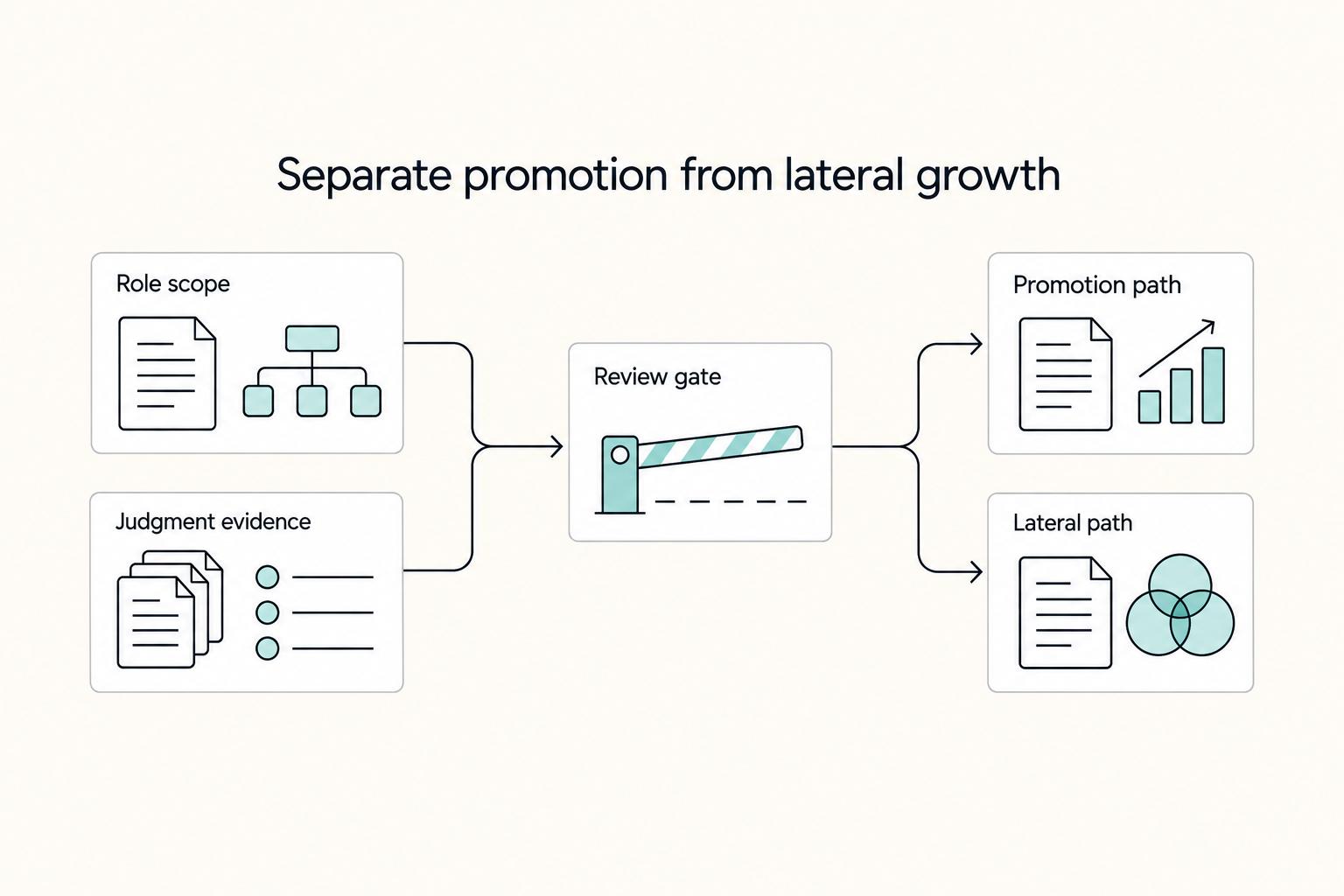
Quick Answer
Define the growth map before title changes: set entry and exit points, name when moves are lateral versus promotional, and require proof for each level. For agency career pathing, the article suggests using U.S. Office of Personnel Management movement logic as structure, then adapting it to private teams with one skills matrix per function and dated evidence artifacts. Run a readiness check and cross-team calibration before approvals, and send partial-readiness cases into a documented development plan.
Set Clear Rules for Promotions and Lateral Moves#
Agency career pathing is not a stack of titles. It is the map for how someone enters a role, grows in it, moves sideways when that makes more sense than a promotion, and exits into a new path. The point is simple. People should know what good looks like before compensation or title conversations begin.
That matters because vague growth rules can create problems. You can get inflated titles, uneven raises, and promotion calls that depend too much on one manager's judgment. One practical model comes from the U.S. Office of Personnel Management's career-path logic. In that model, a career path is a progression of positions, each stage has defined entry and exit points, and movement is not only upward. Typical moves, non-typical moves, and lateral movement are all named. For a small or mid-size agency, that is the part worth borrowing, not the federal job bands.
In practice, career pathing only works if it is specific enough to survive real operations. That usually means three things: role families with a small number of levels, a skills matrix tied to observable work, and a review rhythm leaders will actually maintain. If two team leads would place the same person at different levels after reading your criteria, the levels are still too fuzzy. If someone cannot tell you their current entry point, the next realistic move, and what evidence would prove readiness, the path is still mostly implied.
This guide is not trying to hand you a heavy HR process. It is meant to help you make a few high-value decisions that remove ambiguity. You will define role architecture before you assign or clean up titles. You will decide what counts as promotion evidence, what belongs in a development plan instead, and how often managers should review growth without turning every month into a formal review cycle. Those choices support clearer talent development decisions because people can see a path instead of guessing at one.
One caution up front: this is about growth design, not title theater. A strong path names the qualifications and competencies expected at each stage and shows how people advance through them. It should read more like a road map than a promise.
For now, use a simple test. Can you explain each role's entry point, expected outcomes, and likely next moves in a way that is consistent, evidence-based, and usable by more than one manager? If not, start there.
Need the full breakdown? Read A Guide to Profit Sharing for Small Agencies.
Define agency career pathing before you assign titles#
Define the growth system first, then assign titles. a career pathing framework means the full model: role families, levels, entry and exit points, movement rules, and readiness criteria. A promotion ladder is only the vertical path within one function.
Use the U.S. Office of Personnel Management movement logic as a structure, not a template to copy. In that model, a career path is a progression of positions, with typical and non-typical movement clearly separated, and lateral movement shown within a career stage. It also marks entry and exit points at each level. Borrow that clarity: define the common route, define exception paths, and treat lateral moves as intentional progress.
Use this checkpoint on your draft map: can a manager tell whether a move is typical, lateral, or exceptional without extra interpretation? If not, tighten definitions before title decisions. You do not need OPM-style diagrams, but you do need clear movement rules, including when movement is one-way versus bidirectional.
Put scope on one page before titles go live:
- which roles are in phase one
- what counts as readiness
- who can approve exceptions
Also state what this is not: title inflation, ad hoc raises, or manager-by-manager judgment without shared criteria. If titles come first and standards come later, promotion debates usually turn into cleanup work.
Build role families and level architecture your team can use#
Build role families first, then levels. That order keeps titles anchored to the work instead of individual personalities.
A practical structure is: broad path, then family, then progression series. In Minnesota's executive-branch model, class titles are mapped to 11 broad career paths, those paths are divided into 37 career families, and families are further organized into career series. You do not need that exact scale, but the sequence is useful for agency design.
Start with family boundaries#
A role family is a cluster of related work. A level is the growth of that same work through greater scope, judgment, and accountability.
Before you debate titles, test family clarity:
- Ask two managers to place current team members into families first, without discussing level.
- If placement is inconsistent, tighten family definitions.
- Write a short class-spec style note per family: what the work includes, what it excludes, and typical entry and exit paths.
Keep levels explainable#
Use as few levels as you can defend clearly. If adjacent levels require long verbal explanations, merge them and clarify outcomes.
Level definitions should describe observable outcomes and decisions, not abstract traits:
- Use: specific responsibilities, decision scope, accountability.
- Avoid: vague labels like "strategic" or "strong communicator" with no behavior attached.
| Role family | Level intent | Expected outcomes | Required capabilities | Common entry point | Common exit point paths |
|---|---|---|---|---|---|
| Strategy | Grow from contributing recommendations to owning direction | Clear priorities tied to goals | Analysis, prioritization, decision quality | Analyst or specialist roles | Senior strategy scope, adjacent planning work |
| Delivery | Grow from executing scoped tasks to owning quality and handoffs | Reliable delivery with fewer avoidable escalations | Execution, quality control, risk signaling | Junior delivery roles | Senior delivery scope, program/project paths |
| Operations and enablement | Grow from coordination support to improving team systems | More consistent planning and cleaner operations | Documentation, coordination, process judgment | Coordinator or support roles | Operations management, adjacent enablement paths |
If a family becomes too broad, split it into series while keeping one shared level logic. Publish the current version, date it, assign an owner, and update it on a regular cadence rather than waiting for a perfect model.
Related: How to Build a No-Code MVP for a Client.
Create a skills matrix and promotion evidence pack#
Build one skills matrix per role family, and keep it inside your job architecture so promotion decisions stay tied to how work actually grows. Each skill should be observable in real work, reviewable in artifacts, and connected to delivery quality or client impact.
Write skills as observable behaviors#
Avoid trait labels that invite interpretation battles. Define each skill as:
- the behavior someone performs
- the output they produce
- the effect on delivery or client outcomes
For example, replace vague labels like "strong communicator" with concrete behaviors such as leading a client decision call, documenting tradeoffs, and sending a same-day decision summary. Use named roles your team already uses (for example, Account Coordinator, SEO Specialist, Project Manager, Client Success Lead) so expectations stay practical.
A quick quality check: hand the same artifact to two reviewers and ask which skill and level it demonstrates. If they disagree, tighten the skill wording.
Set promotion evidence by level#
Use one evidence pack format across levels so comparisons are consistent.
| Level intent | Portfolio artifacts | Peer feedback | Manager assessment | Measurable delivery quality |
|---|---|---|---|---|
| Learns and executes scoped work | Completed task samples, annotated deliverables, basic summaries | Reliability, handoff quality, responsiveness | Consistency in core tasks and coachability | Fewer avoidable rework cycles, deadlines mostly met |
| Owns outcomes independently | End-to-end project examples, recommendations, decision notes, issue logs | Coordination quality and problem spotting | Independent judgment and prioritization | More predictable delivery, fewer escalations |
| Expands scope across clients or projects | Multi-project portfolio, cross-functional plans, client-facing materials | Influence beyond direct task execution | Scope management and tradeoff decisions | Better estimation accuracy, fewer misses |
| Raises team quality or carries broader accountability | Quality reviews, training assets, improvement proposals, leadership artifacts | Mentoring and standards-setting | Team-level judgment and accountability | Clear quality lift across team output |
Set a clear decision rule and apply it consistently: promotion should require evidence across critical skills for the next level; partial readiness should trigger a development plan, not a title change.
Keep each evidence artifact audit-friendly: save it, date it, map it to the skill, and record who reviewed it. That makes promotion outcomes explainable months later.
Set promotion and lateral movement rules before review season#
Set the move type first, then discuss the person: use promotion for sustained next-level scope, judgment, and accountability, and use lateral movement for capability broadening across related work without inflating title bands.
That approach is consistent with career-path logic that distinguishes progression across positions from lateral movement within a stage. For a private agency, treat that as a practical framework, not a legal mandate: not every strong move needs to be vertical, but each level should still have clear entry and exit points.
Choose the move that matches the evidence#
Promotion means the person is already performing at the next level across core expectations, not just excelling in one specialty. Lateral movement fits when someone is expanding into adjacent work and building range, while still developing full readiness for the target track.
| Path | Evidence signal | Response |
|---|---|---|
| Promotion | Sustained next-level scope in the current role family | Already performing at the next level across core expectations |
| Lateral movement | Cross-functional growth but not yet full next-level consistency | Expanding into adjacent work and building range |
| Development plan | Partial readiness or a gap in a core expectation | Assign targeted stretch work tied to the gap and re-evaluate at the next cadence |
Use this rule:
- Pick promotion when evidence shows sustained next-level scope in the current role family.
- Pick lateral movement when evidence shows cross-functional growth but not yet full next-level consistency.
Use a two-step gate#
Run two checks before final decisions:
Readiness check against the skills matrix: confirm next-level expectations across required skills with dated artifacts and manager evidence.Calibration across teams: compare similar cases to confirm managers are applying the same standard.
Watch for red flags during calibration: hero-project bias, manager favoritism, and rushed pre-compensation-cycle promotions that skip consistency checks.
If someone is strong in one area but weak in a core expectation, do not force a title change. Assign targeted stretch work tied to the gap, define what evidence will count, and re-evaluate at the next cadence.
Assign ownership and review cadence that survives real operations#
To keep promotion decisions fair in real operating conditions, assign clear owners, run a fixed cadence, and document every call. If no one owns the calendar, evidence, and final decision, standards drift fast.
Use explicit role ownership so decisions stay explainable:
| Role | Primary responsibility | What to verify each cycle |
|---|---|---|
| Founder or agency lead | Own level definitions, approve promotions, enforce consistency across teams | Are teams applying the same standards, and are exceptions documented? |
| Team lead | Run development check-ins, maintain evidence packs, recommend moves | Does the evidence show sustained performance across core skills, not one standout project? |
| Individual contributor | Bring artifacts, track growth goals, confirm next-step expectations | Are examples dated, relevant, and mapped to level criteria? |
Keep the rhythm light but predictable: monthly development check-ins, quarterly calibration across managers, and a semiannual refresh of career-path documents. This is an operating choice, not a legal requirement, but it helps prevent avoidable drift.
Use the same checklist each cycle:
- Update level docs when role scope changes.
- Review evidence packs for dated artifacts and gaps.
- Record each decision and rationale in one place.
- Communicate next actions, including stretch work and re-review timing.
If leaders skip two cycles, pause new promotions until governance is back in place. That discipline usually protects trust and employee retention better than fast, uneven title decisions.
Add compliance and documentation checkpoints for global agency teams#
Keep one boundary firm: a level change is a people decision, not a tax or legal determination. If pay, country of work, entity relationship, or contract scope changes with a promotion, run a separate compliance review before the change goes live.
Bundling those decisions is where cross-border errors usually start. A title gets approved, compensation is updated, and only later the agreement, records, or reporting assumptions no longer match the real setup.
Keep a compliance packet only where it is actually relevant#
For U.S.-connected reporting, track FATCA-related notes, Form 8938 status, FBAR (FinCEN Form 114) status, and the records behind any filings. Form 8938 reports specified foreign financial assets, is attached to an annual income tax return, and does not apply in every case.
| Packet item | What to include |
|---|---|
| Current contract or employment agreement | Plus the country and entity paying the person |
| Form 8938 and/or FBAR review | Advisor notes on whether review was required |
| Submitted forms | Copies or confirmations of submitted forms where appropriate, plus supporting records |
| Additional documents | Any additional documents your advisor asks you to retain for the relevant jurisdiction |
Thresholds for Form 8938 vary by filing context, including higher thresholds for joint filers and taxpayers residing abroad. If someone is not required to file an income tax return for the year, they do not file Form 8938 for that year.
Do not treat Form 8938 and FBAR as interchangeable. FATCA reporting on Form 8938 can apply in addition to FBAR reporting, so your operating check should confirm the status of both.
A practical packet can include:
- current contract or employment agreement, plus the country and entity paying the person
- advisor notes on whether Form 8938 and/or FBAR review was required
- copies or confirmations of submitted forms where appropriate, plus supporting records
- any additional documents your advisor asks you to retain for the relevant jurisdiction
Add a checkpoint before any level change goes live#
Before finalizing a promotion, lateral move, or compensation-linked level change, confirm that classification, contract scope, and recordkeeping were reviewed by the right advisor. The goal is not to run legal tests internally; it is to ensure someone qualified validated the change.
If the role now includes materially different duties or authority, pause and get local guidance before processing the update. Tax and reporting obligations vary by country, entity setup, and program, so avoid applying one checklist across every market.
Launch your minimum viable system in the first month#
Launch a minimum viable system in one function first, and use the month to test whether managers can make repeatable growth decisions from shared criteria. The goal is not polish in week one; the goal is validated learning from a process people can apply consistently.
| Week | Focus | Activities |
|---|---|---|
| Week 1 | Define terms and scope the pilot | Define terms, pick one role family, and write level intent in plain language so managers can distinguish lateral move, readiness, and promotion |
| Week 2 | Draft evidence criteria | Draft the skills matrix for that function using observable evidence; if a skill cannot be evidenced, rewrite it |
| Week 3 | Test the criteria | Run two pilot promotion evaluations to test how the criteria hold up across different cases |
| Week 4 | Calibrate and publish | Calibrate reviewer differences, tighten wording, and publish a usable version |
A minimum viable approach keeps effort focused while you learn what works. In performance management terms, you still need enough structure to support planning, monitoring, developing, rating, and rewarding inside the pilot lane.
A practical first month looks like this:
- Week 1: define terms, pick one role family, and write level intent in plain language so managers can distinguish lateral move, readiness, and promotion.
- Week 2: draft the skills matrix for that function using observable evidence. If a skill cannot be evidenced, rewrite it.
- Week 3: run two pilot promotion evaluations to test how the criteria hold up across different cases.
- Week 4: calibrate reviewer differences, tighten wording, and publish a usable version.
Track two early indicators as system health checks from day one:
- Promotion decision clarity: are decisions clear and consistent, or blocked by fuzzy level language?
- Manager adherence to evidence standards: are reviewers using complete, comparable evidence for every case?
If either indicator is weak, do not expand to more functions yet. Refine the criteria, retrain reviewers, and run another cycle before scaling.
For a step-by-step walkthrough, see How to Choose a Niche for Your IT Outsourcing Agency.
Conclusion#
The practical win here is not a heavier HR layer. It is a clearer way to make talent decisions: explicit levels, a usable skills matrix, and promotion calls tied to evidence instead of manager confidence or urgency.
That matters because the alternative is often external recruitment by default. ACG describes outside hiring as the long-standing default for talent gaps, but also notes the tradeoff. External hires can struggle to assimilate into the organization's culture, and constant sourcing is not always the more cost-effective path. Internal career pathing, by contrast, is about systematically developing and advancing people you already have. For a small or mid-size agency, that is less theory than operational discipline.
In practice, the parts that often carry the most weight are the ones that remove ambiguity early. Clear entry-point logic helps you hire and level people consistently from day one. Disciplined lateral movement gives strong performers room to broaden without forcing title inflation. A durable skills matrix gives managers one shared reference when they assess readiness. If those three pieces are weak, review season can turn into argument, exception handling, and last-minute compensation pressure.
You do not need to roll this out across the whole company at once. Start with one role family where output is easy to compare, then keep a short decision record every time someone is reviewed. The checkpoint that matters most is simple: can two managers look at the same evidence pack and reach roughly the same judgment on level readiness? If not, the criteria are still too vague. Tighten the wording before you add more titles or more process.
Keep these rules in front of you:
- promote only when the person shows sustained readiness across critical skills, not because of one hero project or a retention scare
- use lateral moves when capability is broadening but core next-level expectations are not consistently met
- keep evidence audit-friendly and timestamped so decisions are still explainable months later
- record the "not yet" cases with next-step work attached, or people will hear only the rejection and not the path forward
Time Doctor frames career pathing as a retention tool because clear advancement and growth paths help companies keep strong people. That is the business case: not a nicer org chart, but more consistent judgment and more trust in how growth decisions are made. Start small, document what you decide, and improve it each cycle. Done well, this becomes part of how your agency operates, not a yearly fire drill.
Related reading: A Guide to Selling Your Freelance Business or Agency.
Frequently Asked Questions
What is agency career pathing in plain language?
Agency career pathing is the map for how someone can grow in your company and what each stage requires. The U.S. Office of Personnel Management describes a career path as a roadmap for how people advance, with the qualifications and competencies expected at each stage. In practice, that means growth criteria can be defined before promotion decisions.
How is career pathing different from a promotion ladder?
A promotion ladder focuses on the vertical route inside one function. Career pathing is broader: it can include lateral moves and leadership transitions, not just a title increase.
How often should a small agency review career paths and level criteria?
Do not assume a single validated cadence applies. Review the paths when the work, team shape, or client expectations change enough that current level definitions no longer fit, or when managers cannot apply the same criteria consistently.
What must be in a minimum viable career pathing system?
At minimum, define a role path and the qualifications and competencies expected at each stage in plain language. Also treat recommended paths as guidance, not the only ways to succeed.
How do you start career pathing when you have no HR team?
Start with one role family and draft a simple roadmap that shows advancement stages plus expected qualifications and competencies. Keep it practical, align it with both individual goals and company objectives, and refine it as you learn.
When should someone move laterally instead of getting promoted?
Choose a lateral move when the person is growing but does not yet meet the next stage’s qualifications and competencies. This fits the broader career-path view that growth can include non-promotion moves, including lateral and leadership transitions.
Try a related tool
Researched and edited by the Gruv editorial team. Gruv builds cross-border billing, payouts, and finance-operations software for global businesses.
Sources
- aspe.hhs.gov/sites/default/files/private/pdf/262051/traum...trusted
- dol.gov/sites/dolgov/files/OPA/newsreleases/2025/08/...trusted
- dol.gov/sites/dolgov/files/ETA/advisories/TEN/2015/T...trusted
- ecfr.gov/current/title-5/chapter-I/subchapter-B/part-335trusted
- ecfr.gov/current/title-42/chapter-IV/subchapter-C/par...trusted
- irs.gov/businesses/corporations/do-i-need-to-file-fo...trusted
- irs.gov/forms-pubs/about-form-8938trusted
- justice.gov/jmd/hr-order-doj/us-department-justice-caree...trusted
Educational content only. Not legal, tax, or financial advice.
Related Posts

The Best Digital Nomad Cities for Slow Travel in 2026
If you want a city that still works after the first exciting week, judge it like a place to live, not a place to visit. Location-independent work keeps growing in 2026, but that does not make every popular city a good base. This list is for remote professionals planning a longer stay and weighing the legal and practical choices that still matter once daily life takes over.
How to Build a No-Code MVP for a Client
Treat the work like an engagement with defined scope, acceptance criteria, and decision records. That is how you build a no-code MVP without letting "fast" turn into "fragile."

The Freelance Payment Penalty: A Modeled Audit of Platform Fees, FX Spreads, and Payout Delays
The money rarely disappears through a single, easy-to-spot fee. The real loss is stacked. A marketplace takes its commission, a processor adds a charge for international cards, a bank or payment company converts the currency at a spread, a platform holds the funds before release, and a wire sheds a little to intermediaries on the way in. Each layer looks defensible on its own, but the worker feels the combined result as a smaller deposit and a later payday.