
Quick Answer
Yes. Your spouse can live with you in the US in derivative E-2 status and may work when the admission record is usable, so first confirm Form I-94 is coded E-2S. Then complete identity and operations basics: SSN application with Form SS-5, bank onboarding, and a clear work path as employee or self-employed spouse. Form I-765 can be filed for an EAD as extra evidence if employer onboarding is likely to be difficult.
The Activation Framework: Your First 30 Days to Full US Operational Capacity#
In your first 30 days, move in this order: confirm your admission record, set up your SSA identity record, open banking, then decide whether to file for a physical EAD. If the admission coding is wrong, everything that follows can slow down.
Know the records that control access#
Form I-94 is the DHS arrival and departure record issued when you are admitted to the United States. After entry, you can access it through CBP online and print a copy.
The E-2S annotation is the spouse-specific class of admission code on Form I-94. USCIS and CBP began using spouse-specific codes, including E-2S, on January 30, 2022. That code matters because certain E nonimmigrant spouses are employment authorized incident to status.
CBP is U.S. Customs and Border Protection, which handles admission records such as Form I-94. SSA is the Social Security Administration, which processes Social Security card applications. Your SSN is the Social Security Number employers use to report earnings to the U.S. government.
Form I-765 is the USCIS application for employment authorization documentation, and the resulting card is the EAD. For E spouses, USCIS allows filing for an EAD as additional evidence of identity and employment authorization.
Your first 30 days in order#
Start by pulling your I-94 and making sure it shows E-2S. Do that before you start an SSN application, onboarding, or account opening, because those later steps often depend on the admission record being right.
| Action step | What to bring or prepare | Where to complete it | Proof to keep | Common failure points to avoid |
|---|---|---|---|---|
| Entry check | Passport details used for entry; access to the CBP I-94 site | CBP I-94 portal after admission | Printed I-94 showing E-2S; saved PDF or screenshot | Not checking I-94 promptly; assuming the visa stamp alone resolves work-authorization questions; missing an incorrect class of admission |
| SSN setup | Form SS-5; unexpired foreign passport; printed I-94; enough original documents to meet SSA evidence rules (at least two documents) | Local SSA field office | Copy of Form SS-5; visit confirmation or receipt; mailing address used | Bringing copies instead of originals; applying before confirming I-94 coding; if age 12+ and first SSN, not applying in person |
| Banking setup | The bank's exact account-opening checklist confirmed in advance; identity and address documents requested by that bank | Your chosen bank branch or approved account-opening channel | Account-opening confirmation; account agreement; any written checklist or branch email | Assuming all banks use the same checklist; arriving without current bank requirements; name mismatches across records |
| EAD choice | Documents required for your current Form I-765 filing, if you choose to file | USCIS filing process | Full copy of filing package and filing receipt | Filing because you think it is always legally required; delaying a time-sensitive start while undecided; not retaining a complete filing copy |
If your CBP-issued I-94 data is wrong, USCIS directs in-person correction through a CBP port of entry or deferred inspection office. Verify the current correction process before you go.
For SSN setup, SSA requires at least two documents for an original card application to prove age, identity, and current lawful work-authorized status. SSA lists an I-94 with an unexpired foreign passport as acceptable immigration and work-authorization evidence. If you are age 12 or older and have never had an SSN, SSA says you must apply in person.
Banking comes next, but it is rarely standardized. Confirm your bank's exact requirements before your visit and keep that confirmation in writing.
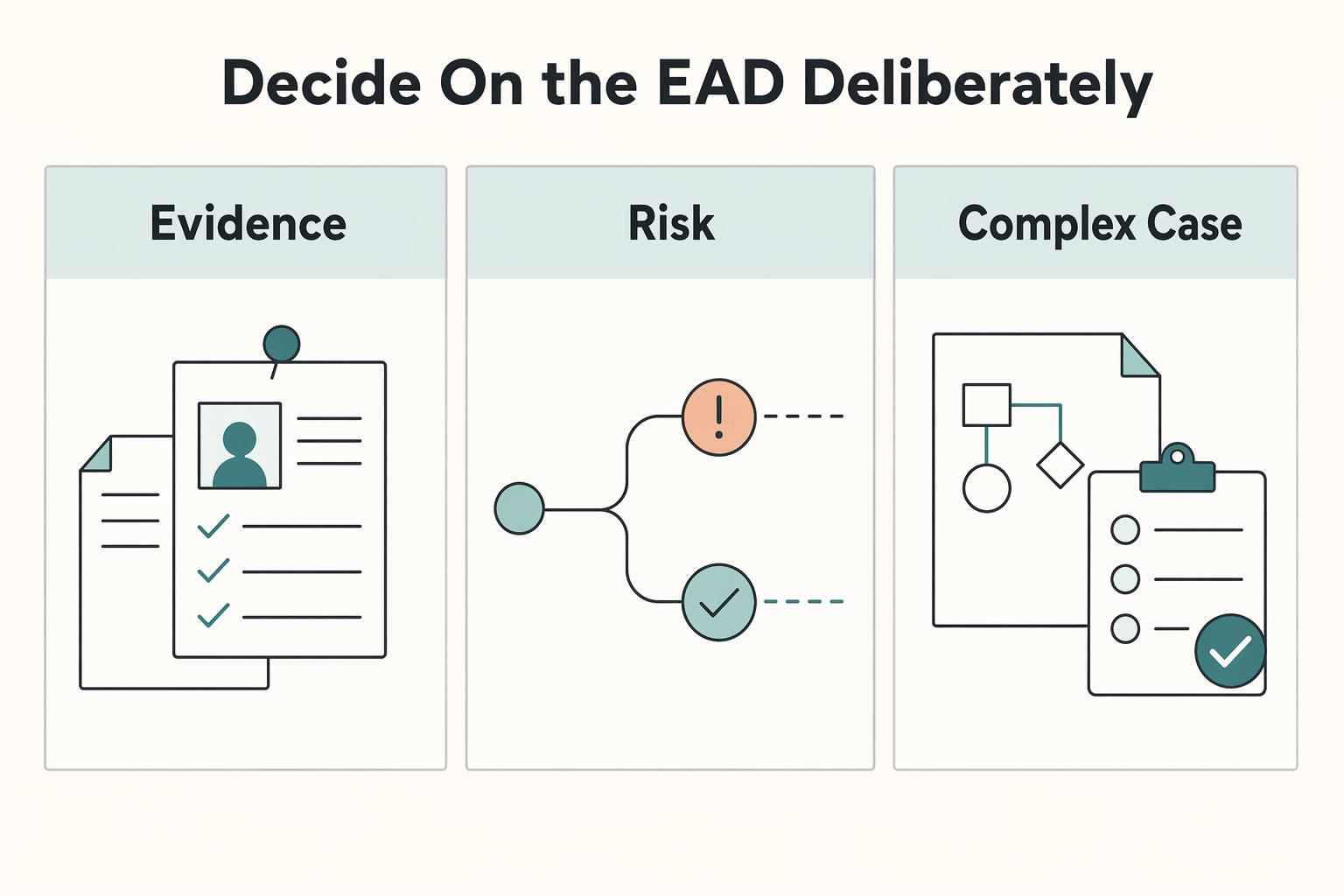
Decide on the EAD deliberately#
For many people, the EAD decision is less about legal eligibility than onboarding friction. The EAD is optional evidence for certain E spouses, not the source of work authorization, so the real question is whether filing now makes your next few months easier.
| Decision point | File now | You may defer |
|---|---|---|
| Hiring or onboarding friction risk | You expect near-term hiring by an employer, staffing firm, or payroll team that may be unfamiliar with E-2S I-94 evidence | You are not starting work soon and can handle extra explanation if needed |
| Speed to start | You want the lowest risk of onboarding delay | Immediate onboarding speed is not critical |
| Administrative preference | You want an additional physical identity and work-authorization document in your records | You prefer to avoid an additional USCIS filing for now |
If timing is tight, filing early can reduce administrative risk. If your plans are still exploratory, deferring can be reasonable. If you request an SSN through Form I-765, SSA says you do not need a separate Social Security office SSN application.
Once your entry documents and first-month checklist are complete, map how you will receive client payments and withdrawals so the plan is operational, not just compliant: Review payout workflow options. You might also find this useful: The Best Podcast Hosting Platforms for Beginners.
Structuring Your One-Person Business: Liability, Tax, and Records#
Choose your business structure before you sign client contracts. That decision shapes your liability exposure, tax workflow, and documentation trail from the start. If your work is simple and low risk, a sole proprietorship can work. If you expect contract obligations, indemnity language, or clients that want a formal entity, a single-member LLC is often the cleaner setup.
Pick the structure that matches your risk#
In practice, the divide is straightforward. A sole proprietorship is simpler, while an LLC gives you cleaner legal separation if your work carries more contract or operational risk.
A sole proprietorship is an unincorporated business owned by one person, and it does not create a separate legal entity. A single-member LLC is a one-owner LLC formed under state law. For federal income tax, the default is a disregarded entity, often called pass-through treatment. That means income is generally treated as the owner's unless corporate tax treatment is elected.
An EIN is the business's federal tax ID. An operating agreement is the LLC's internal governance document covering financial and functional rules.
| Decision lens | Sole Proprietorship | Single-Member LLC |
|---|---|---|
| Liability exposure | No liability shield; you can be personally liable for business debts and obligations. | Separate entity under state law; liability separation depends on proper formation and maintenance under your jurisdiction's rules. |
| Client contract risk | You contract as yourself. | You can contract under the entity's legal name, which can make entity boundaries clearer. |
| Admin burden | Light setup. | State formation and ongoing compliance obligations vary by state. |
| Credibility needs | May feel informal for some clients, banks, or procurement teams. | Often better aligned when counterparties expect entity documents. |
Use this rule of thumb: if your exposure is mostly nonpayment risk and the work is straightforward, simplicity may justify a sole proprietorship. If you expect heavier contract terms, want cleaner separation from the principal E-2 business, or need stronger entity credibility, form the LLC first.
Set it up in sequence#
For E-2 dependent spouses, work authorization is generally incident to status, with valid E-2S on Form I-94 serving as key evidence. The entity decision is separate. It affects liability, taxes, and recordkeeping. Some spouses still file Form I-765 to obtain an EAD card as additional evidence.
| Step | Action | Key detail |
|---|---|---|
| 1 | Form the entity, if using an LLC | Verify state-specific formation steps, fees, and ongoing filing requirements; keep formation records and an operating agreement |
| 2 | Handle tax registration | Form or register the legal entity with the state first, then apply for an EIN; most new disregarded single-member LLCs need an EIN, but not all do |
| 3 | Open business banking | Confirm the bank's document checklist in writing first; resolve name or address mismatches across passport, SSN records, state filings, and bank forms |
| 4 | Start bookkeeping from the first transaction | Record income and expenses as they occur, ideally daily, and retain invoices, receipts, paid bills, deposit slips, and canceled checks |
| 5 | Set a contract process | Use the correct legal name consistently on proposals, contracts, and invoices so records match your entity structure |
That sequence matters: form first, register for tax purposes second, then open banking and start your records immediately.
Treat taxes as an operating task, not a cleanup task#
If you wait until tax season to organize a one-person business, you usually create avoidable problems. Track the basics from your first invoice: invoice date, client, amount, payment date, expense category, and the supporting document for each entry.
| Topic | Article detail | Threshold or timing |
|---|---|---|
| Recordkeeping basics | Track invoice date, client, amount, payment date, expense category, and the supporting document for each entry | From your first invoice |
| 2026 estimated-tax due dates | General federal estimated-tax due dates | April 15; June 15; September 15; January 15 of the following year |
| Estimated-payment trigger | Form 1040-ES generally points to estimated payments | Expect to owe at least $1,000 after withholding and credits; 90% / 100% comparison test |
| Return-filing trigger | An income-tax return is generally required | Net self-employment earnings of $400 or more |
| Cross-border CPA timing | Bring in a cross-border CPA if you moved midyear, have non-US income, or are unsure how day counting applies under the Substantial Presence framework | Early |
Self-employed taxpayers are generally expected to file an annual return and pay estimated taxes quarterly. For 2026, the general federal estimated-tax due dates are April 15, June 15, September 15, and January 15 of the following year.
Form 1040-ES generally points to estimated payments when you expect to owe at least $1,000 after withholding and credits, using the 90% / 100% comparison test. If net self-employment earnings are $400 or more, an income-tax return is generally required.
Bring in a cross-border CPA early if you moved midyear, have non-US income, or are unsure how day counting applies under the Substantial Presence framework. Visa status and US tax residency are different concepts. Then check the state and local filing and payment requirements that apply to you.
Keep your own business operationally separate from the principal E-2 enterprise: separate contracts, invoices, bank records, and client records. That helps maintain cleaner books and clearer documentation of the business's own activity.
For a step-by-step walkthrough, see O-1 Visa for Extraordinary Ability in the US for Independent Professionals.
The Independence Protocol: Mitigating Dependency Risk#
Your income can become independent before your immigration status does, so treat those as separate tracks. In derivative E-2 status, your ability to remain is generally tied to the principal treaty investor's classification and your qualifying spousal relationship. Your company setup, clients, and revenue can strengthen your options, but they do not make you a principal E-2 by themselves.
Know what changes status and what does not#
Use your I-94 as your first checkpoint every time. USCIS and CBP use spouse-specific codes, and an unexpired I-94 marked E-2S is accepted as employment-authorization evidence incident to status. After each reentry, pull the new I-94 and confirm the class of admission before you rely on older records.
| Category | What it means | Examples |
|---|---|---|
| Changes your status basis | Directly affects derivative eligibility | Change or loss of the principal's E classification; a marital change that affects spousal eligibility; an approved filing into a different status |
| Does not by itself change your status basis | Business operations alone do not change the basis | Forming an entity; getting an EIN; earning self-employment income; opening business accounts; hiring; filing taxes |
| Can disrupt proof even when the rules are unchanged | Evidence problems can create practical issues even if the status rule does not change | An incorrect I-94 code at admission; E spouses may still file Form I-765 for EAD evidence |
When you assess risk, separate the rule that governs your status from the documents you use to prove it.
Plan your response to the events that create pressure#
Once you separate status risk from business progress, plan for the events that usually create pressure. If you may file as a principal later, build toward treaty-investor standards now.
| Risk event | Immediate consequence | First legal or operational action | Documentation to gather now |
|---|---|---|---|
| Principal's E-2 business weakens, closes, or principal changes status | Your derivative basis may be at risk because it tracks the principal classification | Get immigration counsel advice before travel, role changes, or assumptions about continued work authorization | Both spouses' I-94s, passports, marriage certificate, principal's visa or approval records, business formation and ownership records, recent tax and payroll or contract activity |
| Separation or divorce becomes likely | Your derivative spousal basis may no longer be secure; do not assume automatic timing outcomes | Get immigration advice before family-court filings that change status records and before international travel | Marriage and court records, address history, your business records, income proof, all current immigration documents |
| You depart and reenter the US | Your work-authorization evidence depends on the new admission record | Verify the new I-94 shows E-2S immediately | I-94 PDF, passport biographic page, any entry stamp, HR-ready copy of documents |
Build a visa-ready enterprise, not just a side business#
- Substantial investment: judged in relation to the enterprise's cost and your commitment, not a fixed statutory dollar floor.
- Real and operating enterprise: an active commercial undertaking producing goods or services for profit.
- Marginality: an enterprise that lacks present or future capacity beyond minimal living income; projected non-marginal capacity should generally be realizable within five years from normal business start.
What matters is operational proof, not just formation paperwork. Your records should show capital committed, startup spend, signed contracts, delivery records, revenue history, and staffing evidence where available.
| Pathway | Core fit | Evidence burden | Business dependency | Timeline sensitivity | Planning complexity |
|---|---|---|---|---|---|
| New principal E-2 | You will direct and develop a US enterprise with substantial invested capital | High business-document burden | High | High if derivative status becomes unstable | High |
| O-1 | You have top-tier field recognition and a US employer or agent can file Form I-129 | High individual-achievement burden | Lower than E-2 | High | High |
| EB-1A | You want a self-petition path based on extraordinary ability | Very high; one-time major award or at least 3 of 10 criteria | Lowest | High | Very high |
Keep proof that ages well#
Good records matter most when time is short, so build your file continuously, not only when a risk event starts. Keep dated, third-party-verifiable records such as signed contracts, payment and tax records, published material about your work, judging or speaking invitations, award documentation, and independent expert letters tied to concrete outcomes. Prefer evidence with a date, source, and context over screenshots without provenance.
Related: The E-2 Treaty Investor Visa: A Path to US Residency for Entrepreneurs.
Conclusion: The E-2 Spouse Visa is a Tool - Use it with Intent#
Use this status as a deliberate work plan, not a passive benefit. Handled well, it can reduce single-income exposure. Handled casually, it can create avoidable onboarding, tax, and status problems.
Business-of-One means you work for yourself, for example as a sole proprietor or independent contractor. Visa-ready means you can quickly retrieve your CBP admission record and keep status filings on time.
| Path | Choose it if | Verify before you start | Main tradeoff |
|---|---|---|---|
| Employee role | You want faster onboarding and simpler day-to-day tax handling | Confirm your I-94 shows E-2S and keep it available for I-9; if the I-94 is wrong, correct it with CBP in person; if an employer asks for extra evidence, consider filing Form I-765 for an EAD | HR teams may still need clarification on E-spouse documentation |
| Business-of-One in your own name | You already have client work and can manage your own records | Confirm status evidence, get an SSN if you are work-authorized and otherwise eligible, and plan for estimated taxes | More recordkeeping and quarterly tax discipline |
| Business-of-One with an entity | You want operations under a business structure and are prepared for added admin | Confirm immigration and tax timing first, then decide if setup and ongoing compliance effort match your revenue and risk profile | More setup and ongoing compliance work |
The goal is not just extra income. It is cleaner risk management for the household. Your plan helps when it creates income that is not tied to the principal's business cycle and when you can document it cleanly. It hurts when you build structure before validating demand, mix personal and business records, or delay tax planning once self-employment income starts.
As a practical trigger, net self-employment earnings of $400 or more generally require a return. If you expect to owe $1,000 or more, estimated taxes generally apply.
Next steps: check your I-94 for E-2S now and fix errors before onboarding or client billing. Choose one work path, gather that path's documents, and calendar your status end date. If you expect self-employment income or a status extension or change, involve tax support early. For extension or change requests, use Form I-539 and generally file before your current authorized stay expires, ideally at least 45 days in advance; consider immigration counsel for case-specific risk.
If you want a deeper dive, read The 2026 Global Digital Nomad Visa Index: 50+ Countries Compared.
Before you lock in your long-term setup, compare whether a freelancer-focused Merchant of Record model fits your cross-border client mix and admin burden: Explore the freelancer MoR overview.
Frequently Asked Questions
Does an E-2 spouse need an EAD to work?
This guide does not verify E-2 spouse work-authorization rules, including when an EAD is required. Confirm the current rule for your exact status before starting work.
Can an E-2 spouse start their own business?
This guide does not verify E-2 spouse business-ownership or self-employment rules. Confirm immigration authorization separately from business-formation steps before operating.
What happens in a divorce?
This guide does not define E-2-specific divorce outcomes. In a different spouse-related context, USCIS policy says VAWA self-petitions are filed on Form I-360, and the burden of proof is on the self-petitioner.
Can dependent children work in the United States?
This guide does not verify E-2 dependent child work rights. Confirm the child’s exact status rules before any paid work or onboarding.
Is an E visa a direct path to a green card?
Separate categories include K3 for a spouse of a U.S. citizen awaiting immigrant visa availability, and returning resident analysis for some LPRs who stayed abroad more than one year.
Try a related tool
Researched and edited by the Gruv editorial team. Gruv builds cross-border billing, payouts, and finance-operations software for global businesses.
Sources
- fam.state.gov/fam/09FAM/09FAM050207.htmltrusted
- irs.gov/businesses/small-businesses-self-employed/si...trusted
- irs.gov/individuals/international-taxpayers/taxation...trusted
- ssa.gov/ssnvisa/ebe.htmltrusted
- ssa.gov/forms/ss-5.pdftrusted
- uscis.gov/working-in-the-united-states/permanent-worke...trusted
- uscis.gov/policy-manual/volume-10-part-b-chapter-2trusted
Educational content only. Not legal, tax, or financial advice.
Related Posts

The 2026 Global Digital Nomad Visa Index for 50+ Countries
Start with legal fit, not lifestyle filters. The practical order is simple: choose a route you can actually document, then decide where you want to live. That single change cuts a lot of wasted comparison work and stops you from falling in love with places that were never a real filing option.
E-2 Visa for Entrepreneurs Launching a U.S. Business
The E-2 is a strong option only if you can clear five gates before major spending: treaty nationality, ownership and control, a real develop-and-direct role, an enterprise that is real and operating and not marginal, and nonimmigrant intent. If any gate is weak, stop and fix the structure first. Use these plain-language checks first:

The Best Podcast Hosting Platforms for Beginners
**Pick podcast hosting like an operator: optimize for control, continuity, and clean workflows, not whatever looks appealing on a pricing page.** Podcast hosting is infrastructure. What you choose at signup sits upstream of your RSS feed, Apple Podcasts listing, analytics, monetization options, and how painful it is to change systems later.