
Quick Answer
Yes. You can use a U.S. LLC to buy in Spain, but only after a written verification pass on legal, tax, and disclosure duties for your facts. In practice, that means confirming who can sign, preparing apostilled formation records with sworn translation, and securing an entity NIF before money movement. Then map U.S. reporting separately, including whether FBAR, Form 8938, or Form 8858 applies.
The Strategic Decision: Is a U.S. LLC Your Optimal Move for Spanish Real Estate?#
Start with "should," not "can." Based on the evidence available here, you do not yet have decision-grade legal or tax support. Treat the ownership structure as a verification step, not a conclusion.
Do not treat generic web copy as legal or tax guidance. A structure decision needs verified Spain property and U.S. LLC guidance for your facts.
Separate legal, tax, and disclosure questions before you decide#
Do not let one adviser answer stand in for everything. Treat the following as separate clarification points, and get each one defined in writing for your exact case:
| Term to clarify | What to get in writing |
|---|---|
| Asset protection | How your advisers define it for your facts, and any requirements that follow. |
| Beneficial ownership disclosure | How your advisers define it for your facts, and any requirements that follow. |
| Disregarded entity | How your advisers define it for your facts, and any requirements that follow. |
| Permanent establishment | How your advisers define it for your facts, and any requirements that follow. |
Use this as a decision test, not a checklist#
Do not collect documents just to feel prepared. Use them to confirm whether the structure fits the property, your use case, and your ability to maintain it.
| Decision test | What a "yes" looks like | What you must verify |
|---|---|---|
| Liability containment | You can explain why this test matters in your case. | Case-specific requirements confirmed in writing. |
| Reporting scope | You can explain why this test matters in your case. | Case-specific requirements confirmed in writing. |
| Banking friction | You can explain why this test matters in your case. | Case-specific requirements confirmed in writing. |
| Governance overhead | You can explain why this test matters in your case. | Case-specific requirements confirmed in writing. |
| Exit complexity | You can explain why this test matters in your case. | Case-specific requirements confirmed in writing. |
Myth vs reality checkpoint on privacy#
Myth: Privacy assumptions are a solid reason to choose this structure. Reality: Do not assume any anonymity outcome is guaranteed, so keep privacy out of the plan until your exact disclosure obligations are confirmed in writing.
Practical fit framework by use case#
Use this as a planning frame, not a conclusion. A rental, personal-use, or hybrid recommendation is not established on its own.
| Use case | Clarify in writing |
|---|---|
| Rental use | Which legal, tax, and disclosure requirements apply to your exact facts. |
| Personal use | Whether added ownership complexity has a documented legal or tax rationale in your case. |
| Hybrid use | How your advisers define and document boundaries for your planned use. |
These are prompts for adviser conversations, not off-the-shelf answers.
Use one rule for this section: do not commit to a structure until your legal, tax, and disclosure answers are all verified in writing for your exact facts.
If you want a deeper dive, read Sole Proprietorship vs. LLC: The Definitive Guide for Global Freelancers.
The Dual-Compliance Gauntlet: Your Action Plan for the U.S. and Spain#
Once the structure passes the fit test, execution becomes a two-lane project. Complete the Spain setup lane first while mapping U.S. filings in parallel. You own the project. Spain-side execution sits with Spanish counsel or gestor. U.S. classification and filing decisions sit with your U.S. tax adviser. The critical handoff is one clean entity-and-owner document set that both advisers are using.
Before you start, keep these definitions straight so company-level and person-level steps do not get mixed:
- NIF (entity-level): Spanish tax ID for legal entities doing tax-relevant operations.
- NIF vs DNI/NIE (person-level): for individuals, Spanish NIF generally aligns with DNI or NIE.
- NIE: foreigner identity number granted through Spain's police authority.
- Beneficial ownership disclosure: Spain operates a central beneficial-ownership register (Registro Central de Titularidades Reales, in force 19/09/2023), and Spanish legal materials include a more than 25% ownership or voting-control benchmark in the beneficial-owner description.
- Apostille: certifies signature, capacity, and seal authenticity on a public document, not the document's substantive truth.
- Sworn translation (traduccion jurada): written translation by a recognized traductor jurado.
- Disregarded entity: U.S. federal tax treatment where LLC activity is treated as part of the owner's return.
Spain lane first#
Spain-side setup often stalls on document quality, not theory. Get the representative, foreign document pack, and ownership trail lined up before you try to move anything.
| Task | Why it is required | Who handles it | What can block it | What to prepare first |
|---|---|---|---|---|
| Confirm signing representative | The representative applying for an entity NIF must already have a NIF | You + Spanish adviser | Representative has no assigned NIF/NIE | Passport, authority proof, current ownership/control chart |
| Build foreign document pack | Foreign-issued documents in this context may require Hague Apostille and sworn translation | You + U.S. document issuer + Spanish adviser | Missing apostille, non-sworn translation, name mismatch | Formation/authority documents, exact legal name, issuance dates |
| Apply for entity Spanish NIF | Entities generally need NIF before tax-relevant operations | Authorized representative + Spanish adviser | Representative ID gap, incomplete pack, inconsistent records | Apostilled documents, sworn translations, representative identification |
| Prepare beneficial-ownership disclosure file | Spain has a central beneficial-ownership framework and ownership/control details need to be clear for disclosure | You + Spanish legal/tax adviser | Unclear cap table, unclear control rights, missing natural-person trail | Cap table, control-rights summary, natural-person identification details |
Document quality is the real checkpoint. Names, dates, and authority need to match across core documents, apostilles, and sworn translations.
U.S. lane filing map#
While the Spain lane moves first, map the U.S. side early so account setup, classification, and year-end reporting do not drift apart. Start with information reporting, then confirm tax reporting:
| Filing item | When it can matter | What to verify |
|---|---|---|
| FinCEN Form 114 (FBAR) | If aggregate foreign financial accounts exceed $10,000 at any point in the calendar year | File separately from the federal tax return; due April 15 with automatic extension to October 15 |
| Form 8938 | Certain U.S. taxpayers with specified foreign financial assets above threshold | Baseline figure is $50,000 for certain taxpayers; confirm current threshold by filing status and residency; directly held foreign real estate is not itself a specified foreign financial asset, though entity interests can be |
| Form 8858 | Fact-pattern dependent where foreign disregarded entity or foreign branch rules apply | Confirm applicability; do not assume it is always required |
| Federal income tax return reporting | Rental operations, expenses, sale events, and entity-classification effects | Confirm current return form and line treatment with an adviser for your ownership and classification facts |
Classification checkpoint#
Treat check-the-box as a real decision point, not routine paperwork. The default federal path is that a domestic LLC with two or more members is treated as a partnership unless it files Form 8832. U.S. rules also allow LLC treatment as a corporation or as part of the owner's return (disregarded entity).
| Treatment | How the section describes it |
|---|---|
| Partnership | Default federal path for a domestic LLC with two or more members unless it files Form 8832. |
| Corporation | U.S. rules allow LLC treatment as a corporation. |
| Disregarded entity | U.S. rules allow LLC treatment as part of the owner's return. |
Consider an alternative election only after a written joint review by your U.S. and Spain advisers. IRS guidance notes that classification changes can trigger deemed liquidation treatment for federal tax purposes. Post-acquisition reclassification can create avoidable complexity.
If you want more context, see Tax Guide for Digital Nomads in Thailand. Before you lock your U.S. reporting workflow, run a quick scenario in the FBAR Calculator to sanity-check your account-tracking process.
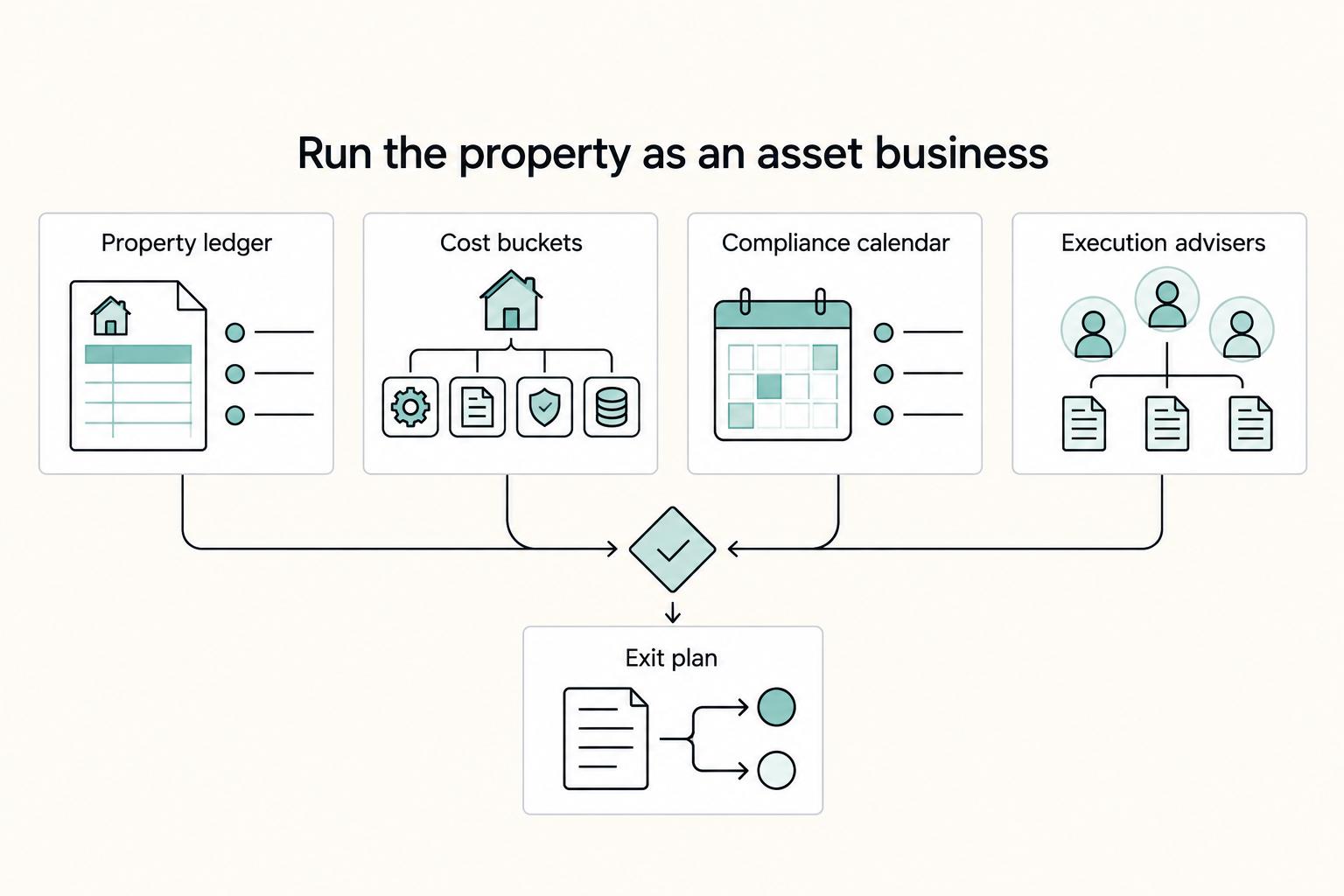
How to Run the Property as an Asset Business#
Once setup is complete, treat this as an operating framework, not a statement of fixed tax or legal rules. If you choose this route, run the property like an asset business with three standing controls: cash flow control, compliance cadence, and document discipline.
Run one property ledger, not a personal wallet#
Keep dedicated bank activity, a dedicated ledger, and a dedicated document file for the property. Mixing personal spending and property activity makes later review and filing prep harder.
Use a simple monthly check: every bank movement should tie to a use record, supporting document, and ledger entry. During rental periods, match receipts to occupancy and agreements. During personal-use periods, block those dates in real time and keep that record current.
Watch for undocumented cash or card spend, mixed payments, and late classification. If you wait until filing season to classify transactions, your advisers may have to reconstruct intent from incomplete records.
Define cost buckets before you optimize tax#
Before you try to optimize tax, start with clean classification. Treat rates and thresholds as variable inputs to confirm before you rely on the model. Start with internal working buckets:
| Cost bucket | What it covers |
|---|---|
| Current operating costs | Recurring spend to keep the property running in its current condition. |
| Acquisition and improvement costs | Spend tied to purchase, upgrades, or material changes to the asset. |
| Financing and entity administration costs | Spend tied to banking, financing, bookkeeping, legal support, and company administration. |
These are management buckets, not final legal treatment. Your advisers should confirm what is currently expensed, capitalized, or handled differently under the rules that apply to your facts.
For records, keep the invoice, proof of payment, vendor identity, property reference, and a short purpose note. For larger projects, keep the signed contract, change records, and completion evidence. If an invoice is vague, fix it while the facts are still easy to verify.
Build a recurring compliance calendar#
A recurring calendar reduces surprises and gives you a cleaner handoff into year-end filings.
| Obligation | Trigger | Filing owner | Evidence to retain |
|---|---|---|---|
| Monthly close and reconciliation | Any month with account activity | You, with bookkeeping support | Bank statements, ledger, invoices, payment proofs, rent roll or owner-use log |
| Rental activity review | Any period with tenants or platform bookings | Adviser prepares, you approve | Rental terms, occupancy calendar, deposit records, platform statements |
| Personal-use support file | Any period used by you or family or held off-market | You, with adviser review | Blocked calendar, usage notes, travel records, non-rental support |
| Ownership/authority refresh | Any change in members, control, or signing authority | You, with legal/tax advisers | Updated ownership records, authority documents, current ID set |
| Cross-border year-end review | Before returns, elections, major distributions, or sale steps | Joint adviser review, owner sign-off | Trial balance, account statements, prior filings, draft positions, issue log |
Keep rental-use and personal-use documentation separate so treatment decisions rest on clear evidence, not assumptions.
Choose advisers for execution, not credentials alone#
Coordination matters more than titles. Decide who owns intake, who checks document consistency, who flags cross-border issues, and who gives final sign-off before submissions.
Put expectations in writing: acknowledgment timing, blocker escalation, draft review sequence, and final approval order. If filings move before coordinated review, governance risk increases.
Plan the exit while the file is still clean#
Exit outcomes are often shaped well before listing. Frame the decision around four items: expected holding path, projected net proceeds, repatriation approach, and pre-sale file quality. Use this pre-list check:
- Does the asset still fit your actual use case?
- What are projected net proceeds after costs and tax, with any rate assumptions marked pending until verified?
- Will proceeds stay in the entity for reinvestment or be distributed?
- Is major cost history supported by invoices, payment proof, and clear classification notes?
Start cleanup early. Reconcile names and key details across title, banking, contracts, and prior filings, then close documentation gaps before buyer diligence starts.
For a step-by-step walkthrough, see US LLC and BVI Company Blueprint for Asset Protection.
Conclusion: Transform Complexity into a Controllable Business Project#
Use a go-or-no-go lens, not a blanket yes or no. For a us llc buy property in spain plan, the decision should come down to use-case fit, your tolerance for ongoing compliance work, and your willingness to run the asset with steady operating discipline.
The three pillars create a clearer screen. Strategic fit means choosing the structure on purpose, not by default. An LLC is often presented as a liability and privacy tool, but those outcomes are not automatic in every case. Compliant setup means confirming who owns what, who can act, and what requirements apply before money moves. Sustainable operations means maintaining records and recurring controls after closing, not improvising later.
Use a practical final screen. Pause if the structure does not match your real use case, if the administrative burden is unrealistic for you, or if you are unlikely to keep clean documentation. Move to deeper review if the structure fits your plan and you are ready to manage it like a business asset. Also take concentration risk seriously. Putting multiple properties into one LLC can increase downside if something goes wrong.
Before acting, apply a verification checkpoint to every source and adviser memo you rely on: is it current, attributable, and tied to your facts? A visible fact-check marker and recent update date, for example April 16, 2025, can help as a baseline, but they are not a substitute for legal and tax validation for your specific situation.
| Pillar | What you must validate | Primary support before proceeding |
|---|---|---|
| Strategic fit | Property use case, risk goals, ownership approach | Qualified legal and tax advisers for your jurisdictions |
| Compliant setup | Ownership chain, signer authority, key documents and responsibilities | Qualified counsel for the jurisdictions involved |
| Sustainable operations | Recordkeeping cadence, account controls, change-management process | Ongoing accounting and legal support |
Execute in order: fit first, setup second, operations third. That sequence keeps risk visible, documentation cleaner, and the project manageable. You may also find this useful: How to Structure a US LLC for Investing in Foreign Real Estate.
If you want a cleaner system for cross-border money movement, talk with Gruv to confirm coverage and compliance gating for your setup.
Frequently Asked Questions
Is it better to buy in your own name or through an LLC?
Do not treat the personal-name versus LLC choice as settled without advice tied to your facts. Treat it as an unresolved legal and tax decision, and confirm it with qualified U.S. and Spanish advisers before you decide.
What compliance and reporting exposure should I expect?
The specific compliance or reporting duties, triggers, thresholds, deadlines, and penalties need fact-specific review. Keep those items pending until an adviser confirms them for your case.
How should I budget for cost and complexity?
The specific one-time and recurring costs for setup, compliance, banking, and operations need current quotes and adviser review. Keep budget figures as quote-based estimates until verified.
Can an LLC get banking or mortgage support for the purchase?
Treat banking and mortgage eligibility for U.S. LLC buyers in Spain as institution-specific. Confirm account-opening and lending requirements directly with the bank, lender, and advisers for the transaction.
What IDs and documents should I have ready?
Required Spanish IDs, tax IDs, and document checklists need transaction-specific confirmation. Do not rely on a definitive document list until advisers verify the requirements for your case.
What does “tax treatment” actually mean here?
Specific tax treatment outcomes, filing positions, and reporting rules need fact-specific review. Keep tax-treatment details pending until advisers confirm them for your ownership and use pattern.
How should I choose the LLC state or structure?
Do not assume any LLC state or structure is better for this use case without adviser review. Keep this as an adviser-led choice tied to verified evidence for your facts.
Try a related tool
Researched and edited by the Gruv editorial team. Gruv builds cross-border billing, payouts, and finance-operations software for global businesses.
Sources
- congress.gov/congressional-report/113th-congress/executiv...trusted
- federalregister.gov/documents/2022/09/30/2022-21020/beneficial-o...trusted
- ftb.ca.gov/about-ftb/data-reports-plans/summary-of-fede...trusted
- irs.gov/businesses/small-businesses-self-employed/re...trusted
- irs.gov/businesses/corporations/do-i-need-to-file-fo...trusted
- oecd.org/content/dam/oecd/en/publications/reports/201...trusted
- ofac.treasury.gov/faqs/all-faqstrusted
- sec.gov/Archives/edgar/data/1269920/0001193125062235...trusted
Educational content only. Not legal, tax, or financial advice.
Related Posts

Sole Proprietorship vs LLC for Global Freelancers in 2026
For most freelancers in 2026, the practical default is still simple: use the simplest structure you can run cleanly, then formalize when risk actually rises. If your work is still in validation mode and the downside is contained, a sole proprietorship is often the practical starting point. When contract exposure, delivery stakes, or dispute risk starts climbing, forming an LLC deserves earlier attention.

Thailand Tax for Digital Nomads Without Residency Mistakes
The most expensive mistakes here happen before anyone opens a tax return. People pick a visa, assume the tax answer comes with it, then try to rebuild the year from scraps after the fact. By then, the damage is usually not one dramatic error. It is a pile of small gaps: an unverified day count, a transfer with no clear purpose note, invoices that do not line up cleanly with payments, and assumptions nobody wrote down when the facts were still fresh.

How to Structure a US LLC for Investing in Foreign Real Estate
If you are considering a **Limited Liability Company (LLC)** to buy property outside the United States, start with compliance, not convenience. A clean structure can support ownership separation and, in some cases, financing options. Weak setup decisions can also create tax exposure and expensive rework.