
Quick Answer
No. A USPS P.O. Box should not be your single address for a foreign-owned LLC. It requires an in-person USPS identity step, and bank onboarding under 31 CFR 1020.220 can require street or physical-location data. Use a role split instead: a CMRA-style mailing address for routine correspondence and a separately appointed registered agent for official notices. Before filing, confirm current state requirements, your provider’s address format, and whether Form 1583 and notarization apply to your setup.
--- For a non-resident founder, a US business address is not a minor admin choice. It becomes the base for mail, compliance, banking, and the first round of trust checks others run on your company. Get that choice wrong, often by trying to use a standard P.O. Box for everything, and the friction shows up quickly. Get it right, and the rest of your setup gets easier to run.
Treat this as an operating decision, not a box to check. The goal is straightforward: give each address a clear job so routine mail, legal notices, and onboarding records do not get mixed together. This guide walks through that structure in three layers so you can build a US presence that is legitimate, compliant, and workable.
The P.O. Box Trap: Why the "Simple" Solution Is a Non-Starter#
Do not use a USPS P.O. Box as the primary address for your LLC. For a non-resident founder, it is a weak fit in three places that matter in practice: activation, bank onboarding, and legal-notice handling.
USPS still requires an in-person identity step before you can access a box. Even if you reserve online, you must bring your application and 2 forms of ID to that post office to receive keys or a combination, and USPS online opening requires you to be 18 years old.
Banking is the second problem. Under 31 CFR 1020.220 (eCFR page current as of 3/12/2026), customer identification requires street or physical-location style address data: a residential/business street address for individuals, and a principal place of business, local office, or other physical location for non-individual customers. A USPS P.O. Box is a mailbox inside a post office, not your business location.
Use this address-role split to keep functions separate:
| Address type | Setup reality | Banking readiness | Mail and courier handling | Legal-notice reliability |
|---|---|---|---|---|
| USPS P.O. Box | Online reservation is possible, but access requires in-person ID verification at the post office | Weak fit when physical-location address data is required | Street-addressing is subject to availability/restrictions, and some merchants do not ship to P.O. Boxes | Poor fit for compliance; USPS says its street-address option cannot be used as your physical residence or place of business in legal documents |
| CMRA virtual mailbox | Separate category from USPS P.O. Box | Separate from bank street/physical-location address requirements | Built to receive U.S. mail for others as a service | Not the same as a registered agent |
| Registered Agent address | Appointed for state compliance | Separate compliance role from mailing-address setup | Focused on service of process rather than routine mail intake | Purpose-built to receive service of process; states can require physical in-state presence |
A CMRA and a registered agent are not interchangeable. USPS defines a CMRA as a business that receives U.S. mail on behalf of others, and requires CMRA delivery addresses to be represented as a private mailbox. Separately, states set registered-agent requirements; for example, Delaware requires a registered agent with a physical Delaware address and availability during normal business hours to accept service of process, and Virginia also requires a physical business address for registered agents.
Before you move to Layer 1, keep this checklist:
- Do not use a USPS P.O. Box as your main LLC address for banking or legal documents.
- Do not assume a virtual mailbox also satisfies registered-agent requirements.
- Confirm your mailbox provider is operating as a CMRA and check how the address is formatted.
- Set up this stack next: a CMRA for operational mail plus a separate registered agent in your formation state. For setup details, see How to Get a US Business Address as a Non-Resident.
If you want a deeper dive, read Sole Proprietorship vs. LLC: The Definitive Guide for Global Freelancers.
Layer 1: The Operational Layer - Forging Your Professional Presence#
Start with the address you will use for day-to-day business mail, and keep it separate from your legal service contact. If you started by looking for a po box for foreign-owned llc, the better setup is a two-lane one: an operational mailing address for routine communications and a separate service-of-process contact for legal notices.
You can see that split in real filings. In an SEC filing dated March 17, 2025, the form includes a dedicated agent for service block with name, address, ZIP, and phone, listing Cogency Global Inc., 122 East 42nd Street, 18th Floor, New York, NY 10168, (212) 947-7200. Use that as the model: operational mail handling and legal-notice handling are different jobs.
For daily work, treat this as your routine correspondence address and keep legal-service contacts in a separate lane. Confirm institution-specific address requirements before standardizing one format everywhere.
What to verify before you choose a provider#
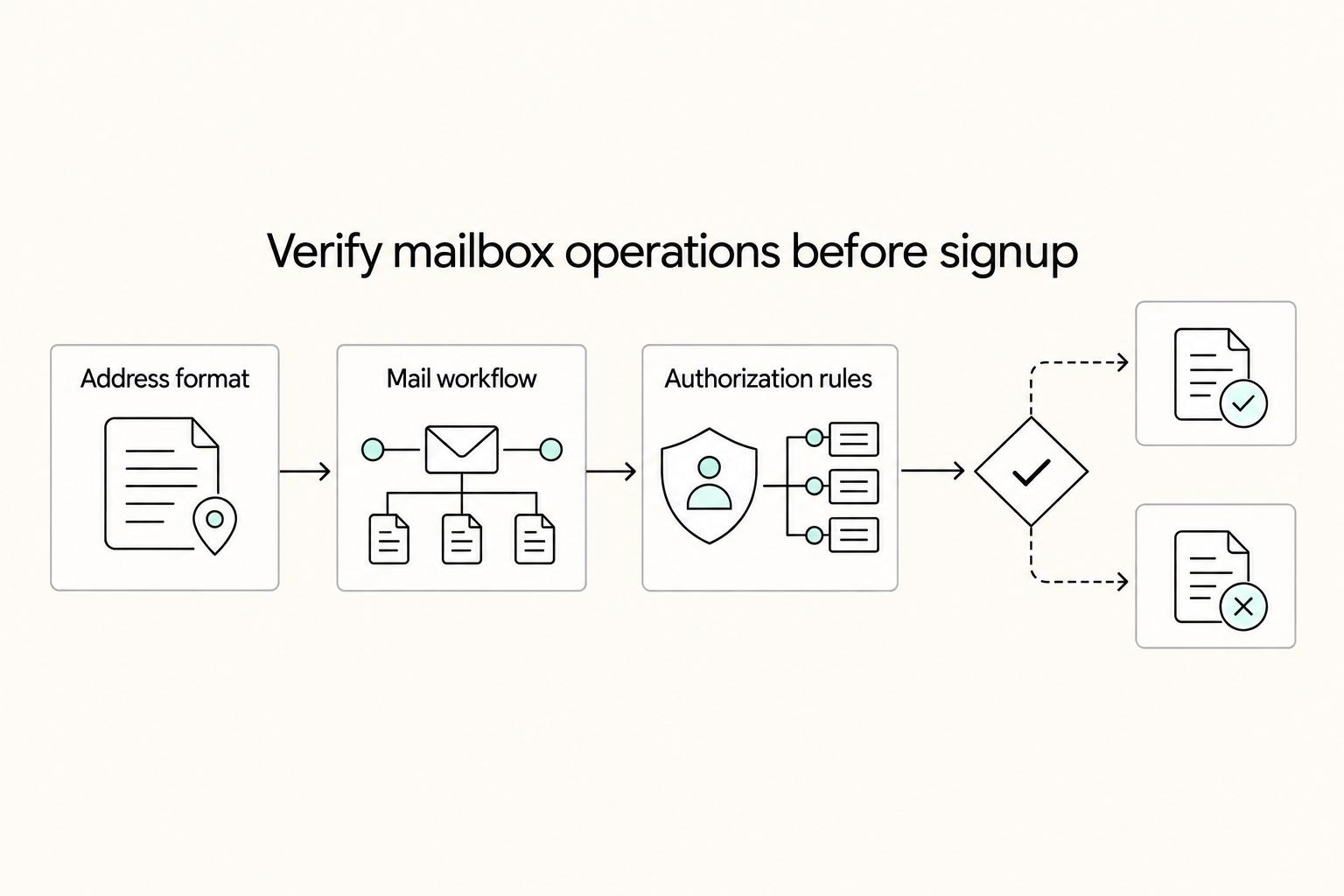
Pick based on operational clarity, not branding. Before you sign up, ask for the exact address format you will publish and confirm the documented mail-handling workflow.
| Decision criterion | What to verify now | If unclear, your risk |
|---|---|---|
| Address format | Exact street-format line you will use, including private mailbox formatting | Inconsistent address usage across systems and documents |
| Mail handling workflow | How incoming mail is logged, when scans are produced, and how forwarding requests are submitted | Operational confusion on time-sensitive mail |
| Authorization requirements | Which authorization steps apply to your setup and where they are documented | Setup delays and rework |
Form 1583 and notarization checkpoint#
Use the provider's current process here, not old screenshots or recycled setup advice.
| Checkpoint | What to confirm |
|---|---|
| Current instructions | If Form 1583 applies to your setup, request the provider's current instructions in writing and verify current USPS/provider requirements. |
| Accepted documents | Confirm the exact identity and address documents they currently accept for your case and verify the current accepted document list. |
| Notarization | Confirm whether notarization is required for your case and whether remote notarization is accepted in that workflow, then verify current USPS/provider/RON rules. |
Do not move forward until those three points are clear in writing.
Choose your operational address now#
Do not activate a mailbox until the address format and authorization steps are settled in writing.
- Select only after you have the exact address format and current authorization steps in writing.
- Test the workflow early with a small trial so intake and forwarding steps are clear.
- Keep this address in its operational lane, then set up your separate agent-for-service layer next.
Related: Brazil's CNPJ for Foreign-Owned Businesses: When It Is Needed and What It Does.
Layer 2: The Compliance Layer - Neutralizing Your Greatest Legal Risk#
This layer should be boring, explicit, and easy to audit. Keep your operational mail workflow separate from your compliance-notice workflow, and treat any LLC/Registered Agent/CMRA rule as unverified here until you confirm it with current state-law sources.
In practice, use a baseline-plus-local-variance model: keep one internal baseline process, then add stricter state-specific steps where required. Treat operational mail and formal-notice handling as separate responsibilities with clear owners, even if one vendor offers both.
| Setup | Acceptable use | Location requirement | Availability expectation | What breaks if you use it for the wrong job |
|---|---|---|---|---|
| Operational mailing address | Day-to-day business mail and admin flow | Verify against provider terms and any current state-law requirements relevant to your filings | Reliable intake, scan/forwarding, and notification workflow | Time-sensitive notices can be routed into a general mail queue |
| Registered Agent address | Formal notice handling only after you confirm the provider is validly appointed in your state | State-specific appointment/address requirements must be verified before filing or updates | A defined notice-acceptance and escalation process | Ownership of notice response and timing becomes unclear |
| One-provider setup | Can work only if mail handling and formal-notice handling are documented as distinct functions | Must be validated for your state and provider contract terms | Two separate handling paths, even under one contract | One signup can blur role boundaries |
Where the gray area really is#
The material above does not establish whether a virtual mailbox, CMRA, or P.O. Box is accepted or rejected for your use case. The real question is what your state currently requires and what service your provider is actually contracted to perform.
Use a state-variance check, not a generic answer. Confirm:
- What your state currently requires for this role.
- Whether the provider explicitly offers Registered Agent service in that state.
- How formal notices are accepted, logged, and escalated to you.
If any of that is unclear, stop and verify before filing or updating records.
The risk chain to avoid#
A common failure pattern is simple: a notice lands in the wrong workflow, response timing slips, and your records become harder to reconcile when you need them most.
Choose and maintain the compliance layer#
Choose the setup only after you have written confirmation of responsibilities, appointment details, and escalation ownership for your state.
Use this checklist before you commit:
- Confirm service coverage for your exact formation state.
- Get the exact service identity, listed address, and appointment documentation in writing.
- Verify notice intake, escalation timing, and who owns backup contact handling.
- Store confirmations, terms, filing copies, and renewal dates in one compliance folder.
- Recheck annually and whenever you change filings, contacts, or providers.
If a vendor cannot clearly separate "mail handling" from "Registered Agent service," keep separate workflows until that separation is explicit. For implementation detail, see How to Get a Registered Agent for Your US LLC.
Once this layer is clean, Layer 3 gets easier because your records have clear owners and roles.
For a step-by-step walkthrough, see How to Structure a US LLC for Investing in Foreign Real Estate.
Before you finalize filings, separate your mailing workflow from your registered-agent workflow and map your next compliance steps in the Gruv docs.
Layer 3: Keep Your Entity Details Consistent Across Records#
Once the compliance layer is in place, consistency becomes the next practical step. You will not control every review outcome, and these IRS excerpts do not establish banking, procurement, or credit approval results, but aligned entity details can help you avoid self-created mismatches.
Banking starts with a consistency check#
Before you submit anything to a bank, make sure your core entity details match across records. This does not guarantee approval, but it helps you present consistent information during review.
| Detail | How it should appear |
|---|---|
| LLC legal name | Exactly as filed |
| Mailing and street-address format | Exactly as recorded |
| Responsible-party details | Exactly as you will submit |
Check those three items side by side before onboarding. Keep your formation approval, SS-4 draft or copy, and address records together so you can respond if verification requests come in.
EIN setup is a form-detail job#
Treat EIN setup as two tasks: complete the SS-4 correctly, then confirm the current filing workflow.
| SS-4 line | Entry |
|---|---|
| Line 1 | Legal name of entity |
| Lines 4a-4b | Mailing address |
| Lines 5a-5b | Street address |
| Lines 7a-7b | Responsible party |
On SS-4, map those entries in advance and keep them consistent with your records.
Then apply the IRS guardrails:
- File only one Form SS-4.
- Keep Form SS-4 information current.
- Telephone application is available only to international applicants.
- Verify the latest SS-4 instructions for current fax-number and mailing-address details before filing.
Credibility, onboarding, and early credit#
For client operations, the goal is clean records, not a prestige signal. The IRS excerpts in this section support SS-4 consistency checkpoints, but they do not verify procurement outcomes, contract onboarding outcomes, payment-operations outcomes, or early-credit outcomes.
Use one master profile and reuse it everywhere you are asked for company details:
- legal entity name
- mailing and street address
- responsible-party details
- intake forms, contracts, invoices, and account records
That consistency is the real payoff of the address setup. When your records stay aligned as the business grows, your internal reconciliation gets easier.
You might also find this useful: A Guide to the 'Foreign Bank Account Reporting' (FBAR) for a US LLC with a foreign owner.
Conclusion: Your Address Is Your Anchor#
Your address setup is an operating decision, not a branding choice. If you are considering a po box for foreign-owned llc, ask the practical question: can one mailbox handle daily business mail while keeping legal-registration duties clearly separate?
| Decision Area | P.O. Box | Business-facing Address + Registered Address |
|---|---|---|
| Daily operations | Works as a mailbox, but remains a mailbox-only setup. | Provider-described as a business-facing address for daily operations. |
| Legal/compliance role | By itself, this is a different role than the Registered Address used for official company formation and legal registration. | Keeps legal-registration responsibilities separate from day-to-day mail handling. |
| Onboarding readiness | A one-address-for-everything setup may blur roles during reviews. | Separating address roles can make records easier to review. |
That role split is the point. A provider example separates a Registered Address for official company formation and legal registration from a business-facing address for daily operations. Use the same logic in your own setup: choose your operational address, then separately set the Registered Address used for legal registration.
Use this sequence:
- Choose your operational business-facing address.
- Set your Registered Address for official company formation and legal registration.
- Reuse that setup consistently across filings, contracts, invoices, tax records, and onboarding.
Final check before the FAQs:
- I have one business-facing address for daily operations.
- I have a separate Registered Address for official company formation and legal registration.
- I use the same address format everywhere details are reviewed.
- I keep proof of both arrangements in one place.
When an address decision turns on a rule, verify the controlling source. FinCEN says its FAQs are explanatory only, FederalRegister.gov says displayed pages are not the official legal edition, and eCFR is labeled authoritative but unofficial, so save the official PDF or other controlling version you rely on.
We covered this in detail in A Deep Dive into Form 5472 for Foreign-Owned US LLCs.
Frequently Asked Questions
What is the difference between a mailing address and a registered agent address?
Usually, they are different jobs. Your mailing address is for routine business correspondence, while your registered agent address is for official state notices and, where applicable, service of process. Keep those roles separate in your records and verify your state’s registered-agent rule before filing.
Can you use a virtual mailbox as your LLC address?
Yes, but only for the right function. A virtual mailbox may work as your business mailing address, but that does not automatically make it acceptable for formation filings, tax records, bank onboarding, or registered-agent use in every state. Confirm with the provider whether the address is a CMRA and what uses it supports, then verify current state rules before relying on it.
Do you need an address in the same state where your LLC is formed?
It depends on state rules. Your registered agent setup must meet the formation state’s requirements, but your mailing address may be treated differently. Verify the exact address type requested on current state instructions before you submit.
How do you handle USPS Form 1583 if you are outside the US?
It depends on your mailbox provider and your specific setup. Do not assume Form 1583 is required in every workflow, and do not assume one notarization method is accepted everywhere. Ask for the exact ID list, notarization options, and activation steps your provider requires, then keep approved records.
Can you use a family member's US address instead?
Yes, but be careful about scope. A family address may handle ordinary mail, but it may be a weak choice for public business records or time-sensitive legal notices. If you need stable handling for official notices, use a dedicated registered agent service and document who handles each address function.
What happens if you do not maintain a registered agent?
This creates compliance risk. If official mail or legal notices do not reach you, you can miss deadlines, and consequences vary by state. Confirm your state’s lapse and replacement process, and update the appointment before the prior agent ends.
Can a P.O. Box work if you also appoint a registered agent?
It may work for some mail use cases, but not for every requirement. A P.O. Box can be accepted in some contexts and rejected when a street address is required. Check acceptance rules with each filing authority and provider before filing or onboarding.
Does your address setup change your federal tax filing duties?
Generally no. Address choices do not, by themselves, remove filing duties that may apply to a foreign-owned LLC. The IRS says Form 5472 is used when reportable transactions occur, so review current instructions at IRS.gov/Form5472 and keep complete ownership and transaction records before filing.
If your LLC had little or no activity, can you ignore Form 5472?
Do not assume you can skip review. Secondary guidance may say foreign-owned disregarded entities still need filing review even with minimal activity, but treat that as a checkpoint, not an absolute rule. Review the current Form 5472 instructions and confirm your specific facts with your tax adviser before the deadline. If you want a quick sanity check on your cross-border setup before onboarding banking and payouts, contact Gruv.
Try a related tool
Researched and edited by the Gruv editorial team. Gruv builds cross-border billing, payouts, and finance-operations software for global businesses.
Sources
- corp.delaware.gov/faqs-regarding-registered-agentstrusted
- ecfr.gov/current/title-31/subtitle-B/chapter-X/part-1...trusted
- irs.gov/instructions/iss4trusted
- irs.gov/forms-pubs/about-form-5472trusted
- scc.virginia.gov/businesses/business-faqs/registered-agentstrusted
- sos.wa.gov/corporations-charities/frequently-asked-ques...trusted
Educational content only. Not legal, tax, or financial advice.
Related Posts

Sole Proprietorship vs LLC for Global Freelancers in 2026
For most freelancers in 2026, the practical default is still simple: use the simplest structure you can run cleanly, then formalize when risk actually rises. If your work is still in validation mode and the downside is contained, a sole proprietorship is often the practical starting point. When contract exposure, delivery stakes, or dispute risk starts climbing, forming an LLC deserves earlier attention.

How to Get a US Business Address as a Non-Resident
The cheapest path is to verify first, then buy. You want an address setup that survives filings, onboarding, and daily operations, not just a clean signup screen.
How to Get a Registered Agent for Your US LLC
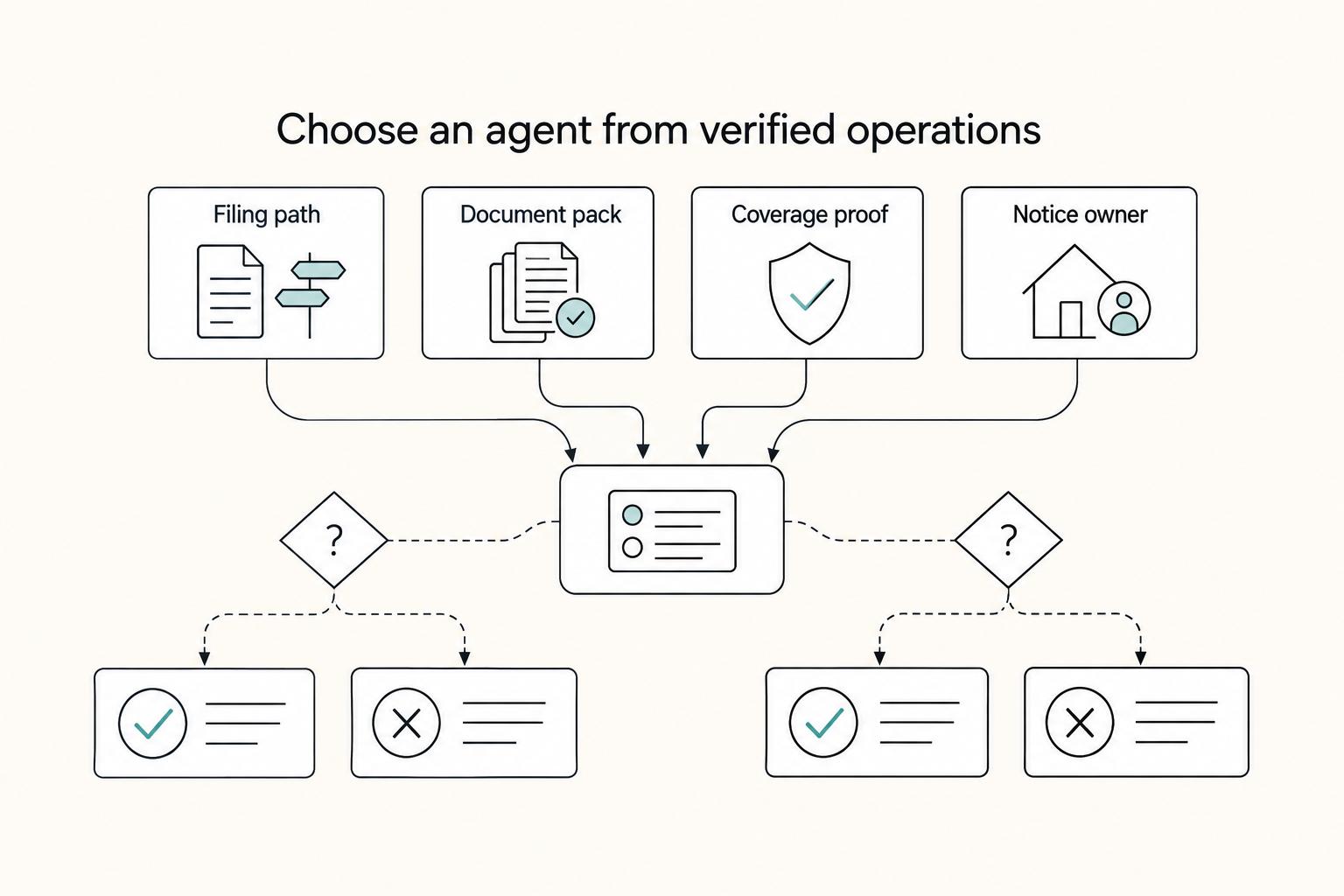
Use these 30 minutes as a decision sprint. Pick a setup you can run reliably, file it correctly, and avoid cleanup later.