
Quick Answer
Yes. You can deduct the business share of your phone costs as a self-employed freelancer, and that amount is reported through Schedule C (Form 1040). The cleanest path is a separate business line or device; when use is mixed, keep a consistent allocation approach backed by bills, payment records, and usage support. Handle monthly service and phone hardware as separate decisions, then pick hardware timing only after the claimed percentage is supportable. If you file with FEIE, keep this treatment aligned with your net-profit records.
Your Cell Phone Isn't an Expense; It's a Strategic Asset - Start Treating It That Way#
If you want to deduct your cell phone bill as a freelancer without creating a weak point in your return, the goal is simple: separate or document your phone use in a way you can explain if anyone asks. This is not about stretching a deduction. It is about matching your business-use allocation, your records, and your filing treatment.
If you are self-employed, including as a sole proprietor or independent contractor, the standard is straightforward. The deductible portion must be an ordinary and necessary business expense. So the practical question is not, "Can I deduct my phone?" It is, "What part is business, and what records support that amount?"
Use a simple decision order#
| Step | Use when |
|---|---|
| Segregate first | when you can separate business and personal use |
| Document mixed use | when one phone or plan covers both |
| Choose deduction treatment | only after the supportable amount is clear |
That order matters. IRS recordkeeping guidance requires you to separate business from non-business amounts and deduct only allowable expenses. Round-number estimates with no support are risky.
In practice, this deduction touches three areas at once.
- Allocation: identify the business portion for mixed use instead of defaulting to the full bill.
- Substantiation: keep supporting documents, such as bills, invoices, receipts, and related records, that back the amount in your books and return.
- Filing workflow: for sole proprietors, the deductible amount flows through Schedule C (Form 1040).
Cell phones were removed from listed property for tax years beginning after December 31, 2009. That did not remove the need for records, reasonable allocation, and a clear filing trail.
From here, follow the practical sequence. Separate where possible, document mixed use when needed, then claim only the amount you can clearly explain and support.
You might also find this useful: A Guide to Vehicle Expense Deductions for Freelancers.
Step 1: Separate business and personal phone use where you can#
If you can keep business and personal phone use separate, start there. It does not remove the need for records, but it makes your position much easier to explain. If you cannot keep that boundary clean, move to Step 2 instead of forcing a setup that will drift.
That sequence is practical. It also lines up with the review themes shown in IRS audit guidance, including allocation of personal expenses and telecommunication expense within recordkeeping issues. That guide is not legal authority, so do not treat it as law. It is still a useful check on where mixed expenses tend to get attention.
Pick the cleanest setup you can keep#
| Option | Setup effort | Compliance clarity | Ongoing admin burden |
|---|---|---|---|
| Separate business line on one phone | Low to medium | High when business activity stays on that line | Low |
| Separate business device | Medium | High when the device stays business-only | Medium |
| VoIP number for business + local SIM/eSIM for personal use | Medium | Medium to high when client communication stays on the business number | Medium |
A setup that looks clean on paper but does not fit how you actually work will usually fail in practice. If that is the case, skip it and prepare to document mixed use properly.
Define your boundary before you buy anything#
Treat "business-only" as an operating rule, not a label. Write one clear rule and follow it month after month. In practice, that usually means keeping client communication and business account activity on the business channel, while personal calls, messaging, and entertainment stay off it. Keep billing records distinct where possible so the setup is easy to identify later. Once you decide where that boundary lives, make sure your records match it.
Use this handoff checklist before Step 2.
- Choose one setup: separate line, separate device, or VoIP plus personal SIM/eSIM.
- Write a one-sentence use rule for that setup.
- Save the first invoice, activation receipt, and any device purchase receipt together.
- Label the line or device clearly in your records.
- Review the first full billing cycle for drift. If usage is mixed, move to Step 2.
Related: How to Handle Taxes for a Side Hustle.
Step 2: The Documentation Strategy - Building Your Deduction File#
When separation is not realistic, the fallback is a deduction file that supports a consistent business-use percentage, not the largest possible claim. For mixed-use phone deductions, the quality of the record trail matters.
If you are self-employed, you can deduct business use of your phone, but only the business-use share of the cost. For a mixed-use personal phone, treat this as an allocation and documentation process you maintain through the year, not a year-end guess.
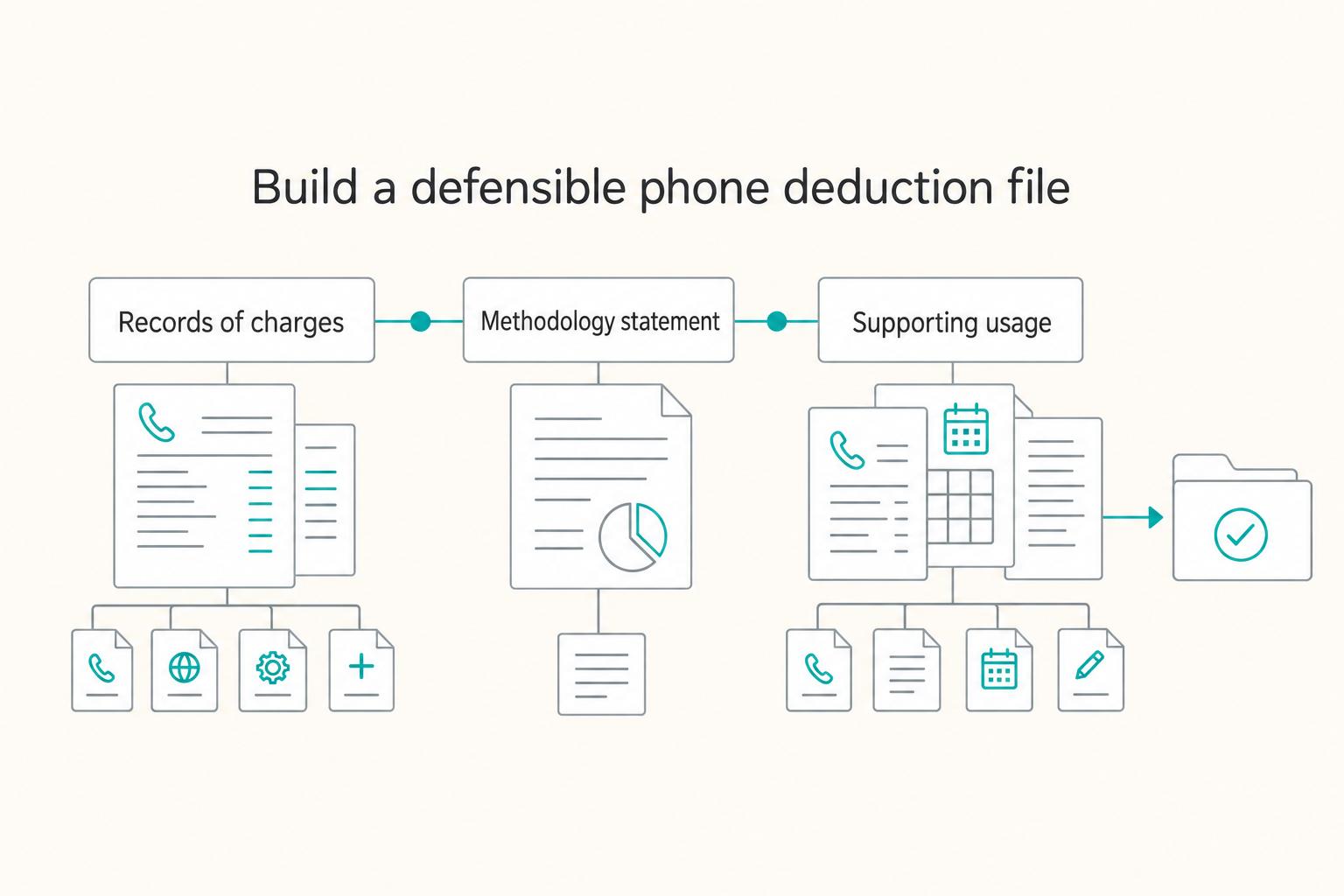
Build the file around three pieces#
Keep one folder for the tax year with:
| Piece | What to keep |
|---|---|
| Records of charges | monthly carrier bills, plus any charges you may allocate to business use, such as roaming, long-distance, add-on services, or plan changes tied to business needs |
| Methodology statement | one short note explaining how you calculate business-use percentage |
| Supporting usage evidence | call or log notes, itemized records, calendar matches, and business-purpose notes for business calls |
Choose a method you will actually maintain#
These are practical documentation methods for mixed-use phones, not formal IRS method labels.
| Method | Workload stability | Ongoing effort | Defensibility |
|---|---|---|---|
| Representative period | Best when phone usage is stable | Low | Good if the period is truly typical |
| Month-by-month allocation | Best when usage changes across the year | Medium | Strong, because each month is documented |
| Full-year logbook | Best when usage is irregular | High | Strongest detail if maintained consistently |
Pick the method you will still follow in a busy month. If your work pattern changes, update your method instead of forcing last quarter's ratio onto new facts.
Keep the note factual: state the method you verified, the period you reviewed, and the business-use ratio your records support.
I used my cellphone for both business and personal purposes during this tax year.
Deductible-share method: verify the allocation method against current source records and actual usage logs before using it.
Period analyzed: verify the representative period or ongoing-log months against the source records for the year before using them.
I marked usage as business when it related to ordinary business activity, and as personal when it did not.
Business-use percentage applied: use only the ratio supported by usage logs, receipts, tax records, or qualified tax adviser records.
I applied this percentage to the phone service costs I am claiming.
Supporting records include bills, usage records, and business-purpose notes where relevant.
Use this monthly maintenance checklist.
- Save the monthly bill to your tax-year folder.
- Save receipts or invoices for any business-related phone charges you plan to allocate.
- Update your monthly business-use calculation or logbook entries.
- Add business-purpose notes for items that are not obvious.
- Spot-check one sample period against calendar or client records to confirm consistency.
That keeps the file contemporaneous and avoids a weak year-end reconstruction. For a step-by-step walkthrough, see Can You Deduct Health Insurance Premiums as a Freelancer?.
Before you finalize your deduction file, use the Tax Residency Tracker to keep your travel and residency timeline aligned with your tax records.
Step 3: Decide whether to deduct the device now or over time#
Once your service-cost documentation is in place, decide how to handle the phone itself. The basic tradeoff is simple: deduct more now, or spread deductions across future years. Pick the method that fits your cash flow and the level of recordkeeping you can maintain.
This step covers the device purchase, not the monthly service allocation from Step 2. The same baseline still applies. The expense must be ordinary and necessary, and any mixed-use claim should stay tied to a supportable business-use share.
Compare the two timing methods#
Before you choose, confirm how your business is taxed, because treatment can vary by entity structure. That does not change the core timing tradeoff, but it can affect how you apply the method.
| Method | Timing impact | Recordkeeping burden | Generally fits | Verification checkpoint |
|---|---|---|---|---|
| Safe harbor election | Pulls the business portion of hardware cost into the current year, subject to the threshold verified for that tax year | Lower ongoing burden after setup; still requires purchase record and business-use support | You want current-year tax relief and a simpler ongoing process | Confirm the current threshold, confirm entity treatment, keep receipts and categorization clear |
| Depreciation | Spreads the business portion over the recovery period verified for the device and tax year | Higher ongoing burden because the asset must be tracked across years | You want deductions spread over time or expect stronger future profitability | Confirm the current recovery period and maintain year-to-year asset records |
Safe harbor is usually the "benefit now" choice. Depreciation is usually the "benefit over time" choice. Neither one fixes weak documentation.
Use these rules to choose.
- If this year is strong and immediate tax relief matters, consider safe harbor only after the current threshold and entity treatment are verified.
- If income is uneven or you expect higher future profit, depreciation may fit better.
- If you are unlikely to maintain multi-year asset records, avoid the more complex method.
- If business use changed during the year, make sure hardware treatment still matches your documented business-use approach.
- If facts are mixed, including shared use, reimbursement issues, or cross-border complexity, confirm treatment before filing.
Keep the hardware decision aligned with the service-cost documentation you built in Step 2. If your facts are mixed or cross-border, confirm the final treatment with a qualified tax professional before filing.
We covered this in detail in How to Deduct Startup Costs for Your Freelance Business.
The Global Professional's Toolkit: Tech for a Compliant Operation#
Use tools that make separation and recordkeeping easier to defend, not just easier to manage. A good setup does two things well: it helps keep business and personal use apart, and it preserves records month after month. IRS audit-planning materials also flag allocation of personal expenses and recordkeeping, and list telecommunication expense as a recordkeeping checkpoint.
| Tool category | Primary use | Deduction support | Best fit | Common mistake to avoid |
|---|---|---|---|---|
| Business VoIP line | Keep client calls and texts separate from personal communications | Gives you a distinct business communication trail and line-level billing records | You want one stable business channel while working across countries | Mixing client and personal communication on one line, then reconstructing later |
| eSIM or separate mobile line | Split personal and business usage on the same device or across devices | Makes business and personal allocation easier to document in mixed-use setups | You travel frequently or use one phone for both work and life | Treating a travel line alone as proof of deductibility |
| Expense tracker | Capture recurring telecom charges and payment evidence | Keeps invoice dates, vendors, amounts, and payment confirmations together | You want fewer documentation gaps at filing time | Depending on memory or uncategorized statements |
| Secure cloud storage | Store receipts, bills, and allocation notes in one archive | Preserves your documentation set for prep and review, even if a device is lost | You want consistent retention and fast retrieval | Spreading files across apps and devices with no naming standard or backup |
Set this up in order so your records match your setup from day one:
- Choose your business line first so your separation logic starts clean.
- Isolate personal usage with a separate line, eSIM, or a clearly documented mixed-use approach.
- Automate capture so telecom records are saved when each charge occurs.
- Centralize records in cloud storage, including invoices, screenshots, and your written allocation method.
Cleaner operations do not create deductibility on their own. They only support a claim you can substantiate. If you are globally mobile, apply the same documentation logic across countries and carriers. Keep any local requirements tied to jurisdiction-specific source records or adviser guidance. Also treat the IRS audit guide as planning context, not binding authority.
If you want a deeper dive, read Do I Have to Pay State Taxes While Living Abroad as a Digital Nomad?.
| Setup | What to document | Best when |
|---|---|---|
| Separate business line or device | Line setup, monthly bills, payment confirmations, and a short note that the line is for business communications | You can keep personal use off that line and want the cleanest record trail |
| Mixed-use phone with a representative period | Bills plus a dated note showing the sample period and why it reflects normal use | Your usage is stable and the sample is genuinely typical |
| Mixed-use phone with an ongoing log | Bills, usage records, and a running business-use log | Your usage changes across months or travel makes one sample period weak |
How do I calculate the business use percentage for my cell phone?#
Use a method you can support with records, then apply it consistently. Keep the bills, the tracking support, whether that is a sample-period note or an ongoing log, and a short explanation of your calculation. If you are not sure your sample is typical, track longer or use a more conservative percentage.
Can I deduct 100% of my cell phone as a freelancer?#
Yes, but only if your facts and records support exclusive business use. Keep documentation showing the setup, yearly bills, and why personal use is excluded. If personal use exists or exclusivity is unclear, claim only the business portion.
What records do I need for a cell phone deduction?#
Keep one complete file: monthly bills, payment confirmations, phone or accessory receipts, and your allocation note. For mixed use, keep the underlying logs or usage evidence that supports your percentage. If records are incomplete, use the amount you can substantiate cleanly.
Where do I claim the cell phone deduction on my tax return?#
Use the current filing instructions for your return year rather than older examples. Keep the form set you relied on, your expense total, and the worksheet tying the claim to your records. Check the current form instructions before filing.
Can I deduct the cost of my phone itself, or just the monthly bill?#
Potentially both, but do not assume service and hardware are treated the same way. Keep the purchase receipt, activation date, and business-use support aligned with your service-method records. Track hardware separately from monthly service, and check the current form instructions before claiming.
How does this work if I'm a U.S. expat using the Foreign Earned Income Exclusion?#
FEIE does not remove self-employment tax on net profit. If your net self-employment earnings are at least $400, IRS guidance says you must pay self-employment tax and attach Schedule SE (Form 1040). Document phone expenses consistently with your net-profit method, and escalate to a tax professional if your cross-border facts are complex.
What FEIE checks matter before I rely on the deduction in an expat filing?#
Start with the basics: you generally file a U.S. return reporting income to claim FEIE, your tax home must be in a foreign country, and one route is meeting the 330 full days test in a 12-consecutive-month period. A full day is 24 consecutive hours from midnight to midnight, and missing the day count fails that test unless a waiver applies. Keep your travel calendar, tax-home support, and expense records aligned, then get a preparer review if your dates, countries, or status changed.
Conclusion: Choose a setup you can defend and document all year#
The right move is not to chase the biggest deduction. It is to choose a phone setup you can defend all year, document it consistently, and file it the same way.
In practice, there are two paths. If you can keep business communications on a separate line or device, keep that setup and retain the bills, payment confirmations, and a short note showing business use. If your phone is mixed use, claim only the business portion and keep the records behind your percentage. The burden of proof is on you, so consistency and substantiation matter more than squeezing out a few extra dollars.
Before filing, run one last check. Could someone review your bills, your log or sample-period note, and your Schedule C amount and follow your math without guessing? If not, your file is not ready. Also keep this rule in view: for a home phone, the base rate of the first line into your residence is not deductible, but additional business costs above that base rate may be.
For next tax cycle, use this closeout list to keep the same issue from resurfacing:
- Pick one method and keep it all year: separate business line or device, or mixed-use allocation with a clear method.
- Maintain one record file with monthly bills, payment confirmations, receipts, and your written allocation note.
- Keep business-use boundaries during the year, not just at filing time.
- Before you file, tie the claimed total to your records and the current-year return instructions.
Bring in a tax professional if your phone-use pattern changed materially or your filing context now spans jurisdictions. For U.S. persons abroad, worldwide-income reporting still applies, and FEIE does not reduce self-employment tax on net profit.
Handled this way, your cell phone deduction stays a normal, supportable business expense instead of a recurring point of uncertainty. This pairs well with our guide on Can I Deduct Education and Professional Development Costs?.
If your setup spans multiple countries or filing regimes, contact Gruv to confirm the right compliance workflow for your case.
Frequently Asked Questions
How do I calculate the business use percentage for my cell phone?
Use a method you can support with records, then apply it consistently. Keep the bills, the tracking support, whether that is a sample-period note or an ongoing log, and a short explanation of your calculation. If you are not sure your sample is typical, track longer or use a more conservative percentage.
Can I deduct 100% of my cell phone as a freelancer?
Yes, but only if your facts and records support exclusive business use. Keep documentation showing the setup, yearly bills, and why personal use is excluded. If personal use exists or exclusivity is unclear, claim only the business portion.
What records do I need for a cell phone deduction?
Keep one complete file: monthly bills, payment confirmations, phone or accessory receipts, and your allocation note. For mixed use, keep the underlying logs or usage evidence that supports your percentage. If records are incomplete, use the amount you can substantiate cleanly.
Where do I claim the cell phone deduction on my tax return?
Use the current filing instructions for your return year rather than older examples. Keep the form set you relied on, your expense total, and the worksheet tying the claim to your records. Check the current form instructions before filing.
Can I deduct the cost of my phone itself, or just the monthly bill?
Potentially both, but do not assume service and hardware are treated the same way. Keep the purchase receipt, activation date, and business-use support aligned with your service-method records. Track hardware separately from monthly service, and check the current form instructions before claiming.
How does this work if I'm a U.S. expat using the Foreign Earned Income Exclusion?
FEIE does not remove self-employment tax on net profit. If your net self-employment earnings are at least $400, IRS guidance says you must pay self-employment tax and attach Schedule SE (Form 1040). Document phone expenses consistently with your net-profit method, and escalate to a tax professional if your cross-border facts are complex.
What FEIE checks matter before I rely on the deduction in an expat filing?
Start with the basics: you generally file a U.S. return reporting income to claim FEIE, your tax home must be in a foreign country, and one route is meeting the 330 full days test in a 12-consecutive-month period. A full day is 24 consecutive hours from midnight to midnight, and missing the day count fails that test unless a waiver applies. Keep your travel calendar, tax-home support, and expense records aligned, then get a preparer review if your dates, countries, or status changed.
Try a related tool
Researched and edited by the Gruv editorial team. Gruv builds cross-border billing, payouts, and finance-operations software for global businesses.
Sources
Educational content only. Not legal, tax, or financial advice.
Related Posts

Do I Have to Pay State Taxes While Living Abroad as a Digital Nomad?
Living abroad does not end `state income tax` exposure by itself. The first decision is practical: choose a filing position your facts can support, then build records that support the same story all year.

How to Handle Taxes for a Side Hustle
If you want less stress at filing time, use sequence instead of shortcuts. When one year includes payroll income, contractor income, and time in more than one country, the order of operations matters. This guide gives you a defensible path so you can make each decision once, document it, and avoid rebuilding the return later.
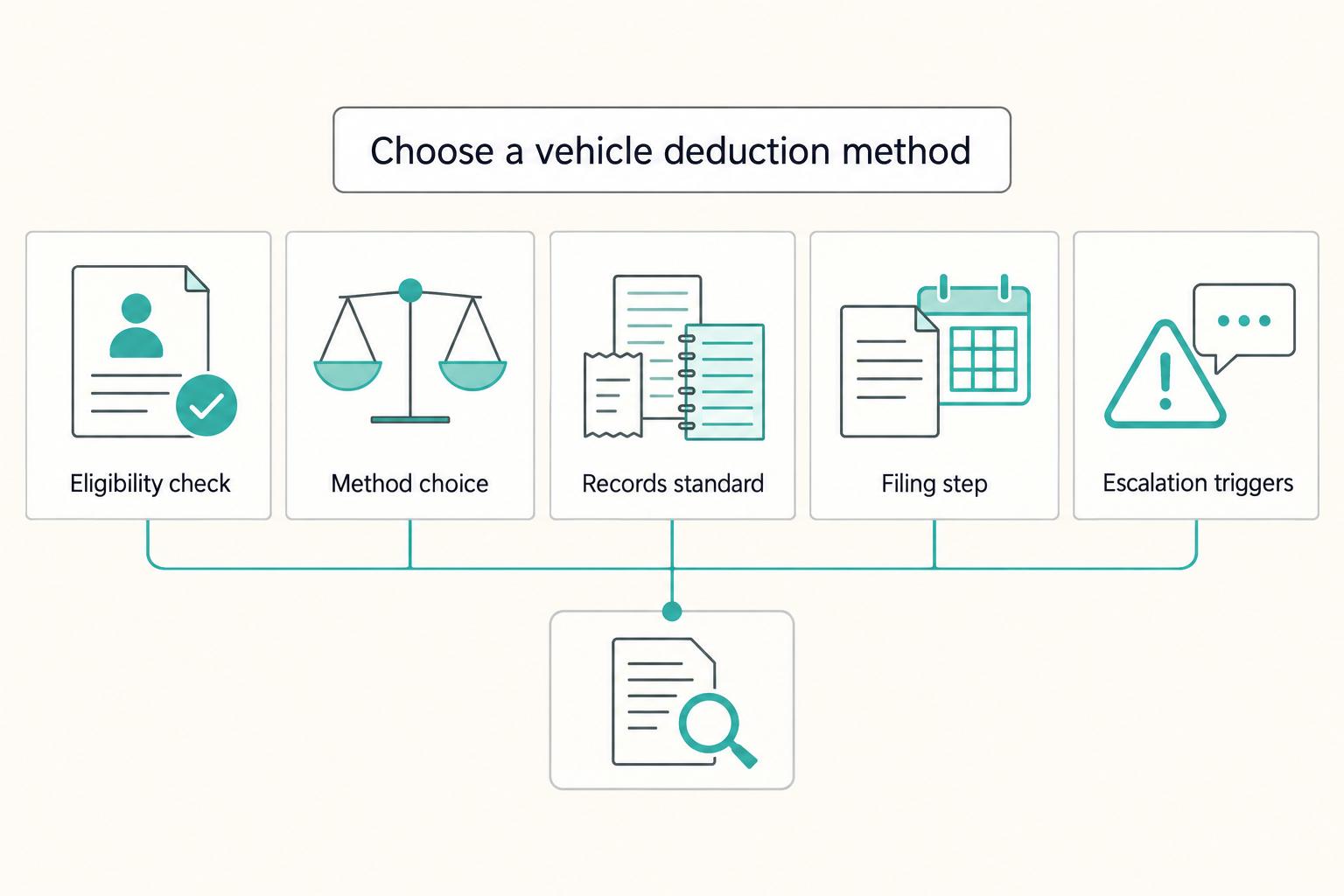
Freelancer Vehicle Expense Deductions: Standard Mileage vs. Actual Expenses
**Handle your vehicle deduction like an operator. Choose one IRS method, document business driving as you go, and escalate before ambiguity turns into risk.**