
Quick Answer
No. If taxes are imposed by and paid or accrued to a section 901(j) country, the credit is generally disallowed. Treat the income in its own country bucket and prepare the related Form 1116 only through line 17 where applicable, instead of mixing it into other FTC categories. If you cannot support a credit position, Schedule A can be the fallback. Pause filing and escalate when payer chain, ownership, or sourcing facts are unclear.
Cross-border work brings opportunity and risk. A strong international engagement can also pull you into U.S. tax and federal law issues that can seriously damage an underprepared business. One of the hardest versions of that problem is income tied to a country under U.S. restrictions.
This is not something to clean up at tax time. It needs a decision process before you sign, before you invoice, and before you file. The practical sequence is simple: Identify, Isolate, and Document. Used consistently, it turns a hard compliance problem into one you can control and explain. Some files also raise separate boycott-reporting questions, and those need their own track rather than being folded into your tax or sanctions review.
Step 1: Identify the Risk - Is Your Client on the Blacklist?#
Before you sign, run a hard go-or-no-go check:
- Could this engagement trigger IRC 901(j) foreign tax credit limits?
- Could it trigger OFAC sanctions exposure?
- Do you have enough documentation to defend your decision?
Treat this as an onboarding control, not tax-season cleanup. If you skip it, you can end up with a disallowed credit, blocked dealings, or an engagement you should never have accepted.
Run two separate reviews#
Keep the tax review and the sanctions review separate. A clean result on one side does not clear the other, so document the conclusions separately in your file.
| Issue | What triggers review | Who enforces | Business impact | Your immediate action |
|---|---|---|---|---|
| IRC 901(j) | Income or taxes tied to a country that may be under section 901(j) for the relevant period | IRS | Credit is generally disallowed for covered taxes; Form 1116 requires separate country treatment and this category is generally completed only through line 17 | Verify filing-period status in current IRS guidance, track separately, and do not assume the credit is available |
| OFAC sanctions | Client, payer, beneficial owner, or related party appears on an OFAC list, or ownership links may cause blocked status | U.S. Treasury OFAC (31 CFR part 501) | U.S. persons are generally prohibited from dealing with SDNs; assets can be blocked | Pause onboarding, do not start work or accept payment, and escalate if screening or ownership is unclear |
Verify current status each filing period#
Do not rely on old country examples from blogs, prior returns, or internal notes. Section 901(j) status can change over time, and IRS guidance tells filers to check current Form 1116 developments and instructions for the relevant period.
Apply the same rule to sanctions screening. OFAC list data changes, and for OFAC-regulated transactions you should keep full and accurate records available for at least 10 years.
Build an evidence-based onboarding file#
Before you accept the engagement, verify and save the core facts you are relying on for your decision:
| File item | What to verify or save |
|---|---|
| Legal entity and beneficial ownership details | Include the parent or control chain where known |
| Ownership-risk check | Check for potential blocked status at 50 percent or more aggregate ownership by blocked persons |
| Payment origin details | Confirm payer identity and whether payment instructions match the contracting party |
| Service destination details | Confirm who receives the services and where they are used |
| OFAC screening results | Save results for the entity, aliases, parent, and known key owners |
| Timestamped screening record | Keep search terms, results, date, and list version or page date used |
Sanctions List Search helps, but it does not replace full due diligence or cap liability.
Your escalation rule#
Use a hard stop if ownership, payment flow, or sanctions screening is unclear. Do not start work. Route the file to a qualified tax or sanctions professional before anything moves forward.
The rule is straightforward. If you cannot clearly identify the parties, ownership, payment path, and current screening status before signature, you do not have a green light. If you want a deeper dive, read Digital Nomad Taxes in 2026 With a Defensible Filing Plan.
Step 2: Isolate the Income - The Correct Compliance Protocol#
Once section 901(j) risk is real, separate that income immediately. Do not let it drift into your normal foreign tax credit process and plan to fix it later.
IRS treatment is country-specific. Income from each section 901(j) country is subject to a separate FTC limitation, and you must use a separate Form 1116 for each affected country. For taxes imposed by and paid or accrued to that country, no credit is allowed. That Form 1116 is generally completed only through line 17.
Isolation protocol you can execute now#
Set up the separation as soon as you identify the risk, not when you start drafting the return. Build it into your books and workpapers right away.
- Create one dedicated bucket per affected country for the filing year.
- Keep income, foreign tax amounts, and sourcing analysis inside that bucket only.
- Maintain a separate record file for that country: contract, invoices, payment records, withholding or tax receipts, and your sourcing memo.
- Before filing, confirm none of those amounts were pulled into any other Form 1116 category.
This is the control that keeps restricted-country amounts from contaminating eligible-country FTC calculations.
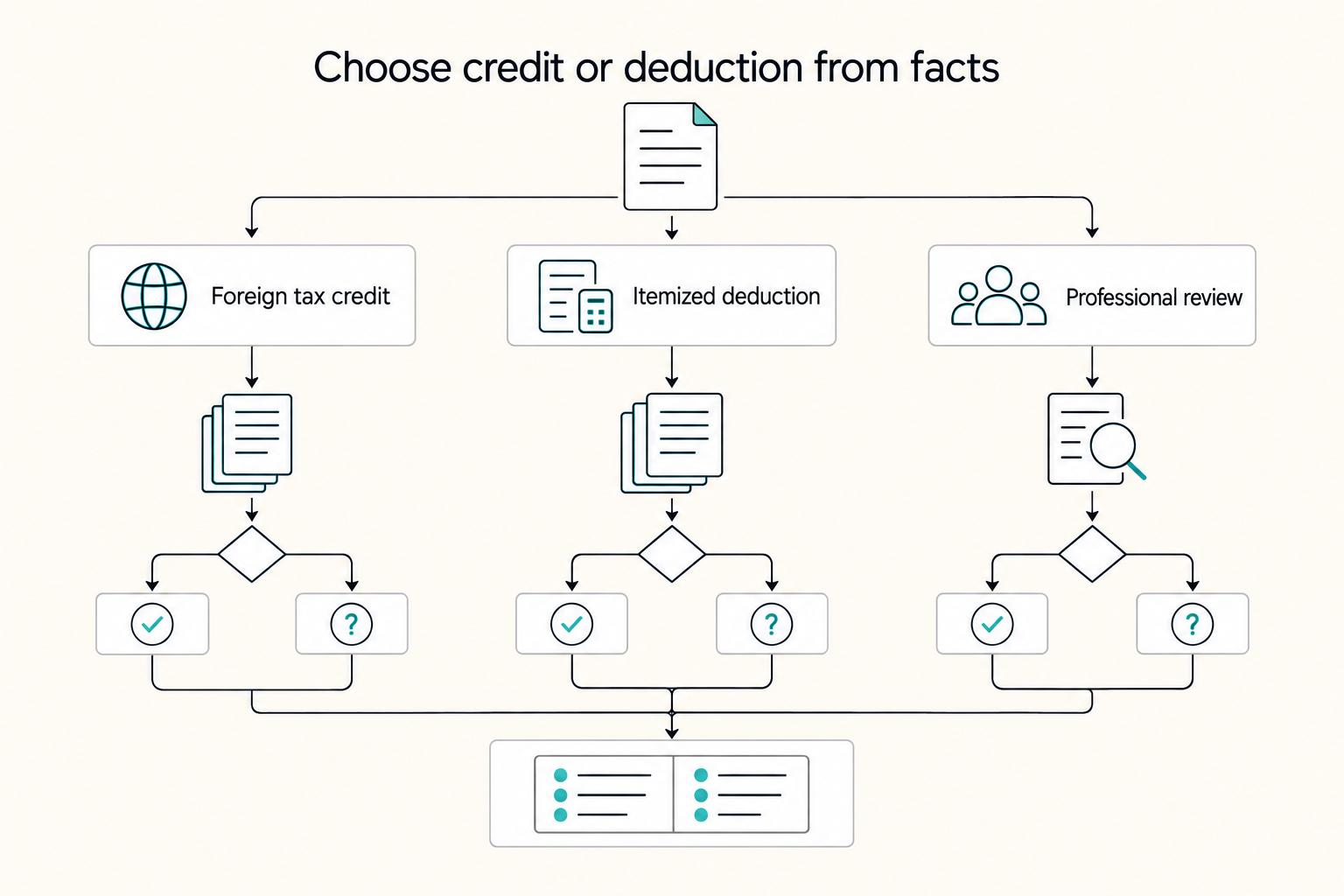
How to choose between a credit and a deduction#
This is not a preference call. It turns on whether the credit is available at all and whether your facts are clean enough to support the position.
| Path | Mechanics | Expected U.S. tax impact direction | Documentation burden | When it applies |
|---|---|---|---|---|
| Foreign tax credit | Claimed under FTC rules on Form 1116 | Direct reduction of U.S. tax liability when a credit is allowed | Case-specific support for the Form 1116 position | Not allowed for taxes imposed by and paid or accrued to a section 901(j) country |
| Itemized deduction | Claimed as a deduction on Schedule A (Form 1040) | Reduces taxable income rather than directly reducing tax liability | Case-specific support for the Schedule A position | Possible fallback when credit is not available and you itemize |
| Hold for professional review | Preserve records and defer final treatment until characterization is resolved | Defers the filing position until facts are resolved | Maintain a complete file while issues are unresolved | Use when source, payer chain, or tax treatment is unclear |
A narrow exception can exist where section 901(j) income is involved but the tax is paid to a non-sanctioned country. Treat that as a professional-review issue, not a routine self-prepare call.
What to do, and what to avoid#
Use this as a pre-filing control, not a reminder after the fact. The goal is to keep restricted-country amounts out of the wrong FTC basket.
- Do prepare a separate Form 1116 for each affected country.
- Do generally stop that section 901(j) Form 1116 at line 17 when taxes were imposed by and paid or accrued to that country.
- Do document why this bucket was excluded from other FTC limitation categories.
- Do route any deduction fallback through Schedule A (Form 1040).
- Do not use this bucket to offset eligible-country FTC amounts.
- Do not merge section 901(j) income into another Form 1116 category.
- Do not assume an intermediary payer changes source characterization by itself.
When the facts are messy#
Messy facts are where bad filings happen. If payer routing, entity layers, or source characterization is unclear, treat the case as high risk until you resolve it. Income paid through intermediaries can still be treated as sourced to a section 901(j) country, so keep a complete evidence file and escalate for professional review before final filing. Related: A Deep Dive into the Foreign Tax Credit (Form 1116).
Step 3: Document Everything - Building Your Audit-Proof Record#
Once you isolate the 901(j) bucket, the next question is proof. If your records cannot support amount, source, and country treatment, you do not have a filing-ready position.
The burden is on you. Build one case file per affected country, and make sure every document supports the same story from start to finish.
Your minimum documentation file#
For each affected engagement or income stream, gather the records that establish the facts, the money trail, and the reporting treatment.
- Scope and parties evidence. Keep records showing who hired you, which entity was involved, what services were performed, and the service period. This can include a contract, statement of work, signed proposal, or equivalent email records.
- Payment trail. Keep invoices, bank deposit records, processor records, remittance details, and transfer or check confirmations. Your file should show who paid, from where, through which intermediary if any, and how each payment ties to an invoice.
- Foreign tax proof. Keep records supporting tax imposed and paid or accrued. A net payout alone may not be enough to substantiate the tax figure.
- Form 1116 workpapers. Keep the separate Form 1116 support for the 901(j) category by sanctioned country, plus workpapers showing why the income stayed in its own 901(j) category. Where applicable, show why the form was generally completed only through line 17.
| Document | Why it matters | Common failure point |
|---|---|---|
| Engagement record | Establishes parties, scope, service period, and country facts | Contract names one entity, invoices name another |
| Invoices and payment records | Proves gross receipts and payment path | Net deposit kept without invoice or remittance detail |
| Foreign tax receipt or withholding proof | Supports tax imposed and paid or accrued | Only platform summary exists; no tax-supporting record |
| Separate Form 1116 workpapers | Shows correct 901(j) treatment by country | Income is mixed back into another Form 1116 category |
| Redetermination support (if figures change) | Supports later foreign-tax figure corrections | No trail for updated figures or missing Schedule C (Form 1116) |
Make the chain of evidence obvious#
A reviewer should be able to trace four things without guessing: entity names, payment path, service period, and country treatment.
Confirm that the payer on your bank records matches the invoiced party, or that any intermediary is clearly explained. Make sure service dates line up across the contract, invoices, and payment records. Then make sure the same country facts appear in both your memo and your Form 1116 workpapers. Payment routing through an intermediary does not, by itself, change source-country treatment, so document that routing path explicitly.
Retention and escalation#
Keep the file for the full period of limitations that applies under current IRS rules. In many standard cases, that is 3 years. It can stretch to 6 years if omitted income exceeds 25% of gross income shown. For certain refund claims, it is 3 years from filing or 2 years from payment (whichever is later). It is 7 years for worthless securities or bad debt claims, at least 4 years for employment tax records, and indefinitely if no return was filed or a fraudulent return was filed. Set retention to the longest period that could reasonably apply.
| Situation | Retention period | When it applies |
|---|---|---|
| Standard cases | 3 years | In many standard cases |
| Omitted income exceeds 25% of gross income shown | 6 years | If omitted income exceeds 25% of gross income shown |
| Certain refund claims | 3 years from filing or 2 years from payment, whichever is later | For certain refund claims |
| Worthless securities or bad debt claims | 7 years | For worthless securities or bad debt claims |
| Employment tax records | At least 4 years | For employment tax records |
| No return filed or fraudulent return filed | Indefinitely | If no return was filed or a fraudulent return was filed |
If any core record is missing, inconsistent, or contradictory, stop there. Do not file on assumptions. Reconcile the record and get professional review before final submission. For a step-by-step walkthrough, see FEIE vs Foreign Tax Credit for High-Earning US Expats. Before filing, consolidate your travel, tax-home, and documentation timeline so your records stay consistent under review with the Tax Residency Tracker.
Conclusion: Run the same checks before onboarding and before filing#
Treat this as a controls problem, not a judgment call. Run the same checks before you accept cross-border work and again before you file. That is how you avoid disallowed credits, sanctions exposure, weak records, and related reporting mistakes.
| Step | Key checks |
|---|---|
| Identify | Verify current status from current sources, not memory; check Publication 514 for the list; screen the client, payer, and any obvious beneficial party against the SDN List and other OFAC lists |
| Isolate | Separate the affected income and taxes before return prep; Form 1116 requires a separate form by income category, including Section 901(j) income; use separate country lines and columns as required when more than one foreign country or territory is involved |
| Document | Keep the contract, scope, invoices, payment trail, foreign tax receipts, screening results, and a short memo on where work was performed and who benefited; for certain OFAC-covered transactions recordkeeping periods were extended from 5 to 10 years effective March 12, 2025 |
Use this closeout checklist before you onboard the work and again before you file:
-
Identify. Verify current status from current sources, not memory. IRS Topic 856 says some foreign taxes are non-creditable, including taxes paid to certain foreign countries, and directs you to current Publication 514 for the list. In parallel, screen the client, payer, and any obvious beneficial party against the SDN List and other OFAC lists. OFAC also states its Sanctions List Search is not a substitute for due diligence, and using it does not limit civil or criminal liability.
-
Isolate. If the facts still indicate restricted treatment, separate the affected income and taxes before return prep. Form 1116 requires a separate form by income category, including Section 901(j) income. If more than one foreign country or territory is involved, use separate country lines and columns as required. Do not blend potentially restricted taxes into your general FTC process.
-
Document. Keep a complete file showing what happened and why you treated it that way: contract, scope, invoices, payment trail, foreign tax receipts, screening results, and a short memo on where work was performed and who benefited. U.S. tax law requires recordkeeping, and for certain OFAC-covered transactions recordkeeping periods were extended from 5 to 10 years effective March 12, 2025.
If anything material is unclear, pause the file. Screen the parties, separate the affected income and taxes, and preserve the evidence until treatment is confirmed. If country status, payment routing, or sourcing facts are unclear, escalate to a qualified cross-border tax and sanctions professional before money moves or the return is filed.
You might also find this useful: A Guide to OFAC Sanctions Screening for Global Businesses.
If your country status or income-sourcing facts are not clean-cut, get a compliance-first review path mapped before you file through Contact Gruv.
Frequently Asked Questions
I was hired and paid by an intermediary. What facts matter first?
Start with the anti-boycott facts that matter: the exact deal terms, any request to participate in or support a boycott, and whether you had operations in, or related to, a boycotting country. Review the contract, invoices, and emails for boycott-related conditions. If the request language is unclear or appears restrictive, pause and get qualified tax or trade-compliance advice before you file.
Is this only an IRS question?
No. Anti-boycott rules cover two tracks: IRS filing duties and Commerce reporting of boycott requests. Treat separate sanctions questions as a different review, and do not treat IRS or Commerce analysis as sanctions clearance. | Issue type | Primary authority | What you should do next | |---|---|---| | Boycott-related tax reporting | IRS | Check whether Internal Revenue Code section 999(a) makes Form 5713 required, and file it with your federal return when required | | Request to participate in a boycott | Department of Commerce | Preserve the request language and confirm whether quarterly reporting applies | | Separate sanctions restriction question | Separate current sanctions review | Handle this as a separate review; anti-boycott analysis is not sanctions clearance |
Do I only need to care if the activity produced income?
No. For Form 5713, "operations" include business or commercial activity even when no income was generated. That means the reporting question can exist even if the engagement was not profitable. If you had operations in, or related to, a boycotting country, verify Form 5713 before filing.
What records should I gather first, and when should I pause work?
Gather the signed agreement or email chain, scope documents, invoices, payment records, and the exact wording of any boycott-related request first. Pause immediately if someone conditions the deal on avoiding business with another country or party, or if the request appears to require boycott participation. Do not keep moving on assumptions when core records are unclear. Hold execution and get a qualified professional to review the file first.
What about penalties?
Use current verified guidance, not old figures. The key point is that agreeing to participate in a prohibited boycott can create criminal and civil penalty exposure. Verify any current penalty range before you rely on it. If you may already have agreed to a restricted request, escalate to qualified counsel immediately.
Try a related tool
Researched and edited by the Gruv editorial team. Gruv builds cross-border billing, payouts, and finance-operations software for global businesses.
Sources
- irs.gov/instructions/i1116trusted
- irs.gov/publications/p514trusted
- sanctionssearch.ofac.treas.govtrusted
Educational content only. Not legal, tax, or financial advice.
Related Posts

Digital Nomad Taxes in 2026 With a Defensible Filing Plan
With digital nomad taxes, the first move is not optimization. It is figuring out where you may be taxable, where filings may be required, and what proof supports that position.

A Deep Dive into the Foreign Tax Credit (Form 1116)
If you paid qualifying foreign income taxes and still owe U.S. tax, start with the Foreign Tax Credit and Form 1116. A credit usually beats a deduction because it offsets tax dollar for dollar. Do not start entering numbers until you decide whether you are taking a credit, an itemized deduction, or an exclusion. If you use the [Foreign Earned Income Exclusion](https://www.irs.gov/individuals/international-taxpayers/foreign-earned-income-exclusion) or the foreign housing exclusion, remove the excluded income and related foreign taxes from the credit path first.
OFAC Sanctions Screening for Global Businesses
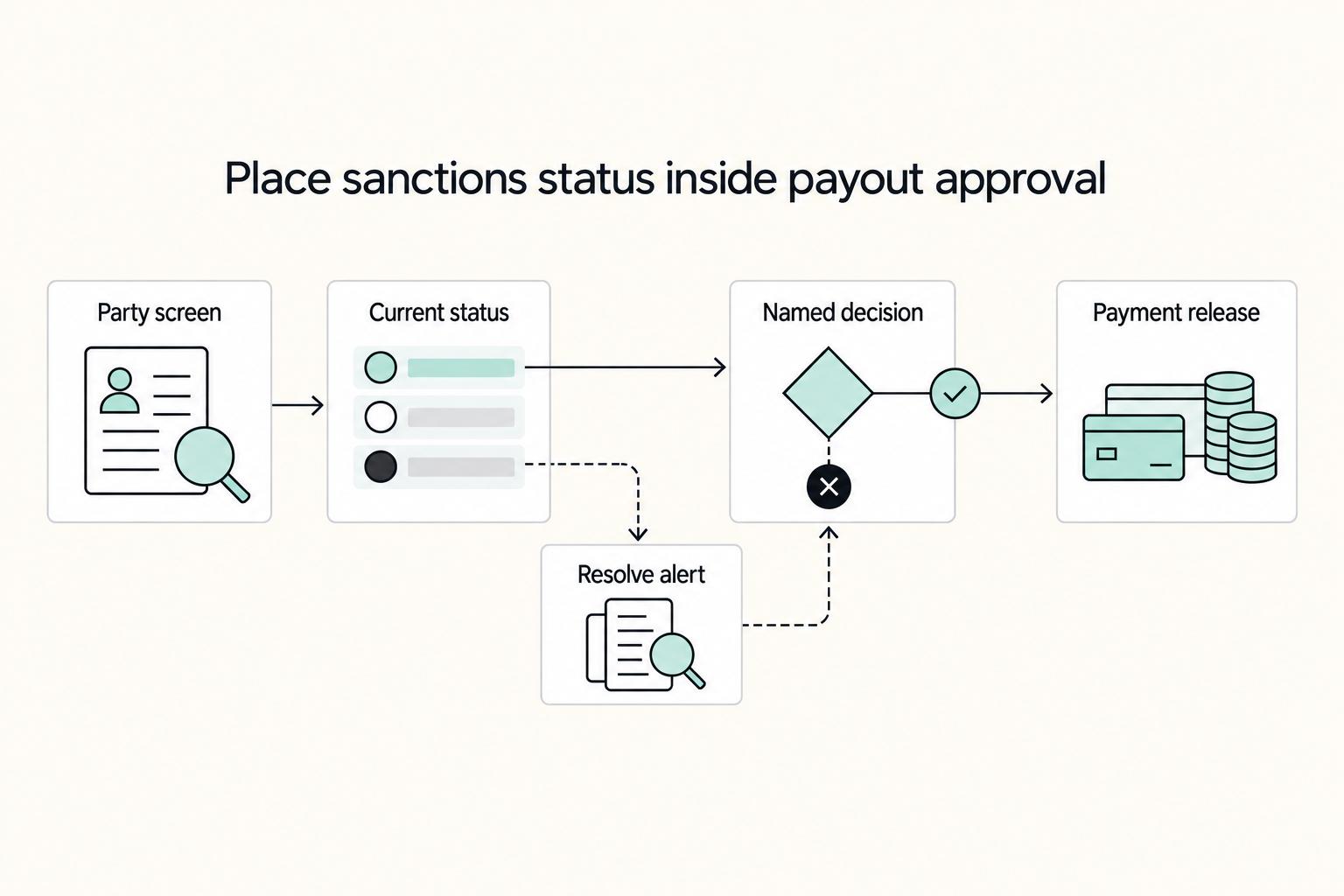
Treat **OFAC sanctions screening** as a payment control, not a formality. If your business touches cross-border counterparties or transactions that may fall under U.S. jurisdiction, screening can help protect your ability to move money when pressure is high. The Office of Foreign Assets Control (OFAC), within the U.S. Treasury, can block property, freeze assets under U.S. jurisdiction, and prohibit certain transactions involving sanctioned parties, countries, or regions.