
Quick Answer
Start with route verification, not neighborhood planning, if you want Budapest to work smoothly for remote life. This budapest digital nomad guide recommends a sequence: compare options broadly, confirm Hungary-specific requirements, organize a retrieval-ready evidence pack, and keep early housing reversible. In your first month, focus on stable work continuity, searchable records, and weekly checkpoints for tax and admin risks before locking longer commitments.
Budapest in 2026 for remote professionals#
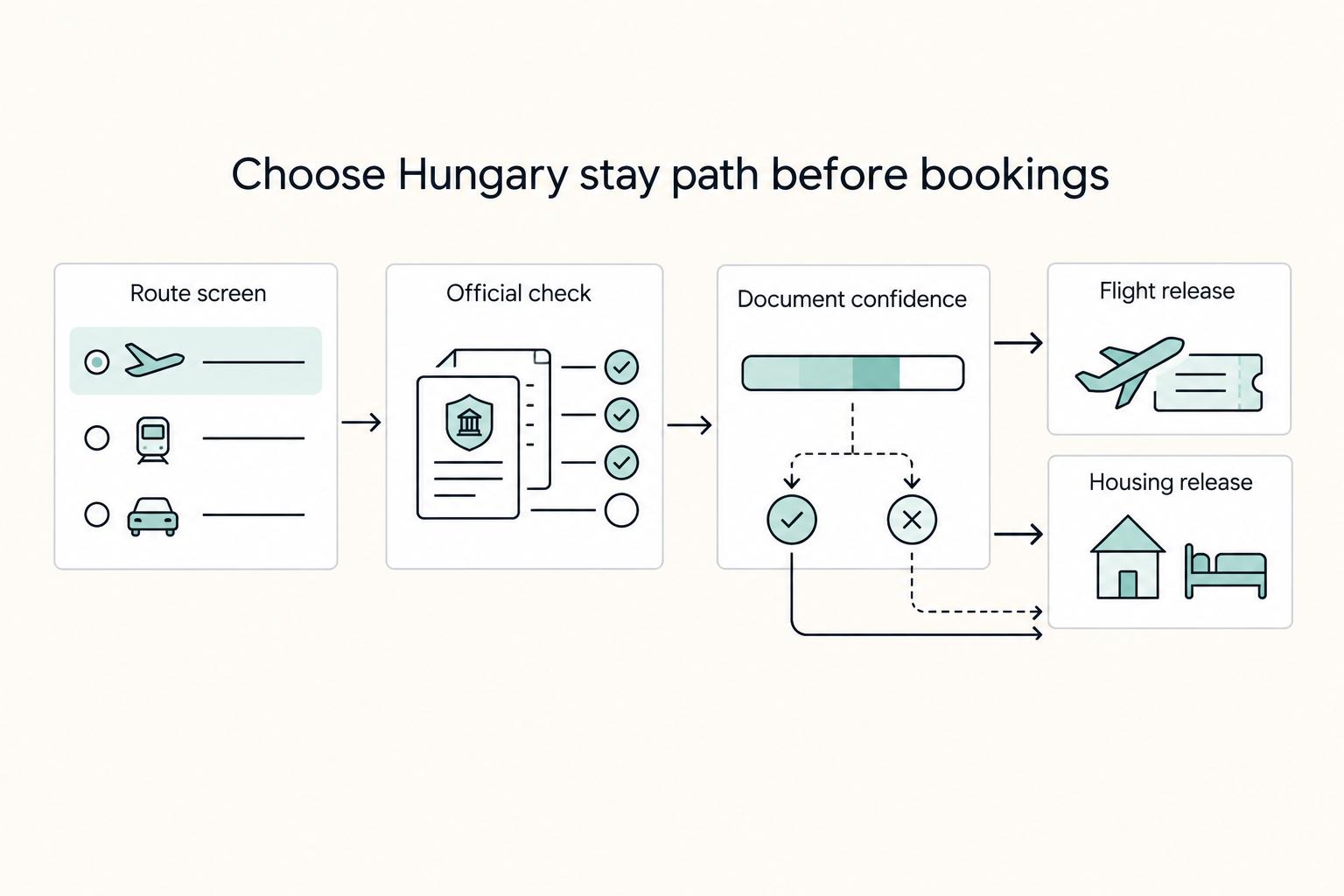
Your first decision is not where to live in Budapest. It is whether your Hungary stay route fits your passport, income, and remote work setup. Until that answer is solid, do not lock in nonrefundable flights or a long apartment contract.
That sequence matters more than almost any neighborhood choice. One mistake is treating Budapest as a lifestyle move first and assuming the paperwork will sort itself out later. If your route is weak, unclear, or still waiting on verification, your job is to preserve options, not optimize the city experience.
Start with route fit, not the umbrella label#
"Digital nomad visa" is a broad label. In Hungary, the country-specific route commonly described in third-party visa guides is the White Card, which those guides say is for non-EU/EEA citizens working remotely for companies abroad. That is useful as a first filter, not final authority.
| Aspect | Article detail | Note |
|---|---|---|
| Route name | White Card | Useful as a first filter, not final authority |
| Applicant described | Non-EU/EEA citizens working remotely for companies abroad | Verify on official Hungarian government pages |
| Income screen | Remote income comes from outside Hungary | May be the route to examine closely |
| Permission length described | 1 year | Treat as provisional until confirmed officially |
| Possible extension described | Additional 1 year | Treat as provisional until confirmed officially |
| Income requirement described | €3,000/month over the prior six months | Treat as provisional until confirmed officially |
| Application timeline described | About 30 days | Treat as provisional until confirmed officially |
| Items that can slow timing | Apostilled documents; criminal background check | Start the evidence pack early |
A practical first screen is simple: if you are an eligible non-EU/EEA applicant and your remote income comes from outside Hungary, the White Card may be the route to examine closely.
Third-party summaries also describe it as a 1 year permission, with a possible additional 1 year extension, a €3,000/month income requirement verified over the prior six months, and an application timeline of about 30 days. Treat all of that as provisional until you confirm it on official Hungarian government pages and record the date you checked.
That verification step is not busywork. It determines what you can safely book. If your eligibility or document list still depends on interpretation, plan as if your timeline can slip.
A good checkpoint before you spend real money is simple: confirm the route on official pages, then start your evidence pack early. Two items that can slow people down are apostilled documents and a criminal background check. Even when they are straightforward, they take calendar time. They are also exactly the details people miss when they focus too early on flights and furniture.
Match commitment to confidence#
If your paperwork confidence is low, keep your commitments reversible. If confidence is high because eligibility, timing, and documents are already checked, you can move earlier on logistics.
| Paperwork confidence | What it usually means | Commitment level to keep |
|---|---|---|
| Low | You are still confirming route fit, document requirements, or timing | Book refundable flights only if needed, keep accommodation short and cancellable, avoid deposits you cannot recover |
| Medium | You likely qualify, but one or two items are still pending, such as background check, apostille, or insurance confirmation | Hold a temporary stay, delay long lease signing, keep arrival plans functional rather than optimized |
| High | Your route is verified, core documents are assembled, and timing looks credible | You can move earlier on admin scheduling and housing research, but still avoid locking a long lease before arrival checks |
The housing trap is worth naming early. Central demand has pushed up rents in Districts V, VI, and VII, so a rushed first-month booking there can create two bad outcomes at once: higher cost and lower flexibility. If your paperwork is still unsettled, paying more for a cancellable short stay is often cheaper than unwinding a bad long commitment.
Plan in two budget buckets#
From day one, split your plan into setup costs and monthly run-rate. Setup costs are one-time items such as visa fees, health insurance, apostilles, background checks, and arrival purchases. Monthly run-rate covers rent, food, transport, workspace, and the spending pattern your workweek creates.
For now, keep the planning ranges unresolved instead of pretending older numbers are current:
- Setup costs: Confirm the current setup-cost range from your own source records
- Monthly run-rate: Confirm the current monthly run-rate range from your own source records
This matters because setup costs hit fast, while your real monthly pattern only becomes visible after a couple of weeks. It also protects you from mixing sources with very different recency. One Budapest budget source is framed for 2026, while another city guide in the research set dates back to February 11, 2021, so verify current pricing before you treat any band as a live planning number.
Think in phases. Pre-departure, the goal is a validated route, a started document pack, and reversible bookings. Arrival week, the goal is address stability and enough admin order to work without scrambling. Weeks two to four, you want a repeatable routine, cleaner records, and a clearer monthly spend pattern. Later commitments come only after the legal route, address reality, and first-month rhythm all hold up. Keep that order, and the rest gets easier fast.
Choose your stay path before you book flights#
Set your stay route first, then book travel and housing to match your paperwork confidence. Use a two-step flow: compare options globally, then verify Hungary-specific rules on official pages before you commit money you cannot easily recover.
"Digital nomad visa" is often umbrella language in third-party content. In Hungary, those same guides often point to the White Card, but that is still a starting point, not a final decision. Treat broad labels as research shorthand, then confirm the exact Hungary route and current constraints on official pages before you lock flights, deposits, or fixed arrival timing.
Use a two-step decision path#
Start with global screening to decide whether Budapest is worth pursuing versus your alternatives, then switch to Hungary-only verification. A comparison tool like The 2026 Global Digital Nomad Visa Index for 50+ Countries is useful for step one, but step two must be route confirmation on official pages.
| Your scenario | Best immediate action | Commitment level to avoid |
|---|---|---|
| You are still comparing countries | Rank options by route fit, admin burden, and first-month reversibility | Fixed return flights and long apartment contracts |
| Hungary looks promising, but you have not verified the current route on official pages | Verify the route on official pages, save the URL and date checked, and keep route constraints unresolved until that check is complete | Nonrefundable flights, route-timed arrival plans, landlord deposits |
| Hungary route appears to fit and official requirements are clear | Move in stages: refundable travel first, short cancellable housing second, tighter bookings only after route lock criteria are met | Treating "likely eligible" as the same as ready to commit |
Travel accounts underline why this matters: one traveler booked an apartment for one month and later felt it was not enough, while another felt six weeks was already enough. A pre-booked return flight can also make extensions harder. Keep flexibility until your route is truly locked.
Route lock criteria#
Before moving from refundable to nonrefundable spend, confirm all three:
- Eligibility confidence: you can match your passport, remote work setup, and stay plan to the Hungary route on official pages without guesswork.
- Document readiness: key documents are in hand or on a realistic timeline; if a critical item is still uncertain, your route is not locked.
- Admin timing clarity: you know what must happen before departure versus after arrival, and you recorded when you verified it.
Once your route is locked, the next bottleneck is your document pack, not travel deals.
Build your document pack before departure#
This is your most useful pre-departure task: if your files are organized and share-ready, everything else moves faster. If critical files are still missing, keep first-month commitments reversible and delay nonrefundable spend.
Build two parallel folders from day one: original (full, unredacted files) and shareable (redacted copies you can send safely). Keep both on your main device and in one secure backup with the same structure.
For Hungary-specific requirements, verify each one on official Hungary pages, save the URL, and log the date checked. Leave requirement-specific values, such as passport validity, unresolved until official-source verification is complete.
Use a folder structure you can search under pressure#
Create the same four top-level folders in both original and shareable:
| Folder | Examples | Note |
|---|---|---|
| 01 Identity | Passport file, photo ID files, and any route-specific identity items | Official verification should define which route-specific items belong here |
| 02 Travel | Booking records, cancellation terms, and any travel coverage documents | Include travel coverage documents only when the route or provider record requires them |
| 03 Work and income proof | Role/work evidence and income records | Use items that show remote-work continuity |
| 04 Address evidence | Current address records, temporary booking confirmations, and later housing proof | Replace temporary proof as better housing evidence becomes available |
Use a naming pattern so the latest file is obvious: YYYY-MM-DD_document-name_version (for example, 2026-04-08_passport_original).
Track readiness, not just storage#
A folder alone is not enough. Track each item so you always know what is usable now and what can block your timeline.
| Status | Item | Owner | Next action |
|---|---|---|---|
| ready | Identity file set | You | Re-check official Hungary requirement pages before departure |
| pending | Work/income evidence | You / employer / client | Collect final signed copies, then save original + shareable versions |
| re-check | Address evidence | You / housing provider | Replace temporary proof when your housing plan is confirmed |
Use this as a decision rule: if a critical item is pending or re-check, keep flights and first-month housing flexible. This document pack is what determines how safely you can commit in the next housing step.
Pick housing without trapping yourself in a bad first month#
Keep month one reversible. Choose a place you can leave, and move to a longer commitment only after your paperwork timing, admin flow, and weekday work routine are stable in real conditions.
Treat this as a testing month, not a forever-home decision. Routine is often harder to maintain on the road, and early upsides can become downsides once normal work pressure returns. If a place looks great but makes calls, cooking, gym time, or basic errands harder, it is the wrong first-month base.
Use your first stay to test four points on actual workdays: commute reliability to your primary and backup work spots, call conditions at busy hours, host or building response speed when something breaks, and daily errand friction (food, laundry, cooking, recovery).
A coworking space can cover gaps because it provides work infrastructure and amenities. Use that as backup, not as a reason to keep a weak housing setup.
| First-month option | Flexibility | Admin usefulness | Operational risk |
|---|---|---|---|
| Short-stay rental | Can be flexible if cancellation terms are clear | Varies by host; confirm what records they can provide | Varies by listing and response quality |
| Serviced stay / aparthotel | Often easier to extend or adjust | Often easier to get standardized booking paperwork | More predictable operations, less home-style setup |
| Hotel / B&B fallback | Best for short-notice switches | Usually straightforward booking records | Strong for arrival-day failures, weaker for settled routines |
For local short-stay compliance, verify instead of assuming. Keep the district short-term rental rule unresolved until official or local-source verification is complete, then get written confirmation from the host or property manager and save it with cancellation terms and property details.
Before any longer lease, run a go/no-go check:
- Rule compliance confirmed in writing
- Cancellation terms still acceptable if your timing changes
- Backup options ready, including a hotel/B&B fallback
- Your stay path is stable enough that housing will not need a sudden reset
If any item is weak, stay flexible. Once the place passes real workdays and commute tests, move to the first-week operations sequence.
Execute your first 7 days in Budapest in the right order#
Use week one to reduce uncertainty before you optimize lifestyle choices. Work this checklist in order: stabilize your address, validate mobility, secure work continuity, then verify document access. If any one of these is weak, pause nonessential plans until it is stable.
Treat online recommendations as hypotheses, not operating truth. Some Budapest guides are based on short stays, and longer-stay experiences can look very different. Keep what helps, but trust your own commute tests, call-quality checks, and reliability checks over general tips.
| Task | Why it matters | Success signal | Fallback |
|---|---|---|---|
| Confirm your base for the full first week | Housing instability creates avoidable rework across every other setup step | You have the exact address, check-in method, host contact, and written terms saved | Change accommodation quickly while cancellation or short-stay flexibility still exists |
| Test your main and backup routes | Budapest is often described as walkable with strong public transport, but your actual routes still need proof | Two repeatable routes work at the times you will actually travel | Confirm current local transport and workspace details from local sources |
| Secure work continuity | "Usable internet" is not enough if calls or focus blocks fail in practice | You complete one real call and one focused work block without noise or dropouts | Move to a verified backup workspace and reassess the flat |
| Verify critical file access | Admin tasks fail fast when files are unavailable at the moment you need them | You can open ID, accommodation, and work files from cloud and offline copies | Rebuild access the same day before any dependent admin step |
Change quickly if friction repeats. Use a simple trigger: two failed commute tests, two disrupted calls, or one file-access failure you cannot resolve the same day. Your week-one outputs should be clear before you move into weeks two to four: stable base, workable transport pattern, one backup workspace option, and reliable access to critical files.
Stabilize weeks 2-4 with work, tax, and admin checkpoints#
In weeks 2-4, your job is to run a repeatable system, not react to every rough day. Lock one primary workspace, one backup workspace, and one realistic commute pattern, then hold that setup long enough to judge it on pattern, not noise.
Use this order and stick to it: confirm your primary and backup work locations, test the same commute windows you actually use for calls and deadlines, then decide whether to change anything only after consistent results. If you keep changing flats, cafes, or routes after single good or bad days, you create the same failure mode as a "do everything all at once" approach: you end up on the defensive instead of fixing the real blocker.
Handle tax prep in the same phase, but keep it scoped. Start with what you can resolve from your own records, then escalate only the points that change decisions, and track each question through the Tax Guide for Freelancers in Hungary.
- Self-resolve first: map your income sources, client countries, invoice currencies, expected expense categories, and which documents are present vs missing.
- Escalate for advisor input: any open point that could change your filing position, reporting treatment, or how you structure invoices, contracts, or expense handling.
When you check official pages, log the page title, URL, and check date. If a page shows a consent layer first, record that as a separate step before treating the page as reviewed.
Treat invoicing/admin as evidence hygiene, not later cleanup.
- Use one naming pattern across files (for example:
2026-03_Client_Invoice-004.pdf,2026-03_Client_PaymentProof_Invoice-004.png). - Store each invoice with its matching contract or SOW, payment proof, and related receipts.
- Capture receipts the same day.
- Keep housing/identity records in a separate searchable folder from client billing files.
Run one weekly checkpoint with only three fields per area: status, risk, next action. If you cannot write one clear line per area, the setup is not stable yet.
| Area | Stable setup signals | Escalate now signals |
|---|---|---|
| Work | Primary space supports real calls and focused blocks; backup is tested | Repeated call disruption, repeated noise issues, or no workable backup |
| Transit | Same routes hold at your actual working hours | Reliability keeps breaking meetings or causing late starts |
| Tax | Open questions are listed and split into self-check vs advisor input | You are making treatment assumptions without documents or advisor review |
| Documentation | Invoices, receipts, contracts, and payment proof are linked and searchable | You would need memory, not records, to reconstruct a payment trail |
Plan your budget like an operator, not a tourist#
Treat your Budapest budget as a two-phase system: stabilizing first, recurring second. In month one, pay for flexibility and information; only lock recurring commitments after your work routine, commute, and admin setup have held up in real use.
Classify each expense by purpose, not label:
- Stabilizing: short flexible stays, extra transit while testing routes, paid backup workdays, and other costs that help you confirm what works
- Recurring: costs tied to a routine that has already proven reliable across your actual working hours
Classify first, then optimize#
Build a rough forecast before arrival, then re-forecast after your initial operating period using your own transactions and calendar. A practical rule: if a cost buys flexibility or learning, keep it in stabilizing; if it supports a proven routine, move it to recurring.
Use Budapest price signals to calibrate risk. One stay account reports housing as the largest spend and places a cheaper-end private Airbnb at 21,376 HUF/night. That is not a citywide benchmark, but it is a clear warning that month-one flexibility can be expensive, so housing should be your first review point.
Use smaller recurring prices as drift checks, not universal averages: 450 HUF per public transport journey, 3,500 HUF for a restaurant plate, 1,500 HUF for a beer, and 5,000 HUF for a haircut. If these convenience costs keep repeating, verify whether your routine is stable or still compensating for setup gaps.
| Tier | What you are buying | Flexibility | Operational risk | Trigger to switch |
|---|---|---|---|---|
| Lean | Easy-exit housing, home-first work setup, transit-first movement | High | Higher disruption risk if housing/work setup is weak | Stay here if calls, commute, or admin are still unstable after week 2 |
| Base | More settled housing, repeatable workspace rhythm, proven commute | Medium | Moderate risk if you lock in before assumptions are validated | Move here only when route reliability, backup workspace, and document access are consistently working |
| Buffer | Base plan plus spare room for forced changes | Lower by design (intentionally overprovisioned) | Lowest disruption risk, higher cash burn | Use when one forced move, paperwork delay, or work interruption would strain cash flow |
Lean is a control tier, not a failure tier. Base is for when your routine is boring in a good way. Buffer is for uneven income or timing uncertainty you cannot absorb cheaply.
Judge housing by total friction, not rent alone#
Budapest may be cheaper than Western or Nordic Europe, but rent alone still misses operational risk. Score each housing option on:
- Commute reliability: can you make your real schedule consistently, using routes you have tested
- Workspace fallback: if home stops working, do you have a backup that is actually usable
- Admin access: can you receive and retrieve records without adding dependency on a host or another move
- Exit flexibility: if paperwork or housing timing shifts, can you leave without compounding loss
In crowded nomad periods, housing and workspace competition can rise together. That is when short-term "good enough" decisions create long-term daily friction.
Your contingency line should cover concrete events: forced move, extra short-stay nights, added transport during route retests, or paid workspace days when home fails. If burn rises, cut discretionary dining, social spend, and comfort upgrades first. Pause any new recurring commitment, especially longer housing terms, until budget and admin status are both stable.
Avoid the delays competitors rarely explain#
Most delays here come from sequence errors, not one big mistake. If you lock your Hungary path first, keep your files retrieval-ready, and avoid irreversible housing too early, you cut off the delay chain before it compounds.
The first phase of a move creates many small decisions, and the attention drain is real. People with repeat relocation experience often report a short productivity dip, sometimes for a week or two, while they handle setup friction like internet. The risk is not just admin effort. It is lost work capacity while you fix issues that should have been handled upstream.
Check your delay stack before you commit#
Use this quick stack in order, and stop at the first weak link:
| Dependency | What to check | Quick self-check |
|---|---|---|
| Route clarity | Decide whether you are still comparing destinations or executing a Hungary plan | Can you explain your Hungary path in one sentence without importing assumptions from other countries? |
| Document integrity | Keep identity, work, and address records in one pack with originals, redacted share versions, and an offline copy | Can you retrieve any required file fast without digging through old email threads, chats, or cloud folders? |
| Housing flexibility | Keep month one reversible until route and document flow are stable | If timing shifts, can you change housing without paying twice for a rushed decision? |
| Connectivity continuity | Test your primary connection and one backup early | If your main connection drops during a call, do you already know your immediate fallback? |
When delays pile up, the pattern is usually the same: you patch a downstream symptom because it feels urgent. Better Wi-Fi does not fix route confusion. A better flat does not fix broken document flow. Sideways fixes increase decision fatigue and burn time.
Escalate upstream, not sideways#
Use this reset playbook as soon as drift appears:
- Pause new commitments when you spot mixed-country guidance, missing key files, no connectivity backup, or pressure into less-flexible housing.
- Restart from the highest blocker in this order: route, then documents, then housing, then connectivity.
- Re-test the failed dependency before moving on. If file retrieval failed, fix that first, then revisit housing.
- Resume gradually only after the upstream blocker is stable, not just quiet for a day.
Use the 2026 Global Digital Nomad Visa Index if you are still choosing between countries or your Hungary plan no longer holds. If Hungary is still your path, stay in Hungary-specific execution mode and fix the blocker in front of you.
Your next move this week#
Run this as a seven-day sprint: decide, prepare, then verify before you commit to nonrecoverable costs.
- Decide your route and your yes/no rule. Set a decision date this week. In one note, write your likely stay path, what proof you already have, and what still must be confirmed before you book flights or sign longer-term commitments.
- Prepare one complete document pack. Keep identity, work and income proof, travel records, and address records in one folder. Mark each file
ready,pending, orupdate needed, and test that you can retrieve any key item in minutes. - Prepare a redacted sharing pack. Create second copies with sensitive fields hidden where appropriate, so you are not editing files during a live request.
- Protect housing flexibility. Keep month one reversible. A split stay can help, including a short first stop (for example, ten days) and a second short block (for example, two weeks), while you confirm reliable internet, bed comfort, and a usable kitchen.
- Draft your first month in three lanes. Separate admin steps, tax/admin questions, and work continuity tasks. If an item does not fit a lane, rewrite it until it is specific.
Use general guides for orientation, not final decisions. This type of content is general informational material and should not be relied on for individual circumstances, so confirm route-specific requirements through official channels before you pay anything nonrefundable.
Open our digital nomad visa index for 50+ countries if you still need route selection. Open Hungary's White Card for Digital Nomads: A Complete Guide if Hungary is your likely path. Open Tax Guide for Freelancers in Hungary if your blockers are tax/admin prep.
If core dependencies are still unresolved at week's end, extend flexible commitments and run this checklist again instead of forcing an irreversible decision.
Frequently Asked Questions
Is Budapest actually a good base for remote professionals in 2026?
Short answer: yes for some people, but only if your route, housing, and work continuity hold up under your real week-one conditions. Judge the city by whether you can keep output steady, reach backup work options quickly, and avoid getting trapped in rigid housing while admin is still moving.
Should I start with the Hungary White Card or compare other digital nomad routes first?
Short answer: compare first, then commit. If Hungary still fits after your broad route screen, stop mixing in advice from other countries and switch to Hungary-specific execution with Hungary's White Card for Digital Nomads: A Complete Guide. For the Hungary path, one source describes the White Card Residency Permit as the digital nomad route and ties it to remote work for a foreign company, not a Hungarian one. If you are relying on that route, verify current official eligibility and the current threshold before acting. Also confirm whether your case is eligible to use the Enter Hungary website before you plan around it.
What documents should I prepare before moving to Hungary?
Short answer: build one evidence pack before you travel, not after a request lands. Keep identity, travel, work, income, and address records together, with originals, redacted share copies, and one offline copy on your laptop or phone. If you are considering the White Card, one source frames it around third country nationals and remote work tied to a non-Hungarian employer, so your employment proof matters. The failure mode is simple: you have the right documents somewhere, but not in a form you can retrieve, share, or verify quickly when an admin step appears.
What should I do in my first 7 days in Budapest?
Short answer: stabilize housing, internet, and file access before you chase comfort upgrades. Test your main connection, confirm one backup place to work, and make sure you can pull your core records without searching email threads or cloud folders during a live request. Keep housing flexible while you do those checks. One source also notes short-term apartment rental options are common enough that temporary stays can buy you time. Messaging hosts for a longer stay may help if you need a discount without locking into a bad first-month choice.
What should be finished by day 30 to avoid delays?
Short answer: your route should be clear, your evidence pack should be usable, and your work setup should feel boring. By day 30, you want admin requests to be answerable from one folder, housing to be stable enough that an address change is unlikely, and any open tax or compliance questions listed clearly for escalation. Here is a fast self-check: | Area | Good signal | Warning signal | |---|---|---| | Route clarity | You can explain your Hungary path in one sentence | You are still mixing general “digital nomad visa” advice from multiple countries | | Document readiness | You can retrieve and share the right file in minutes | Key records live across chats, inboxes, and random cloud folders | | Housing and work continuity | You have a backup place to work and month-one flexibility | A long lease or weak internet would hurt your ability to respond to admin issues |
How should I estimate cost of living in Budapest without guessing?
Short answer: split your budget into setup costs and recurring monthly costs, then replace assumptions with your own receipts as fast as possible. Do not treat scraped city rankings or old summary numbers as decision-grade facts. Your practical move is to price your first month from actual housing quotes, transport assumptions, and work setup needs, then re-forecast after week two using what you really spent. If you use short-term housing first, save the booking screenshots and host messages because they also help you compare flexibility against cost instead of chasing the cheapest number on paper.
Try a related tool
Researched and edited by the Gruv editorial team. Gruv builds cross-border billing, payouts, and finance-operations software for global businesses.
Sources
Includes 1 external source outside the trusted-domain allowlist.
- assets.eurofound.europa.eu/f/279033/f94005016b/wpef24034.pdftrusted
- meredith.edu/wp-content/uploads/2025/03/StudyAbroadPredep...trusted
- oasis.library.unlv.edu/cgi/viewcontent.cgitrusted
- repository.library.northeastern.edu/files/neu:bz60wp35m/fulltext.pdftrusted
- snap.berkeley.edu/project/10247983trusted
- snap.berkeley.edu/project/9274006trusted
- state.gov/report/custom/c848c9b08dtrusted
- asylumineurope.org/wp-content/uploads/2024/11/Compilation-tempo...external
Educational content only. Not legal, tax, or financial advice.
Related Posts

Hungary White Card Guide for Digital Nomads: Eligibility, Documents, Fees, and Timeline
Treat this like an audit, not a hope-and-pray submission. Your job is to decide whether your real-world setup fits the permit logic, pick the right filing route, then build one evidence pack that stays coherent even if someone reviews it line by line.

The 2026 Global Digital Nomad Visa Index for 50+ Countries
Start with legal fit, not lifestyle filters. The practical order is simple: choose a route you can actually document, then decide where you want to live. That single change cuts a lot of wasted comparison work and stops you from falling in love with places that were never a real filing option.

Freelancer Tax in Hungary for Defensible Residency and VAT Decisions
Follow this order to reduce compliance risk: confirm your residency facts, register before you start business activity, choose your regime, then lock down invoicing and VAT controls. If you do it in reverse, you can end up reworking invoices, registrations, and filings after payments have already started.