
Quick Answer
Start by treating your braga digital nomad guide as a timing plan, not a city tour: pick the D8 route first, prepare the document pack second, and keep housing commitments reversible until key checks are cleared. Separate temporary-stay and long-term D8 implications early, then validate internet in the exact unit during working hours. Set a primary and backup payout path before arrival, and monitor presence days because the 183-day marker can affect both status planning and tax exposure.
Start Here and Plan Your Move Without Guesswork#
Treat this move like a sequence, not a leap. Confirm your legal path first. Build your document pack second. Test housing and internet third. Commit money only after those checkpoints pass.
That order protects you from expensive chain reactions. A rushed housing payment can force bad paperwork choices. A missed requirement can break your timeline and your cash plan at the same time. When one decision affects both legal status and monthly burn, you want proof before any non-refundable spend.
Braga can work well for remote professionals. It can also become stressful quickly if you make commitments in the wrong order. The city itself is not the hard part. The hard part is stacking too many assumptions at once and then trying to unwind them under deadline pressure.
The goal is practical: keep your options reversible until the high-impact facts are verified. If you follow that discipline from the start, later decisions usually get easier because you are choosing from a stable base instead of reacting under pressure.
Confirmed constraints to plan around first#
Start with stay length, because everything else depends on it. Portugal allows short tourist access, but the 90-day window is not a long-stay strategy for remote work in Braga.
If you want a longer base, choose the route you intend to use and plan around it from day one. For remote workers paid from outside Portugal, the D8 route is one path people assess. D7, D8, and D9 are also commonly referenced as longer-stay options, but they do not create the same planning sequence.
For D8 specifically, public guidance often describes two tracks:
- Temporary-stay D8: described as up to 1 year, non-extendable, and not tied to residence-permit rights.
- Long-term D8 path: described as a 4-month entry visa followed by a possible 2-year residence permit with 3-year renewals.
That split matters because it changes your move design. If your goal is a multi-year base, plan for the long-term path from the start. Your lease strategy, document timing, cash reserves, and compliance checklist get cleaner when the route matches the outcome you actually want.
This is one of the first places plans start to drift. People talk about "the D8" as if it were one simple choice, then discover later that they built the rest of the move around the wrong version. Once that happens, housing, timing, and budgeting all become harder to unwind.
Where plans usually fail#
Most failed moves do not fail because people lack motivation. They fail because timing was handled loosely early on, then tightened too late. People spend early because rough numbers feel reassuring, only to find that a key requirement was outdated, incomplete, or interpreted differently.
Use public figures for scenario planning only until your official track is confirmed. Numbers like around EUR 3,280 monthly income and around EUR 10,000 savings are useful for modeling risk, but they are not approval signals by themselves. They can help you see whether the plan is plausible. They cannot tell you that your case is ready.
Presence requirements are another common fault line. Public guidance for D7 and D8 often references at least 183 days per year in Portugal. That same threshold can touch multiple decisions. Missing required presence can put residency permission at risk. Crossing day-count thresholds can also affect tax residency treatment.
In practice, this is where otherwise solid plans start to wobble. Client obligations, travel windows, filing cycles, and housing commitments begin to collide because nobody fixed the order of decisions first. The rule that keeps you out of trouble is simple: if a detail can change your legal position or your monthly costs, verify it before deposits.
For broader context on visa routes and sequence logic, review Portugal Digital Nomad (D8) Visa: A Complete Guide.
What this guide covers for Braga#
Use this guide as an execution order, not as background reading. The point is not to know more facts in the abstract. It is to make the next move decision with fewer blind spots.
The sequence is designed to keep your move flexible while the high-impact variables are still moving: visa timing, document readiness, housing commitments, internet verification, and payment continuity. Those are the areas that tend to create real cost when handled in the wrong order.
Do not plan around fixed promises from listings or casual forum certainty. Terms, processing windows, and contract details can shift. Your protection is a dated record of what was verified, by whom, and when. That record matters more than how confident a listing sounds.
Start a single evidence pack now and keep it current. Include document versions, income proof, appointment records, lease terms, payment logs, and tax notes. Treat that pack as your working file. Each time something changes, update it once so every later decision is working from the same set of facts.
The payoff is simple. When a requirement changes, you can adapt without rebuilding the whole plan. When a landlord, advisor, or agency asks for proof, you already have it organized. That is how you keep momentum without guessing, and it is the mindset that carries through the rest of this guide.
Build Your Mental Model Before You Book Anything#
Before you lock flights or housing, make sure your planning model is sound. You are not solving one move decision. You are coordinating legal entry, city setup, and income continuity under time pressure.
If one track slips while the others keep moving, costs rise fast. Deposits become harder to reverse. Work routines become unstable. Decision quality drops because everything suddenly feels urgent. That is why so many otherwise capable people end up making weak choices late in the process.
A good mental model keeps the move manageable. It tells you what to act on now, what can wait, and what you need to verify before spending. Without that structure, every small uncertainty starts to feel like a reason to rush.
Define the terms that actually change your plan#
Tight definitions prevent fuzzy decisions. Use plain terms tied to action, not vague labels.
Digital nomad setup here means remote work plus enough mobility and enough reliable internet to deliver normal output week after week. Legal entry track means your right to enter and remain under the route you chose. Income continuity track means invoices, payouts, and cash access still functioning while paperwork and routines are settling.
Lifestyle preference matters, but legal status and payment continuity determine whether the move is stable. For legal entry, the Portugal D8 visa, often called the Digital Nomad Visa, is one route many remote professionals assess first.
Quick-fact pages can help with early modeling. Common framing includes one-year length, extendable language, non-EU/EEA/Swiss eligibility, income framed as four times the Portuguese minimum wage of EUR 920, and processing estimates around 3 to 4 months.
Use those facts as planning inputs, not final truth for your file. They are useful because they help you estimate timing and pressure points. They are not enough to carry a real application or justify non-refundable spending. Confirm details through official channels for your case, then update your timeline and checklist from what was actually confirmed.
Run three tracks at the same time#
Run all three tracks from the start. Sequential planning feels cleaner, but it hides delays and forces rushed commitments later.
The legal entry track is where you confirm current D8 requirements through official Portugal channels and log the exact wording, date, and proof source. The Braga setup track is where you shortlist neighborhoods, units, and backup work locations, but keep deposits conditional until visa-critical items are clear. The income continuity track is where you map where money lands each month, test payout paths, and keep one pre-verified backup route ready.
Handled together, these tracks protect each other. If legal confirmation takes longer than expected, your housing shortlist is still fresh and your payment plan still holds. If a unit fails internet checks, your visa timeline does not collapse because the rest of the move is still moving on schedule. If payments need extra cleanup, you are not discovering that at the same time you are already tied to a lease.
Parallel planning does not mean doing everything at once in a frantic way. It means keeping the move balanced so one delay does not force another. That is what reduces panic decisions and makes tradeoffs visible while you still have room to choose.
Separate knowns from what must be verified locally#
Use public platforms and community discussions to narrow choices, not to close decisions. They are helpful for shortlisting, but not strong enough for final legal, financial, or contract commitments.
Make every claim pass one simple test: does this directly affect legal status or monthly burn? If yes, verify it through official Portugal channels or local checks before paying. This keeps your attention on the real risk instead of spending energy debating low-impact details.
Also plan for operating friction after arrival. A common early failure mode is losing structure because every basic task is new at once. Set baseline work hours, location rules, and connectivity checks before you move so your first month starts from routine, not improvisation.
The discipline is straightforward:
- Known: dated, confirmed, and linked to your file.
- Unknown: pending verification, no irreversible spend attached.
That split is simple, and it works. It keeps small uncertainties from turning into expensive assumptions and gives you a clean way to decide what must be checked next.
Decide Whether Braga Fits Your Working Style#
Choose the city based on work stability and recurring cost pressure first. Lifestyle and aesthetics matter, but they should break ties, not carry the whole decision.
For many remote workers comparing Portuguese cities, housing cost is the strongest recurring lever. January 2026 snapshots are useful for orientation, even though they do not replace live listings.
| City | 1BR city-centre snapshot | Common positioning for remote workers | Main tradeoff to test |
|---|---|---|---|
| Lisbon | ~EUR 1,371 | Networking, startups, events | Highest rent pressure |
| Porto | ~EUR 1,096 | Culture, food, deep work | Lower rent than Lisbon, higher than Braga |
| Braga | ~EUR 802 | Best value, calmer pace | Calmer pace may not fit every routine |
Use a decision rule that reflects how your work actually runs. If event density and in-person networking drive client flow, Lisbon can stay viable despite cost pressure. If you want strong culture with deep-work potential, Porto can be a better middle ground. If lower housing pressure and a steadier rhythm matter most, Braga deserves a hard look.
Do not stop at vibe. These figures are self-reported snapshots, not contract terms. Before non-refundable spending, run three checks in order:
- Compare live listings in your exact target zones.
- Rebuild your monthly plan with a higher-rent case.
- Confirm the updated numbers still hold against visa timing and cash buffer.
If your plan only works in the optimistic case, it is not ready. A city choice should survive at least one expensive month without forcing reactive decisions. If Braga still looks right after that test, work backward from your target arrival.
For a direct city tradeoff lens, review Lisbon vs. Porto: A Digital Nomad's Dilemma.
Map Your Visa Timeline Backward From Your Target Move Month#
Once Braga looks like a fit, timing becomes the main risk control. Backward planning is the simplest way to protect cash and schedule at the same time.
Start with your target arrival month. Then map dependencies in reverse so each payment happens after the requirement it depends on is confirmed. This is less glamorous than planning flights or browsing apartments, but it is what keeps the move from turning into a string of costly guesses.
The practical goal is clear: no housing or travel commitment should rely on an unverified visa assumption.
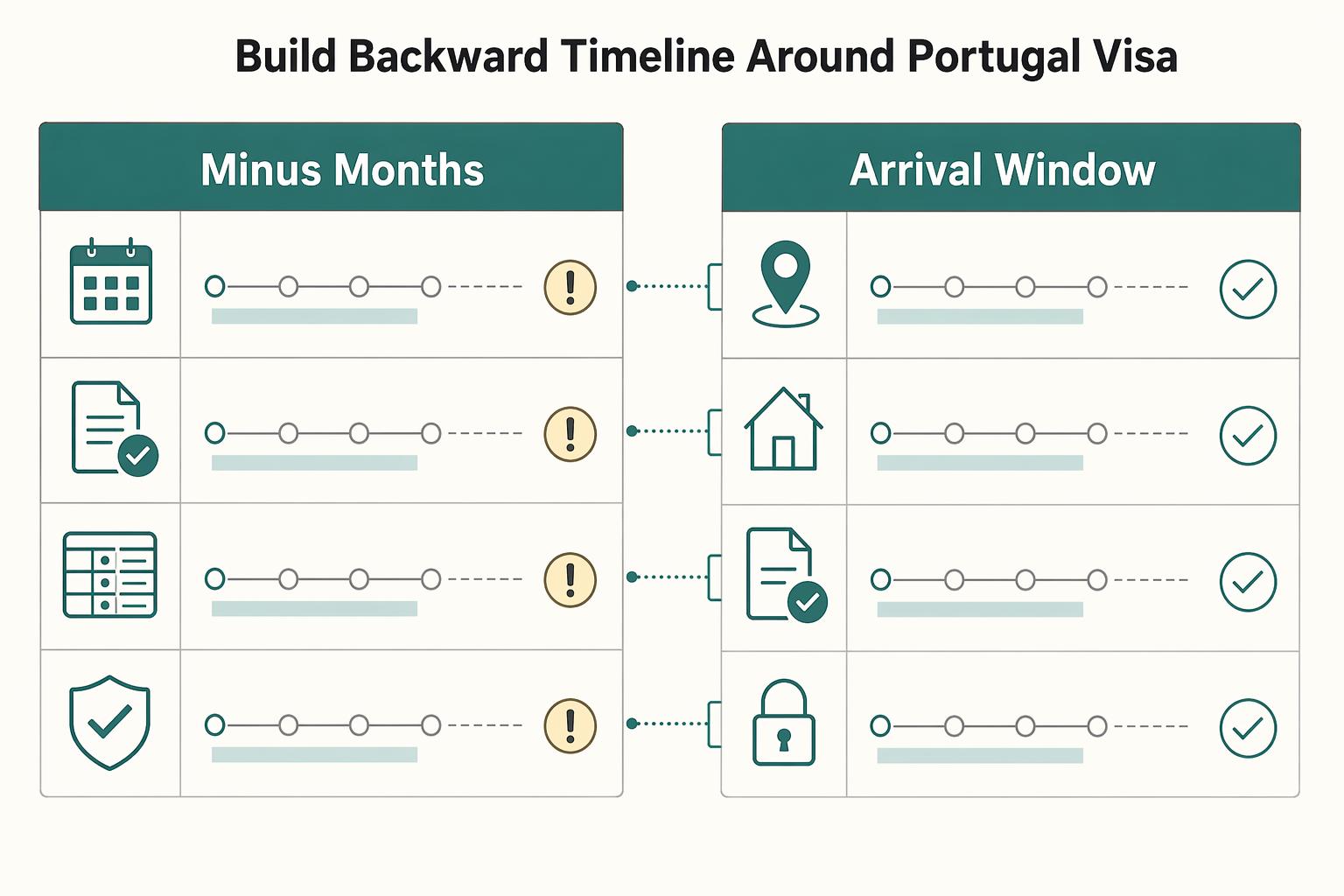
Build a backward timeline around the Portugal D8 Visa#
Start earlier than feels necessary and keep buffer at each step. That buffer absorbs normal delays without pushing you into bad spending decisions later.
| Timing | Step | Planning note |
|---|---|---|
| T minus 5 to 6 months | Choose the D8 route | Public guidance describes a temporary-stay route up to 1 year and non-renewable, and a residency path framed as 4 months before a longer residence step. |
| T minus 4 to 5 months | Assemble core documents | Include proof of remote work, income evidence, and savings evidence. |
| T minus 3 to 4 months | Verify housing-document rules | One guide states that a rental contract of at least 3 months may be required. |
| T minus 2 to 3 months | Submit and track the application | One guide says processing can take up to 60 days, so planning should not depend on a best-case turnaround. |
| Arrival window | Prepare the AIMA step | One guide indicates residency card issuance can take about 2 to 12 weeks after applying. |
Use the table as the backbone of your schedule. Move to the next paid commitment only after the requirement above it is confirmed, and keep enough buffer that a normal delay does not force a bad decision.
Treat this timeline as a control panel, not a calendar decoration. Each checkpoint tells you whether to proceed, wait, or adjust. When one step moves, you can see immediately which later commitment should move with it.
Resolve conflicts before paying deposits#
Conflicting public guidance is normal. Spending before you resolve those conflicts is what does the damage.
This material includes conflicts on core points, including income thresholds framed as EUR 3,680 per month versus EUR 3,280 per month, and initial validity framed as 4 months versus 120 days. Those differences are operational, not cosmetic. They can change eligibility interpretation, document preparation, and move timing.
Set one rule: if a conflict can affect eligibility, timeline, or required documents, pause the dependent payment. That includes housing deposits, long-term leases, and non-refundable travel. You are not being overly cautious. You are stopping one unresolved item from spreading cost into other parts of the plan.
A short pause for verification usually costs less than undoing a commitment made under mixed assumptions. It also keeps your paperwork cleaner, because you are not trying to justify a housing or flight choice built on a requirement that later turns out to be wrong for your case.
Avoid cascade delays#
Use one checkpoint log for the whole move. Record date, requirement, confirmation channel, and which document satisfies it.
This catches common sequence errors early, like signing a lease before your file is complete or scheduling travel around an unverified threshold. It also gives you clean context when someone asks why a decision was made or why a date moved.
Small contradictions are manageable when found early. Left unresolved, they cascade into missed deadlines, rushed compromises, and sunk costs. A weak lease decision can create a paperwork problem. A paperwork problem can trigger a scheduling problem. A scheduling problem can then force bad spend. That is the chain you are trying to interrupt.
Keep the log alive through arrival, not just before the move. Many first-month delays come from treating tracking as a visa task instead of a normal operating habit. The more disciplined the log is, the easier it is to spot pressure before it becomes expensive.
Assemble the Document Pack Before You Commit to Housing#
Document readiness should drive housing timing, not the other way around.
When files are scattered, lease decisions trigger rushed edits, mismatched records, and avoidable re-submissions. A clean packet keeps choices open. A fragmented packet shrinks options and raises stress. That is why strong moves often look slower from the outside while actually moving with less friction.
The practical test is simple: can you answer a document request the same day without rebuilding anything? If the answer is no, your file is not ready to carry a housing commitment yet.
Build the must-have-first checklist#
Start with the likely blockers and standardize how files are named, stored, and reviewed. Public guidance describes the D8 route for remote workers and highlights a core set to prepare early, then confirm through official channels.
- Identity evidence: keep identity files together and use one consistent legal-name format across all records.
- Income evidence: prepare proof aligned with the public planning baseline of at least EUR 3,280 monthly.
- Residence evidence: include accommodation proof for Portugal in a format you can update quickly if terms change.
- Health evidence: include active health-insurance documents and track validity windows.
- Timeline note: initial validity is described as 120 days before a residence-permit step.
Treat this as a planning checklist, not a universal legal answer for every case. The point is to secure the items most likely to block progress before housing pressure pushes shortcuts. If a document is likely to be requested and slow to replace, get it into shape early.
Separate the packet so updates stay simple#
Split files into four folders: identity, income, residence, and health. That structure localizes updates when one requirement changes and avoids full-packet rework.
This matters because public updates in June 2025 describe legal and regulatory changes for people moving to Portugal. When guidance shifts, you want to replace one set of files, not reassemble everything from scratch. Clean structure is what gives you that flexibility.
Before marking any document ready, run a quick quality pass:
- Current: valid for your filing window.
- Readable: clear scans and complete fields.
- Consistent: matching names, dates, and addresses across your application documents.
- Traceable: logged with review date and purpose.
Add a one-page index that maps each file to its requirement and last review. That small step saves time during submission, reduces needless back-and-forth, and makes later checks less error-prone because you can see the whole packet at a glance.
Red flag before any long-term lease#
Do not lock a long-term lease while visa-critical documentation is unresolved. Early deposits can feel productive, but they often create expensive rework across housing timing, application sequencing, and monthly cash flow.
If dependents are moving with you, plan for more friction in both visa and housing decisions. Keep extra time and cash buffer so one delay does not force a weak commitment. This is one of those cases where patience is cheaper than speed.
When any required item is unclear, pause property decisions and finish the packet first. The strongest housing move is often the one you delay until your file is truly ready. Once the document side is controlled, neighborhood choices become much easier to test on their real merits.
Before non-refundable housing payments, run one final readiness pass with Digital Nomad Visa Cheatsheet.
Choose a Neighborhood Using Work Pattern and Commute Friction#
Choose your area based on repeatable output, not first impressions. The right neighborhood is the one where a normal weekday works without friction.
Public neighborhood-level evidence for remote work fit in Braga is limited. That means your own standardized test should carry more weight than online rankings or one short visit. A place can feel pleasant for two hours and still be a poor base for steady work.
If an area feels great but forces schedule changes every week, it is not a good fit for focused remote work. That is the standard to keep in view.
Run two matching weekday trial blocks in each area#
Use the same trial schedule in each candidate area so results are comparable. Run one midday deep-work block with at least one live call. Then run your essentials loop and return. Later, run one evening block that reflects your normal wind-down and checks home-level quiet.
Track the same signals every time:
- Connection stability during real work sessions.
- Call quality in live conversations.
- Time and friction for essentials near your routine.
- Evening noise impact on sleep and next-day focus.
Consistency matters more than duration. If your test changes by neighborhood, the results stop being decision-grade. One good café session or one quiet afternoon is not enough. You want repeated evidence that the area supports your actual week, not just a lucky moment.
Choose based on focus quality, not vibe alone#
Use one decision question for each area: can you sustain your current workload there without redesigning your schedule?
Landmarks like Sao Tiago Chapel and Braga Cathedral can help orientation and lifestyle context, but proximity to landmarks does not prove better output. Before deposits, run a go or no-go screen:
- If connection problems repeat, pause and confirm a practical backup.
- If essential errands repeatedly cut into work blocks, classify it as commute friction.
- If evening noise forces routine changes, treat it as sustained work risk.
- If two areas feel close, choose the one with fewer routine disruptions.
Remote-worker concentration can pressure local infrastructure and contribute to gentrification over time. That is another reason to prioritize everyday function over trend value. A neighborhood should earn its place in your plan by making work easier to sustain, not by sounding good in a listing.
Price Your Monthly Life With Ranges Not Single Numbers#
Build your budget as a range, not a single number. One fixed figure hides risk and creates false confidence.
Neighborhood choice and monthly costs interact. If rent lands high and setup cash lands high in the same month, your buffer can disappear fast. A range-based plan stays useful when real life lands on the expensive side, which is exactly when one neat total stops helping.
Older comparison data can help you sketch a first draft. It should not decide your final spend plan. Use it to frame scenarios, then replace it with live terms as quickly as you can.
Use ranges with clear confidence labels#
Use low, mid, and high bands for each major line. Then label confidence so you can see where assumptions are strong and where proof is still missing.
Third-party numbers are directional. Why published estimates diverge is not fully explained here, so avoid precise-looking totals that imply certainty. Precision without proof is how people talk themselves into fragile budgets.
A practical confidence standard:
- High confidence: confirmed by signed terms or your observed spend.
- Medium confidence: supported by current listings, not yet contracted.
- Low confidence: based on older or mixed public estimates.
Confidence labels keep discussions honest. They also help you decide what to verify next, instead of debating one number that may not hold. This is especially useful when comparing cities or lease options, because it shows whether a cheaper-looking setup is actually cheaper or just less verified.
Build two practical scenarios first#
Start with two realistic scenarios before any city comparison. One should assume a central setup. The other should assume a shared or edge-of-center setup in Northern Portugal.
| Budget line | Solo studio in central Braga | Shared or edge-of-center setup in Northern Portugal | Verify before committing |
|---|---|---|---|
| Rent anchor | Directional one-bedroom city-center anchor: EUR 550 from older data | Verify current rate with the relevant authority | Listing date, lease length, included bills, total move-in cash |
| Outside-center anchor | Directional one-bedroom outside-center anchor: EUR 442 from older data | May be lower or similar depending on location and property | Commute tradeoff, transport cost, contract terms |
| Upfront housing cash | Plan for possible multi-month deposit pressure | Same risk can apply | Deposit months, refund terms, payment schedule |
| Setup dependencies | NIF and local bank account are needed to finalize residency registration | Same requirement | Whether NIF and bank timing match lease and registration timing |
The objective is not perfect prediction. It is to prove your plan remains stable across two plausible setups without depending on best-case timing. The central case shows what comfort costs. The edge case shows whether any savings are worth the extra friction. Both are useful if you read them honestly.
Stress-test before comparing Braga to Lisbon or Porto#
Run your stress test before calling any city affordable.
- Include setup pressure, not just monthly rent, while your visa file is active. One visa-cost context references EUR 3,480 per month income proof for one applicant plus savings evidence by bank statement.
- If income arrives in USD and spending happens in EUR, model conversion timing and keep additional rental cash reserve.
- Before treating Lisbon as affordable, include the cited entry-cost scenario first: EUR 900 to EUR 2,000 monthly rent with 2 to 5 months of deposit.
- If Braga still works after this test, continue with Braga and validate current local pricing before signing.
Keep two unknowns visible until local confirmation: Braga-specific healthcare monthly ranges and dependable long-term rental process timelines or approval odds. Leaving those unknowns visible is part of the discipline. If you hide them inside a neat total, the plan looks stronger than it is.
Verify Internet and Work Setup in the Real World#
Internet claims should narrow options, not close decisions. Final calls should be made inside the exact unit, during your actual work hours, with your real workload.
Available guidance is often broad, Portugal-wide, and some ranking content is promotional. That can still be useful for screening, but not for lease commitments. You are not renting a marketing promise. You are renting the specific performance of a specific place.
A stable remote setup is proved by repeatable performance, not by strong listing language. Once your budget and shortlist are roughly in place, this is the check that tells you whether a unit can actually support your working life.
Use online signals to narrow options, then verify in person#
Community posts, platform filters, and listing descriptions are inputs for your test script. They are not substitutes for testing.
If forums report strong speeds or reliable coworking backups, add those points to your checklist and validate them on the ground. If a listing claims excellent connectivity, test from the exact location where you will work, not just in a hallway or near the router. Small differences in placement can matter, and polished listings rarely tell you what happens at your real desk.
The core question is practical: can your normal workday hold up in that unit, on your schedule, with your tools? If the answer is uncertain, the listing has not earned a lease decision yet.
Run the same pre-lease check in every unit#
Run one repeatable script in every apartment so results stay comparable.
- Test connection quality during your real work window.
- Check performance at your actual desk location, not only near the router.
- Run your real mix of calls, uploads, and sync activity, not just one speed check.
- Identify and test a backup option before signing, including coworking spaces and public places suitable for remote work.
Set a pass or fail threshold before viewings begin. If a unit cannot support a normal weekday with a workable fallback, remove it from the shortlist regardless of price or aesthetics. That pre-committed threshold matters because it stops you from negotiating yourself into ignoring a weak result.
Plan Tax Residency and Compliance Checkpoints Early#
Treat compliance as an early track, not as cleanup after the move. Immigration permissions and tax obligations move on related timelines, but they are not the same decision.
Tourist access for up to 90 days is not a substitute for long-stay residence permission. Plan and document each track explicitly so they do not get mixed under deadline pressure. If your stay could cross the 183-day threshold already mentioned earlier, keep day counts and paperwork aligned from the start instead of trying to reconstruct them later.
For residence processing, common channels include a Portuguese Embassy or Consulate, or VFS Global where applicable. After entry, steps can include local municipality registration, obtaining a NIF, and attending a biometric appointment. Track each date in one place so one delay does not quietly shift downstream deadlines.
Cross-border obligations can still apply depending on home-country rules. Confirm your position with qualified guidance before filing periods pile up. In practice, good compliance posture comes from disciplined record handling, not from building a complicated system around guesswork.
Build your evidence trail from day one:
- Visa submission receipts and appointment confirmations.
- Entry-date proof and residence-process records.
- NIF and municipality registration documents.
- Income, payment, and bank records in one consistent structure.
- Advisor notes with date, scope, and follow-up actions.
This record discipline reduces two common risks. First, it prevents avoidable filing confusion while details are still changing. Second, it gives you defensible proof if questions come later. The more routine your documentation becomes, the less mental load compliance creates, and that matters because payment setup is the next place loose admin turns into real stress.
Set Up How You Get Paid Before Arrival Week#
Lock payment continuity before arrival week. You need one primary route, one pre-verified backup, and a clear tracking chain from invoice creation to settlement.
If payment operations are shaky, even a well-designed move starts absorbing avoidable stress fast. Delayed cash feels like an admin issue until it starts colliding with rent, deposits, or tax deadlines. Keep this setup simple and testable. Reliable beats sophisticated.
Use this pre-arrival checklist:
- Verify both payment routes with low-value test payments before live invoicing.
- Standardize invoice fields: client legal entity, client country, service period, due date, unique reference, and VAT treatment note.
- Maintain a status log with timestamps for issued, sent, settled, pending review, failed, and reversed.
- Store invoices and related payment records in one place to support OSS record-keeping and possible audits.
- Assign one compliance owner for held payments, including an escalation path and client update template.
- Pre-schedule reconciliation and VAT filing dates before workload expands.
Before sending live invoices from Portugal, run one VAT decision gate: check whether cross-border supplies fit an OSS scheme. OSS is optional, but if you opt in, all supplies covered by that scheme must be declared through OSS, and OSS returns are additional to domestic VAT returns.
Set cadence upfront and keep it stable. Union and non-Union OSS returns are quarterly, while the import scheme is monthly. The EU-wide EUR 10 000 threshold can trigger review for certain TBE services and intra-EU distance sales. If treatment remains complex, consider a VAT Cross-border Ruling request in a participating EU country where you are VAT-registered.
Keep failure handling explicit from day one. OSS participants can deregister voluntarily or be excluded by the Member State. If the primary payment route fails, switch to backup immediately and log incident time, client notice, and resolution date. A calm move depends as much on clean money flow as it does on visas or housing.
Execute Your First 30 Days in Braga in the Right Order#
Your first month should run by risk priority, not convenience. Start with items tied to legal status, income continuity, and housing stability. Capture proof the same day while details are fresh.
A fast start is less important than a clean sequence. If week one is messy, weeks two through four become expensive to fix. The goal of the first 30 days is not to do everything. It is to turn the move from a bundle of assumptions into an operating routine built on observed facts.
- Week 1: Validate setup and unlock essential admin access.
Run your full workday setup during real working hours and log any issues by date and location. Keep core documents organized and presentation-ready. If mainland employment services may matter for your case, confirm two practical gates early: in-person registration requires identity documentation, and iefponline access requires both a NISS and a Seguranca Social Direta password.
- Week 2: Stabilize housing and pressure-test your area choice.
Run weekday trial routines in likely neighborhoods before treating any area as final. Add one train-station dry run so transit assumptions are tested in practice: ticketing and services are handled in the newer building next to the old station building. For broader Northern Portugal rail planning, verify whether routing through Porto fits your pattern better, since one travel guide describes Braga as a weaker hub for wider northern train trips.
- Week 3: Formalize recurring compliance and money operations.
Convert month-one records into a repeatable package: invoices, payment confirmations, bank statements, credit notes, contract changes, and payout status logs. Lock recurring admin dates before workload expands. Re-check process freshness before acting: the EURES Portugal page snapshot is dated 13/08/2024, and IEFP is described there as a mainland network of 83 local employment services.
- Week 4: Close unknowns and reset from observed reality.
List unresolved items and rank them by impact. If an unresolved item could affect legal status or income continuity, pause new long-term commitments. Rebuild your monthly plan from observed spend and operating friction, then decide whether to keep, tighten, or adjust your setup.
By day 30, the target is clear: fewer assumptions, cleaner records, and a plan based on observed performance rather than optimism.
Make the Move Only After Your Verification Checkpoints Pass#
Braga can be a practical long-stay base when decisions are made in the right order. Confirm, document, then commit.
This material also shows why input filtering matters. Some captured pages are interface text. Some use terms like NOMAD in an unrelated transport context. Some are navigation shells without requirement language. None of those should drive high-cost decisions on their own. Research only helps if you separate real requirement language from page clutter, summaries, and marketing copy.
Before irreversible spending, run four gates:
- Relevance gate: the source must directly address Portugal or Braga relocation decisions, not generic interface text, contact blocks, or unrelated research context.
- Completeness gate: menu labels are not requirements. Use requirement language, not link titles.
- Conflict gate: if sources disagree, keep the item unresolved and pause the dependent decision.
- Commitment gate: if visa, housing, internet, or compliance evidence is unresolved, stay with reversible short-term options.
Keep one final rule active until your setup is stable: if a decision can change legal status or monthly burn, write a dated verification note before spending. That one habit does more to protect the move than most elaborate planning tools.
When you need a deeper city-fit comparison, pressure-test assumptions with the Porto and Lisbon guides, then use Portugal Digital Nomad (D8) Visa: A Complete Guide to structure remaining official checks. For city context, review Porto, Portugal: The Ultimate Digital Nomad Guide (2025).
After checkpoints pass, keep your first-year compliance calendar in one place with the Tax Residency Tracker. The objective stays practical: fewer unknowns, handled in the order that protects the move.
Frequently Asked Questions
Is Braga a good city for digital nomads compared with Lisbon and Porto?
Whether Braga is better or worse than Lisbon or Porto for remote work depends on your work rhythm, daily logistics, and weekly reliability needs. Treat this as a fit decision you validate in person. Use short trial periods before making long housing commitments.
What does a realistic monthly budget in Braga look like for a long stay?
A fixed Braga monthly budget is difficult to pin down in advance. Start with a conservative buffer, then replace estimates with your first month of real spending on housing, food, transport, and workspace. Verify any number that materially changes your decision before paying non-refundable costs.
Why do internet speed estimates for Braga differ across guides?
A verified Braga speed benchmark is hard to pin down, so treat published figures as unverified and directional. Test the exact location during your actual work hours before committing long term.
Which Braga neighborhoods are best for remote workers who need reliable focus time?
Do not assume there is a single ranked list of Braga neighborhoods. A practical approach is to test candidate areas on weekdays for noise, routine convenience, and work-session stability. Choose the area that protects focus and meeting reliability.
Is the Portugal D8 Visa the right visa path for remote professionals moving to Braga?
The D8 is described as Portugal’s digital-nomad route for remote workers, and one guide frames eligibility around non-EU/EEA/Swiss citizens. Published requirements conflict across sources, including income thresholds and related criteria, so do not treat one third-party number as definitive. Use Portugal Digital Nomad (D8) Visa: A Complete Guide as context and confirm current official requirements against your document set.
What should I verify first before committing money to a move to Braga?
Verify core application evidence first: income proof and the commonly cited document set of bank statements, invoices, Portuguese bank account setup, and NIF-related fiscal documentation. Also check whether your intended stay could cross the more-than-183-days-in-a-year threshold linked to tax residency and possible worldwide-income taxation. Keep dated records of each completed step.
What details are still unknown from current public guides and must be confirmed locally?
Three high-impact items conflict across sources: processing time, temporary-stay renewability, and income thresholds. Braga-specific budget levels, neighborhood rankings, and internet reliability benchmarks are also not established. Treat these as open items and confirm them through official Portuguese channels and local verification.
Try a related tool
Researched and edited by the Gruv editorial team. Gruv builds cross-border billing, payouts, and finance-operations software for global businesses.
Sources
- eures.europa.eu/living-and-working/living-and-working-condit...trusted
- taxation-customs.ec.europa.eu/archives/taxable-persons/vat-cross-border-ru...trusted
- taxation-customs.ec.europa.eu/news/continued-growth-revenue-and-registrati...trusted
- vat-one-stop-shop.ec.europa.eu/index_entrusted
- vat-one-stop-shop.ec.europa.eu/one-stop-shop_entrusted
Educational content only. Not legal, tax, or financial advice.
Related Posts
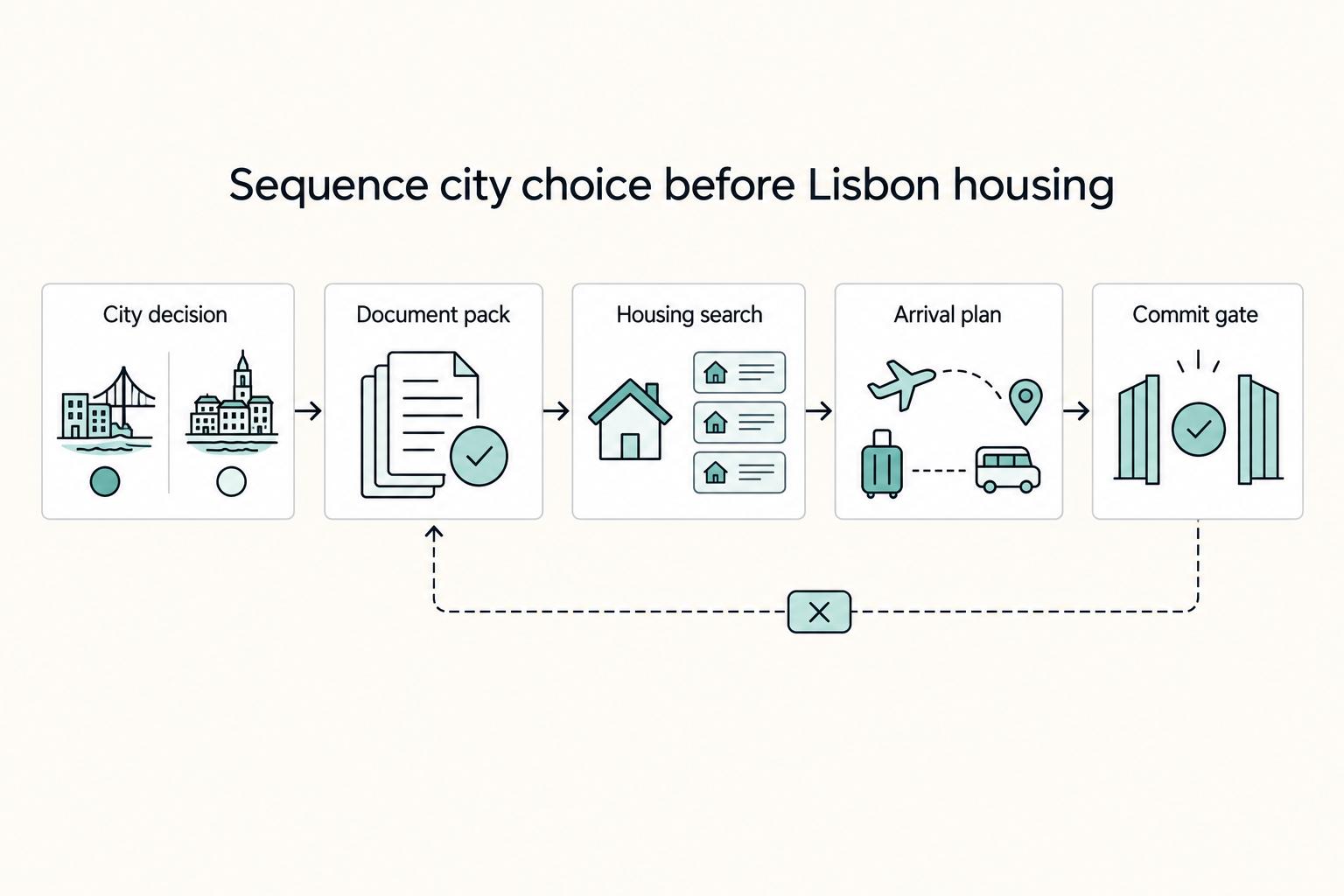
Lisbon vs Porto for Digital Nomads
Choose your city first, then build the rest of the move around that choice. When people reverse the order, housing research, admin prep, and booking decisions start pulling in different directions.
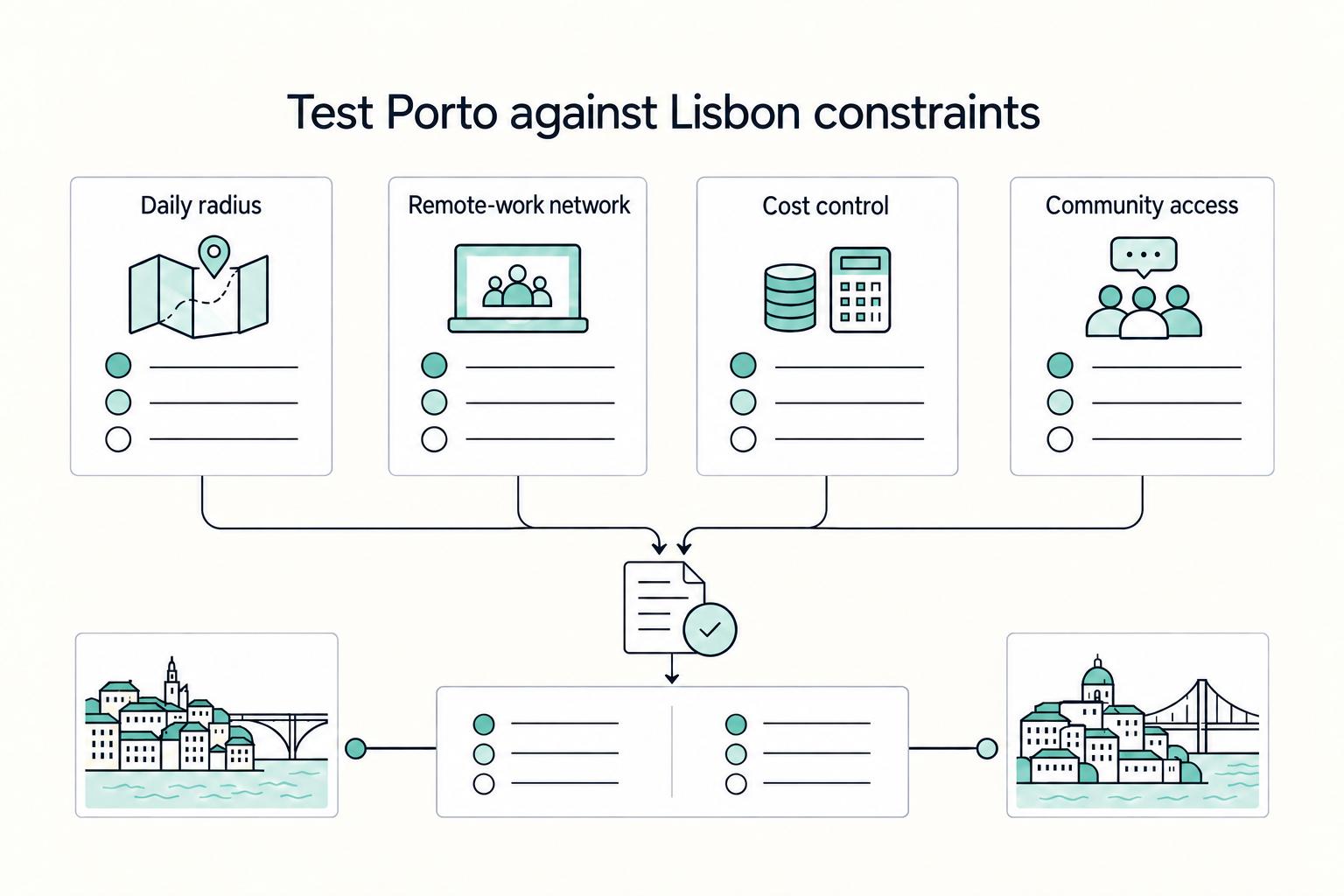
Porto, Portugal: The Ultimate Digital Nomad Guide (2026)
This porto digital nomad guide is built for one job: help you relocate without breaking your income or your legal footing. You are not here for generic neighborhood hype. You are here to make clear decisions, assemble proof that holds up under review, and land in Porto with a weekly system you can actually run.

Portugal Digital Nomad Visa Decisions That Prevent D8 Delays
Start with verification, not paperwork. In this research set, some material is useful only as EU VAT context, not as D8 instruction, and mixing those categories is one of the fastest ways to build the wrong plan. We use the same separation rule in [Global Digital Nomad Visa Index](/blog/global-digital-nomad-visa-index) comparisons.