
Quick Answer
The bona fide residence test qualifies you for the Foreign Earned Income Exclusion by living as a resident of a foreign country for an uninterrupted period that includes a full calendar year. Brief trips are allowed if you intend to return. If you can’t span January 1-December 31, use the 330-day Physical Presence Test and keep your tax home outside the United States. Align records and Form 2555 with the path you choose.
The Bona Fide Residence Test for US Expats#
If your facts support a full, uninterrupted calendar year abroad, the residence route is often the cleaner way to claim the Foreign Earned Income Exclusion. For calendar-year filers, that means January 1 through December 31. If your year will not support that uninterrupted span, do not try to force it. Plan around the Physical Presence Test instead: 330 full days abroad within any 12-month period, with a foreign tax home during the period you claim.
The practical difference is simple. Residence turns on continuity and intent, not a raw day count. Short or temporary trips back to the United States can be fine if you intended to return to your foreign home without unreasonable delay and actually did so. The time-based route works differently. Days do not need to be consecutive, and days abroad can count for any reason while your tax home is in a foreign country.
Think of this as a two-lane decision from the start of the year. One lane is residence: an uninterrupted year plus facts showing that your real home and routine were abroad. The other lane is time: 330 full days plus a foreign tax home. If you spend the year drifting between the two, you usually end up with travel logs, address history, and Form 2555 details that do not tell the same story.
That is why early discipline matters more than filing-season creativity. Pick the standard your year can actually support, then build records that fit that standard as the year unfolds.
Quick decision rules#
Use these as an early checkpoint, not a rescue plan after year-end:
- Full-year coverage: if your residence period clearly spans January 1 through December 31, the residence route is often the better fit.
- Incomplete year: if a full calendar year is not available, move to the 330-day route early and track it precisely.
- Tax home gate: do not rely on day counting unless your tax home is in a foreign country.
- Continuity evidence: keep proof of where you lived and worked so brief trips look temporary, not like a move back.
- Single-story test: make sure your travel log, address history, and Form 2555 narrative all reflect the same timeline.
Form 2555 preparation#
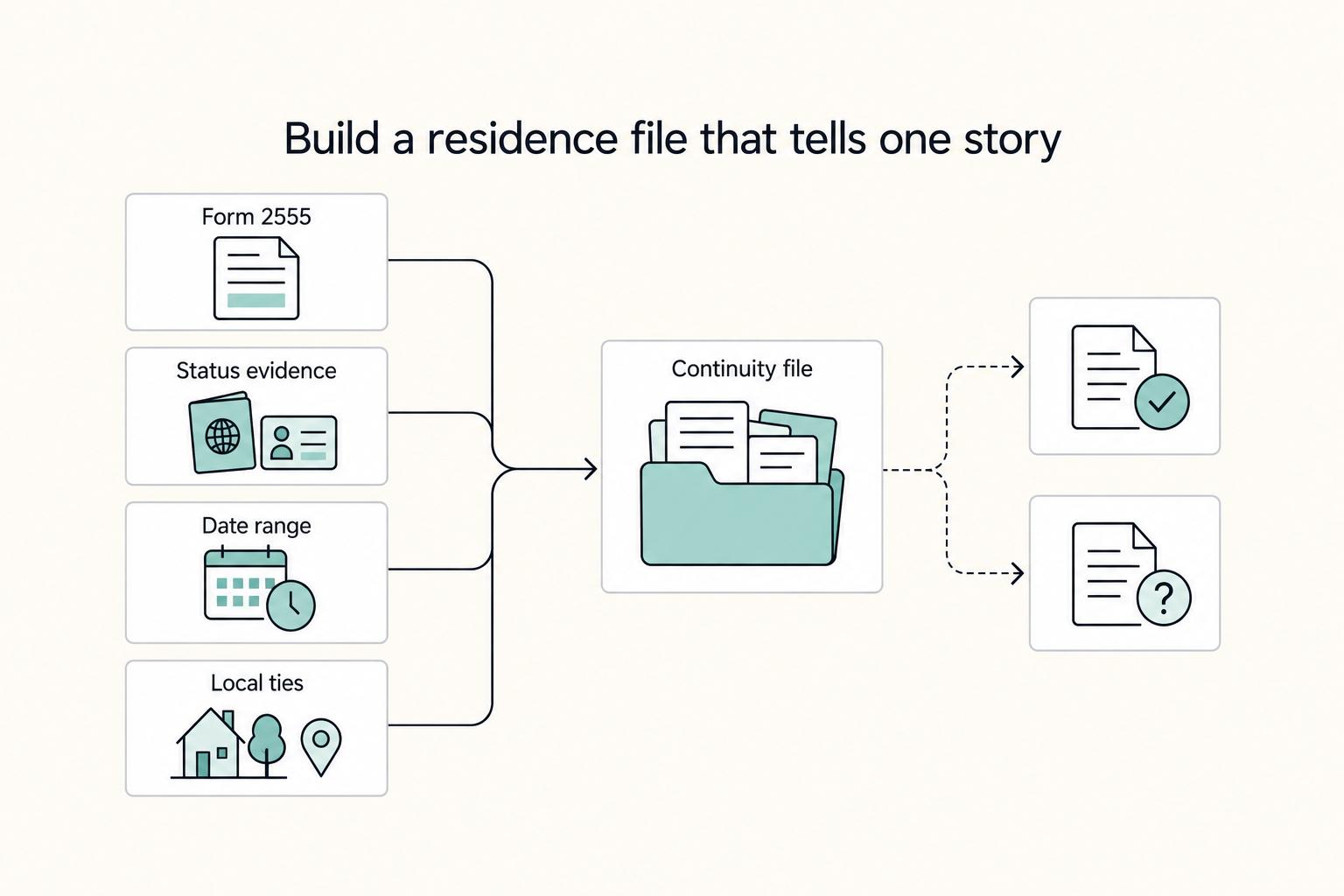
Form 2555 is usually much easier when you prepare for it during the year instead of rebuilding everything at filing time. The goal is not a huge document stack. It is a file where dates, locations, and your claimed qualification method line up cleanly.
- Keep a dated travel log with departure and return dates, locations, and trip purpose.
- Maintain a short work-location narrative that matches your address history and contract activity.
- For time-based filings, define your 12-month window and update the 330-day tally as you go.
- For residence-based filings, document the uninterrupted calendar year and preserve proof that short trips were temporary.
- Before filing, run a consistency check so Form 2555 dates, tax return details, and your records line up.
If your assignment or living pattern cannot reliably cover an entire calendar year, do not push a residence theory beyond what the facts can carry. Use day counting while you build stronger long-term ties abroad, then switch only when your year clearly supports it. In practice, that call alone often separates a clean claim from a disputed one.
What the Bona Fide Residence Test is and isn't#
This route lets you qualify for FEIE by being a resident of a foreign country for an uninterrupted period that includes an entire tax year. For calendar-year filers, that full year is January 1 through December 31. U.S. citizens may use this route. U.S. resident aliens may use it only if they are citizens or nationals of a country with a U.S. income tax treaty.
Just as important is what this standard does not mean. It is not an automatic result of holding a visa, signing a lease, or spending a long stretch abroad. It is a facts-and-circumstances test built around the real pattern of your life outside the United States. The IRS looks at intention, purpose of stay, and the length and nature of your presence abroad.
That is why continuity matters so much. Brief or temporary travel away from your foreign residence can be allowed when you intend to return without unreasonable delay. Once foreign residence is established, it runs from when it began until you abandon it. So a defensible file shows a continuing pattern over time, not a few isolated documents gathered right before filing.
In plain terms, it asks whether your life actually looked foreign-centered for the relevant period. It is not a label contest. It is a coherence test. Your housing, work pattern, travel, and return intent should point in the same direction.
Decision contrast#
Before you commit to one qualification method, compare the standards directly:
| Decision factor | Bona fide residence | Physical Presence Test |
|---|---|---|
| Core standard | Resident of a foreign country for an uninterrupted period including an entire tax year | 330 full days in a foreign country or countries within any 12-month period |
| Main focus | Continuity and intent | Strict day count |
| Travel treatment | Brief or temporary trips allowed if you intend to return without unreasonable delay | Days abroad can count for any reason while tax home is foreign |
| When it fits best | You can show full-year continuity and genuine residence ties | Full calendar-year coverage is not feasible or day tracking is cleaner |
| Records to prioritize | Address timeline, ties abroad, return-intent proof, Form 2555 narrative | Dated travel log, 12-month window math, foreign tax home proof, Form 2555 alignment |
The distinction is worth keeping in mind all year. Residence is built on continuity. Physical presence is built on days. Either can work, but only if your records are built for the method you claim rather than around common 183-day rule myths.
Do you actually qualify this year?#
Start with the hard gate, not the result you would prefer. Does your foreign residence remain uninterrupted and include an entire tax year? For calendar-year taxpayers, that means January 1 through December 31. If the answer is no, move to the Physical Presence Test and track 330 full days abroad within a chosen 12-month period.
Next, check whether your filing status allows you to use the residence route at all. U.S. citizens may rely on it when the facts support it. U.S. resident aliens may use it only with treaty-country citizenship or nationality. If that treaty point is unclear, treat it as unresolved risk, not a minor detail, and default to the time-based route until it is confirmed.
If you do qualify under the residence standard, the qualifying period can include parts of one or two other tax years from when residence begins until you abandon it. That timing flexibility only helps after the uninterrupted full-year requirement is met. In practice, you are better off mapping your intended Form 2555 period before year-end than trying to reverse-engineer it later.
Do a quarterly self-check. Ask three simple questions: where did you live, where did you work, and does your travel still fit the route you intend to claim? If the answer starts drifting, change course early. It is much easier to pivot in real time than to explain mixed signals after the fact.
This is where many borderline files get clearer. A year can begin looking temporary and later become more settled, or the reverse. The point is not to defend your original assumption at all costs. The point is to claim the method your actual year supports.
Decision rules you can act on#
If you want a practical checklist for the current year, use this one:
- Full-year coverage available: favor the residence route and collect continuity evidence month by month.
- Full-year coverage not available: adopt the 330-day route now and maintain precise full-day tracking.
- Resident alien filing: verify treaty-country citizenship or nationality before claiming this standard.
- Mixed signals in your records: fix them immediately so addresses, travel dates, and your work narrative stay consistent.
- Borderline facts: use the route that is easier to explain plainly on Form 2555 and in your supporting records.
Bona fide residence versus a fixed-term assignment - which fits you?#
If your move abroad is tied to a fixed-term assignment, that often points away from the residence route and toward the time test. The more your stay abroad looks like a temporary project with a known finish line, the harder it is to present your foreign life as genuine residence rather than a long visit.
This is where people tend to stretch the filing position past what the facts can support. You may spend substantial time abroad and still present a pattern that reads as temporary. Labels do not carry much weight on their own. What matters is substance: where your day-to-day life was centered, whether your ties look durable, and whether your overall pattern supports an indefinite foreign home.
Host-country tax posture and local ties can help when they fit the facts, but no single document settles the issue. A lease, local registration, or other record may support the story. It does not replace the story. If the basic picture is still temporary, the time route is usually the cleaner and more defensible choice from the beginning.
The real question is not whether you can gather a few residence-style documents, but whether your year reads naturally as residence from start to finish.
Practical fit test#
Use these patterns as a reality check:
| Pattern | What it points to |
|---|---|
| Fixed-term contract with a planned return date | Default to the time-based route and keep the travel math clean. |
| Open-ended work with no clear end date | Build and document a stable base in one country. |
| Frequent multi-country movement without a primary base | The residence case weakens, so either consolidate or rely on the time test. |
| Midyear shift from temporary to open-ended | Update records immediately so your facts and filing position stay aligned. |
| Cannot explain your living pattern in three plain sentences | Your documentation is not ready yet. |
When your facts could fit both approaches, take the one that reduces avoidable argument. Clarity usually beats ambition. A modest claim you can prove is stronger than a broader claim that depends on wishful framing.
The tax home test - do you have one outside the United States?#
Do not treat day counting as a substitute for a foreign tax home. It does not work that way. For FEIE planning, tax home is a core gate, especially for the Physical Presence Test. Time abroad counts toward the 330-day standard only when your tax home is in a foreign country. If your real operating base remains U.S.-centered, a large day total will not fix the problem.
Tax home is evaluated through facts and intentions. The IRS looks at the nature and purpose of your stay abroad, and your records should show that your regular business activity is anchored overseas. In practical terms, ask where you usually work, what address your work activity is tied to, and whether your travel pattern looks like a foreign base instead of a series of trips away from a U.S. base.
A common failure mode is strong travel evidence with weak base-of-operations evidence. Another is the reverse: a foreign address on paper, but work activity that still looks centered in the United States. Both are hard to defend because they split the file into conflicting stories.
The fix is straightforward, even if it takes planning. Build the foreign base and the travel record together. If you are relying on day counting, make sure the day count sits on top of a file that clearly shows where your work and life were based during the claimed period.
Decision rules and proof to gather#
This is the proof set that usually matters most:
- U.S.-centered operations: do not start counting days yet; move your working base overseas first.
- Foreign-centered operations: keep contracts, address history, and activity patterns that show where business is regularly conducted.
- Rotating client schedule: anchor your base to the country where you most consistently operate, then track full days.
- Form 2555 readiness: maintain a dated travel log, an address timeline, and a concise work-location narrative that match.
- Proof quality check: prioritize records created during the year, not only reconstructed summaries at filing time.
The 330-day rule is simple on paper. The real work is showing that those days count because your tax home was foreign during the period you claim. Once that foundation is in place, the choice between residence and day counting becomes much easier.
Planning your timeline and travel without breaking continuity#
If you are using the residence route, continuity is the organizing principle for the entire year. Your qualifying period must include January 1 through December 31 if you are a calendar filer, and your travel should read as brief or temporary detours with a clear return path to your foreign home.
The best way to manage it is to treat the year as a documented timeline, not a memory test. Keep your foreign address active. Maintain ongoing work activity abroad. Save proof of return travel after short trips. Since the qualifying period runs from when residence begins until you abandon it, repeated patterns matter as much as any single trip. What hurts most is often not one dramatic event. It is a series of small gaps that make your center of life look as if it shifted back to the United States.
A simple travel rhythm helps keep the file coherent. Before a trip, confirm the return plan and preserve booking records. During the trip, log dates and purpose while the details are fresh. After the trip, reconcile your log with tickets and your address timeline. None of that creates eligibility on its own, but it prevents the avoidable holes that make a valid claim harder to explain.
This is also where intent becomes visible. When a trip is short and temporary, your records should show that it was planned that way and that you resumed your foreign pattern afterward.
On-trip guardrails#
These habits help keep continuity intact while you travel:
- Keep proof of return travel to your foreign home, including tickets and confirmations.
- Log each departure and return with date, location, and reason for travel.
- Maintain a stable base abroad through lease or address continuity and ongoing contract activity.
- Avoid long or repeated U.S. stays that can make the year look U.S.-centered.
- Keep your Form 2555 narrative in sync with what your travel calendar actually shows.
- If plans change unexpectedly, document why and show how you returned to your foreign base without unreasonable delay.
When travel starts drifting from the original plan, respond quickly. The earlier you tighten the record or adjust your filing route, the easier it is to preserve continuity and keep the eventual return coherent.
Documentation and forms - what to file and what to keep#
This part is less about paperwork volume and more about building a file that makes sense. Form 2555 is the core document for FEIE and, when eligible, the Foreign Housing Exclusion or Deduction. File it with Form 1040. Even when income is excluded, you still report the foreign earned income on your U.S. return and claim the exclusion through the form.
| Item | File or keep | Article notes |
|---|---|---|
| Form 2555 | File | Complete the qualification path that matches your facts, and include housing sections only when eligible. |
| Form 1040 reporting | File | Include foreign earned income even when claiming FEIE. |
| FBAR and FATCA Form 8938 | Track separately | They are independent from FEIE qualification. |
| Residence evidence | Keep | Lease records, utility bills, or local registrations that support your timeline. |
| Travel calendar | Keep | A dated log that supports uninterrupted residence or, for time-based claims, full-day counting. |
| Work-location narrative | Keep | A concise summary of where work occurred, tied to dates and addresses. |
| Housing records | Keep | Receipts and summaries for qualified housing expenses, aligned to applicable limits. |
For 2026, the FEIE maximum is $132,900 per qualifying person. Housing benefits are generally limited to 30% of that maximum, and location and qualifying-day rules apply. The 2026 housing amount limitation is $39,870. Those numbers only help if they match the right qualifying period, so your calculations, dates, and explanation need to point to the same claimed window.
The most valuable filing habit here is consistency. Dates, addresses, status details, and qualification method should line up across Form 2555, Form 1040, and the records behind them. A file with fewer documents but one clear story is usually stronger than a thicker file with internal contradictions.
It also helps to separate what must be filed from what must be retained. Filing is about presenting the claim. Recordkeeping is about being able to support it later without reconstructing the year from memory.
What to file#
When you get to the return itself, focus on accuracy and alignment:
- Form 2555: complete the qualification path that matches your facts, and include housing sections only when eligible.
- Form 1040 reporting: include foreign earned income even when claiming FEIE.
- Status consistency: present U.S. citizen or qualifying U.S. resident alien status consistently across the return.
- Adjacent compliance: track FBAR and FATCA Form 8938 separately because they are independent from FEIE qualification.
- Final review pass: verify that dates and addresses match your travel log and narrative before submission.
What to keep#
Your retained records should support the route you chose, not every possible route:
- Residence evidence: lease records, utility bills, or local registrations that support your timeline.
- Travel calendar: a dated log that supports uninterrupted residence or, for time-based claims, full-day counting.
- Work-location narrative: a concise summary of where work occurred, tied to dates and addresses.
- Housing records: receipts and summaries for qualified housing expenses, aligned to applicable limits.
- Consistency file: one organized package where form entries and supporting records tell the same story.
A strong file is about fit, not volume. Each document should reinforce the same qualification method. If your facts stop supporting the residence route, follow Form 2555 instructions for the alternative method instead of stretching a weak position into a larger problem.
Red flags and when to talk to a pro#
The biggest mistake is trying to force a residence claim onto a year that does not support it. If the year abroad does not include uninterrupted residence covering the full calendar year, that route is usually wrong. Move to the time test and focus on 330 full days in a 12-month window with a foreign tax home.
Another common problem is blending separate gates into one. Tax home is its own requirement, and intentions can matter there. Treaty eligibility for resident aliens is also separate and must be confirmed before using the residence standard. If either point is weak, the safer move is often the time-based route backed by strong travel records.
Professional help is most useful before year-end, while you can still change travel plans, tighten documentation habits, or rethink which route you will claim. Advice after filing can help assess risk, but it cannot create evidence that was never kept.
Common red flags#
These are the patterns that most often deserve a second look:
- Fixed-term assignment presented as automatic residence qualification: A temporary project may conflict with residence facts and intent.
- Resident alien claim without confirmed treaty-country citizenship or nationality: Resolve treaty eligibility before choosing the residence route.
- Frequent or extended U.S. stays that make your tax home look U.S.-centered: Reassess quickly and consider the time test.
- 183-day rule confusion: That rule does not replace FEIE residence or time tests.
- Inconsistent records: If dates, addresses, and narrative conflict, the claim becomes harder to defend.
If uncertainty remains, use the route supported by the cleanest evidence and get cross-border advice on edge cases. The goal is not the most aggressive position. It is a position that is accurate, coherent, and supportable.
Where this varies by country - and how to confirm safely#
Country differences usually change the evidence more than the IRS standard itself. The core U.S. rules stay the same. What varies is how easy it is to document your status, your local ties, and, for resident aliens, whether treaty-linked eligibility exists.
If you are a U.S. resident alien, treaty-linked citizenship or nationality is a threshold issue for the residence route. If that element is not available, use the Physical Presence Test with a foreign tax home and precise day tracking. That is a cleaner answer than trying to stretch local paperwork into something it cannot prove.
Local records can also look very different from one country to another. Some places generate strong registration evidence. Others provide much less. Use whatever local documents actually exist to support your timeline and living pattern, but do not confuse local paperwork with automatic IRS qualification.
Treaty and eligibility#
Confirm eligibility before you choose your route. Resident aliens need treaty-linked citizenship or nationality to use the residence standard. The Physical Presence Test does not depend on that treaty issue. It applies based on 330 full days abroad within a 12-month period, with a foreign tax home.
A practical sequence looks like this:
- Verify whether treaty-linked eligibility exists for your resident alien status.
- If yes, choose between residence and time tests based on your facts.
- If no, commit to the time test and maintain full-day records from the start.
Proof and coordination#
Once the route is clear, coordinate your evidence around it. Local records should corroborate your story while the filing logic stays focused on the U.S. test you are claiming. The local documents support the claim. They do not replace the legal standard.
To keep the file coherent:
- Retain evidence of citizenship or nationality when treaty eligibility is relevant.
- Keep day tracking tight if using the time path, including a defined 12-month window.
- Show a foreign tax home through consistent work-location and address records.
- Align all dates and addresses across Form 2555, travel logs, and supporting files.
- Treat local registrations, leases, and bills as corroboration that reinforces continuity.
If both methods look available, use the one you can explain in plain language without stretching the facts. Consistency across documents is usually more persuasive than a larger stack of mixed records.
Conclusion - make the defensible choice and document it well#
The defensible answer is usually the simpler one. If you cannot show uninterrupted foreign residence that includes a full calendar year, use the time test and make sure your tax home is in a foreign country during the period claimed. That route is a counting standard: 330 full days abroad in any 12-month period.
If your year does support the residence route, focus on continuity and intent. If you are using the time route, focus on exact day totals and a clearly foreign base of operations. Either way, report the income on your U.S. return and use Form 2555 to claim the exclusion using the method that matches your facts.
Good outcomes usually come from decisions made early, not from last-minute reconstruction. Commit to one route, keep records that match it throughout the year, and correct drift as soon as the facts change.
How to lock this in#
If you want this to hold up cleanly, keep the process simple:
- Pick one path early: uninterrupted full-year residence or 330-day time qualification with a foreign tax home.
- Build the evidence around that path, not around a hoped-for result at filing time.
- Keep dates synchronized across travel logs, address history, work narrative, and Form 2555.
- Account for partial-year qualification correctly: FEIE maximums are prorated by qualifying days.
- Avoid mixed signals that suggest your center of life moved back to the United States.
- Review your file before filing season so you can fix contradictions while details are still easy to verify.
A defensible claim is clear, consistent, and boring to review. State the basis plainly, support it with records created during the year, and avoid reaching beyond what your facts show. If your timeline is close, travel is uneven, or tax-home evidence is thin, get professional advice before year-end so you still have time to adjust.
Try a related tool
Researched and edited by the Gruv editorial team. Gruv builds cross-border billing, payouts, and finance-operations software for global businesses.
Sources
Includes 2 external sources outside the trusted-domain allowlist.
Educational content only. Not legal, tax, or financial advice.
Related Posts

183-Day Rule Tax Myths That Trigger Residency Filing Mistakes
If you are a mobile freelancer or consultant, start here: the "183 day rule tax" idea is not a single universal test. It is a shortcut phrase people use for different residency rules that do not ask the same question. If you mix federal and non-federal residency logic, you can create filing risk even when your travel calendar looks clean.

Opening a Bank Account in Europe as a Non-Resident
If euros arrive on time, reconcile cleanly, and remain usable without constant support tickets, you have solved the real problem. The search phrase "open european bank account non resident" usually means one thing in practice: protect cashflow. Start there, not with prestige features.

The Best Digital Nomad Cities in Eastern Europe
If you are choosing among the **best digital nomad cities eastern europe** can offer, make the call in this order: legal path first, city second, spending last. That sequence helps you avoid the most expensive relocation mistake: paying deposits based on assumptions you have not verified.