
Quick Answer
Choose one primary board and one secondary board, then validate every listing before you write a tailored pitch. For web3 crypto job boards, prioritize posts with a visible recency marker, clear role and location fields, and a direct application route. Use `web3.career` for broad role discovery, test `Cryptocurrency Jobs` when structured fields are easier to scan, keep `CryptoJobsList` for company sourcing, and use `Braintrust AIR` when most targets are engineering roles.
Start Here With a Freelancer-First Selection Lens#
Treat this as a time-allocation decision, not a popularity contest. If you are freelancing between client deliverables, your scarcest resource is focused application time. The right board is the one that helps you reject weak listings fast and spend real effort where there is a real chance of a response.
One limit matters from the start: in the excerpts reviewed here, public pages do not provide consistent, listing-level proof of employer vetting rigor, placement outcomes, or overall listing quality across web3.career, Cryptocurrency Jobs, CryptoJobsList, and Braintrust AIR. Keep that limit in view throughout. When a page makes broad platform claims but leaves job-level detail thin, treat the gap as risk, not as neutral missing information.
That is why a freelancer-first lens works better than a brand-first one. You are not choosing the most famous board. You are choosing the board that makes it easiest to tell whether a role is current, relevant, and worth a custom pitch.
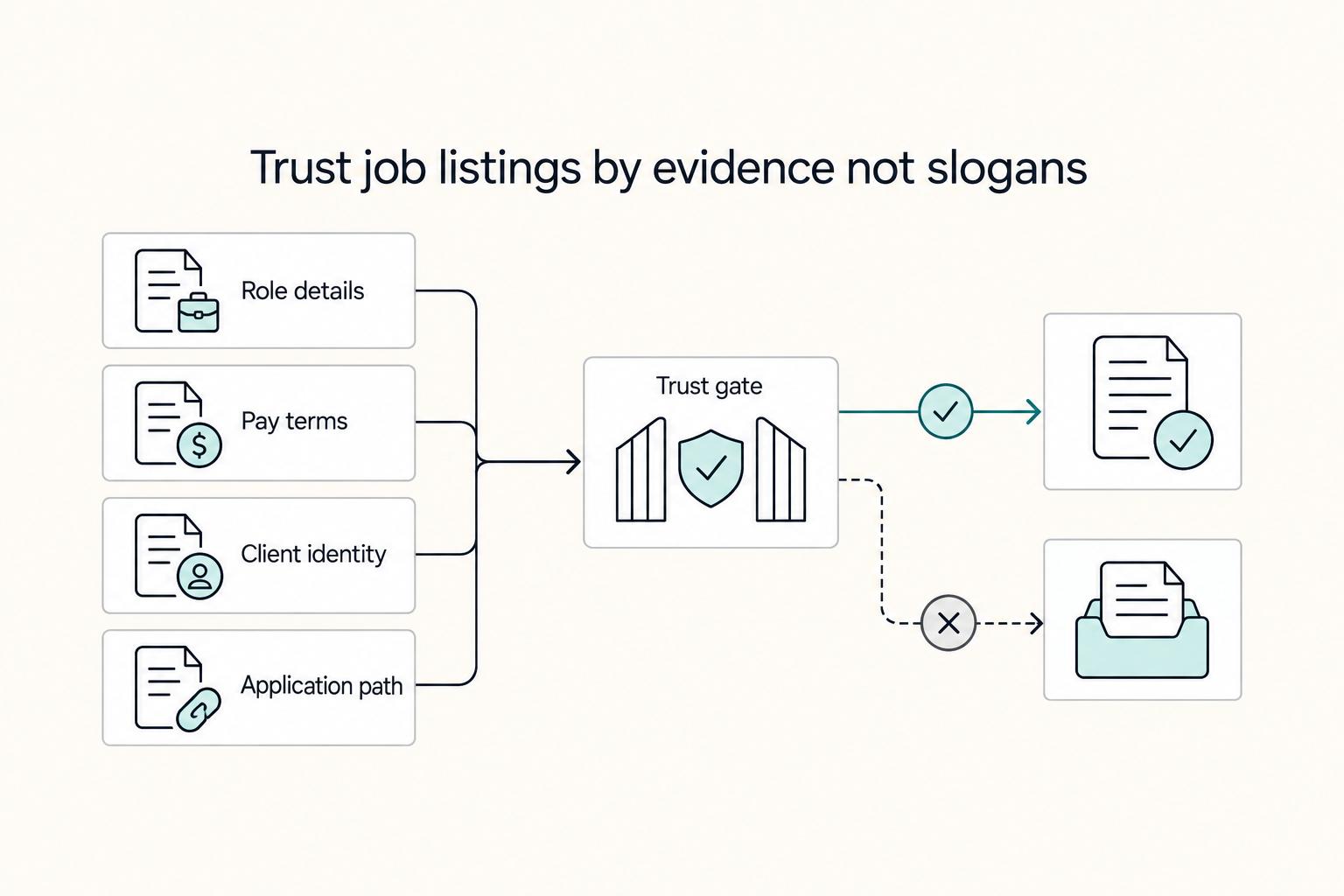
Use this four-check lens before you write anything tailored:
- Recency marker: Look for visible age labels first. If a post looks old, downgrade it until freshness is confirmed.
- Core metadata: Confirm role type, location, and work mode early. Even one concrete field like
Full-timehelps you screen faster, including when you prefer contract work. - Application-path clarity: Verify where the application actually goes. Heavy platform promotion can blur whether you are applying directly or entering an extra funnel.
- Remote reality check: Remote labels help, but they do not prove that a specific listing is active, scoped well, or high intent.
Use one simple rule for the rest of this article: run one primary board for most weekly submissions and one secondary board for overlap checks. If your primary keeps showing clear metadata and recent posts, keep it. If those signals weaken, move your effort quickly instead of forcing volume. That gives you a cleaner weekly pipeline and makes it easier to compare what is actually working over time.
If you want help organizing that review habit, Browse Gruv tools.
Use These Criteria Before You Trust Any Board#
Trust listing fields, not slogans. Boards can call themselves leading, widely used, or trusted, but your decision should come from details you can verify on the listing itself.
| Checkpoint | What to verify | Notes |
|---|---|---|
| Role fit | Start with your lane (Smart Contract, DeFi, or non-tech) | Specific titles are easier to evaluate than broad, ambiguous labels |
| Recency signals | Prioritize listings with visible posting age | Posts with stale or missing timing should drop in priority |
| Salary and location transparency | Confirm compensation detail, including token context when shown | Also confirm location or remote expectations |
| Application-path clarity | Confirm where your submission lands | Confirm who receives it |
| Duplicate-post risk | Check whether the same role appears across boards with conflicting details | Keep one canonical listing and ignore the rest |
| Trust checkpoint | Separate marketing language like leading, #1, or trusted by | Rely on verifiable listing data |
Stay consistent by scoring every board against the same six checkpoints. Mark each item as pass, partial, or fail, and do not change the rubric just because a platform looks busier or more polished.
- Role fit: Start with your lane (
Smart Contract,DeFi, or non-tech). Specific titles are easier to evaluate than broad, ambiguous labels. - Recency signals: Prioritize listings with visible posting age. Posts with stale or missing timing should drop in priority.
- Salary and location transparency: Confirm compensation detail, including token context when shown, plus location or remote expectations.
- Application-path clarity: Confirm where your submission lands and who receives it.
- Duplicate-post risk: If the same role appears across boards with conflicting details, keep one canonical listing and ignore the rest.
- Trust checkpoint: Separate marketing language like
leading,#1, ortrusted byfrom verifiable listing data.
This is where many reviews go soft. They stop at platform positioning when the real question is whether the listing itself gives you enough to make a sound time decision. A board can look credible on the homepage and still waste your time if role type, recency, or location turn inconsistent once you click through.
Add one compliance sanity check for cross-border freelance work. Confirm data-handling expectations early, and keep GDPR awareness in scope for EU-facing engagements. If privacy terms are unclear, ask for clarification before sharing sensitive details.
Use one decision rule throughout the rest of your evaluation: if a board regularly hides role type, recency, or location, keep it secondary even when volume looks high. If two boards look similar on volume, choose the one with clearer listing metadata as your primary queue. Related: The Best International Money Transfer Services (Beyond Wise).
Compare the Top Web3 Crypto Job Boards at a Glance#
Use this snapshot to choose a primary board quickly, then validate with live listing checks before you invest application effort. Hiring is fragmented across niche boards, social channels, and private pipelines, so the practical move is to separate supported signals from assumptions.
| Board | Best For | Role Breadth | Metadata Quality | Trust Signals | Main Tradeoff | Recommended Use | Can verify now vs cannot verify now |
|---|---|---|---|---|---|---|---|
| web3.career | Broad discovery across Web3 roles | Described as highly complete and widely used | Not consistently shown here | Third-party characterization, not listing-level proof | Broad coverage can add noise without strict filtering | Use for discovery, then validate listings with your scorecard | Can verify now: third-party characterization as complete and widely used. Cannot verify now: vetting rigor, placement outcomes, consistency of listing freshness. |
| Cryptocurrency Jobs | Adding another specialized board to your comparison set | A ranked-source set includes Cryptocurrencyjobs.co near the top | Excerpts do not provide stable listing-field examples | Presence in ranked lists only | Name and source variation can complicate apples-to-apples comparisons | Keep it primary only if your sample shows clear role, location, and recency fields | Can verify now: inclusion in a ranked top-board list. Cannot verify now: consistent salary and location transparency, duplicate-post behavior. |
| CryptoJobsList | Board-led market scanning plus job discovery | Included in one top-board ranked set | Verify with platform directly | Publishes its own analysis content (updated Mar 18, 2025; 19 min read) | Useful for sourcing, but self-published rankings are not neutral proof | Use for sourcing and cross-check each listing with the same six criteria | Can verify now: ranked-list inclusion and updated board-operated analysis content. Cannot verify now: cross-board outcome quality or vetting standards. |
| Braintrust AIR | Secondary comparison option in this section | Confirm with the relevant authority | Not evidenced here | No supported trust signal here | High uncertainty until manual listing checks | Treat it as secondary until live listings confirm role fit, recency, and application path | Can verify now: evidence gap for this section. Cannot verify now: specialization depth, metadata quality, hiring outcomes. |
Use the table to narrow the choice, not to finish it. If two options still tie, default to the one with clearer listing fields as your primary queue and keep the other for overlap checks. For planning support, see How to Create a Content Calendar for Your Freelance Business.
web3.career Review for Broad Role Coverage#
web3.career is strongest when you need broad role discovery fast. It is less attractive when your main goal is a direct application path with minimal friction.
The board positions itself around blockchain, smart contract, and crypto hiring, and visible tags span both technical and non-technical roles. That breadth is useful when you are mapping demand across several lanes in one sitting. The on-page Remote label also helps with first-pass filtering.
The tradeoff shows up once you move from discovery to submission. Bondex promotion is prominent on-page, including repeated Join now and talent-pool prompts, so some listings may involve extra steps before a clear direct-apply route appears. If you are trying to protect application time, that matters more than broad coverage alone.
A practical way to use web3.career is to separate scanning from submitting. Scan it first to map demand by role tags and work mode. Then shortlist only the listings that pass five checks: title clarity, tags, location or Remote, application destination, and whether a Bondex step appears. After that, check freshness and listing quality on a second board before you send anything tailored.
That pattern keeps the upside and limits the downside. If your shortlist depends on wide discovery, keep web3.career near the top. If your bottleneck is application speed and clarity, it makes more sense as a secondary source while you submit from a stricter board.
Cryptocurrency Jobs Review for Structured Job Data#
Cryptocurrency Jobs is worth testing when you want a more focused board identity and a cleaner first pass through blockchain and crypto roles. Just keep your trust threshold at listing level, not platform level.
Its positioning is explicit. It describes itself as the leading job board for blockchain jobs and cryptocurrency jobs and says it curates new blockchain jobs from companies and startups using blockchain technology. The homepage also shows both sides of the market through Post a job and Join our talent collective. Those are useful orientation signals, but they show what the platform wants to be. They do not prove every listing will meet your quality bar.
That is why a short live audit matters before you make it your weekly primary. Capture the exact title and application destination for a small sample of relevant roles. Note whether role scope, recency, and location details are easy to find and compare. Then check whether the same posting appears elsewhere with conflicting details. If key fields are often missing, keep this board secondary and use a broader source for top-of-funnel discovery.
The advantage of this approach is discipline. You get the benefit of a specialized board without assuming listing quality beyond what the page actually shows. If the live sample looks clean, it can earn primary status. If not, it still has value as a comparison layer.
CryptoJobsList Review for Brand-Signal Discovery#
CryptoJobsList works best as a discovery and company-mapping layer, not as your final trust gate. It can improve targeting speed, but the submit decision should still come from listing-level verification.
The clearest support is visibility. Crypto hiring discovery is fragmented, and CryptoJobsList appears in third-party comparison contexts. It also publishes board-operated analysis content, including an item updated Mar 18, 2025 with a 19 min read label. That helps with market scanning and company awareness. It does not confirm listing recency, compensation clarity, or outcome quality.
Used well, this board can save time upstream. Start by building a target-company list there. Then validate each target role on a second source before applying. While you do that, track five fields for every listing: title, posting-age marker, location or remote signal, compensation visibility, and application destination. If two or more fields are missing, backlog the role instead of sending a custom pitch.
That sequencing is the key judgment here. If brand signal is your first objective, start here and keep your verification gate strict. If detailed listing metadata is your first objective, begin on your stricter board and use CryptoJobsList as a secondary source to catch companies or roles you might miss elsewhere.
Braintrust AIR Review for Engineering-Focused Freelancers#
Braintrust AIR is the clearest fit in this group when your pipeline is mostly engineering work. If you need broader non-engineering coverage, treat it as one part of a wider board mix rather than a complete answer.
The clearest signal here is engineering-focused positioning. Braintrust has dedicated Web3 and crypto developer hire pages, and both repeat the same matched to **3** highly qualified candidates in minutes language. A Braintrust blog post also highlights AI engineer examples at $75-$100/hr and references a 550K community.
That is a directional signal, not a full trust case. The main practical tradeoff is scope. If you rely on this channel alone, you may miss roles in operations, customer success, and finance. For mixed pipelines, use Braintrust for engineering submissions and Cryptocurrency Jobs for broader role discovery.
One evidence boundary is worth stating plainly before you build a process around it. The detailed AIR application-tracking engine description appears in a third-party article; do not assume official sources document feature-level AIR behavior. So treat AIR as a useful label, but verify how it behaves through live listing checks before you depend on it operationally.
Before each submission, confirm role scope, recency marker, location or remote terms, and at least one compensation signal. If two fields are missing, move the listing to your secondary queue. That keeps this board useful for engineers without letting the brand substitute for evidence.
Avoid Common Application Traps and Verify Listings Faster#
Better filters beat more applications. If you verify quickly, remove low-confidence listings early, and save custom pitches for roles that clear basic trust checks, you protect both your time and your response quality.
| Step | What to do | Key detail |
|---|---|---|
| Role-fit first, then dedupe | Tag each listing by actual scope | Remove duplicates across web3.career and CryptoJobsList before writing tailored pitches |
| Build a lightweight evidence pack | Capture the job URL, recency marker, company identity clues, compensation visibility, and contact path | Keep it in one place |
| Run anti-fake-job checks | Pause listings that ask for ID, home address, or wallet information too early | Also pause unknown links and downloads |
| Escalate low-confidence cases | Ask direct questions | Contact the hiring company through an official channel before sharing sensitive details |
The fastest way to do that is with a lightweight evidence pack. Capture the job URL, recency marker, company identity clues, compensation visibility, and contact path in one place. Once you have it, the rest of the screening is much easier to compare across boards.
Then run this sequence:
- Role-fit first, then dedupe: Tag each listing by actual scope, then remove duplicates across
web3.careerandCryptoJobsListbefore writing tailored pitches. - Build a lightweight evidence pack: Capture the job URL, recency marker, company identity clues, compensation visibility, and contact path in one place.
- Run anti-fake-job checks: Pause any listing that asks for ID, home address, or wallet information too early, or pushes unknown links and downloads.
- Escalate low-confidence cases: Ask direct questions and contact the hiring company through an official channel before sharing sensitive details.
A common failure mode is letting brand-heavy pages lower your guard. Logos such as Trezor or CoW DAO can support discovery, but they do not prove that a specific listing is current, legitimate, or high intent. Treat logos as orientation, not verification.
When signals are thin, the right tradeoff is usually fewer high-confidence applications, not more volume. That can feel conservative, but in practice it keeps you from spending your best writing effort on roles that were weak from the start.
Pick One Primary Board and One Secondary Board This Week#
Make the call now: assign one primary board for most applications and one secondary board for coverage. Then keep that pair for one review cycle and re-rank based on results you can actually observe.
The point of everything above is to simplify execution. You do not need a perfect industry ranking. You need a repeatable weekly process that tells you where your time is best spent. That means choosing the board with the clearest visible evidence as your default, then using a second board to catch misses and spot duplicates.
Use this weekly execution plan:
- Choose primary based on visible evidence: Favor the board where listing details are easiest to verify at a glance, such as a clear recency marker (
9 months ago), remote metadata, and requirement signals like8-10 yearsfor senior roles. - Use secondary for reach, not trust transfer: Use it to catch additional opportunities and detect duplicates. Social-proof labels like
Trusted by Coinbasecan support discovery, but they do not validate any single listing. - Track one clean scoreboard for seven days: For
web3.career,Cryptocurrency Jobs,CryptoJobsList, andBraintrust AIR, log board, role fit, recency signal, submission status, and response outcome. Re-rank by response quality and listing clarity, not platform messaging. - Apply a freshness guard: Treat year-labeled compilation pages as discovery support only. A page labeled
Moonshot List 2022with 55 companies can help you find targets, but it does not prove active openings now.
If both boards show thin signals for your role, tighten standards and apply selectively rather than increasing volume. That is the core operating principle behind the whole selection lens: protect your time, verify what you can, and let observable listing quality decide where your effort goes next.
If you want a second set of eyes on your shortlist criteria for your country or program, Talk to Gruv.
Frequently Asked Questions
What are the best web3 crypto job boards for freelancers in 2026?
There is no single winner you can prove from this guide alone. Choose based on role fit and listing clarity, then validate with your own weekly results.
Which board is best for Smart Contract and engineering freelancers versus non-tech freelancers?
Use role fit first: prioritize boards where listings clearly match your skills, then add a broader backup.
Is a larger posted job count always better for getting hired?
No. A larger posted count alone does not prove better hiring odds. A paid posting model, including examples like $299.00 /post, may filter some noise, but price alone does not guarantee better outcomes.
How can I quickly tell whether a crypto job listing is trustworthy?
Run a short check before writing a custom pitch: recency marker, real company identity, and clear contact path. Pause any listing that asks for sensitive personal or wallet details too early.
Should I start with one board or apply across all four from day one?
Start with one primary and one secondary board. Expand only after one weekly cycle shows your current pair is missing clear-fit roles.
What information should I verify before spending time on a custom application?
Capture five fields: job URL, recency marker, company identity clues, compensation visibility, and contact path. If two or more are missing, backlog it. For cross-border client work, add a quick data-handling check with this GDPR checklist.
What do most Web3 job board reviews fail to explain for freelancers?
Many reviews blend platform claims with listing-level trust decisions. Preparation content can help interview readiness, but it does not prove hiring outcomes. Your own evidence pack and direct employer verification are still the core filters.
Try a related tool
Researched and edited by the Gruv editorial team. Gruv builds cross-border billing, payouts, and finance-operations software for global businesses.
Sources
Includes 4 external sources outside the trusted-domain allowlist.
- digitalcommons.liberty.edu/cgi/viewcontent.cgitrusted
- blockchain-jobs.lovable.app/blog/remote-contract-workexternal
- cryptojobslist.com/blog/web3-job-boardsexternal
- hashtagweb3.com/the-best-web3-job-boards-to-kickstart-your-c...external
- sourceforge.net/software/compare/CryptoJobsList-vs-Signaly-T...external
Educational content only. Not legal, tax, or financial advice.
Related Posts

GDPR Compliance Checklist for Freelancers Working With EU Clients
Start by separating the decisions you are actually making. For a workable **GDPR setup**, run three distinct tracks and record each one in writing before the first invoice goes out: VAT treatment, GDPR scope and role, and daily privacy operations.

Build a Freelance Content Calendar That Survives Client Work
If your publishing keeps slipping, the problem is often not a lack of ideas. It is that the plan breaks the moment client work shifts. A **freelance content calendar** should give you a usable schedule for what you plan to write, produce, and publish, plus enough structure to decide what moves when the week gets crowded.

The Best International Money Transfer Services (Beyond Wise)
**Build one primary route and one fallback route per client and currency pair, and you'll usually do better than any "best international money transfer" list when cash flow certainty matters.** If you run a business-of-one, you are the CEO. Your job is to build a reliable "get paid" system, not chase whatever app is trending this week.