

Quick Answer
For eligible US applicants, compare lower-fee Chase Sapphire Preferred or Capital One Venture with premium options only after an incremental annual-cost calculation. UK readers can compare Clarity and Barclaycard Rewards for overseas spending, with Starling, Chase UK or a region-appropriate Wise debit card for cash and fallback access. Repay statements in full, check current terms and keep an independent recovery path. There is no universal winner or required number of credit accounts.
Choose a travel credit card and a workable fallback#
Build a three-part card setup (primary, spend, backup) so one failure is less likely to derail your trip or your work. Forget the myth of "one perfect card." You want a system that still works when a terminal declines your card, a transaction gets flagged, or a merchant won't take your usual option.
Start with eligibility, the total annual cost and the ability to repay the full statement balance. Then choose a rewards card and a separate fallback. Three physical cards can be useful, but two independent ways to pay may be enough; opening extra credit accounts is not a prerequisite for travelling.
A lot of freelancer pain comes from timing and friction: late client payments, a surprise hold, or a charge that fails at the exact moment you need it to go through.
The 3 roles in your stack (and why each exists)#
Use three roles to plan the setup. An existing card can cover a role; the aim is resilience rather than collecting accounts.
| Stack role | Job to be done | Common failure it covers | What "good" looks like |
|---|---|---|---|
| Primary credit (rewards) | Put predictable, high-value spend on a rewards rail | You over-optimize categories and the card stops fitting real spend | Simple earn structure that matches your actual expenses and workflow |
| Spend card (day-to-day + cash access) | Handle everyday purchases and local-currency needs | You hit avoidable conversion friction or you need cash fast | Low-friction spending abroad (where supported), clear controls, and easy replenishment |
| Backup credit (ideally independent if possible) | Save the day when the primary fails | Lock, refusal, damaged card | Stored separately, with available credit, current details and a tested payment path |
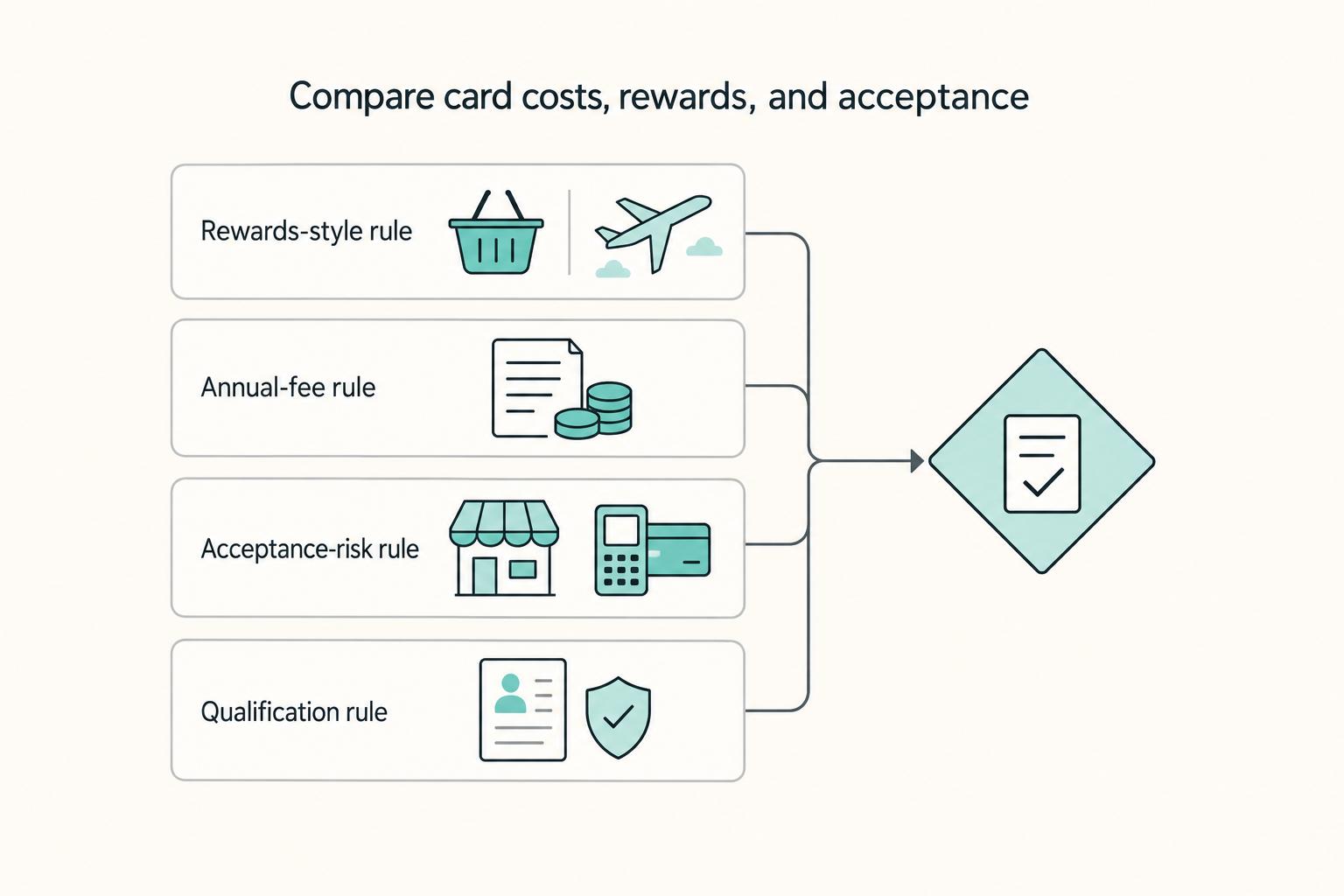
The shortlist below distinguishes US credit products, UK credit products and debit alternatives. Fee and feature details were checked against issuer pages in October 2026. These are feature-based starting points, not a hands-on ranking, an approval prediction or a statement that an account can be retained after moving abroad.
A risk-first selector you can run fast (no spreadsheets required)#
Run these checks before you chase travel rewards or credit card points. You're trying to reduce declines, not win a points debate.
| Check | What to verify | Grounded note |
|---|---|---|
| Region reality check | What you can actually qualify for | Rules, pricing, and eligibility vary by issuer and jurisdiction, and they change. |
| Acceptance plan | Keep a fallback that does not share the same single point of failure | Do not rely on a single way to pay. |
| Cashflow timing check | Map your invoicing cadence to your billing cycle | If payments land late, you need headroom and a plan that does not force panic spending. |
| Failure drill | Decide what you do if the primary declines at checkout | Store the backup separately and keep issuer contact info accessible. |
Because this happens in real life: you arrive, try to pay, and the terminal declines your primary card. If your backup sits in the same wallet, you may still be stuck. If your backup lives elsewhere and you've already tested it, you're more likely to keep moving.
Who the comparison helps and how to evaluate the shortlist#
This list is for operators with variable income who want fewer declines and less FX fee leakage, not hobbyist points collecting.
This comparison suits readers who can repay their statements in full and want a repeatable way to compare rewards, foreign-currency costs and fallback access. If you are carrying debt, assess repayment and total borrowing cost before choosing a card for points.
This is for (and not for)#
This is for freelancers, creators, and small teams who run real monthly burn across SaaS, ads, lodging, and flights. You want to keep that spend on a predictable rewards rail (think a mainstream travel card). You also want a debit fallback for day-to-day operations.
It's not for two groups:
- Anyone carrying a revolving balance. Interest costs usually erase travel rewards and credit card points fast, and it turns your "stack" into debt management.
- Anyone optimizing one airline at all costs. If you only care about a specific airline network, you want a program-specific deep dive, not a generalist nomad stack (for example, a premium travel card plus a debit backup for acceptance gaps).
Hypothetical: you run client work from abroad, your ad platform bills overnight, and your lodging deposit hits the same week. You do not win by squeezing an extra category multiplier. You win by preventing a decline, avoiding unnecessary FX fees, and keeping your spend auditable.
A weighted scoring rubric you can adapt#
Use the suggested weights below after the eligibility and repayment gates. They total 100%, but they do not represent published product scores or measured performance. Score each eligible candidate from 0 to 5 using its exact terms and your spending records.
| Criterion (weight) | Evidence to check | Comparison rule |
|---|---|---|
| FX costs (30%) | Foreign-transaction fee, network/conversion rate, ATM costs | Compare total cost for the same purchase or withdrawal |
| Acceptance and continuity (25%) | Network, issuer, device and account dependencies | Prefer a fallback with a different likely failure path |
| Rewards fit (20%) | Earn categories, caps and usable redemption | Use normal spend; value unused rewards at zero |
| Protections (15%) | Benefit guide, residency, eligible trip and payment conditions | Compare covered risks and exclusions with your separate insurance |
| Eligibility and administration (10%) | Residence, income, credit assessment, fees and renewal tasks | Exclude ineligible cards before scoring |
For example, scores of 4, 4, 3, 2 and 5 produce 4×0.30 + 4×0.25 + 3×0.20 + 2×0.15 + 5×0.10 = 3.60 out of 5. Those are invented inputs to demonstrate the method, not ratings of any card. A high score cannot override an unaffordable statement balance.
What's the best travel credit card for a digital nomad in 2026? Use this 10-minute selector (not opinions)#
Choose from cards available to you, then compare the roles and costs. A US product with the same brand name as a UK card can have different fees, protections and rewards. A nomad's physical location today does not by itself determine their eligibility.
Use the rubric above (FX leakage, acceptance, rewards fit, protections, admin) and stop debating vibes. This is how you pick from the universe of travel cards without buying into rewards you cannot reliably use.
Step 1 (3 minutes): Choose your stack role (pick one primary)#
Pick the job first, then shortlist cards that typically play that job well in your market.
| Your primary job-to-be-done | Start your shortlist at | Key differentiator to verify in the current guide |
|---|---|---|
| Premium travel perks and protections | Premium travel credit cards you can actually apply for in your country | Protections and eligibility change. Confirm what triggers coverage and where you can use the card. |
| Simple, consistent travel rewards | A low-admin travel rewards card from a major issuer in your market | Low-admin earning matters more than theoretical optimization when you run a business-of-one. |
| Everyday spend abroad with lower FX friction | A "no/low FX" everyday card that fits your residency and banking setup | Decide your "daily driver" once, then reduce switching costs with a stable habit. |
Pick the job first, then keep it simple. Decision rule: if you cannot describe the card's primary job in one sentence, it will become shelfware.
Step 2 (3 minutes): Apply two hard constraints (before you read a single points blog)#
Region constraint: build your list from cards you can actually apply for based on where you live and bank. Big brands can run different products in different countries, so confirm the exact product and terms from issuer docs.
Acceptance constraint: assume nothing. If your itinerary includes smaller merchants or infrastructure friction, bias your stack toward whatever payment networks are most reliably accepted where you are going, and treat any "maybe accepted" option as conditional, not the foundation.
Step 3 (4 minutes): Run the "Nomad Risk Check" so travel rewards do not break your ops#
- Decline plan: keep an alternative issuer or network where practicable and store the physical backup separately. Two cards in one wallet do not cover wallet theft, and two accounts accessed only through one phone do not cover losing that phone.
- Cash plan: check your issuing-country ATM allowance, issuer charges, machine-owner surcharge and any credit-card cash interest. Compare the total before accepting the transaction. A fee-free withdrawal is not necessarily interest-free.
- Timing plan: reserve cash for the full statement balance before its due date. An invoice expected next week is not money available today.
Hypothetical: your lodging deposit fails on your primary at check-in. You pull out your backup credit card, then use your debit option for local spending until the issuer clears the lock. No scrambling, no reputation damage.
Should you use credit cards, debit cards, or both? The safe-default stack (with failure modes)#
Use both: a credit card for credit-based spending and a debit/spend card for controlled day-to-day spending (especially across currencies).
The goal is not to win on paper. The goal is to keep your money ops simple and predictable.
The 2-rail stack I want you to operate (not debate)#
-
Credit card (your primary "statement-based" spend rail): Use a credit card for consolidated spend where you want one monthly statement and clean merchant reporting. Keep it boring: fewer accounts to reconcile, fewer moving parts.
-
Debit or spend card: Use available account funds for everyday purchases and cash access. A multi-currency account can help you budget, but compare its conversion fee with a no-foreign-transaction-fee card's network conversion. Debit is not borrowing, and a low fee alone does not establish the same dispute rights or travel protections as a credit product.
For a concrete regional example, Wise's Canada page currently shows an ATM allowance up to 100 CAD per calendar month, followed by 2.69 CAD per withdrawal plus 2.69% of the amount above 100 CAD. These Canadian terms do not describe a UK or US account; check the account's own pricing screen before withdrawing.
Compare the costs of a debit transaction#
| Cost | What to check |
|---|---|
| Conversion | Rate and any conversion fee; Wise advertises a mid-market rate with conversion fees |
| Card spending | Issuer charge and whether the account holds the payment currency |
| Cash access | Monthly allowance, excess charge and ATM-owner fee |
| Replenishment | Transfer method, total fee and actual availability |
| Account access | Supported residence, account limits and recovery route |
If you add redundancy beyond this, keep it simple: avoid putting all your access (cards + app logins) in one place.
The best travel credit cards for digital nomads (by job-to-be-done) + a fast comparison table#
The right travel card setup depends on the job in your stack (primary, daily spend, fallback), not hype.
The table uses the exact market and product, because brand-family labels obscure material differences. US-dollar annual fees below are for the US basic cards; they are not UK prices. Debit options follow the credit shortlist and do not supply a credit line. Check linked terms before an application.
Quick comparison table (scan first, then choose)#
| Product and market | Type and annual fee | Feature supporting the fit | Main decision limit |
|---|---|---|---|
| Chase Sapphire Preferred, US | Credit; $95 | No foreign-transaction fee; 3x dining and 2x other travel | Category earning differs from flat-rate cards; travel protections have conditions |
| Chase Sapphire Reserve, US | Credit; $795 | Up to $300 annual travel credit; 4x direct flights/hotels | High fee; credited travel purchases do not earn points |
| Amex Platinum, US | Card; $895 basic annual fee | 5x eligible flights and prepaid Amex Travel hotels | 1x other purchases; credits and lounge access require a usable itinerary and terms review |
| Amex Gold, US | Card; $325 basic annual fee | 4x restaurants worldwide to $50,000/year; US supermarkets to $25,000/year | US supermarket category does not turn overseas groceries into 4x spend; then 1x |
| Capital One Venture X, US | Credit; $395 | 2x everyday miles; 5x flights and 10x hotels/cars through Capital One Travel | Higher portal earn requires portal bookings; compare price and servicing |
| Capital One Venture, US | Credit; $95 | 2x everyday miles; no foreign-transaction fee | Redemption value varies; paying a second annual fee only for backup may be unnecessary |
| Halifax Clarity, UK | Credit; check offered terms | Travel-spend option with published no non-sterling purchase/cash-withdrawal fee features | Cash interest starts on withdrawal; eligibility and Halifax-to-Lloyds changes need checking |
| Barclaycard Rewards, UK | Credit; check offered terms | 0.25% eligible cashback and no transaction fees abroad advertised | Use the exact Rewards terms; other Barclaycards have different fees |
| British Airways Amex, UK | Credit; no annual fee | 1 Avios per £1 and a spending-based companion voucher | Airline-reward fit is separate from cheapest foreign-currency spending; check FX charges and redemption availability |
| Wise, account-country specific | Debit; regional pricing | Multi-currency balance and conversion controls | Conversion/ATM charges apply; Canadian example is not a global allowance |
| Starling personal account, UK | Debit | Mastercard conversion with no Starling overseas spend/withdrawal fees | Machine-owner fees and daily cash limit still matter |
| Chase current account, UK | Debit | No Chase foreign-use charge; local-currency Mastercard conversion | Overseas ATM withdrawal limit and continued account eligibility apply |
Picks by job-to-be-done (use-cases + where each fits)#
Primary credit card (any issuer): Make one your default, keep a backup on a different payment network, and do not "rotate" constantly unless you actually enjoy admin.
Daily spend and cash: Compare Wise with a domestic-bank debit card available to you. Use the same amount, currency and cash requirement. A multi-currency balance may be convenient, while a no-fee bank card may cost less for a particular transaction. Keep the comparison tied to the account's residence market.
Hypothetical: you land in Singapore, your primary credit card works for the hotel, but a smaller vendor needs a debit payment. You run Wise card for the purchase, then keep your backup credit card untouched unless something breaks.
Which cards work best if you're UK-based vs US-based? Use these two decision paths#
US and UK readers should follow separate product and eligibility paths. The suggestions below follow published features rather than a claim about what nomads in each country generally choose.
| Decision area | US-based | UK-based |
|---|---|---|
| Primary rail | An eligible card whose usable benefits justify its cost; begin with the simpler lower-fee comparison. | An FX-friendly credit card you can use consistently. |
| Add-on / backup | An existing separately stored card or other accepted method with a different likely failure path. | An existing separately stored card or other accepted method; add a rewards account only if its net value justifies it. |
| Debit redundancy | An eligible debit account with documented foreign-use and cash terms | An eligible UK bank debit account or multi-currency card with documented terms |
Use your home base to pick one primary credit rail, one daily-spend FX rail, and one backup. Approvals, benefits, and day-to-day usability can diverge between the US and the United Kingdom, so you want a clean path you can implement without second-guessing.
Path A (US-based): optimize travel rewards + protections, then add redundancy#
Treat this as your 3-rail stack for travel rewards and credit card points, with a failure plan you can actually run on a bad day.
- Primary: compare Preferred or Venture for lower annual cost; compare Reserve, Venture X or Platinum only when their extra benefits cover the extra cost.
Use a benefit guide to check the trip length, residence rules, insured people, payment requirement and exclusions. A card with cancellation or rental cover is not automatically a replacement for medical, evacuation or long-stay travel insurance.
- Fallback: an existing independently accessible card or another accepted payment method.
Give the fallback one job: it works when the primary fails. Store and access it independently where possible.
- Daily spend/FX: compare eligible bank debit and multi-currency options.
Use a debit account with funds already available and a documented recovery path. Select it by the costs of your actual currencies and withdrawals, rather than treating one provider as the universal default.
Path B (UK-based): optimize FX + acceptance + admin simplicity#
Run this path when you care more about predictable day-to-day spending abroad than squeezing every last point.
- Daily driver (pick one): an FX-friendly credit card you can use consistently
Choose one and stop rotating. Consistency makes declines, reconciliations, and merchant testing easier to manage.
- Rewards add-on (optional): a rewards card that matches how you'll actually redeem
Add it only if you actually plan to redeem the rewards. Keep a second non-identical card in the stack so you do not depend on a single rail.
- Debit fallback: use an independently accessible option where it adds useful resilience.
Use one debit or spend option for routine cash access, and keep another independently accessible method if it addresses a real failure risk. Avoid extra accounts whose fees or administration outweigh that benefit.
| Decision you're making | Safer default | Why it stays operational |
|---|---|---|
| "Which primary card do I run?" | US: one primary travel rewards credit card. UK: one consistent day-to-day credit card | One primary reduces admin and makes spend patterns predictable. |
| "What if a merchant declines my usual rail?" | Carry a second card on a different rail (when possible) | Single-rail stacks fail at the worst times. |
| How do I control FX costs? | Compare a no-FX-fee credit/bank debit card with a quoted multi-currency conversion | Use the total for the same transaction, including any cash and machine fees |
Account-access drill: Keep issuer contact numbers, account identifiers and recovery instructions available securely offline. Make sure you can authenticate after losing the primary phone or SIM. Avoid storing full card photos and security codes as a substitute for recovery planning. Report theft and unauthorized transactions promptly through the issuer's official channel.
Are premium annual fees actually worth it for nomads? A break-even model you can run in 5 minutes#
A premium fee is worthwhile when the additional benefits and rewards you will actually use exceed its extra annual cost relative to the simpler eligible alternative. One valuable benefit may be enough; two unused perks are not.
Otherwise, "premium" becomes extra cost plus extra admin. Use this section to decide whether premium belongs in your system.
Step 1: Start with what you can guarantee you'll use (not aspirational perks)#
Estimate the value you will actually use over the benefit's stated period. A useful annual credit need not be used every month. For a monthly credit that expires without rollover, count only the months in which you expect qualifying use, rather than multiplying one month's use by twelve.
- Lounge access: Count visits you would otherwise pay for, at a conservative value. Check participating locations, guest charges, enrollment and access rules instead of using an advertised retail value.
- Insurance: Compare the guide with the risks you need covered. Count only coverage that genuinely replaces an expense, with eligible bookings and exclusions understood; otherwise keep separate insurance in the budget.
Step 2: Fill a one-page break-even worksheet (use conservative inputs)#
Use a low estimate for points. Treat credits as "realized" only after you actually redeem them.
| Line item (annual) | Your estimate | How to keep it honest |
|---|---|---|
| Premium annual fee | Use the posted fee and extra-user cost | |
| Credits actually used | Subtract only purchases you would otherwise make, net of added booking cost | |
| Incremental rewards | Compare against the simpler card, not zero rewards | |
| Avoided fees | Count FX savings only where the alternative would charge them | |
| Other useful benefits | Use your replacement cost, with coverage/access conditions satisfied |
Illustrative comparison: a premium card costs $395 and the lower-fee alternative costs $95, so the hurdle is $300 extra per year. Assume—not as a claim about these issuers—that you realize $180 of usable credits, $80 of incremental rewards and $40 of otherwise purchased lounge access. Benefits total $300, so you merely break even before administration, interest or booking-price differences.
If half the assumed credit value goes unused, benefits fall to $210 and the premium choice is $90 worse. If a required portal booking costs $50 more than a comparable direct booking, subtract another $50. Do not count the same spend as both an incremental reward and a saved cost, or add avoided FX fees when both candidates already waive them.
Hypothetical reality check: If you mainly book cheap regional flights last-minute and pay month-to-month lodging, protections may not trigger often. If you prepay big trips and one disruption would force multiple nights of extra lodging, protections can dominate the points math even when your travel rewards look average.
Decision rule: Choose the eligible lower-cost option when recurring benefits do not clear the incremental fee. A one-time welcome bonus is a separate first-year calculation, not evidence for every renewal. Read cancellation or downgrade terms before changing an account, and check the effect on existing bookings and rewards.
The freelancer cashflow layer competitors ignore: align cards to invoices, holds, and payment rails#
Treat your card stack as a cashflow system first, then layer travel rewards on top.
| Control | Action | Evidence |
|---|---|---|
| Statement funding | Reserve the full balance due from cleared funds | Amount, due date and repayment account |
| Income timing | Track overdue invoices separately from the card limit | Expected date and actual receipt |
| Booking holds | Check available credit after authorization holds | Hotel/rental amount and issuer status |
| Fallback | Test an independent payment and access path | Working card, contacts and recovery method |
This is the part that keeps your setup from collapsing when a client pays late, a terminal fails, or you need a non-card rail fast.
-
Match spending to the statement cycle. Suppose the balance due on the 20th is $2,400 and cleared cash available for repayment is $2,800. Reserve the $2,400 now, leaving $400 genuinely uncommitted. A $1,000 client invoice expected on the 18th may arrive late; exclude it from the repayment reserve until it clears. Keep a failed debit or autopay in the exception log until resolved.
-
Prepare an agreed way to receive client payment. A bank-transfer option can help when a card payment link fails, but give the client verified account details and track receipt. Do not send new bank details in response to an unverified message, and do not count a transfer confirmation as cash available. Credit-card cash advances are not a substitute for a funded repayment plan.
-
Separate business and personal records. Match receipts and booking confirmations to the card and transaction used, record client reimbursement separately, and check whether the card's terms permit the intended business use. A personal rewards card's attractive earn rate does not settle that permission.
-
Allow for holds and declines. A $600 hotel authorization reduces available credit even if it is not a final $600 bill. Confirm release timing with the hotel and issuer; do not assume the hold clears at checkout. A backup card at a different issuer helps with an issuer lock, but neither card solves a merchant-wide outage. Keep a feasible cash or bank alternative where the merchant accepts it.
Decline drill: Ask whether the first payment failed or is pending before trying again. Check the app or issuer when the result is uncertain to avoid duplicate charges. For a confirmed decline, use the tested alternative, keep the receipt and reconcile any earlier authorization later. A small successful test establishes only that transaction, not guaranteed future acceptance.
Assign each card a job and write down your rules#
Assign your existing payment methods to booking, daily spend and fallback roles. Add an account only when it improves resilience or usable value enough to justify its cost and administration.
The goal is not novelty or "the perfect card." It's a system that still works when you're tired, the Wi-Fi is bad, and a payment gets weird. Assign each card a job, decide where you will and won't use it, and keep the setup simple enough that you'll follow it.
A three-role checklist you can adapt#
-
Primary rewards card (your "big purchase" card) Description: Put high-stakes purchases here - things you'd rather not troubleshoot mid-trip, like flights, lodging, and work gear. Choose based on how much admin you're willing to do and what benefits you realistically use (for example, a Chase Sapphire option, Capital One Venture X, or Amex Platinum). Key differentiator: You're optimizing reliability and clear rules, not perfect points.
-
Daily spend and cash: Use an eligible debit card or multi-currency account with funds available. Record the exact country pricing, foreign-currency conversion process, ATM allowance and machine-owner charges. Choose local currency at the terminal when you want issuer/network conversion, and review the actual charge after posting.
-
Fallback access: Keep a separately stored card or another payment method the merchant accepts, with a workable recovery path. Prefer a different issuer or network where feasible, and make sure losing one wallet or phone does not disable everything. A new rewards credit card is optional.
| Stack role | Example | What you optimize | Non-negotiable rule |
|---|---|---|---|
| Primary | Chase Sapphire (or Chase Sapphire Reserve) | Clear rules for big purchases | Put major, high-stakes purchases here |
| Spend/FX | Wise card (or Starling) | Day-to-day spending + FX control | Confirm the currency and total cost before you tap |
| Fallback | Capital One Venture Rewards Credit Card | Continuity | Store separately and keep it ready to use |
Make it repeatable: break-even + review cadence#
Review fees, usable benefits, acceptance and the repayment reserve before renewal or a residence change, and at least every 6–12 months. Keep, downgrade or cancel according to the comparison, after checking rewards and booking consequences. Do not open another fee-bearing card merely to satisfy the three-role template.
Write down which card handles bookings, daily spend and an emergency; where the backup is stored; how to reach each issuer; and how the full statement will be funded. For business-specific terms and recordkeeping, continue with The Best Business Credit Cards for Freelancers.
Frequently Asked Questions
What's the best credit card for a digital nomad?
No single card wins for everyone. Treat this as a system choice: pick a primary rewards card that matches your real spend and your tolerance for admin, then add redundancy so one decline does not end your day. Your "best" card is the one you can keep funded, keep compliant, and get accepted often enough to matter.
Should digital nomads use credit cards, debit cards, or both?
Both can be useful: credit for statement-based purchases and debit for available funds and cash access. A primary credit card, debit option and separately stored backup form one practical template. Use only accounts you can afford and keep eligible; no fixed number of credit accounts is necessary.
Which travel cards are best for UK-based nomads vs US-based nomads?
Start with eligibility. Different countries issue different products and approvals vary, so build from what you can actually get approved for where you live. Treat any shortlist as a starting point, then validate fees (including foreign transaction fees), acceptance, and benefit terms directly with the issuer.
How do I know if an annual fee is worth it for my travel schedule?
Compare the premium card's extra annual fee with benefits and incremental rewards you will actually realize relative to a simpler eligible card. Exclude unused credits, unsupported insurance value and a one-time bonus from the recurring calculation. If the result is negative, the annual fee is not justified by that model.
What should freelancers prioritize: points, FX savings, or cashflow reliability?
Prioritize cashflow reliability first, then costs like foreign transaction fees, then points. Points and miles can turn everyday spending into travel rewards, but only if you pay on time and avoid interest drag. When your income arrives on invoices, avoiding payment outages beats theoretical rewards.
What are the biggest risks to avoid when choosing nomad cards (declines, ATM fees, FX conversion traps)?
Check issuer and ATM fees, cash-advance interest, authorization holds and the currency offered at checkout. Visa explains that merchant/ATM conversion into your home currency includes its own rate and fees. Review the offer; selecting local currency lets the card issuer or network handle conversion, with your own card's terms still applying.
What's a simple "backup plan" if my card gets frozen abroad?
Use a separately stored card or another accepted payment method after confirming the original transaction's status. Contact the issuer through its official number or app to resolve the lock. Keep access and recovery instructions available if the phone or SIM also fails; a second card on that same device does not cover every outage.
Try a related tool
Researched and edited by the Gruv editorial team. Gruv builds cross-border billing, payouts, and finance-operations software for global businesses.
Sources
Includes 7 external sources outside the trusted-domain allowlist.
- wise.com/ca/pricing/card-feestrusted
- americanexpress.com/us/credit-cards/card/platinumexternal
- americanexpress.com/us/credit-cards/card/gold-cardexternal
- barclays.co.uk/credit-cards/reward-cards/barclays-rewardsexternal
- capitalone.com/credit-cards/venture-xexternal
- capitalone.com/credit-cards/ventureexternal
- chase.co.uk/gb/en/support/travel-with-chaseexternal
- creditcards.chase.com/rewards-credit-cards/sapphire/preferredexternal
Educational content only. Not legal, tax, or financial advice.
Related Posts
The Best Business Credit Cards for Freelancers
Pick for reliability first. For a freelancer, the right business card is usually the one that keeps recurring bills moving, keeps records clean, and avoids extra costs when income swings from month to month. Rewards still matter, but they sit on top of those basics. They do not replace them.

The Best Digital Nomad Cities for LGBTQ+ Travelers
Pick a city only if the country behind it fits your stay, your work, and your risk tolerance. If you are comparing the **best lgbtq nomad cities**, treat each option as one commitment decision: city plus country, not city alone.

A Guide to Notion for Freelance Business Management
If your workspace feels busy but fragile, you do not need more pages. You need one connected system. Treat your freelance business like a business-of-one and use Notion as the control layer that connects client decisions, delivery, and billing in one place.