
Quick Answer
Use a four-stage system: capture media requests, run outreach from one inbox, centralize client reporting, and upgrade only when a tool removes a repeated weekly task. Start with HARO-style channels and social request feeds, then move to inbox-led execution with options like OnePitch so replies and follow-ups stay together. Add a unified workspace such as JournoLink when reporting fragments. Keep the Monday-midweek-Friday checklist as your proof gate before paying for higher-tier platforms.
A lean weekly PR system for freelancers#
Solo PR work can break down from execution drift, not just from having too few apps. Dropped leads, missed follow-ups, and patchy client updates are common failure points when your weekly routine gets too heavy.
Use a stage-based approach so each tool matches the job you need today. Upgrade only when a new tool removes recurring manual work you can point to. The goal is practical control: keep your pipeline moving, keep reporting clear, and avoid paying for features that sit idle.
- Stage 1: Media requests intake. Start with channels that surface quote and interview requests, then qualify quickly. Many freelancer PR tools are free or partly free, which helps you build response habits before you raise spend.
- Stage 2: Inbox-led outreach. Once targeting is repeatable, use tools that send from connected Gmail or Outlook accounts. OnePitch presents itself as a budget-friendly option for list building and client management while sending from your own inboxes, so replies and follow-ups stay in one place.
- Stage 3: Unified view for client delivery. As client work expands, move to one view with separate client profiles and dashboards. JournoLink is described as offering instant distribution, campaign prompts, press room management, and journalist contacts.
- Stage 4: Budget and proof check before upgrades. Treat pricing and ratings as signals, not guarantees. A page may show
$19/month, a15% OFFbanner, and4.6 on G2 from 200+ reviews, but those details can change, so verify current limits before paying.
A simple way to use these stages is to map one current pain point to one stage. If you miss inbound opportunities, strengthen intake first. If your issue is late follow-ups, tighten inbox-led outreach before buying more discovery tools. If client reporting is fragmented, move toward a unified view before adding another channel.
Keep one rule at every stage: if a tool does not remove at least one repeated weekly task, postpone it. Keep tracking the same weekly outcomes so your stack stays lean while targeting and pitch quality improve.
How to choose PR tools when you work solo#
Pick tools for weekly reliability, not maximum feature count. Keep only what improves follow-up and reporting without creating extra app switching or admin burden. Buying decisions get easier when each tool has one clear job and one clear success check.
| Filter | What to check | Example |
|---|---|---|
| Audience fit | Check who the recommendation is written for before treating it as buying advice | One list covers 27 tools, was updated on October 18, 2023, and is framed for agencies |
| Task replacement test | Does this tool remove at least one repetitive weekly task? | The tool should replace other apps, not add more switching |
| Outreach execution quality | Prioritize features that improve your next action, not just activity signals | A 2018 recommendation mentions email-open tracking; treat opens as follow-up signals, not intent to reply |
| Recency and limits check | Treat older recommendation posts as idea sources, not final buying proof | A price like $19/month is a snapshot; verify current plans and limits before paying |
- Audience fit. Check who the recommendation is written for before treating it as buying advice. One list covers 27 tools and was updated on October 18, 2023, but it is framed for agencies. Use agency lists for ideas, then filter for solo-friendly execution.
- Task replacement test. Use a hard gate before you buy: does this tool remove at least one repetitive weekly task? If not, postpone it. A strong freelancer filter is consolidation: the tool should replace other apps, not add more switching.
- Outreach execution quality. Prioritize features that improve your next action, not just activity signals. A 2018 recommendation mentions email-open tracking, and the article notes the recommendations are author opinions, so treat opens as a follow-up signal, not intent to reply.
- Recency and limits check. Treat older recommendation posts as idea sources, not final buying proof. A price like $19/month is a snapshot, so verify current plans and limits before paying.
Use these filters in order, not all at once. Start with audience fit so you do not copy advice meant for larger teams. Move to task replacement so the tool has a measurable purpose. Then check execution quality and recency before you spend. This sequence keeps you from overbuying early and under-measuring later.
When you evaluate any option, write a one-line success statement before the trial starts. Example: "This tool should cut weekly list maintenance time and improve follow-up completion." After two weekly cycles, decide from your log, not brand familiarity. If a platform creates more weekly cleanup than it removes, it is too early for your stage.
If you want a contract-side decision lens before buying software, read How to Write an Arbitration Clause for a Freelance Contract. For a fast next step after this section, use Browse Gruv tools.
Quick comparison table for fast shortlisting#
Use this table as a first-pass shortlist, not a final buying call. These picks are stage-based, and roundup rankings can be biased or stale, especially when affiliate monetization affects placement or page dates lag actual positioning.
| Tool | Best for | Key pros | Key cons | Use case |
|---|---|---|---|---|
| Buffer | Consistent social cadence | Can support a simple scheduling rhythm | Verify capabilities and plan limits directly | Queue weekly posts around media moments if the workflow fits |
| Muck Rack | Active journalist pitching | Supports database and outreach workflows in an all-in-one PR platform model | Requires strict vendor due diligence before purchase (roadmap, support, security, and ROI) | Build and maintain targeted media lists |
| Prowly | Outreach plus content operations | Combines contact work and campaign assets in one workspace | A roundup claim positions it with a one million contact database, which you should verify directly | Manage contacts and campaign assets together if validated |
| BuzzSumo | Topic and content research | Can help you scan shared topics quickly | Verify capabilities and plan limits directly | Validate angles before pitching |
| Keyhole | Mention and hashtag tracking | Can be useful for live campaign signals | Verify capabilities and plan limits directly | Monitor campaign buzz on social channels |
| Google Analytics | Outcome tracking | Adds a traffic-attribution lens | Verify capabilities and plan limits directly | Measure site visits after placements |
| Grammarly | Draft cleanup | Can speed up writing polish | Verify capabilities and plan limits directly | Tighten pitches and press copy |
Before you commit, run a short verification pass. Check recency and affiliate context first. Confirm current plans and caps directly with the vendor. Ask about support and security standards such as SOC 2 and 2FA. Name the one weekly task it must remove. If you cannot name that task, postpone.
It helps to compare options on the same scorecard so your decision is not swayed by presentation style. Keep the criteria fixed: fit for your stage, expected time saved, setup effort, and clarity of reporting output. If one option looks strong but requires heavy setup you cannot sustain, count that as a real cost.
Use one decision lens across every option: remove the current bottleneck first. That keeps execution tighter and helps reduce manual list upkeep, inaccurate contacts, and disconnected reporting.
Muck Rack as the best database option for active outreach#
Muck Rack fits when frequent pitching is your normal week and your bottleneck is list quality, not writing speed. It is most useful once contact checks and list upkeep take more time than drafting pitches.
Its practical edge is profile depth plus consolidation: verified contacts, coverage history, topical focus, and tools for research, outreach, monitoring, and measurement in one place. The value is not raw list size. It is tighter filtering and cleaner targeting week after week.
You are usually ready when the pattern looks like this: your pitch copy is solid, but response quality stays uneven because contact selection is inconsistent. In that case, better contact data can improve outcomes faster than another copy tweak. If your list quality is already strong and outreach volume is low, this level is probably early.
Where it fits best#
Use it when you pitch regularly in one or two clear beats and can reuse beat-specific lists instead of rebuilding them from scratch.
A workable pattern:
- Build one list per beat with fields for last relevant byline, angle fit, and last outreach date.
- Add a brief note field for contact preferences so later outreach is more precise.
- Send outreach in small beat-based batches so you can adjust framing from early responses.
- Review results monthly before renewal, and fix targeting first if outcomes stay flat.
This pattern works because it separates contact quality from message quality. If responses improve after list cleanup, keep investing in contact precision. If responses stay flat with accurate contacts, shift effort to angle and timing.
Cost pressure and renewal risk#
The main friction point is pricing visibility. Muck Rack uses a sales-led quote process, so there is no public self-serve pricing table. Public third-party estimates suggest entry access near $5,000 per year, common annual contracts around $12,000 to $15,000, and larger deployments above $25,000. Treat those as planning ranges, not official tiers.
| Scope | Amount | Note |
|---|---|---|
| Entry access | near $5,000 per year | Public third-party estimates; treat as planning ranges, not official tiers |
| Common annual contracts | around $12,000 to $15,000 | Public third-party estimates; treat as planning ranges, not official tiers |
| Larger deployments | above $25,000 | Public third-party estimates; treat as planning ranges, not official tiers |
If another vendor is on your shortlist, compare the same scope in writing: contact quality, filtering precision, contract length, and cancellation terms. Before you sign, confirm what support looks like during onboarding and how quickly data corrections are handled.
Buy only when the tool removes a weekly bottleneck you can name and measure. If you cannot state that bottleneck in one sentence, delay the contract and keep tightening your current process. If country setup questions are part of that decision, see A Guide to Tax Residency in the Czech Republic for Nomads.
Prowly as the best middle ground for outreach plus content operations#
Prowly can be a middle ground when your bottleneck is switching between outreach and content tasks, not maximizing live tracking depth. It combines media database work with press release production in one workspace, which can simplify weekly execution.
Prowly describes itself as an affordable all-in-one PR platform with AI-assisted search, integrated press release tools, and over 1 million contacts. Treat that positioning as directional and validate it in your own routine. The practical test is simple: can you find relevant journalists, build targeted lists, and prepare campaign content with less switching?
It is strongest when one person handles planning, drafting, list work, and follow-ups. When those tasks live in separate tools, context gets lost and handoff errors rise. Keeping related work together can reduce rework, especially when the same client needs repeated outreach cycles.
Where this middle ground works#
Choose Prowly when the same week includes list building, release drafting, and follow-ups for the same client or beat. Keeping contacts and content together can reduce handoff errors and make reuse easier across cycles.
Use this checkpoint before committing:
- Use the 7-day full-search trial to build two beat-specific lists, and confirm recent coverage matches your angle.
- Build one release asset and one outreach asset in the same workspace, then reuse them the next week.
- Track monthly reply rate, positive response rate, and hours spent maintaining lists.
To make this useful, keep the trial focused on one campaign, not many. A narrow trial gives you clearer signal on whether consolidation is helping. If setup effort consumes most of the trial, that is useful evidence too.
The tradeoff versus Muck Rack is depth in real-time online news tracking and social-media-led journalist engagement. If outreach volume is still low, an all-in-one setup can feel like extra overhead. If your workflow is simple, extra features may not change outcomes.
Choose Prowly over Muck Rack when consolidation removes a recurring weekly task you can measure. Choose Muck Rack when deeper live tracking and social engagement matter more.
Buffer as the best consistency tool for solo distribution#
Buffer fits when consistency is the problem. In this stack, a scheduler has one job: keep publishing on track when client work crowds your calendar.
As of 3/4/2026, Buffer is used here as a social scheduling example. The upside is straightforward: move repetitive publishing steps off your plate so more time goes to strategy, angles, and follow-ups. If drafts are ready but keep missing their window, this is often the first bottleneck to fix.
It is mainly a consistency tool, not a substitute for engagement. Scheduled posts can maintain cadence, but you still need deliberate time to answer replies and continue conversations. The value comes from pairing planned publishing with active response habits.
Practical weekly queue#
Tie one lightweight queue to active outreach rather than random prompts:
- One post that mirrors the pitch angle you are sending now.
- One post with supporting proof tied to that same angle.
- One follow-up post that extends the story after coverage or feedback.
Add one quick prep step before you schedule: check that each post points to a current campaign angle. If a post does not support active outreach, move it to a later week. This keeps distribution consistent without adding unnecessary overhead.
Verification checkpoint and failure mode#
Validate the setup by tracking publishing consistency and response handling together. A full queue can create false confidence if posts go out but replies are delayed or missed. If consistency improves but conversations do not, tighten response discipline before you add more tools.
A practical review looks like this: compare scheduled posts sent with comments or replies handled in the same period. If posting is on time and response handling lags, the likely problem is attention allocation, not scheduling.
Choose Buffer when missed posting windows are the recurring issue. Keep it only if it reduces repetitive work and supports steady week-to-week execution, and reassess tradeoffs as needs change.
HARO and relationship channels as the best low-cost lead stream#
When budget is tight, HARO-style request channels plus direct relationship outreach can be a strong low-cost lead stream. The tradeoff is clear: lower cash spend and higher time spend, with response speed and qualification quality as the main bottlenecks.
HARO itself has shifted. Connectively, formerly HARO, was reported as shut down in 2024, and later reporting says it returned after acquisition. Treat that shift as a reason to stay channel-agnostic rather than depending on one source.
This channel mix works best when you can respond fast and stay selective. Sending generic responses to every request creates volume without quality. Fewer targeted responses usually perform better than many weak fits.
Weekly execution order#
Keep the sequence simple and repeatable. Monitor HARO-style feeds and social request channels such as X or BlueSky request hashtags, plus no-cost options like Source of Sources. Qualify fit by topic, audience, and whether you can add specific value. Then send a concise, personalized pitch while the request is still fresh. Log outcomes in one tracker, then reuse winning angles in future pitches and related social posts.
For outbound discovery, prioritize direct journalist outreach and verify fit manually before pitching. Direct journalist relationships remain the most durable part of this approach.
One practical improvement is to log why each pitch was accepted, ignored, or declined. Over time this gives you a clearer qualification pattern and helps reduce low-probability submissions.
Tradeoff and failure mode#
This model works only when execution stays sharp. Off-topic or generic responses are ignored quickly, and AI-generated pitches may be ignored or even banned in some channels. Review response speed, qualification discipline, and conversation quality each week, then narrow channels if quality drops.
If quality declines, do not add more channels immediately. First tighten qualification criteria and response timing on the channels already producing useful conversations.
Grammarly and Mailchimp as the best credibility layer for owned communications#
Treat this as a credibility layer, not your core strategy. First clarify the message, then send a short owned update people can act on.
A simple flow is to run your editing pass, then send a concise Mailchimp update after an earned mention. Mailchimp is often described as a free option for higher-volume email sending. Tighten the angle first, then polish and send.
The main advantage is continuity. When earned media and owned updates share the same core message, your audience is more likely to see a clear point of view and your outreach is easier to sustain. When they diverge, confusion tends to rise and drafting time gets wasted.
A practical loop is to convert one earned mention into one short email update. Then reuse opening and phrasing patterns that seem to resonate in the next outreach cycle. Keep this loop small and repeatable: one earned mention, one clean update, one observed response pattern.
If positioning is still muddy, tighten it before scaling outreach with How to Manage Your Personal Brand as a Freelancer.
BuzzSumo Keyhole and Google Analytics as the best measurement stack#
Use this stack only if your weekly report can answer three questions clearly: what got attention, where it spread, and what actions followed on-site.
Native channel analytics can provide a baseline, but they often miss the full cross-channel view. A third-party analytics setup is useful when each tool has one distinct role and reporting combines those streams into one strategic view. If you use BuzzSumo, Keyhole, and Google Analytics together, keep your definitions and time windows aligned before you compare results.
The goal is not more dashboards. The goal is clearer decisions. If your report cannot tell you what to repeat, stop, or test next week, simplify your tracking setup before adding more analysis layers.
If campaign naming drifts, reports can turn noisy and hard to trust. Set one naming rule before outreach starts, such as YYYYMM_channel_topic, and apply it everywhere.
Run one weekly checkpoint before changing your mix:
- Capture a 7-day snapshot of attention, reach or amplification, and on-site actions.
- Mark top-performing topics from that combined view.
- Change one variable the next week, such as angle, channel, or publish time, then compare against the same baseline.
To reduce false conclusions, keep other variables as steady as possible during that test week. Avoid strong attribution claims unless campaign tagging and measurement setup are in place.
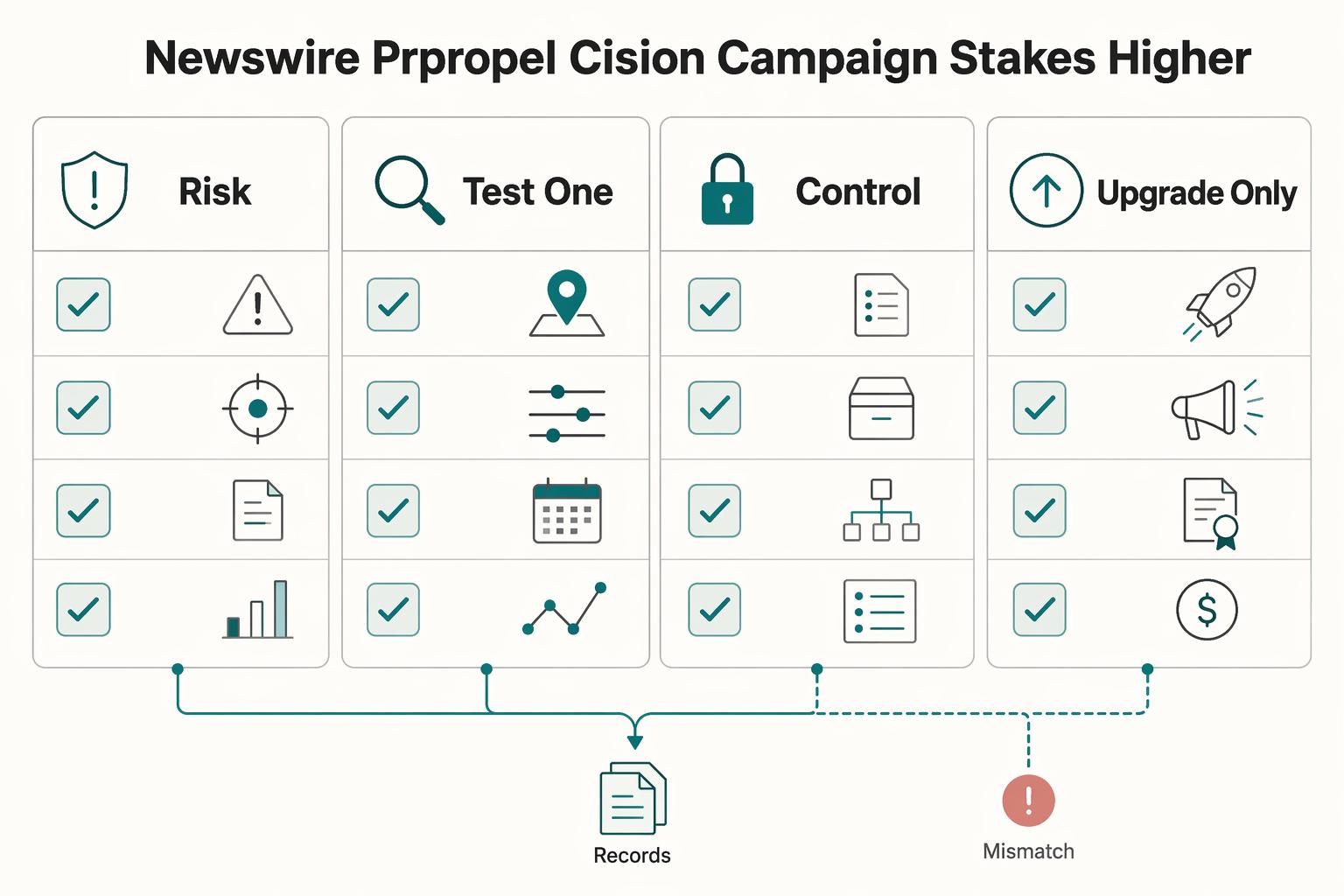
PR Newswire PrPropel and Cision when campaign stakes are higher#
At this tier, the decision is straightforward: upgrade only when campaign risk or client requirements justify paid distribution and tighter process control.
Use this level for launches, sensitive announcements, or contracts that require formal distribution. Cost pressure is real, and modern PR spans multiple functions, so one platform rarely covers every need. If messaging and targeting are weak, extra spend can add complexity without guaranteed results.
Treat PR Newswire, PrPropel, and Cision as candidates to test against current requirements, not automatic upgrades. Define the role you need most now, then evaluate each option against that role in a controlled trial.
A red flag is upgrading because a tool appears on many lists. One-source market stats are directional at best, so confirm actual fit before you commit.
Run this checkpoint before signing an annual plan:
- Define one risk trigger, such as contractual distribution requirements or high-visibility announcements.
- Test one paid candidate with a fixed message set and audience list.
- Compare three outputs: execution control, response quality, and on-site outcome movement.
- Upgrade only if the paid test clearly outperforms your current stack on the outputs that matter most for that campaign.
Add one post-test review note: record what improved and what did not. That short note helps prevent repeat mistakes in the next high-stakes campaign. If that bar is not met, keep your current mix and tighten message discipline first.
Upgrade checkpoints and a weekly operating checklist#
Upgrade only when a new tool removes a repeated bottleneck you can already see in your weekly routine.
| Trigger | Issue | Next step |
|---|---|---|
| Trigger 1 | manual list rebuilds and missed follow-ups | Trial one list-building tool against the same target set and measure continuity; keep the upgrade only if follow-up completion and list carryover improve |
| Trigger 2 | weak reporting clarity | Use one source for on-site outcomes, one for social movement, and one shared campaign timeline with owners, dates, and dependencies |
| Trigger 3 | content prep delays outreach | Formalize a repeatable draft-to-publish process with your current content tools |
Watch cost and time drift first. One vendor comparison frames consolidation as $19/month versus an $80+/mo multi-tool stack, and the same source claims switching across disconnected tools can consume about ~9% of time. Treat both as directional signals, then validate with your own logs before adding spend.
- Trigger 1: manual list rebuilds and missed follow-ups
If you keep rebuilding lists from ad hoc research and follow-ups slip, trial one list-building tool against the same target set and measure continuity. Keep the upgrade only if follow-up completion and list carryover improve.
- Trigger 2: weak reporting clarity
If reporting is mostly anecdotal, tighten measurement before adding outreach tools. Use one source for on-site outcomes, one for social movement, and one shared campaign timeline with owners, dates, and dependencies so handoffs and bottlenecks stay visible week to week.
- Trigger 3: content prep delays outreach
If draft cleanup and asset prep slow pitching windows, formalize a repeatable draft-to-publish process with your current content tools. Productivity claims such as up to 10 hours per week per user should be treated as an upper bound, not a baseline.
Use one weekly checklist to keep decisions grounded:
- Monday: shortlist targets, set angles, assign owners, and lock dates in one campaign timeline.
- Midweek: run outreach, complete follow-ups, and log replies, no-replies, and carryover tasks.
- Friday: review response signals, social movement, and referral traffic, then keep only what improved outcomes.
Treat this checklist as decision evidence, not admin overhead. If a tool upgrade cannot show improvement in these weekly checkpoints, pause expansion and tighten execution with your current stack.
A useful habit is to keep one short note each Friday: what improved, what stalled, and what changes next week. That record makes upgrade decisions faster and reduces reactive spending.
Conclusion#
Keep your stack lean and evidence-led. Add a tool only when it clearly replaces repeated manual work and keeps reporting usable.
- Start with consolidation, not expansion. Review needs across platforms, outreach, monitoring, and analytics, then address the biggest bottleneck first. A tool earns a place when it replaces an existing step instead of creating a parallel process.
- Use a weekly checkpoint before you upgrade. Review the same report each week so patterns are easier to spot before you change tools. If the signal stays unclear, simplify first rather than adding software.
- Apply a keep-or-cut ROI test. If a tool is not saving clear weekly time, treat it as budget risk. A practical benchmark is whether it saves about
10 hours a week.
Freshness still matters. One PR tools guide shows an update on 25 February 2026, while another freelancer tools list shows 10/11/2025. Use older roundups for ideas, then verify current plans and limits before you buy.
In practice, the right PR tools for freelancers are the ones you can run consistently, review weekly, and trim quickly when they stop earning their place. If you want one next step today, run the weekly checklist for one full cycle and decide from that evidence before adding anything new.
Frequently Asked Questions
What are the best PR tools for freelancers on a budget?
Start with the smallest stack that removes one repeated task right now. A practical base is Anewstip with its free option and paid upgrades, #journorequest with a daily digest at 3pm UK time, and one writing or scheduling tool you already use. The free roundup with 12 tools split into 3 PR, 7 marketing, and 2 organization options is a useful reminder to stay lean early. If you are unsure where to start, pick one intake channel and one tracking method first. Add more only after you can show consistent follow-through across a full week.
Do freelancers really need Muck Rack or Cision to win coverage?
This guide does not show enterprise platforms are mandatory. It supports choosing free or paid tools based on fit, then moving up when manual contact discovery and media list upkeep create repeated execution issues. A useful test is whether list maintenance now takes more effort than writing and sending pitches. If not, you likely still have room to improve outcomes with a lighter setup.
What is the minimum PR tool stack for a one-person business?
Use three parts: one lead source, one method to build and maintain media contact lists, and one simple results tracker. For example, use #journorequest for inbound opportunities, Anewstip for journalist discovery, and a weekly log for pitch date, response status, and outcome. Keep this updated consistently before adding more software. This minimum stack works because it keeps decisions visible. You can see what you sent, what got traction, and where execution is slipping.
Which tools should I use for outreach versus monitoring versus reporting?
Use outreach tools to find relevant contacts and send pitches, monitoring tools to track coverage and mention movement, and reporting tools to show outcomes clearly. Cost can vary across monitoring options; in one roundup, examples include £7.99 pcm for Readly and £27.49 pcm for Pressreader, and the same source notes some access may be available through local libraries for free. Pressreader is also described as covering 7,000+ newspapers and magazines, so check fit before paying. Keep the boundaries clear, because when one tool tries to do everything, reporting inputs can become inconsistent.
When should I move from free tiers to paid PR software?
Upgrade when free limits create repeated misses you can see in your weekly routine. Pick one paid upgrade that fixes the main bottleneck first, then review whether follow-through and outcomes improved. If execution does not improve, keep the stack simple. If your weekly checkpoints still look noisy after the upgrade, roll back fast and reassess. Paying more is not the same as improving execution.
What is missing from most "best PR tools" lists for freelancers?
Some "best tools" lists emphasize features more than the day-to-day discipline of maintaining list quality over time. One grounded point to keep in view is that solo and small practices are still expected to deliver an agency-level experience. In practice, the strongest stack is the one you can run consistently and report on clearly each week. The missing piece is usually decision criteria. Without a clear keep-or-cut rule, tool choice turns into subscription creep instead of better outcomes.
Try a related tool
Researched and edited by the Gruv editorial team. Gruv builds cross-border billing, payouts, and finance-operations software for global businesses.
Sources
Includes 5 external sources outside the trusted-domain allowlist.
- blog.hubspot.com/agency/tools-for-public-relationsexternal
- prcavalry.com/blog/public-relations-tools-for-freelancersexternal
- pressmaster.ai/article/best-ai-tools-content-creation-2025-...external
- sproutsocial.com/insights/social-media-analytics-toolsexternal
- thedigitalprojectmanager.com/tools/best-public-relations-project-manageme...external
Educational content only. Not legal, tax, or financial advice.
Related Posts

How to Manage Your Personal Brand as a Freelancer
Your brand is not a mood board. Think of it as the experience people have of your work: the promise you make, the proof you can show, and the way you present yourself across client touchpoints. Get that clear first, and your fit is easier to read from profile to proposal.

How to Write an Arbitration Clause for a Freelance Contract
**Build a simple dispute playbook so both sides know what happens next. Use it when conflict starts.** When you run a solo business, you cannot absorb unpaid work, vague terms, or open-ended civil court uncertainty. You are the CEO of a business-of-one, which means your contracts need to function like systems, not wishful thinking.
A Guide to Tax Residency in the Czech Republic for Nomads
**Use this guide to make a defensible Czech tax residency call, then back it with a simple documentation system.** If you are a freelancer in Prague or a digital nomad moving between countries, start with compliance and use safe defaults that keep your expat tax risk low. Optimize only after your residency position holds up on paper.