
Quick Answer
Start with a lean setup for competitive intelligence tools for agencies: one core platform such as SEMrush or Ahrefs, one change-detection layer like Visualping or Feedly, and one weekly brief tied to a decision. Add Similarweb only when you need broader market context, and add Klue or Crayon only when live deals require maintained battlecards. If a tool does not alter what your team does next, cut it.
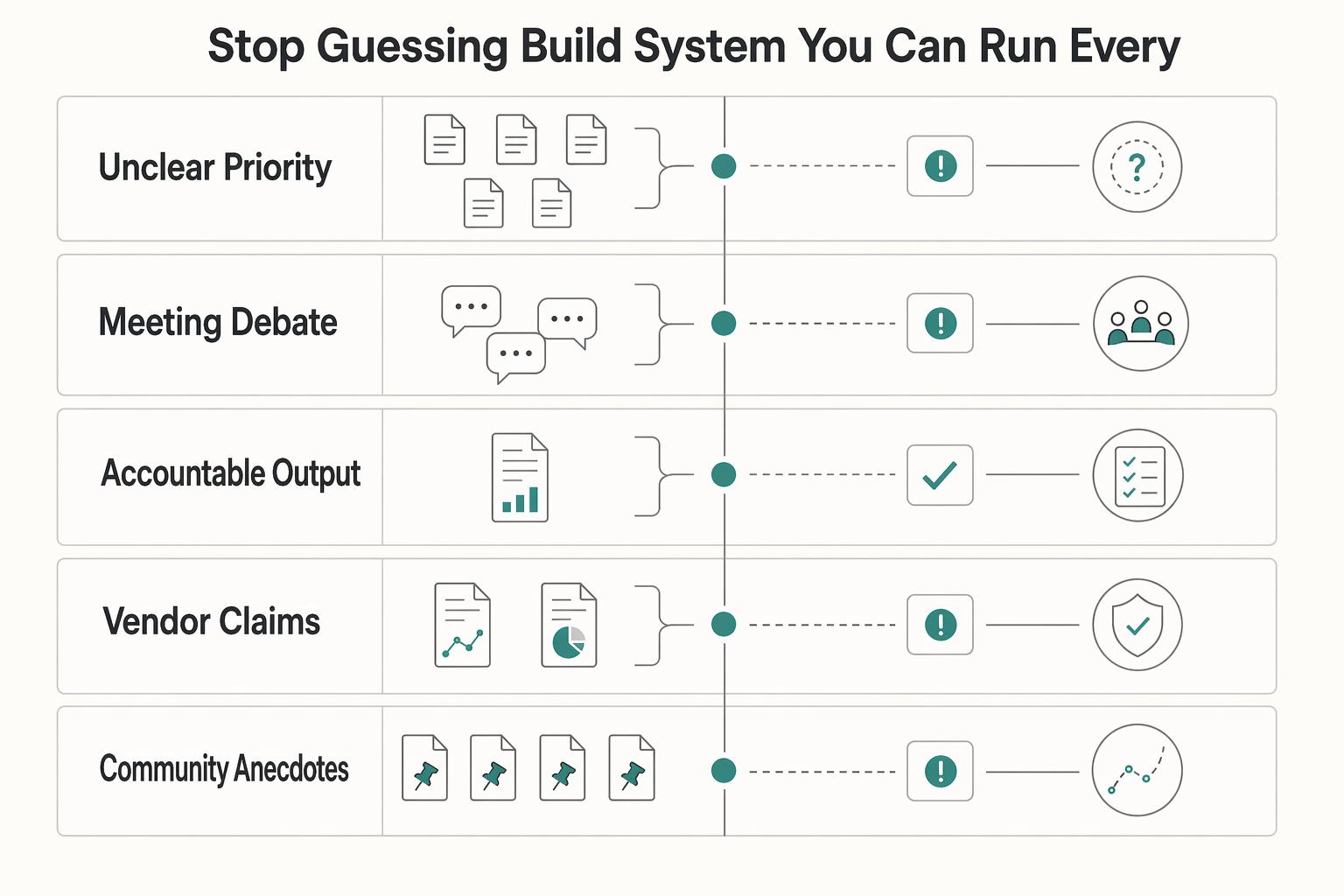
Stop guessing and build a CI system you can run every week#
You do not have a tooling problem first. You have an ownership problem. When signals live across five tabs, three free trials, and nobody owns the next move, you get the same result: more data, more debate, and no usable output.
| Failure pattern | Symptom | Correction |
|---|---|---|
| Unclear priority | You collect rankings, ad copy, pricing pages, and launch notes, but nobody can answer what decision the signal is meant to support. | Force each signal into a decision bucket before review. |
| Meeting debate instead of confidence | Teams argue because the data feels interesting but not trustworthy. | Compare reporting on properties you control against Google Analytics and Search Console; treat outside estimates as directional if it does not line up closely enough. |
| No accountable output | Intelligence dies in notes when there is no named owner and no recurring deliverable. | Assign one person to publish one output each cycle, even if it is only a one-page summary with "what changed, what it means, what we do next." |
A better way to work is simple: signal -> decision -> owner -> deliverable. The tool gathers or centralizes the signal. You decide what it changes. One person owns the follow-up. That ownership produces something concrete, like a watchlist update, a client recommendation, or a short internal brief. That is where CI tools stop being a research hobby and start affecting accounts.
CI software helps with tracking, analysis, alerts, and centralizing information in one place. It is not the whole answer. It will not replace human judgment about why a competitor changed pricing, messaging, or positioning. You still need to verify what matters before you act.
Three failure patterns break adoption:
- Unclear priority
If a signal will not change positioning, spend, outreach, or client advice, it is background noise for now.
- Meeting debate instead of confidence
Compare reporting on properties you control against Google Analytics and Search Console. If it does not line up closely enough to trust on known sites, treat outside estimates as directional, not factual.
- No accountable output
Assign one person to publish one output each cycle, even if it is only a one-page summary with "what changed, what it means, what we do next."
Use-case fit comes before feature comparison. One cited example describes a company spending $180K on a CI platform that sat unused for 18 months. If your real need is simple monitoring and a regular brief, buying enterprise software is a scope mistake, not a sophistication move.
The rest of this guide stays practical. You will get a shortlist table to narrow options fast, a selection framework to match tools to the job, and an operating playbook so the research turns into action.
| Evidence tier | What it is good for | How to treat it |
|---|---|---|
| Vendor claims | Fast market scan and feature discovery | Useful starting point, but provisional until verified |
| Community anecdotes | Practitioner context and edge cases | Helpful signal, especially on adoption and support, but still incomplete |
| Hands-on validation | Real buying and operating decisions | Highest confidence, especially when checked for accuracy, ease of use, pricing, integrations, and reliability |
Simple rule: if a claim has not been validated in use, treat it as provisional. That is the standard we will use throughout.
Who is this list for and what should you evaluate first?#
Pick your operating model first, then choose tools that match your team capacity, ownership, and client reporting needs. If you skip that, even good CI software becomes extra dashboards with no clear follow-through.
| Situation | Priority | What to set up |
|---|---|---|
| You run recurring competitor reviews | Repeatability | One owner, a weekly cadence, and one client-facing output each cycle. |
| You do occasional research | Speed over platform depth | Use lighter tooling that gets answers without ongoing upkeep. |
| You are at risk of overbuying early | Do not add complex platforms yet | If ownership and cadence are not stable yet, complex platforms are usually premature. |
Start by deciding which situation fits you now, then score tools against the basics below.
| Scorecard criterion | What to test first | Pass signal |
|---|---|---|
| Workflow fit | Can one person run the weekly review without heavy manual wrangling? | The same output is produced each cycle by a clearly accountable owner |
| Signal quality | Do findings help you make informed decisions quickly? | Patterns are usable without obvious noise, and they support fast decisions |
| Actionability | Does each review end in a clear next move? | Every cycle produces at least one decision or recommendation |
| Setup burden | How much manual collection and reporting is still required? | First usable output comes quickly with low manual effort |
| Reporting clarity | Is output clean enough to explain in a client update? | Data is normalized and analysis-ready, with a clear "what changed, what it means, what we do next" story |
Use listicles and roundup posts for discovery, not proof. Some are vendor-authored, so validate claims inside real product workflows and your own trial run before you commit budget.
Default sequence: start with core intelligence, add monitoring, then add broader context, and add enablement (like battlecards) last. Expand only after usage is consistent and the tool is clearly changing decisions across repeated cycles.
What are competitive intelligence tools for agencies in practical terms?#
In practice, a CI tool is useful only when it maps to four things: one signal, one decision, one owner, and one recurring output. If you cannot name all four, you likely do not need that tool yet.
CI is the process of collecting and analyzing competitor and industry information so your team can make informed decisions faster. CI tools support that process by collecting, analyzing, and delivering signals from sources like news, reviews, social platforms, and broader market context. The working test is simple: can one person turn the output into a weekly brief the team can act on?
| CI job | What signal you watch | When to use it | Owner | Expected first deliverable |
|---|---|---|---|---|
| Search visibility intelligence | Competitor movement in search visibility | Use when search shifts can affect pipeline or demand capture | SEO lead or strategist | Weekly search-change brief with top risks and openings |
| Market context estimation | Category movement and relative traffic direction | Use when you need wider context before reacting to a single-channel change | Strategy lead | Monthly market context memo |
| Monitoring and alerts | Pricing-page, messaging, feature-page, or key site changes | Use when timing matters and late awareness creates risk | Account owner or analyst | Priority watchlist and alert log |
| Battlecard enablement | Competitor insights translated for live sales conversations | Use when teams need seller-ready guidance, not raw research | Sales enablement owner or founder | One updated battlecard for an active deal |
This structure keeps tools from overlapping. In this workflow, place SEMrush in search visibility, Similarweb in market context, Visualping in monitoring and alerts, and Klue in sales enablement.
Use one practical checkpoint before you expand your stack: does the platform reduce manual collection and reporting by pulling enough signals into one place? If not, it adds work. Lag is the common failure mode, and that gap is where deals get lost.
Use confidence tiers that guide action#
Use a simple internal standard. Mark evidence as ready to act when you can validate the signal on a customer-facing source, confirm it with an independent second source, and show that it changes positioning, messaging, pricing discussion, or outreach priorities.
Mark evidence as directional only when it comes from a single third-party estimate, a roundup post, or an unverified anecdote.
Run a weekly decision loop#
The value shows up in handoff, not dashboards. Each week, turn one verified signal into one decision and one output.
Example: an alert shows a competitor changed its pricing page. Validate the page change directly, then check your search or market-context tool to see whether this is part of a broader shift or a one-off update. Then issue one clear recommendation for the week and ship the supporting update to messaging, sales talk track, or comparison content.
Comparison table to shortlist the right tool in 10 minutes#
Shortlist by job-to-be-done and owner capacity first: pick the tool that fixes your current decision bottleneck - monitor, aggregate, analyze, or distribute, then confirm one owner can ship a recurring output from it. For most agencies, the lean sequence is still one core tool plus one monitoring add-on.
| Tool | Best first owner and decision | Where it overlaps or becomes redundant | Keep it only if this output ships | Confidence | Action |
|---|---|---|---|---|---|
| SEMrush | SEO lead deciding what changed in competitor search visibility and what to do next | Overlaps with SpyFu for keyword and ad intel. Redundant if you are not making weekly SEO or content decisions from competitor movement. | Weekly search change brief with 3 threats or openings | High | Core |
| Similarweb | Strategy lead deciding whether a traffic or category shift is broader market movement | Overlaps with search tools on traffic benchmarks, but is positioned for digital market and competitor traffic analysis. Redundant if search-only signals are enough for decisions. | Monthly market context memo used before strategy resets | Medium | Core |
| SpyFu | Paid search owner needing quick competitor keyword and ad checks | Overlaps heavily with SEMrush. Redundant once your core search platform already answers the paid and SEO questions you act on. | Weekly paid keyword watch note tied to one account change | Medium | Optional add-on |
| Visualping | Account owner monitoring competitor pricing, messaging, or feature page changes | Overlaps at page-change monitoring level only. Redundant if alerts do not trigger same-week validation in your core tool. | Slack or email alert log that leads to one validated follow-up check | High | Optional add-on |
| Crayon | Sales enablement owner packaging competitive intel for live deals | Overlaps with Klue on battlecards and distribution. Redundant for lean teams without a dedicated enablement owner or active seller use. | Updated battlecard or deal digest used in live sales conversations | Medium | Defer |
| Klue | Founder or enablement lead distributing intel into seller workflows | Overlaps with Crayon on sales-facing intelligence. Redundant if your primary decisions are search, market context, or site-change monitoring. | Battlecard updates plus Slack alerts or email digests sellers actually use | Medium | Defer |
Use confidence labels consistently across rows: High = evidence is verifiable in public sources, workflow fit is clear, and adoption risk is low. Medium = useful but more directional and or harder to sustain as a team habit. Unknown = source coverage or comparison claims cannot be validated yet.
Before you commit budget, run one verification check on a known competitor change: confirm the tool detects it, the owner can validate it quickly, and it becomes the exact recurring output you need, such as a Slack alert, email digest, or battlecard. If that chain breaks, defer the tool.
Execution rule: choose one monitoring trigger, one validation check in your core tool, and one client-facing output each cycle.
Which tools are actually worth paying for in 2026?#
Use one buying rule: pay only for tools that produce a recurring decision and a client-visible deliverable in your current workflow. If a tool stops at a dashboard and your team still needs spreadsheet work before anything changes, it is reporting, not intelligence.
Buy for complementarity, not overlap. SEO and traffic tools help you see where competitors get audience. Alerting helps you catch meaningful page-level changes. Battlecard platforms support sales enablement workflows.
| Bundle or category | Primary job | Complements vs overlaps | Ownership and execution burden | 2026 decision |
|---|---|---|---|---|
| SEMrush + an alert tool | Weekly search decisions + change detection on key pages | Search visibility and page-change alerts answer different questions | Low to moderate if one owner runs weekly review and ships outputs | Buy now when an owner already ships a weekly brief and alert follow-up |
| Similarweb + SEMrush | Market context + channel-level search action | Similarweb adds market and traffic context; SEMrush supports SEO follow-through | Moderate; requires strategy and SEO ownership to avoid duplicate analysis | Pilot if both owners are active and outputs are distinct |
| Crayon or Klue | Battlecard creation for live deals | Sales enablement output, not a replacement for SEO or traffic tooling | Higher burden; needs a named owner, stable cadence, and seller usage | Defer unless those prerequisites are already in place; pricing is often ~$20K-$40K/yr in listed snapshots |
| AlphaSense | Deep research for dedicated intelligence work | Complements CI when you need heavy research beyond routine monitoring | High burden and cost (~$24K/yr per user in listed snapshot) | Defer for most agencies without a dedicated research function |
| Kompyte | Budget battlecard test | Lets you test battlecard demand before a larger enablement platform | Moderate; low price still fails without maintenance and usage | Pilot if you need a budget validation path (listed from $300/yr) |
A practical red flag is finding out about a competitor pricing change from a prospect before your team sees an internal alert. Another is paying for multiple search-heavy tools without clearly different outputs.
Before you purchase and before you renew, run the same checkpoint:
- Confirm active usage by the named owner in the latest cycle.
- Confirm one decision changed and one deliverable shipped because of the tool.
- Confirm renewal only if usage and impact meet your internal cutoff.
If your service line is primarily SEO-led, use this as your next step: The Best SEO Tools for Freelancers. For keyword-focused stack decisions, use: The Best Keyword Research Tools for SEO Freelancers.
How do you choose between SEMrush SimilarWeb SpyFu and battlecard tools?#
Choose by decision, not by feature list: one question, one tool. If you cannot name the decision it will change, skip the subscription for now.
Use SEMrush or Ahrefs for organic and backlink work, and treat them as substitutes because they overlap on keyword gaps, traffic analysis, and backlinks. Add SpyFu when your open question is paid search behavior, especially PPC history and competitor keyword buying. Use Similarweb when you need cross-channel traffic and market context. Use battlecard platforms later, when you need one-page competitor guidance that sales can use in live deals.
| Tool type | Core use case | Best-fit owner | Expected weekly artifact | Skip if |
|---|---|---|---|---|
| SEMrush or Ahrefs | Organic priorities, keyword gaps, backlinks | SEO lead or strategist | Search brief with priority moves | You already have one and the second would answer the same SEO question |
| SpyFu | PPC history and paid keyword visibility | Paid media lead | Short paid-competition note | Paid signals rarely change your bids, copy, or landing pages |
| Similarweb | Cross-channel traffic-source and market context | Strategy or account lead | Market-context memo for planning | You only act on search deltas and do not use broader channel context |
| Battlecard platform | Sales enablement with one-page competitor cards | Sales enablement or product marketing | Updated battlecard used in active deals | Sales does not use battlecards in live conversations |
Before you add any platform, run a quick check: who owns review, what recurring artifact ships, and what action changes when the signal is true. If the tool adds more information but not clearer action, it is adding analysis load, not intelligence.
Implement in this order before you add another tool:
- Pick your primary SEO platform: SEMrush or Ahrefs, not both.
- Choose one missing question to solve next: PPC history, market context, or sales enablement.
- Ship one recurring artifact from the first tool for two cycles.
- Add a second platform only if a clear blind spot remains.
What is the minimum viable CI stack for a lean agency?#
Keep your stack small by design: one core intelligence tool, one monitoring layer, and one company-signal source. If a layer does not change your next action in review cycles, treat it as overhead and remove it.
Most stack failures are order-of-operations failures, not feature failures. When you buy the wrong thing first, duplicate the same workflow, or split reporting across too many places, trust drops fast. Your lean stack works when each layer has one owner, one expected artifact, and one source of truth.
Start with three roles, then prove each one earns its place#
- Core intelligence tool
Use one primary platform for competitor research and make it your default place to review movement. Choose for workflow fit: the right owner should be able to open it every cycle, produce a short brief, and move directly to decisions without copying data across extra dashboards.
- Monitoring layer
Add one alerting layer to catch changes between reviews. Choose based on alert type and ownership: if no one triages alerts, this becomes noise. Keep only alerts that lead to clear follow-up actions.
- Company-signal source
Add one lightweight source for company updates and directional signals. Use it as early warning, then verify important items in primary company materials or your own review notes before passing them forward.
Keep a one-page inventory for these three layers: tool, accountable owner (person, not department), expected artifact, value KPI (not usage), and system of record. This is your fastest way to prevent tool sprawl.
Operator view: promote or retire by behavior, not brand#
| Role | Owner | Review cadence | Expected artifact | Promote or retire trigger |
|---|---|---|---|---|
| Core intelligence tool | Strategy owner | Every review cycle | Competitor brief with priority moves | Promote if it repeatedly changes priorities or recommendations. Retire if output stays descriptive and does not change decisions. |
| Monitoring layer | Ops or account owner | Between and during review cycles | Alert digest with action flags | Promote if alerts surface meaningful changes early enough to act. Retire if alerts are consistently noisy, duplicated, or ignored. |
| Company-signal source | Account owner | Every review cycle | Company movement note for client context | Promote if signals help explain competitor direction or timing. Retire if it mostly repeats low-value updates. |
| Market-context add-on | Planning owner | Planning windows only | Category context memo | Add only when client questions require cross-channel or market context. Remove if decisions still come from your core layer alone. |
| Battlecard add-on | Sales enablement owner | Active deal cycles | Updated one-page battlecard | Add only when sales uses it in live deals. Remove if cards are rarely used or not maintained. |
Two add-ons are useful, but conditional: market-context tools when planning questions demand broader context, and battlecard tools when sales needs live, maintained competitor cards. Neither is default.
As a gut check, overlap is expensive in many stacks: one benchmark reports an average of 8.3 tools and $2,340 per rep per year in overlap waste. Your agency CI stack is not identical to that dataset, but the operating rule still holds: if you cannot name the owner, artifact, and action changed, you likely do not need the tool.
Run one weekly loop and keep evidence behind every recommendation#
Run one weekly loop, and do not turn any signal into client advice until you can show proof behind it. Public monitoring is necessary but not sufficient, so each cycle should stay simple: collect, validate, decide, and document what changed.
This reset is about operating discipline, not adding tools. You want evidence teams can act on in days, not months. If a competitor can ship what you planned for Q3 by next Tuesday, your loop needs to catch real movement fast and filter noise just as fast.
| Phase | Objective | Core tools | Owner | Output | Decision made |
|---|---|---|---|---|---|
| Setup | Define what you watch and what qualifies as usable evidence | One core research tool (such as Semrush or Ahrefs), one monitoring layer (such as Visualping or Feedly), one company signal source (such as Owler) | Strategy lead | Source map, competitor/page watchlist, assumptions log, evidence rule with URL/date/owner/provenance | Which competitors, pages, and signals enter the weekly loop |
| Review | Convert raw alerts into evidence-backed findings | Core research tool, page-change alerts, company watchlist | Strategy lead or account lead | Weekly risk/opportunity brief with original-source checks and cross-check notes | What changed enough to affect priorities, messaging, or account recommendations |
| Enablement | Turn validated findings into client and sales actions | Review brief, client notes, current battlecard doc | Account lead or sales enablement owner | Client action memo and, when relevant, updated battlecard labeled observed/validated/buyer-confirmed | What you will say, change, or test next |
| Optimization | Remove low-signal work and tighten the loop | One-page inventory, review notes, alert history | Ops or team lead | Updated inventory, retired-task list, keep/retire log | What stays in cadence and what gets removed |
Use these guardrails to keep the playbook lean and enforceable:
- One owner, one output, and one decision per recurring task.
- No recommendation without a recorded source and a verification note.
- For higher-impact claims, seek buyer validation conversations when possible, especially after buyers evaluated both options.
- After two cycles, retire any recurring task that does not change a decision, priority, or client-facing recommendation.
Build your agency CI stack once then run it with confidence#
Run CI as a system, not a shopping list. If you cannot name the decision, owner, and output for each tool, you are still buying software, not running operations.
| Step | What to do | Check |
|---|---|---|
| Choose a stack with one job per tool | Keep it tight: one core research tool, one monitoring layer, and one recurring artifact. | Evaluate each tool by decision impact, not feature volume. |
| Assign ownership and handoff before lock-in | Give each recurring task a clear owner, a verification step for important changes, and a named recipient for the final output. | Ask what data sources feed the platform, and whether it can centralize data across teams instead of creating fragmented spreadsheets or outdated decks. |
| Make each review produce an action | End every cycle with one deliverable and a short list of unknowns to validate next. | If notes do not tie to a decision, a source page to verify, or a next check, treat them as noise. |
| Retire low-signal work quickly | Remove point solutions that only provide snapshots. | If a workflow does not change messaging, priorities, or sales handling over repeated reviews, remove it. |
-
Choose a stack with one job per tool. Keep it tight: one core research tool, one monitoring layer, and one recurring artifact, such as a brief or battlecard update. Evaluate each tool by decision impact, not feature volume.
-
Assign ownership and handoff before lock-in. Give each recurring task a clear owner, a verification step for important changes, and a named recipient for the final output. Ask two buyer-checkpoint questions early: what data sources feed the platform, and can it centralize data across teams instead of creating fragmented spreadsheets or outdated decks.
-
Make each review produce an action. End every cycle with one deliverable and a short list of unknowns to validate next. If notes do not tie to a decision, a source page to verify, or a next check, treat them as noise.
-
Retire low-signal work quickly. Point solutions that only provide snapshots can create activity without action. If a workflow does not change messaging, priorities, or sales handling over repeated reviews, remove it.
Final operator checkpoint: owners assigned, outputs defined, verification step agreed, and handoff path clear from research to the team that uses it.
Need a second set of eyes on your CI operating setup? Talk to Gruv.
Frequently Asked Questions
What are competitive intelligence tools for agencies?
Use them when you need better business decisions, not just more monitoring. Competitive intelligence is the gathering and analysis of competitor information, and the strongest practice mixes public research with human conversations. Proof looks like a competitor profile, a short action memo, or a sales guidance update that changed what you said or did next.
Which tools should a small agency start with?
Start with the smallest stack you will actually maintain: one core research tool, one monitoring layer such as Visualping for website or pricing changes, and one recurring output. Do not buy a second core platform before the first one has a named owner and a regular review. You know it fits when one person can produce a brief that points to a real decision instead of a dashboard nobody opens.
How do you choose between SEMrush, Similarweb, SpyFu, and battlecard tools?
Pick the category by the question you need answered, then choose the product your team can use consistently. For tools like SEMrush or SpyFu, run a practical trial against your own CI questions instead of relying on generic rankings. Use Similarweb when you need digital market and competitor traffic context, and use battlecard tools such as Klue when sales needs structured competitor guidance for live deals. Do not turn this into a feature shootout, because the bigger mistake is buying a category you do not have the time or people to support.
What is the minimum viable CI stack for a lean agency?
Keep it to three parts: one analysis tool, one monitoring tool, and one artifact that forces a decision. Do not add separate platforms for every signal type until you can show the base stack is producing practical insights. A healthy setup gives you a simple competitor profile and a short memo that changes messaging, priorities, or sales handling.
How should you operationalize CI without adding overhead?
Give each recurring task one owner and one decision question, then send the output to the people who will use it. Start with your own sales notes and client feedback because your team already has first-party context that no external tool can replace. At minimum, confirm important pricing or positioning changes before you pass them on, and make sure the final memo names the action you want taken.
Are Reddit threads and community recommendations enough to choose a tool?
Use community advice as a shortlist, not as proof. Do not spend more budget because a tool is popular in a thread. First test it in your real process and ask whether it produced a usable competitor profile, a validated insight, and a decision that reached a stakeholder. A focused 3 to 6 week test is usually long enough to tell whether the tool changes behavior or just creates more reading.
How often should you refresh your CI stack?
Review it whenever your offer mix, client goals, or sales motion changes, and keep checking whether each tool still earns its place. Do not keep software because the demo looked thorough or because you already trained the team on it. After repeated review cycles, any tool that never changes a decision should be reduced, replaced, or removed.
Try a related tool
Researched and edited by the Gruv editorial team. Gruv builds cross-border billing, payouts, and finance-operations software for global businesses.
Sources
Includes 3 external sources outside the trusted-domain allowlist.
- gao.gov/assets/d24105506.pdftrusted
- ntia.gov/sites/default/files/publications/ntia-ai-rep...trusted
- nvlpubs.nist.gov/nistpubs/SpecialPublications/NIST.SP.800-53r...trusted
- sloanreview.mit.edu/projects/the-future-of-strategic-measurement...trusted
- tiffin.edu/wp-content/uploads/AI-Tools-with-Description...trusted
- agencyanalytics.com/blog/competitor-analysis-toolsexternal
- arxiv.org/html/2507.02097v1external
- autobound.ai/blog/top-15-competitive-intelligence-tools-2026external
Educational content only. Not legal, tax, or financial advice.
Related Posts
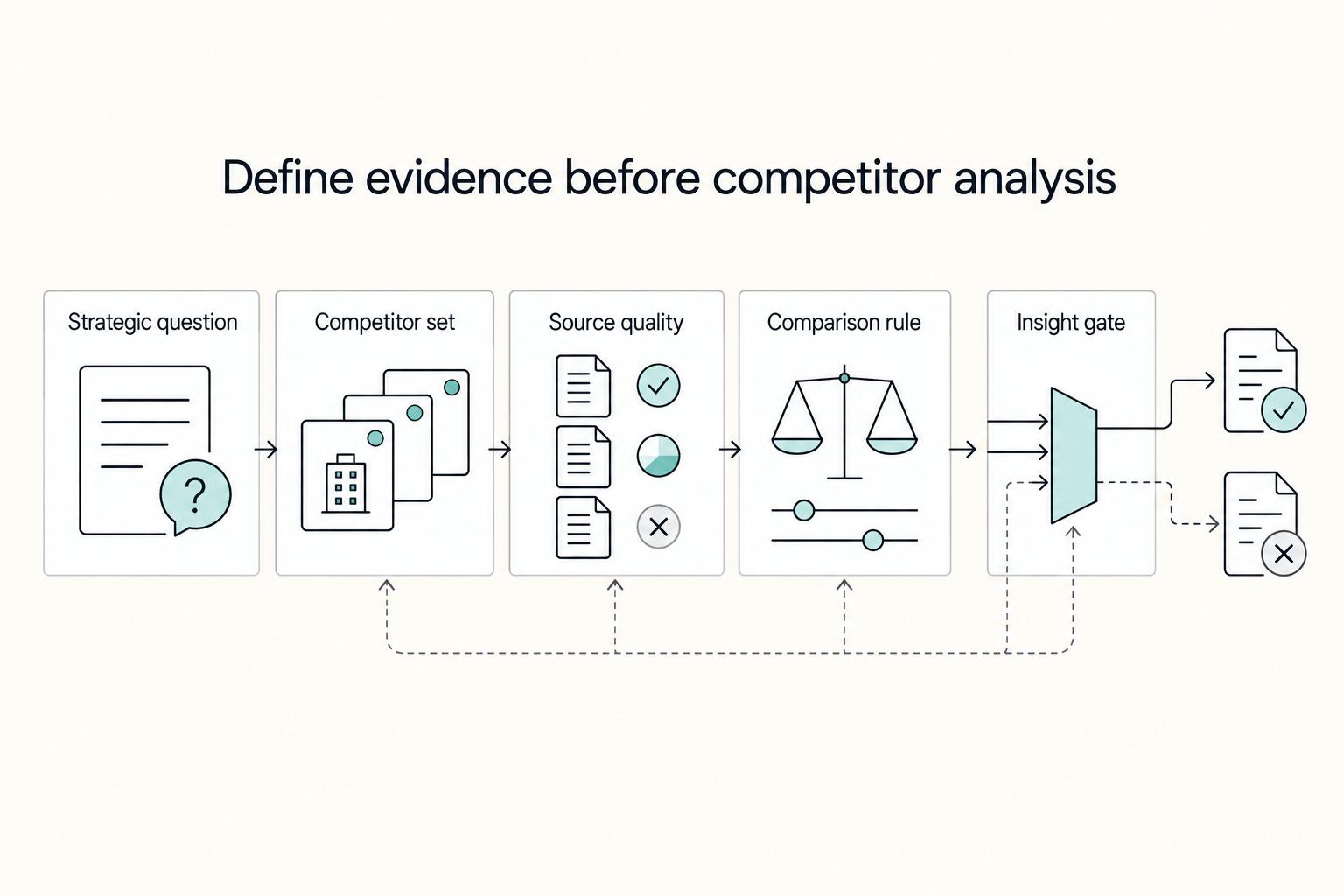
IT Agency Competitor Analysis in One Afternoon
A useful IT agency competitor analysis can leave you with a short decision list by the end of one afternoon, not a long document no one uses. The goal is simple: decide where to focus, what to stop doing, and what proof to strengthen next.

The Best SEO Tools for Freelancers
Before you buy anything, decide how you will defend it to yourself and to a client. For a solo operator, tool selection is not a taste question. It is an operations decision about whether you can produce the same monthly report on time, explain the numbers, and keep working if a tool changes or disappears.
A Freelancer's Guide to Donating to Charity (and the Tax Benefits)
The safest move is to **treat charitable giving like a repeatable compliance workflow**, not a "tax optimization" trick. As a globally mobile freelancer, you already juggle moving parts like income timing, residency signals, and multiple accounts.