
Quick Answer
Start with a shortlist, then apply a 30-day decision sequence to confirm legal stay, paperwork readiness, and day-to-day work reliability before you commit. For safest cities for digital nomads, the article centers practical options like Taipei, Tokyo, Singapore, Reykjavik, Amsterdam, and Lisbon, but keeps them in "Monitor" until your dossier is complete. It also flags active visa tracks such as Portugal Digital Nomad (D8) Visa and South Korea Digital Nomad (Workation) Visa as checkpoints, not guarantees.
Choose a Safe and Stable Nomad Base Without Guesswork#
Treat this as a relocation decision, not a travel mood. The fastest way to make a good call is to run every city through the same three checks in the same order: shortlist signal, stay feasibility, and day-to-day work readiness. Stick to that order and you avoid most expensive mistakes before money leaves your account.
Rankings are useful for discovery, but they are weak as a final decision tool. Many popular lists blend safety, cost of living, internet speed, lifestyle, and visa access into one score. That mix can surface ideas quickly, but it does not tell you whether a city actually works for your exact move window. Use ranking overlap to find candidates, then switch to evidence you can verify.
Use this sequence:
- Shortlist signal: Keep cities that appear across multiple remote-work lists. Repetition lowers randomness, but it is not proof.
- Stay feasibility: Check whether your intended length of stay is actually workable before you spend.
- Remote-work practicality: Validate rent and internet at listing level. Require at least one accommodation option with verified Wi-Fi before any deposit.
Build one evidence page per city from day one. Include current rent examples, legal-stay notes, and at least two housing options that pass your internet check. Midway through the process, drop any city that still has a missing core item, even if it looks strong on social media.
That page does two things. First, it stops you from forgetting what you verified and what you only assumed. Second, it keeps all options comparable when timing gets tight and one city starts to feel more familiar simply because you researched it first. When two places look equally attractive, the better file usually points to the better decision.
This filter is intentionally narrow. It favors places that survive long-stay reality checks over places that simply have momentum online. That matters in 2026 because many nomad discussions now point to crowding and price pressure in familiar hubs. With more than 30% of professionals working remotely at least part-time, demand can shift quickly and make older listicles stale.
Once you treat shortlist signal as only step one, the next move is simple: decide what counts as a pass before you compare cities side by side.
If you want a simple place to organize the work, Browse Gruv tools.
Use These Selection Criteria Before You Compare Cities#
Set the scorecard before you compare anything. If you compare first, you end up debating vibes while the real feasibility gaps stay hidden.
| Bucket | What to check | Scoring |
|---|---|---|
| Personal safety | Consistency of safety signals, not rank position alone. | Pass, weak pass, or fail; add one sentence of evidence. |
| Legal and workplace protections | A realistic legal-stay path and workable conditions now. | Pass, weak pass, or fail; unresolved if you cannot write the evidence sentence. |
| Foreigner friendliness | How hard month-one setup will be for a newcomer. | Pass, weak pass, or fail; add one sentence of evidence. |
| Remote-work stability | Whether your day-to-day work can run reliably in practice. | Pass, weak pass, or fail; add one sentence of evidence. |
Score the four buckets separately so your tradeoffs stay visible:
- Personal safety: Judge consistency of safety signals, not rank position alone.
- Legal and workplace protections: Confirm there is a realistic legal-stay path and workable conditions now.
- Foreigner friendliness: Test how hard month-one setup will be for a newcomer.
- Remote-work stability: Confirm your day-to-day work can run reliably in practice.
Keeping those buckets separate matters. A city can feel strong overall because it is affordable or well known, while still being weak on the thing that will break your move, such as paperwork timing or everyday work reliability. Separate scoring makes that visible before you book.
Use a simple scoring method: mark each bucket as pass, weak pass, or fail, then write one sentence of evidence. If you cannot write that evidence sentence, treat the bucket as unresolved. That discipline matters because unresolved items are often where people quietly smuggle in assumptions.
Keep safety-led evidence separate from lifestyle-led rankings. One widely cited study assessed 237 cities with mixed factors such as visa length, visa cost, internet speed, cost of living, and safety. That is useful for discovery and initial narrowing, but it is not a safety-only conclusion. If you merge mixed-method lists into one scoreboard without labeling the method, the comparison looks clean while the logic underneath is messy.
Before you rank anything, apply a minimum viability gate. With more than 70 countries now offering remote-worker pathways, simple availability is a weak test. The practical question is whether legal-stay progress and stable daily operations can both hold inside your real timeline.
Use one hard rule from start to finish: if safety signals and long-stay feasibility pull in opposite directions, deprioritize that city for this move cycle. You can revisit it later. For this move, you need fit, timing, and execution certainty in the same place.
That rule keeps the list honest. It also sets up the next step, where timing and evidence have to move together on a fixed 30-day clock instead of drifting in parallel.
Follow a 30-Day Move Timeline With Clear Checkpoints#
Run the move on two tracks from day one: one primary city and one live backup. This is not about rushing. It is about protecting decision quality so one late failure does not wipe out the whole plan.
Use identical evidence standards for both tracks, and date-stamp every update so you can compare options without guesswork. If one file is full of fresh housing checks and the other is built on older assumptions, you are no longer making a clean comparison.
| Window | Focus | What to produce | Decision trigger |
|---|---|---|---|
| Days 1-7 | Shortlist and evidence pack | Build one page each for Taipei, Tokyo, Singapore, Reykjavik, Amsterdam, and Lisbon with safety notes, housing options, and remote-work signals. Include at least one long-stay option with furnishings, a full kitchen, and ongoing guest service. | If a city cannot produce a basic evidence page, move it to backup or remove it. |
| Days 8-15 | Paperwork readiness | Track document ownership, lead times, and open questions for each legal-stay route. Keep Portugal Digital Nomad (D8) Visa and South Korea Digital Nomad (Workation) Visa active only when relevant to your passport and timing. | If critical paperwork stays unclear, treat that city as a schedule risk. |
| Days 16-23 | Operational setup | Verify neighborhood fit, internet reliability, quiet call locations, and at least one dedicated co-working option. Stress-test a backup option like Valencia or Penang before committing funds. | If work continuity looks weak, do not commit. |
| Days 24-30 | Commit or pause | Run a final go or no-go review across legal-stay path, budget durability, and fallback readiness. | If the primary city still fails a critical checkpoint, pause or switch to backup. |
The dates matter less than the discipline of moving both tracks forward with the same standard of proof. A backup city only protects you if it is real, current, and ready to take over without restarting the process from scratch.
Keep your notes directly comparable. That sounds basic, but this is where many relocations drift once deposits, lead times, and paperwork start colliding. Long-term nomad stories often describe picking places without a strict process. That can work for flexible travel. It is much weaker for a structured move where housing, legal stay, and work continuity must align at the same time.
By day 30, each city should have either a clear case file or a clean rejection reason. That makes the shortlist table useful, because you are comparing execution readiness rather than online reputation.
If you want the policy detail behind one backup route, read South Korea's New Digital Nomad (Workation) Visa: What We Know.
Compare the Shortlist in One Scannable Table#
Use this table as a readiness dashboard, not a definitive safety ranking. The current evidence pack is mixed and not methodologically comparable across cities, so every option stays at Monitor until your own dossier is complete.
That caution is practical, not theoretical. Verify city-level safety data for Taipei, Bern, Singapore, Tokyo, Reykjavik, Amsterdam, Lisbon, and Valencia through official government advisories and current crime statistics before relying on any single source.
Read the Decision field as an action status, not a label of city quality:
Choose now: dossier is complete and verified for booking.Monitor: keep active while closing evidence gaps.Reject: remove for this move cycle when critical items remain unresolved at checkpoint.
| City | Best for | Safety profile type | Visa feasibility signal | Operational risks | Who should avoid it | Confidence | Decision |
|---|---|---|---|---|---|---|---|
| Taipei | Structured shortlist validation | Current pack lacks comparable safety method | No city-specific signal in current pack. Verify legal-stay path directly. | Confidence can outrun evidence when reputation feels strong. | Anyone needing immediate high-certainty proof. | Low | Monitor |
| Bern | Conservative timeline planning | Current pack lacks comparable safety method | No city-specific signal in current pack. Verify legal-stay path directly. | Missing document ownership can create slow drift. | Anyone with a fixed near-term departure date. | Low | Monitor |
| Singapore | High-discipline execution | Current pack lacks comparable safety method | No city-specific signal in current pack. Verify legal-stay path directly. | Brand reputation can mask unresolved checklist items. | Anyone relying on reputation instead of file-level checks. | Low | Monitor |
| Tokyo | Detail-heavy planning | Current pack lacks comparable safety method | No city-specific signal in current pack. Verify legal-stay path directly. | Paperwork sequencing can break if owners and dates are unclear. | Anyone without a named owner and due date per document. | Low | Monitor |
| Reykjavik | Low-noise shortlist review | Current pack lacks comparable safety method | No city-specific signal in current pack. Verify legal-stay path directly. | Non-comparable inputs can delay final commitment. | Anyone who needs a fast commit without new validation. | Low | Monitor |
| Amsterdam | EU-oriented administration | Current pack lacks comparable safety method | No city-specific signal in current pack. Verify legal-stay path directly. | Process assumptions copied from other countries can fail. | Anyone assuming one-country paperwork logic applies everywhere. | Low | Monitor |
| Lisbon | Document-led EU route testing | Current pack lacks comparable safety method | No city-specific signal in current pack. Verify legal-stay path directly. | Proof package gaps can stall approval timelines. | Anyone not ready to compile ongoing income, insurance, and accommodation proof. | Low | Monitor |
| Valencia | Active backup track | Current pack lacks comparable safety method | No city-specific signal in current pack. Verify legal-stay path directly. | Backup may fail if it is not tested in parallel. | Anyone running a single-city plan without fallback checks. | Low | Monitor |
Low confidence here is a process signal, not a city verdict. It means your current evidence pack still cannot support a high-certainty booking call across options on the same methodological basis.
The operating rule is straightforward: no city moves to Choose now until the evidence is comparable, current, and complete enough to support real payment decisions. Once you keep that standard, picking a primary city becomes a narrower, more practical call.
Pick the Best City for Your Situation#
At this stage, pick a working primary, not a mythical overall winner. The right move is the option that best matches your current document readiness and timeline, while one backup stays alive until the last checkpoint.
Use the table to narrow the call, then run this validation sequence:
- Taipei: Keep as primary only if legal stay, tax posture, and operating setup can be verified inside your timeline.
- Tokyo and Singapore: Keep active only while paperwork and timing checkpoints keep clearing.
- Bern and Reykjavik: Keep in play only if full readiness checks keep passing at each checkpoint.
- Amsterdam and Lisbon: Prioritize when your Europe-oriented admin path is ready to execute without schedule strain.
If Europe is in play, put one hard admin checkpoint early. The cross-border SME process is expected to take up to 35 working days, eligibility includes a EUR 100,000 Union turnover ceiling, and OSS can centralize obligations through registration in one Member State. If that window conflicts with your move date, switch primary cities earlier and keep momentum through your backup track.
That is the decision logic here. You are not trying to prove one place is best for everyone. You are trying to choose the city that fits your paperwork, timing, and work setup with the least avoidable friction for this move cycle.
Do not treat mixed-source inputs as evidence of safety or stability. A city earns Choose now only after legal stay, tax posture, and operating basics are verified.
Related: A Step-by-Step Guide to Filing a Letter of Undertaking (LUT) for GST.
Validate Visa and Paperwork Feasibility Before You Book#
Paperwork has veto power here. If the legal-stay path is not document-ready for your move window, that city is not ready. Run city selection and paperwork checks in parallel, and avoid paying for flights, deposits, or long rent commitments while eligibility and ownership are still unclear.
Use the current file as a planning map:
- Portugal Digital Nomad (D8) Visa: One industry source says Portugal introduced a dedicated digital nomad residence visa in 2022 and cites a starting monthly income threshold of EUR 3,680. Use that as a planning checkpoint for income proof and document ownership before you book. If helpful, review this deeper D8 breakdown.
- Portugal route activity: The same source reports 9,322 applications and 7,664 approvals by September 2025. Treat that as proof the route is active, not as any approval promise.
- South Korea Digital Nomad (Workation) Visa: Keep this as a backup option only after you verify requirements through official channels and record them in your own file.
- Paperwork ownership grid: Maintain one checklist with an owner and due date for each critical item, including visa documents and tax dependencies such as LUT and GST when relevant.
In practice, this is where otherwise strong plans fail. People often know what documents exist in theory, but nobody owns each item, lead times are not tested, and dependencies are not tied to the departure date. The fix is operational, not conceptual: assign every document, track every due date, and run a weekly risk check until booking.
Your paperwork file should answer a few simple questions fast. What is the legal route? Which documents are missing? Who owns each one? Which items depend on another approval first? If your file cannot answer those questions at a glance, you do not yet have a booking-ready plan.
Decision rule: if any critical lead time extends beyond your target move date, switch to the backup city instead of forcing a weak timeline.
Make the Safety vs Cost vs Stability Tradeoff Explicit#
For long stays, use this order: legal feasibility and daily work reliability first, cost second, lifestyle third. If visa details are not verified through official channels for your passport and destination, treat the city as not ready.
This is where many decisions go off track. Research often starts with weather, social buzz, or aesthetics, then paperwork gets bolted on late. Reverse that order and the final choice gets cleaner.
Use a simple tradeoff lens:
- Stability-first: Choose legal clarity and dependable work infrastructure even when costs are higher.
- Budget-first: Lower-cost options can work, but only with stricter checks on housing zone, backup workspace, and internet reliability in your exact setup.
- Experience filter: First-time long-stay movers usually benefit from predictability. Experienced movers with trusted local support and fallback housing can accept more variability.
The useful part is making the tradeoff explicit before you commit. If you write down the priority first, you stop asking every city to be cheap, easy, safe, legally clean, and perfect for work all at once. That is usually where decision quality starts to break down.
Put the tradeoff in writing before you commit. A one-line priority statement removes ambiguity when two cities look close and helps you explain the final choice to collaborators, clients, or family without reopening the same debate. Once the priority is explicit, the tradeoff becomes honest.
Catch Red Flags That Should Disqualify a City#
A city should not reach booking week with open questions in the core file. By that stage, uncertainty should be narrow. If any critical check is still unverified, remove that city from this cycle and proceed with the backup.
Most disqualifiers are not dramatic events. They are process gaps people try to ignore because a city still looks attractive in rankings or online chatter. The danger is not just that the city may fail. It is that you may notice the failure too late, after time and money are already committed.
Use these as hard stops:
- Strong buzz, weak method: If a ranking does not explain methodology, or it measures broad live-work-visit appeal instead of safety, treat it as context only.
- No realistic long-stay legal route confirmed: If you cannot verify a workable legal-stay path, do not move the city to
Choose now. - Discussion-heavy evidence: Forum threads and confident social posts are not enough on their own, especially when those same threads also contain caveats.
- No live backup: If your primary fails late, a cold backup can reset your timeline. Keep a second viable option active, including for popular choices like Miami, Austin, Denver, or San Diego.
- Unowned critical documents: If key paperwork still has no owner or due date, you do not have an execution plan yet.
These checks matter because late-stage reversals are expensive in time and money. Rejecting a city early can feel conservative, but it is usually the move that protects your schedule and budget.
Treat unresolved red flags as disqualifiers, not warnings. That is how you preserve schedule control and avoid rushed bookings under pressure. From there, the remaining questions are usually the ones people ask most often when they try to compare safety-led and nomad-led city lists.
Make Your Final City Choice This Month#
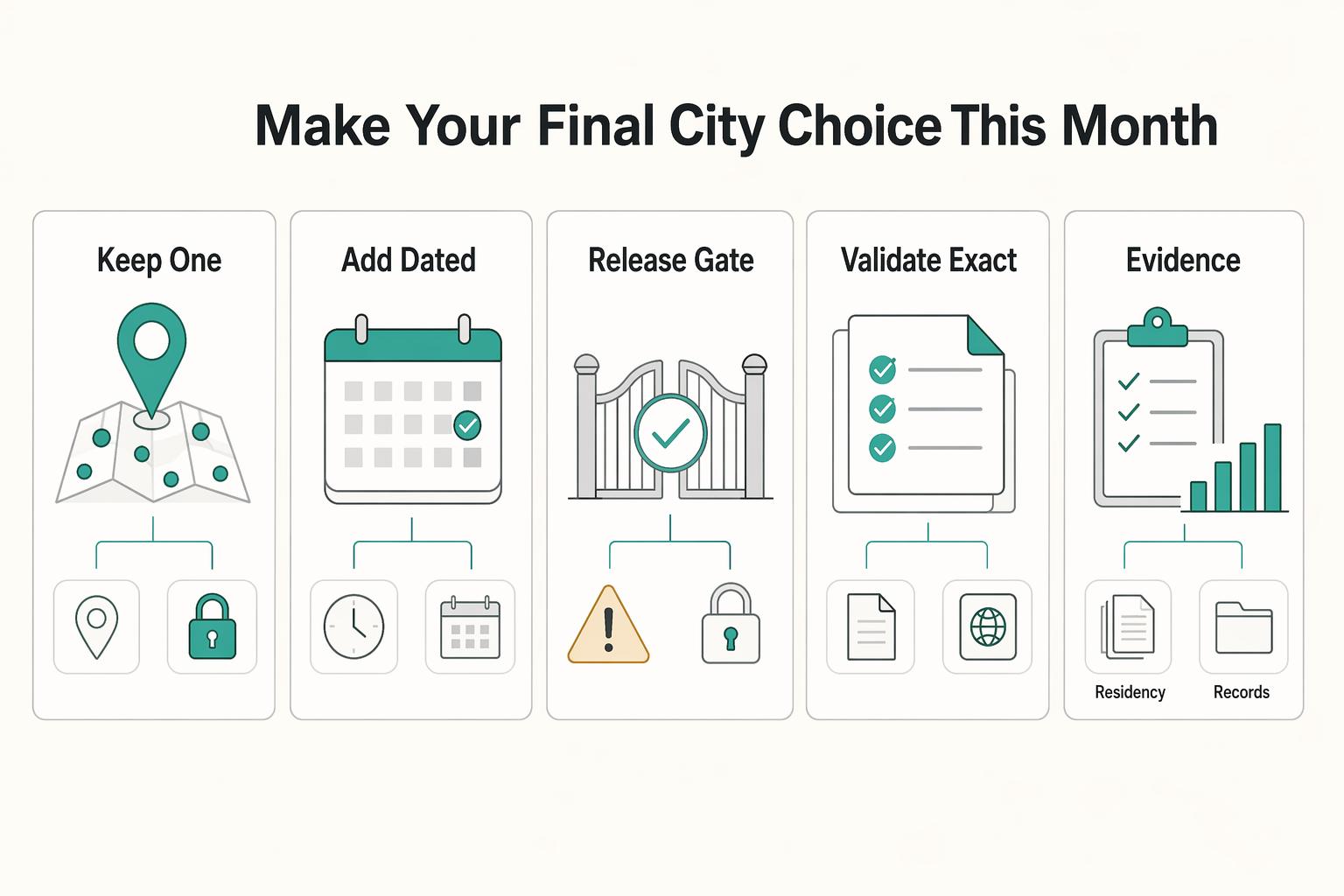
Your final choice should come only after two gates are green: legal-stay feasibility and day-to-day work setup. Keep the sequence strict: shortlist, compare, validate visa and documents, then commit.
A few execution habits keep this last step disciplined:
- Keep one primary city and one live backup until booking day so one delay does not reset the move.
- Add a dated checkpoint before payment and refresh stale notes against recent updates on 19 January 2026, 4 February 2026, and 7 February 2026.
- Treat legal compliance as a hard gate for long stays, and do not build your plan on tourist-visa gray zones.
- Validate your exact neighborhood for stable internet and at least one reliable workspace option, whether that is co-working or work-friendly cafes, instead of relying on city-level reputation.
- Run one final document sweep to confirm every required item is complete, current, and owned.
No deposit, flight payment, or rent commitment should happen until your checklist is complete and legal-stay feasibility is verified for the city you are actually booking. That is the thread through the full process: fewer opinions, more comparable evidence, and a backup ready if the primary slips.
Frequently Asked Questions
What are the safest cities for digital nomads right now?
There is no single global list that answers this cleanly for everyone. Publishers score different factors, and some rank countries instead of cities. Use the phrase as a starting query, then verify legal stay options, internet reliability, and local risk checks before committing.
Which cities show up most often across safety-focused and general nomad lists?
Recurring names vary by list type because methods are not standardized. Some rankings target broad travel appeal, while others emphasize affordability or remote-work fit. Repetition is a signal to investigate, not proof that one city is best.
Are the best digital nomad cities the same as the safest cities?
Not always. One 2026 country profile for Vietnam reports a safety score of 72/100, about $943.80 monthly living cost, and 250.45 Mbps internet. The same profile notes a 90-day e-visa and no digital nomad visa, so safety, cost, and long-stay feasibility can diverge.
How do female-focused safety rankings differ from general remote-worker safety rankings?
In these examples, female-focused travel content surfaces peace-and-stability signals more directly. One travel source highlights Iceland holding the top Global Peace Index spot for 14 consecutive years. General nomad rankings more often blend safety with cost, visa access, and work setup.
What should I verify before choosing a city for a six-month or longer stay?
Verify three items in parallel: legal stay route, monthly budget durability, and day-to-day work reliability. Confirm current visa rules on official country pages. Then validate internet quality and a backup workspace before paying long-term deposits.
Why do safety rankings for digital nomad cities conflict?
Inputs and weights differ. Some rankings favor developed, higher-cost countries, while affordability-led lists prioritize budget and practical living conditions. Publication date also matters, so do not mix older and newer lists as if they were directly comparable.
Try a related tool
Researched and edited by the Gruv editorial team. Gruv builds cross-border billing, payouts, and finance-operations software for global businesses.
Sources
Educational content only. Not legal, tax, or financial advice.
Related Posts

Portugal Digital Nomad Visa Decisions That Prevent D8 Delays
Start with verification, not paperwork. In this research set, some material is useful only as EU VAT context, not as D8 instruction, and mixing those categories is one of the fastest ways to build the wrong plan. We use the same separation rule in [Global Digital Nomad Visa Index](/blog/global-digital-nomad-visa-index) comparisons.

South Korea Digital Nomad Visa Filing Path and Evidence Plan
Treat this visa as a gate, not a travel detail. The Digital Nomad (Workation) Visa, also called the F-1-D visa, is presented as a route for remote work tied to non-Korean employers or overseas business activity. Practical order matters: confirm fit, build evidence, then choose where to file.
How to File a GST LUT Without Rework
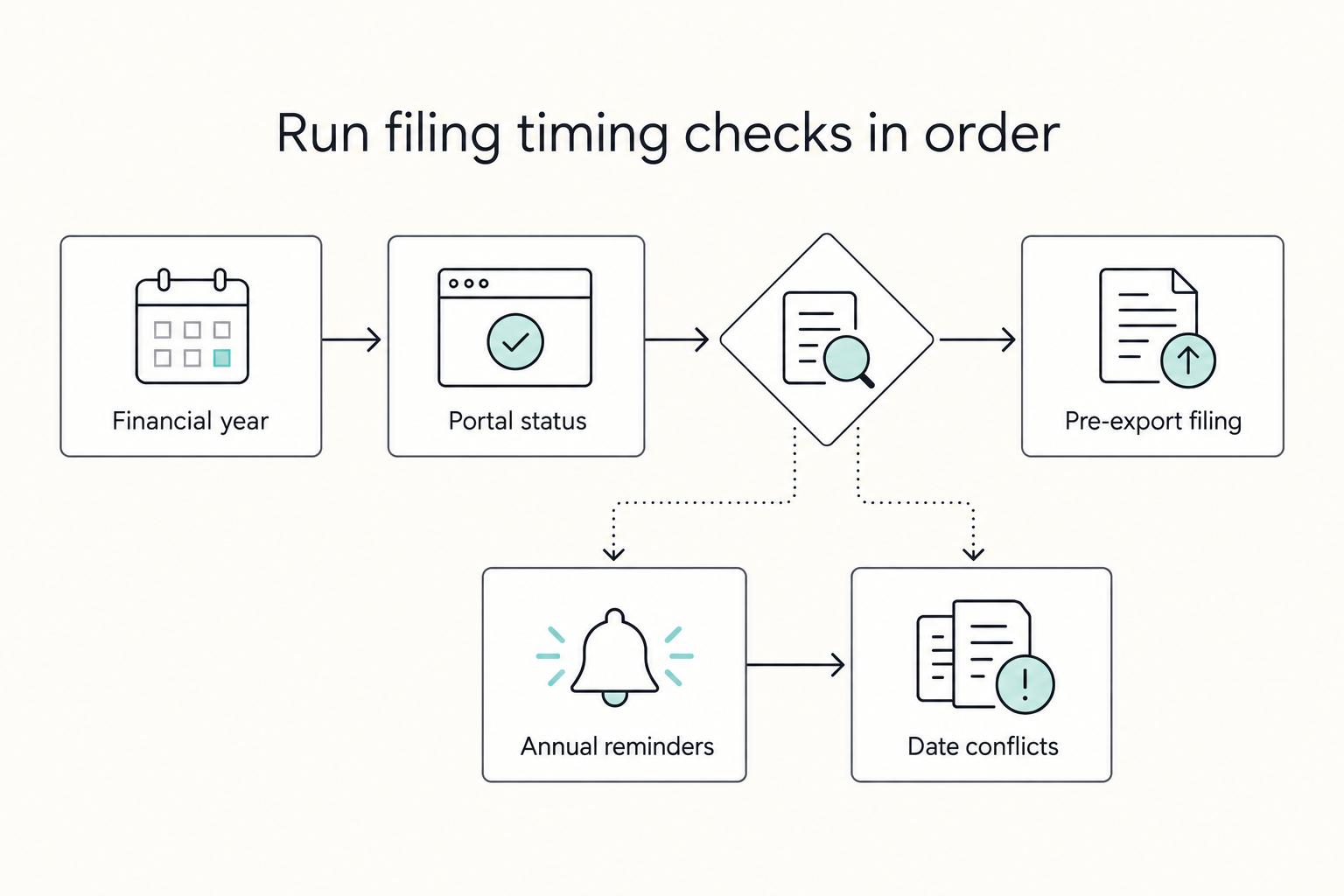
Filing LUT is more straightforward when you lock the sequence before you log in. Set four items first: your tax route, the financial year, who can sign, and where proof will be stored. If any one of those is fuzzy, filing can slow down and invoice treatment can get risky.