
Quick Answer
Use a domestic payroll lane only when payer, worker, currency, and reporting all stay in the US. For cross-border agency work, switch to a connected setup that handles W-9 or W-8BEN intake, payout records, and reconciliation in one trail. When W-8BEN appears, review 1042-S and withholding before release. Track FBAR exposure at the $10,000 aggregate foreign-account level and keep invoice-to-bank evidence retrievable.
The Best Payroll for US Contractors Isn't a 'Service' - It's a System#
Use a domestic payroll tool while your work is truly US-only. Once your client, your residence, or your payout currencies cross borders, you usually need a payment-and-compliance system, not payroll-only software.
Domestic payroll tool#
This is the US-only contractor lane. Collect Form W-9, pay contractors, and file Form 1099-NEC when required. It is a US reporting workflow, not a cross-border compliance workflow.
Global contractor payment compliance system#
This combines cross-border onboarding, payments, and compliance operations in one place. That is the role global offerings from Rippling, Deel, and Gusto's global contractor product are positioned for, with stated coverage of 185+, 150+, and 120+ countries.
Payments-only rail#
This moves money, but it does not run full contractor onboarding, tax-form collection, or ongoing compliance operations.
| Category | What it handles | Compliance visibility and currency control | What it does not handle |
|---|---|---|---|
| Domestic payroll tool | W-9 collection, US contractor payment flow, 1099-NEC workflow | Limited outside-US reporting; US-reporting-first | May not cover foreign-status documentation, 1042-S lane support, or foreign-account visibility |
| Global payment/compliance system | Cross-border onboarding, payments, centralized records | Stronger cross-jurisdiction and multi-currency visibility | Does not eliminate all tax or classification risk |
| Payments-only rail | Fund transfer | Minimal visibility beyond transaction movement | Onboarding, tax forms, recurring compliance operations |
The practical checkpoint is simple. Move to the system approach when any of these are true:
- Your client pays from outside the US or requests non-USD settlement.
- You live abroad or hold foreign financial accounts.
- A contractor provides Form W-8BEN instead of W-9.
Start with the payee form. A W-9 usually points to the 1099-NEC lane, while W-8BEN can move you into Form 1042-S and withholding review. Track two items right away: whether aggregate foreign account balances exceed $10,000 at any point, which triggers FBAR review, and the USD conversion method you use for foreign-currency amounts reported on your US return. Verify any penalty figures or time-sensitive thresholds before you act.
Related: How to Use Gusto for Payroll for a Small US-Based Agency.
What a fragmented stack costs, and when you have outgrown it#
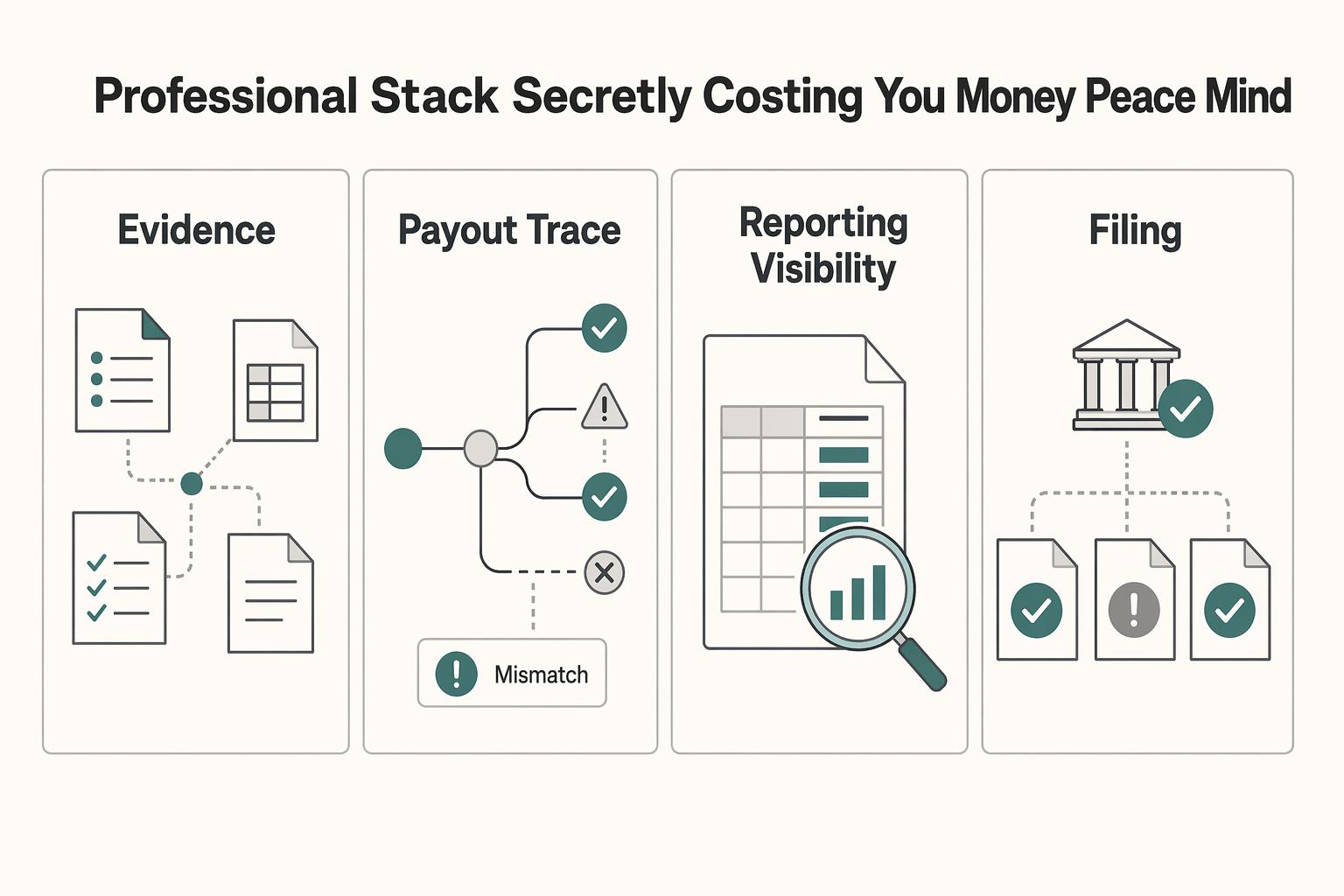
A fragmented cross-border stack stops feeling cheap over time. It pushes reconciliation, fee tracking, and compliance follow-through back onto you. When you compare options, ask who owns reconciliation, visibility, and compliance follow-through.
| Area | Fragmented stack | Integrated system |
|---|---|---|
| Workflow ownership | You manually connect invoice, payment, FX, and bank records | One system keeps more of the payment and record trail together |
| Fee transparency | Costs show up in layers across processor, FX, payout, and transfer steps | More of total cost is visible in one place before settlement |
| Reporting visibility | Status and balances are split across apps, inboxes, and spreadsheets | Closer to a single source of truth for operational reporting |
| Compliance readiness | You manually track forms, filing lanes, thresholds, and deadlines | Some systems include tax, contract, or classification safeguards with payouts |
Before you add another tool, audit these four failure modes:
-
App-juggling (manual reconciliation). You are manually reconciling when you have to compare records across tools just to confirm what was paid and received. If one invoice requires CSV exports and multi-tool matching to explain a short deposit, you have become the integration layer.
-
Fee leakage (layered charges). Base processing fees are only one layer. Cross-border payouts, international transaction fees, FX conversion, and transfer fees can all stack. Use the same method every time: net received = gross invoice - processor fee - international fee - FX conversion cost - payout/transfer fee. Current provider fee ranges stay pending until you verify them against current provider or source records.
-
Data blindness (no live single record view). When transactions are not reconciled, pending items create reporting blind spots. The issue is not convenience. It is whether you can see balances, status, and exceptions without rebuilding the trail by hand.
-
Manual compliance burden (you are the control system). You are manually tracking information-return workflow, including potential 1099-NEC lanes when you pay U.S. independent contractors. You are also monitoring foreign-account reporting triggers for U.S. persons, including the $10,000 FBAR threshold and its filing dates of April 15, with an automatic extension to October 15. At 10 or more information returns, e-file is required, which turns ad hoc admin into a formal process.
You have outgrown a fragmented stack when two or more of these are true:
- You invoice or get paid across borders, or need non-USD settlement.
- You run recurring multi-currency flows and cannot explain FX impact per invoice.
- You reconcile the same transaction across email, dashboards, and spreadsheets every cycle.
- Compliance tracking for returns or FBAR monitoring lives in spreadsheets.
- Your audit trail is scattered instead of retrievable as one invoice-to-bank record path.
Separate tools can look cheaper on paper, but once you become the control system, the real cost is time, operational risk, and avoidable uncertainty.
For a step-by-step walkthrough, see Best HRIS Software for Small Businesses in 2026. Before you switch tools, quantify where your current setup is leaking margin across transfer fees and FX spread with the payment fee comparison tool.
Connect payments, records, and compliance signals in one setup#
If you want less admin risk, build a setup that keeps payments, records, and compliance signals connected. The point is not to automate judgment. It is to make the trail easy to see, easy to prove, and easy to review when software should not be making the call.
1. Payment rail#
Money movement is the first design choice. In the US, ACH handles direct deposits and direct payments. Your setup should capture that ACH activity and keep the record tied to the invoice.
For cross-border work, hold the same standard. Each payout and settlement record should stay tied to the original bill, not scattered across tools. Check whether you can trace one payment from invoice issued to net amount received without manual CSV stitching.
2. Multi-currency account structure and tax-document intake#
Match your account structure to how clients actually pay you. If you receive different currencies, keep a clear client-and-invoice trail for each receipt, hold, and settlement event.
| Item | Article detail | Timing / threshold |
|---|---|---|
| Currency receipts | Keep a clear client-and-invoice trail for each receipt, hold, and settlement event | If you receive different currencies |
| Payee tax forms | Collect required payee tax forms before payment starts | Before payment starts |
| W-9 records | Keep W-9 records retrievable in one place | Four years |
| 1099-NEC prep | Make sure the payee file is complete | Before January reporting starts; especially when reportable nonemployee compensation reaches the $600 level for Form 1099-NEC |
Collect required payee tax forms before payment starts. Keep W-9 records retrievable in one place for four years. Before January reporting starts, make sure your payee file is complete, especially when reportable nonemployee compensation reaches the $600 level for Form 1099-NEC.
3. Bookkeeping sync and reporting layer#
If your books do not match cash reality, the rest of the setup will not hold. Invoices, vendors, and payments should sync into accounting, and you should be able to export reporting data when needed.
Lender-readiness is not branding. It is consistent records, reconciled cash-flow history, and exportable documentation packages you can produce on demand.
| Capability | What it automates | What you still own |
|---|---|---|
| Payment rail | Invoice-linked payout records and status tracking | Reviewing gross vs net received and unexplained deductions |
| Multi-currency account structure | Currency-specific receipt and settlement logs | Conversion timing, where funds are held, and account-ownership review |
| Bookkeeping sync | Posting invoices, vendors, and payment activity into accounting | Reconciliation against bank statements and contract terms |
| Compliance tracking | Date reminders and threshold watchlists | Final filing decisions and cross-jurisdiction review |
| Reporting layer | Exportable reports and transaction history | Verifying exported packages are complete and decision-ready |
4. Compliance tracking with human review#
Use software for reminders and early warning, not legal judgment. Your setup should help you track the known federal checkpoints. For Form 1099-NEC, that generally means tracking reportable nonemployee compensation at $600+ and filing by January 31. Some payments are excluded from 1099-NEC/1099-MISC reporting and handled under 1099-K rules. For FBAR, it means aggregate foreign account value over $10,000, due April 15 with an automatic extension to October 15.
| Checkpoint | Trigger / scope | Timing / note |
|---|---|---|
| Form 1099-NEC | Track reportable nonemployee compensation at $600+ | File by January 31 |
| 1099-K rules | Some payments are excluded from 1099-NEC/1099-MISC reporting | Handled under 1099-K rules |
| FBAR | Aggregate foreign account value over $10,000 | Due April 15; automatic extension to October 15 |
| Classification review | IRS treatment depends on control-and-independence evidence | Requires human review |
Classification decisions still require human review because IRS treatment depends on control-and-independence evidence, not a platform toggle. For any non-federal rule you rely on, verify the current threshold before you act.
If you are selecting and configuring one integrated system, use this checklist:
- Confirm it supports your real lanes first: ACH for US flows, plus your actual cross-border routes.
- Verify W-9 collection, storage, and retrieval inside each payee record.
- Confirm invoices, vendors, and payments sync to bookkeeping and export cleanly.
- Add reminders for January 31, April 15, and October 15, then add verified extra deadlines.
- Test one transaction end to end and confirm the invoice, payout, bank receipt, and ledger entry all match.
If you want a deeper dive, read Value-Based Pricing: A Freelancer's Guide.
Stop Searching for a 'Payroll Service,' Start Building Your Operating System#
Choose by operating fit, not brand. The best option for a US contractor is the setup that matches your cross-border complexity and clearly assigns ownership for onboarding, tax forms, payouts, reconciliation, and reporting.
1. Domestic tool#
Use this when payer, worker, payment method, and reporting all stay in the US. At this stage, your process should collect Form W-9, validate and store TINs, run payouts, reconcile payment records, file required information returns, and deliver recipient statements. Gusto is an example of this lane: it currently publishes a contractor-only plan at $35/mo + $6/mo per contractor and says it automates 1099-NEC e-filing.
The operating checkpoints here are straightforward. File 1099-NEC by January 31 and e-file when you reach 10 or more information returns. If a payee is not a US person, a W-9-only workflow is no longer enough, and Form 1042-S may apply.
2. Fragmented stack#
This can work, but only if you assign owners for each control point before the first payment. In this stage, onboarding lives in one tool, payouts in another, reconciliation in bank exports, and reporting in spreadsheets.
| Control point | What to assign | Grounded detail |
|---|---|---|
| Payee form check | Assign an owner | Verify W-9 or W-8BEN |
| TIN issues | Assign an owner | Resolve missing or incorrect TINs |
| Payout hold | Assign an owner | Pause payouts when 24 percent backup withholding may be required |
| Payment rail mapping | Document by transaction type | Payment-card and third-party-network transactions are not reported under the same rules as 1099-NEC/1099-MISC |
Set explicit ownership for who verifies W-9 or W-8BEN. Decide who resolves missing or incorrect TINs and who pauses payouts when 24 percent backup withholding may be required. Also document payment rails by transaction type, because payment-card and third-party-network transactions are not reported under the same rules as 1099-NEC/1099-MISC.
3. Integrated system#
Use this when cross-border contractor work is routine and you need one connected record across onboarding, payments, reconciliation, and reporting evidence. Rippling positions its contractor workflow around onboarding, payment, and invoicing, with published figures of 185+ countries and 50+ currencies. Deel positions contractor hiring and management in 150+ countries and broader payment and compliance coverage across 200+ countries and jurisdictions.
Treat vendor pricing and coverage numbers as time-sensitive context, not guarantees, and re-verify them before you rely on them. Your real control is process ownership. Name who tracks foreign-account exposure, who confirms reporting triggers, and who signs off on filing readiness. If your facts trigger FBAR, the reference points are $10,000 aggregate foreign accounts and an April 15 due date. Current 1099 thresholds stay pending until verified against current official, filing, or source records before use.
| Decision criterion | Domestic tool | Fragmented stack | Integrated system |
|---|---|---|---|
| Compliance control | One owner can run W-9/TIN checks, 1099 workflow, and recipient statements in one system | Controls are split unless you assign owners for each step and handoff | Strong only when forms, approvals, exports, and filing ownership are explicitly assigned |
| Data visibility | Core payout and filing data is usually centralized for US-only workflows | Data is fragmented across apps, bank records, and spreadsheets | Better visibility when onboarding, payout records, invoices, and reports stay linked |
| Contractor payment reliability | Reliable for stable US-only payout flows | Reliability depends on manual handoffs between tools | More consistent for recurring cross-border payouts when rails and fallback rules are defined |
| Audit trail quality | Adequate if tax forms, filings, and recipient statements are retained together | Weak unless every form, payout proof, and reconciliation file is saved consistently | Stronger when contractor profile, tax form, payout evidence, and reporting outputs remain connected |
| Monthly operator effort | Low when scope remains US-only | High due to repeated reconciliation and exception handling | Lower after setup, but only if owners and review steps are documented |
You might also find this useful: The Best Multi-State Payroll Services. If your next step is consolidating contractor disbursements into one traceable workflow, review how Gruv Payouts handles compliance-gated payouts and status tracking where supported.
Frequently Asked Questions
What's the best way to get paid as a US contractor living abroad?
Use a setup you can reconcile end to end. Map the full payment path and record trail: who pays you, in what currency, to which account, and what you can export later. Choose a setup where invoices, payment confirmations, and account statements are easy to reconcile in one workflow. Cross-border filing and reporting details are not defined here, so confirm current rules before you file.
What is the difference between a payroll provider, a contractor payment platform, and an EOR?
Before you rely on the label, get the vendor to confirm in writing what it does and who pays you. Here, payroll basics are supported (gross pay, deductions, net pay, pay stubs, and employer setup details such as an EIN). The exact definition differences between a payroll provider, a contractor payment platform, and an EOR are not defined here, so treat these as verify-before-you-sign categories.
How do I handle my own taxes as a 1099 contractor?
Keep income, expenses, and payment evidence matched and retrievable in one place. Do not assume a payment app handled your filing obligations for you. Confirm current forms, deadlines, and thresholds before filing.
What should I check if a tool says it can handle contractor payments?
Run one end-to-end test payment before you trust it. Confirm you can see and export the details needed to verify pay, including hours, rates, deductions, and net amount, without manual cleanup. If support cannot show where those fields live, avoid the tool.
What's the safest way to receive international payments as a US contractor?
The safest method is the one that preserves a clear, exportable transaction trail. Supported payroll payment methods include paycheck, direct deposit, and paycard, and some states have strict rules for electronic or alternative payment methods. Use a method that preserves documentation. Cross-border compliance details are not defined here, so confirm current rules before filing.
Do I need to worry about foreign-account reporting if I only use modern platforms?
Potentially. The specific thresholds and filing triggers are not defined here. List every account or balance-holding product you use and track balances consistently. Bring that account list to your accountant early so you are not reconstructing records at year-end.
Can I use a domestic payroll tool for international contractors or clients?
A domestic payroll tool can support payroll basics such as gross pay, deductions, net pay, and pay-stub detail. Whether it is sufficient for international contractors or clients is not defined here, so treat cross-border workflows as a separate compliance review.
What does independent contractor status mean in practice?
It is a legal classification question, not a software toggle. The specific legal tests are not defined here, so confirm current federal and state rules before filing. Keep contracts, invoices, and payment records aligned with the real working relationship. If they diverge, escalate quickly with What to Do If You've Been Misclassified as an Independent Contractor.
What is permanent establishment risk, and should I worry about it?
Treat this as a legal escalation trigger, not a DIY interpretation. The PE rule details and triggers are not defined here, so have the client and their advisors confirm current jurisdiction-specific requirements. Keep scope, contracts, and records clear so facts can be reviewed quickly if risk questions come up.
Try a related tool
Researched and edited by the Gruv editorial team. Gruv builds cross-border billing, payouts, and finance-operations software for global businesses.
Sources
Educational content only. Not legal, tax, or financial advice.
Related Posts
Value-Based Pricing for Freelancers Under Real Payment Risk
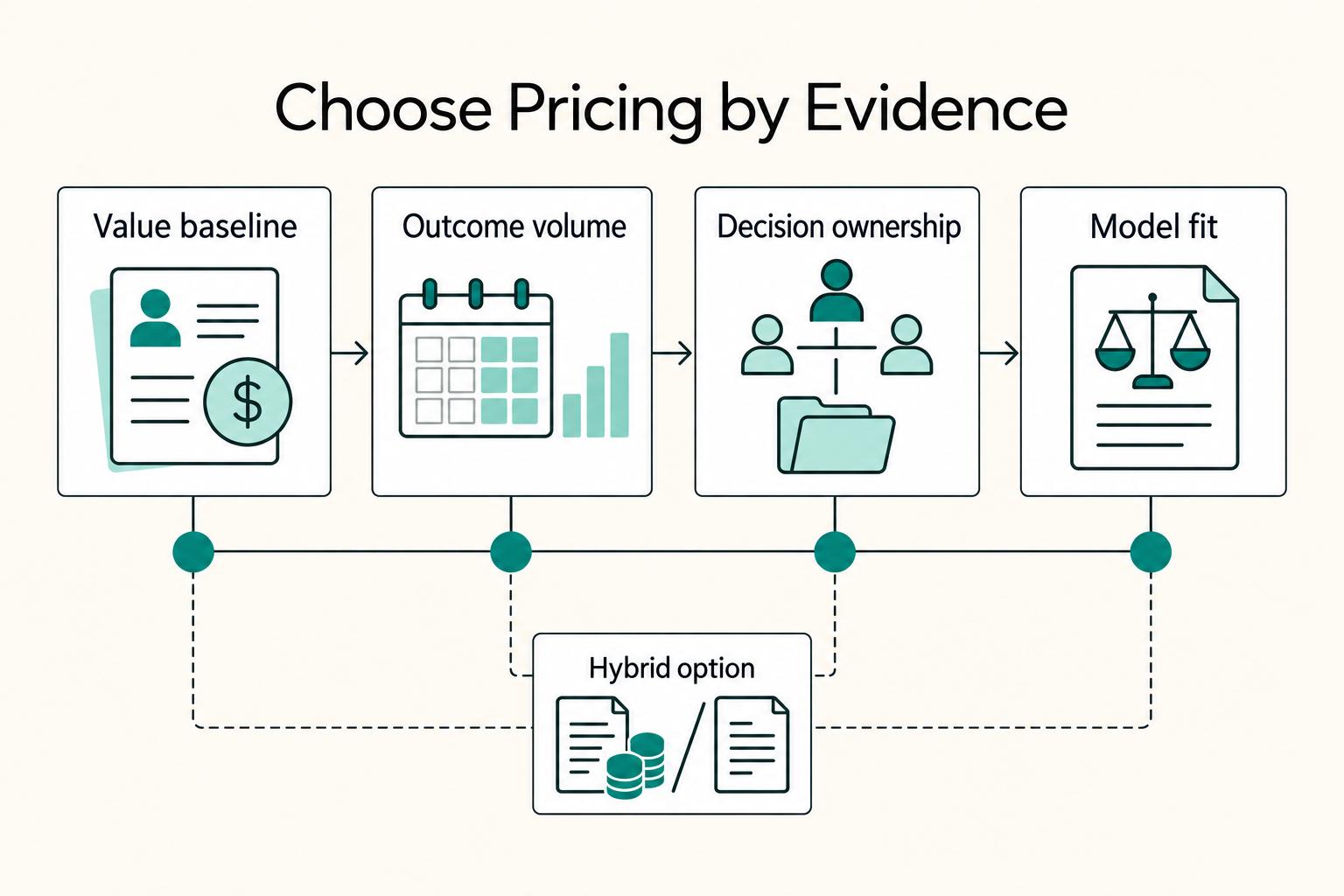
Value-based pricing works when you and the client can name the business result before kickoff and agree on how progress will be judged. If that link is weak, use a tighter model first. This is not about defending one pricing philosophy over another. It is about avoiding surprises by keeping pricing, scope, delivery, and payment aligned from day one.

What to Do If You've Been Misclassified as an Independent Contractor
Treat this as a protection problem first, not a label debate. If your work was treated as an independent contractor arrangement even though the relationship functioned differently, your first goal is to protect pay, rights, and records while you choose the least risky escalation path. You can do that without making accusations on day one, which often keeps communication open while you document what happened.
How to Use Gusto for Payroll for a Small US-Based Agency
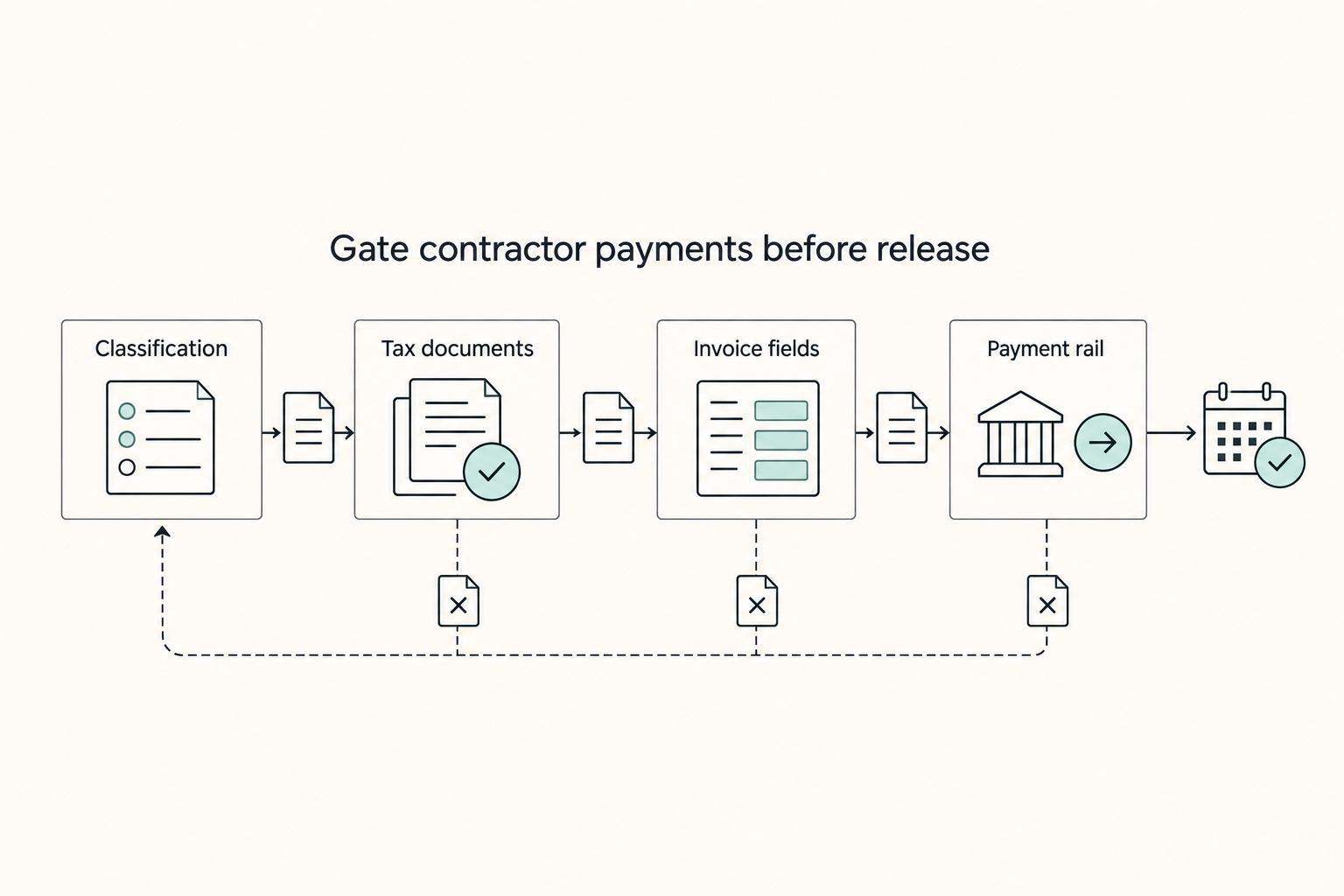
Gusto is a strong primary payroll system when your agency mostly runs U.S. payroll. Once you start paying people outside the U.S., it becomes one part of a broader stack, because sending money and carrying compliance responsibility are different jobs.