
Quick Answer
The best meditation apps for freelancers are the ones you can repeat during high-pressure client weeks, not the loudest brands. This article recommends a practical decision framework, then a 30-day rollout with two daily anchors and one fallback micro-session. If evidence is incomplete, keep confidence conservative, test in real conditions, and keep the app that helps you restart fastest when your schedule gets messy.
Stop Guessing and Pick a Meditation App That Holds Up During Real Client Weeks#
Freelance work breaks generic wellness advice. Working for yourself demands responsibility and accountability, and your schedule shifts fast, context switching drains attention, and stress spikes when delivery risk climbs. As the CEO of a business-of-one, your mind is part of your delivery stack. You own the outcome, so your mindfulness routine has to protect energy and mental health during real deadlines, not just on calm days.
The best meditation apps for freelancers solve an operating problem. You need a routine that helps you reset quickly, keep focus, and protect work-life balance when your calendar gets messy. This guide gives you a practical starting point before we compare specific apps. Here is what you will get from this guide:
- 10-minute decision framework: a fast filter to choose an app based on your workload pattern, tolerance for setup friction, and need for guided structure.
- Side-by-side shortlist: a clear comparison of options like Headspace and Calm, plus alternatives, so you can choose without endless searching.
- 30-day rollout plan: a simple adoption system built for irregular client weeks, so your routine survives crunch periods.
A quick trust boundary. This guide is shaped by a limited set of available excerpts and editorial roundups, and this category is crowded. Those snippets do not confirm full feature parity, consistently current pricing, or a definitive ranking method across every app. Where detail is incomplete, we keep the recommendation conservative and we label confidence accordingly.
Picture a week when one client expands scope and another pushes feedback into the evening. A good app choice still gives you a fast reset between calls and a consistent wind-down after delivery.
| Operating result | What good looks like | Why it matters |
|---|---|---|
| Better focus | You return to deep work faster after interruptions | Protects billable output quality |
| Fewer shutdown days | You use short sessions even during heavy weeks | Prevents all-or-nothing routine collapse |
| Repeatable consistency | You run the same core habit across different schedules | Builds a dependable professional system |
If stress spillover already hurts your week, pair this guide with How to Create a Work-Life Balance as a Freelancer. It gives you a stronger baseline before you try to add a new habit.
What Should Freelancers Evaluate Before They Pick an App?#
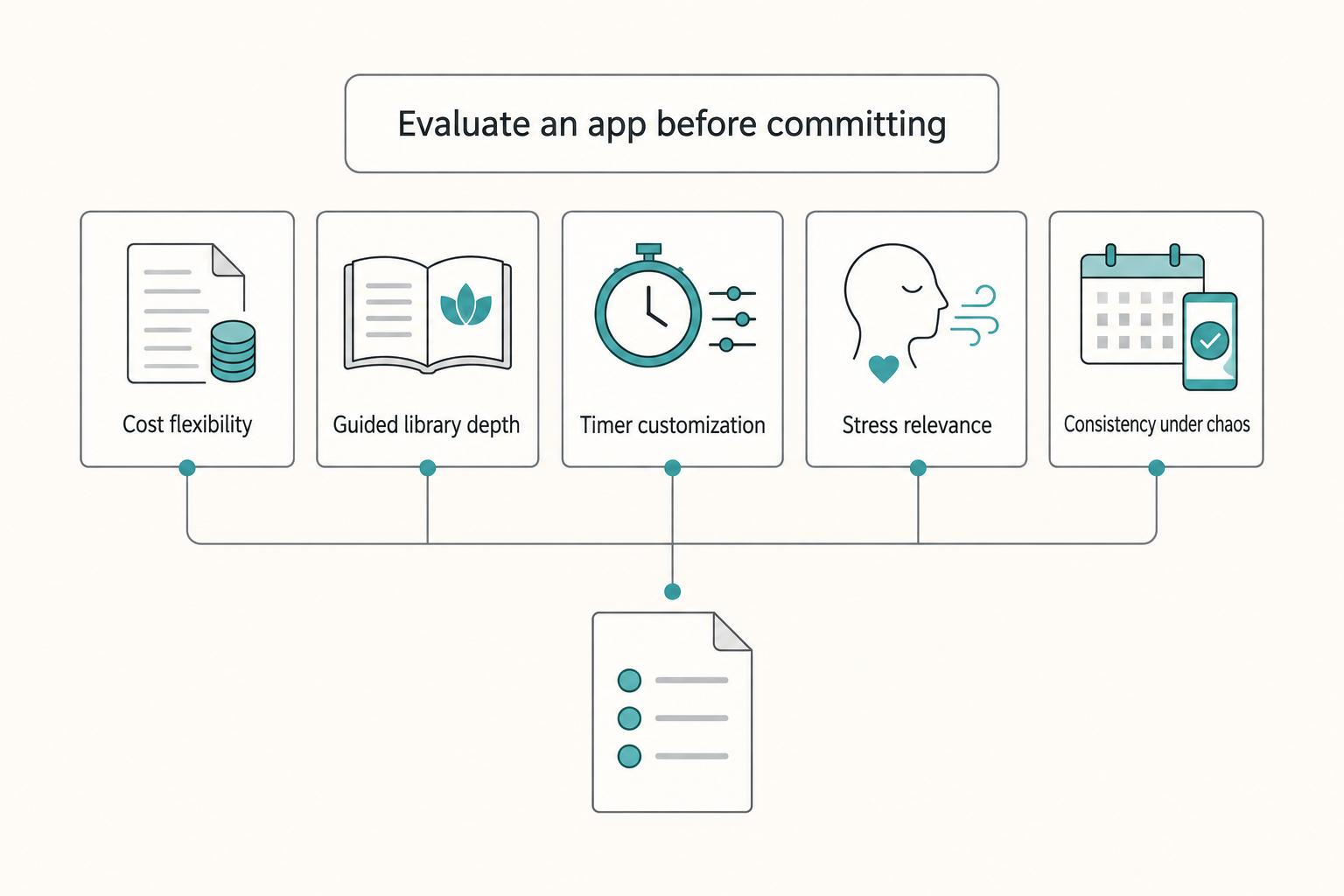
Freelancers should choose an app by testing whether it survives irregular client weeks, not by chasing the loudest brand. You already know the outcome you want: calmer focus and repeatable consistency. Now turn that into a fast filter you can run before you commit.
This section is for independent professionals managing irregular hours, isolation, and pressure without direct supervision. Meditation is often framed as a practical way to calm the mind and recharge, but this is not medical advice or a clinical treatment guide.
Instead of trusting hype, pick two or three contenders and score them against the same criteria. (Apps like Headspace and Calm show up in broad platform roundups, but that is not the same thing as a definitive ranking.)
| Criterion | What to verify quickly | Why it matters for freelancers | 0 to 2 score rule |
|---|---|---|---|
| Cost flexibility | Clear free path, clear paid path, no confusing lock-in | Protects margin when revenue fluctuates | 0 unclear, 1 partial, 2 clear |
| Guided library depth | Enough guided sessions to keep you on track when you are fried | Some people need guidance to meditate consistently | 0 thin, 1 moderate, 2 strong |
| Timer customization | Easy control over session length and timer behavior | Irregular schedules demand short, adaptable resets | 0 rigid, 1 some control, 2 flexible |
| Stress relevance | Sessions that match overload periods and end-of-day wind-down | Work-home blur can push overwork and weak recovery | 0 weak, 1 mixed, 2 strong |
| Consistency under chaos | Fast mobile access and low setup friction | On-the-go access helps you keep the habit on busy days | 0 hard, 1 manageable, 2 easy |
Use an evidence filter before you trust any recommendation. Editorial summaries can help you scan options, and community chatter can surface real-world friction, but anecdotes are not proof.
Keep your confidence calibrated. Exact pricing tiers and a single reliable cross-app ranking are not established, and only a fraction of adults meditate regularly, so "best app" claims are easy to oversell.
If two options tie, run a short pilot in a real week. After a heavy client day, open each app and see which one gets you into a useful session with the least friction.
Which App Fits Your Work Pattern Best Right Now?#
Pick the app you can actually stick with under pressure, then switch quickly if it fails your real week. Mindfulness apps are meant to make meditation and wellbeing practice more accessible, and roundup sources suggest they can help reduce stress, improve focus, and support emotional health. You built your scoring criteria. Now use them to choose a practical shortlist you can actually run when work-life balance and focus all compete for the same limited attention.
Use this table as an operator view, not a forever verdict. Where evidence comes from broad roundups with partial detail (and sometimes advertising-fee disclosures), confidence stays lower.
| App | Best for | Strengths | Tradeoffs | Confidence level | Switch trigger |
|---|---|---|---|---|---|
| Insight Timer | If it's on your list already | Specific features or pricing for Insight Timer are not described here | Exact pricing tiers or feature set are not confirmed | Low | Switch if setup choices create friction and you keep skipping sessions |
| Headspace | If it's on your list already | Specific features or pricing for Headspace are not described here | Exact pricing and feature detail versus alternatives remain unclear in current excerpts | Low | Switch if guided flow feels too rigid for chaotic client days |
| Calm | If you want the most clearly supported pick here | Includes breathing exercises separate from its meditation plans; one roundup describes a smaller annual barrier to entry ($59.99 yearly) | Pricing detail is from a limited snippet, not a full market-wide method | Medium | Switch if you keep using it "at night only" but it doesn't help your daytime routine |
| Buddhify | If you're testing alternatives | Limited source depth available here | Not enough detail here to confidently call strengths, pricing, or fit | Low | Switch if you cannot maintain a consistent weekly rhythm |
| Smiling Mind | If you're testing alternatives | Limited source depth available here | Not enough detail here to confidently call strengths, pricing, or fit | Low | Switch if simplicity still does not produce regular use |
| Simple Habit Meditation | If you're testing alternatives | Limited source depth available here | Not enough detail here to confidently call strengths, pricing, or fit | Low | Switch if quick access exists but habit stickiness stays weak |
| Guided Mind | If you're testing alternatives | Limited source depth available here | Not enough detail here to confidently call strengths, pricing, or fit | Low | Switch if guidance quality feels inconsistent week to week |
If you want a safe default based on what's covered here, start with Calm. It's the only option here with specific, directly stated feature detail (breathing exercises separate from meditation plans) and a referenced annual barrier-to-entry price.
In a client-heavy week, keep the app that helps you restart fastest. Replace the one that adds friction.
The Best Meditation Apps for Freelancers in 2026 With Real Use Cases#
The best meditation apps for freelancers in 2026 are the ones you can repeat during high-pressure weeks, so treat this as a practical test list, not a permanent ranking. You already filtered by fit and confidence. Now pressure-test each option against real work patterns so you can pick one app, protect work-life balance, and stay consistent when client pressure spikes.
For this section, mindfulness apps are accessible smartphone tools you can open quickly and run on demand. Regular engagement with mindfulness exercises via apps can help reduce stress, improve focus, and promote emotional health, but the app only helps if your routine survives real delivery weeks.
| App | Brief description | Key differentiator to test | Real freelancer use case | Confidence |
|---|---|---|---|---|
| Insight Timer | A mindfulness app option to evaluate for personal fit. | Hypothesis only: test whether its session options and overall feel make it easy to repeat. | Between-call reset and end-of-day decompression. | Provisional |
| Headspace | A mindfulness app option to evaluate for personal fit. | Hypothesis only: test whether its guided approach helps you start and stick with it. | Morning routine before client communication. | Provisional |
| Calm | A mindfulness app option to evaluate for personal fit. | Hypothesis only: test whether it supports your wind-down habits during deadline-heavy weeks. | Late-night recovery after delivery pushes. | Low to medium |
| Buddhify | A mindfulness app option to evaluate for personal fit. | Hypothesis only: test whether its session style fits irregular schedules. | Short reset before a difficult scope conversation. | Low |
| Smiling Mind | A mindfulness app option to evaluate for personal fit. | Hypothesis only: test whether the experience feels simple enough to stay consistent. | Midday reset when attention drops. | Low |
| Simple Habit Meditation | A mindfulness app option to evaluate for personal fit. | Hypothesis only: test whether it fits time-boxed days and quick routine checks. | Fast pre-meeting centering during stacked calls. | Low |
| Guided Mind | A mindfulness app option to evaluate for personal fit (where available). | Hypothesis only: test whether its guidance style helps you keep a repeatable routine. | Evening decompression after revision-heavy work. | Low |
Decision rule: pick one app, then test it on your hardest day type. Imagine a chaotic day where a client expands scope late. Keep the app that gets you from stress to your next clear action fastest.
Trust boundary still applies. The current 2026 evidence mix includes high-level roundups, a startups/companies list, and pages with disclosed affiliate relationships. Use this shortlist as an operating hypothesis and validate it in your rollout.
Insight Timer vs Headspace for Freelancers Which Is the Better Operator Choice?#
There is no universal winner here. The better operator choice is the app that gets you practicing consistently under real client pressure. Your goal is not perfect features. Your goal is consistent execution.
Mindfulness is a present-moment awareness practice paired with a non-judgmental attitude, and it develops over time, not in a one-off weekend. Pick the app that helps you show up repeatedly during busy weeks.
Instead of assuming either app is "more customizable" or "more guided," run a simple A/B test and let your behavior decide.
| Operator criterion | Insight Timer | Headspace | What to test this week |
|---|---|---|---|
| Cost control | Note whether pricing or upsells (if any) change your follow-through. | Note whether pricing or upsells (if any) change your follow-through. | Track whether cost concerns make you skip sessions. |
| Setup friction | Record how many taps/decisions it takes you to start a session. | Record how many taps/decisions it takes you to start a session. | Measure how fast you start after opening the app. |
| Session flexibility | See if you can quickly find a session that fits your time window. | See if you can quickly find a session that fits your time window. | Compare how each app handles sudden schedule changes. |
| Habit stickiness | Notice what makes you come back (or what makes you drop off). | Notice what makes you come back (or what makes you drop off). | Count completed sessions on high-interruption days. |
| Stress recovery speed | Test whether it helps you reset quickly after a stressful call. | Test whether it helps you reset quickly after a stressful call. | Check how quickly you regain focus after a stressful call. |
Plain-language rule: keep the app you start fastest, with the least decision load, on your most chaotic days.
Hypothetical scenario: a client shifts deliverables late, your evening gets compressed, and you feel fried. Open each app on separate nights. Keep the one that gets you into a useful session fastest with the least friction.
Confidence note: this summary supports what mindfulness is and that it's a skill cultivated over time. It includes a Headspace growth analysis published Aug 09, 2023 with a "$3B" headline, but it does not provide direct freelancer performance comparisons between Insight Timer and Headspace. It also does not include verifiable Wirecutter or Reddit signals for Insight Timer, or Verywell Mind positioning detail for Headspace. Treat this as a low-to-medium confidence decision framework, then confirm your final choice in live use.
If you want a deeper dive, read How to Get Featured in the Press as a Freelance Expert.
How Do You Implement a 30-Day Meditation System When Your Calendar Is Chaotic?#
Run a simple 30-day system with two daily anchors, one fallback micro-session, and a weekly keep or switch review so your mindfulness habit survives client chaos. Now that you picked an app, shift from comparison to execution. No single app is a panacea. Apps tend to help most when you connect them to fixed triggers in your day, not to mood or spare time.
A 30-day challenge works best when it stays simple, specific, and focused on one core habit. Treat meditation apps as support tools, not magic fixes. Whatever you use, your system is what creates consistency (and this is habit design, not a promise of specific mental-health outcomes).
Week by week rollout#
| Week | Main action | Key differentiator |
|---|---|---|
| Week 1 baseline and friction audit | Track your current pattern for one week, find a start-of-day slot and an end-of-day slot, run short sessions, and write down what caused misses. | You design from real constraints before you optimize. |
| Week 2 anchor sessions | Lock two short daily anchors with clear triggers, one before your first client task and one after your final delivery task, and pre-commit with reminders and a pinned default session. | Tiny actions plus triggers beat willpower. |
| Week 3 stress-event protocol | Define one fallback micro-session for client overrun days and run the micro-session right after a long revision call to avoid a zero day. | Planned recovery days protect momentum. |
| Week 4 retention review | Review your log and make a keep or switch decision; keep the app when consistency feels more sustainable and switch when friction stays high despite anchors. | Aim for identity shift, not streak perfection. |
- Week 1 baseline and friction audit. Track your current pattern for one week and find two realistic windows: a start-of-day slot and an end-of-day slot. Run short sessions, then write down what caused misses. Key differentiator: you design from real constraints before you optimize.
- Week 2 anchor sessions. Lock two short daily anchors with clear triggers: one before your first client task and one after your final delivery task. Pre-commit by setting reminders and pinning a default session so setup takes seconds. Key differentiator: tiny actions plus triggers beat willpower.
- Week 3 stress-event protocol. Define one fallback micro-session for client overrun days. Hypothetical scenario: a revision call runs long and compresses your evening, so you run the micro-session right after the call to avoid a zero day. Key differentiator: planned recovery days protect momentum.
- Week 4 retention review. Review your log and make a keep or switch decision. Keep your app when consistency feels more sustainable; switch when friction stays high despite anchors. If needed, test the same routine in a different app for the next cycle. Key differentiator: aim for identity shift, not streak perfection.
Minimum routine and scorecard#
| Metric | Daily tracking method | Keep or switch signal |
|---|---|---|
| Completion rate | Mark each anchor and fallback as done or missed | Keep when completion trends upward |
| Post-session focus score | Rate focus immediately after each session | Keep when focus feels steadier and more reliable |
| Interruption recovery time | Note how quickly you return to deep work after disruption | Switch when recovery still feels slow across the week |
| Missed-day rebound speed | Record how fast you restart after a missed day | Keep when you restart in the next available block |
Use it to pick a single app, then start the 30-day rollout.
What Usually Breaks Meditation Habits for Freelancers and How Do You Prevent It?#
Protect your meditation habit by treating failure modes as operating risks, then locking simple controls before client chaos hits. You have a 30-day system. This section is the risk control layer that keeps it intact when deadlines compress your day and stress spikes.
Apps do not automatically fix autopilot phone behavior. If you open your phone and drift into compulsive or constant checking, that can undercut mindfulness and break consistency, which is why intentional use matters.
Failure modes that break consistency#
| Failure mode | What it looks like | Control to use |
|---|---|---|
| Subscription creep | Recurring spend across overlapping meditation apps; trial-to-paid patterns can create silent cost drift, and at least one wellness app offer uses a 7-day trial window. | Use one monthly app budget guardrail. |
| App hopping | Switching between meditation apps before a habit forms; frequent switching resets cues and makes every session a fresh decision. | Predefine one switch threshold before day 1. |
| Unrealistic session targets | Oversized daily plans during unpredictable client weeks; when targets depend on motivation, you miss days and lose momentum. | Keep two short anchors plus one fallback micro-session. |
| Delivery-window collapse | Routine failure during high-pressure handoff periods; urgent client work crowds out recovery unless you protect a default flow. | Keep one fallback sequence in your primary mindfulness app. |
- Subscription creep. Name: recurring spend across overlapping meditation apps. Brief description: trial-to-paid patterns can create silent cost drift, and at least one wellness app offer uses a 7-day trial window. Key differentiator: one monthly app budget guardrail protects work-life balance and prevents stress from avoidable spend.
- App hopping. Name: switching between meditation apps (for example, Headspace and others) before a habit forms. Brief description: frequent switching resets cues and makes every session a fresh decision. Key differentiator: predefine one switch threshold before day 1, then follow it instead of chasing novelty.
- Unrealistic session targets. Name: oversized daily plans during unpredictable client weeks. Brief description: when targets depend on motivation, you miss days and lose momentum. Key differentiator: keep two short anchors plus one fallback micro-session so you always have a minimum routine.
- Delivery-window collapse. Name: routine failure during high-pressure handoff periods. Brief description: urgent client work crowds out recovery unless you protect a default flow. Key differentiator: keep one fallback sequence in your primary mindfulness app to avoid zero days.
Prevention controls that survive client pressure#
| Control | How to run it | Decision rule |
|---|---|---|
| Switch threshold | Review your completion pattern weekly during the 30-day cycle | Switch only when friction stays high across reviews despite using anchors and fallback |
| Budget guardrail | Cap monthly app spend and keep one primary app active | Cancel or pause extras when they do not support daily execution |
| Fallback flow | Save one short reset in your primary mindfulness app for overrun days | Run it immediately after disruption to restart focus |
Hypothetical scenario: a client escalates revisions late, your evening disappears, and you feel overloaded. Run the fallback flow first, then resume your next anchor at the next trigger.
Keep your confidence calibrated. The evidence supports the idea that mindfulness apps can be a way to use your phone intentionally, and that compulsive phone use can undermine mindfulness. Beyond that, treat cross-app comparisons as uncertain and let your own 30-day log break ties.
Build Your Safe Default and Start This Week#
Use one app, one routine, and one review cadence for 30 days, because a system beats any generic top-10 list under real client pressure. You have the criteria, the shortlist, and the rollout plan. Now convert it into execution. Meditation apps create value when you use them during packed weeks, not when you keep researching.
Use external rankings as context, not commands. One major roundup headline lists 41 mental health apps. Another says it tested more than 50 and narrowed to 14 by factors like affordability and accessibility, with Headspace tagged "Best for Meditation." Useful signal, but it still does not decide your workflow.
Final execution order#
| Step | What to do | Key differentiator |
|---|---|---|
| Pick one safe default | Choose one app from your shortlist, commit to it for this cycle, and remove the other options from your home screen. | You cut decision friction before it can break your mindfulness routine. |
| Run the 30-day playbook exactly | Keep two short anchors each day and one fallback micro-session for overrun days, then track completion rate, post-session focus, interruption recovery time, and missed-day rebound speed. | You protect consistency when work gets messy. |
| Reevaluate with switch triggers, not mood | Review your log weekly and at day 30, make a keep or switch decision based on execution quality, and if the routine keeps breaking despite clean triggers, switch apps and rerun the same system without changing your rules. | You avoid restarting from scratch and keep momentum. |
- Name: Pick one safe default. Brief description: Choose one app from your shortlist and commit to it for this cycle. Remove the other options from your home screen so you stop making daily app decisions. Key differentiator: you cut decision friction before it can break your mindfulness routine.
- Name: Run the 30-day playbook exactly. Brief description: Keep two short anchors each day and one fallback micro-session for overrun days, then track completion rate, post-session focus, interruption recovery time, and missed-day rebound speed. Hypothetical scenario: a client shifts deadlines late, so you run the fallback immediately after delivery instead of skipping the day. Key differentiator: you protect consistency when work gets messy.
- Name: Reevaluate with switch triggers, not mood. Brief description: Review your log weekly and at day 30, then make a keep or switch decision based on execution quality. If your routine keeps breaking despite clean triggers, switch apps and rerun the same system without changing your rules. Key differentiator: you avoid restarting from scratch and keep momentum.
Commit to one app, run your 30-day test, and decide deliberately at the end. Keep the professional boundary clear: these tools can support mental health and work-life balance, but they do not replace professional care.
If burnout still bleeds into delivery weeks, tighten your operating baseline with How to Create a Work-Life Balance as a Freelancer.
Frequently Asked Questions
Which meditation app is best for freelancers?
There is no single winner for every freelancer. One roundup lists 15 meditation apps, but what works best usually comes down to fit with your routines and preferences, not brand popularity. Expect a bit of trial and error: try one you can realistically repeat during high-pressure weeks, and keep it if you actually use it and it helps.
Is Insight Timer better than Headspace for freelancers?
This guide does not establish a direct winner. If you are deciding between them, try the same basic routine in both and compare which one you stick with more easily and which feels more helpful. Keep the one that lowers decision friction when client work gets messy.
What should freelancers look for in a meditation app?
Start with survivability under chaos: low setup friction, sessions that match stress and sleep moments, and enough flexibility to fit irregular days. If you need clearer next steps, prioritize guided instruction (and the accountability support that often comes with it). Confirm the cost model early since options can include free versions, subscription models, and free trials.
How can I build a meditation routine with an unpredictable freelance schedule?
Tie the habit to triggers, not free time. Set two short anchors, one before your first client task and one after your final delivery task. Add one fallback micro-session for overrun days so a chaotic schedule does not turn into a zero-session week, and aim for regular engagement since consistency is the part associated with lasting positive change.
Are free meditation apps good enough for serious stress management?
Free options can be a solid place to start, especially if they help you practice consistently. Subscription features may be worth it if extra structure helps you stick with the habit. Decide based on what you will actually use, not app-store marketing.
How long should a freelancer test one app before switching?
There is no fixed test duration to point to, so avoid arbitrary deadlines. Use a structured trial window and switch only if it still does not fit after you have tried it consistently. This helps you avoid constant app hopping across different options.
Try a related tool
Researched and edited by the Gruv editorial team. Gruv builds cross-border billing, payouts, and finance-operations software for global businesses.
Sources
Includes 7 external sources outside the trusted-domain allowlist.
- goskills.com/Office-Productivity/Resources/Tools-for-free...external
- memtime.com/blog/timely-alternatives-worth-your-timeexternal
- nytimes.com/wirecutter/reviews/best-meditation-appsexternal
- nytimes.com/wirecutter/reviews/best-meditation-appsexternal
- pragmaticthinking.com/blog/the-best-meditation-appsexternal
- pragmaticthinking.com/blog/the-best-meditation-appsexternal
- verywellmind.com/best-meditation-apps-4767322external
Educational content only. Not legal, tax, or financial advice.
Related Posts

Freelance Work-Life Balance That Holds Up in Real Weeks
Freelance work-life balance breaks down when boundaries stay implied instead of written. Once that happens, your week gets rebuilt one message at a time, delivery becomes less stable, stress goes up, and you spend more energy renegotiating expectations than doing focused work.
How to Get Featured in the Press as a Freelance Expert
Treat press outreach as a repeatable earned media channel, not a lottery ticket. The goal is to be quoted, mentioned, or featured because your expertise fits a real story, not to expect instant placement in outlets like Forbes or TechCrunch.

The Freelance Payment Penalty: A Modeled Audit of Platform Fees, FX Spreads, and Payout Delays
The money rarely disappears through a single, easy-to-spot fee. The real loss is stacked. A marketplace takes its commission, a processor adds a charge for international cards, a bank or payment company converts the currency at a spread, a platform holds the funds before release, and a wire sheds a little to intermediaries on the way in. Each layer looks defensible on its own, but the worker feels the combined result as a smaller deposit and a later payday.