
Quick Answer
Choose the marketplace that can prove your control points before you upload sensitive materials. In marketplaces for selling businesses, the safest path is to shortlist one fit-first option and one reach-first option, then verify buyer qualification, NDA timing, LOI ownership, and post-LOI support in writing. Empire Flippers is framed as a curated route, while BizBuySell is framed as a broader exchange path, but either choice should stay provisional until those mechanics are documented.
You are not choosing a marketplace you are choosing your risk profile#
Choose downside control before reach. In marketplaces for selling businesses, buyers and sellers usually start with no relationship, so trust risk is the default, not the exception. Your first question is not "where will I get the most eyeballs?" but "where can I reduce exposure to fraud, weak screening, and unclear trust-and-safety processes?"
- Fit the model first. Sales-based and auction-based platforms create different pressure on confidentiality, pricing, and buyer behavior. If your deal needs controlled access, more exposure is a tradeoff, not an automatic advantage.
- Read signals, not slogans. "Vetted," "trusted," or "curated" only tells you the platform knows trust and safety matters. It does not prove current identity checks, re-verification, two-factor authentication, link analysis, or ongoing monitoring.
- Verify before you list. Your checkpoint is whether support or public docs can explain the process in plain English. A polished listing page is not evidence of strong trust-and-safety operations.
| Claim | What it actually tells you | What you still need to validate |
|---|---|---|
| "We vet users" | The platform recognizes onboarding risk | Whether current identity checks, re-verification, or account review steps exist |
| "We have a large buyer audience" | Reach may be broad | How trust controls are applied before sensitive information is shared |
| "We help deals move faster" | The front end may be streamlined | How monitoring, user reporting, and escalation are handled when issues appear |
For Empire Flippers, BizBuySell, Flippa, or any other option, treat each as a hypothesis until you confirm the mechanics. Even recent trust-and-safety guidance is still generic vendor guidance, not proof of any platform's current controls.
Before you list, run these minimum checks:
- onboarding checks for identity or misrepresentation risk
- whether re-verification, two-factor authentication, or link analysis are used
- ongoing monitoring methods, including reporting and moderation flow
- escalation path for fraud or harassment reports
- what access is granted before trust checks are completed
If you still need to tighten your positioning, numbers, or owner dependence before listing, start with A Guide to Selling Your Freelance Business or Agency. For the full breakdown, read The Best Platforms for Selling Digital Products.
Is this list for you and what should you score first?#
Use this checklist if you are preparing for a business-sale process with buyer conversations, NDA gating, diligence, and an LOI. If you are doing one-off resale, such as inventory, equipment, or a single asset, use a resale workflow instead.
Score a shortlist before you publish. You do not need every available metric set to decide well: one framework highlights 26 metrics and another highlights 14, and both also warn that metric overload and vanity metrics can hurt decisions. Start with evidence tied to your goal, then weight criteria after you verify how each platform actually works.
| Criterion | Suggested weight range after verification | Evidence that counts | Marketing language only | Missing proof that should block listing |
|---|---|---|---|---|
| Platform fit | 30% to 40% | Your deal type matches the platform model, and the inquiry-to-serious-interest path is clear | "Built for founders," "largest network" | You cannot confirm whether the format supports your sale process or only broad visibility |
| Trust evidence | 25% to 35% | Plain-English explanation of who is qualified, what checks exist, and when access is expanded | "Vetted buyers," "trusted marketplace" | No clear answer on who is screened, when they are screened, or what changes by stage |
| Process support | 20% to 30% | A defined sequence for NDA, information access, and LOI handoff | "White-glove," "streamlined deals" | No clear sequence from first inquiry through LOI ownership |
| Uncertainty risk | 10% to 20% | Known unknowns are documented and acceptable for your risk tolerance | "Fast sale," "high demand" | Too many unresolved questions to defend your choice internally |
Treat each platform as a hypothesis, not a default. Empire Flippers can signal fit if you want a more curated path; the verification gap is what screening depth and access controls apply at each step. BizBuySell can signal fit if you want broad exposure or broker-led routes; the verification gap is how qualification and confidentiality work before deeper sharing. BusinessesForSale.com can signal fit if reach is your priority; the verification gap is whether that reach comes with enough process control for your risk profile.
Before you shortlist platforms, prepare these artifacts so support answers can be tested against something concrete:
- NDA terms: who signs, what is covered, and what stays restricted until later diligence
- LOI structure: which points are non-binding vs binding, expected exclusivity language, and timeline assumptions
- Valuation assumptions: method, add-backs, owner-replacement logic, and which numbers are estimates vs audited
If your valuation assumptions are not ready, do that first: How to Perform a Business Valuation for a Small Agency. Related: A Guide to Xero for Freelancers and Small Businesses.
Which marketplace category fits your business model?#
Choose category before brand. If you skip that, you end up comparing marketing claims from platforms built for different buyer paths.
Start with two filters: your participant model, which for most business sales you should treat as B2B, and your scope, specialized vs general. Use that to choose a path first, then evaluate individual platforms.
| Category | Best-fit scenario | Why it fits | Primary execution risk | What to verify before listing |
|---|---|---|---|---|
| Curated digital M&A | You are selling a digital-first operating business and want tighter control early | A specialized lane can fit when you want a narrower buyer path instead of maximum visibility | You assume "curated" means strong screening, but the actual gate may be lighter | Exact NDA trigger, who sees financials before and after NDA, whether LOI handoff is structured, and what diligence support exists |
| Broad exchange directory | You want wide exposure across many business types, or plan to involve a broker | A general lane can increase visibility and buyer discovery routes | More exposure can also mean more noise and earlier confidentiality pressure | Buyer screening steps, whether broker involvement changes flow, NDA sequence, and who owns the path to LOI |
| Adjacent digital option | Your deal is mixed, unconventional, or packaged more like a digital asset | These lanes can attract buyers already looking for digital opportunities | Listing format can over-focus one asset class and underrepresent the full business | Whether full-business diligence is supported, not just teaser visibility, plus NDA and LOI discipline |
If your business is mixed-asset, use a primary-plus-backup tie-break:
- Pick your primary category based on what drives value in buyer diligence.
- Keep one backup category for distribution risk, not as a default second listing.
- Break ties with process proof, not reach slogans: buyer screening, NDA flow, LOI structure, and diligence support.
Brands often discussed here include Empire Flippers, BizBuySell, BusinessesForSale.com, Flippa, and Acquire, but you should still validate current category fit before you rely on it.
For another example of testing vendor claims against process mechanics, see The Best Payment Gateways for SaaS Businesses.
The quick comparison table that reduces 3 weeks of confusion to 10 minutes#
Pick one fit-first option and one reach-first option, then let process risk decide the winner. Use this table to separate what is proven from what is still marketing language.
Use the labels literally: Verified = current direct proof, Partially verified = plausible fit but incomplete process proof, Unverified = open claim until confirmed in current docs or support replies.
| Platform | Marketplace type fit | Buyer-quality proof | Confidentiality and LOI workflow clarity | Support ownership | Evidence confidence | Unresolved verification items | Disqualifier |
|---|---|---|---|---|---|---|---|
| Empire Flippers | Partially verified: fit-first candidate for a curated digital lane | Unverified: no current buyer-quality proof available | Unverified: NDA trigger, buyer-access sequence, and LOI handoff are not established | Unverified: diligence and closing support ownership not confirmed | Partially verified: category fit only | Request current screening description, NDA sequence, LOI handoff owner, and post-LOI support path | Pause if support explains positioning but cannot provide a written step-by-step process |
| BizBuySell | Partially verified: reach-first candidate in a broad exchange lane | Unverified: no verified buyer-screening standard here | Unverified: confidentiality controls and LOI sequence not confirmed | Unverified: seller vs broker vs platform support ownership not confirmed | Partially verified: category fit only | Confirm who qualifies buyers, when confidential data is released, who manages LOI flow, and what happens after LOI | Pause if broker involvement changes the process and no default path is clear |
| BusinessesForSale.com | Partially verified: reach-first candidate in a broad directory lane | Unverified: no current buyer-quality proof here | Unverified: NDA and LOI workflow not established | Unverified: support ownership through diligence not established | Partially verified: category fit only | Verify buyer-access controls, NDA sequence, LOI handling, and transaction guidance | Pause if listing steps are clear but deal steps are unclear |
| Flippa | Partially verified: adjacent digital option for an online-business angle | Unverified: no verified quality gate confirmed | Unverified: confidentiality and LOI mechanics not confirmed | Unverified: ownership after buyer interest is unclear | Partially verified: category fit only | Confirm how full-business diligence is handled, plus NDA and LOI sequence | Pause if listing is easy but process control is unclear once buyers request details |
| Acquire | Partially verified: adjacent digital option for digital-first deals | Unverified: no platform-wide buyer-quality proof established | Unverified: NDA, LOI, and closing sequence not confirmed as standard | Unverified: ownership from listing to close not confirmed | Partially verified: category fit only | Ask whether NDA/LOI paths are standardized, who owns support, and what seller documents are provided | Pause if answers are anecdotal instead of documented |
Send the same evidence-pack request to every platform: a dated process sequence for buyer access, a clear owner after buyer interest, and a clear LOI path. If the reply stays generic, keep the row Unverified and move on.
Do not let headline fees or "largest network" claims break the tie. Low advertised fees can still raise total cost of ownership once operating overhead and control tradeoffs are included.
Also check recency before you trust any comparison source. If a guide is not the latest edition, treat it as context only and verify current platform process details directly.
If you run a mixed-asset business, for example content plus agency services, use this tie-break rule: choose the fit-first option only when it provides a current written NDA-to-LOI path and names execution ownership after buyer interest. If both options are vague, keep the reach-first option as backup and share only teaser-level information until those points are verified.
You might also find this useful: The Best E-Discovery Software for Small Businesses.
Best marketplaces for selling small businesses with use cases not fluff#
Shortlist two options: one fit-first primary and one reach-first backup. Then let written process proof decide which one earns your listing.
Do not choose on brand comfort alone. Choose the platform that can show buyer screening, NDA timing, LOI handling, and who owns execution once buyer interest becomes serious.
| Platform | Best-fit use case | Verified signal | Critical gap to verify | Not a fit if |
|---|---|---|---|---|
| Empire Flippers | You want a fit-first candidate for a curated digital sale lane | Category fit is partially verified for a curated digital path | Ask for the current screening description, NDA sequence, LOI handoff owner, and post-LOI support path | Support can describe positioning, but not the step-by-step buyer access path |
| BizBuySell | You want a reach-first candidate in a broad SMB exchange lane | Category fit is partially verified for broad exposure and broker-possible routing | Confirm who qualifies buyers, when confidential data is released, who manages LOI flow, and what happens after LOI | Broker involvement changes the process and nobody can explain the default path without one |
| BusinessesForSale.com | You want broad directory-style visibility as a backup channel | Category fit is partially verified for broad listing distribution | Verify buyer access controls, NDA timing, LOI handling, and transaction-guidance ownership | The listing process is clear, but the deal process stays vague |
| Flippa | You have an online-business angle and want an adjacent digital option | Category fit is partially verified for digital-first listings | Confirm how full-business diligence is handled, plus NDA and LOI sequence | It is easy to list, but hard to control once buyer questions start |
| Acquire | You want another digital-first option for an online business sale | Category fit is partially verified for digital-first deals | Ask whether NDA and LOI flow are standard across deals, who owns support, and what documents sellers receive | The process is explained through anecdotes instead of current documentation |
Use this as a rule-out table, not a popularity table. Reviews are most useful when they map real use cases, hidden costs, and practical tradeoffs. In this category, the expensive mistake is often poor process control: duplicate buyer handling, confidentiality drift, and time lost on a platform that cannot show a clear deal path.
If you are selling a mixed-asset business, for example SaaS plus content, use a scenario pattern:
- Tight timeline: keep a reach-first backup ready if the fit-first option stalls in verification.
- High confidentiality: stay at teaser-level data until NDA trigger and buyer access sequence are shown in writing.
- Possible broker involvement: ask where platform responsibility ends and broker responsibility begins.
Keep one hard-stop rule: no clear screening, no clear NDA path, no clear LOI path, no listing. Before outreach, get your price logic straight with How to Perform a Business Valuation for a Small Agency.
If you want a deeper dive, read The Best HRIS Software for Small Businesses.
What can go wrong after listing and how do you de-risk it?#
After listing, your main job is downside control, not platform shopping. The biggest risk is losing control of access, terms, and pace once buyer activity picks up. Treat this as platform risk: map your dependencies, read terms and updates closely, check reliability and security, and run a worst-case scenario before you rely on any platform for critical deal flow.
Your downside checklist#
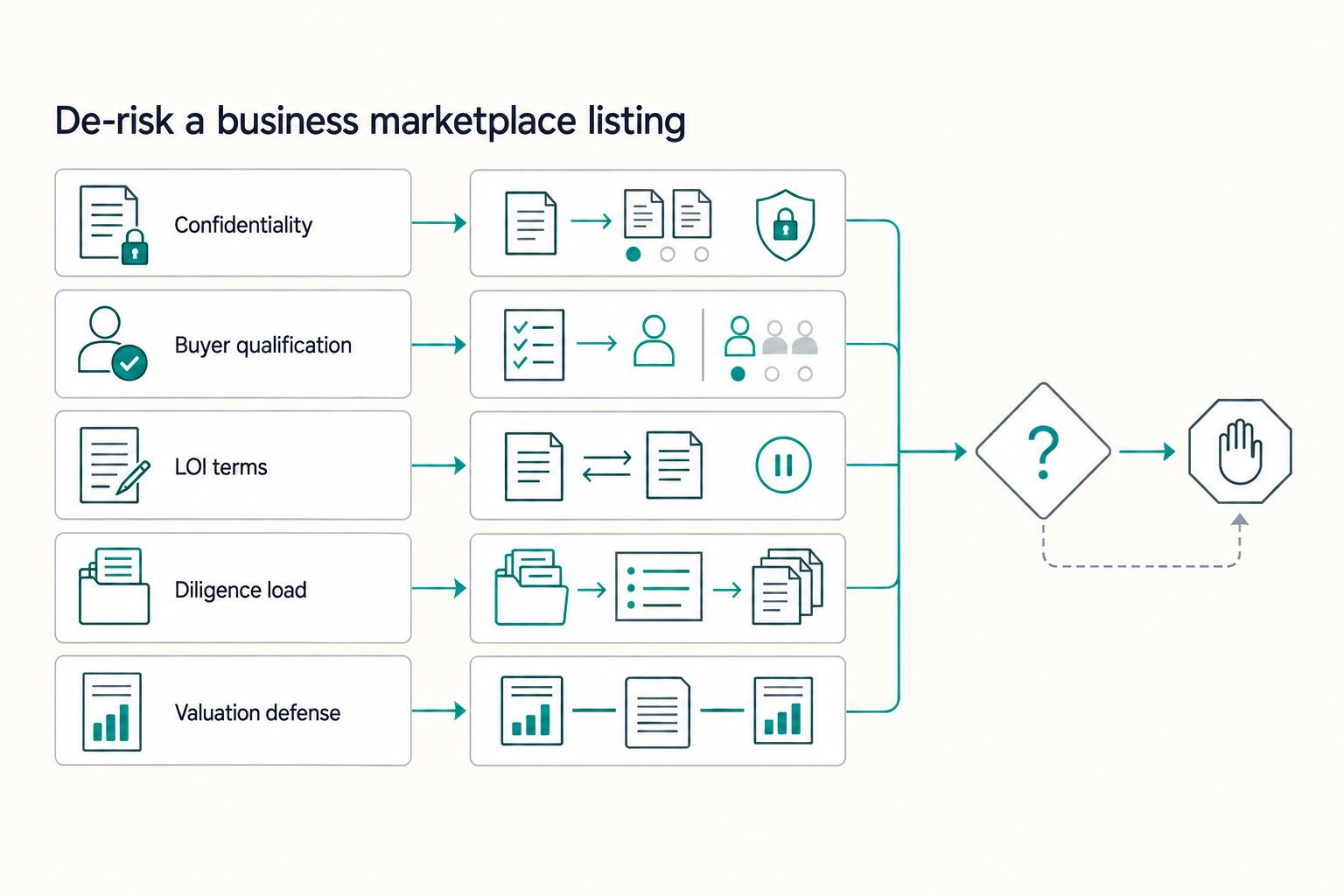
| Risk area | Control | Failure mode |
|---|---|---|
| Confidentiality | Keep early materials at teaser level, then grant deeper access in controlled stages you can track and revoke | Confidentiality drift after files spread faster than your process |
| Buyer qualification | Set a simple intake standard and one owner on your side who approves deeper access | Avoidable churn from buyers who consume diligence time but are not execution-ready |
| LOI terms | Write your non-negotiables upfront and compare each draft to your baseline; pause new disclosures until changes are explained in writing | LOI term drift |
| Diligence load | Use one evidence pack, one index, and one running Q&A log, then release in batches | Diligence overload |
| Valuation defense | Keep your pricing logic and assumptions in one memo, and make sure listing, teaser, and deal-room numbers match | Valuation pushback is harder to resolve when your own documents conflict |
- Lock confidentiality before you share deep files. Keep early materials at teaser level, then grant deeper access in controlled stages you can track and revoke. The failure mode is confidentiality drift once files spread faster than your process.
- Gate unqualified buyers early. Set a simple intake standard and one owner on your side who approves deeper access. This cuts avoidable churn from buyers who consume diligence time but are not execution-ready.
- Freeze LOI guardrails before first redlines. Write your non-negotiables upfront and compare each draft to your baseline. If core terms move late, pause new disclosures until changes are explained in writing.
- Control diligence load with one source of truth. Use one evidence pack, one index, and one running Q&A log, then release in batches. This reduces diligence overload and keeps answers consistent across buyers.
- Defend valuation with a short written rationale. Keep your pricing logic and assumptions in one memo, and make sure listing, teaser, and deal-room numbers match. Valuation pushback is harder to resolve when your own documents conflict.
Also keep an off-platform copy of your teaser, buyer logs, and file index. Account enforcement actions, policy or fee changes, platform stability issues, or payment disruptions can interrupt access and create sudden revenue risk.
Cross-border data handling#
If your room includes EU personal data, default to minimal disclosure first and expand only when there is a clear deal need. Treat NDA and GDPR as separate checks in your process, and use the deeper GDPR checklist for EU clients before widening access.
Unknowns table for your shortlist#
Use one copy for your primary option and one for your backup so open items stay visible before you scale buyer access.
| What to verify | Where proof comes from | Owner | Status |
|---|---|---|---|
| Access controls and NDA trigger | Current terms, support replies, product screenshots | Seller or advisor | Open / Verified / Blocked |
| Buyer qualification flow | Written process from platform or rep | Seller | Open / Verified / Blocked |
| LOI handoff and redline path | Written workflow confirmation | Seller with counsel | Open / Verified / Blocked |
| Deal-room handling for EU personal data | Internal data review and legal/compliance check | Seller with counsel | Open / Verified / Blocked |
| Policy, fee, and account-risk changes | Terms updates, policy notices, recent announcements | Seller | Open / Verified / Blocked |
If a row stays open, treat it as active risk. Verify first, then expand access. For prep support, use A Guide to Selling Your Freelance Business or Agency and How to Perform a Business Valuation for a Small Agency. Related reading: The Best PEO Services for Small Businesses. Product overview: Browse Gruv tools.
Empire Flippers vs BizBuySell which should you choose right now?#
Choose based on how much process control you want to own. If you are selling a clearly online business and want a more guided, curated path, start with Empire Flippers. If you want broader deal flow across categories and geographies and are ready to run more of the process yourself, start with BizBuySell.
| Stage | Empire Flippers | BizBuySell |
|---|---|---|
| Pre-NDA | Keep pre-NDA materials to a light teaser | Use your listing and teaser to pre-screen for fit before calls start |
| Qualification gate | Buyer identity, acquisition rationale, target timeline, and funding path before any deep call | Identity, rationale, timeline, and funding path before NDA |
| After NDA | Release monthly revenue, traffic data, and major supplier or platform dependencies | Release valuation memo, summary financials, and a single Q&A log |
| LOI timing | Move to LOI discussion before opening broader diligence | Hold sensitive customer, employee, and dependency detail until LOI terms are stable |
| Verification item | Ask for current proof of how buyer vetting and migration support actually work in live deals | If broker participation matters to your decision, verify current participation directly and document what you confirm |
| Primary risk | Assuming "curated" means your own screening can be lighter | High volume with weak fit that dilutes your diligence standards |
The tradeoff is straightforward: more built-in support versus more seller-owned execution. Use the two paths below, then verify your assumptions before you list.
If you lean toward Empire Flippers#
Run this as a controlled process, not an automatic handoff.
- Set your qualification gate first: buyer identity, acquisition rationale, target timeline, and funding path before any deep call.
- Keep pre-NDA materials to a light teaser.
- After NDA, release a second layer: monthly revenue, traffic data, and major supplier or platform dependencies.
- Move to LOI discussion before opening broader diligence.
- Ask for current proof of how buyer vetting and migration support work in live deals.
Your risk is assuming "curated" means your own screening can be lighter.
If you lean toward BizBuySell#
Assume reach can outpace structure, so your controls must be tighter from day one.
- Use your listing and teaser to pre-screen for fit before calls start.
- Apply the same qualification gate before NDA: identity, rationale, timeline, and funding path.
- After NDA, release only controlled materials first: valuation memo, summary financials, and a single Q&A log.
- Hold sensitive customer, employee, and dependency detail until LOI terms are stable.
- If broker participation matters to your decision, verify current participation directly and document what you confirm.
Your risk is not lack of interest; it is high volume with weak fit that dilutes your diligence standards.
| Decision point | Empire Flippers fits better when | BizBuySell fits better when |
|---|---|---|
| Model fit | You are selling an online business and want a curated path | You want broader industry/geography exposure and volume |
| Process style | You want more built-in support in the workflow | You are comfortable owning more of the workflow |
| Buyer screening depth | You want marketplace-side vetting evidence plus your own gate | You are prepared to carry more screening responsibility yourself |
| NDA sequence control | You want a strict teaser-to-NDA-to-data sequence | You can enforce strict seller-side NDA sequencing under broader outreach |
| LOI discipline | You want LOI progression defined early and checked in writing | You can enforce LOI order and stop term drift with your own process |
| Diligence access expansion | You want staged access with clear gates before wider room access | You can run staged access manually across more inbound traffic |
| Advisor dependency | You prefer more built-in guidance | You already have a broker/advisor or a strong internal deal owner |
| Post-LOI support ownership | You want ownership clarified before listing | You are comfortable owning support with your team or broker unless confirmed otherwise |
| Scale and broker evidence | Current listing and participation evidence pending marketplace/source-record verification | Current listing and participation evidence pending marketplace/source-record verification |
Pick one primary channel, define your proof checks before listing, and set a fallback path if those checks fail. If your pricing case is still weak, tighten it first with How to Perform a Business Valuation for a Small Agency. If you cannot verify buyer-vetting quality or a workable post-LOI path, move to your backup before you widen access.
Related reading: A Guide to the Americans with Disabilities Act (ADA) for Small Businesses.
Pick your safe default and move forward with a verification-first shortlist#
Start with one rule: choose the option that proves buyer qualification, NDA gating, and LOI discipline before you share sensitive information. Use fit first, then trust signals, then unknowns.
Verification-first shortlist (fit, trust, unknowns)#
| Platform | Fit-first use in your shortlist | Trust signals to request in writing | Unknowns you must verify before listing |
|---|---|---|---|
| Empire Flippers | Fit-first candidate for your deal shape if it matched your earlier scoring. | Who qualifies buyers, when NDA access begins, and how offers move into LOI terms. | Current listing or broker-participation evidence pending marketplace/source-record verification. |
| BizBuySell | Reach-first candidate if you want broad exposure or broker-led execution. | One named owner for buyer triage, NDA release, and diligence permissions. | Current listing or broker-participation evidence pending marketplace/source-record verification. |
| Flippa | Alternate candidate for added optionality in your final two. | What buyers can see pre-NDA, what changes post-NDA, and what support exists post-LOI. | Current listing or broker-participation evidence pending marketplace/source-record verification. |
| Acquire | Alternate candidate if your process can enforce staged access controls. | Mutual NDA step, offer structure, and who owns the deal after first interest. | Current listing or broker-participation evidence pending marketplace/source-record verification. |
| BusinessesForSale | Breadth candidate only if confidentiality controls are explicit. | Buyer qualification flow, confidentiality gate, and access controls by stage. | Current listing or broker-participation evidence pending marketplace/source-record verification. |
If any platform cannot show that access control sequence clearly, do not use it as your first listing venue.
Publish-only checklist (pass/fail)#
| Owner | Required step | Pass or fail rule |
|---|---|---|
| You | Name one fit-first option and one reach-first option | Pass if you can state who controls buyer screening on each option |
| Platform rep | Confirm the sequence in writing: buyer qualification -> NDA gate -> first access level -> offer handling -> LOI ownership -> post-LOI support | Pass if the order and access boundaries are specific, not generic |
| Broker/advisor | Confirm ownership for NDA release, LOI redlines, and diligence-room permissions | Pass if each step has one clear owner |
| You | Hold back your full evidence pack until both options pass | Fail any option that requests sensitive files before terms, access limits, and buyer checks are stable |
- You: Name one fit-first option and one reach-first option.
Pass if you can state who controls buyer screening on each option.
- Platform rep: Confirm the sequence in writing: buyer qualification -> NDA gate -> first access level -> offer handling -> LOI ownership -> post-LOI support.
Pass if the order and access boundaries are specific, not generic.
- Broker/advisor: Confirm ownership for NDA release, LOI redlines, and diligence-room permissions.
Pass if each step has one clear owner.
- You: Hold back your full evidence pack until both options pass.
Fail any option that requests sensitive files before terms, access limits, and buyer checks are stable.
If your teaser, CIM, or diligence room includes personal data and access will cross jurisdictions, validate transfer safeguards before upload and record who approved that path. Use GDPR for Freelancers: A Step-by-Step Compliance Checklist for EU Clients for the control checklist, The Best OKR Software for Small Businesses for a decision-tracking format, and Talk to Gruv only to confirm country/program support where needed.
Frequently Asked Questions
What are the best marketplaces for selling a small business?
Pick by deal shape and control needs, not by a generic ranking. If you are selling an online business, Empire Flippers is a logical first check. If you are evaluating other platforms (including BizBuySell), treat platform metrics and process claims as unproven until you verify them yourself.
Empire Flippers vs BizBuySell which is better for my business type?
Choose Empire Flippers if your company is clearly an online business and you can support the listing with revenue, expense, and analytics evidence. Also confirm you are comfortable with its listing terms (for example, an exclusivity window) and negotiation flow (offers can come below asking price, and sellers can accept or counteroffer). For BizBuySell, verify listing requirements and process details directly before you decide.
Are marketplace buyers vetted or am I listing in a directory?
Assume nothing and verify every platform the same way. Your checklist is buyer identity, acquisition rationale, proof of funds or financing path, expected close timeline, and what access they get after NDA. The failure mode is trusting a curated label and then finding out late that the buyer cannot actually close.
How do NDA and LOI steps differ across platforms?
Confirm the sequence before you list, because NDA scope, offer handling, and LOI ownership can differ. Keep one checklist across every platform: NDA signed, core terms fixed in LOI, diligence-room access staged, and sensitive files released only after the terms stop drifting.
Should I use a broker or sell directly on a marketplace?
Sell directly only if you can personally manage screening, NDA approval, counteroffers, and diligence handoff without slowing the deal down. Use a broker if you need someone else to own buyer triage and keep terms from slipping after first interest. In either case, name one owner for your checklist: buyer vetting, NDA release, LOI redlines, and data-room permissions.
What information is missing from most marketplace comparisons?
Many comparisons do not clearly show the operating detail that decides whether your sale stays controlled. You need to know the listing evidence burden, the NDA gate, who owns the LOI, and who carries the work after LOI into diligence and closing. If a comparison leans on scale or participation claims, treat that as a placeholder until you verify the current details.
How do I compare Flippa, Acquire, and BusinessesForSale safely?
Do a like-for-like check instead of chasing brand names. For Flippa, Acquire, and BusinessesForSale, the defensible position is that you should verify these four items directly before listing: | Platform | Screening depth | Confidentiality gate | LOI ownership | Post-LOI support | | --- | --- | --- | --- | --- | | Flippa | Verify directly | Verify directly | Verify directly | Verify directly | | Acquire | Verify directly | Verify directly | Verify directly | Verify directly | | BusinessesForSale | Verify directly | Verify directly | Verify directly | Verify directly | If a rep cannot answer those four points clearly in writing, do not upload your full file set yet.
Try a related tool
Researched and edited by the Gruv editorial team. Gruv builds cross-border billing, payouts, and finance-operations software for global businesses.
Sources
- congress.gov/crs-product/R47298trusted
- digitalcommons.pepperdine.edu/context/etd/article/2464/viewcontent/Llamas_...trusted
- ftc.gov/sites/default/files/documents/public_events/...trusted
- hbs.edu/ris/Publication%20Files/22-050_ec28aaca-2b94...trusted
- hdsr.mitpress.mit.edu/pub/1qxkrnigtrusted
- home.treasury.gov/system/files/261/FSOC2024AnnualReport.pdftrusted
- snap.berkeley.edu/project/12206725trusted
- stripe.com/en-br/resources/more/platform-risk-how-to-id...trusted
Related Posts

GDPR Compliance Checklist for Freelancers Working With EU Clients
Start by separating the decisions you are actually making. For a workable **GDPR setup**, run three distinct tracks and record each one in writing before the first invoice goes out: VAT treatment, GDPR scope and role, and daily privacy operations.
A Guide to Selling Your Freelance Business or Agency
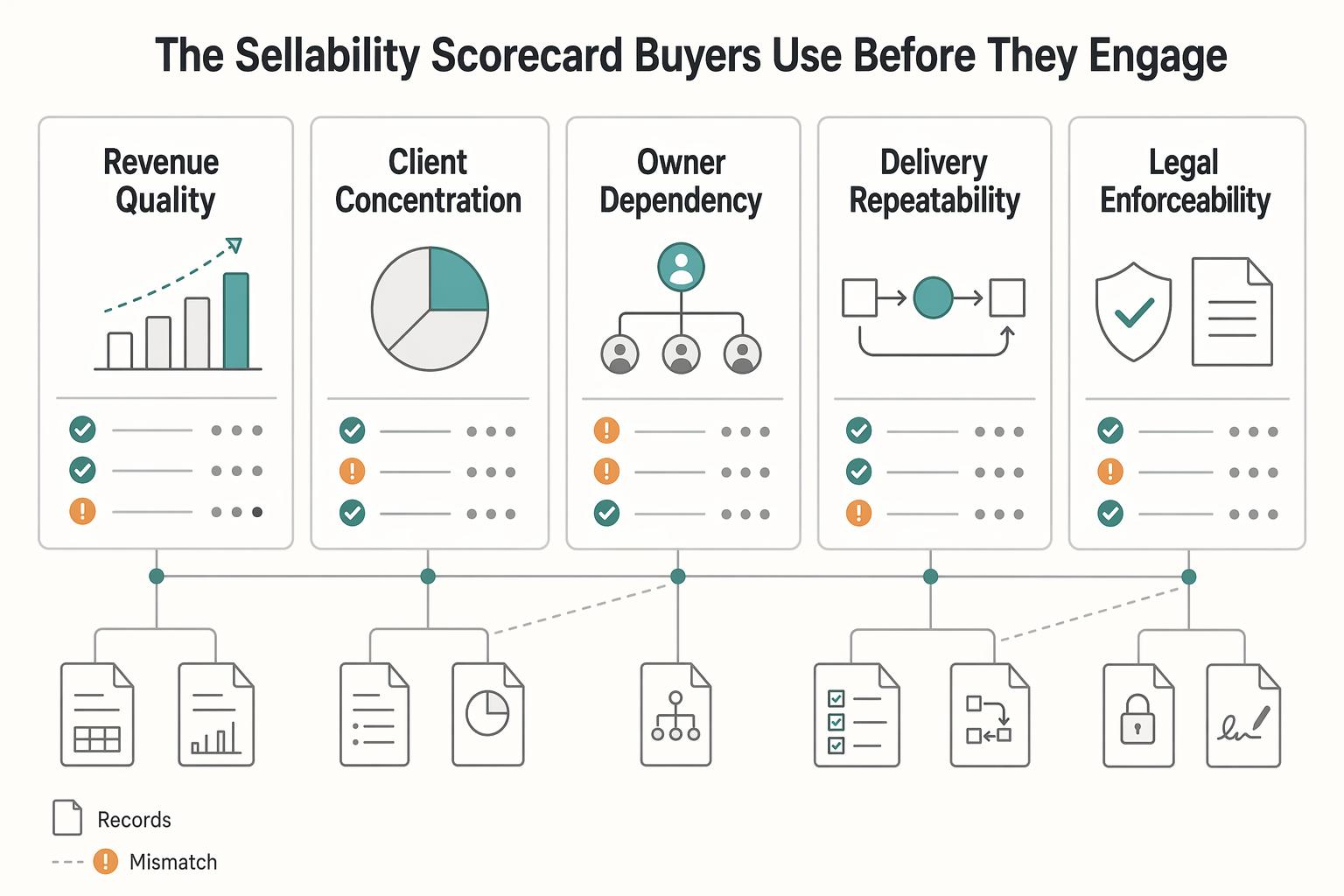
**When you sell your freelance business, buyers are paying for a reliable asset they can verify, transfer, and run, not for your personal hustle.** A common mistake is mixing advice about winning clients with advice about closing an acquisition. Those are different jobs. This guide is a sellability-to-close playbook designed to reduce surprises before buyer conversations begin.
How to Perform a Business Valuation for a Small Agency
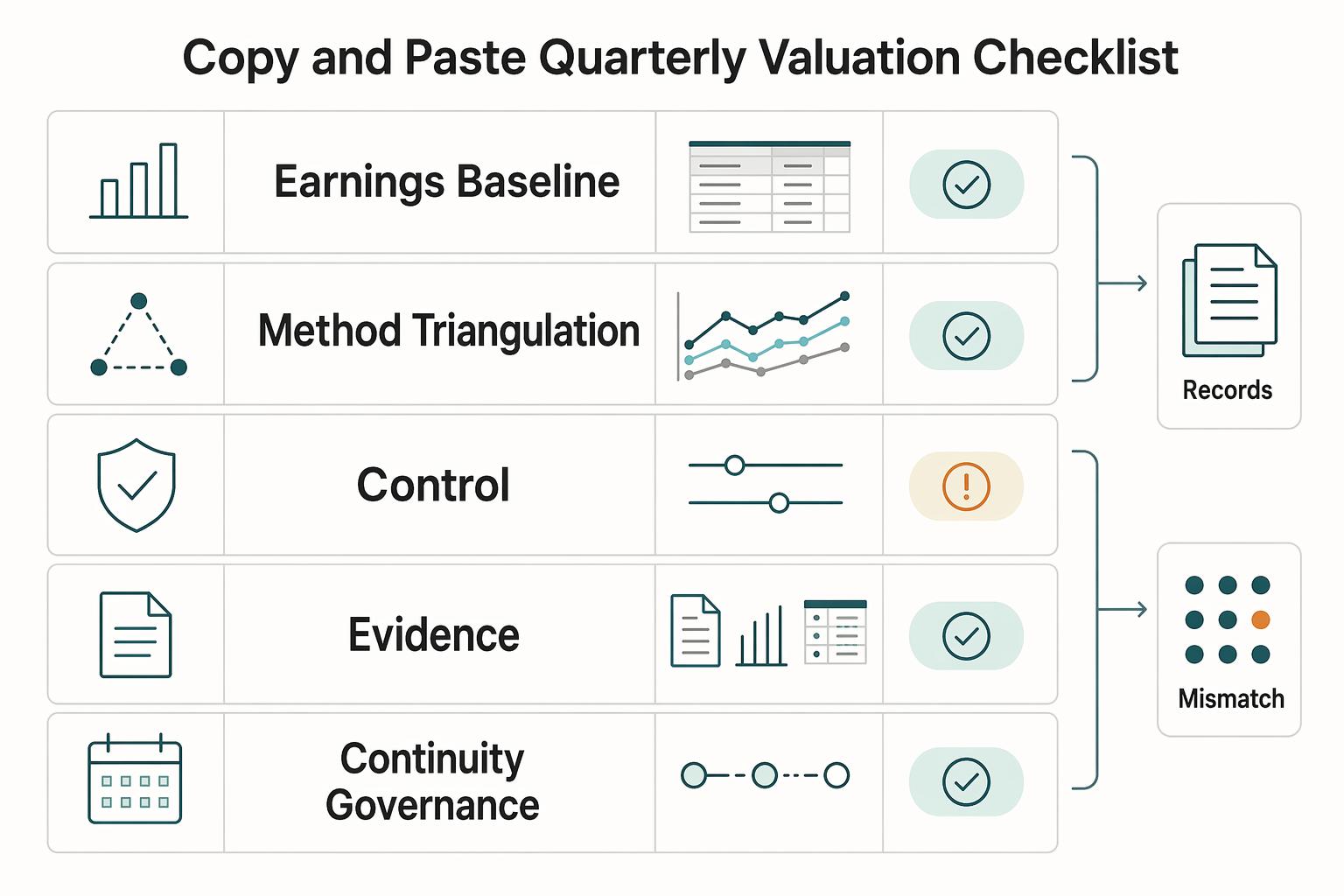
**Treat valuation for a small agency as a risk control system, not a headline multiple, and you are more likely to protect agency value before you ever start selling a business.**