
Quick Answer
For US business reserves, compare Live Oak Business Savings and Capital One Business Advantage Savings by fees, ongoing rate, and transfer holds. Ally Savings is a personal-savings candidate whose agreement prohibits business use. Keep imminent payments and an operating buffer in checking, and sweep only cleared, available, unrestricted surplus.
How to Compare High-Yield Savings Accounts as a Freelancer#
A freelancer needs two different kinds of savings: reserves belonging to the business and personal savings funded from properly recorded owner draws or pay. Start by identifying which money you are placing. A consumer HYSA may suit a personal emergency fund while prohibiting business transactions; business reserves need an account whose terms permit that use.
This US-focused comparison checks account structure, fees, transfer restrictions, and reserve rules before yield. It covers two business savings candidates and one personal savings candidate. It is a shortlist based on published terms checked on 5 October 2026, not a hands-on ranking or a promise that every applicant qualifies.
Use this first-pass filter before you compare anything else:
- Access rule check: Read eligibility before you look at the APY card. Then confirm the account is easy to use online and practical for how you actually fund it. If opening or funding depends on complicated rules, keep looking.
- Friction cost check: Compare maintenance fees and exact waiver conditions. As an illustration, a $4.99 monthly fee costs $59.88 a year. On a constant $2,000 balance earning a hypothetical 3% APY, gross annual interest is $60; that fee nearly consumes it before tax. Actual rates, balances, and compounding can differ.
- Funding threshold check: Distinguish the opening deposit, ongoing fee-waiver balance, and amount needed to earn interest. Live Oak's business savings page states no minimum opening deposit, while Capital One's business savings page lists a $3 monthly fee waived with a $300 balance. Read each product's controlling terms.
Use business savings for the business's tax, refund, and emergency reserves when the account permits that use. Keep company funds out of your personal savings account. A sole proprietor also needs to follow the bank's permitted-use terms even though the business is not a separate legal person.
One last rule before the list: no roundup is complete, and terms change. Treat every recommendation as a candidate, not a verdict, and verify the current version before you move emergency funds.
How this list selects accounts and who it is for#
The accounts below serve US customers who can satisfy the bank's identity, residence, business, and application requirements. Being paid by US clients does not itself make a freelancer overseas eligible. If your account needs another currency or jurisdiction, compare a local business deposit product and its protection scheme instead.
Each option here has to clear four checks.
Profile fit. The account has to work with uneven inflows and regular tax set-asides, not just a clean payroll-style deposit pattern. If the design assumes steady pay cycles, it is a bad fit no matter how good the top-line yield looks.
Cost clarity. Monthly maintenance fee terms need to be explicit before you apply. A strong advertised rate is not very useful if the recurring cost is vague, buried, or scattered across multiple pages.
Eligibility clarity. Confirm that the bank accepts your business form and intended use. A payroll-linked bonus is optional; a prohibition on business use is a basic account restriction. Do not use support's informal interpretation to override the deposit agreement.
Cash access fit. Pair the reserve account with an operating checking account that supports your invoices, taxes, refunds, and contractor payments. Interest on checking is useful when available, but payment capability and available funds matter first.
That standard runs throughout this piece. Before you fund anything, capture the fee terms, minimum opening deposit, and eligibility language you saw on application day. If a rule is even slightly gray, ask support to confirm it in writing. If the answer is still fuzzy when you are ready to apply, move on. An unclear rule is enough reason to drop the account from the shortlist.
That is why the next section focuses on what to verify, not just what looks good at first glance. If you are still tightening how you bill and collect, try the free invoice generator.
A concrete savings shortlist for US freelancers#
The key distinction is business versus personal use. Rates are variable unless a particular offer guarantees them for a defined period. Check the live rate and your application disclosures; the table emphasizes terms that determine whether the account fits.
| Account | Money it can serve | Published fee and balance terms | Why shortlist it | Main access or eligibility check |
|---|---|---|---|---|
| Live Oak Business Savings | Business reserves | No monthly maintenance fee or minimum opening deposit; $0.01 balance to earn interest | An online business deposit account with external-account funding | Bank-initiated incoming ACH can have a five-business-day hold after posting; check cutoff and outgoing transfer timing |
| Capital One Business Advantage Savings | Business reserves | $3 monthly fee waived with a $300 balance; check the account disclosure's balance calculation | Worth comparing if you already use Capital One business checking | Promotional rate lasts three months, then a variable rate applies; check transaction limits, other fees, and post-promo rate |
| Ally Bank Savings | Personal savings after properly recorded draws or pay; not business reserves | No monthly maintenance fee or minimum opening deposit | Personal savings buckets can help separate household goals | Deposit agreement prohibits business use; certain withdrawals and transfers are limited to 10 per statement cycle |
Live Oak's business savings terms are a starting point when you want an online business reserve account without a maintenance-fee waiver. Its portal-initiated incoming ACH can take one to two business days to post and is held for five business days once posted. That distinction between earning interest and having spendable funds matters more than the advertised rate when a payment is due.
Capital One's business savings page is worth checking alongside an existing business checking relationship. Read the three-month promotional period separately from the ongoing variable rate. Confirm how its $300 fee-waiver balance is measured and the exact transfer limits in the account disclosure before deciding.
Best HYSA choices by freelancer profile#
The right choice depends on the job the account has to do. Most freelancers do better with a simple match between account type and money purpose than with a clever setup built around a short-lived rate.
| Profile | Best when | Tradeoff |
|---|---|---|
| Simple reserve saver for a solo sole proprietor | You want one reserve bucket with low friction and do not want to babysit multiple rules | You still need to re-check the rate because it can change |
| Variable-income saver for uneven months | Money lands in bursts rather than on a payroll cycle, and the account needs to stay useful even when deposits are irregular | Promo-style benefits can be harder to keep if the conditions are narrow |
| Split-goal setup for taxes, emergency fund, and short-term buffer | You want a cleaner line between spending cash and reserve cash, often alongside an interest-bearing checking account | You have to manage transfer timing across accounts and keep the rules consistent |
Business reserve saver. Compare Live Oak with Capital One when you need money titled and used for the business. The decision is fee and access fit, not an assumption that either is always the highest-yielding bank. A new transfer hold can make an otherwise useful reserve account unsuitable for money due this week.
Variable-income saver. Favor base terms you can meet in a weak month. Check whether the business account remains fee-efficient when you pause deposits or reduce the balance. Separate optional bonuses from normal interest, and compare the ongoing rate after any introductory period ends.
Personal split-goal saver. Ally Savings offers personal savings buckets, no monthly maintenance fee, and no minimum opening deposit. Its deposit agreement prohibits business use. Use it only for permitted personal purposes, not business refunds or contractor payments. Buckets organize one account; they do not create additional deposit insurance.
Save the account agreement, fee schedule, and dated rate disclosure for your exact product. A brand name may cover several personal and business products with different restrictions. A familiar bank or a sponsored comparison position is not evidence that a particular account permits your use.
Once you know which profile matches your business, the next decision is operational: how much money should sit in savings and how much should stay immediately available in checking.
Savings versus checking: protect payment access#
Keep money needed for imminent bills, refunds, taxes, and contractor payouts in operating checking or move it back early enough to cover transfer delays. Savings is appropriate for reserves that can wait through that account's actual availability window. Interest-bearing checking can help, but earning interest is secondary to paying on time.
This is a liquidity-versus-yield tradeoff, not a judgment about which account type is better. A savings account can offer more APY, but the terms may include transfer or withdrawal limits, and rates vary across banks. The goal is not to squeeze every dollar into the highest posted yield at all times. The goal is to make sure the right cash is in the right place when invoices, bills, taxes, refunds, or contractor payouts hit.
When cash flow is volatile, lean toward a larger operating buffer in checking. That protects near-term obligations from access constraints and gives you room for timing surprises. A higher rate on reserve money will not help if a transfer delay turns into a missed payment or forces you to reshuffle cash at the worst moment. If you keep pulling reserve money back within days, your checking buffer is probably too small.
When operating obligations and the near-term buffer are covered, move eligible reserves into business savings. Tax money still has a due date: schedule its return to checking before payment, allowing for weekends, holidays, holds, and your payment method. Never treat customer-held or otherwise restricted funds as unrestricted reserve cash.
FDIC coverage is generally $250,000 per depositor, per insured bank, per ownership category. A sole proprietor's business deposits aggregate with that owner's other single-ownership deposits at the same bank. Opening separate tax and emergency accounts does not by itself multiply coverage. Use the FDIC estimator for your actual ownership and balances.
A practical setup is operating checking plus a permitted-use reserve account, with an internal schedule for each reserve's purpose and due date. Personal emergency savings can sit separately after properly recorded transfers to the owner; do not use that separation as a reason to move company obligations into a consumer account.
How to handle direct deposit and opening requirements without a W-2#
Opening rules are where self-employed applicants lose the most time. Treat eligibility language as a pass-or-fail screen. If an account depends on employer-style payroll behavior you cannot meet, take it off the shortlist before you spend another minute on it.
Use this order before you apply:
- Read direct deposit terms first. Check whether benefits require a specific source, cadence, or deposit type. "Direct deposit" can mean more than one thing in bank copy, so do not assume your self-employed inflows count. If the wording is unclear, ask support to define qualifying deposits in writing.
- Check the minimum opening deposit next. Confirm the amount and timing so opening the account does not crowd your operating cash. A low threshold on paper is only helpful if you can meet it without tightening the rest of the month.
- Review fee-waiver and bonus conditions last. Check source, amount, timing, and required holding period in the offer itself. Bank definitions of qualifying direct deposit do not follow automatically from your IRS worker classification.
A displayed promotional APY is an annualized yield, not the interest you will receive in a three-month promotion. Compare the promotional period, subsequent rate, eligibility, fees, and likely holding period together. Do not build a permanent reserve rule around an introductory offer.
In practice, a clear self-funding path and stable ongoing terms are usually safer than promo mechanics you may not be able to keep. The less your setup depends on a narrow interpretation of "qualifying deposit," the less likely it is to break later.
Before you hit submit, keep a small evidence file:
- Save the terms language for direct deposit, minimum opening deposit, APY conditions, bonus conditions, and monthly maintenance fees as a screenshot or PDF.
- Get written support confirmation for any ambiguous rule before funding.
- Run a small first-transfer test and verify posting behavior before moving emergency reserves.
The goal is not paperwork for its own sake. It is to preserve the exact version of the offer you relied on in case the live page changes or a later support answer conflicts with what you saw.
If a key requirement is still unclear after that, treat the ambiguity as the answer and move on. Once an account clears this screen, you can build your money flow around terms you can actually keep.
Build your get-paid system around the HYSA choice#
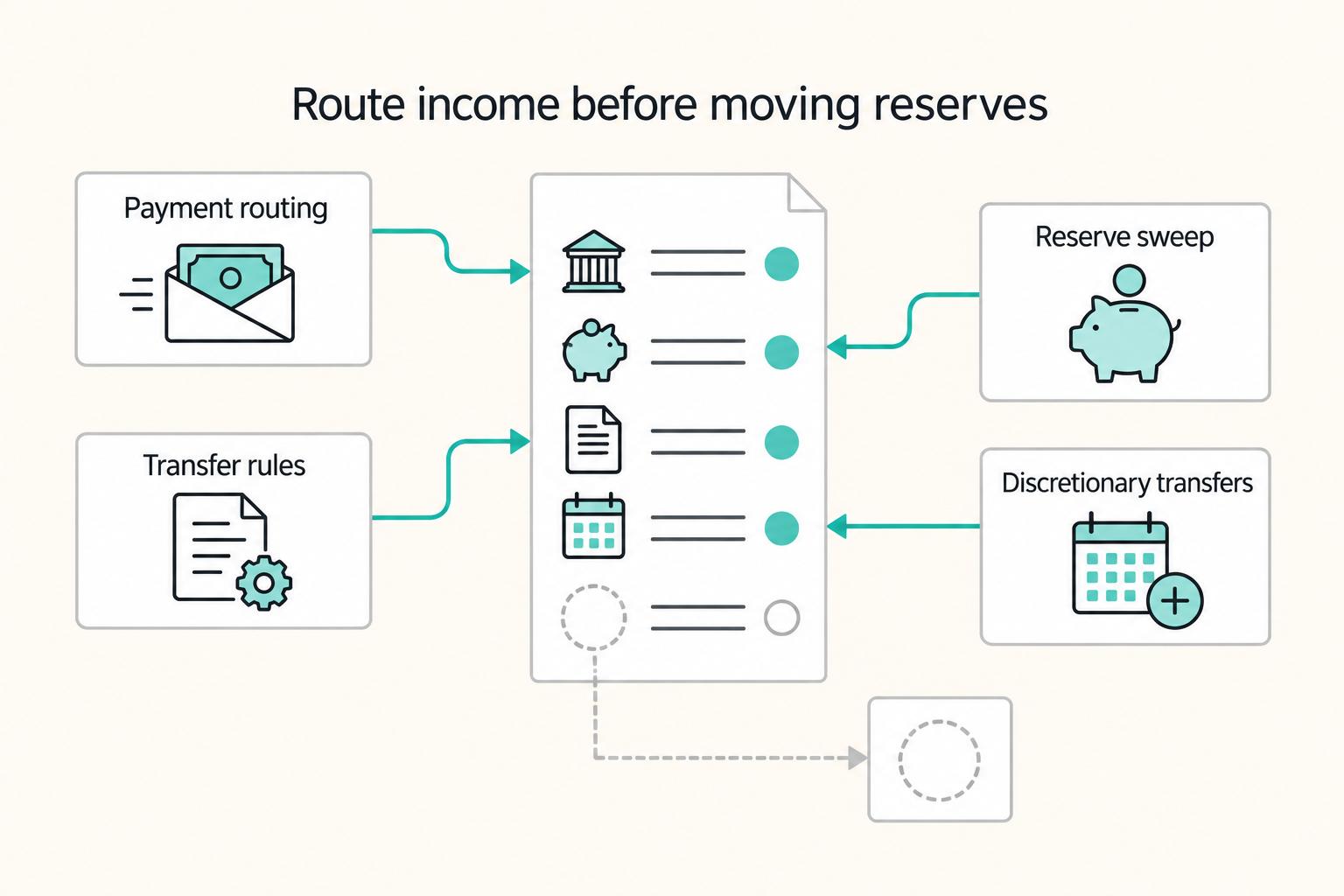
Reserve sweeps should be based on cleared, available, unrestricted cash and obligations you have already committed to pay. A received invoice or processor balance is not a substitute for spendable bank funds.
The working sequence is simple: client funds land, operating needs are covered, reserve money moves to savings, and only then do lower-priority transfers happen. That order matters more than squeezing out a little more APY. It protects bills and taxes first, and it keeps your reserve habit tied to settled cash rather than hopeful projections.
- Route incoming client payments to your operating account first. Let funds settle there so near-term obligations are handled before reserve transfers begin. This matters even more when payout timing is not perfectly predictable.
- Move reserves using an operating-floor rule. Subtract committed near-term obligations and a chosen operating buffer from available unrestricted cash. Cap each sweep at the remaining surplus. A percentage-of-receipts habit may help fund tax reserves, but it must not override this cash constraint.
- Set transfer rules from actual access terms. Keep money needed during a bank's hold or transfer window in checking. Initiate transfers back from savings before due dates, allowing for cutoffs, weekends, holidays, and an additional buffer that fits your experience.
- Schedule noncritical transfers last. Keep discretionary outflows behind operating and reserve steps so lower-priority spending does not eat the buffer you actually need.
Worked example: checking has $20,000 of cleared, unrestricted cash. Over the next two weeks you owe $4,000 to contractors, $3,000 for operating bills, $2,000 for taxes, and expect $1,000 in refunds. With a $5,000 operating buffer, the floor is $15,000, leaving a maximum $5,000 sweep. Keep the imminent $2,000 tax payment inside the floor; it must not also be swept to a tax bucket. If another $3,000 invoice is still unpaid, do not include it in today's surplus.
A bank deposit, a fintech balance, and a money-market investment are different structures. For a deposit-placement program, identify the receiving banks, when placement occurs, pass-through insurance conditions, and your other deposits at those banks. Do not assume an advertised aggregate insurance limit protects every balance before settlement or duplicates coverage you already use.
Set return triggers as well as sweeps. Pause outward reserve transfers if available checking would fall below the operating floor. If upcoming obligations rise, initiate a transfer back while the bank's timing still leaves room before the due date. Keep transfers pending until confirmed available; a transfer instruction alone cannot fund a payout.
Red flags that disqualify an account before you apply#
Some problems are not worth troubleshooting. If you cannot pin down one clear, binding version of the key terms, disqualify the account before you apply.
| Red flag | What it means | Action |
|---|---|---|
| Fee language conflicts across pages | Monthly maintenance fee or waiver wording differs between the product page and the account agreement | Stop until one controlling version is clear |
| Direct deposit wording is unclear for self-employed income | A direct-deposit requirement is listed but not clearly defined for your situation | Treat it as a no until you have written terms that say otherwise |
| Minimum opening deposit would strain cash flow | The opening requirement forces you to tighten operating cash too far | Disqualify it even if the rate looks good |
| Ranking-page claims are not traceable to policy text | A roundup or forum claim cannot be matched to the account's own terms | Do not use it for a final decision |
The most common deal-breakers are these:
- Fee language conflicts across pages. If monthly maintenance fee or waiver wording differs between the product page and the account agreement, stop until one controlling version is clear. You do not want to discover after funding that the cheaper interpretation was just marketing shorthand.
- Direct deposit wording is unclear for self-employed income. If a direct-deposit requirement is listed but not clearly defined for your situation, treat it as a no until you have written terms that say otherwise.
- The minimum opening deposit would strain cash flow. If the opening requirement forces you to tighten operating cash too far, it is the wrong fit even if the rate looks good. Good reserve habits should reduce stress, not create it.
- Ranking-page claims are not traceable to policy text. If a roundup or forum claim cannot be matched to the account's own terms, do not use it for a final decision.
These are not small technicalities. They are the points where a seemingly good account turns into avoidable admin and cash stress.
Before applying, save a compact evidence pack: the account agreement, fee table, direct-deposit language, and a timestamped product-page screenshot. That file gives you something concrete to compare against if a term changes or a support answer conflicts with what you saw.
Bank interest is generally taxable in the US. IRS interest-income guidance says to report taxable interest even if you do not receive Form 1099-INT. Include that tax effect when comparing net yield and keep the bank's statements with your records.
Final pick strategy for your next account review#
When it is time to choose, keep the review boring and repeatable. Protect cash flow first, then optimize APY. Done well, this should be a quick, disciplined review, not a research project that drags on while your reserve money sits in the wrong place.
Shortlist two or three accounts whose terms permit your intended use. For US business reserves, compare Live Oak Business Savings and Capital One Business Advantage Savings; add another business product if its fees and access suit your setup. Ally belongs on a separate personal-savings shortlist, not the business reserve list.
Verify the controlling terms for your account and region: permitted use, opening amount, maintenance fees, ongoing APY, balance tiers, transfer limits, and availability holds. For a promotion, record both its end date and the subsequent rate rather than treating the displayed APY as permanent.
Then run a small first-transfer test. Move a modest amount and see whether the timing works with your actual payment cycle. If timing feels tight, keep more in checking and less in savings. That is not failure. It is a cleaner match between liquidity needs and reserve goals.
Finally, set your operating and reserve split. Define a simple rule for what stays liquid and what moves to savings after core obligations are covered. A repeatable rule is usually safer than chasing a perfect forecast or rearranging money every time a client pays early or late.
Compare interest in dollars. On a hypothetical constant $10,000 balance, 3.5% versus 3.0% APY is about $50 of additional gross interest over a year if both rates remain unchanged. That gain should not justify risking a missed payment, losing a fee waiver, or funding an account that prohibits business use.
Run this checklist on a fixed review cadence, for example quarterly, and again after major income-pattern changes. If terms or timing no longer fit, adjust early before it becomes a payment problem.
Frequently Asked Questions
Do HYSAs require direct deposit if you are self-employed?
Not always. Some accounts do not require direct deposit at all, while some bonuses or boosted rates do. The key issue is the qualifying deposit definition, not the headline marketing. Separate the basic usability of the account from the optional perk. If self-employed income or self-funded transfers are not clearly addressed, ask for written confirmation before you apply. If you cannot get that clarity, choose an account that still works without the direct-deposit feature.
What minimum opening deposit is realistic for uneven freelance income?
A realistic opening deposit is one you can fund while retaining the operating floor. Distinguish it from a fee-waiver balance and the amount needed to earn interest. A low opening minimum is not useful if the transfer holds funds you need for an imminent contractor payment.
Should freelancers keep money in HYSA, interest-bearing checking, or both?
Use operating checking for near-term obligations and a permitted-use savings account for reserves that can tolerate its access window. An interest-bearing checking account is optional. Keep personal savings separate from business obligations, and schedule tax-reserve transfers back before the payment due date.
Which fees matter most when picking a HYSA for freelance cash management?
Compare maintenance fees and waiver conditions first, then ACH or wire charges, withdrawal limits, and any charges your actual funding route incurs. Compare promotional and ongoing rates separately. Use the balance you expect to hold, not an optimistic future balance, when estimating interest after fees and tax.
How do you verify a best-account recommendation before opening?
Save the bank's current account agreement, fee schedule, rate disclosure, and promotional terms. Confirm business or personal use, applicant eligibility, deposit insurance ownership, and transfer holds. Then test a small inbound and outbound transfer; avoid moving the main operating buffer until you know when the money becomes available.
Can a sole proprietor qualify for the same terms as W-2 employees?
Sometimes, but do not assume it. Terms can differ by account type and by how deposits are classified. If an offer seems built around employee wage flows, verify each requirement against your self-employed setup before you rely on the rate, fee waiver, or bonus. The safer path is to choose an account whose base terms work for you even if the employee-style perk never applies.
Try a related tool
Researched and edited by the Gruv editorial team. Gruv builds cross-border billing, payouts, and finance-operations software for global businesses.
Sources
Includes 4 external sources outside the trusted-domain allowlist.
Educational content only. Not legal, tax, or financial advice.
Related Posts

The Freelance Payment Penalty: A Modeled Audit of Platform Fees, FX Spreads, and Payout Delays
The money rarely disappears through a single, easy-to-spot fee. The real loss is stacked. A marketplace takes its commission, a processor adds a charge for international cards, a bank or payment company converts the currency at a spread, a platform holds the funds before release, and a wire sheds a little to intermediaries on the way in. Each layer looks defensible on its own, but the worker feels the combined result as a smaller deposit and a later payday.

How to Respond to a Subpoena for Business Records
Move fast, but do not produce records on instinct. If you need to **respond to a subpoena for business records**, your immediate job is to control deadlines, preserve records, and make any later production defensible.
A US Expat's Guide to Investing in UCITS ETFs to Avoid PFIC Issues
The real problem is a two-system conflict. U.S. tax treatment can punish the wrong fund choice, while local product-access constraints can block the funds you want to buy in the first place. For **us expat ucits etfs**, the practical question is not "Which product is best?" It is "What can I access, report, and keep doing every year without guessing?" Use this four-part filter before any trade: