
Quick Answer
Start with sequence, not popularity: the best cities for work life balance are the ones that pass legal stay checks, realistic monthly budget tests, and your actual workweek constraints. On the current shortlist, Copenhagen, Helsinki, Oslo, and U.S. options like Minneapolis and St. Paul stay provisional until you verify visa or status requirements, housing and healthcare details, and commute reality. Use one comparison table, pick a primary city plus fallback, and execute the 90-day checklist before committing to leases or flights.
What This List Solves for Remote Professionals in 2026#
Use this as a decision tool, not a travel ranking. If you are relocating for better balance, work in the safest order: legal stay viability first, monthly affordability second, and weekly pace third. Get that order wrong and you usually pay for it later.
That sequence matters even more in 2026 because the signal is noisy. Forbes cites MBO Partners at about 18.5 million Americans identifying as digital nomads, up 153% since 2019. More people moving means more rankings, more threads, and more confident opinions built on partial context. Those inputs can help you discover options, but on their own they are not strong enough to justify deposits, flights, or a long-stay lease.
The common failure mode is not choosing a clearly bad city. It is choosing in the wrong order and calling it progress. CoworkingCafe found 69% of remote workers said balance improved, but the same survey of 1,140 remote and hybrid workers also reported one in three experienced burnout, 44% worked longer hours, and 60% reported more personal time. That mixed picture is the real warning. A city can look great in broad remote-work coverage and still fail under your actual schedule, budget, and legal constraints.
In practice, relocations drift when lifestyle excitement becomes the first commitment and the hard checks get delayed. Someone falls in love with a neighborhood, a ranking, or a social media version of the week they want, then discovers later that the stay pathway is unclear or the monthly burn only worked on an optimistic spreadsheet. The fix is simple: lock the constraints that can stop the move, then compare only places that survive those checks.
A place that feels balanced on a short visit can feel very different once you add client calls, groceries, admin, and the recovery time you actually need. That is why this piece stays focused on repeatable weeks, not aspirational weekends. Legal and cash mistakes are expensive to unwind. Pace and routine issues can usually be tested earlier, as long as you do not skip the harder checks first.
Use three gates before any city becomes a real candidate:
- Legal stay viability: Confirm a stable path to enter and remain before you shortlist.
- Month-to-month cost reality: Build your actual monthly burn with a low-to-high range before you commit.
- Work rhythm and recovery fit: Test overlap hours, focus windows, and off-hour recovery so the week stays sustainable.
One mindset helps at this stage. You are not trying to pick the most impressive city. You are trying to pick the least fragile setup that still gives you a week you can repeat. If one gate fails, the city is not wrong forever. It is just not ready for commitment now.
This article stays intentionally narrow. It is for remote professionals planning relocation or extended stays, not short tourist trips. The practical outcome is one primary city and one fallback that both clear legal and financial checks and still support a repeatable week. Once you work in that order, decisions get cleaner and the stress level drops.
The next step is to build a shortlist that can survive scrutiny. That is what the selection method does. However, if your immediate planning horizon is a winter relocation window, run the same filters against Best Digital Nomad Cities for Winter Sun before committing.
How to Choose a Work Life Balance City Without Guessing#
Start by disqualifying cities, not romanticizing them. Rankings are useful for option discovery, but they get expensive when you treat them like proof.
Use a strict four-filter screen and stop at the first failure. That one habit saves time, money, and the kind of spreadsheet work that only exists to justify a city you already want. If a place fails an early gate, remove it and move on. You can always revisit later if new evidence appears.
Use this order every time:
- Legal stay pathway: If your path to enter and remain is unclear, remove the city.
- Real monthly cost: Model a normal month with a low-to-high range, not one optimistic estimate.
- Workday and time-zone fit: Test real overlap with your team or clients before housing decisions.
- Recovery lifestyle access: Choose a week you can sustain, not a city that only performs on weekends.
| Gate | Minimum evidence | Pass signal | No-go signal |
|---|---|---|---|
| Legal stay pathway | Current rule source plus your case notes | Clear status and required document path | Unknown route, missing requirements, or conflicting notes |
| Monthly cost reality | Two current housing comps and full month-one budget | Positive month-one and steady-state buffer | Budget fails once setup and recurring costs are included |
| Workday and recovery fit | Calendar overlap test and commute trial | Core work blocks and recovery windows both hold | Commute or timing breaks repeatable weekly delivery |
To keep yourself honest, build one evidence page per city. Limit it to four fields: visa pathway notes, housing range, healthcare entry requirements, and coworking commute pattern. Those four fields usually expose weak options quickly. They also force the city back onto facts. Visa notes tell you whether the stay is even possible. Housing range shows whether the monthly model survives real listings. Healthcare entry requirements catch admin friction that often surfaces late. Coworking commute pattern reveals whether the week is workable beyond theory. If legal-pathway notes are still thin, use The 2026 Global Digital Nomad Visa Index for 50+ Countries and the Digital Nomad Visa Cheatsheet as discovery inputs before you spend.
If any field is incomplete, keep the city pending and move on. Do not fill the gap with assumptions because the place still feels attractive. Pending should feel neutral, not like failure. It only means the city has not earned commitment yet.
Date-stamp every evidence page and set a recheck date. That small step prevents a common error: stale notes quietly becoming assumed facts when you revisit the shortlist. Most planning failures at this stage are not dramatic. They are small outdated assumptions that compound.
When rankings conflict, compare method before score. One widely cited comparison covered 50 cities and used work intensity, society and institutions, and city livability, while also considering pandemic impact. That can still be useful context, but only as one input. A broad global comparison and a domestic affordability ranking are not trying to answer the same question. Treat listicles as low confidence when criteria are unclear, country coverage is uneven, or the comparison leans on older context such as 2021 rather than current validation.
A practical rule is simple: no complete evidence page, no shortlist slot. If you want to move faster without getting sloppy, add one more discipline. Each time you reopen a city, ask whether any of the four fields changed since your last review. If the answer is unclear, re-verify before doing anything else.
This process can feel strict, but it usually speeds up good decisions. By the time a place reaches your real shortlist, you should know exactly what still needs proof and exactly what would knock it out.
Compare the Shortlist Fast Before You Commit#
Use this table for triage, not a final ranking. Its job is to sort candidates quickly, show where evidence is still thin, and tell you where verification time will pay off before you spend money.
Each row remains provisional until you verify legal stay, housing, healthcare entry, and commute reality for your case. That matters because several cities here carry strong reputation value but limited confirmed detail. A low-confidence row is not a rejection. It means the city is still in evidence-gathering mode.
| City | Best for | Legal-stay friction | Cost pressure | Time-zone fit | Burnout risk | Who should skip it | Confidence |
|---|---|---|---|---|---|---|---|
| Copenhagen | Readers testing a quality-of-life and work-infrastructure shortlist | Not confirmed. Verify pathway and renewals directly. | Not established. Build a local monthly range. | Not established. Test against your real calendar. | Depends on workload and recovery setup. | Anyone booking before legal and cost checks are complete. | Low |
| Helsinki | Readers testing a quality-of-life and work-infrastructure shortlist | Not confirmed. Verify pathway and renewals directly. | Not established. Build a local monthly range. | Not established. Test against your real calendar. | Depends on workload and recovery setup. | Anyone booking before legal and cost checks are complete. | Low |
| Oslo | Readers testing a quality-of-life and work-infrastructure shortlist | Not confirmed. Verify pathway and renewals directly. | Not established. Build a local monthly range. | Not established. Test against your real calendar. | Depends on workload and recovery setup. | Anyone booking before legal and cost checks are complete. | Low |
| Minneapolis, MN | U.S.-based tradeoff shoppers comparing practical setup options | Not confirmed. Verify your own status requirements. | Not established. Check by neighborhood. | Not established. Test overlap with your team or client hours. | Depends on commute, workload, and routines. | Anyone treating shortlist mentions as proof of fit. | Low |
| St. Paul, MN | U.S.-based tradeoff shoppers comparing practical setup options | Not confirmed. Verify your own status requirements. | Not established. Check by neighborhood. | Not established. Test overlap with your team or client hours. | Depends on commute, workload, and routines. | Anyone treating shortlist mentions as proof of fit. | Low |
| Omaha, NE | Cost-structure comparisons where you need hard local quotes before deciding | Not confirmed. Verify your own status requirements. | One U.S. guide cites coworking day passes around $20-$35. City-level verification is still required. | Not established. Test your schedule directly. | Depends on workload and boundary control. | Anyone choosing on one data point alone. | Low |
| Madison, WI | Mid-size U.S. option to validate with process, not list placement alone | Not confirmed. Verify your own status requirements. | One U.S. guide cites studios outside core downtowns around $1,000-$1,500. Local validation is required. | Not established. Test your schedule directly. | Depends on workload, routines, and local fit. | Anyone skipping local verification steps. | Medium-Low |
| Buffalo, NY | Tradeoff comparisons where shortlist confidence is currently limited | Not confirmed. Verify your own status requirements. | Not established. Check by neighborhood. | Not established. Test overlap with your team or client hours. | Depends on commute, workload, and routines. | Anyone treating shortlist mentions as proof of fit. | Low |
The confidence column measures certainty of evidence, not city quality. A Low row can still become your best option after verification. That is the point of triage. You are not trying to crown a winner yet. You are deciding where verification effort is justified.
Read each row left to right as a risk scan. If three or more fields still read as not established, treat that city as an idea, not a near-term move. If only one field is unresolved and it can be closed quickly, keep the city active and finish the task. A city does not need a perfect row to stay alive. It needs a row where the remaining uncertainty is narrow, specific, and cheap to close.
For each Low or Medium-Low row, open these four tasks before you book anything:
- Legal document check.
- Two housing comps from your target areas.
- Healthcare entry requirement check.
- One real commute test during your expected work window.
If one task fails, remove the city and move to your fallback. That pass-fail discipline protects you from sunk-cost thinking. It also prevents the most common planning trap at this stage: spending energy defending a city because you already imagined yourself there.
Define what counts as complete before you start. A housing comp is not complete when you have a rough price memory. It is complete when you have two current examples in the neighborhoods you would actually consider and the numbers fit your monthly model. Apply the same standard to legal, healthcare, and commute checks. The moment you find yourself explaining away two or three weak fields, the shortlist is telling you something.
Once you tighten the shortlist this way, the city sections below become decision notes you can act on, not inspiration you need to debate.
Copenhagen for Balanced Structure and International Access#
Keep Copenhagen on your final shortlist only if you have documented legal-stay and tax checkpoints. Its clearest confirmed advantage is administrative clarity for certain cross-border VAT situations, not a full relocation case on its own.
That distinction matters. A city can look organized and internationally connected, but those strengths do not answer the two commitment questions that actually decide the move: can you stay, and can you operate cleanly once you arrive? For Copenhagen, the strongest supported value sits on the operating side.
Denmark is listed in the VAT Cross-border Rulings project. A VAT-registered business can request an advance ruling on complex cross-border VAT treatment. If your invoicing spans multiple EU contexts, that can reduce filing uncertainty before major housing commitments. It does not grant immigration permission, and it does not replace local stay verification.
Use this pass-fail sequence if billing structure is part of your case for moving there:
- Confirm whether your invoicing pattern is complex enough to justify a CBR request in the EU country where you are VAT-registered.
- Verify whether your Union turnover is within the EUR 100,000 cap in the current and previous calendar year for the cross-border SME scheme.
- If relevant, confirm prior notification and EX number handling in your Member State of establishment.
- Plan for up to 35 working days for cross-border SME registration handling after notification receipt.
- Confirm whether your activity fits One Stop Shop registration in one Member State and whether the EUR 10,000 threshold applies to your cross-border VAT e-commerce obligations.
Treat that sequence as a filter, not paperwork for its own sake. If your billing setup is simple, these tax points may not be the reason to choose Copenhagen. If your billing setup is complex, they matter before you tie yourself to rent and deposits. The practical takeaway is narrow but useful: if invoicing structure is one reason the city is attractive, document that first.
After that, run separate lifestyle verification through schedule overlap, commute reality, and week-to-week recovery, because those points are not established. Copenhagen can still be the right choice. It just has to clear the same hard gates as every other option.
Carry that same discipline into Helsinki and Oslo so the comparison stays consistent.
Helsinki for Deep Focus and Lower Noise Workweeks#
Put Helsinki near the top if your week depends more on deep focus, predictable routines, and lower ambient noise than on dense in-person networking. If relationship-heavy in-person work is the main constraint, keep Copenhagen ahead and treat Helsinki as the alternative.
That is the core tradeoff. The choice is less about city branding and more about the work pattern you need to protect. If your outcomes depend on long uninterrupted blocks and a calmer rhythm, Helsinki deserves serious consideration. If your outcomes depend on frequent meetings, event density, or steady in-person touchpoints, those same strengths can become limitations.
The migration signal supports caution with broad assumptions. Across the Nordic region, remote work-era migration shifted away from inner urban areas toward outer urban and near-urban rural areas from 2020 to 2021, then returned toward pre-pandemic patterns by 2022. The same source notes that implications for urban cores are difficult to track. The short version is that movement patterns changed during the remote-work shock and then partly normalized, which is another reason to keep headline rankings secondary to a trial of your own week.
Before you sign housing, pressure-test weekly reality:
- Run a focus trial against your real client or team calendar and track deep-work hours, interruptions, and end-of-day fatigue.
- Include a seasonality check for daylight and climate shifts, then note whether output or mood changes.
- Schedule recurring social anchors early, such as coworking days or hobby groups, and watch for isolation-related performance drag.
Those logs matter more than a general reputation for calm. What counts is whether your own week shows steady output and manageable fatigue under normal load. If it does, that is a stronger signal than any headline score. If it does not, the city may still be appealing, but it is not solving the problem you are trying to fix.
If Helsinki passes those checks and still leaves room in your budget model, keep it active. If not, do not force it because it looked right on paper. A calmer rhythm only helps if it actually improves the workweek you need to repeat.
Oslo for High Earning Potential With a Cost Tradeoff#
Oslo is the highest-upside option here only when your net income can absorb higher recurring costs and larger upfront rental cash requirements. If budget control is tight, Helsinki is usually the safer operational choice in this comparison.
This is where reputation and day-to-day reality often diverge. Oslo appears strongly in work-life coverage, including a 2022 summary of Kisi research that placed it first with a 100 percent score on a multi-factor scale. That is useful directional context, but it is not proof for 2026 decisions. The harder inputs are purchasing power, taxes, and month-one cash exposure.
One Oslo comparison page reports a 41% tax rate, about $86,701 median salary, about $51,414 net salary, 57% lower purchasing power versus Denver, and a 12% higher cost of living. Those figures do not make Oslo a bad option. They show where the pressure lands. If your income profile is strong enough, Oslo may still be worth it. If it is not, setup stress can erase the lifestyle upside early.
| City option | Best fit | Watch-out |
|---|---|---|
| Oslo | Higher earners seeking a stable week and strong post-work city options. | Higher recurring costs and heavier upfront cash requirements. |
| Helsinki | Remote workers optimizing for tighter monthly burn and predictable routines. | Less upside if your top priority is premium-city access. |
Run a strict budget pass-fail test before you commit:
- Start with the Norway estimate of 20,000 to 40,000 NOK per month for one person.
- Replace each line with your own quotes for rent, food, transport, insurance, and setup costs.
- Add rental deposit exposure of three to six months rent.
- Validate month-one and steady-state cash flow using net pay, not gross pay.
Gross salary headlines can hide the real issue here. What matters is how much cash remains after taxes and how much gets tied up before the first month settles. The common mistake in Oslo is not a small miss in monthly totals. It is underestimating how much cash gets locked up early and how quickly that compresses your margin for error.
If the model fails on net cash flow, delay the move. A delayed start is cheaper than a forced reset. If the model works after deposit exposure and recurring costs are both accounted for, Oslo deserves a serious look.
And if cost pressure pushes the international plan out of reach for now, that is your cue to consider a U.S. base as a strategic bridge, not as a retreat.
When a United States Base Is the Better Move#
A U.S. base is often the better move when visa timing is uncertain and continuity matters more than international upside right now. In that situation, legal simplicity and faster setup usually beat a cross-border plan that is still half verified.
That does not mean settling for less. It usually means reducing moving parts while protecting income continuity and operational stability. A domestic setup can lower administrative drag and give you room to revisit international options later with better evidence. It also lets you fix one layer at a time. You can adjust neighborhood, commute, and monthly burn without solving cross-border admin at the same moment.
Ranking lists still help, but they are not one shared scoreboard. A global index states it is not a livability ranking and is not intended to identify the best cities to work in. U.S.-focused lists usually weigh affordability, commute patterns, and local lifestyle factors. Read them as different tools for different questions, not as competing final answers.
Use this U.S. shortlist with explicit tradeoffs:
- Minneapolis, MN: Included in the leading trio of a recent U.S. ranking. Key differentiator: balance signals tied to affordability and commute conditions.
- St. Paul, MN: Part of the same leading trio. Key differentiator: similar profile to Minneapolis if you want Twin Cities access before choosing a neighborhood.
- Omaha, NE: Also in that top trio. Key differentiator: lower-friction setup for simpler monthly planning.
- Madison, WI: Highlighted in a mental health framing. Key differentiator: stronger fit when recovery quality is your top criterion.
- Lincoln, NE: Featured as a dedicated subsection in another U.S. ranking article. Key differentiator: smaller-market alternative before committing to a larger metro.
Treat each city as a candidate that still needs verification. Anecdotal forum picks are useful prompts, not proof. Let them generate questions, then test those questions against your own commute, housing, and budget checks. The point of the domestic shortlist is not that these places automatically win. It is that they may offer a cleaner starting point when your bigger risk is timing, not destination quality.
If timeline risk is high, pick the U.S. city that clears your legal and cash-flow checks now, then revisit cross-border options when hard facts are in place. This approach keeps optionality without forcing a premature international commitment.
At that point, the shortlist is only half the job. The move still succeeds or fails on execution, which is why the 90-day sequence matters.
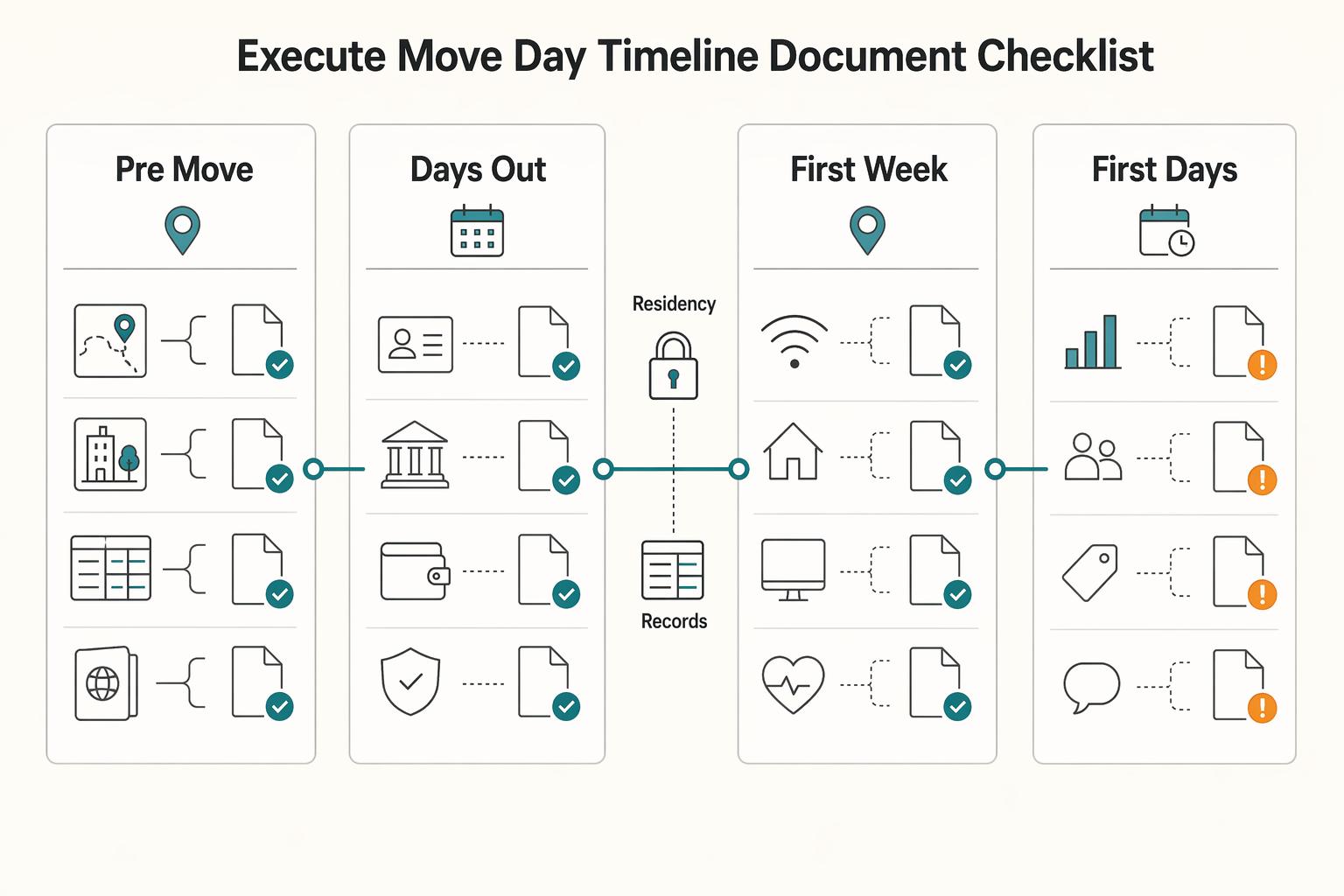
Execute the Move With a 90 Day Timeline and Document Checklist#
Treat relocation like a 90-day execution sequence, not a last-minute sprint. First-quarter stability usually depends less on enthusiasm and more on document discipline before departure.
| Phase | Timing | Key tasks |
|---|---|---|
| Pre-move phase | 90 to 31 days | Lock your city and housing shortlist; build a core document pack covering identity records, health coverage, lease options, and tax intake notes; capture filing status, expected foreign financial assets, and whether you may be a specified person for Form 8938. |
| 30 days out | 30 days out | Confirm legal stay pathway, set banking and payment rails, and map first month cash flow with a buffer; start an account value tracker for each account with institution, country, currency, and highest value. |
| First week on arrival | First week on arrival | Finish local admin tasks early, then verify work setup and commute reality against your planned schedule; run a quick burnout risk check so errands do not consume your core work blocks. |
| First 90 days | First 90 days | Set recurring tax watchpoints and reminders for FBAR, FinCEN, FATCA, and Form 8938 review; keep a simple evidence folder with statements, conversion notes, and residency records. |
A strong move follows a clear order: narrow city and housing options, lock legal and cash checks, then use arrival week and the first 90 days to confirm that real life matches the plan. Weak launches usually fail when those steps blur together and urgent tasks crowd out the important ones.
Use this timeline:
- Pre-move phase (90 to 31 days): Lock your city and housing shortlist. Build a core document pack covering identity records, health coverage, lease options, and tax intake notes. Capture filing status, expected foreign financial assets, and whether you may be a specified person for Form 8938. Treat
$50,000as a baseline figure for some filers, and remember thresholds are higher for joint filers and some taxpayers abroad. - 30 days out: Confirm legal stay pathway, set banking and payment rails, and map first month cash flow with a buffer. Start an account value tracker for each account with institution, country, currency, and highest value. For FinCEN-style reporting, value each account separately, convert non-U.S. currency with Treasury rates, and record amounts in U.S. dollars rounded up to the next whole dollar.
- First week on arrival: Finish local admin tasks early, then verify work setup and commute reality against your planned schedule. Run a quick burnout risk check so errands do not consume your core work blocks.
- First 90 days: Set recurring tax watchpoints and reminders for FBAR, FinCEN, FATCA, and Form 8938 review. Keep a simple evidence folder with statements, conversion notes, and residency records. Form 8938 is attached to your income tax return, and if you do not have to file an income tax return for the year, you do not need to file Form 8938.
The checklist does not need to be complex. It needs to answer basic questions quickly: what changed, when it changed, and which record supports it. A simple account tracker and one evidence folder usually beat scattered notes across email, screenshots, and browser tabs.
Before departure, run one document integrity check. Confirm that every critical decision has supporting paperwork in a single location, that file names are clear, and that anything time-sensitive is flagged. It is boring work, but it prevents avoidable confusion when deadlines and travel logistics stack up.
Use this section as a go-or-no-go checkpoint:
- If legal pathway details are still unclear at 30 days out, the move is not ready.
- If first month cash buffer works only when every assumption goes right, the move is not ready.
- If the first week turns into constant admin spillover, your setup assumptions were too loose.
- If reporting records are already messy in the first 90 days, fix the record process before year-end pressure builds.
Keep one running move log with date, decision, and supporting document, and review it at the same time each week during the first month. That habit catches drift before it becomes expensive. Store everything in one place from day one so later review is fast and year-end cleanup is manageable.
If checkpoints begin to slip, move the relocation date instead of forcing a weak launch.
Pick the City You Can Sustain Not Just the One You Can Name#
Choose the city you can operate in every week, not the one that wins a headline. Different rankings use different methods and time windows, so apparent contradictions are normal. Entrepreneur's summary reports a 25-city MoneyNerd comparison where Copenhagen was #1 in 2023, while CoworkingCafe's 2025 framing places Minneapolis, St. Paul, and Omaha at the top.
That is not a reason to stall. It is a reminder to decide from verified constraints, not borrowed confidence. If two options look close, choose the one with fewer unresolved assumptions and cleaner first-month cash coverage. Therefore, in real relocations, that is usually the more durable choice.
Turn that into action now:
- Complete one comparison table today. Score each city on legal stay clarity, monthly budget fit, commute reality, and recovery time.
- Choose one primary city and one fallback. Make the primary the city with the clearest legal path and strongest monthly model today.
- Set a day 30 decision gate. If legal documents, first month cash buffer, or housing checks are still unresolved, delay signing and move dates.
The safer call is the one with explicit tradeoffs and checkpoints. Broad preference data points point the same way: when balance is prioritized over higher pay at 57% in a cited 2024 worker result, schedule and recovery are core filters, not optional extras. Meanwhile, if isolation risk remains high after schedule fixes, review The Best Ways to Overcome Loneliness as a Digital Nomad before finalizing the move.
Make the decision boring and provable. That is how you protect momentum, reduce rework, and choose a city you can sustain.
Frequently Asked Questions
What are the best cities for work life balance for digital nomads in 2026?
No single city is universally best. Use ranked shortlists as a starting point, then verify legal stay, cost, and operating conditions for your specific situation before committing.
Are top-ranked U.S. cities like Minneapolis, MN automatically best for global remote workers?
No. A strong domestic rank does not validate fit for global remote work. Verify legal continuity, housing costs, and tax obligations independently before treating any ranking as a decision.
How should I choose when rankings from Elevate Leadership, CoworkingCafe, and global indexes disagree?
This guide does not verify those ranking systems, so treat cross-index comparisons as unverified in this section.
How far in advance should I plan a relocation for better work-life balance?
No specific relocation timeline is documented here.
What should I verify before signing housing in Copenhagen, Helsinki, or Oslo?
Confirm city-specific housing requirements with the relevant local authority or a qualified adviser before signing.
What tax and reporting items should U.S. persons track after moving, including FBAR and Form 8938?
For the items supported here: track each foreign account’s maximum value for the year as a reasonable approximation of its greatest value, convert non-U.S. currency using the Treasury Financial Management Service rate, and record amounts in U.S. dollars rounded up to the next whole dollar. Form 8938 is attached to your annual income tax return and is used to report specified foreign financial assets when applicable thresholds are exceeded (including a cited $50,000 aggregate baseline for some filers, with higher thresholds for joint filers and some taxpayers abroad). If you do not have to file an income tax return for the year, you do not need to file Form 8938.
Try a related tool
Researched and edited by the Gruv editorial team. Gruv builds cross-border billing, payouts, and finance-operations software for global businesses.
Sources
Includes 1 external source outside the trusted-domain allowlist.
Educational content only. Not legal, tax, or financial advice.
Related Posts

Child Tax Credit for U.S. Expats: Eligibility, FEIE, and Filing Checks
Claiming the Child Tax Credit from abroad is manageable when you treat filing as a sequence of gates, not a refund chase. Prove eligibility first, build support documents second, file third, and escalate as soon as one gate is unclear.
Tax Residency in Colombia for Digital Nomads and Expats
Living in Colombia is manageable when you treat tax residency as a classification decision early, then maintain it as facts change. The biggest failures rarely come from one dramatic event. They come from avoidable shortcuts: estimating days from memory, using visa language as a tax answer, or waiting until filing season to map cross-border income.

The Freelance Payment Penalty: A Modeled Audit of Platform Fees, FX Spreads, and Payout Delays
The money rarely disappears through a single, easy-to-spot fee. The real loss is stacked. A marketplace takes its commission, a processor adds a charge for international cards, a bank or payment company converts the currency at a spread, a platform holds the funds before release, and a wire sheds a little to intermediaries on the way in. Each layer looks defensible on its own, but the worker feels the combined result as a smaller deposit and a later payday.