
Quick Answer
Choose the best vegan nomad cities by testing relocation readiness first, then lifestyle fit. The article recommends a two-city plan (primary plus backup), with checkpoints on visa application path, renewal risk, and exit constraints before any long housing commitment. It highlights Da Nang, Ubud, Taipei, Berlin, London, Chiang Mai, and Tel Aviv as shortlist options, but repeatedly warns that many listicle signals are low confidence until you verify current rules for your own case.
Pick a Vegan Nomad City With an Operations Lens#
Choose a vegan nomad city the way you would plan any real relocation, not the way you would vote in a popularity contest. The job is to find a place where you can live and work for 4 to 24+ weeks without getting tripped up by paperwork, weak internet, or stay limits.
The easiest mistake is letting great food hide weak logistics. Run two tracks at the same time:
- Vegan day-to-day reality
Check whether you can eat well outside one trendy pocket and still keep a stable workweek with reliable internet and a work-friendly setup.
- Move complexity
Map the admin path before you commit: entry or stay route, application burden, renewal and exit constraints, plus housing paperwork.
Timing can wreck an otherwise good plan, especially in Europe. Short-stay Schengen limits can cap stays at 90 days in any 180-day period. That affects lease length, delivery timelines, and the point when you may need to switch cities.
Use popular roundups as discovery signals, not proof. Freshness varies a lot. Some widely shared references still show dates like May 4, 2022, while other city-list content was updated February 4, 2026. That gap matters when you are deciding where to sign a lease or file paperwork.
Before you book flights or housing, narrow your options to 2 or 3 cities and verify them with real documents. Confirm current rules through official channels, save your application checklist, and write down your fallback if renewal or exit timing breaks your first plan.
Related: How to Manage a Global Team of Freelancers.
Start With Selection Criteria and Who This List Fits#
This list is for people making a multi-month decision where admin delays can interrupt paid work. If you only want restaurant ideas, it is more rigorous than you need. If you are choosing where to base yourself while working, the extra discipline is worth it.
If UK admin is part of your move, keep these dates and thresholds visible:
| UK admin item | Timing/threshold | Grounded note |
|---|---|---|
| Notify HMRC | 5 October 2025 | For the previous tax year (6 April 2024 to 5 April 2025) |
| Payment | 31 January | Plan to pay by this date |
| Self Assessment registration | Before filing online | First-time filers must register |
| National Insurance number | Required to register | Needed for Self Assessment registration |
| Sole trader registration | Over £1,000 in a tax year | Earnings above this trigger registration |
| Old account reactivation | Before filing | Using an old account without reactivation can delay a return |
Start with fit:
- Who this list fits: Remote workers who want decision checkpoints before committing to housing. For UK admin planning, that includes notifying HMRC by 5 October 2025 for the previous tax year (6 April 2024 to 5 April 2025) and planning to pay by 31 January.
- Who this list does not fit: Short vacation travelers and readers looking only for food discovery.
Before you score any city, set a few non-negotiables. Legal-stay rules are country-specific checks, not a one-size-fits-all template. For UK tax setup, first-time filers must register for Self Assessment before filing online, a National Insurance number is required to register, earnings over £1,000 in a tax year trigger sole trader registration, and filing through an old account without reactivation can delay a return.
Once those basics are clear, score each option on four lenses: food access, admin friction, legal certainty, and downside if a key step slips. Write the downside in plain language before you rank anything. If a delay could push you past a fixed deadline and you do not have a backup, downgrade that city even if the lifestyle case looks strong.
That framing carries through the rest of the shortlist. The goal is not to find a perfect city. It is to find the strongest option you can actually execute.
Compare the Shortlist at a Glance#
Use the table below to narrow fast, then do the deeper verification work on the winners. The main thing to notice is not which city looks most attractive. It is which city can absorb a missed step without forcing a messy pivot.
| City | Country/Jurisdiction | Best for | Biggest friction | Visa certainty signal | Fallback plan if renewal fails | Confidence note |
|---|---|---|---|---|---|---|
| Da Nang | Vietnam | Early-stage shortlist testing | Verify city-level details locally | Treat as unconfirmed until you verify the current stay route through official channels | Keep a second city preselected before signing a long lease | Low confidence: mostly community/listicle signal; verify directly |
| Ubud | Indonesia | Early-stage lifestyle-first testing | Limited city-level data — verify locally | Treat as unconfirmed until you verify the current stay route through official channels | Use a short first stay and keep a backup jurisdiction ready | Low confidence: anecdotal signal, not a verified admin profile |
| Taipei | Taiwan | Candidate to validate before ranking | No city-specific evidence here for admin or food depth | Treat as unconfirmed until you verify the current stay route through official channels | Delay long commitments until permit and renewal details are confirmed | Low confidence: requires direct checks before ranking |
| Berlin | Germany | Candidate to validate if predictability is your priority | Confirm Berlin-specific legal and food details locally | Treat as unconfirmed until you verify the current stay route through official channels | Maintain a second option in a different jurisdiction | Low confidence: treat as provisional until paperwork checks are complete |
| London | United Kingdom | Candidate to validate if continuity matters | Confirm city-specific legal and food details locally | Treat as unconfirmed until you verify the current stay route through official channels | Keep a backup city and avoid long housing commitments early | Low confidence: plausible fit, but not proven here |
| Chiang Mai | Thailand | Nomad-oriented shortlist candidate | Source coverage is narrow and older | One Nov 3, 2022 source names Chiang Mai among three popular nomad cities and highlights affordability, coworking, and community | Keep a parallel city option if renewal or stay timing changes | Medium confidence: explicit mention exists, but evidence is still limited |
| Tel Aviv | Israel | Specialist shortlist candidate if personal constraints drive choice | Confirm admin and food reliability locally | Treat as unconfirmed until you verify the current stay route through official channels | Pair with a backup city before committing | Low confidence: needs fresh city-level verification |
Use a simple rule here. If legal certainty matters more than cost, validate Berlin and London first. Treat Da Nang and Ubud as second-wave options. If vegan density and affordability matter more than certainty, start with Da Nang and Ubud, but set a clear fallback trigger before you make any long commitment.
Da Nang and Ubud for Food-First Nomads Who Accept More Visa Friction#
Treat these cities as attractive but provisional. If food access is your first draw, Da Nang and Ubud may belong on the shortlist early. They should not become primary choices until you verify current stay rules directly.
The limitation here is straightforward: claims about vegan convenience, nomad community strength, and visa renewal or exit logistics are not established. That does not make either city a bad choice. It means you should treat both as test-stay candidates, not as places to lock in with long housing on listicle momentum alone.
Use the same pre-commit checkpoint for both cities:
- Build a dated checklist of entry steps, renewal conditions, and exit-related requirements.
- Verify each checklist item through official channels before committing to long housing.
- Set a clear switch point: if required steps are still unclear near your move date, move that city to backup status.
In practice, the failure mode is simple: people commit to long housing before legal-stay assumptions are fully confirmed. Keep the first stay short, keep a second city ready, and do not let lifestyle optimism outrun the paperwork.
If you want a deeper dive, read Can Digital Nomads Claim the Home Office Deduction?.
Berlin and London for High Predictability and Year-Round Infrastructure#
If uninterrupted client delivery is your main constraint, start with Berlin and London. These are the cities to test first when continuity matters more than cost, though they do not carry the same confidence level in this material.
London has concrete UK admin anchors here. Berlin does not. That is the practical split, and it matters. In practice, Berlin may still be a strong fit, but it stays conditional until your Germany-specific checks are complete.
For London, treat tax admin as hard timeline gates, not background tasks. Notify HMRC by 5 October 2025 for the prior tax year (6 April 2024 to 5 April 2025), and pay by 31 January. First-time online filers must register for Self Assessment, and filing through an old account without reactivation can delay the return. If the £1,000 sole-trader threshold applies to your case, include that in your setup checks from the start rather than trying to patch it later.
For Berlin, do not assume predictability just because the city feels like an obvious infrastructure play. Build a complete verification file before you treat it as your primary option: visa application status, renewal assumptions, and exit-rule notes.
The red flag in this pair is overconfidence. If continuity is non-negotiable, this is the right place to begin, but only commit after your verification file is complete and your backup is still viable. For London-specific relocation context, see London, UK: A Guide for Expats and Remote Workers.
Taipei and Chiang Mai for Balanced Cost, Safety, and Community#
Taipei and Chiang Mai work as balanced contenders, but neither should be treated as final until your legal-stay documents are confirmed. The better approach is to run them in parallel and force a decision only after the key paperwork questions are answered.
The support here is enough for a shortlist, not enough for a finished choice. Vegan-travel coverage is recent (Feb 13, 2026), while one digital-nomad cost framing is older (Jan 13, 2024) and still references a 2019 top 12 list. That mix is useful for direction, but not strong enough on its own for a long-stay decision.
Set two decision dates before you depart. At the first, confirm your route and initial document checklist for each city. At the second, confirm legal-stay timing details and your fallback if approvals slip. If the legal steps are still unclear by that second date, keep the city in backup status and move forward with the one that has cleaner documentation.
The failure mode here is easy to recognize. Daily life looks workable, so people commit to longer housing and only later discover that paperwork timing has shifted. When the details are still uncertain, choose the city with clearer documentation first, complete one clean cycle, and revisit the other after that.
Tel Aviv and Europe Alternatives for Specialists With Specific Priorities#
This path is for people whose choice is being shaped by something more specific than cost or restaurant density. If client overlap, language comfort, or existing network ties matter most, start there, but confirm your tax-admin lane before you commit to housing.
| Option | Position here | Admin note |
|---|---|---|
| Tel Aviv | Non-EU option when relationship constraints are the priority | EU VAT tools here, including OSS and the cross-border SME scheme, are EU mechanisms; EUR 10,000 and the SME EUR 100,000 cap are not the shortcut here |
| Vienna, Munich, and Palma de Mallorca | EU options for recurring cross-border B2C activity | For eligible cases, the cross-border SME scheme requires Union turnover not exceeding EUR 100,000 in the current and previous calendar year; registration should not take longer than 35 working days after prior notification |
| Zurich and Glasgow | Specialist-fit bucket when ties are strong | Do not treat them as sharing the same EU admin treatment; OSS is built on registering in one EU Member State of identification and is presented as reducing red tape by up to 95% for qualifying cases |
Tel Aviv is best treated as the non-EU option in this set when relationship constraints are the priority. The important distinction is administrative, not lifestyle-based. EU VAT tools in this material, including OSS and the cross-border SME scheme, are EU mechanisms, so EU thresholds such as EUR 10,000 and the SME EUR 100,000 cap are not the shortcut here.
Vienna, Munich, and Palma de Mallorca make more sense as EU options when you want one validated path for recurring cross-border B2C activity. For eligible cases, the cross-border SME scheme requires Union turnover not exceeding EUR 100,000 in the current and previous calendar year, and registration should not take longer than 35 working days after prior notification. If that filing path is central to how you work, that difference is material.
Zurich and Glasgow belong in the specialist-fit bucket when ties are strong, but they should not be treated as if they share the same EU admin treatment. OSS is built on registering in one EU Member State of identification and is presented as reducing red tape by up to 95% for qualifying cases. That is a useful tool in the right case, but not a reason to blur jurisdictions.
The clean decision rule is to pick one primary city and one backup in a different jurisdiction. If EU cross-border B2C billing is central, make an EU city primary. If relationship constraints dominate, reverse the order, but document the filing path first.
Before you pay deposits, build a compact evidence pack for the path you are choosing: VAT registration country, SME prior-notification status, current and prior-year Union turnover against the EUR 100,000 cap, and whether cross-border B2C activity exceeds EUR 10,000. The common failure mode is choosing on vibe, then discovering that your filing path does not match where clients are billed.
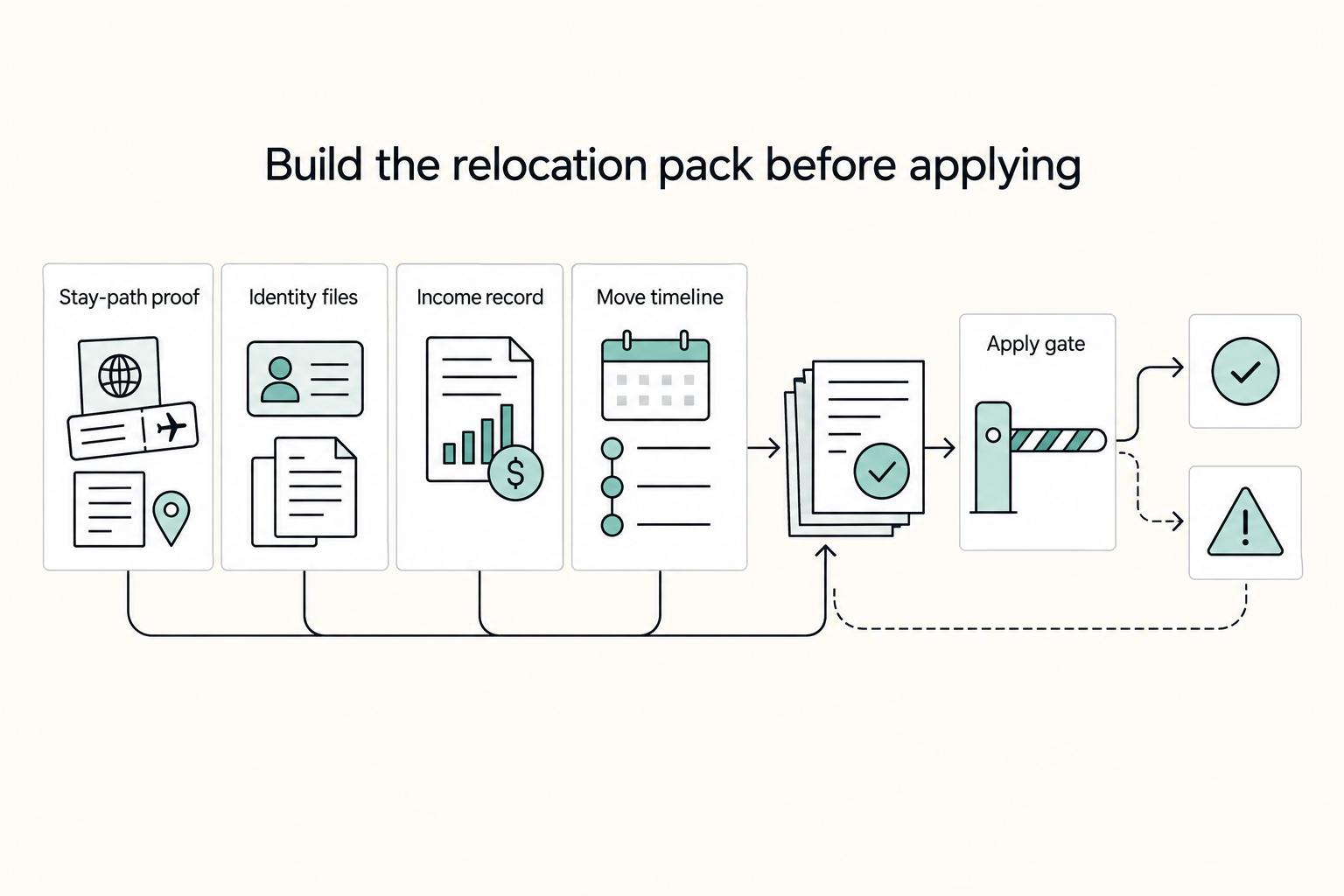
Build Your Move Timeline and Document Pack Before You Apply#
Fix the move sequence before the spending starts. Treat legal-stay assumptions as unconfirmed until you verify them through official channels for your case, and build your timeline around that reality.
- Shortlist 2 cities with clear roles
Pick one primary city and one backup in a different jurisdiction. Use a multi-month planning mindset, not a standard 2-week vacation mindset.
- Verify your stay route before you book
Confirm your legal-stay path first, then prepare a working document pack you can adapt to official requirements. Start with four folders: identity documents, work or income proof, stay-purpose evidence, and country-specific renewal paperwork.
- Pressure-test your timeline with a reconnaissance period
Run a trial phase before committing to long housing. One personal example used a five-month test period, with January-February in one base and March in another, to surface friction early.
- Keep your pack lean and portable
Plan for movement if timelines slip. One example used one suitcase, one tote bin, and two backpacks, which made switching easier when plans changed.
The common failure mode is locking in long housing because the city feels right, then scrambling when renewal or exit assumptions are not resolved. Use this checkpoint: if key legal assumptions are still unclear by your decision date, pause bookings and activate the backup city plan.
That same logic applies across the whole shortlist. Do not lock long housing in Da Nang, Ubud, Taipei, Berlin, or London until your legal-stay, renewal, and exit assumptions are verified for your case.
Choose One City and Commit to a Clear Execution Plan#
At some point, more research stops helping. Choose one primary city and one backup, then execute in sequence instead of reopening the whole shortlist every time you see a new recommendation.
- Set your source hierarchy before you decide
Use personal narratives for context, not as decision authority. One nomad narrative reports 10 years, 3,650 hotel nights, and more than 120 countries, while also saying there is no strict destination-picking method. Experience volume is useful, but it does not replace your own criteria.
- Filter out unstable signals before you spend
Opinion threads can help with discovery, but they are weak for final decisions. One Quora page shows an error message and includes strongly opinionated language, with a visible 3y marker on one answer. If a source is unstable or dated, treat it as idea input only.
- Use date markers as a hard confidence check
This material includes references tied to August 2015, September 2015, and November 17, 2016. Older content can still provide context, but your go or no-go decision should rest on current verification.
- Lock your two-city plan and run it in order
Assign one city as primary and one as backup, then execute the same sequence for both: verify official requirements for your case, prepare documents, and only then commit major spending. For visa and exit-rule questions, rely on official government channels, since validated legal instructions are not established.
Final rule: if your primary city is not verified by your decision date, switch to your backup without reopening the full shortlist. or Talk to Gruv.
Frequently Asked Questions
What makes a city one of the best vegan nomad cities beyond restaurant count?
Restaurant count is only one signal. Reliability matters more because vegan food abroad can be hard to find, and options can shrink when places close for the season. Check whether you can eat well across weekdays, weekends, and off-season periods.
Which cities are consistently mentioned in current results, and which are weakly supported?
Treat recency and repetition as separate tests. The Vegan Review list of 10 cities is dated August 19, 2020, while a VegOut piece on 8 cities is dated Feb 14, 2026. Use older lists for ideas, then confirm with newer coverage and direct local checks.
How should I choose between Da Nang, Ubud, Taipei, and Berlin?
Do not force one ranking for all cases. Pick one primary city and one backup, then compare on two checks: can you maintain your food routine outside peak travel moments, and can you verify current relocation requirements before deposits?
Can I rely on Reddit and old listicles like The Vegan Review alone when relocating?
No. They are useful discovery signals, not complete decision documents. Use them to build a shortlist, then verify current facts directly before committing.
What documents should I prepare before choosing a city?
Prepare a draft document pack for your situation, then confirm exact requirements through official channels before committing.
How early should I start a Visa application if I want to avoid avoidable delays?
Start once your shortlist is realistic, and avoid major non-refundable commitments until official requirements are confirmed for your case.
Try a related tool
Researched and edited by the Gruv editorial team. Gruv builds cross-border billing, payouts, and finance-operations software for global businesses.
Sources
Includes 2 external sources outside the trusted-domain allowlist.
Educational content only. Not legal, tax, or financial advice.
Related Posts

London, UK: A Guide for Expats and Remote Workers
Get two calls right early and the rest of the move gets easier: how you'll be in the UK, and where you'll work when conditions are less than ideal. Make those decisions before you lock dates or prepay a long stay. If you book first and sort the basics later, admin and work reliability usually collide in your first week.

Can Digital Nomads Claim the Home Office Deduction?
Claim the deduction only when your facts and records can carry it. With the home office deduction for digital nomads, the real decision is usually a three-way call: claim it, do not claim it, or pause and get help because your file is not ready.
How to Manage a Global Freelance Team Without Compliance Gaps
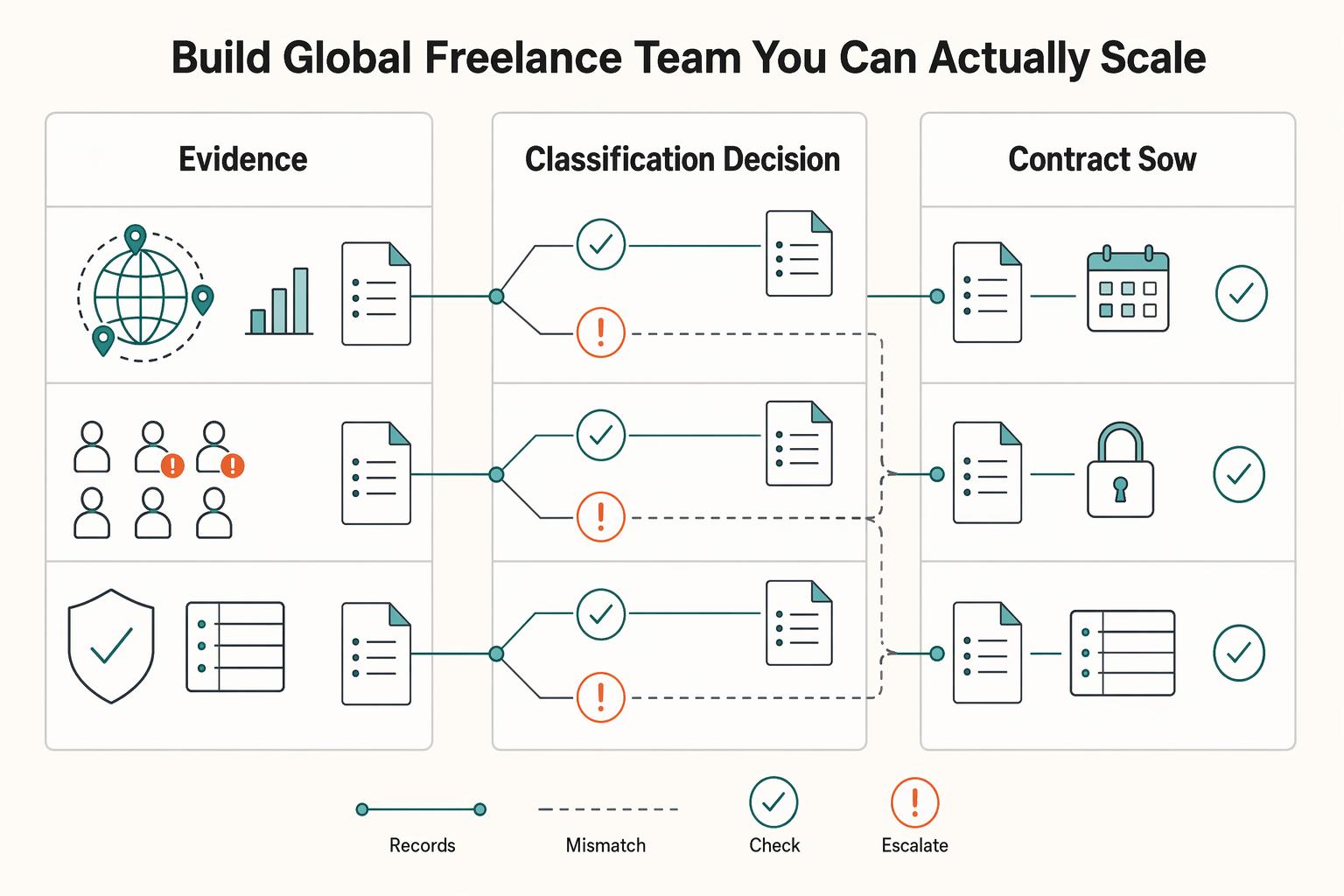
If you want to manage a global freelance team without constant cleanup, use the same intake-to-payout process for every engagement and save an artifact at each gate. Common failure points are instinct-based classification, vague scope, and payments approved in chat with no audit trail.