
Quick Answer
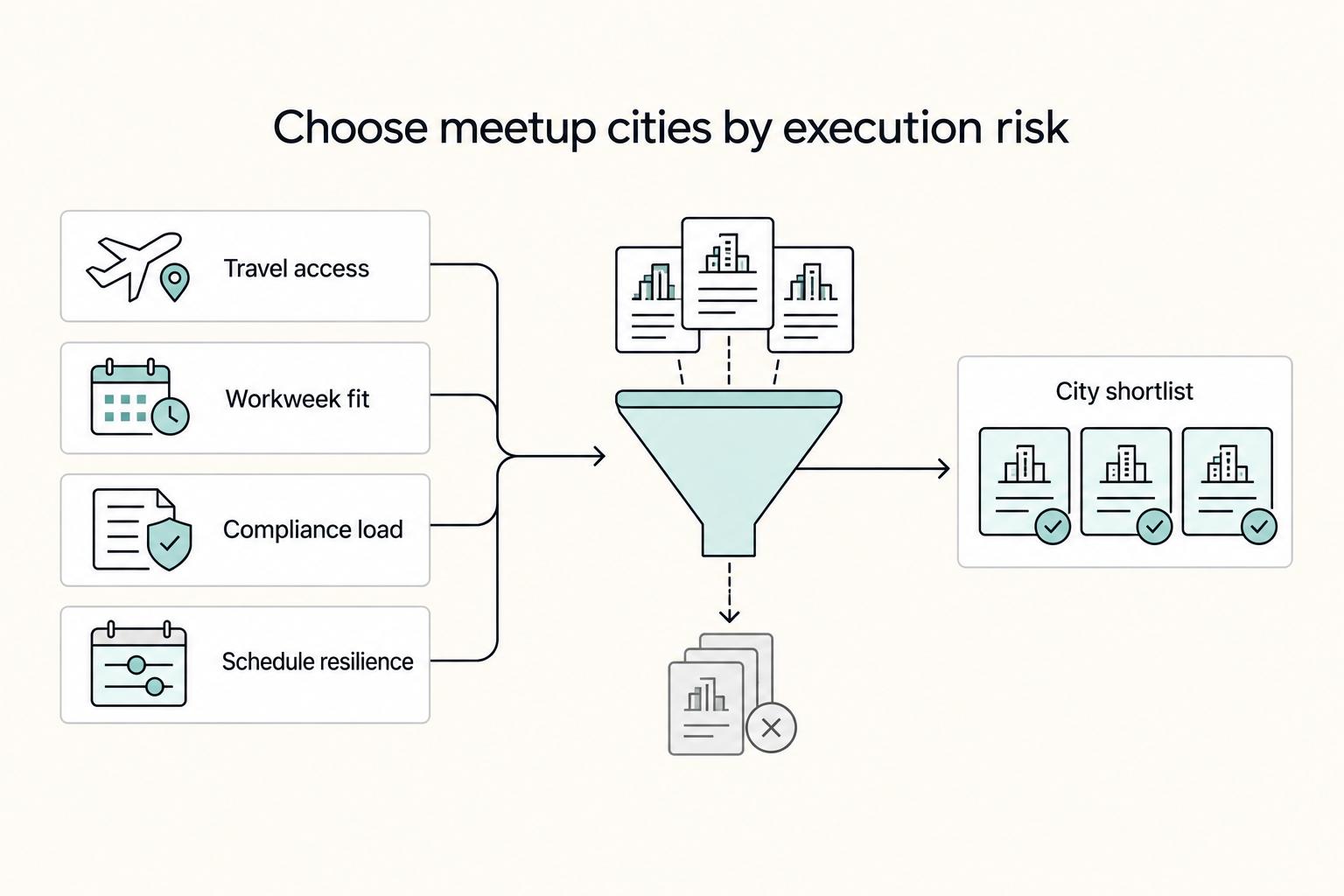
Choose the best cities for remote teams by running a shared scorecard first, then validating entry and document risk before paying for anything non-refundable. The article recommends using practical checkpoints across workday reliability, stay feasibility, cost predictability, and legal exposure, then applying a consistent tie-breaker when options like Lisbon and Barcelona look equally attractive. Keep one primary city and one same-region backup so the meetup window survives delays.
What to Look for in a Digital Nomad City for Team Meetups#
Pick the meetup city your team can actually execute, not the one that wins on social buzz. For a distributed team, a good destination is the one that still works once flights are booked, calendars tighten, and the work starts. That usually comes down to stable internet, a clear entry path, workable overlap hours, and day-to-day logistics that hold up under pressure.
Treat this article as a decision filter, not an inspiration list. If you are weighing Lisbon, Barcelona, Bali, Mexico City, or another option, run the same checks in the same order, then commit to one primary choice and one backup before any non-refundable spending begins. That sequence matters because the common failure mode is simple: a team falls in love with a destination first, then discovers paperwork, role-status, or approval problems in the final stretch.
The practical order is this:
- Workday reliability: Confirm stable internet, workable coworking options, and overlap hours that match how your team actually runs meetings. This protects workshop time and helps you avoid lifestyle-first picks that look good in chat but perform badly once the agenda starts.
- Entry and stay practicality: Verify whether the destination has a clear remote-worker pathway for your planned duration. In 2025, dozens of countries officially offer digital-nomad or remote-worker visas. A clearer pathway usually means fewer late surprises when several travelers need approval at once.
- Cost predictability: Compare total trip spend, not rent headlines, across flights, lodging, workspace, local transport, and contingency. That keeps the plan from being quietly underpriced at the start and cut back later.
- Legal and tax exposure: Identify compliance and tax requirements before any non-refundable booking. Fewer unknowns here mean less go or no-go churn in the final approval week.
When two cities feel equal on experience, use one tie-break rule: choose the option with fewer paperwork unknowns and fewer single points of failure. It is simple, repeatable, and easy to defend when stakeholders want a clear reason for the choice.
That is the thread running through the rest of this guide. Start with execution, narrow the shortlist early, lock documents before money gets sticky, and keep a real backup ready instead of hoping the favorite city works out.
How to Choose a City for a Remote Team#
Let execution risk decide the first cut. Start by asking whether a city can support a full team workweek before you weigh quality-of-life upside. That order sounds obvious, but it prevents the familiar debate where everyone compares vibe, weather, and photos while the real blockers stay unresolved.
This method is built for team meetups and relocation windows, not solo backpack travel. Public rankings can help surface options, but your overlap hours, meeting cadence, and intended stay length should outrank any generic list. A city that looks strong in a roundup can still fail your team if live collaboration windows are too thin, the travel path is too fragile, or entry steps stay ambiguous too close to departure.
Use one shared scoring table for every candidate so you are not changing the rules city by city:
| Factor | What to verify | Why it matters |
|---|---|---|
| Entry and stay feasibility | A clear remote-worker or digital-nomad visa path for your intended duration, plus unresolved document requirements | Fewer entry unknowns reduce cancellations close to departure |
| Team workability | Time-zone overlap that matches your real meeting cadence | Protects workshop time and decision speed |
| Cost predictability | Total spend bands across flights, lodging, workspace, local transport, and contingency | Reduces budget shocks after bookings are locked |
| Connectivity and workspace | Reliable high-speed internet and at least one backup coworking option | Lowers single-point-of-failure risk during collaboration days |
| Legal and tax complexity | How traveler status can affect tax, social security, and workplace protections | Prevents compliance blockers after non-refundable spend |
The table helps with filtering, but the operating discipline matters just as much. Once you finish the first pass, keep a one-page scorecard per city with open risks, owner names, and a hard go or no-go date. In review calls, discuss unresolved risks first and city preference second. Teams usually move faster when the open questions are visible and taste-based arguments are pushed to the end.
Use explicit confidence labels in the same scorecard: verified, partial, or unverified. A city can stay in discussion with partial items, especially early, but it should not move to final payment if critical items remain unverified without owners and deadlines. That small process choice helps you keep momentum without pretending certainty you do not have.
There is also a practical difference between a nice city and a workable city. A nice city may offer good weather, strong food, or solo-travel appeal. A workable city supports the exact week you are trying to run. Can the team land without excessive drag, start on time, meet live when needed, and keep the schedule intact if one assumption breaks? That is the standard.
If two candidates still look close after scoring, apply the same tie-break each time: pick the one with fewer paperwork unknowns and fewer single points of failure. Consistency matters more than cleverness here. A simple rule helps teams decide faster and keeps later reviews from turning into a rerun of the same conversation.
For a practical next move, run this scorecard against your top three options and close one blocker per city before the next review call. That is usually enough to separate the cities that are merely attractive from the ones that are actually ready.
Build the Shortlist 90 to 120 Days Out#
The 90 to 120 day window is when the plan is still flexible and relatively cheap. You are not trying to find the perfect destination. You are building a shortlist that can survive booking, compliance review, and schedule shifts without forcing a late reset.
Start with three primary candidates plus one same-region backup. That gives your team enough range for a real decision without creating analysis sprawl. It also keeps you from ending up with five half-researched cities and no usable backup when one fails document or approval checks.
Build the shortlist across distinct archetypes so you do not overfit to one style of trip. A common spread is Lisbon or Barcelona for Europe access, Bali or Uluwatu for retreat style, and Mexico City or Montreal for Americas coordination. You do not need to cover every interesting option; you need useful contrast. One city may win on overlap hours, another on entry certainty, and a third on budget stability. That comparison gets much clearer when the candidates are intentionally different.
Once you name the candidates, run the same sequence for each and do not skip steps just because one city already has internal fans.
- Set ownership and scope first: Assign one owner to each city brief and one city per archetype. Shared ownership sounds collaborative, but in practice it often creates duplicate work, fuzzy assumptions, and slower decisions.
- Define budget guardrails before ranking: Set category limits for flights, lodging, coworking, local transport, and contingency before preference discussion starts. Without those guardrails, teams tend to over-index on city image and underprice execution risk.
- Run a team-fit pass against the agenda: Test overlap hours, long-haul fatigue risk, and whether the week is collaboration-heavy or retreat-heavy. The same destination can be excellent for team building and poor for decision-heavy workshop days.
- Run an admin-risk pass early: If EU-facing business activity is in scope, flag VAT work at shortlist stage, not after booking holds. OSS can be handled through registration in one EU Member State for relevant declaration and payment flows. The cross-border SME scheme uses one prior notification in the Member State of establishment and may take up to 35 working days. CBR requests are filed where you are VAT-registered and must follow that country's national VAT-ruling conditions. Treat thresholds such as EUR 100 000 and EUR 10 000 as tax-scheme limits, not travel criteria.
- Pre-commit a backup path: Choose one same-region backup now and tie go or no-go to unresolved paperwork risk. A backup selected late is usually a backup that is not ready.
What separates a solid shortlist from a weak one is not research volume. It is scope control. Each candidate needs the same categories, the same evidence standard, and the same owner logic. If you make one city prove itself while another gets waved through on reputation, the process will drift and the final decision will be hard to defend.
This is also where your language with stakeholders matters. Frame each option as a hypothesis until critical checks close. That small shift keeps everyone focused on readiness instead of attachment. It is much easier to change course when the team understands a city is still being validated, not already informally chosen.
If several teammates are first-time international travelers, lean toward options with simpler entry assumptions and fewer open admin questions. You can still get a strong team week without maximizing novelty. In practice, straightforward approval paths matter more than destination buzz once multiple travelers, managers, and finance reviewers are involved.
By the end of this window, you should know which cities are worth carrying forward and which are still coasting on vibe. From there, the job changes: you are no longer exploring. You are turning a shortlist into a document-ready plan.
Lock Documents and Visa Checkpoints 60 to 30 Days Out#
At 60 to 30 days, uncertainty stops being a planning detail and becomes a budget risk. This is the window for hard go or no-go decisions. If critical documents are still incomplete at the cutoff, move to the backup city and do not reopen the full destination debate.
The simplest way to manage this is with one shared traveler pack and one tracker for the whole team. Validate destination specifics on official government pages, then store the evidence in one place so approvals are made from the same facts, not scattered screenshots and chat summaries. Teams get into trouble when everyone is working from partial information and no shared source of truth.
Your pack should include passport-validity confirmation, accommodation proof, insurance evidence, and role-status notes for each traveler. For every record, log the owner, upload date, and status using verified, pending, or rejected. Those labels may feel basic, but they stop a common last-minute problem: everyone assumes someone else already checked the missing item.
Run the checkpoints in a fixed order:
- Master document pack checkpoint: Build a checklist per traveler and assign deadlines to every missing item. Visible deadlines surface missing files before booking windows tighten.
- Destination pathway checkpoint: If Portugal or Mexico is still in scope, confirm the current official entry and visa pathways for your exact trip length and activity before payment deadlines. Do not rely on old screenshots or recycled chat summaries.
- Role-status checkpoint: Record each traveler as Employee or Contractor in the same tracker and escalate unclear cases before final booking approval. Unresolved status can create payroll, tax, or compliance surprises after tickets are paid.
- Long-stay tax-risk checkpoint: If any stay may extend or be split across trips, flag potential tax-residency risk for specialist review before plans are locked. Timeline shifts can create obligations outside the original scope.
- Advisory and emergency checkpoint: Log advisory level and page timestamp from the government travel page you use, store emergency consular contact details in the team brief, and recheck before final approval. Timestamped checks reduce stale-assumption risk.
Use one enforcement rule and stick to it: every pending item needs both an owner and a due date. If either is missing, the city does not advance. That single rule catches a surprising amount of hidden drift because it forces you to decide whether an open item is actually manageable or just being ignored.
This is also the stage where you should stop talking in generalities. "We are pretty sure it is fine" is not an approval state. "The item is pending, owned, and due by Friday" is. That shift in language improves decision quality because it replaces optimism with visible status.
If you need Portugal-specific planning context, use Portugal Digital Nomad (D8) Visa: A Complete Guide as supporting orientation, then validate final requirements on official pages before payment.
Once this pass is complete, compare only cities with a credible booking path. Everything else is noise.
Compare the Top Cities in One Scan#
Use comparison tables to see what you actually know, not to run a popularity contest. At this stage, the question is not which city sounds best. It is which one has enough confirmed detail to survive approval without late surprises.
Available information on this topic is uneven, includes digest-style compilations, and leaves at least one candidate source unavailable. Treat that as part of the decision, not just a research annoyance. The matrix below should guide your verification priority, not pretend a city is ready when evidence is still thin.
| City | Best for | Key pros | Key cons | Likely paperwork friction | Practical team-use case |
|---|---|---|---|---|---|
| Lisbon | Provisional shortlist candidate | Frequently considered for team meetups | No validated city-level comparison in the current pack | Unknown in current pack; requires direct official checks | Keep on the shortlist until entry, legal, and logistics checks are confirmed |
| Barcelona | Provisional shortlist candidate | Frequently considered for team meetups | No validated city-level comparison in the current pack | Unknown in current pack; requires direct official checks | Keep on the shortlist until entry, legal, and logistics checks are confirmed |
| Bali | Provisional shortlist candidate | Frequently considered for retreat planning | No validated city-level comparison in the current pack | Unknown in current pack; requires direct official checks | Keep on the shortlist until entry, legal, and logistics checks are confirmed |
| Mexico City | Provisional shortlist candidate | Frequently considered for Americas coordination | No validated city-level comparison in the current pack | Unknown in current pack; requires direct official checks | Keep on the shortlist until entry, legal, and logistics checks are confirmed |
| Montreal | Provisional shortlist candidate | Useful additional option during planning | No validated city-level comparison in the current pack | Unknown in current pack; requires direct official checks | Use as a backup path if the primary choice fails verification |
| Queenstown | Provisional shortlist candidate | Useful additional option during planning | Evidence coverage is thin for direct comparison | Unknown in current pack; requires direct official checks | Use as a backup path if the primary choice fails verification |
For lower-cost Asia options, keep the uncertainty explicit instead of filling gaps with assumptions:
| City | Lower-cost Asia option: connectivity and meetup tradeoff snapshot |
|---|---|
| Bangkok | Candidate only; treat connectivity and meetup tradeoffs as unverified until primary checks are complete |
| Da Nang | Candidate only; available coverage is not method-consistent across sources, so tradeoffs remain unverified |
| Uluwatu | Candidate only; treat meetup tradeoffs as high uncertainty until primary checks are complete |
Add a confidence tag to each row: verified, partial, or unverified. Only advance a city when entry, legal, and logistics checks close with documented owners. Hold final payments until your selected option reaches at least partial across all three. That threshold is not perfect certainty, and it does not need to be. It is just enough structure to keep the team honest while decisions keep moving.
A simple review rhythm helps. In each review, close the highest-risk open item first, then update the confidence label, then decide whether the city stays primary, drops to backup, or exits. That order prevents a common planning trap where teams keep revisiting settled preference debates while unresolved blockers sit in the background getting older.
If a comparison table feels less decisive than you expected, that is useful information too. Thin evidence should narrow the field, not invite more speculation. The goal here is not to crown a winner from incomplete data. It is to identify which candidates still deserve active effort.
Best City Picks by Team Scenario#
Use scenario lanes to align on purpose before you argue about destination. They do not replace due diligence, but they sharpen the conversation. Instead of asking which city is generally attractive, ask which option fits the kind of week you are actually trying to run.
Lisbon for Europe coordination with longer planning horizons. Keep Lisbon in the mix when Europe overlap and coordination are your main constraints. For longer planning windows, assume more paperwork exposure and validate EU VAT handling early: whether OSS applies through single Member State registration, whether the cross-border SME route applies with prior notification, and whether your timeline can absorb the 35-working-day processing target. This does not mean Lisbon is automatically harder; it means a Europe-centered plan deserves early attention to the admin work that can slow approval later.
Barcelona for high-intensity workshop weeks. Put Barcelona in the mix when the meetup depends on dense in-person sessions and fast decisions. In that kind of week, lost time matters more than novelty, so keep it on the same validation path as other EU options and hold travel approvals until role-status, reimbursement, and required compliance checks are fully closed. A city only helps a workshop week if the operational basics are stable enough for people to focus on the work.
Bali and Uluwatu for retreat-style team building. Use Bali or Uluwatu when focus, reset time, and alignment matter more than heavy daily cross-region coordination. That can work well for a retreat-style week, but only if you treat the operating basics seriously. Keep selection conditional on reliable workspace access, one backup location, and realistic transit assumptions that do not quietly consume core collaboration hours. Retreat settings lose value fast when the team spends too much of the week compensating for preventable logistics.
Mexico City and Montreal for Americas-centered planning weeks. Use Mexico City or Montreal when flight practicality across the Americas is the biggest attendance constraint. That is often the right lens if you need stronger participation more than a more exotic destination. Treat short and extended stays as separate compliance cases, and complete entry and tax checks before deposits are finalized. Duration matters here, and plans that look simple for a short trip can become less simple when the stay extends.
Bangkok and Da Nang for budget-sensitive APAC meetups. Consider Bangkok or Da Nang only if overlap hours match your real meeting cadence. Before you sign off, test a sample agenda against live time windows to confirm that collaboration quality holds once everyone is on the ground. A budget-friendly option is only a win if it still supports the decisions, workshops, and live sessions the team needs to complete.
These lanes are useful because they turn a vague preference discussion into a practical fit discussion. They also make tradeoffs easier to explain. A retreat-style week and a decision-heavy workshop week do not need the same city, and pretending they do usually muddles the evaluation.
If two lanes still look equally strong after the first pass, use the same decision rule as everywhere else: choose the option with fewer unknowns and fewer single points of failure. That kind of consistency does more for execution than another round of preference debate.
U.S. Alternatives When International Complexity Is Too High#
When international uncertainty stays high late in the cycle, a U.S. meetup is usually the better operational call. If visa and document confidence is still only partial, choose the domestic option now and revisit international next cycle. That is not a retreat from ambition. It is a sequencing choice that protects attendance, budget, and execution.
Treat Atlanta, GA; Frisco, TX; Boulder, CO; Salt Lake City, UT; Miami, FL; Columbia, MD; and Fishers, IN as candidates to validate, not default winners. Use the same scorecard logic here too. Keeping one method across international and domestic branches makes your rationale easier to defend and reduces the chance that the team starts making preference-based exceptions.
If you go domestic, make three moves.
Match objective first, then test local fit. If coworking density and urban access lead, start with Miami, FL and Columbia, MD. If connectivity reliability leads, test Salt Lake City, UT. If remote-work concentration leads, test Frisco, TX. Keep each option provisional until you validate it for your dates, budget, and attendance mix.
Filter quickly, then verify operational details. Use CoworkingCafe-style indicators as an early screen, then verify venue availability, neighborhood practicality, and commute friction for the exact meetup week. Fast screening is useful, but it should feed verification, not replace it.
Keep alternates ready for cost or capacity shifts. Maintain Atlanta, GA; Boulder, CO; and Fishers, IN as active backups in case first-choice options tighten on price or space. A domestic backup is only useful if it is current enough to book without starting over.
The decision rule is straightforward: if your team cannot absorb visa uncertainty this quarter, choose a U.S. location now and preserve momentum. Then reopen international planning in the next cycle with better lead time and cleaner approvals. Teams usually regret forcing a fragile international plan more than they regret choosing a simpler domestic option for one quarter.
Red Flags That Derail Remote Team Meetups#
Most expensive failures are visible before flights are confirmed. The hard part is not spotting them. It is deciding that a warning sign is a blocker, not something that will probably sort itself out.
Great city, unclear status. If role status or tax review is unresolved, your plan is not ready. Keep Employee vs Contractor and Tax Residency in Mexico as explicit decision checks, and hold non-refundable spend until both are clearly closed. In practice, teams lose the most time when they let status ambiguity sit in the background because the destination feels exciting enough to keep moving.
Solo-nomad rankings treated as team evidence. A city that works for solo nomads is not proof that a team week will run well. Team meetups carry coordination pressure, shared schedules, and failure points that solo rankings do not capture. Require at least one team-specific validation step before approval so you are not borrowing confidence from the wrong use case.
Weak evidence hidden behind popularity. Popularity is not the same as operating evidence. Lower your confidence when a recommendation rests on anecdote, unclear method, or recycled summaries. Treat shifting deadlines without warning and duplicate work from unclear ownership as active warning signs too. Those are not side issues. They are signals that the planning process itself is getting unstable.
Finance and ops checkpoint skipped. Do not book first and verify later. Add one pre-departure checkpoint for payout readiness, reimbursement flow, and clear sign-off ownership. If that checkpoint slips, pause confirmations and move to backup planning. Teams often focus so heavily on travel and entry that they underweight whether money and approvals can move cleanly once the trip is underway.
The main discipline here is simple: if even one red flag remains open, stop selection and close the blocker first. That can feel strict in the moment, especially when people want the city decision finished, but it is far cheaper than unwinding a plan after the team is already committed.
Conclusion#
Choose the city you can approve with evidence, clear ownership, and a real fallback. That is what keeps a distributed team meetup on schedule when pressure rises. Lifestyle upside matters, but only after logistics, paperwork, and risk controls are strong enough to survive real-world variance.
Remote work demand appears durable, and work-from-home rates rose sharply from 2019 to 2021. The planning takeaway is straightforward: use repeatable decision discipline, not one-off destination enthusiasm.
Before final commitment, run the same closeout sequence every cycle:
- Complete one final scorecard pass for every candidate: Use identical criteria across cities and update confidence labels from closed evidence, not optimism.
- Hold a hard decision date with blocker logic: Treat unresolved critical items as blockers. If required approvals are still open at cutoff, switch to the backup city and protect the meetup window.
- Lock one primary city and one backup city in the same cycle: This preserves momentum when entry assumptions change and prevents late cancellations from resetting the quarter.
Then pressure-test the assumptions most likely to cause rework for your team mix. If legal, tax, or classification requirements are still unclear, keep that uncertainty as a blocker until jurisdiction-specific guidance is confirmed.
In practice, the strongest choices are the cities you can execute with documented checks, named owners, and a backup path that is genuinely ready. If you want help stress-testing your shortlist before commitment, talk to Gruv.
Frequently Asked Questions
What makes a city "best" for remote teams instead of solo digital nomads?
A team city has to support group execution, not just individual comfort. Check three basics first: stable internet, workable daily costs, and enough opportunities for in-person connection so the week does not fragment. Solo rankings help discovery, but they often miss coordination pressure across multiple calendars and dependencies.
How far in advance should we plan an international remote team meetup?
Use a phased approach instead of one fixed timeline. Start while you can still swap cities without penalties, then tighten commitments after entry assumptions and team constraints are clear. If key status details are still unclear late in planning, move to a U.S. option this cycle and keep the international pick for a later cycle.
Which documents should every team member prepare before we book flights?
Build one shared document pack with core travel details and role-status review so approvals are based on the same facts. Keep Employee vs Contractor as a required check, not an afterthought, because classification uncertainty can delay finance and compliance sign-off. If needed, use Are You an Employee or a Contractor? A Self-Assessment Checklist before any non-refundable booking.
How should we compare Lisbon, Barcelona, Bali, and Mexico City for one-week and one-month stays?
Score each city with the same criteria, then run two scenarios separately: one week and one month. A short collaboration sprint may tolerate more uncertainty than a longer stay where legal and finance exposure can expand. Keep internet reliability as a hard gate for both scenarios, then compare cost, meeting-cadence fit, and coordination friction.
When should we choose a U.S. city like Atlanta, GA or Boulder, CO instead of going international?
Choose U.S. alternatives when documentation certainty is low and your team cannot absorb delay risk this cycle. This is a timing decision, not a quality downgrade. Use the same scoring logic used for international options so the decision stays consistent and auditable.
How do we reduce tax and classification risk when some teammates are contractors and others are employees?
Treat classification and tax review as separate approval checks with named owners and dated decisions. Do not assume one country rule applies everywhere, because legal and finance challenges vary by context. Discipline on these checks helps reduce late-stage surprises, even when city options look similar on paper.
Try a related tool
Researched and edited by the Gruv editorial team. Gruv builds cross-border billing, payouts, and finance-operations software for global businesses.
Sources
Educational content only. Not legal, tax, or financial advice.
Related Posts

Portugal Digital Nomad Visa Decisions That Prevent D8 Delays
Start with verification, not paperwork. In this research set, some material is useful only as EU VAT context, not as D8 instruction, and mixing those categories is one of the fastest ways to build the wrong plan. We use the same separation rule in [Global Digital Nomad Visa Index](/blog/global-digital-nomad-visa-index) comparisons.
Are You an Employee or a Contractor? A Self-Assessment Checklist
Forget the label. Classification turns on the relationship you actually run, not the title you typed into the contract. It is also much easier to fix before you sign.
Tax Residency in Mexico for Nomads Beyond the Temporary Resident Visa
Start with one conservative call: are you likely becoming a Mexican tax resident this year, and what evidence supports that call today? That decision shapes the rest of your year. If you skip it, every later task turns reactive, from local tax planning to U.S. filing choices.