
Quick Answer
Pick a city only after a city-country check: for best nomad cities for startups, the article recommends scoring startup signal, visa feasibility, operating cost, and first-90-day execution risk before committing. It then narrows choices with a shortlist table, uses a 90-day sequencing plan, and requires a document pack before irreversible spend. Lisbon, Tallinn, Berlin, Singapore, Bangkok, and Dubai are treated as testable options with explicit confidence levels and checkpoints, not automatic winners.
What Makes a City Work for Entrepreneurs and Startups#
Choosing a nomad base for your company is an execution decision first. Lifestyle matters, but it belongs in the second round. The costly mistakes usually show up after the city-ranking stage, when a place that looks great online turns into a slow or expensive setup once you start invoicing, signing contracts, and working against real deadlines.
You have more options than you used to. In 2025, an estimated 18.5 million Americans identified as digital nomads, up 153% since 2019. More choice can help you find a better fit, but it also makes it easier to pick a city that clashes with your residency path, tax setup, or operating model once the move stops being hypothetical.
This guide is built to help you decide, not just browse. By the end, you should have four concrete outputs:
- A scoring method you can apply across startup signal, residency feasibility, cost pressure, and first-quarter execution risk.
- One primary city-country option and one backup option.
- A 90-day sequence that puts legal, financial, and operational dependencies in the right order.
- A compact document checklist you can finish before filings or long commitments.
If two options feel equally attractive, choose the one with fewer unresolved assumptions. Unknowns are what usually break launch timelines and force expensive rework.
The scope here is practical by design. City fit and country setup are connected, so treat them as one decision. City fit is your day-to-day operating reality: network depth, livability, and execution friction. Country setup is the legal and tax envelope around the move: whether your route is workable and stable enough to build on. If those two layers are misaligned, the city that looked like a win can become a drag before month two.
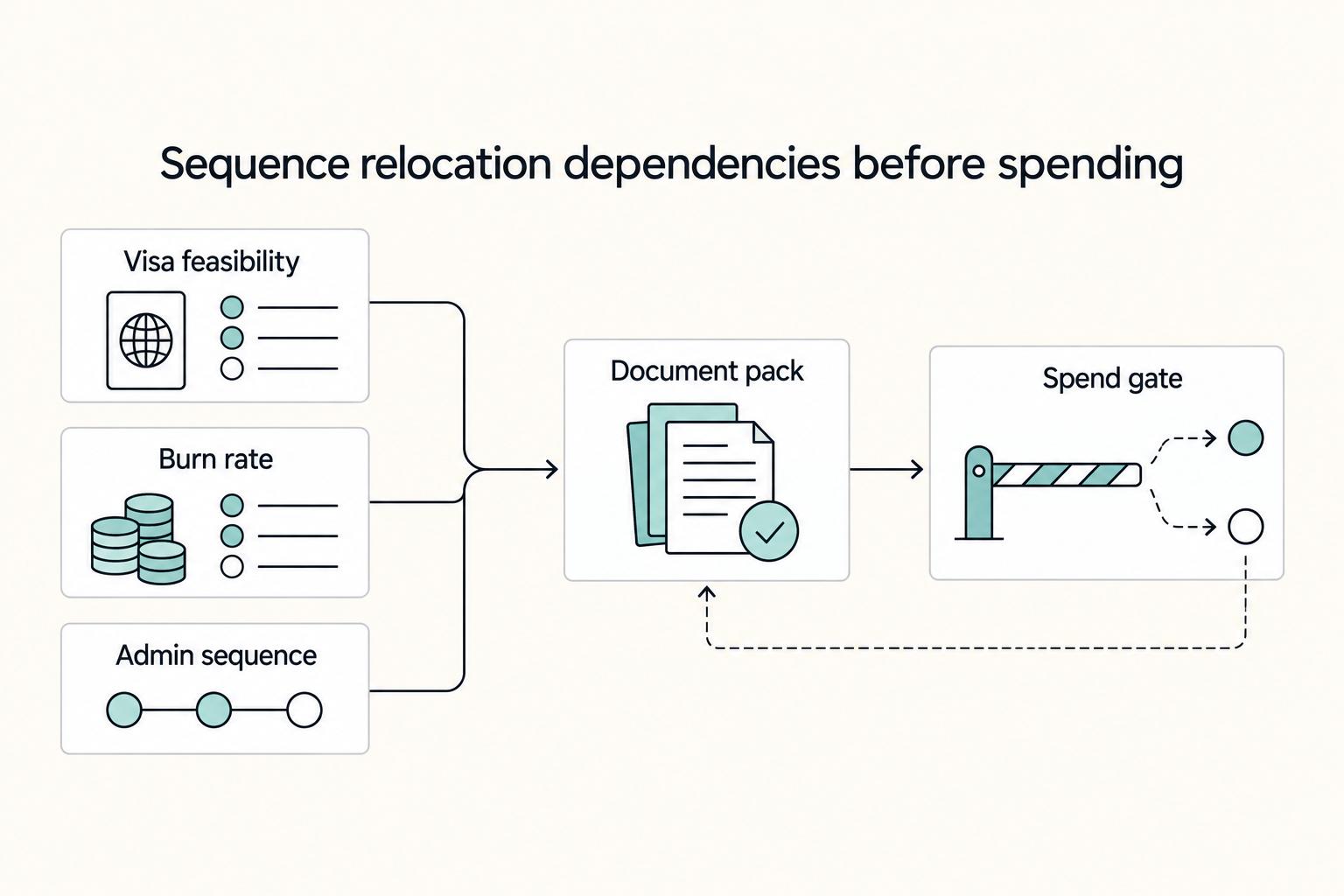
One rule will save you from the most expensive mistakes: keep irreversible commitments on hold until three checks are green. Your residency route should look plausible, your monthly burn should survive a conservative revenue scenario, and your minimum evidence pack should be complete. A common failure mode is signing housing, locking dates, or paying fees before those checks pass. When evidence is thin, lower your confidence, verify directly, and keep the backup path live.
Do that well, and the rest of the move becomes a sequencing exercise instead of a gamble. The next section gives you a scoring method that keeps comparisons tied to what actually affects execution.
Who This List Is For and How Cities Are Scored#
This list is for founders and startup operators who need the first 90 days to run on schedule. It is not for lifestyle-only travel choices, and it is not country-policy analysis in isolation. If you are weighing Lisbon, Tallinn, Berlin, Singapore, Bangkok, Tokyo, Jakarta, and Sydney because location affects hiring, sales access, or runway, this is the right lens.
General rankings are still useful for building a shortlist. One widely cited study reviewed 237 cities using filters like visa conditions, internet speed, cost of living, safety, and livability. That helps you build options. It is not enough for a business move where legal sequencing and operating constraints determine whether you lose weeks in setup.
Use this method when you're making one of three decisions:
- Choosing an operating base where delivery and customer commitments need to stay stable.
- Testing demand with a small team and needing setup steps that protect momentum.
- Scaling hiring or partnerships and needing real network depth quickly.
To keep the comparison grounded, score each city-country option across four buckets:
- Startup network depth: access to relevant customers, partners, and talent.
- Visa feasibility: whether your path appears workable before major spend.
- Operating cost and livability: whether runway can absorb actual monthly costs.
- First-90-day execution risk: the probability of admin delays, sequence mistakes, and avoidable blockers.
Weight those buckets based on your immediate constraint, then keep the weighting fixed for one decision cycle. If runway is tight, overweight visa feasibility and execution risk. If growth depends on hiring or partnerships, overweight network depth. Keeping the weights fixed prevents you from moving the goalposts toward the city you already want.
When two options land close, use one tie-breaker. If revenue timing is uncertain and runway is tight, pick the place with simpler administration and steadier costs over prestige. If near-term hiring and partnership velocity will decide growth, favor network density even if comfort factors are weaker. In both cases, keep non-refundable commitments frozen until route and documents are validated.
This method is designed to produce a decision you can act on, not a perfect theoretical ranking. The point is not to be exhaustive. It is to compare like with like, expose weak assumptions early, and give yourself a clear next move. If you want a practical follow-up after scoring, browse Gruv tools to pressure-test your assumptions before spending.
Compare the Top Nomad Startup Cities at a Glance#
Use this table as a filter, not a verdict. Each row is a working hypothesis that needs one early checkpoint. In month one, your goal is to confirm fit quickly, then either commit or pivot before sunk costs start driving the decision.
| City | Best For | Visa/Residency Path to Verify | Startup Signal to Validate | Biggest Tradeoff | First 30-Day Checkpoint | Data Confidence |
|---|---|---|---|---|---|---|
| Lisbon | EU market access plus lifestyle fit | Portugal Digital Nomad (D8) Visa fit | Quality of relevant customer and partner access | Popularity can raise costs | Confirm housing terms and visa document readiness before non-refundable fees | Low (assumption to verify) |
| Tallinn | Digital-first administration culture | Estonia residency path fit | Cross-border customer reach beyond local market size | Smaller local market | Validate where your first 10 target customers are based | Low (assumption to verify) |
| Berlin | Talent and network depth | Germany route viability | Hiring funnel quality for your role mix | Bureaucracy pace | Book key admin appointments in your first weeks | Low (assumption to verify) |
| Singapore | Regional HQ efficiency | Entry and residency path viability | Partnership and sales-cycle conversion in region | Higher operating costs | Stress-test runway with conservative revenue timing | Low (assumption to verify) |
| Bangkok | Cost-flexible operating base | Stay legality for a long-horizon plan | Whether location supports customer development, not just lower spend | Weaker HQ signal for some founders | Separate living-base choice from incorporation decision | Low (assumption to verify) |
| Dubai (UAE) | Founder incentives and connectivity | United Arab Emirates setup path | Client and banking fit for your model | Costs can escalate quickly | Model full recurring business costs before long commitments | Low (assumption to verify) |
The low-confidence label is deliberate. It does not mean a city is wrong. It means you should attach a 30-day validation test and a clear exit condition before committing fixed costs. That keeps optimism useful without letting it run your budget.
Before you optimize for city preference, deal with tax-process reality. If your plan includes EU B2C activity, keep these anchors separate and explicit.
One Stop Shop (OSS) requires a taxable person to register in one Member State of identification. EUR 10,000 is a separate B2C e-commerce trigger and should not be merged with other thresholds. Cross-border SME scheme references a Union turnover cap of EUR 100,000, with prior notification through the Member State of establishment, and a stated process window of up to 35 working days after receipt.
Those rules answer different questions. Mixing them creates bad sequencing and bad forecasts. If your cross-border VAT treatment is still uncertain, a VAT Cross-border Ruling can be requested under national VAT ruling conditions in the country where you file. It does not remove the work, but it can reduce uncertainty before you lock launch dates or long commitments.
Use the table to shortlist, then strip out tax ambiguity before you start spending against a timeline.
Best European Cities for Founders Who Need Execution Certainty#
Europe rewards founders who respect process. Lisbon, Tallinn, Berlin, and Genoa can all work, but they are different bets on compliance, operating pace, and first-quarter friction. The safest way to compare them is to run the same first-month checkpoints for each one instead of getting pulled around by reputation.
| City | Process note | First checkpoint |
|---|---|---|
| Lisbon | Portugal appears on the published VAT Cross-border Rulings participant list | Identify VAT uncertainty early, confirm local ruling conditions, and hold off on long commitments until the filing path is clear |
| Tallinn | Estonia appears on the published CBR participant list; if early sales are B2C across several EU states, test whether OSS registration is the cleanest route | Check whether your first 10 target customers are reachable from there and whether the related tax treatment is workable |
| Berlin | Germany is not confirmed as part of the published CBR participant list | Verify VAT handling for your transaction mix, including OSS and national processes, before hardening launch timing |
| Genoa | Italy appears on the published CBR participant list; if you might qualify as a small enterprise, test cross-border SME eligibility early | Keep the EUR 100,000 Union turnover cap, prior notification through the Member State of establishment, and up to 35 working days explicit in planning |
Lisbon is strong when you want EU access and may run into cross-border VAT questions early. Portugal appears on the published VAT Cross-border Rulings participant list, which gives you a path to seek advance clarity for complex cross-border VAT treatment. That does not guarantee growth. The real advantage is earlier process confidence when ambiguity would otherwise slow your launch sequence. In practice, identify your VAT uncertainty early, confirm local ruling conditions, and hold off on long commitments until your filing path is clear.
Tallinn suits founders who value digital-first administration and expect early cross-border activity. Estonia appears on the published CBR participant list, which can help when VAT treatment is unclear. The useful checkpoint is not whether Tallinn feels efficient in theory. It is whether your first 10 target customers are reachable from there and whether the related tax treatment works for your model. If early sales are B2C across several EU states, test whether OSS registration is the cleanest route before you commit to deadlines that assume smooth setup.
Berlin can be the right call when talent density and network access matter most, but this is where assumption discipline gets expensive if you skip it. Germany is not confirmed as part of the published CBR participant list, so do not treat that path as available by default. Your first-month priority is to verify VAT handling for your transaction mix, including OSS and national processes, before you harden launch timing. The common failure mode here is pace drift. When process assumptions stay vague, hiring plans and customer timelines slip in ways that are costly to recover.
Genoa is a more conservative option, and that can be a feature. If compliance predictability matters more than local startup signaling, it deserves a look. Italy appears on the published CBR participant list, which can help when cross-border VAT treatment needs advance clarity. If you might qualify as a small enterprise, test cross-border SME eligibility early. Keep the anchors explicit: Union turnover cap of EUR 100,000, prior notification through the Member State of establishment, and a stated process window of up to 35 working days. That can improve planning confidence, but it still does not replace demand validation.
The pattern across these four cities is straightforward. Lisbon and Tallinn may offer clearer tools when cross-border tax questions show up early. Berlin may offer deeper network density, but timing risk rises if you assume process paths before checking them. Genoa can be the safer option when your first goal is smoother compliance handling rather than maximum startup buzz.
One red flag stays constant across all four: choosing by reputation before confirming route, filing order, and processing assumptions. If EU B2C sales are in scope, keep the EUR 10,000 OSS trigger separate from the EUR 100,000 SME cap. They are not interchangeable, and blending them leads to avoidable mistakes.
Best Asia-Pacific Cities for Speed, Access, and Cost Control#
In Asia-Pacific, evidence quality matters as much as city appeal. Among these cities, Singapore is the only one with direct support as a startup-hub option. Tokyo, Bangkok, Jakarta, and Sydney may still fit your model, but they need tighter local validation before you treat them as execution-safe.
| City | Validation strength | Commitment rule |
|---|---|---|
| Singapore | Direct support as a startup-hub option; a 2025 source frames it as a leading startup hub in Asia with business-friendly policy, strong infrastructure, and international market access | Model fixed commitments against conservative revenue timing before locking into a higher-cost base |
| Tokyo | City-level startup strength, cost profile, and execution advantages are not confirmed | Keep it on the shortlist only when your model clearly depends on Japan-specific access, and define what must be true by day 30 |
| Bangkok | No city-specific support here for startup depth, cost position, or operating speed | Separate where you live from where you structure legal and commercial operations until assumptions are tested in real work |
| Jakarta | Unsupported city-level claims should not drive irreversible choices | Set measurable validation targets, compare them with first-quarter operating needs, and increase commitment only if your own evidence supports it |
| Sydney | No confirmed city-specific support here on startup outcomes, cost advantage, or execution speed | Start with a limited footprint, verify core assumptions quickly, and spend more only when your own data justifies it |
The menu is wider now. Countries continue to introduce remote-work and nomad visa pathways. That helps with access, but it does not replace city-level due diligence on sales reach, operating pace, and cost control. You still need proof that a city supports your specific way of building.
Singapore is the strongest supported choice when you need institutional signal and regional access quickly. A 2025 report frames Singapore as a leading startup hub in Asia, with business-friendly policy, strong infrastructure, and international market access. The main checkpoint is financial discipline. Model fixed commitments against conservative revenue timing before you lock into a higher-cost base. If your revenue path is uncertain, do not pay for signal you cannot use yet.
Tokyo should stay on your shortlist only when your model clearly depends on Japan-specific access. City-level startup strength, cost profile, and execution advantages are not confirmed. That does not make Tokyo weak. It means it is still a hypothesis and needs a tight validation plan before long commitments. Decide what must be true by day 30, then lower confidence quickly if the evidence does not show up.
Bangkok can be appealing as a lower-cost base, but confidence is also low here. There is no city-specific support here for startup depth, cost position, or operating speed. The disciplined move is to separate where you live from where you structure legal and commercial operations until those assumptions are tested in real work.
Jakarta deserves the same posture. It may fit your model, but unsupported city-level claims should not drive irreversible choices. Set measurable validation targets, compare them with your first-quarter operating needs, and increase commitment only if your own evidence supports it.
Sydney belongs in the same test-first group under this pack. There is no confirmed city-specific support here on startup outcomes, cost advantage, or execution speed. Start with a limited footprint, verify your core assumptions quickly, and spend more only when your own data justifies it.
The decision rule is simple. If you need the strongest evidence-backed starting point for credibility and regional access, start with Singapore. For Tokyo, Bangkok, Jakarta, and Sydney, keep commitments reversible until first-quarter assumptions hold up under real operating conditions.
When Country Incentives Should Override City Rankings#
If legal-stay certainty or tax setup is your main risk, country policy should outrank city preference.
City rankings help with feel, convenience, and local quality of life. They do not resolve legal feasibility. A city can look perfect while your visa category restricts work activity, weakens long-stay stability, or creates tax exposure you never modeled. Digital nomad visas are generally aimed at remote workers, freelancers, and entrepreneurs, while tourist visas are typically work-restricted. With more than 70 countries now offering remote-worker pathways, the real advantage comes from choosing a policy environment you can operate in with confidence.
This matters most when national rules set the ceiling. In practice, treat these as country-first decisions:
- Portugal: confirm visa and residency fit first, then choose among city options.
- Estonia: lead with compliance and policy clarity before lifestyle factors.
- United Arab Emirates: evaluate country-level setup logic before optimizing for one city.
Keep the order strict. If residency status, tax structure, or long-stay certainty is the core constraint, lock policy first. Choose the city inside that envelope second. A common failure mode is spending on housing or move logistics before legal path clarity is in place.
For U.S. founders, keep retirement planning visible from the start, including SEP IRA and Solo 401(k) considerations. Then escalate unresolved cross-border issues to licensed tax and immigration professionals before filing or restructuring. If you want a quick planning refresher, SEP IRA vs. Solo 401(k): Which is Better for You? can help frame the tradeoffs.
Once country fit is clear, relocation stops being a broad comparison exercise and becomes a dependency schedule. That is where the first 90 days deserve most of your attention.
90-Day Relocation Timeline and Document Checklist#
The first 90 days should run like a dependency map, not a loose travel plan. Your job is to confirm legal and operating feasibility first, then commit money where reversal would be expensive.
Remote work expanded quickly after 2020, and visa-route options expanded with it. Some lists now cite 73 digital nomad visa countries in 2025. More routes do not remove risk on their own. They increase the need for sequencing discipline so you do not confuse optionality with readiness.
Use this four-phase timeline:
- Days 0-14: shortlist and feasibility check. Pick two city-country options plus one backup. Tie each city to a plausible country path. Validate visa feasibility first, then stress-test budget assumptions and your minimum document set on paper.
- Days 15-45: build the evidence pack. Gather identity and income documents, accommodation records, and insurance documentation where relevant. Add tax-residency intent notes so your assumptions are explicit. If useful, keep one comparison reference such as Tax Residency in Romania: A Guide for Nomads in an Affordable Hub to pressure-test your logic.
- Days 46-75: lock dependencies in order. Sequence visa milestones first, then housing terms, then banking and payment rails. Define a delay branch before you need it so major costs stay reversible if approvals or documents slip.
- Days 76-90: complete arrival setup. Finish local registration and early compliance tasks, then finalize collection and payout operations. Run your first reconciliation cadence before day 90 so finance routines are stable early.
Review the plan weekly while you're in this window. Confirm what changed, what slipped, and which dependency now controls the timeline. That simple check keeps the plan current and prevents your backup option from going stale while you focus on the preferred path.
Keep one compact checklist you can actually maintain:
- Core identity file set.
- Income and support evidence.
- Accommodation and insurance documentation tied to your route.
- Appointment calendar with filing deadlines.
- Notes on unresolved assumptions and who is responsible for verification.
The sequence is the risk control. Reverse it, and small unknowns become expensive rework. Housing, banking, and launch timing all get harder when the underlying legal route is still unclear.
Before irreversible bookings, confirm three checkpoints are green: visa feasibility, monthly burn resilience, and first-quarter operating flow. If one is still uncertain, hold the commitment and keep your backup path active. That discipline is what stops relocation from turning into a cash-flow problem.
Mistakes That Derail Startup Moves#
Most startup moves fail in small, boring ways. Founders usually do not run out of ambition. They act on a city narrative, skip one verification step, and then lose a month to preventable admin friction. City content is useful for generating options, but the real decision still has to pass through documents, sequencing, and downside checks.
These are the failure patterns that show up most often:
- Treating listicles as decisions. City roundups can help you build a shortlist, but they do not prove that your move is operationally ready.
- Confusing repetition with evidence. When multiple posts repeat the same claim, check the fit against your actual model before you turn that echo into certainty.
- Locking commitments too early. Problems compound when housing, fees, or go-live dates are fixed before approvals and appointments are stable.
- Underestimating admin load. Attractive cities can still create heavy paperwork friction in month one. Keep one complete evidence pack with identity, income, accommodation, and filing notes so repeated requests do not stall execution.
- Running without a fallback. Single-thread plans break when one document or approval path stalls. Keep one backup city-country option ready enough to activate quickly.
The expensive version of relocation is rarely the city itself. It is paying twice for timing mistakes, rushed fixes, and avoidable reversals. A disciplined sequence costs less because it reduces rework.
The correction is plain and repeatable: confirm route, confirm burn, confirm documents, then spend. If Lisbon is still on your shortlist, pressure-test eligibility assumptions with Portugal Digital Nomad (D8) Visa: A Complete Guide before you commit to leases or move dates.
Choose Your City and Commit to One Execution Plan#
Your best option is the city-country combination you can execute in 90 days without breaking runway or legal clarity. That is the standard that matters.
At this stage, more browsing usually makes the decision worse. The goal is not to find a perfect city. It is to choose an option that works under real constraints, with a backup ready if timing slips. Narrow to three options, score them with one method, and commit to a primary plus a backup with explicit switch conditions.
- Score three options with one rubric. Compare expected monthly burn, confidence in legal-stay feasibility, and first-quarter execution load. If stay status or tax-residency triggers remain unclear, score that option lower until resolved.
- Pick one primary and one backup, then define switch gates. Confirm the primary only after legal feasibility and budget stress tests pass. Keep one backup that you can activate quickly if approvals or compliance steps stall.
- Complete the document checklist before irreversible spend. Finalize identity records, income support, accommodation evidence, and route-specific paperwork. Delay long leases and large prepayments until the file set is complete and reviewed.
- Validate money operations before booking travel. If your plan depends on cross-border collections and payouts, confirm the setup path, payout coverage for target markets, and expected operational timing before relocation.
Commit when city fit, legal readiness, and payment operations align. If you want a final sanity check on your country path or execution plan, talk to Gruv.
Frequently Asked Questions
What makes a city genuinely good for startup nomads, beyond cost of living and Wi-Fi?
A strong choice combines realistic living costs, reliable internet, legal stay options, and a useful peer community. Cost matters, but it is only one input, and even Lisbon estimates vary by source and currency. The real test is whether your work can run predictably in your first few months.
Should I prioritize city rankings or country visa and tax policy first?
Prioritize country policy when long-stay certainty is a core constraint. A high-ranked city does not help if legal stay is weak or unclear. After that filter, use city rankings to choose among options that already pass legal and budget checks.
What should I verify before I commit to Lisbon, Tallinn, or Berlin?
Check three items before irreversible spend: visa feasibility, monthly burn assumptions, and first-quarter admin tasks. Keep one document pack with identity, income support, accommodation records, and appointment timeline. If Lisbon is still in scope, review Portugal Digital Nomad (D8) Visa: A Complete Guide before locking dates.
Is Singapore worth the higher cost for an early-stage founder?
It can be, when higher spend ties to a clear revenue path such as near-term partnerships or enterprise sales access. If runway is the main risk, a lower-cost base may protect execution while you validate demand.
Can I use a lower-cost base like Bangkok or Jakarta while incorporating elsewhere?
Some founders consider this split approach, but it should be treated as a legal and compliance question first, not just a cost tactic. You need clear assumptions for stay permission, payment operations, and reporting duties across jurisdictions. If those assumptions are still fuzzy, delay structural decisions and keep commitments reversible.
How do I compare Portugal, Estonia, and the United Arab Emirates without getting lost in legal detail?
Use one comparison sheet with the same fields for each country: entry path clarity, expected recurring costs, required documents, and timeline risk. Keep notes short and evidence-based, then escalate open points to licensed immigration and tax professionals.
What are the minimum documents I should prepare before filing any nomad-visa path?
Start with core identity documents, proof of income or support, accommodation evidence, and any insurance documents your route may require. Final checklist details vary by country, so verify requirements through official channels before submission.
Try a related tool
Researched and edited by the Gruv editorial team. Gruv builds cross-border billing, payouts, and finance-operations software for global businesses.
Sources
Educational content only. Not legal, tax, or financial advice.
Related Posts

Portugal Digital Nomad Visa Decisions That Prevent D8 Delays
Start with verification, not paperwork. In this research set, some material is useful only as EU VAT context, not as D8 instruction, and mixing those categories is one of the fastest ways to build the wrong plan. We use the same separation rule in [Global Digital Nomad Visa Index](/blog/global-digital-nomad-visa-index) comparisons.

SEP IRA vs Solo 401(k) for Freelancers With Uneven Cash Flow
Pick the plan you can keep funding in weak months, not the one that looks best in a strong quarter. That is the real decision.
Romania Tax Residency for Nomads Who Want Fewer Surprises
Decide your tax position before you move money, sign leases, or change billing addresses. This guide is for a `non-resident individual` who wants a clear sequence to classify residence, document facts, and avoid filing surprises in Romania.