
Quick Answer
Choose from the best nomad cities for creatives by filtering for move viability first, then lifestyle fit. On the current shortlist, Lisbon is the most evidence-backed starting point, while Berlin and Mexico City need stricter pre-commitment checks; Bali, Krakow, Tbilisi, and Chiang Mai need clear first-month validation plans. The practical path is simple: shortlist with one scorecard, run a dated 90/60/30 sequence, and clear a verification-before-payment gate before deposits.
Start Here if You Want a City You Can Actually Move To#
Start with move viability, not vibe. The right city is one you can legally stay in, work from reliably, and set up fast enough that client delivery does not wobble in the first month.
This guide is for remote creatives planning a real move or a serious long stay while projects are still live. If you want a holiday base, a nightlife-first pick, or a loose list of places that look good on social feeds, this will feel stricter than most city roundups. That is intentional. A place only works when legal stay, daily work conditions, and basic admin all hold together under pressure.
The order of operations is simple: legal viability first, operating reliability second, lifestyle preference third. People often reverse that order. They fall for a city, book quickly, and then discover that paperwork, timing, or first-month logistics do not line up with contracts already in motion. At that point, the problem is not inspiration. It is execution. You do not need more ideas yet. You need an option that can survive the first 30 to 90 days of real work.
Before you get attached to any destination, run it through this filter:
- Long-stay fit: Keep cities that are repeatedly discussed as places people can actually live and work over time, not just enjoy for a week.
- Practicality stack: Look at cost, internet reliability, work rhythm, and culture together. A city that wins one category and fails the rest can still be a poor move.
- Failure-risk check: Treat unstable internet and weak community as early warning signs. Either one can break your pace quickly when your calendar is full.
- Proof over hype: Give more weight to places with a visible track record of people working there than to recycled excitement.
When two options look close, do an elimination pass instead of starting a preference debate. Ask which city leaves fewer unanswered questions around legal route, first-month setup order, and delivery reliability during busy weeks. The one with fewer unknowns is usually the better move, even if the other one feels more exciting.
Lisbon, Mexico City, and Bali are explicitly named in one creative-city recommendations list, so they are reasonable starting points, not automatic winners. Keep only the cities that survive your actual constraints: timeline, paperwork tolerance, budget, and workload type. If a place sounds great but your first-month sequence is still fuzzy, move it into a maybe-later pile.
Your first move does not need to be permanent. It does need to be executable. Pick a city that gives you a stable opening quarter, then reassess once you have real operating data instead of pre-move imagination.
By the end of this guide, you should have three outputs: a final shortlist, a practical first-month setup checklist, and a dated move sequence. That is the difference between browsing and relocating. The next section explains how the list was pressure-tested so you can use it as a decision tool, not a mood board.
How This List Was Chosen and Who Should Use It#
This list rewards clarity over online chatter. A city ranks higher here when the move looks more workable, not when online momentum is louder.
It is built for remote creatives planning at least a month while managing active client work. If your goal is a short trip, a social sprint, or a loose lifestyle experiment with no delivery pressure, this approach may feel overly strict. Keep the strictness anyway if your income depends on predictable output. One avoidable relocation mistake usually costs more than one extra week of verification.
Each city is screened against the same five criteria:
- Digital nomad visa feasibility: Is there a realistic longer-stay route you can verify before booking?
- Admin friction: How difficult is first-month setup likely to be in practice?
- Cost realism: Does the city still fit once you move past headline prices?
- Work reliability: Can you depend on internet and daily setup when deadlines are live?
- Creative-community fit: Are there people and spaces that support sustained creative output, not just casual networking?
Those criteria matter in different proportions depending on your work. If you run fixed client meetings across time zones, reliability and setup friction deserve extra weight. If your work is more async, cost realism and community fit may matter more. The important part is choosing the weighting on purpose instead of reacting to whichever city has the most online buzz this week.
The shortlist starts with cities that keep showing up in creative and nomad recommendations, including Lisbon and Mexico City, then tests those options against alternatives remote workers keep discussing. A city stays on the list only if it still looks usable after you ask the unglamorous questions: Can you stay legally? How messy is month one likely to be? Does the full cost still work? Can you keep delivering without rebuilding your routine from scratch?
Caveat before booking: Entry and stay requirements change by jurisdiction. Recheck current rules before paying any nonrefundable cost.
To keep the decision grounded, use one dated scorecard for your top three cities. Add one line for each criterion, one line for open unknowns, and one line for the next verification step. If legal clarity, work reliability, or first-month setup weakens, move that city down immediately instead of arguing with your own notes.
Use the scorecard actively. If a city shifts from green to yellow on any core criterion, give it a specific recheck date. If it is still yellow by that date, downgrade it. That one habit helps when travel pressure starts creeping in and momentum tempts you to ignore unresolved issues.
If you also want to tighten client-facing positioning while planning the move, read How to Write Compelling Case Studies for Your Portfolio. If you want the next practical planning step, Browse Gruv tools.
With that method in place, use the comparison table below as a first-pass filter. It is there to cut weak fits fast, not to make the decision for you.
Quick Comparison Table for Creative Nomads#
Use this table to remove weak fits quickly, then verify legal entry and first-month setup details before spending anything nonrefundable. It is a triage tool, not a final ranking.
One 2026 source uses a top-10 format, while one 2025 source uses a five-city format and includes Chiang Mai. That mismatch is useful. It reminds you not to overvalue list position. What matters is whether a city matches your passport constraints, work pattern, budget range, and tolerance for uncertainty.
| City | Best for | Legal-entry complexity | Setup friction in first month | Creative-scene depth | Common failure mode | Avoid if |
|---|---|---|---|---|---|---|
| Lisbon | Creatives who want a widely discussed base | Not scored here; verify country rules directly | Not scored here; confirm with your own checklist | Appears in 2026 top-10 coverage | Mistaking visibility for readiness | You want zero admin uncertainty |
| Mexico City | Creatives who want a high-energy major city | Not scored here; verify country rules directly | Not scored here; confirm with your own checklist | Appears in 2026 top-10 coverage | Committing before setup is validated | You want a slower, lower-variance landing |
| Berlin | Creatives planning long-term network depth | Not scored here; verify country rules directly | Not scored here; confirm with your own checklist | Appears in 2026 top-10 coverage | Choosing prestige over personal-fit constraints | You need a very simple first month |
| Bali | Creatives optimizing for flexible lifestyle mix | Not scored here; verify country rules directly | Not scored here; confirm with your own checklist | Appears in 2026 top-10 coverage | Letting lifestyle appeal outrun work planning | You need highly predictable routines immediately |
| Krakow | Creatives evaluating alternatives beyond the common shortlist | Verify independently | Verify independently | Confirm with the relevant authority | Assuming parity with better-documented cities | You only want options with repeated source coverage |
| Tbilisi | Creatives open to emerging nomad momentum | Not scored here; verify country rules directly | Not scored here; confirm with your own checklist | Appears in 2026 top-10 coverage | Deciding from cost signal alone | You need standardized relocation playbooks |
| Chiang Mai | Creatives considering a frequently discussed Asia base | Not scored here; verify country rules directly | Not scored here; confirm with your own checklist | Featured in 2025 five-city hotspots coverage | Relying on anecdotes instead of a move checklist | You will not run pre-move verification |
After that first cut, split the field into two practical buckets:
- Lower-friction first move, based on repeated coverage: Lisbon, Mexico City, Berlin, Bali, Tbilisi.
- Potential upside with more validation work: Chiang Mai, Krakow.
That split is not a quality verdict. It is a risk-control move. If your preferred city lands in the second bucket, keep one backup from the first bucket active until legal-entry clarity and first-month setup are both verified. That small discipline helps prevent rushed rebooking and last-minute pivots that collide with client deadlines.
A simple way to use the table is in three passes. First, remove any city that clearly fails a non-negotiable. Second, flag the places that still need legal or setup verification. Third, keep only one primary and one backup, each with a dated next check. The goal is not to crown a universal winner. It is to build a plan you can actually execute.
If two cities still look tied, decide by unknown count. The one with fewer unresolved first-month questions is usually the better move, even when another option looks better in theory. Once weak fits are gone, it becomes easier to see where the most discussed cities really win and where they still require more proof.
Lisbon Berlin Mexico City and Where Each Wins#
If you want the strongest first-move candidate in this set, Lisbon has the clearest support. Berlin and Mexico City can still be excellent choices, but each needs tighter personal verification before it earns the same level of confidence.
Lisbon looks like the best-supported all-round option here. It shows up with strong coworking visibility, reliable internet, and a practical remote-work baseline when your business-hour overlap and connectivity matter. That combination matters more than it first sounds. When work depends on responsiveness, a city that lets you start delivering quickly is often worth more than a city that looks more exciting on paper. The tradeoff is familiar: highly visible hubs can also mean higher costs and more competition for a smooth setup.
Berlin makes sense when long-term creative network depth matters most. That upside is clear. How smooth the city-specific setup will be for your case — especially around first-month admin pace and ease — is worth verifying before you commit. That gap is not a reason to reject it. It is a signal to verify before you commit. Keep Berlin high if network density is central to your strategy, then pressure-test your assumptions instead of borrowing confidence from the city's reputation.
Mexico City belongs in many shortlists because scale and momentum can matter for creative work. It offers energy, range, and a major-city pace that some people do their best work in. Do not assume you already know enough city-specific detail on legal pace, onboarding friction, or first-month reliability for your situation. So treat it as a serious candidate, not an assumed default.
The cleanest way to separate these three is by dominant risk. If your biggest concern is month-one disruption, Lisbon is easier to back. If your main goal is long-term network depth and you are willing to do more validation first, Berlin climbs. If you work well in a faster, more dynamic environment and can tolerate tighter pre-move checks, Mexico City stays in play.
A practical selection rule looks like this:
- Choose Lisbon when operational predictability matters more than upside variance.
- Move Berlin up when long-term network gain justifies extra verification work.
- Keep Mexico City in contention when pace and energy matter, then tighten pre-commitment checks before deposits.
Before paying anything nonrefundable, run the same verification pass across all three:
- Confirm the legal-stay route for your nationality.
- Validate the proof requirements tied to that route.
- Check consistency across identity, income, insurance, and address records.
- Verify any no-local-employment conditions where applicable.
- Reconcile visa timing assumptions with your actual project calendar.
Thresholds, tax treatment, total cost, and visa duration vary by country. Do not let one destination teach you the wrong lesson about another. That becomes even more important once affordability enters the discussion, because cheaper does not automatically mean easier.
Bali Krakow Tbilisi and the Affordability Reality Check#
Lower monthly costs can buy you breathing room, but they do not erase move friction. Bali, Krakow, and Tbilisi are strongest when you treat them as fit-based options with tradeoffs, not automatic budget wins.
| City | Cost note | Best fit | Main caution |
|---|---|---|---|
| Bali | 2025 Southeast Asia planning anchor: $900 to $1,500 per month | When lifestyle flexibility helps you keep output steady | Validate daily work setup and internet reliability; lower expected spend does not guarantee an easy landing |
| Krakow | 2025 Eastern Europe planning anchor: $1,200 to $2,000 per month | When you want a more structured-feeling European base | Less documented than better-known options; verify independently |
| Tbilisi | Appears often in lower-cost planning discussions; no range stated here | When you like independent scene energy and can handle a more self-directed setup | Housing order, admin timing, and first-month logistics may require tighter sequencing |
Bali, Indonesia: Bali can work well when lifestyle flexibility helps you keep output steady rather than pulling you away from structure. A common planning anchor for 2025 Southeast Asia is around $900 to $1,500 per month. That range can look appealing fast, especially if recovery time and delivery rhythm both matter. The mistake is assuming lower expected spend guarantees an easy landing. It does not. Validate your daily work setup and internet reliability before committing, especially if your workload cannot absorb interruptions. Bali tends to reward people who bring their own operating discipline.
Krakow, Poland: Krakow is a reasonable choice when you want a more structured-feeling European base without defaulting to a bigger headline hub. A common planning anchor for 2025 Eastern Europe is around $1,200 to $2,000 per month. That can support a steadier first month if consistency matters more to you than maximum scene visibility. The tradeoff is that less repeated coverage of Krakow is available here than for some of the better-known options. If your growth plan depends on the broadest possible creative density, larger hubs may still offer more upside. If your goal is a calmer operating base, Krakow may deserve a longer look.
Tbilisi, Georgia: Tbilisi often appeals to budget-sensitive creatives who like independent scene energy and can handle a more self-directed setup. It appears often in lower-cost planning discussions, but lower spend does not mean easier onboarding. The practical tradeoff is that housing order, admin timing, and first-month logistics may require tighter sequencing than in cities with more standardized nomad patterns. If you are organized, that may be acceptable. If you need the city itself to absorb more uncertainty for you, it may not be the easiest first move.
The useful way to think about affordability is stress-testing, not bargain hunting. Ask what happens if one variable moves against you: a delayed client payment, slower setup than planned, or temporary connectivity issues. If the whole move becomes unstable as soon as one thing slips, the plan was underbuilt regardless of the monthly estimate.
Use this choice rule:
- If burnout is your biggest risk, Bali can make sense when flexibility supports output instead of replacing structure.
- If paperwork confusion is the bigger threat, compare Krakow and Tbilisi with the same written checklist and pick the city where the first tasks are clearest.
- If first-week logistics still feel vague, keep a backup city active instead of forcing a decision.
The final checkpoint is simple: never confuse low rent with low friction. For Bali and Tbilisi in particular, confirm your daily work location, backup connectivity for delivery weeks, and first-month admin order before you lock the move.
And if none of the common picks fits cleanly, that does not mean you should settle. It means emerging alternatives may be worth considering, but only under a stricter standard.
When to Pick Emerging Alternatives Instead#
Pick an emerging city only when it clearly improves execution. "More interesting" is not enough. Novelty does not lower risk by itself.
Use a strict promotion rule: move an emerging option into your final three only if it beats your current shortlist on at least two hard criteria:
- Legal-stay clarity you can verify before booking.
- Dependable remote-work setup, including reliable Wi-Fi and workable daily conditions.
- Realistic full-month cost fit.
- Safety and community conditions that support steady output and longer-term comfort.
That standard matters because newer options often sound better than they look once you map the move. Before you commit, require a written first-month setup sequence for any candidate, including Chiang Mai, Medellin, or Oaxaca. That sequence should cover a legal-check date, a document checklist, a neighborhood or workspace fallback, a connectivity backup, and the order of your first admin steps. If you cannot write those steps clearly, the city is not ready for a full move decision.
Keep uncertain options in a test bucket instead of treating them like locked plans. In practical terms, that means no nonrefundable spend, one dated verification cycle, and a clear go or pause decision at the end of that cycle. This keeps optionality open without pretending a half-verified idea is finished.
Use one additional guardrail: if an emerging option asks you to accept unknowns on both legal route and first-month operations at the same time, pause it. Isolated unknowns are manageable. Stacked unknowns are how otherwise sensible moves start consuming time, money, and attention you should still be giving to client work.
When two cities are close, choose the one with fewer first-month unknowns. There is no need to force a permanent identity decision up front. Reassess after one full month. If compliance and output both hold, keep going. If not, switch cleanly.
Once the shortlist stabilizes, timing becomes the next real risk gate. A strong city choice can still fail if the sequence is loose.
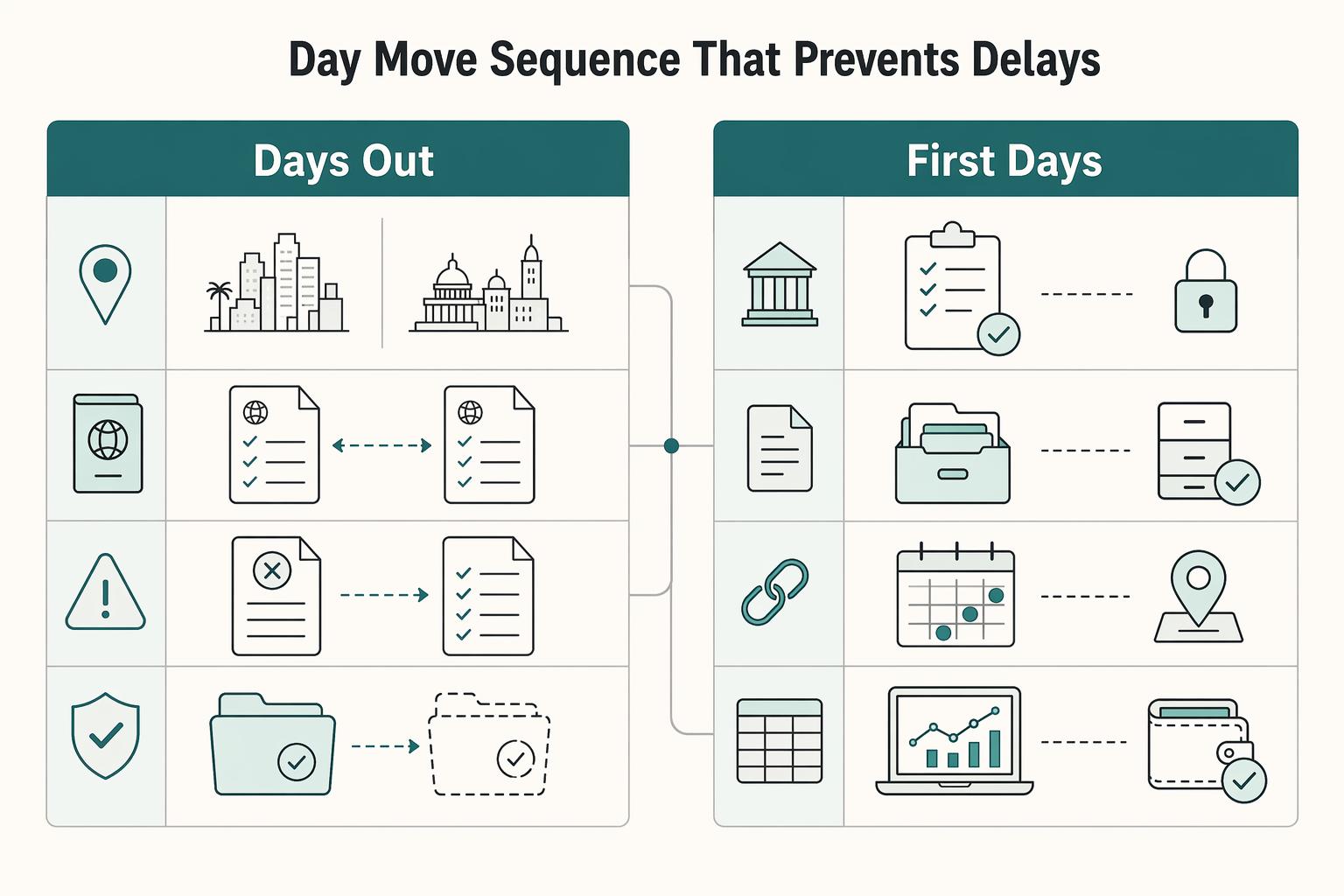
Your 90 60 30 Day Move Sequence That Prevents Delays#
Use this timeline as an execution order, not as a legal rule. What matters is placing checks in the right sequence before money, travel, and client delivery start colliding.
| Phase | Primary task | Checkpoint |
|---|---|---|
| 90 days out | Narrow to two cities and verify the legal path for each | Finish with one primary choice and one realistic fallback |
| 60 days out | Lock landing logistics and build your proof pack | Complete document pack and housing plan |
| 30 days out | Run a failure-mode check before nonrefundable spend | End with an error-free submission set and a conflict-checked calendar |
| First 14 days after arrival | Handle legal-status tasks first, then connectivity and payment basics, then stabilize your work setup | Keep client delivery lighter if you can during this window |
| First 90 days in-country | Run monthly reviews and decide to stay, switch, or exit | Review compliance tasks, actual spend versus plan, and delivery reliability at each 30-day checkpoint |
90 days out: narrow to two cities and verify the legal path for each. This is where browsing stops and decision work begins. Confirm whether your route is a Digital Nomad Visa or another lawful entry option for your nationality. One published tracker says 65 countries offer digital nomad visas, and program requirements vary, so compare only routes you can verify directly. Finish this stage with one primary choice and one realistic fallback. If you still have three or four "strong maybes" at this point, you do not have a shortlist yet. You have unresolved research.
60 days out: lock landing logistics and build your proof pack. This stage is about turning a city choice into a move you can support on paper. Finalize your first-month housing approach, then assemble the documents the route requires. Make sure income evidence clearly shows your work is remote and ongoing. If you will be mid-project during travel week, also line up a communication plan for active clients so delivery does not drift while you are dealing with logistics. A move tends to expose whatever was already loose in your schedule, so tighten that now rather than after departure.
30 days out: run a failure-mode check before nonrefundable spend. This is the point where small inconsistencies become expensive. Review every document line by line for exact name, number, and date consistency. Reconcile travel dates, filing windows, and appointments with client commitments. If role classification is unclear, resolve it now with Are You an Employee or a Contractor? A Self-Assessment Checklist. This is your best chance to catch contradictions before they turn into missed appointments, rejected submissions, or a rushed fallback plan you did not intend to need.
First 14 days after arrival: execute essentials in strict order. Handle legal-status tasks first. Then sort connectivity and payment basics. Then stabilize your work setup. Keep client delivery lighter if you can during this window. Relocation often reduces output for a week or two even when the move goes well, and decision fatigue tends to show up early. The biggest mistake here is treating every task as equally urgent. It is not. If legal status and dependable internet are not secure, other setup tasks can wait.
First 90 days in-country: run monthly reviews and decide to stay, switch, or exit. At each 30-day checkpoint, review compliance tasks, actual spend versus plan, and delivery reliability. Do not wait for vague dissatisfaction to build. Look at what is happening. If the same gaps keep repeating and you are still patching basics after multiple reviews, switch cities or exit cleanly instead of drifting deeper into a poor fit. The goal of the first quarter is not to prove your original choice was perfect. It is to establish whether the city works under real operating conditions.
Treat each stage as a gate with a concrete output. The 90-day gate should end with two verified city options. The 60-day gate should end with a complete document pack and housing plan. The 30-day gate should end with an error-free submission set and a conflict-checked calendar. If a gate output is missing, do not force progress to the next stage just because the travel date feels close.
A simple way to keep the sequence honest is to ask these questions at the end of each phase:
- Is the legal route still clear?
- Is the proof pack complete and internally consistent?
- Is first-month setup mapped in execution order?
- Is client delivery protected during the transition?
- Is the city performing against plan after arrival?
This timeline works because it replaces vague hope with explicit gates. First confirm the route. Then build proof. Then catch mismatches. Then land lightly. Then review with real data. That order prevents the classic mistake of booking first and solving later.
And even a clean sequence will fail if the paperwork does not tell one coherent story. That is the next task.
The Documents You Need Before You Relocate#
Treat document prep as risk control, not admin theater. In practice, relocation problems are often consistency problems, not missing-file problems.
Start by building one evidence pack, then localize it by country. Keep passport identity pages, income or funds proof, housing records, insurance, and tax identity documents in one baseline folder. That baseline is not a universal checklist. It is your base set so each destination can be adapted without rebuilding from scratch every time. When pressure rises, the value is not just having the files. It is knowing where they are, which version is current, and whether they still support the route you plan to use.
Next, resolve role clarity before filing anything country-specific. Confirm whether your setup is employee, contractor, or mixed, and make sure the documents tell one consistent story. If classification is unclear, pause and resolve it first with Are You an Employee or a Contractor? A Self-Assessment Checklist. Small wording mismatches across documents are a common reason otherwise strong applications become slower and harder to defend. A clean file set should not force an officer, landlord, or service provider to guess what kind of work arrangement you actually have.
Then put a verification-before-payment gate in place. Do not pay nonrefundable deposits, appointment fees, or long-stay bookings until names, document category, and visa route all align. Check spelling, date formats, and ID numbers across files, then verify your planned stay against common tourist windows like 60 or 90 days. This is boring work, but it is also cheap insurance. A short review here often prevents expensive cleanup later.
The next rule is simple: treat each destination as its own compliance track, Hungary White Card included. Do not carry assumptions from one city or country into another. Some places require a long-term route for longer stays. Some restrict business activity without a work permit. Local tax obligations may apply, and visa runs are not available everywhere. Use country-specific requirements every time. For one country-specific track example, see Hungary's White Card for Digital Nomads: A Complete Guide.
To keep the pack usable under pressure, maintain one current version and one archived version after every major update. Add a short date note whenever something changes so you can answer verification questions quickly. Use consistent file names and one checklist index so you can find critical records fast when a portal asks for a re-upload or clarification. The aim is not a folder that looks impressive. It is a document set that makes your situation easy to understand.
A useful final check is this: if the folder is technically complete but still leaves obvious questions about your role, route, or intended stay length, the story is not tight enough yet. Fix that before you move. Once shortlist, sequence, and evidence pack all line up, most remaining choices get easier because you are choosing between verified options instead of competing assumptions.
Pick One City and Commit to a Real Move Plan#
At this point, inspiration is not the constraint. Execution is. Leave this process with one city you are ready to move to, one backup you can still activate, and a dated plan that protects client work while you settle.
- Choose one primary city and one backup. Pick the option with fewer unknowns around legal stay, daily work setup, and budget fit. Rankings can help discovery, but fit decides outcomes. Some city lists are explicitly unranked for a reason.
- Turn intent into dated checkpoints. Set dates for legal-route confirmation, housing decisions, document verification, and client scheduling adjustments. If a task has no date, treat it as unresolved.
- Protect first-month delivery as a non-negotiable. Anchor the opening month around connectivity, compliance tasks, and delivery windows. Add community steps early as part of execution, not as optional lifestyle planning. Isolation is a common failure mode, and online group discovery is often more fragmented than people expect.
- Keep a verification gate before payment. Before deposits or long bookings, confirm that stay route, work status, and document set all match. Use your visa-specific deep dive and the contractor-status checklist, including Are You an Employee or a Contractor? A Self-Assessment Checklist, before committing funds.
Good city choices only pay off when legal access, daily operations, and creative momentum hold together in the same place. If those three things are not aligned yet, it is not your city yet. If you want help checking what is supported for your specific country or program, Talk to Gruv.
Frequently Asked Questions
What are the best nomad cities for creatives in 2026 if I need both affordability and strong community?
Start with cities that balance reliable internet, manageable daily costs, and an active remote-work community. Use a connectivity floor around 25 Mbps download, then check safety and healthcare access before committing. Filter for stable output, not just low rent or social buzz.
How should I choose between Lisbon, Mexico City, Berlin, Bali, and Tbilisi?
Use one scorecard for all five, then remove any city where legal stay terms are unclear for your passport and work profile. If your plan exceeds a typical 60 or 90 day stay, confirm a longer-stay route such as a Digital Nomad Visa before booking. Legal clarity should outrank lifestyle preference when two options look equally attractive.
What paperwork should I prepare before I apply for a Digital Nomad Visa?
Prepare the exact document set required by the country and program, then localize it for your destination. Requirements vary, so confirm whether the route is limited to remote workers and what proof is required before you file. Confirm worker classification before filing and use Are You an Employee or a Contractor? A Self-Assessment Checklist if needed.
What is the most practical 90/60/30 timeline for relocating without delays?
Use 90/60/30 as planning cadence, not legal rule. At 90 days, lock your top two cities and verify legal path. At 60 days, finalize documents and housing strategy. At 30 days, run a mismatch check on names, dates, and ID numbers before nonrefundable spending. Each phase should end with a verification gate.
Are list-style rankings from Reddit, Fused Magazine, or lifestyle blogs reliable enough to decide a move?
Use them to discover options, not to validate legal entry or work authorization. Final decisions need separate checks for visa terms, internet reliability, affordability, and healthcare access. Treat rankings as discovery, then verify with current visa guidance and recent update dates such as January 2026 markers.
Which city is most forgiving for a first-time creative nomad managing client deadlines?
The most forgiving city is the one with the fewest setup unknowns in your first month, not a universal winner. Pick the place where you can confirm legal stay, secure dependable internet above your working threshold, and line up backup connectivity before arrival. If your plan depends on a visa-run fallback, choose a different route because that reset is not available everywhere.
Try a related tool
Researched and edited by the Gruv editorial team. Gruv builds cross-border billing, payouts, and finance-operations software for global businesses.
Sources
Includes 4 external sources outside the trusted-domain allowlist.
- digital.library.unt.edu/ark:/67531/metadc500105/m2/1/high_res_d/diss...trusted
- creators.spotify.com/pod/show/beach-commute/episodes/7-realities-...external
- indino.org/post/ultimate-guide-to-nomad-friendly-cities...external
- libertynomads.net/whats-new/the-best-cities-for-digital-nomad-...external
- yahoo.com/lifestyle/story/the-10-best-cities-for-digit...external
Educational content only. Not legal, tax, or financial advice.
Related Posts

Hungary White Card Guide for Digital Nomads: Eligibility, Documents, Fees, and Timeline
Treat this like an audit, not a hope-and-pray submission. Your job is to decide whether your real-world setup fits the permit logic, pick the right filing route, then build one evidence pack that stays coherent even if someone reviews it line by line.
Are You an Employee or a Contractor? A Self-Assessment Checklist
Forget the label. Classification turns on the relationship you actually run, not the title you typed into the contract. It is also much easier to fix before you sign.
How to Write Compelling Case Studies for Your Portfolio
Treat your case study as buyer decision evidence, not as a polished recap of work you enjoyed doing. To build trust, give the reader enough real context and proof to answer one question: should they trust your judgment on a project like theirs?