
Quick Answer
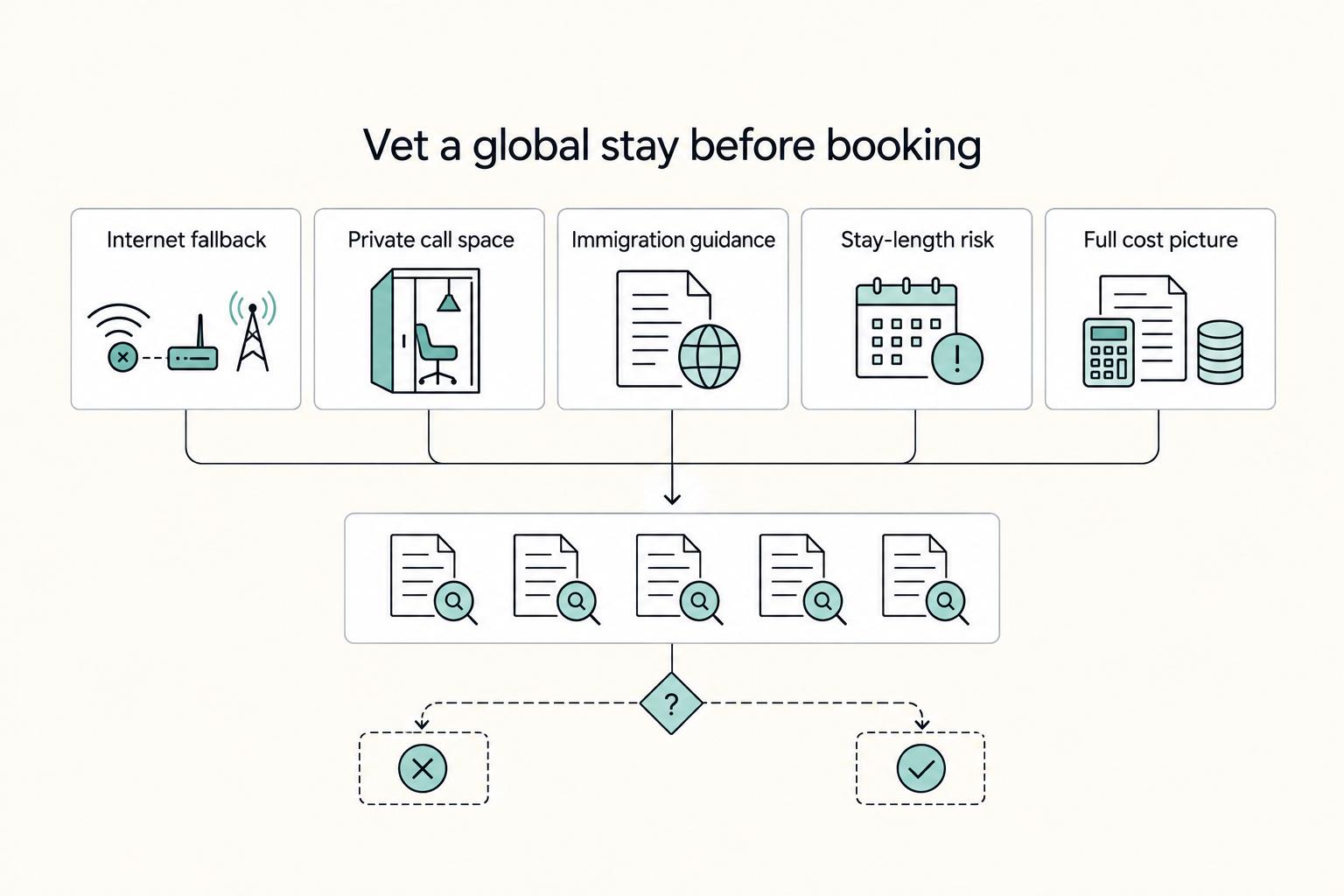
Yes - book only after three checks pass: operations, compliance, and ROI. Require written evidence of fiber plus backup connectivity, guaranteed private call booths, and a clear boundary on immigration guidance. Confirm whether your case needs artifacts such as an A1 certificate, CoC, or posted worker notification before paying. Then run break-even billable-hours math against the retreat’s real collaboration format, not brochure language.
Beyond the Beach: A Due Diligence Framework for Your Next Coworking Retreat#
A coworking retreat is only worth booking if it can support real work, real deadlines, and real compliance obligations. When a retreat gets the basics wrong, the cost shows up quickly in missed client delivery, compliance exposure, and admin drag that eats the week you meant to spend producing.
Screen it like a business decision, not a lifestyle purchase. Treat glossy promises carefully. If a site shrugs off bad internet as a minor issue, or hand-waves visa and mobility risk, do the verification yourself. Marketing copy is not evidence.
Before you book, pressure-test every option against three mission-critical pillars. The next sections turn those checks into a practical booking sequence with clear decision points:
- Operationally-grade
Check whether the retreat can prove work-ready infrastructure, not just advertise "fast Wi-Fi." Ask for evidence of redundant internet, such as fiber plus a backup connection, and confirm guaranteed access to private, sound-proofed call booths. Ask for proof before payment.
- Compliance exposure
Your first question is not "Can I get in?" but "Can I do my actual work there under the status I will use?" If your trip touches the Schengen Area, check current stay-limit rules before you commit. You need current rule-checking for your jurisdiction, not broad reassurance.
- Real ROI
Price the trip against your billable-hours break-even, then look at what the retreat actually improves: focus, network quality, and deal flow. Look for structured professional value, not just a busy social calendar.
Related: The Best RVs and Campervans for Digital Nomads. If you're looking at "best coworking retreats" and
Pillar 1: Is the Retreat "Operationally-Grade"? Assessing Business Continuity#
Treat this as a pass/fail business check: if a retreat cannot show you how work continues during disruptions, do not book it.
1. Verify connectivity, not marketing claims#
Ask for this in writing before you pay:
- Stated uptime expectations
- Primary connection type
- Backup path (for example, fiber plus a 5G backup)
- Failover process when service drops
- Who owns incident response
A speed-test screenshot alone is not enough. Poor connectivity is a continuity risk and can cost over 30 minutes of productivity in a day.
2. Run a workspace pass/fail audit#
Use this checklist and mark any vague answer as a fail.
| Checkpoint | Pass if... | Fail if... |
|---|---|---|
| Call privacy | You have guaranteed access to private, sound-proofed call booths | Privacy is "usually available" |
| Ergonomic readiness | Desk/chair setup supports a full workday | Setup is casual or unclear |
| Noise control | Quiet work is realistically protected | Noise is unmanaged |
| Power reliability | Desk-level power is stable and available | Power access is inconsistent |
| Booking rules | Focus space can be reserved predictably | You must compete daily for quiet space |
3. Confirm fallback readiness#
Ask for a simple continuity playbook covering:
- Equipment replacement path
- Local IT escalation option
- At least one alternative workspace
- Immediate client-facing contingency message/process if delivery slips
You are looking for named backup options, not general reassurance.
4. Check time-zone overlap as an operations constraint#
Use overlap quality to decide how you will communicate.
| Overlap quality | Operating impact | Recommended communication mode |
|---|---|---|
| Strong overlap | Live decisions and calls are practical | Synchronous meetings for key decisions, async notes for follow-through |
| Partial overlap | Work is possible, but decisions may queue | Protect overlap for high-value calls; move status updates async |
| Minimal overlap | Slow approvals and handoff friction are likely | Async-first; schedule only essential live conversations |
If a retreat cannot answer these checks clearly, keep looking. That is basic business hygiene.
We covered this in detail in The Best Road Trips for Digital Nomads in the US.
Pillar 2: Will This Trip Create a Compliance Nightmare? Mitigating Your Biggest Risks#
Treat compliance as pre-trip risk control, not post-booking cleanup. Before you pay, confirm your work authorization path, map your stay limits, decide your tax escalation points, and get coverage and contract answers in writing.
| Checkpoint | What to verify | Evidence to keep |
|---|---|---|
| Work authorization path | Confirm the route for your exact passport and destination; extra artifacts may apply, such as A1 certificate & CoC or posted worker notifications | Save the links/files you relied on |
| Stay-limit map | Track arrival date, planned exit date, prior days in-region, buffer days, and confirm the current stay threshold with the official immigration source | Keep boarding passes, passport-stamp photos, and lodging invoices |
| Tax residency trigger check | Physical presence for as little as 60-183 days can trigger major tax liabilities; escalate if the stay extends, you repeat stays in one country, or your work pattern changes materially | Keep entry/exit dates, accommodation records, payment records, and work-location logs |
| Coverage and contract terms | Confirm personal coverage, professional coverage, operator liability, and any stated includes, excludes, or limits | Save written replies on liability, remedy, claims process, required documents, governing law, and dispute terms |
- Work authorization path (before booking)
Do not assume a retreat booking gives you permission to work in-country. Confirm the route for your exact passport and destination, then check whether extra artifacts may apply in your case (for example, A1 certificate & CoC or posted worker notifications).
Use this sequence:
- Passport-country pair: Confirm the current work authorization path from the official immigration source
- Stay rule: Confirm the current legal stay threshold from the official immigration source
- Work condition limits: Confirm the current work-condition limits from the official immigration source
- Evidence saved: Keep the official links and source files you relied on
If your retreat is in Schengen, track the 90/180 count before you book and while you travel. A 30-day stay can use one-third of your six-month allowance, and overstay risk can include fines, deportation, or entry-ban exposure that affects mobility across 29 countries.
- Stay-limit map (before and during travel)
Build a one-page tracker with arrival date, planned exit date, prior days in-region, and buffer days. Include a required field for the current stay threshold, and verify it against the official source before use. Update it during the trip, not just at departure. Keep simple records such as boarding passes, passport-stamp photos, and lodging invoices so your timeline is easy to prove if questioned.
- Tax residency trigger check (decision points)
For longer or stacked stays, decide tax exposure before purchase. The grounded risk is that physical presence for as little as 60-183 days can trigger major tax liabilities, depending on country and facts.
Use clear escalation rules:
- Before booking: escalate if this trip plus planned travel could approach a local presence threshold.
- During travel: keep entry/exit dates, accommodation records, payment records, and work-location logs.
- Escalate immediately if the stay extends, you repeat stays in one country, or your work pattern changes materially.
Coverage should be documented the same way, with includes and excludes stated explicitly.
| Coverage area | Confirm it explicitly includes | Confirm it explicitly excludes or limits |
|---|---|---|
| Personal coverage | Medical treatment abroad and travel health insurance for your destination | Limits tied to work-related travel or activity type |
| Professional coverage | Business equipment and work-related use while traveling | Exclusions for theft, damage, or business property in shared spaces |
| Operator liability | Facility incidents, service outages, and member-property handling under their terms | Broad disclaimers, missing liability terms, or no proof of applicable cover |
Ask before you pay (and save written replies):
- What is your policy if member equipment is lost, stolen, or damaged on site?
- If internet/workspace service fails, what liability and remedy are written into the contract?
- What is the claims process, and which documents are required?
- Which terms govern the booking, including governing law and dispute terms?
If the answers stay vague instead of document-based, keep looking.
This pairs well with our guide on The Best Anti-Theft Backpacks for Digital Nomads.
Pillar 3: What's the Real ROI? A Framework for Strategic & Financial Returns#
Treat this as a business investment only when two gates pass: the retreat can plausibly pay back its cost, and the network is strategically relevant to your work. If either gate fails, classify it as optional travel.
| Step | What to include | Decision signal |
|---|---|---|
| ROI worksheet | Total trip cost, program, travel, lodging gap, meals and incidentals, insurance, workspace/equipment add-ons, downside buffer for lost billable time, and expected value channels such as new client work, referrals, collaborations, focused output, or skill gains | Set your minimum return target in billable hours before you pay a deposit |
| Weighted network score | Curation quality, collaboration format, participant relevance, and post-retreat outcomes | Total network score = sum(weight × score) |
| Strategic-fit workflow | Review alumni profiles, event format, organizer support, and keep an evidence pack with alumni role snapshots, agenda, and written organizer answers | Book only if both your financial-return threshold and your network-fit threshold clear your minimum criteria |
- Build a reusable ROI worksheet first
Start with total trip cost, not just the booking price. Include your expected spend categories (program, travel, lodging gap, meals and incidentals, insurance, workspace/equipment add-ons) plus a downside buffer for lost billable time. Then list expected value channels separately (new client work, referrals, collaborations, focused output, or skill gains that improve delivery).
Use this planning line before booking:
Break-even billable hours = Total trip cost / your current billable rate Confirm your own cost and billable-rate inputs before relying on the result.
Set your minimum return target in billable hours before you pay a deposit. If internet reliability is uncertain, price that operational risk into the same worksheet: losing over 30 minutes per day can erase expected upside quickly.
- Use a weighted network score, not a vibe check
Network ROI is strongest when the group is curated and collaboration is structured. Score evidence, not marketing language.
| Criterion | What to verify | Weight (1-5) | Score (1-5) | Weighted score |
|---|---|---|---|---|
| Curation quality | Application process, attendee criteria, visible professional profiles | |||
| Collaboration format | Mastermind sessions, workshops, facilitated introductions | |||
| Participant relevance | Match to your industry, buyer type, or capability goals | |||
| Post-retreat outcomes | Alumni examples of collaborations, referrals, or continued support |
Total network score = sum(weight × score)
Ask for attendee profile examples, a real agenda, and a clear explanation of post-retreat introductions before you score.
- Run a short pre-booking strategic-fit workflow
Review alumni profiles, then event format, then organizer support. Map each finding to your actual objective: client pipeline, capability growth, or targeted partnerships. Keep a small evidence pack with alumni role snapshots, agenda, and written organizer answers so your decision is traceable.
Confirm the retreat can operate as a temporary operational headquarters before final approval, including proof of redundant internet (for example, fiber with a 5G backup). Then apply one rule: book only if both your financial-return threshold and your network-fit threshold clear your minimum criteria. If one fails, it is a no-go. If useful, pair this with How to Price Webflow Development Services.
The Global Professional's Vetting Checklist: 7 Questions to Ask Before You Book#
Once the upside looks plausible, switch from promise to proof. Use one evidence standard for every answer: a written policy, contract clause, or documented process.
| Question | Caution trigger | Operational outcome |
|---|---|---|
| Ask how internet failure is handled | Vague claims like "high-speed Wi-Fi" with no documented backup plan | Protects delivery reliability and avoids daily productivity loss that can exceed 30 minutes |
| Ask whether private call space is guaranteed, not just available | "First come, first served" or informal workarounds | Protects call quality and client-facing execution |
| Ask what immigration guidance they provide, and where it stops | Casual assurances that tourist entry is "fine" without verification steps | Reduces legal exposure; in Schengen, track the 90/180 count because a 30-day stay uses one-third of your six-month allowance |
| Ask what stay-length risks you must verify yourself | Blanket claims that longer stays have no tax implications | Reduces accidental tax residency risk, which can arise around 60-183 days depending on jurisdiction |
| Ask for the full money picture before paying a deposit | Unclear fees or refund wording | Protects cash flow and downside control |
| Ask how your equipment is protected | Trust-based answers without documented process or liability clarity | Improves equipment protection and clarifies risk ownership |
| Ask how collaboration is produced in practice | Social programming with no evidence of curated professional structure | Improves the odds of real collaboration value over social activity |
- Ask how internet failure is handled.
Request a recent speed test from the primary workspace and written proof of redundant connectivity (for example, fiber with a 5G backup). Caution trigger: vague claims like "high-speed Wi-Fi" with no documented backup plan. Operational outcome: protects delivery reliability and avoids daily productivity loss that can exceed 30 minutes.
- Ask whether private call space is guaranteed, not just available.
Request written booking rules for private, sound-proofed booths and confirmation that access is included in your stay. Caution trigger: "first come, first served" or informal workarounds. Operational outcome: protects call quality and client-facing execution.
- Ask what immigration guidance they provide, and where it stops.
Request a written boundary statement on what they can and cannot advise, plus their documented process for pointing you to official visa and registration sources; verify the current requirement from official records before use. Caution trigger: casual assurances that tourist entry is "fine" without verification steps. Operational outcome: reduces legal exposure; in Schengen, track the 90/180 count because a 30-day stay uses one-third of your six-month allowance.
- Ask what stay-length risks you must verify yourself.
Request written guest guidance on registration expectations, tax-risk reminders, and when they require professional advice; verify the current requirement from official or advisor records before use. Caution trigger: blanket claims that longer stays have no tax implications. Operational outcome: reduces accidental tax residency risk, which can arise around 60-183 days depending on jurisdiction.
- Ask for the full money picture before paying a deposit.
Request the payment schedule, refund terms, included vs. excluded costs, and cancellation/disruption clauses in contract language. Caution trigger: unclear fees or refund wording. Operational outcome: protects cash flow and downside control.
- Ask how your equipment is protected.
Request written security procedures for access control, lockable storage, incident reporting, and post-incident handling in shared spaces. Caution trigger: trust-based answers without documented process or liability clarity verified from contract or vendor records before use. Operational outcome: improves equipment protection and clarifies risk ownership.
- Ask how collaboration is produced in practice.
Request a real agenda, sample attendee profile mix, and documented process for introductions, mastermind sessions, and follow-up. Caution trigger: social programming with no evidence of curated professional structure. Operational outcome: improves the odds of real collaboration value over social activity.
How to use the pass, flag, and escalate rule#
Pass: all seven answers are documented, and core business controls are clear (redundant internet, guaranteed call space, transparent terms, and honest compliance boundaries).
Flag: the retreat is viable but one gap is fixable; ask for a contract clause, written confirmation, or a documented process before paying.
Escalate: any uncertainty on visa status, registration expectations, tax exposure, or liability scope; verify with the relevant authority or advisor first. If the operator resists written clarity, walk away.
You might also find this useful: The Best Cities for a Workation in Europe.
A Curated List of Top-Tier Retreats (Analyzed Through the Gruv Framework)#
Use this section as a fit check, not a winner list: the right choice is the model that matches your work style, compliance tolerance, and break-even target. Before you pay any operator, get fresh written proof for backup internet, private call access, and where their immigration guidance stops.
| Retreat | Best for | Operations reliability signal to demand | Compliance complexity | Networking style | Ideal trip profile |
|---|---|---|---|---|---|
| Mokrin House | Focused output in one base | Recent workspace speed test, written backup internet plan, written private-call policy | Medium (depends on your full travel year) | Lower-density, place-led | You need concentrated delivery time |
| Hacker Paradise | Built-in professional interaction | Chapter-specific workspace proof, backup plan, and call-space rules (not brand-level claims) | Medium to high (especially with Schengen stops) | Curated, event-led | You want structured peer time and can protect focus blocks |
| Outsite | Independent work travel with light structure | Property-specific workspace details, connectivity proof, and call-space terms | Low to medium (country-dependent) | Self-directed, lighter-touch | You want autonomy more than facilitation |
| WiFi Tribe | Ongoing community across multiple stops | Stop-by-stop evidence pack (speed, backup, call privacy) before each leg | High (more moving parts to track) | Community-first, longer-arc | You prioritize recurring relationships over location stability |
- Mokrin House
This is the practical fit when your main goal is to ship work with minimal moving parts. Ask for a recent speed test from the actual workspace, a written backup internet plan, and a guaranteed private-call setup. If those answers are vague, treat it as a delivery risk, because unreliable internet can cost over 30 minutes per day.
Compliance Brief: you still need to plan this against your full travel calendar. If Schengen is part of your year, track the 90/180 rule closely, since a 30-day stay can use one-third of your six-month allowance.
Strategic ROI: this format is strongest when your break-even is tied to billable output or a deadline. Choose this if you want a temporary headquarters for focus and can source networking elsewhere.
- Hacker Paradise
Choose this when you want professional interaction to be part of the core experience, not an add-on. Verify each chapter directly: exact workspace, recent speed test, backup internet details, and written private-call rules for that specific stop.
Compliance Brief: treat every destination as its own planning task. If a stop is in Schengen, your 90/180 tracking is on you, and overstay consequences can include fines, deportation, and bans that affect access across 29 countries.
Strategic ROI: the upside is highest if you will actively use masterminds and curated peer time. Choose this if you want structure and introductions, and you can still defend deep-work hours.
- Outsite
This is usually the better fit if you prefer autonomy and lighter programming. Evaluate the specific property, not the label: confirm workspace setup, current connectivity evidence, and whether private call space is guaranteed, limited, or unavailable.
Compliance Brief: burden varies by location, so avoid assumptions across stays. If you are stacking trips, monitor time-in-country because physical presence in roughly the 60-183 day range can raise tax-residency questions.
Strategic ROI: returns usually come from consistent work rhythm plus optional community touchpoints. If community fit is your deciding factor, pressure-test it with The Best Digital Nomad Communities to Join. Choose this if you want flexible structure with lower social pressure.
- WiFi Tribe
Pick this only if you are comfortable running repeated checks as locations change. Require a stop-by-stop evidence pack before each leg: current speed test, backup internet plan, private-call setup, and clear guidance boundaries.
Compliance Brief: multi-stop travel increases admin load. It can make Schengen tracking easier to mismanage and can surface tax-residency risk faster in a heavy travel year.
Strategic ROI: the upside is deeper recurring relationships over time, with more planning overhead. Choose this if community depth is worth higher compliance and logistics effort.
For a step-by-step walkthrough, see The Best Co-Working Spaces for Digital Nomads.
Conclusion: Make Your Next Move a Strategic One#
Your next retreat should clear three business checkpoints before it gets your card details. If a listing cannot pass them, treat it like a nice trip with work risk attached, not a professional base.
- Operational Integrity
Start with proof, not atmosphere. You want evidence of resilient internet, such as fiber with a 5G backup, plus guaranteed access to private, sound-proofed call space. Ask for recent proof from the actual workspace and explicit confirmation of call-booth access, because the failure mode is simple: dropped client calls, missed deadlines, and avoidable revenue loss.
- Compliance & Risk Mitigation
Check the legal fit before you think about community or scenery. If the stay touches Europe, track your Schengen 90/180 day count. A single 30-day retreat can consume one-third of that six-month allowance. For tax, do not rely on a universal rule: presence of 60-183 days can create exposure depending on the country, so verify the current country threshold from official or advisor records before use. If the trip is long enough to raise questions, speak to an international tax advisor before booking.
- Strategic ROI
Run the numbers against business goals, not mood. Calculate the break-even point in billable hours, then ask whether the peer environment is professionally curated or mostly social. One more red flag: if the cost would push you into debt your business cannot comfortably carry, the retreat is overpriced for your current stage, even if everything else looks polished.
The next step is straightforward: shortlist two or three options, validate operations with evidence, confirm visa and tax fit, then commit only when the spend matches your work goals. If you need a final pre-booking pass, go back to the checklist and FAQ above and use them line by line. Need the full breakdown? Read The Best Business Travel Insurance for Digital Nomads and Executives.
Frequently Asked Questions
Are all retreat listings actually built for real work?
No. Treat the label as marketing until the operator proves the setup. One provider states plainly, “We are not a coworking space,” while another offers a 4-week virtual retreat delivered through live video, recorded sessions, and chat tools. First verify whether you are booking a fixed-site retreat, a nomadic retreat that changes location, or a virtual retreat, then request the exact workspace details for your dates. A common mismatch is paying for focus and landing in a product that is really community-led, travel-led, or fully online.
How do you tell if the workspace claim is strong enough for client work?
You need property-level proof, not city-level comfort. A venue may advertise fiber cable WiFi at 300 mbits, while a city FAQ may cite 48.04 Mbps download, 47.69 Mbps upload, or even over 400 free Wi-Fi zones. None of that confirms the desk, booth, or backup setup you will actually use. Ask for one recent speed test from the actual workspace, photos of the call area, and written confirmation on whether private calls are guaranteed, limited, or room-only.
Is all-inclusive better than pay-as-you-go?
Only if it matches your work style and your tolerance for admin. Some providers say most two-week and one-month trips include accommodation and coworking space, while one-week trips can be more adventure-driven, so the package structure matters more than the label. Ask for the exact inclusions for your dates, not generic package copy, and do not assume bundled always means coworking-first, cleaner, or cheaper. | Model | Operational reliability | Compliance workload | ROI fit by work style | |---|---|---|---| | All-inclusive fixed-site | Can be easier to audit if accommodation and workspace are bundled in one place | Can be lighter because you track fewer moving parts | Better if you want focused output and predictable routines | | All-inclusive roaming | Can be harder to audit because each stop can differ | Can be higher because every location may need a fresh check | Better if community depth matters more than location stability | | Pay-as-you-go | Can be highly variable because you assemble the stay yourself | Depends on how many bookings, moves, and countries you stack together | Better if you value flexibility and can manage your own setup without losing work time |
What insurance should you line up before you go?
Treat insurance as a case-by-case decision, not a fixed checklist. This section’s grounding does not establish universal coverage requirements. Before departure, confirm with your insurer what is covered for work travel, devices, and work-related claims, and get key limits or exclusions in writing.
Can you treat retreat costs as a business expense?
Maybe, but do not rely on old internet advice here. Your next move is to ask your accountant for the current rule in your home jurisdiction and record the deduction rule only after official or advisor verification. Keep invoices, payment confirmations, dates, event schedules, and any written proof that the trip had a real business purpose, because thin documentation is hard to defend later.
How should you handle visas or work permission for a month-long stay?
Assume nothing until you verify the destination’s current rules for your passport and trip purpose. Some retreats sell 4, 10, 14-night, or 1-month stays, but the retreat length does not tell you whether your status allows you to work remotely from that location. Check the official immigration source, ask the operator where their guidance stops, and record the visa condition only after official verification. Legal and tax risk sits with you, not the retreat, so do not book first and research later.
Try a related tool
Researched and edited by the Gruv editorial team. Gruv builds cross-border billing, payouts, and finance-operations software for global businesses.
Sources
Includes 1 external source outside the trusted-domain allowlist.
- buffalo.edu/grad/beyond/professional-development/write.htmltrusted
- dspace.mit.edu/bitstream/handle/1721.1/108832/986240784-MIT...trusted
- frederickcountymd.gov/civicalerts.aspxtrusted
- iese.edu/media/research/pdfs/REV-82-E.pdftrusted
- snap.berkeley.edu/project/9274006trusted
- snap.berkeley.edu/project/10053261trusted
- webfiles.ucpress.edu/oa/9780520413092_WEB.pdftrusted
- alpinecoworking.com/faqexternal
Educational content only. Not legal, tax, or financial advice.
Related Posts
The Best Digital Nomad Communities to Join
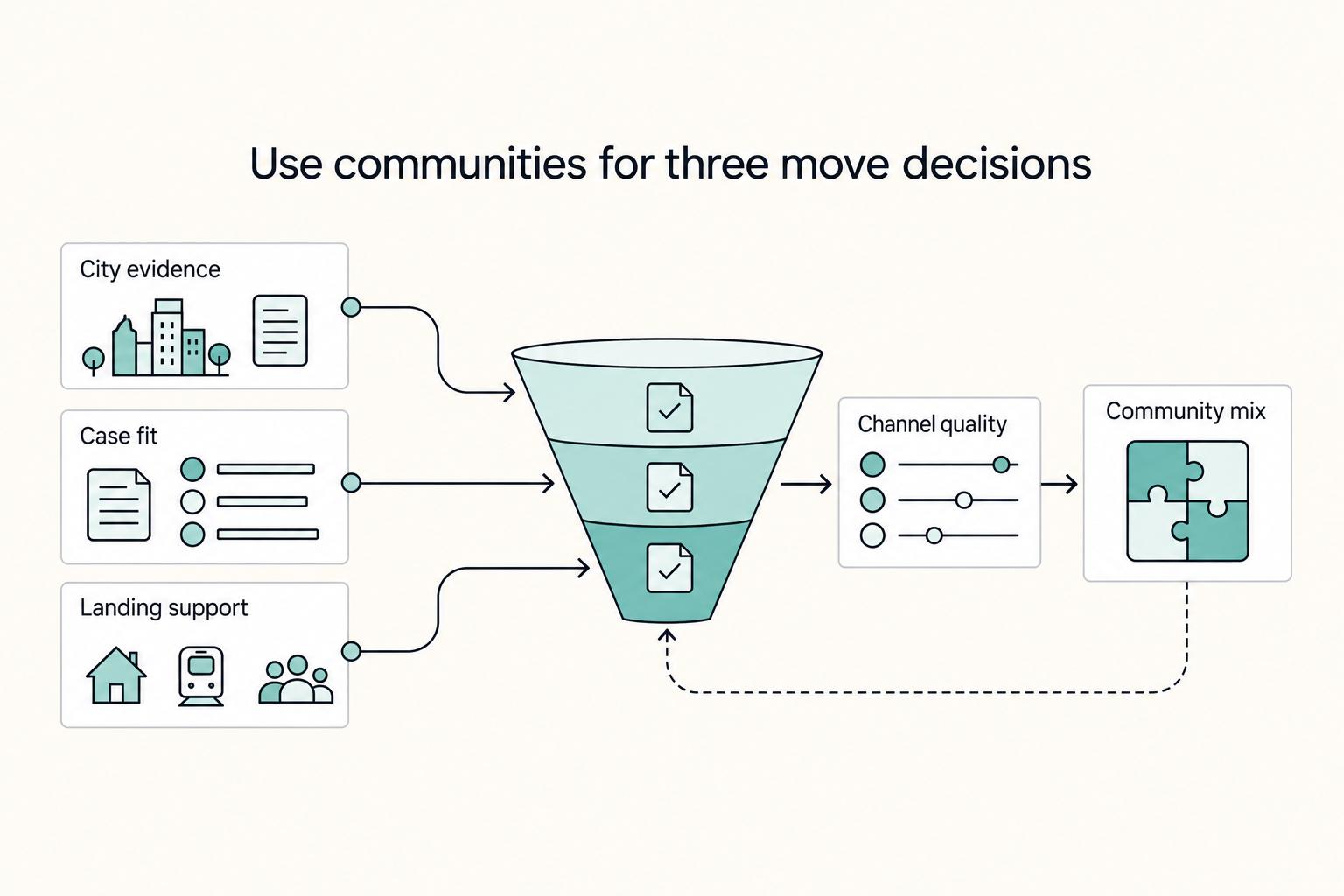
If your move date is real, use communities to answer three decisions in order: which city stays on your list, whether your case actually fits, and whether your landing week is covered. Judge every channel by outcomes, not activity. If it does not give you evidence you can use, stop giving it time.

How to Price Webflow Development Services
If you want to price Webflow development without leaking margin, treat pricing as an operating model, not a number you pull from memory. Separate platform costs from service work so the client can see what they are buying.

The Freelance Payment Penalty: A Modeled Audit of Platform Fees, FX Spreads, and Payout Delays
The money rarely disappears through a single, easy-to-spot fee. The real loss is stacked. A marketplace takes its commission, a processor adds a charge for international cards, a bank or payment company converts the currency at a spread, a platform holds the funds before release, and a wire sheds a little to intermediaries on the way in. Each layer looks defensible on its own, but the worker feels the combined result as a smaller deposit and a later payday.