
Quick Answer
The best cities for nomad families are the ones that survive a verification-first process, not the ones with the best vibe. Start with legal stay fit, schooling feasibility, and pediatric healthcare access, then compare cost, housing, and internet reliability inside those guardrails. Use a small shortlist, attach evidence to each score, and execute a 60- to 90-day plan with written fallbacks for visa and schooling.
Stop guessing: pick a nomad-family city with a scorecard + a 90-day move plan#
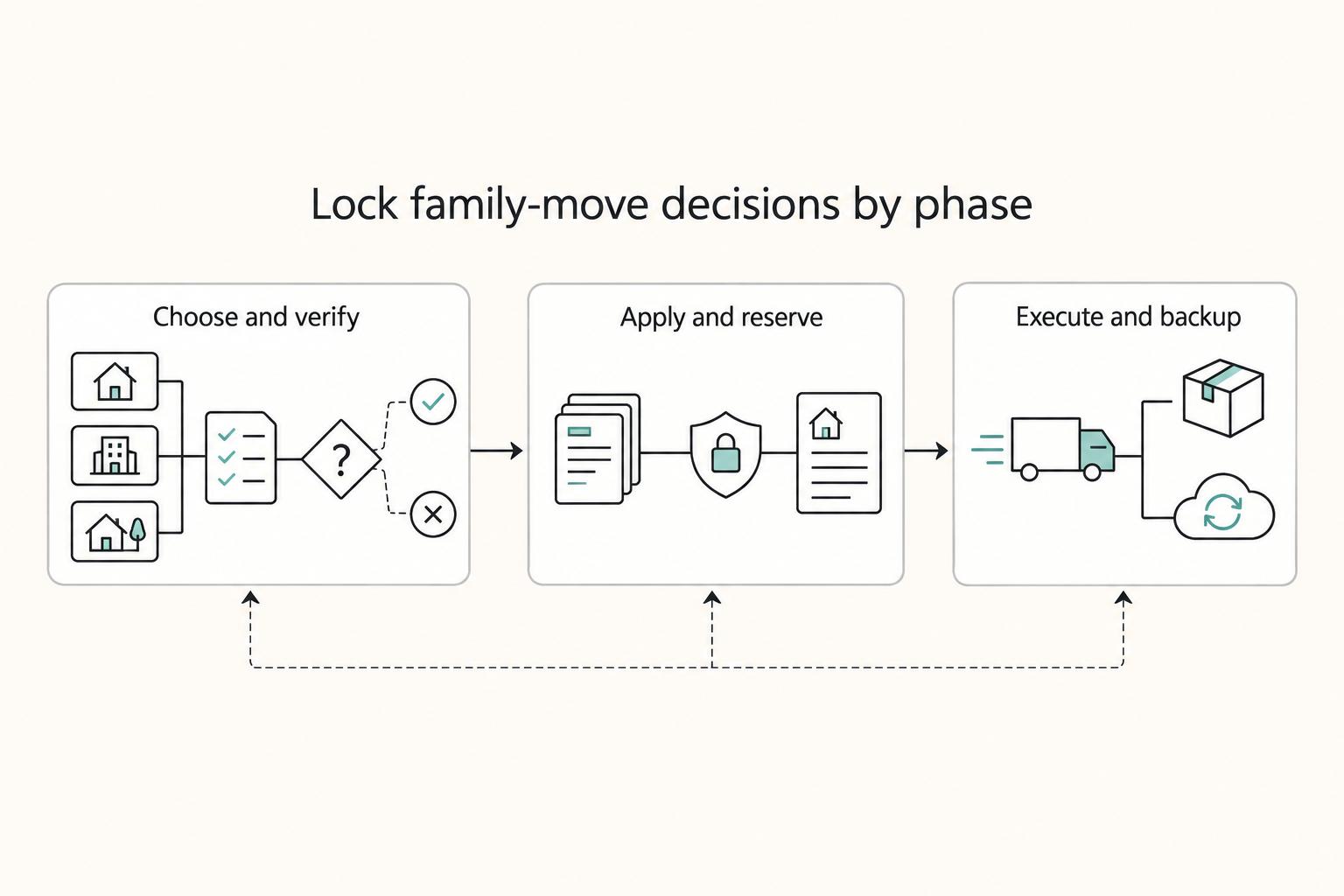
Don't pick cities on vibes alone. Compare them with a simple, verification-first framework, then confirm every "yes" with a primary source before you book anything nonrefundable. When you're moving with kids, not just traveling, you need a process that still works when you're tired, busy, and on a deadline. The operator loop is simple: assess, verify, then execute.
Build a simple comparison you can actually audit#
Skip "popular with nomads" as your main filter. Your day-to-day will be shaped by practical logistics, so write down the few things that matter most to your family and score cities against those.
Use a simple 1 to 5 rating for each factor you choose. Add a notes column with what you checked and where you checked it, so you can re-check later without starting from zero.
For each "yes," keep a verification checkpoint. When you're validating eligibility or requirements, confirm it on the original page and expect some access friction on certain sites, including reCAPTCHA ("Recaptcha requires verification.").
A quick hypothetical: you compare two "safe cities" and one wins on vibe. Your framework flags one major uncertainty, so you treat it as a trial instead of a base and keep your main option intact. That alone can save you from moving twice.
Turn the comparison into a pre-move timeline + a reusable document pack#
Treat the move like a project. Define decision locks, then build a reusable folder of key documents you can share quickly.
Your safe defaults:
- One source of truth folder (secure) with the key documents you might need.
- A verification log (date, link, what you confirmed) so you can re-check quickly.
- A "call-this-first" list with the handful of contacts that unblock problems fast.
If you need a starting map, use one index to orient yourself, then confirm details on the original pages: The Global Digital Nomad Visa Index.
The Gruv-style city scorecard: how we rank "best cities for nomad families" (so you can audit the pick)#
Rank cities for nomad families by weighting what protects kid stability first, then let cost and vibe compete inside those guardrails. A basic scorecard is useful. A ranking method you can defend when reality pushes back is better. This is the Gruv-style approach: weighted scoring, fail-fast guardrails, and receipts for every point.
1) Weight constraints, not preferences#
Skip rigid percentages. Use a weighted score that matches how family life tends to break under stress.
| Area | Relative weight | What to assess |
|---|---|---|
| Schools and childcare | Highest weight | Seat availability, admissions timing, language fit, commute to campus, after-school coverage |
| Healthcare and day-to-day safety | High weight | Pediatric access, urgent care workflow, neighborhood risk variance, how fast you can reach help |
| Visa fit and timeline risk | Medium-high weight | Your actual path, dependent rules, renewal friction |
| Housing and daily ops | Medium weight | Lease norms, furnished inventory, walkability, groceries, playground proximity |
| Internet reliability and work setup | Lower, but nonzero | Backup SIM, coworking options, and what if the primary line fails |
For many families, that order works as a default. If you do worldschooling instead, treat your learning plan like "school": curriculum, tutor availability, and a weekly cadence you can sustain. On visa fit, verify your actual path (tourist status vs a digital nomad visa or other long-stay option), dependent rules, and renewal friction, because rules vary by jurisdiction. On work setup, keep a backup plan for when the primary line fails.
Use an external index only as a starting map. For example, one non-official list claims 53 "digital nomad visas (or long-stay visa options)" exist "to date," but you still verify the exact rules on official pages before you commit. Start here: Global Digital Nomad Visa Index.
2) Fail fast with minimum viability, then audit every score#
Define your minimum viable family setup. If a city fails a non-negotiable, remove it from the shortlist, even if the apartment looks perfect.
A practical way to think about it:
- Schooling is real before you commit: don't rely on "we'll figure it out after arrival." Make sure your plan works for your situation and timeline.
- Healthcare is clear in writing: know where you go, how you access care, and how payment works. Don't assume one kind of coverage behaves like another.
- Work has redundancy: plan for failures (connectivity, workspace access) so one bad day doesn't become a week of chaos.
Then apply a two-list shortlist:
- A few safe-default cities (stability first): low operational surprises.
- A couple adventure cities (higher variance, higher upside): more upside, more moving parts.
Finally, attach evidence to each score and store it. Use receipts, not forum confidence.
| Score field | What you verify | Evidence you store (examples) |
|---|---|---|
| International schools | intake dates, required documents, commute | admissions page screenshot, email reply |
| Visa path | allowed stay, dependents, renewal steps | official program page link (where available) + notes |
| Healthcare | pediatric access, payment method | insurer/clinic info, clinic contact workflow |
What are your non-negotiables (and what can flex) before you choose Bangkok vs. Melbourne?#
Define hard operational gates first (legal stay, schooling, work reliability), then let "vibe" and cost compete only among the cities that survive. Scoring is useful, but gates save time. This pre-filter stops you from debating Bangkok vs. Melbourne when one option fails your family's basics.
| Gate or rule | What to verify | Why it matters |
|---|---|---|
| Legal stay length | Minimum continuous stay and the legal path for that exact duration | You win by eliminating, not by browsing |
| School plan | Availability, documents, commute you can sustain, and fees you can pay | Protect kid rhythm first |
| Measurable rules | Thresholds you can check before you wire deposits | Stop arguing and start verifying |
| Family ops baseline | Redundancy for work, childcare, and healthcare | Keep work from collapsing when reality hits |
1) Gate 1: Legal stay length (the "can we even be here?" test)#
Decide the minimum continuous stay you need for stability, then verify the legal path for that exact duration. This avoids the classic mistake Aqee calls out: "Not considering visa requirements and legal status." With "195 countries and thousands of cities," you win by eliminating, not by browsing. For any country you're considering, compare tourist status versus any long-stay option using official government and consulate pages. Use an index as a map, then confirm locally: Global Digital Nomad Visa Index.
2) Gate 2: School plan (seats + commute + budget)#
Treat schooling like a mission-critical dependency, whether you choose international schools or worldschooling. Protect kid rhythm first, then optimize everything else. If you cannot confirm a realistic path (availability, documents, commute you can sustain, fees you can pay), downgrade that city to a short trial, not a base.
3) Convert preferences into measurable rules (so "safe" means something)
Replace adjectives with thresholds you can verify before you wire deposits. This stops debate and starts verification.
- "Safe city": shortlist a few neighborhoods, define your nighttime comfort standard, and set a maximum school commute you can sustain. Keep route screenshots and in-person walk notes.
- "Affordable": set a hard ceiling for rent + school fees + health insurance. Don't pick a place just because it's "cheap" without considering quality of life. Keep quotes, invoices, and an insurer plan summary.
4) Build your family ops baseline and single-point-of-failure policy
Write down redundancy for work, childcare, and healthcare in every finalist city. This keeps work from collapsing when reality hits.
Bitizenship puts it plainly: "With your trusty laptop and a good internet connection, you can work hard and be an adventurer, everywhere in the world." You still need "reliable internet" "if you're on video calls." If one parent cannot miss client calls, plan a coworking fallback or pay for higher redundancy.
Verification checkpoint before any deposits (non-negotiable):
- School admissions requirements (documents, timelines, placement rules).
- Visa appointment availability and processing expectations in that jurisdiction.
- Lease terms in writing, especially deposit refunds, break clauses, and utility responsibility.
Hypothetical operator move: you want Melbourne for stability, but you keep Bangkok as a rapid fallback if school timing slips. Pick the city that survives the gates, not the one that wins the mood board.
What relocation timeline should a nomad family follow (and what paperwork must be ready by Day 0)?#
Use a simple operator plan, often 60 to 90 days, with decision locks so you commit in the right order: stay strategy, school calendar, then housing. It's not a legal requirement, just a way to avoid getting stuck between a school waitlist, a lease start date, and a status that does not match your intended stay.
A 60 to 90-day plan with decision locks (so you stop reworking)#
Digital Nomad Visas are an emerging pathway (Relocate.World calls the category an "emerging trend"). Many programs are new and untested, and administrative processing can lag behind legislation. Also, while around 50 countries offer Digital Nomad Visas, only a few provide a pathway to permanent residence or citizenship, so treat "we'll just stay forever" as a plan to verify, not assume.
Use these three phases, and lock decisions at each checkpoint (adjust the dates to your reality and the jurisdiction's official guidance).
| Phase | Primary outcomes | Decision lock (don't proceed without it) |
|---|---|---|
| T-90 to T-60 (Choose + verify) | Confirm your legal stay strategy (tourist status vs Digital Nomad Visa), shortlist schools, validate healthcare access for Bangkok or Melbourne | You can explain your stay plan in one sentence and it matches the jurisdiction's official guidance |
| T-60 to T-30 (Apply + reserve) | Submit applications where relevant, reserve temporary housing, start school outreach (especially for international schools, including in Singapore) | You have a written schooling path (Plan A and Plan B) with realistic commute assumptions |
| T-30 to Day 0 (Execute + backup) | Finalize flights, set up SIM and internet plan, confirm clinic and emergency plan in Mexico City (neighborhood-specific, for example Polanco) | You have redundancy for work and kid-care (one backup each) |
Hypothetical operator move: you want Melbourne's stability, but school timing looks tight. You lock Bangkok as a "stabilize-first" base and only sign a longer lease after admissions confirms a start window.
Day-0 "document pack" + admin tactics (build once, reuse across jurisdictions)#
Build a reusable pack that supports visas, schools, landlords, banks, and clinics across jurisdictions. Do not guess what a specific program "requires" since rules vary by jurisdiction and program. Instead, carry a core set of documents that often reduce friction and can be requested depending on context:
| Group | Core items | Qualifier |
|---|---|---|
| Identity and family | Passports; birth certificates; marriage certificate | Marriage certificate if applicable |
| Financial continuity | Proof of income or employment; proof of address; bank statements; health insurance documentation; policy summary | Often supports visas, schools, landlords, banks, and clinics |
| Schooling and worldschooling support | Transcripts; immunization records; learning support documentation; letters of recommendation | Learning support documentation if relevant |
"Don't get delayed" defaults:
- Scan everything into a secure folder and keep a running expiration calendar (passports, insurance, visas).
- Maintain a one-page family profile (names, passport numbers, emergency contacts) you can hand to schools, clinics, and landlords.
Money ops (the part most lists skip):
- If you invoice international clients, use stable receiving details where available so your audit trail stays clean for school fees and rent deposits.
- If you pay contractors (nanny, tutor, relocation help), batch payouts weekly and centralize receipts so month-end reconciliation does not collide with move week.
Quick-compare table: the shortlist most families end up with (and why)#
Use this shortlist to pick 3 finalists, then treat every row as a verification workload before you commit to a lease. This is the fast narrowing tool, but you still have to validate the details in your exact neighborhood and for your exact stay plan.
The shortlist table (read each cell as "what to verify first")#
| City | Best for | Visa fit (verify) | Schooling reality | Healthcare reality | Housing & cost signal | "Watch-outs" |
|---|---|---|---|---|---|---|
| Bangkok (Thailand) | Families who want a big-city base and lots of day-to-day services | Confirm tourist entry vs longer-stay options, dependent rules, and renewal risk (rules vary) | Start with commute mapping, then shortlist schools you can actually reach daily | Identify pediatric urgent care and after-hours options near your target area | Validate furnished inventory and lease terms before deposits | Traffic can turn a "great school" into a daily grind |
| Mexico City (Polanco) | Families who want city conveniences and variety | Confirm permitted stay length and extension/renewal logic (rules vary) | Compare bilingual private options vs international schools and check mid-year intake rules | Confirm pediatric + emergency routes (clinic, hospital, ambulance expectations) | Neighborhood drives experience. Validate building standards and basic utilities (water, power) | Neighborhood variance can hit routines fast |
| Melbourne (Australia) | Families optimizing for "planability" | Plan early and verify entry and stay pathway details (including dependent rules where relevant) | Validate enrollment windows, documentation, and true all-in costs | Confirm how you access pediatric care and emergencies based on your status/coverage | Confirm minimum lease term, furnished availability, and bond rules | Visa complexity can become your critical path |
| Singapore | Families prioritizing predictability and clear systems | Verify the specific pathway you qualify for and what it lets you do day-to-day | Plan for limited seats and timing. Start admissions outreach early | Confirm hospital access, pediatricians, and insurer network fit | Build a real budget from current listings and fee schedules | Wego calls Singapore "the gold standard for urban family travel," but you still need a numbers-first plan |
| Uluwatu (Indonesia) | Families chasing outdoor time and community | Treat rules as changeable. Verify every step and get the current guidance in writing | If you need school, verify options, standards, and fit for your child | Map the nearest dependable emergency care and your transport time to it | Confirm transport realities and rental contract clarity | If reliability is uneven where you stay, build redundancy (internet, transport, medical) |
| Cape Town (South Africa) | Families balancing nature and budgeting (with more upfront ops work) | Verify stay rules and paperwork sequencing (and dependent rules where relevant) | Validate school fit by neighborhood and calendar | Confirm private care access and emergency workflows | Confirm utility and security expectations in your target area | Plan for potential service interruptions with a written backup setup |
How to use this like an operator (so you do not get surprised at the airport)#
Run a two-pass filter:
- Pass 1 (kill switches): If you cannot explain your stay plan in one sentence (tourist vs longer-stay route, dependent rules, renewal risk), you do not have a real option yet. One traveler described a surprise "you're only getting 14 days this time" at the airport. Treat that as a preventable failure, not bad luck. Use your visa comparison notes as a routing map, then confirm on government and consulate guidance.
- Pass 2 (family ops): Borrow Wego's "nine parent-traveler essentials" mindset (stroller accessibility, public transport ease, kid-friendly dining, changing and nursing access, playground density, family stay signals, clean air comfort, kid-friendly attractions density, safety and calm). Convert each into a yes or no for your exact neighborhood, not the city name. And remember Wego warns availability can change over time.
Hypothetical: you shortlist Singapore, Bangkok, and Cape Town. You pick one "predictability hub," one "infrastructure base," and one "lifestyle bet." Then you verify schools first, pediatric emergency routes second, and only then start negotiating leases. That sequence keeps family travel and worldschooling from turning into avoidable rework.
The best cities for digital nomads with families (2026): picks with pros/cons + a concrete use-case each#
If you are considering any of the cities below, treat them as hypotheses, not validated winners, until you verify schools, healthcare access, and visa fit for your exact family. The point of a "best cities" list is not the list itself. It is the city-specific verification tasks you run before money leaves your account.
A quick operator note on evidence: some popular travel pages sit behind bot checks (some sites even flag "protected by reCAPTCHA"). Comparison tools may list features like "Fastest internet" without showing what matters for a digital nomad family (backup options, neighborhood variance, install timelines). You win by verifying, not by believing.
How to use these picks (the safe default)#
Start with a shortlist, then run the same loop on every option before you pay deposits.
12 city ideas (unranked):
- Bangkok, Thailand
- Mexico City (Polanco), Mexico
- Da Nang, Vietnam
- Uluwatu, Indonesia
- Seoul, South Korea
- Singapore
- Cape Town, South Africa
- Buenos Aires, Argentina
- Melbourne, Australia
- Dubai, United Arab Emirates
- Tokyo, Japan
- Auckland, New Zealand
For each city, run the same 3-check loop before you pay deposits: (1) legal stay plan (tourist vs long-stay options, dependent rules), (2) schooling path (international schools vs bilingual vs homeschooling route), (3) healthcare access (pediatric urgent care plus your insurer's network).
If you need a routing map for the "legal stay" check, use Global Digital Nomad Visa Index. Then confirm details on official government guidance for your jurisdiction.
Cheaper city or more operationally stable city - what's the right call for your family?#
Pick stability first when your family already runs at capacity, then optimize for cost once routines and paperwork stop breaking your weeks. "Cheap" can be expensive if it increases admin load, breaks schooling continuity, or creates fragile work setups. Use a rule you can apply repeatedly.
The "cost vs chaos" decision rule (use this as your default)#
If any of these are true, treat a stability hub as your first base: new baby, special education needs, a parent in a high-intensity workload, or zero tolerance for school disruptions. You buy time, predictability, and fewer failure points.
Later, you can trial a lower-cost pick with less downside because you already have a working system.
Model the real cost delta before you decide. Many families underestimate the one-time and setup costs that show up fast in any jurisdiction.
| Cost line item to model | What to capture (no guessing) | Why it flips the decision |
|---|---|---|
| School onboarding | Tuition deposits, uniforms, enrollment fees | "Affordable rent" stops mattering if school cash flow spikes upfront. |
| Housing start costs | Lease deposit, furniture top-ups, utilities setup | Deposits and setup can compress your runway right when you need slack. |
| Health coverage | Insurance premiums plus expected out-of-pocket visits | Kids convert "rare" medical needs into real scheduling and cash flow. |
| Surprise buffer (per jurisdiction) | Visa runs, document translation, unplanned medical visits | Every border and bureaucracy creates a new category of surprise. |
One operator note: a Quora contributor warns, "Moving every three months for years is high-risk," and calls it "a myth" that people can "easily avoid taxes forever... coming in on 90-day visas." Do not build your family plan on perpetual resets.
Choose your stability lever, then write two fallbacks#
Infrastructure stability reduces risk through transit, connectivity, and reliable services. Community stability reduces risk through parent networks, childcare swaps, and local operator knowledge. Pick the risk you cannot absorb.
Lock this in writing:
- Visa fallback: an alternate city or country you can enter if your primary jurisdiction stalls. If budget drives the fallback, start with The Best Digital Nomad Cities for Affordable Living.
- Schooling fallback: online term, tutor, or delayed intake plan that keeps learning consistent.
Finally, keep money ops boring: consistent invoices, centralized receipts, and traceable payment rails.
Hypothetical scenario: you plan one base, but admissions delays slip. Your written fallback shifts you to another viable short base while you run an online term, then you re-enter once the school start date locks.
The safe default: pick 3 finalists, verify the gates, then execute the 90-day plan#
Use a repeatable shortlist-and-verify workflow so you choose from confirmed realities, not forum confidence or "popular with nomads" hype. The goal is not to find a perfect city. The goal is to run a decision loop you can trust again next year in a different country.
Ryan Nee, writing about staying nomadic with a full-time job and noting he has been nomadic since mid-2018, calls out the common trap of false choices: "There's a huge amount of room between those extremes." You do not need to choose between "perfectly rooted" and "chaotic beach life." You need a tight operating loop.
Step 1: Keep the shortlist small, diverse, and intentional#
Pick a small set of finalists that represent different tradeoffs, then run the same checks on each. You can include familiar options like Singapore, Melbourne, Seoul, Bangkok, Da Nang, Uluwatu, or Cape Town, but do not assign them labels and assume the result. Let verification do the work.
Use this simple tracking table, and keep it updated as you verify.
| Finalist city | Your pass/fail requirements | What you verified (source type) | What still feels unknown | Next action |
|---|---|---|---|---|
| City A | List yours | Government site, school site, insurer list | List unknowns | Book calls, request documents |
| City B | List yours | Same source types | Same | Same |
| City C | List yours | Same source types | Same | Same |
Step 2: Verify first, then timebox execution (90 days as an optional container)#
Treat official program names and popular labels as starting points, then confirm the actual requirements on official sources before you pay deposits.
If you like timeboxes, borrow a 90-day planning window as your container. Travel planning gets complex fast, and one itinerary guide puts it bluntly: with "more than 40 countries" in Europe alone, "there's no one-size-fits-all" route. It adds, "we all have unique interests, priorities and budgets." Apply that mindset here.
Hypothetical: you narrow to Bangkok, Seoul, and Cape Town. You run the same source checklist, discover one option requires paperwork you cannot assemble on time, and you keep moving with the other two instead of forcing a risky commitment. That is calm, not because you guessed right, but because you verified early.
Frequently Asked Questions
What makes a city truly good for digital nomad families, beyond cost?
Beyond cost, a good remote-working destination is one you can actually live and work from without constant friction. That usually means doing the unsexy homework, like visas and internet reliability, before you fall in love with the lifestyle stuff. Alyson Clarke from World Travel Family puts the challenge plainly: “For me… it is choosing destinations.” And one travel blogger frames the real work as “organising visas” and making sure you “don’t get stranded in a WIFI black hole.” As one real-world example (not a ranking), a Quora respondent said Bucharest’s WiFi is “fast and reliable,” and described the city as “safe” and “affordable.”
How do I compare cities for schools, healthcare, safety, and visa fit in one framework?
Use a one-page scorecard with gates (pass or fail) plus weighted scores (tradeoffs). Make your gates cover the basics you cannot “figure out later,” then score what remains. | Dimension | What to verify (source type) | “Fail” signal | |---|---|---| | Schools | Admissions info, required records, commute map | No clear intake path you can execute | | Healthcare | Insurer network info, local options you understand | No option you trust for your family | | Safety | Neighborhood shortlist + your family rules | You cannot name “where” works for you | | Visa fit | Official guidance (government/consulate) | You cannot explain your pathway |
What relocation timeline should a nomad family follow before moving?
Keep it simple: verify first, apply and reserve second, execute last. The common mistake is committing money before you confirm the basics, especially your visa pathway and whether you can actually work reliably (internet). A travel blogger describes the real work as “organising visas” and making sure you “don’t get stranded in a WIFI black hole.”
What documents should we prepare before choosing a city (and which ones cause delays)?
Prepare a reusable “core pack” for identity and whatever your visa, schools, and insurance providers require. Requirements vary, so treat every checklist as destination-specific and verify it with the source that will actually approve you. Delays usually show up when records are scattered, scans are unclear, or you only start chasing requirements after you arrive.
How should families choose between a cheaper city and a more operationally stable city?
Choose stability first when a disruption breaks work or schooling, then chase savings once routines hold. Cost looks cheap until you add setup time and the admin tax. Make a decision you can repeat, not one you need to re-litigate constantly.
Do we need a Digital Nomad Visa, or can we use tourist status?
Do not assume either option works without verification, because rules vary by jurisdiction and change. Treat “Digital Nomad Visa” as a category, then confirm what applies to you and your family on official sources before you book. If you need a starting point to compare pathways, use Global Digital Nomad Visa Index.
How do we handle uncertainty when rules vary by country and change?
Operate with safe defaults: verify twice (now and right before payment), and keep two written fallbacks (visa and schooling). Example (hypothetical): if an appointment backlog appears after you commit, you shift to your fallback base and run an online term instead of forcing a rushed solution. Keep every claim tied to a source type, not a forum thread, even when the thread sounds confident.
Try a related tool
Researched and edited by the Gruv editorial team. Gruv builds cross-border billing, payouts, and finance-operations software for global businesses.
Sources
Includes 1 external source outside the trusted-domain allowlist.
Educational content only. Not legal, tax, or financial advice.
Related Posts

The 2026 Global Digital Nomad Visa Index for 50+ Countries
Start with legal fit, not lifestyle filters. The practical order is simple: choose a route you can actually document, then decide where you want to live. That single change cuts a lot of wasted comparison work and stops you from falling in love with places that were never a real filing option.

The Best Digital Nomad Cities for Affordable Living
If you want a low-cost base that still feels affordable after you land, start with friction, not rent. Affordability can break down when work setup and logistics wobble at once. Your best first move is the city you can operate from with the fewest unknowns.

Use Case Studies to Win Better-Fit Freelance Clients
The point of case studies is not to sound impressive. It is to help a buyer approve you faster by lowering the risk they feel when hiring an outside specialist. When your proof is vague, scattered, or hard to verify, clients often default to someone whose work feels easier to trust.