
Quick Answer
Some providers let eligible non-resident owners open a US LLC business account remotely. Prepare the EIN, formation documents, owner identification, business activity and required legal and physical addresses. A US passport or green card is not required, but a foreign passport may be. US registration alone does not guarantee approval.
You Can Bank in the US as a Non-Resident - Here's What That Actually Takes#
Yes, this is possible. No, it is not automatic. Approval depends on whether your profile is coherent, documented, and aligned with platform risk rules.
Some providers let eligible international founders apply without a US passport, green card or SSN. You still need the provider’s accepted identification, properly formed US entity and EIN. Check owner-specific requirements before applying; Relay’s current guide lists an SSN requirement.
The practical takeaway is this: stop thinking like an individual applicant. Think like an operator presenting a clean business profile. Banks and fintechs are evaluating entity legitimacy, ownership clarity, activity transparency, and jurisdiction risk.
That is why many founders get mixed results while following the same checklist. The checklist is only half the job. The other half is how well your profile fits the platform you choose.
Who This Guide Is For#
This guide is for founders who already formed a US LLC, or are close, and need a working USD collection system for client work.
- In scope: Freelancers, creators, agencies, and small remote teams using a US LLC to bill clients and receive USD.
- Out of scope: Personal banking, US-resident specific workflows, and pre-LLC planning without an EIN in progress.
If your EIN is not ready, pause here and finish that first.
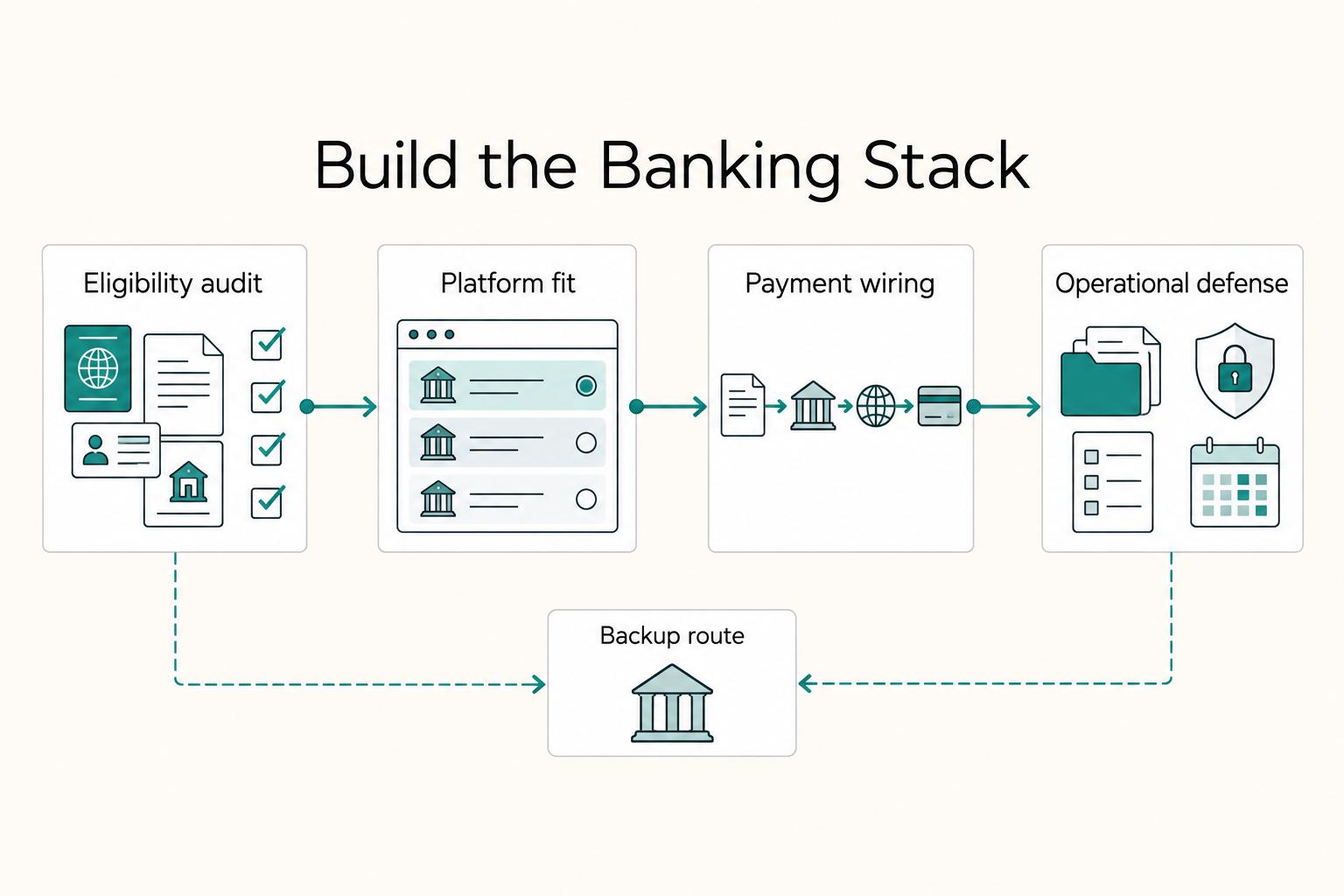
The Four-Gate Framework#
Use these gates in order. Each gate removes one class of failure before you expose yourself to the next one.
| Gate | Focus | Core Question |
|---|---|---|
| Gate 1: Eligibility | Can you qualify now? | Does your profile pass basic risk and documentation checks? |
| Gate 2: Selection | Which platform first? | Which provider is a fit for your country, address type, and business activity? |
| Gate 3: Get-Paid Wiring | Can you collect cleanly? | Is your invoice to payout chain mapped and tested end to end? |
| Gate 4: Operational Defense | Can you stay open? | Do your records and reporting habits support account longevity? |
Skipping the order creates rework. Choosing a platform before eligibility review wastes applications. Opening an account before wiring payments creates operational drift. Moving money before recordkeeping habits are in place creates compliance risk later.
Gate 1: Can You Actually Get Approved? Run the Eligibility Audit First#
Run this audit before you apply anywhere. The goal is simple: one clean application to the right platform, not five weak applications in a row.
| Checkpoint | Need ready | Why it matters |
|---|---|---|
| EIN | IRS EIN and confirmation letter | No EIN, no account opening |
| Formation documents | Official Articles of Organization or Certificate of Formation | Exact entity name match matters, including punctuation and LLC suffix formatting |
| Country of residence | Current support on each target platform | Policy can change and may lead to extended review or ineligibility |
| Business addresses | Legal and physical addresses accepted for each required field | Mercury permits a US or international physical principal address; registered-agent, PO-box and UPS Store addresses do not qualify for that field |
| Document stack | Passport, address details, business activity description, and beneficial ownership details alongside entity documents | Generic business descriptions create review friction |
Check that entity details, residence country, addresses and business activity agree across the application and supporting documents.
Work these checkpoints in sequence.
Checkpoint 1: Your EIN#
Your EIN is the first hard gate. It is the IRS identifier that tells financial platforms your LLC exists as a US tax entity.
No EIN, no account opening. Do not start applications with the assumption that you can add EIN details later. Some founders try this and end up in partial onboarding states that stall for weeks.
Operator move: store your EIN confirmation letter in two places before you apply. One folder for immediate upload, one backup archive. If support asks for it again, you can respond in minutes.
Checkpoint 2: Your Formation Documents#
The account belongs to the LLC, so your entity documents must be clean and immediately verifiable.
Have your Articles of Organization or Certificate of Formation ready in official form. A certified or stamped copy is usually safer than an informal download because it reduces manual verification friction.
Name consistency matters more than people expect. The entity name in your bank application should match your formation documents exactly, including punctuation and LLC suffix formatting.
Checkpoint 3: Your Country of Residence#
Country risk policy is real and it changes. Two founders with the same business model can get different outcomes based on residence jurisdiction alone.
Platforms apply internal filters shaped by AML requirements and their own risk tolerance. That is why one country may pass quickly while another goes to extended review or becomes ineligible.
Before you apply, confirm current country support directly on each target platform. Do this right before submission, not weeks earlier, because approval conditions can move.
Checkpoint 4: Legal and Physical Business Addresses#
Distinguish the LLC’s legal address from the physical location where you operate. Mercury accepts a US or international principal business address and requires existing or planned US operations.
A registered-agent address may serve a legal-address role, but it cannot substitute for the physical principal address under Mercury’s rules. Relay also asks for a separate operational address when the legal address is a registered agent.
Do not assume address acceptance. Verify the exact address rule where you are applying and prepare one consistent address format across your application documents.
Checkpoint 5: Your Document Stack#
Show up to the application with a complete package:
- Valid government-issued passport.
- IRS EIN confirmation letter.
- Articles of Organization or Certificate of Formation.
- Legal and physical business addresses in the formats accepted for the provider’s required fields.
- Specific business activity description and expected payment profile.
- Beneficial ownership details for owners and controllers.
A vague business description gives the provider little information to assess. Explain the actual service, client profile and expected payment activity.
Write a concrete version before application day. Include what you sell, who pays you, and how funds usually arrive. Keep it plain and specific. A clear narrative lowers review friction.
Example structure you can adapt without inventing details:
- Service type: what work you perform.
- Client type: who pays you.
- Payment rail: ACH, card payout, or wire.
- Typical amount pattern: small recurring, project based, or milestone based.
Finish all five checkpoints before opening an application tab. If one checkpoint is weak, fix that first.
Which Banks Are Actually Approving Non-Resident LLCs Right Now?#
Start with what is working now, not what was true two years ago. Platform positioning changes faster than old blog posts.
For many non-resident operators, the realistic shortlist is Mercury, Relay, Wise Business, and a traditional bank path for later-stage cases. Each path has a different review posture and operational fit.
The best choice is not the most popular name. It is the platform whose rules match your current profile.
As-of notice: Conditions change. Confirm current eligibility for your country, business model, and address setup before submitting.
| Platform | Remote Opening | Non-Resident Friendly | Best Fit |
|---|---|---|---|
| Mercury | Yes | Yes, with specific conditions | Service and tech-adjacent businesses with clear documentation |
| Relay | Online application | Confirm current owner requirements before applying | US-operating businesses that need account segmentation |
| Wise Business | Yes | Conditional by country | Teams with frequent multi-currency conversion needs |
| Bank of America and similar | Often in person | Limited for non-resident remote founders | Established operators with stronger US ties |
Mercury#
Mercury’s basic business banking has no required monthly fee or minimum balance. ACH payments and domestic wires are free to send and receive. Paid workflows and some international payment features carry separate charges.
Approval details matter more than pricing.
Mercury requires:
- Formation documents and an IRS issued EIN document, not just an EIN number typed into a form.
- Government ID for each person with operating control and any owner with at least 25% equity.
- A principal business address that fits Mercury policy. Mercury states that registered agent addresses, PO boxes, and UPS box addresses are not accepted for this field.
Your physical principal address can be outside the US. Use the address where you actually operate, and prepare verification documents rather than substituting a registered-agent address.
Mercury is a fintech company; banking services are provided through Choice Financial Group and Column N.A., Members FDIC. For USD international wires, SHA processing has no Mercury sending fee but intermediary fees may reduce the recipient’s amount. OUR is an optional $15 service that charges intermediary fees back to Mercury. Check international-wire eligibility separately from account-opening eligibility.
Choose a paid plan only if its workflow features justify the cost. Confirm the billing term and checkout price before budgeting; the pricing page separates basic banking from paid invoicing and accounting features.
Relay#
Relay is often a practical fit for straightforward service businesses that want structure from day one. One useful feature is account segmentation inside one LLC, which helps you separate operating cash, tax reserves, contractor payouts, and owner pay without creating extra entities.
That separation is not just for bookkeeping neatness. It improves operating clarity and makes monthly review easier when revenue and expenses move quickly.
Relay’s current onboarding guide says the business must operate in the US and every beneficial owner must have a valid SSN. Its entity-document guide also describes non-US owner passports. Confirm how those requirements apply to your owners before relying on a passport-only application.
Wise Business#
Wise Business is usually strongest as an FX layer. If your revenue is USD but your costs or withdrawals are in another currency, Wise can reduce friction in conversion workflows.
The key is role clarity. Wise can be valuable for holding and converting multiple currencies, but many operators still prefer a dedicated US operating account as the center of client collections.
Country restrictions apply and can change. Verify eligibility for your residence country before you invest time in setup.
Traditional Banks (Bank of America and Others)#
Traditional banks can make sense later, but they are rarely the easiest first account for a remote non-resident founder.
Many branches prefer in-person onboarding or existing relationship context. If you do not already have meaningful US ties, this route can consume time with uncertain payoff.
Treat this path as a stage-two option after your system is stable, not as the first gate to clear.
Where to Start#
Use this sequence to reduce wasted effort:
- Check operating and address fit first. Mercury can suit a US-registered LLC with existing or planned US operations and an acceptable physical business address, including an international address.
- Check Relay’s owner requirements before treating it as a backup. Its account segmentation may be useful, but the current SSN and operating-presence requirements control eligibility.
- Add Wise for conversion workloads. Use it as an FX layer when your volume justifies it, not as your only US operating anchor.
- Apply in sequence, not all at once. Multiple simultaneous applications can create unnecessary friction. Prioritize one, then move to your backup.
This is a systems decision. Pick the first platform based on fit, then build redundancy deliberately.
What Documents Do You Need to Open a US Business Bank Account as a Non-Resident?#
Prepare the full package before you apply. Strong documentation turns onboarding into a process. Weak documentation turns it into a negotiation.
Once you shortlist your platform, your next job is straightforward: remove every predictable document failure mode before submission.
The Core Document Set#
Use this as your pre-application checklist:
Government-issued photo ID Accepted ID types vary by institution. Confirm accepted document types before upload so you do not lose time on avoidable resubmissions.
EIN confirmation letter Your EIN (Employer Identification Number) must be supported by the official IRS letter. A typed EIN value without that document is often not enough for final verification.
Articles of Organization or Certificate of Formation This proves the LLC exists. Keep the official copy ready and make sure your application entity name matches exactly.
Legal and physical address details Prepare the information for each required field. A legal registered-agent address does not establish where the business actually operates.
Business description statement This is where many applications slow down. Write a clear paragraph that explains what your business does, who pays you, and how funds move.
Beneficial ownership information Collect full legal names, addresses, dates of birth, and ID details for owners and controllers before opening the form.
A compact quality check helps:
| Weak Input | Strong Input |
|---|---|
| International consulting | UX research services for US SaaS clients paid by ACH |
| Online business | Digital course sales processed through Stripe |
| Import export | Wholesale procurement for US retail clients with invoice based transfers |
You are not trying to sound impressive. You are trying to make your activity legible to a reviewer who has never seen your business before.
One Document You May Not Expect to Manage#
Some obligations are not part of account opening, but they still matter once your structure is live.
FBAR (FinCEN Form 114) applies to US persons with a financial interest in, or signature authority over, foreign financial accounts when aggregate value exceeds $10,000 at any time in the calendar year. US entities, including LLCs, can be US persons for this purpose even when foreign-owned. The foreign individual owner is not automatically a US person because they own the LLC. A US bank account is not a foreign account for FBAR.
FBAR is a reporting requirement, not an onboarding document. Still, it belongs in your operating plan because your banking structure does not remove foreign account obligations you already have.
Treat it as part of your annual compliance calendar, not a last-minute tax season surprise.
Gate 3: Wiring the "Get Paid" System After Approval#
Approval only gives you an empty account. Value comes from wiring a clean path from signed contract to settled funds in the right currency.
After onboarding, many founders lose momentum here. They have account credentials but no defined payment flow, so they improvise client by client. That creates inconsistency, delays, and documentation gaps.
Build one default chain and run it every time.
The Core Payment Stack#
ACH as default collection rail ACH (Automated Clearing House) is the standard US bank-to-bank transfer network and should be your primary method for US client payments when possible. It is familiar to AP teams and typically cost efficient.
| Method | Best use | Noted detail |
|---|---|---|
| ACH | Routine US client payments | Standard US bank-to-bank transfer network; Mercury base plan includes ACH transfers with no fee |
| Domestic wire | Urgent US settlement | Mercury standard lists domestic wires with no fee |
| International wire | Cases where transfer speed is worth the fee structure | For USD wires, SHA is free to send but intermediary deductions can apply; optional OUR costs $15. Non-USD wires have separate conversion fees. |
| Stripe payouts | Card workflows | Connect payouts to the US business account to keep revenue inside the LLC accounting trail |
| Wise | Conversion workflows | Collect in the US operating account, convert through Wise, then withdraw to the home bank |
ACH transfers and ACH debit collection are different workflows. Basic Mercury banking includes free ACH payments; paid invoicing features can add debit collection or recurring invoices. Compare subscription and transaction charges for the specific feature you need.
Wires for time-sensitive payments Domestic wires are free on Mercury. For international USD wires, compare SHA and optional OUR fee handling before promising a net receipt amount. Verify destination and owner-country restrictions as well as expected arrival time.
Use this decision rule:
- Choose ACH by default for routine client payments.
- Use domestic wire for urgent US settlement.
- Use international wire when transfer speed is worth the fee structure.
Stripe for card workflows If clients pay by card, connect Stripe payouts to your US business account. This keeps revenue inside your LLC accounting trail instead of splitting records across personal and business destinations.
Wise for conversion workflows Use Wise as a conversion layer when you need to move USD into your home currency. A common sequence is collect in your US operating account, convert through Wise, then withdraw to your home bank.
Clarity matters here. Use a primary account for operations, a conversion layer for FX, and a local account for spending. Keep each role distinct.
The Invoice-to-Payment Chain#
Every invoice should carry complete payment instructions and consistent terms:
- LLC legal name exactly as registered.
- US routing and account details for bank transfer.
- Payment terms such as net 15, net 30, or due on receipt.
- Preferred method stated clearly: ACH, wire, or card link.
Before the first payment, agree the client tax-documentation packet. For a disregarded LLC, the income owner generally supplies the appropriate form: W-8BEN for a foreign individual or W-8BEN-E for a foreign entity. A domestic LLC taxed as a corporation generally supplies W-9. The payment type and any effectively connected income or treaty claim can require different documentation.
Keep this chain documented:
- Contract signed.
- Tax form exchanged if required.
- Invoice issued with correct bank details.
- Payment received into approved US business account.
- FX conversion logged when applicable.
- Withdrawal to local account recorded.
When this sequence is stable, month-end close gets easier and compliance requests become routine instead of disruptive.
Gate 4: Operational Defense - What Keeps Your Account Open#
Most account pain starts after approval, not before. The risk is not opening the account. The risk is failing an activity review later.
Banks and fintechs continuously monitor activity. Holds often happen when incoming or outgoing flows do not match your declared business profile.
You can reduce that risk with process, not luck.
Build a Paper Trail Before You Need One#
AML controls exist to prevent financial crime, and your provider must follow them. That means you need evidence that your transfers fit your stated business activity.
Build the habit early:
- Save invoice and contract files for significant payments in one searchable folder.
- Log unusual transfers before they hit the account, including sender name, expected amount, and business context.
- Keep your business description current when your service mix changes.
- Respond to support requests quickly with complete documentation in one reply.
This is operational defense. If your profile says web design and your account starts receiving unexplained large international transfers, review friction is expected. Consistency between profile and activity is the core objective.
If a hold occurs, move fast and stay organized. Do not send fragmented replies across multiple tickets. Send one complete packet and answer each request by deadline.
FBAR and FATCA: The Reporting Obligations Operators Miss#
Account health is not only about transaction behavior. Annual reporting obligations can also create risk if you ignore them.
| Obligation | Form | Who Files | Threshold (general) | Non-Filing Exposure |
|---|---|---|---|---|
| FBAR | FinCEN Form 114 | US persons, including US entities with covered foreign accounts | Aggregate foreign account value exceeds $10,000 at any time in the calendar year | Severe and separate from IRS penalties |
| FATCA | Form 8938 | US taxpayers and certain domestic entities | $50,000 year-end or $75,000 at any time for specified domestic entities; individual thresholds differ | $10,000 initial, up to $50,000 after IRS notice |
Form 8938 is filed with the annual tax return. Certain domestic entities, which can include some US LLC structures used to hold foreign financial assets, may need to file when threshold tests are met.
Two practical notes from the operating side:
- Thresholds can vary by filing context, so confirm your exact case with a qualified advisor.
- If no US income tax return is required for the year, Form 8938 is generally not required regardless of asset values.
The administrative point is simple. Put these checks on your annual calendar. Do not wait until deadlines are close.
The Backup Account Rule#
A single account is a single point of failure. Build redundancy before you need it.
Open and maintain a second approved account path where possible. Keep it lightly funded, connected to your invoicing workflow, and ready for immediate use.
If your primary account is restricted, backup readiness protects client continuity. You can continue collecting payments while resolving the review instead of pausing revenue.
That is the operating difference between a fragile setup and a resilient one.
Tax Recordkeeping Your Non-Resident LLC Can't Skip#
Your banking stack and your tax paperwork are one system. If forms and records lag behind payments, you create cleanup work that gets expensive fast.
Once money starts flowing, recordkeeping discipline becomes part of cash flow discipline. The founders who stay calm at year end are usually the ones who built a simple system in January.
Form W-9 vs. Form W-8: Send the Right One First#
Clients use your form status to decide how they process your payments.
- Form W-9: generally used by US persons, including a domestic entity taxed as a corporation.
- Form W-8BEN: generally used by a foreign individual who is the income owner, including the owner of a disregarded LLC.
- Form W-8BEN-E: generally used by a foreign entity that is the income owner; foreign ownership alone does not make the US LLC the appropriate filer.
Sending the wrong form can create withholding complications that take time to unwind. Do not treat this as admin trivia. Confirm your classification with a cross-border tax advisor before sending forms to new clients.
A practical operating rule: decide your standard client onboarding packet once, then reuse it. That packet should include your contract template, invoice template, and the correct tax form flow for your structure.
Form 1099-NEC, FBAR, and Schedule SE: Know What Applies#
These three items are often lumped together, but they do different jobs.
| Item | What it covers | Threshold or note |
|---|---|---|
| Form 1099-NEC | US clients paying service providers may issue it | Reporting and exemptions depend on payee classification, payment type and valid documentation; agree the applicable form with the client |
| FBAR (FinCEN Form 114) | Foreign financial account reporting | US persons, including US LLCs, with covered foreign account interests or signature authority and aggregate value above $10,000 at any time; a US account is not foreign |
| Schedule SE | Self-employment tax calculation | Nonresident aliens are generally not subject to US self-employment tax, except where a totalization agreement imposes it |
Form 1099-NEC Client reporting depends on the payee and payment, not simply on the LLC’s foreign ownership. Give the client the correct classification and documentation before its reporting cycle.
FBAR (FinCEN Form 114) Check whether a US person, including the US LLC, has a covered interest in or signature authority over foreign accounts exceeding $10,000 in aggregate at any time during the year. A US bank account does not count as a foreign account. The foreign individual owner does not automatically have an FBAR duty merely because they own a US LLC.
Schedule SE Nonresident aliens are generally not subject to US self-employment tax unless a totalization agreement imposes it. US citizens and tax residents follow different rules. Forming a US LLC does not by itself make the foreign owner subject to Schedule SE.
Whether Schedule SE applies to your exact non-resident LLC setup depends on classification and individual tax posture. Verify in advance. Do not assume based on one forum answer or one accountant's generic template.
Form 5472 and pro forma Form 1120 A foreign-owned US disregarded entity generally must file this packet when it has reportable transactions with a related party. Owner contributions and distributions can matter, even when no US income tax is due. Keep a separate record of owner-to-LLC transfers and use the IRS Form 5472 instructions to establish the filing requirement.
Build the Recordkeeping System Once#
Keep the system light but complete. Complexity is not required. Consistency is.
Track these categories all year:
- Invoices issued by client and date.
- Payments received with supporting statements.
- FX conversion records where currency changes occur.
- Copies of all W-8 or W-9 forms sent or received.
- FBAR or related filing confirmations when applicable.
- Notes for unusual transactions and supporting contracts.
Then run one monthly routine:
- Reconcile invoices to bank receipts.
- File supporting documents in the same naming format.
- Flag missing forms or missing contract files.
- Update your advisor question list while context is fresh.
This monthly discipline prevents year-end reconstruction and reduces the risk of filing mistakes under deadline pressure.
Build the Stack, Not Just the Account#
Opening the account is step one. Building a durable system is the real objective.
You want a setup that keeps revenue moving, survives compliance checks, and still makes sense six months from now when you revisit your records.
The Four-Gate Framework, Summarized#
Use the same sequence when opening the first account or adding a backup:
- Confirm eligibility: EIN, owner identification, country support, operations and accepted addresses.
- Choose the provider whose current requirements fit the business and owners.
- Test the invoice, collection, conversion and withdrawal path with traceable records.
- Reconcile monthly, answer provider review requests and track applicable annual reporting.
Where Gruv Fits#
Gruv is most useful when you want the full invoice-to-withdrawal path to be traceable, not just the account opening event. For teams that need cleaner payout records and consistent operational flow, that layer can reduce manual cleanup.
If you are already rebuilding your invoicing terms, this is the right moment to align banking, payout, and records into one system. Keep the implementation practical: one primary account, one backup path, one monthly recordkeeping cadence.
Final reminder: recheck requirements before each new application or major profile change. Country lists shift, policies tighten, and ownership changes can trigger re-review. The operators who stay stable are the ones who run the checklist every time.
Frequently Asked Questions
Can a non-US resident open a US bank account for their LLC without visiting the US?
In many cases, yes. Remote opening is available on some online platforms for qualifying non-resident LLC owners. The constraint is eligibility fit, not just intent. Country policy, address model, and business profile can all affect approval, so confirm criteria directly with your selected provider before applying.
What documents do I need to open a US business bank account as a non-resident?
Prepare the EIN confirmation, LLC formation documents, accepted owner identification, business activity and beneficial ownership details. Separate the legal address from the physical operating address and verify both against the provider’s rules. Some providers accept an international physical address; owner SSN or passport requirements also differ.
Is Mercury still accepting non-resident LLC accounts?
Mercury supports many non-resident LLC profiles, but acceptance is conditional and policy driven. Check current eligibility rules before you apply, especially for country support and principal address requirements.
Which US bank is easiest for non-residents to get approved at right now?
There is no universal easiest option. Approval depends on your country, activity profile, document quality, and address setup. Use a fit-first sequence: verify eligibility, pick the platform that matches your profile, then apply one at a time.
Do I need a US address to open a US business bank account?
Separate legal and physical address requirements. Mercury accepts a US or international physical principal address, but requires US registration and existing or planned US operations. Registered-agent, PO-box and UPS Store addresses do not qualify for its physical principal address. Other providers set their own rules.
What happens to my US LLC bank account if I move to a different country?
A residence change can alter your risk profile with the institution. Notify your provider, update profile details promptly, and ask whether your new country affects account status or feature access. Handling this early is safer than waiting for a review trigger.
What is the risk of my non-resident LLC account being frozen?
A mismatch between declared activity and actual transfers can trigger review. Keep contracts, invoices and payment context organized, answer provider requests promptly, and keep a second approved collection path where possible. Documentation does not guarantee release or prevent closure.
Try a related tool
Payment fee comparison
Compare fee assumptions across ACH, wires, and FX conversions to estimate what you'll actually net from US client payments.
Free invoice generator
Create a client-ready invoice with your LLC's US banking details to reduce payment friction and speed up collections.
Researched and edited by the Gruv editorial team. Gruv builds cross-border billing, payouts, and finance-operations software for global businesses.
Sources
Includes 5 external sources outside the trusted-domain allowlist.
- irs.gov/businesses/small-businesses-self-employed/re...trusted
- irs.gov/forms-pubs/about-form-8938trusted
- mercury.com/pricingexternal
- relayfi.com/hc/en-us/articles/38050807932436-How-to-Open...external
- relayfi.com/hc/en-us/articles/38049251551636-Required-Do...external
- support.mercury.com/hc/en-us/articles/28770467511060-Eligibility...external
- support.mercury.com/hc/en-us/articles/28773219548180-Sending-int...external
Educational content only. Not legal, tax, or financial advice.
Related Posts

The Freelance Payment Penalty: A Modeled Audit of Platform Fees, FX Spreads, and Payout Delays
The money rarely disappears through a single, easy-to-spot fee. The real loss is stacked. A marketplace takes its commission, a processor adds a charge for international cards, a bank or payment company converts the currency at a spread, a platform holds the funds before release, and a wire sheds a little to intermediaries on the way in. Each layer looks defensible on its own, but the worker feels the combined result as a smaller deposit and a later payday.

How to Respond to a Subpoena for Business Records
Move fast, but do not produce records on instinct. If you need to **respond to a subpoena for business records**, your immediate job is to control deadlines, preserve records, and make any later production defensible.

A US Expat's Guide to Investing in UCITS ETFs to Avoid PFIC Issues
The real problem is a two-system conflict. U.S. tax treatment can punish the wrong fund choice, while local product-access constraints can block the funds you want to buy in the first place. For **us expat ucits etfs**, the practical question is not "Which product is best?" It is "What can I access, report, and keep doing every year without guessing?" Use this four-part filter before any trade: