
Quick Answer
Confirm your business form and dedicated-account obligations, then shortlist accounts that support your invoice and tax-payment routes. Compare France-facing tariffs, complete approved receipt and outgoing-payment checks, and reconcile fees and FX before moving recurring clients. Keep the old account monitored through the transition.
Why Most Freelancer Bank Comparisons in France Miss the Real Risk#
When you compare freelancer bank options in France, monthly price is easy to overweight, but cashflow risk can be the bigger decision factor. A safer choice is the account that still works when onboarding drags, paperwork expands, or fee and FX terms start hurting after money moves.
Start with the payment paths you actually use: client EUR transfers, tax and supplier debits, card expenses, and any foreign-currency receipts. A low monthly fee is useful only if the provider accepts your legal status and supports those paths with records you can reconcile.
Provider eligibility and tariffs change. The comparison below uses France-facing official pages checked on October 5, 2026. Save the precise plan and legal terms offered to you at opening, since promotions, billing commitments, and approved activities can differ.
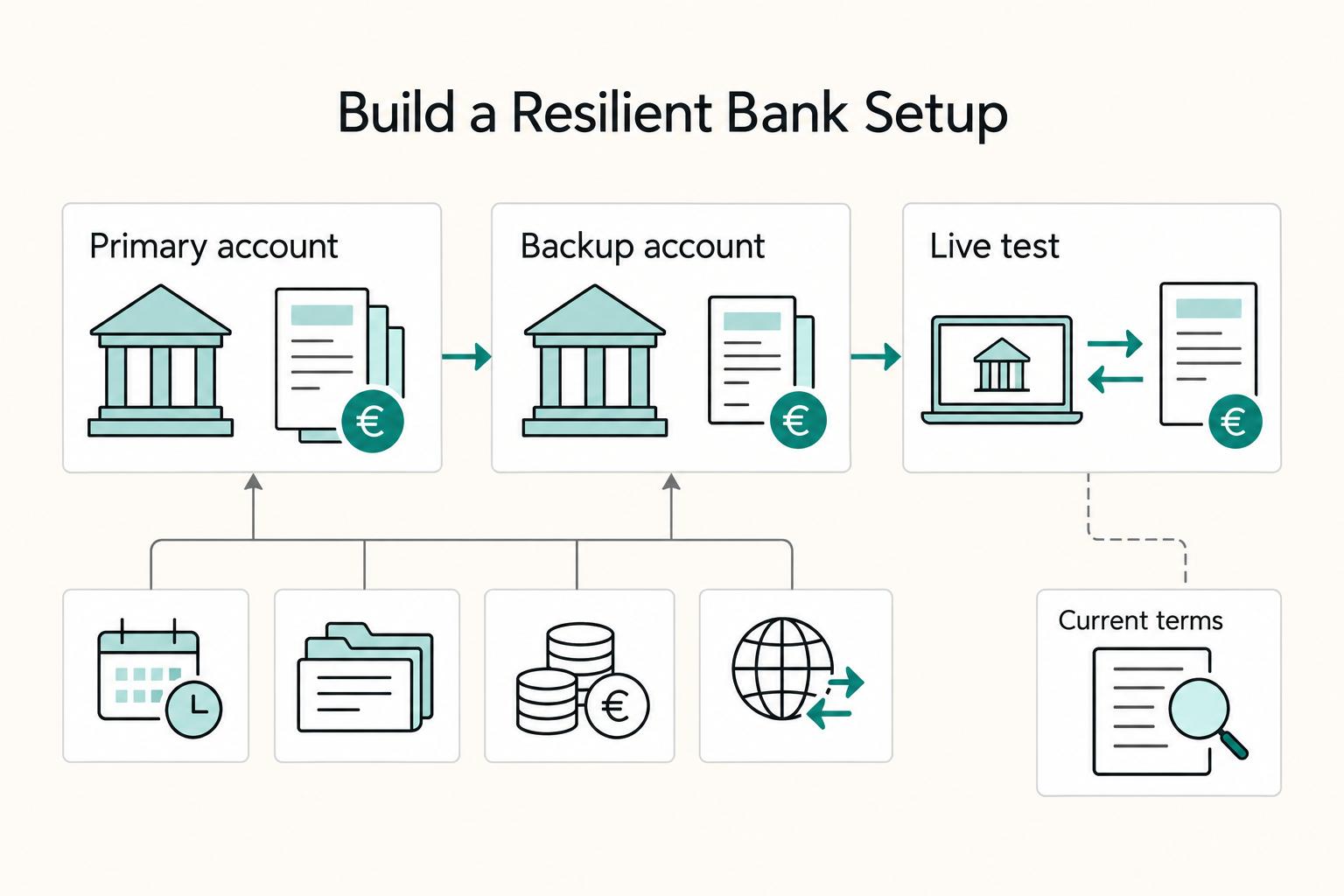
- Choose one primary account
Pick the option that matches your real invoice flow, including cross-border payments and conversion needs.
- Choose one backup account
Keep a second option ready so onboarding friction or term changes do not force a rushed move.
- Verify before full migration
Run real transactions, confirm document requirements, and test fee and conversion behavior before routing all client payments.
For an implementation angle, see Automating Your Freelance Finances: A Zapier Workflow for Connecting Stripe.
Selection Criteria and Who This List Is For#
This list is for freelancers, creators, and small teams in France who invoice clients and need reliable incoming payments, not just a low monthly fee. If you only need a personal current account for household spending, this level of detail is probably unnecessary. Use five criteria, in this order:
- Account eligibility
Confirm that the provider accepts your entity form, residence, activity, and required account-holder name. An individual freelancer account is not automatically suitable for a SASU or EURL. Use the France-facing tariff and offer rather than importing another market’s fees.
- Total cost
Score the full cost path, not only the monthly plan: sending, receiving, card, and cash access fees. A pay-as-you-use model can still produce very different totals depending on how you use it.
- International fit
If clients pay in non-EUR currencies, prioritize accounts that clearly show exchange basis and fees. A useful benchmark is mid-market-rate conversion with upfront fees and clearly stated discount thresholds.
- Payout visibility
Prefer accounts where statuses and timestamps are clear enough to diagnose delays or returns quickly.
- Admin tooling
Choose for reconciliation speed, not feature count. If exports and matching are messy, low sticker pricing can still cost you time every week.
Decision rule: if most clients are outside France, start by comparing international-capable options that clearly publish exchange basis and fee details, then verify current France-facing terms before committing.
Account Type Rules in France You Need Before Comparing Banks#
Choose account type before pricing. Service Public’s micro-entrepreneur guidance, checked May 28, 2026 by the publisher, distinguishes the following cases.
| Situation | Rule | Note |
|---|---|---|
| Commercial company (for example SASU or EURL) | Use an eligible company account and satisfy formation/capital-deposit requirements | Do not apply the micro-enterprise turnover rule |
| Micro-entrepreneur turnover | Dedicated account required when annual turnover exceeds EUR 10,000 for two consecutive years | Separate business activity from personal spending |
| Commercial micro-business activity | Dedicated account required regardless of that turnover threshold | Confirm the activity classification |
| Dedicated versus professional | A permitted separate personal-type or professional product can be used in the micro-enterprise context | Check business-use permission and EI naming |
- Incorporated companies (EURL, SARL, SASU, SAS)
For a company, keep the account and capital-deposit requirements separate from the micro-entrepreneur rules. Service Public explains the professional account needed for commercial-company formation. Confirm the product accepts your company form and can provide the deposit documentation you need.
- Dedicated account for professional activity
Dedicated describes separation of business and personal activity; professional describes the product offered. Check the provider’s business-use permission and the EI account naming requirement described by Service Public before using a personal-type product.
- Micro-entrepreneur and auto-entrepreneur threshold window
The turnover rule is not the only trigger: commercial micro-business activity has a dedicated-account obligation regardless of that threshold. Determine your activity category before deciding that a shared personal account is permissible.
- If turnover exceeds 10,000 EUR for two consecutive years
Use the status table above to decide the legal requirement, then obtain written confirmation that the selected product permits your activity. A bank’s refusal to open an account is a separate issue; Service Public describes the right-to-an-account route through Banque de France.
Use a simple compliance checkpoint before opening anything: confirm business status, confirm the exact account type being offered, and confirm your freelance activity is allowed in provider terms.
Prepare identification, business registration and activity details, and any ownership or capital-deposit records requested for your status. Ask whether an opening fee, annual commitment, or separate onboarding charge applies; do not infer a universal EUR 50 fee.
The Risk-First Scorecard That Beats Price-Only Rankings#
Use a risk-first scorecard before you focus on monthly fees. Reliability, constraints, and FX clarity can matter more for cashflow than a lower plan price.
| Focus | Providers named | What to verify | Scope note |
|---|---|---|---|
| Operational reliability | Qonto, BoursoBank, Monabanq | Run one incoming invoice, one transfer out, and one support contact; prioritize clear timestamps, clear status labels, and a concrete next step from support | Use the same three checks on each option |
| Condition risk | Axa Banque and N26 Business | Compare base-plan limits to a normal month, then check one higher tier so the upgrade path is visible before committing | Treat any condition that can interrupt client-payment work as high risk |
| International invoice fit | Wise Business account and Bunq | Compare supported receipt currency and rail, exchange-rate basis, receiving and conversion charges, and settlement currency | Use France-facing tariffs and an actual route quote |
The provider rows below distinguish an advertised capability from tested performance. A product page can establish that an account offers an invoicing feature or a supported business profile; it cannot establish that your particular receipt will arrive on time or that support will resolve an exception.
- Qonto, BoursoBank, Monabanq: operational reliability checks
Score how quickly each account helps you track payment movement and resolve exceptions. Run the same three checks on each option: one incoming invoice, one transfer out, and one support contact about payment status. Prioritize clear timestamps, clear status labels, and a concrete next step from support.
- Axa Banque and N26 Business: condition-risk checks
Test what happens when your usage hits plan boundaries. Compare base-plan limits to a normal month, then check one higher tier so the upgrade path is visible before committing. Treat any condition that can interrupt client-payment work as high risk, even when the headline fee is low.
- Wise Business account and Bunq: international invoice fit checks
For Wise and bunq, obtain a quote for the same receipt currency, payment rail, and conversion amount. Compare the landed EUR amount after receiving and conversion costs, and inspect how the fee and original currency appear in the export. Card FX and foreign-currency account receipts are separate tests.
- Weighted score you can reuse each quarter
An illustrative score weights reliability 40%, plan constraints 30%, international fit 20%, and total cost 10%. Rate each from 1 to 5 using saved evidence, then calculate the weighted score. This is a decision tool, not an industry ranking; change the weights before scoring if your needs differ.
If a large share of your invoices is non-EUR, make FX transparency mandatory in a first-pass review of Wise Business account and Bunq. If most of your invoices are domestic EUR, reduce international weight but keep reliability and condition risk at the top.
You might also find this useful: How to Use SEO to Attract High-Quality Freelance Clients.
Comparison Table You Can Scan in 60 Seconds#
Use these documented differences to choose two candidates. The table describes capabilities and eligibility, not a measured reliability ranking. Plan pricing snapshots below are dated October 5, 2026; use the tariff and offer provided at signup for the final decision.
| Provider | Documented candidate fit | Key constraint to check | Validation before migration |
|---|---|---|---|
| Qonto | Business account with invoicing and administrative features | Plan allowance, annual versus monthly billing, paid additions | Invoice receipt, expense export and fee matching |
| Bourso Business | Eligible individual enterprises and single-person companies | Representative must already hold a personal BoursoBank current account; acceptance required | Account-holder naming, receipt and outgoing transfer |
| Monabanq PratiqPro | Auto-entrepreneurs using cheque or cash deposits | Eligible machines, allowances and excess-deposit charges | One supported deposit and bookkeeping export |
| AXA Banque | Auto-entrepreneur account candidate | Card activity conditions and fees for quiet months | Permitted use and a normal month of EUR transactions |
| Hello Business | Eligible individual businesses and single-person companies needing physical deposits | Local deposit route and offer eligibility | Cheque/cash access, receipt records and fee lines |
| Wise Business | Supported foreign-currency receipt and conversion | Receiving details setup charge and rail-specific receipt costs | Same-currency receipt, conversion quote and invoice reference |
| N26 Business | Freelancers operating under their own name | Entity/holder-name fit, tax-debit support, card conditions | SEPA receipt, required outgoing debit, export |
| bunq Business | Eligible businesses needing supported currency capabilities | Accepted legal form, currency account and rail terms | Foreign receipt, landed value and export detail |
For a like-for-like FX test, suppose a USD 1,000 receipt converts at an illustrative EUR 0.90 per USD with a USD 10 receiving fee and EUR 5 conversion fee. The landed amount is (1,000 − 10) × 0.90 − 5 = EUR 886. Compare that with another quote on the same basis, including correspondent deductions where relevant. These figures are invented to demonstrate the calculation, not a provider tariff.
Ask each finalist for an example export showing original invoice currency, receipt amount, fees, conversion, and transaction reference. A better quote is less useful if you cannot identify which invoice it settled.
If you want a deeper dive, read Can Digital Nomads Claim the Home Office Deduction?.
Best Picks for Admin-Heavy Freelancers Who Want Fewer Manual Tasks#
If admin time is your main bottleneck, prioritize the account that keeps invoicing, expenses, and payment tracking in one place, even when the monthly plan is higher.
| Provider | Workflow to evaluate | Pricing snapshot: October 5, 2026 |
|---|---|---|
| Qonto Basic | Invoicing alongside business payments | EUR 9/month excluding tax, billed annually EUR 108; verify selected offer |
| Hello Business | Cheque and cash deposit access | EUR 10.90 excluding tax/month; provider states EUR 11.50 including tax |
| Monabanq PratiqPro | Auto-entrepreneur banking with physical deposits | EUR 9/month; check deposit allowances and excess fees |
Apply the legal-status table before choosing an admin package. Added invoicing features do not resolve an account product that excludes your business form or payment needs.
- Qonto
Qonto is worth evaluating when invoicing and expense records are part of the same workflow. Its France pricing page lists Basic at EUR 9 per month excluding tax when billed annually at EUR 108, with 30 monthly transfers included. Check which expense and accounting functions require a higher plan or add-on before assigning a time-saving value.
- Hello bank! Pro (BNP Paribas access)
Hello Business lists EUR 10.90 excluding tax per month, with the provider stating EUR 11.50 including tax because only part of the package is taxable. Its official offer includes cheque and cash deposit routes through the BNP Paribas/Cash Services network. Confirm the local deposit machine, limits, and eligibility before relying on physical access.
- Monabanq
Monabanq’s auto-entrepreneur offer lists PratiqPro at EUR 9 per month and cheque/cash deposit arrangements through eligible Crédit Mutuel/CIC machines. Deposit allowances and excess fees matter if physical collections are frequent; compare a normal month against the tariff rather than calling every deposit free.
Before full migration, run three admin checkpoints:
- If invoicing is included, send one live invoice, mark it paid, and verify whether reporting/export outputs reconcile without manual reformatting.
- Process one real expense with a receipt and verify what data carries into bookkeeping export, if available.
- Save the current pricing and plan-inclusion page at signup, then recheck it before moving recurring clients.
Compare admin value using your own workload. If an illustrative EUR 20 monthly upgrade saves one hour you value at EUR 40, its gross time value is EUR 40 and the difference EUR 20 before setup and maintenance. Verify the export actually removes that work; it is not a promise of cash savings.
Best Picks for Low-Cost Domestic Operations in France#
For low-cost domestic operations, pick the account that stays predictable for everyday EUR use after you verify live fees and any minimum deposit requirement. The wrong low-cost choice is the one that only looks cheap on signup day.
Bourso Business is a candidate for eligible individual enterprises and single-person companies whose representative already has a personal BoursoBank current account. Its official offer advertises a free account and business card, subject to approval and terms. AXA Banque also offers an auto-entrepreneur route; compare its actual card-use conditions with your quietest month, not only a busy month.
N26 Business Standard targets freelancers operating under their own name and advertises a free account. Check the holder name against invoices, entity eligibility, tax-debit support, and any physical-card charge. A product for a person working under their own name is not automatically an account for their incorporated company.
Best Picks for International Client Mix and Multi-Currency Work#
If non-EUR invoicing is frequent, choose the account that makes receipt currency, exchange rate used, and total conversion cost explicit on each transaction.
Wise Business is a candidate for receiving and converting supported currencies. The France-facing pricing view shows a EUR 60 charge for receiving account details, mid-market conversion with separately stated fees, and route-dependent sending and conversion prices. Registration being free does not mean every receipt or transfer is free.
Distinguish a domestic receipt into the supported currency’s local details from a Swift receipt. Wise’s France-facing page lists different receiving charges by route, including EUR 2.39 for a EUR Swift receipt at this check. Use the quote for your currency and payment method and record any intermediary deductions separately. Avoid applying card ATM conditions to invoice receipts.
bunq’s France Business page offers foreign-currency capabilities, and its help documentation sets legal-form and onboarding conditions. Compare the specific currency account and rail you need rather than assuming every foreign currency behaves like EUR SEPA. N26 remains a candidate for eligible own-name business banking; check its actual supported receipt route before offering it for a non-EUR invoice.
Decision rule: when international invoicing is frequent, transparent FX and receipt-currency visibility usually matter more than a low headline fee.
Hidden Costs and Red Flags Behind Free or Cheap Plans#
Low headline pricing is only useful if total cost stays predictable when invoicing patterns change. Freelancer account decisions usually break on conditions, not taglines.
A plan can look cheap at first, then get expensive when key conditions and card terms only show up in fine print.
- Activity-condition trap
Check card activity requirements, monthly allowances, account-detail setup costs, foreign-currency conversion, and Swift receipt deductions. Calculate a low-activity month as well as your normal month. A zero foreign-transaction fee label does not establish zero total conversion cost; use the actual rate and fee breakdown rather than a generic 3–5% estimate.
- Headline-price illusion
Low monthly pricing can look compelling in isolation, then mislead comparisons if other conditions apply. The real test is how total cost behaves across normal monthly activity. Minimum money requirements belong in the same review because no-monthly-fee plans can still be restrictive.
- Constraint opacity on plan pages
Plan pages often highlight price first and bury operational limits. ATM withdrawal terms, including out-of-network access, foreign transaction terms, and minimum requirements can matter more than a small fee difference. If key limits are hard to find in plain language, treat that as a risk signal.
Before opening, run one documentation checkpoint:
- Capture dated screenshots of current terms for Axa Banque, BoursoBank, and N26 Business.
- Save the exact pages that show monthly fees, foreign transaction terms, ATM withdrawal terms, and any minimum requirement.
- Recheck those terms before moving recurring client invoices.
Decision rule: if a low-cost plan is only low-cost inside narrow conditions, prefer the option with clearer terms and steadier total cost.
Want a quick next step? Try the free invoice generator.
The 14-Day Verification Checklist Before You Switch Fully#
Use the following 14-day schedule as an illustrative validation plan after onboarding approval, not a guarantee that opening or settlement completes in two weeks. Extend it for document review or payment delays. Use genuine authorized transactions with clear records.
- Days 1-3: Open, configure, and clear transfer prerequisites
Complete setup and required identity checks. For EUR SEPA payments, record the correct beneficiary name and IBAN; other corridors may require a BIC or local routing details. Use any offered beneficiary-verification result before approval. If a mismatch appears, confirm the details through a known contact rather than changing the name just to silence the warning.
- Days 4-7: Run one live outgoing and one real incoming payment
Receive a genuine client payment and send an authorized small payment. Match the invoice reference, currency, expected gross amount, fee lines, and credited net amount. Record the provider reference and final status. If a payment is unresolved, ask the bank to trace it before sending another payment for the same obligation.
- Days 8-11: Validate card and security behavior in normal usage
Run normal card activity in the categories you use most and review how those transactions appear in account history and exports. Test any security checks your bank uses during payment approval so records stay clear. If you use international card payments, review fee and exchange-rate impact carefully because those costs can compound over time.
- Days 12-14: Keep fallback options and apply the migration gate
If possible, keep your previous account active during the test window as a fallback. Repeat your core payment paths, then move recurring clients only after transfer details are consistently correct and unresolved issues are cleared. If a step still breaks under normal volume, extend the parallel run instead of forcing a switch date.
Decision rule: switch fully only after transfer data and payment handling are consistently accurate in real use.
When a Bank Account Alone Is Not Enough for Payment Reliability#
A bank-only setup can be enough until delays, exceptions, or weak traceability start creating real cashflow risk. Two clean test cycles prove the current setup works today, not that it will stay reliable as volume or complexity grows.
Use the legal-status table above before adding another provider. A foreign-currency wallet or new IBAN does not remove the need for a permitted account type or relevant French reporting.
- Bank-first lane
Use this when you are solo, mostly in EUR, and exceptions are rare. Keep one account and define minimum operating evidence for each payment flow: reference, status trail, and reconciliation output that closes cleanly each month.
- Cross-border lane with clearer conversion visibility
Add a supported currency-receiving route when repeated conversion or receipt issues justify it. Test one actual invoice from customer instructions through receipt, FX, and bookkeeping. A direct-debit collection product is a separate service: confirm its mandates, limits, and fees instead of importing a generic GoCardless cap into a bank-account comparison.
- Modular rails lane for team payouts and policy control
Add separate approval controls when you pay a team or contractors and the account’s standard controls no longer fit. Define approvers, second-approval thresholds, recipient-change verification, and decision exports. Confirm supported activities and escalation routes with the provider; unexplained review-site anecdotes cannot establish the risk of your particular account.
Use one escalation rule to avoid overbuilding. Stay bank-first while exceptions stay low and reconciliation remains clean. Move to modular rails when manual fixes or delays threaten client commitments. If payout controls beyond a standard account are needed, confirm eligibility and terms early before migration.
Choose the Account That Protects Cashflow First, Then Optimize Cost#
Choose for reliability, constraints, and international fit first. Optimize price second. The right account is the one that keeps transfers predictable in your actual client mix and stays cost-efficient at your real volume.
- Reliability before headline fee
Test payment traceability: record the submitted instruction, bank reference, final outcome, and support response when something is delayed. An advertised instant-payment feature does not guarantee every route or beneficiary receives funds instantly.
- Real usage cost before plan marketing
Use the current plan’s commitment and allowances. In an illustrative comparison, plan A costs EUR 10 plus EUR 0.50 for each transfer above 20; at 40 transfers it costs EUR 20. A EUR 18 plan with 40 included transfers would cost EUR 18 for that usage before other fees. These are invented plans showing why a headline price can reverse at higher volume.
- Compliance fit before full migration
If the account is legally held abroad, assess the French foreign-account declaration duty for your residence and entity. The tax authority’s guidance explains reporting for covered French-resident individuals using form 3916/3916-bis. Ask the provider which institution and country legally maintain the account; brand nationality or currency alone is not the test.
Pick two finalists, score both with a risk-first checklist, then test them on real transactions before routing recurring invoices. A 30-day free trial can help you test fit, but it is not proof on its own. The best choice is the one that keeps cashflow stable when volume and exceptions are real.
Frequently Asked Questions
Do freelancers in France need a professional account, or is a dedicated business account enough?
A dedicated account separates professional and personal activity and is not necessarily a premium professional product. For micro-entrepreneurs, apply the turnover and commercial-activity rules in the status table, plus the provider’s business-use and account-naming conditions. Incorporated companies need an account product appropriate to their company form.
Which account is usually best if most of my clients pay from outside France?
Outside France does not necessarily mean outside EUR or SEPA. For non-EUR invoices, compare Wise Business and bunq on the supported receipt route, full FX cost, landed amount, and export detail. For EUR invoices, prioritize permitted use, SEPA handling, and reconciliation. There is no universal best account for all foreign clients.
Are free freelancer bank accounts actually free once conditions and card costs are included?
No monthly charge does not mean no charges. Check card issuance, receiving details, transfer allowances, cash or cheque deposits, Swift receipts, FX, and activity conditions. Price your normal and quiet month using the France tariff, and distinguish one-time setup from recurring cost.
What should I compare beyond monthly price before choosing Qonto, BoursoBank, or N26 Business?
Compare eligibility, customer-facing holder name, supported incoming and outgoing routes, tax debits, available payment status, support escalation, and exports. Then calculate total cost under your actual volume and test one incoming and one outgoing payment before migration.
How do I choose between Wise Business account and Bunq for multi-currency client payments?
Request equivalent quotes for the same currency and rail, including receiving, conversion, and intermediary costs. Confirm legal-form eligibility, permitted activity, payout currency, and how the invoice reference survives into the export. A card conversion feature is not the same as receiving foreign-currency client payments.
Can I start with a personal current account and switch later without disrupting client payments?
Only if the legal rules and provider terms allow the initial account for your activity. During migration, verify the new RIB through a known customer contact, update open invoices and recurring mandates, and keep the old account monitored for late receipts and pending debits. Do not assume automated mobility covers every professional payment.
What is the safest way to test a new account before moving all invoices to it?
Test with small real transactions and verify charged amounts against published pricing before full rollout. At minimum, check the expected receiving method, sending flow, and any card usage you rely on, including threshold-based fees where relevant. Move higher-volume invoicing only after those checks are consistent.
Watch
Best Bank Accounts for Freelancers in France
Try a related tool
Researched and edited by the Gruv editorial team. Gruv builds cross-border billing, payouts, and finance-operations software for global businesses.
Sources
Includes 7 external sources outside the trusted-domain allowlist.
- wise.com/fr/pricing/businesstrusted
- axa.fr/particuliers/banque/compte/auto-entrepreneur...external
- boursobank.com/professionnels/compte-professionnelexternal
- bunq.com/fr-fr/businessexternal
- entreprendre.service-public.gouv.fr/vosdroits/F35991external
- entreprendre.service-public.gouv.fr/vosdroits/F21118external
- hellobankpro.fr/fr/banque-pro/hello-businessexternal
- help.bunq.com/fr-fr/articles/who-can-open-a-bunq-business-...external
Educational content only. Not legal, tax, or financial advice.
Related Posts

Can Digital Nomads Claim the Home Office Deduction?
Claim the deduction only when your facts and records can carry it. With the home office deduction for digital nomads, the real decision is usually a three-way call: claim it, do not claim it, or pause and get help because your file is not ready.
Automating Your Freelance Finances: A Zapier Workflow for Connecting Stripe, QuickBooks, and Wise
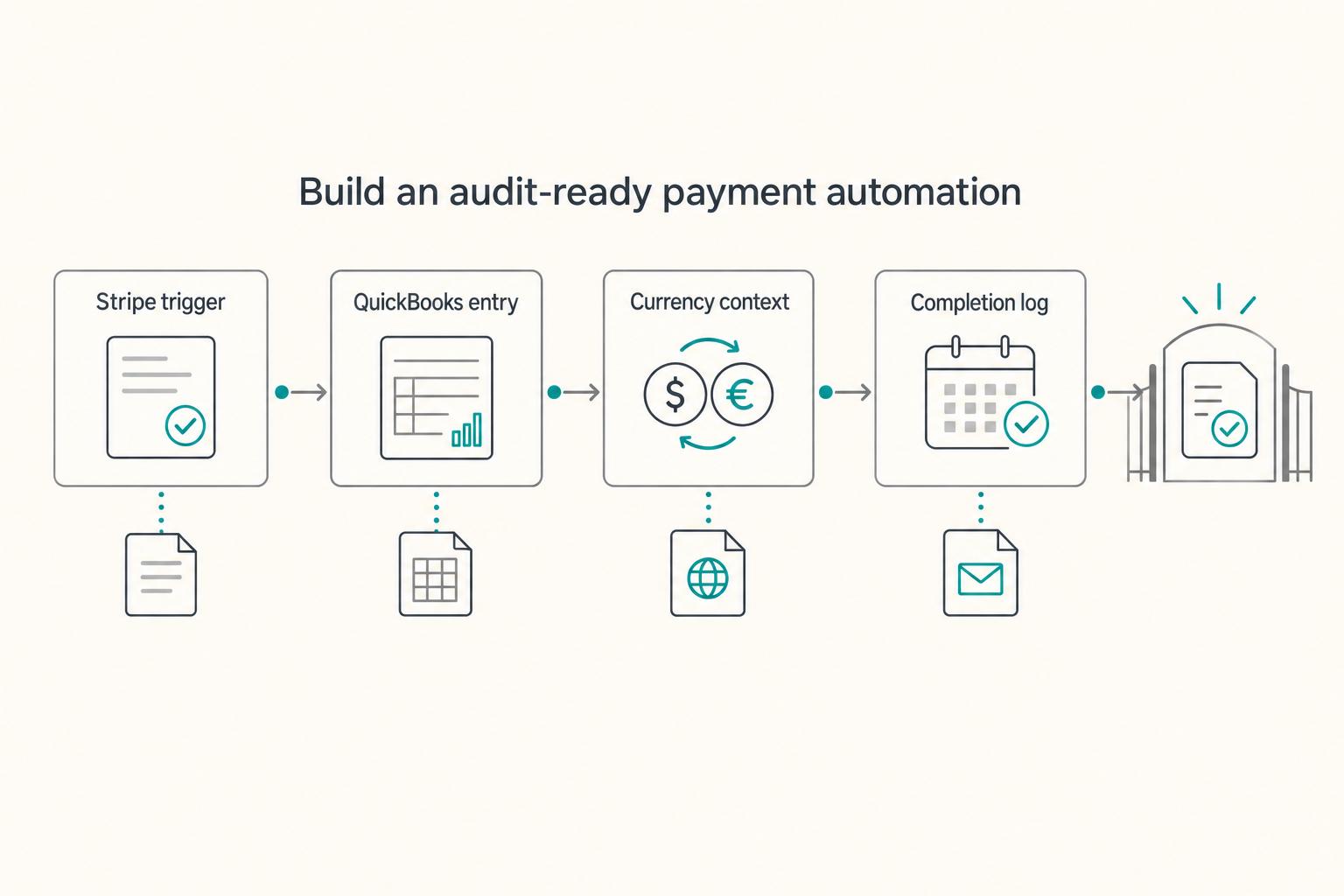
Start with one payment flow you understand, then automate its accounting record without losing the source reference. Stripe captures payments, QuickBooks holds the books, Zapier connects the selected steps, and Wise records any separate cross-border balance or conversion activity.

How to Use SEO to Attract High-Quality Freelance Clients
**Build your *seo for freelancers* around qualified leads, not raw traffic: tighten who you target, what you prove, and how you gate inquiries.** You're the CEO of a business-of-one. Your marketing job isn't "get more attention." It's "get the right work, predictably, without turning your calendar into a sorting machine."