
Quick Answer
Start with the reporting question and check what your existing analytics already answers. GA4 may cover acquisition and product retention; add event analysis or replay only for a remaining gap. Evaluate a billing-connected tool for subscription metrics, then document owners, cohorts and calculation conventions.
Stop guessing and pick a SaaS analytics stack that stays useful at scale#
Pick a SaaS analytics stack by role fit and decision ownership, not by the longest feature list. Ad hoc dashboards drift when traffic, product, and subscription reporting split across tools, and decisions slow down.
For a small SaaS team, useful analytics should answer acquisition, product and recurring-revenue questions without becoming a second job.
Start with role fit before brand fit#
There is no one-size-fits-all winner in SaaS analytics software, so lock role fit first. A practical stack usually spans traffic analytics, product behavior analytics, and subscription finance analytics. Use this map to build a shortlist around how you actually make decisions.
| Stack layer | Core question | Example to evaluate | What to validate before you commit |
|---|---|---|---|
| Traffic visibility | Where do qualified users come from and how do they interact with your site | Google Analytics | Conversion definitions and event setup quality |
| Product behavior | Which in-product paths convert and which paths stall | Mixpanel | Event taxonomy ownership and funnel tracking discipline |
| Subscription finance | Are recurring revenue signals improving or degrading | ChartMogul | Billing integration quality and KPI definition consistency |
Build a shortlist around the next decision#
Use this pack to move from research to controlled execution.
| Pack item | What it includes | Use |
|---|---|---|
| Shortlist | Map each required function to existing coverage; shortlist additional products only for specific gaps. | Keeps the stack focused by layer. |
| Selection rubric | Score each option on SaaS metrics depth, implementation effort, governance readiness, and integration reliability. | Compares options with the same criteria. |
| Rollout checklist | Assign one owner per KPI, define one source of truth for MRR, LTV, and churn, and run a weekly review. | Moves from research to controlled execution. |
Example workflow: signups look healthy, but retention starts slipping. Keep Google Analytics as acquisition truth, inspect onboarding drop-off in Mixpanel, then verify subscription impact in ChartMogul before you change pricing, onboarding, or channel spend.
Who this list is for and how we score each platform#
Use this list if you run a SaaS business and need decision-grade reporting for MRR, LTV, and churn, not just a prettier dashboard. The goal is simple: pick tools that produce consistent answers under pressure. That means clear scope, a scoring rubric you can repeat, and an ownership model that holds up when revenue questions get hard.
Who belongs on this shortlist#
This list is for operators making growth, product, and finance decisions in the same week. You need clean definitions, a repeatable review cadence, and records you can defend when metrics get questioned.
- In scope: teams that track traffic, product behavior, and subscription finance as separate layers, then reconcile them in one KPI dictionary.
- Out of scope: teams that only need social channel scheduling and engagement reporting. Hootsuite and Zoho Social help teams publish, schedule, manage, and analyze social content, but they do not serve as a primary system for SaaS MRR, LTV, and churn governance.
- Practical signal: if a tool cannot support subscription decisions, keep it as a channel tool, not a core analytics system.
How we score platform fit#
Use role fit, implementation effort, governance and integration quality as evaluation criteria. The table gives a proposed comparison checklist, not measured vendor scores.
| Platform anchor | Role fit | Scoring signal we require | Unknowns we flag |
|---|---|---|---|
| Google Analytics | Traffic and audience interaction | Event measurement for top of funnel and site interaction | Subscription finance depth |
| Mixpanel | Product analytics reporting | Report coverage across Insights, Funnels, Flows, and Retention | Billing linked KPI depth |
| Baremetrics | Subscription SaaS metrics | Billing connected visibility into MRR, churn, and LTV | Breadth outside subscription analytics |
| ChartMogul | Investor grade subscription reporting | Billing integrations, segmentation and documented security controls | Product behavior depth |
| ProfitWell Metrics | Subscription benchmarking context | Out of the box benchmark claim across 30,000+ companies | Shared methodology versus peer tools |
| Adobe Analytics | Broad digital interaction analytics | Cross channel interaction insight | Apples to apples subscription benchmark comparability |
Use this rubric to rank tools by role fit first, then implementation complexity, governance readiness, and integration evidence. If two tools tie, pick the one that reduces decision latency this quarter.
What analytics stack should a small SaaS team start with?#
A small team needs coverage of acquisition, product behavior and recurring revenue, with clear ownership. Those functions do not require three products. Start with existing coverage and add tools when a question remains unanswered.
Use this practical default stack#
Map functions to tools, then expand only when a real blind spot blocks a decision.
| Layer | Name | Brief description | Key differentiator |
|---|---|---|---|
| Traffic baseline | Google Analytics | Helps you understand how people use your site and app so you can improve the experience. | Strong for usage visibility, not subscription-finance reporting. |
| Behavior insight | Mixpanel or Fullstory | Mixpanel assesses engagement over time through its Retention report, while Fullstory shows what users see and do with session replay. | Mixpanel gives retention and trend analysis. Fullstory gives session-level behavioral evidence. |
| Subscription reporting | Baremetrics or ChartMogul | Both focus on subscription analytics and recurring revenue visibility. | Baremetrics emphasizes subscription metrics and insights. ChartMogul automates reporting for MRR, churn, and LTV. |
Lock ownership before you add tooling#
Set ownership by layer so each metric has a clear decision path.
| Owner or asset | Primary responsibility | Tool or metric |
|---|---|---|
| Traffic owner | Owns Google Analytics setup quality and traffic review cadence. | Google Analytics |
| Behavior owner | Owns Mixpanel event taxonomy or Fullstory replay review cadence. | Mixpanel or Fullstory |
| Finance owner | Owns canonical definitions for MRR, LTV, and churn in Baremetrics or ChartMogul. | MRR, LTV, and churn |
| KPI dictionary | Write one formula per KPI and keep one source of truth before you buy anything else. | One formula per KPI |
Add tools only when an identified question remains unanswered. If session replay shows individual friction but not how common it is, first check event funnels or aggregate usage data; another replay tool may simply duplicate the same coverage.
Best SaaS analytics platforms that deserve a place on your shortlist#
Build the shortlist around the next acquisition, product or recurring-revenue decision. A product may cover multiple roles; another purchase should close a specific gap with maintainable data and ownership.
Compare platforms by role fit#
| Platform | Best use | Brief description | Key differentiator | Tradeoff to test |
|---|---|---|---|---|
| Google Analytics | Top of funnel traffic visibility | Tracks how people use your sites and apps so you can improve acquisition and on-site experience. | Strong baseline for traffic and audience interaction. | It does not replace subscription finance analytics. |
| Mixpanel | Event-based product analytics | Uses event instrumentation for product behavior analysis. | Clean analysis depends on three core event fields: Event Name, Timestamp, and Distinct ID. | You must enforce taxonomy discipline early. |
| Fullstory | Behavior diagnostics | Uses session replay to capture what users see and do. | Gives direct session context when teams need qualitative evidence behind drop-offs. | It can overlap with other behavior tools if you run both without clear boundaries. |
| Baremetrics | Fast subscription SaaS metrics | Focuses on subscription analytics and insights from billing-connected data. | Integrates with Stripe to monitor churn rate, LTV, NRR, and related health signals in one place. | Scope can feel narrow if product analytics is your main gap. |
| ChartMogul | Revenue trend monitoring | Automates reporting for recurring revenue KPIs. | Tracks MRR, churn, and LTV, and supports cohort analysis for churn, retention, and conversion. | Check whether GA4 or another existing product already answers your behavior questions before adding specialized analysis. |
| ProfitWell Metrics | Billing-heavy subscription monitoring | Provides out-of-the-box subscription KPI coverage with payment stack integration. | Includes benchmark context across 30,000+ companies for directional comparison. | Benchmark methodology differs across tools, so avoid absolute cross-tool rankings. |
Apply a practical shortlist rule#
Use one decision rule for this section: pick tools that answer your next operating question in one review cycle. If a platform cannot move a pricing, retention, or acquisition decision, drop it from your shortlist.
Is Google Analytics enough for a SaaS business?#
Google Analytics can answer acquisition and some product-behavior questions, including user retention. Its sufficiency depends on your instrumentation and the question. A subscription analytics tool adds billing-specific recurring-revenue reporting; a dedicated product or replay tool is useful when a particular analysis remains difficult.
Add the next tool by decision type#
Google Analytics includes acquisition reports, and GA4 also offers retention reports and cohort exploration. Those can show returning users and engagement when tracking is configured well. They do not automatically reconcile subscription billing, calculate your chosen MRR convention or provide session replay.
| Decision you need this week | Keep Google Analytics only | Add this next | Specific signal you gain |
|---|---|---|---|
| Are new users arriving from the right channels | Yes | No | Acquisition trend and channel visibility |
| Are users returning after activation | Possibly: test GA4 retention and cohort reports first | Mixpanel if the required event analysis remains difficult | More detailed event-based product retention analysis |
| Where do users get stuck in product flow | Possibly: configured funnel reports can show drop-off | Fullstory when you need session context | Replay evidence to investigate individual experiences |
| Is subscription health improving | No | ProfitWell Metrics or ChartMogul | KPI visibility for recurring revenue outcomes |
| Do we need directional external benchmark context | No | ProfitWell Metrics | Out-of-the-box benchmark context across 30,000+ companies |
Keep one KPI dictionary across tools#
Your dashboards will conflict if teams use different metric definitions. Keep one shared KPI dictionary so every tool reads the same business state.
- MRR tracks your monthly recurring revenue baseline.
- LTV is an estimate whose basis must be stated: lifetime revenue and lifetime gross profit are different conventions.
- Customer churn rate is lost customers divided by the opening customer cohort for a defined period; revenue churn is a separate measure.
- Keep behavioral user retention distinct from paying-customer churn. Use consistent identities, cohorts and periods when connecting them.
How do you choose between Baremetrics ProfitWell Metrics and ChartMogul?#
Choose the platform that matches your billing complexity and reporting cadence, then test it against one recurring revenue decision you make every month. Pick the tool your team will actually review on schedule, with definitions you can defend.
Compare the options on operator fit#
| Platform | Best for | Strength | Tradeoff to test | Concrete use case |
|---|---|---|---|---|
| Baremetrics | Fast subscription KPI visibility | It tracks vital subscription metrics in one dashboard and keeps core SaaS metrics easy to read. | It centers on subscription analytics, so confirm that scope matches your reporting needs. | Weekly operator review for recurring revenue signals. |
| ProfitWell Metrics | Billing-oriented subscription insights | It supports segment and cohort exploration and includes native integrations plus API sharing. | Align KPI definitions before acting on trend comparisons. | Monthly performance pack that connects recurring revenue trends to CRM and marketing workflows. |
| ChartMogul | Scaled recurring revenue analysis | It supports deeper analytics and segmentation and can aggregate MRR across multiple billing systems. | You need a clear ownership model for definitions and reporting cadence before trend analysis helps. | Leadership reporting cadence across billing systems during growth or migration. |
Make the final choice with one decision rule#
Use this rule: pick the platform that reduces time to a confident finance decision in your next review cycle.
- Choose Baremetrics when team speed and dashboard clarity matter most.
- Choose ChartMogul when you need stronger trend depth, segmentation, or multi-billing consolidation.
- Choose ProfitWell Metrics when billing-centric workflows drive decisions and you want connected reporting into payments, CRM, and marketing tools.
The 10 minute decision framework and 30 60 90 day rollout checklist#
Run a layered rollout that locks one objective, one KPI owner, and one implementation sequence before you add another analytics tool. Tools do not fix reporting drift. A rollout sequence, ownership, and QA do. Use one focused planning block for each step.
| Step | Focus | Key detail |
|---|---|---|
| Step 1 | Choose one primary objective | Pick only one outcome for this cycle: channel efficiency in Google Analytics, product retention in Mixpanel, or subscription health in ChartMogul or Baremetrics. |
| Step 2 | Lock KPI ownership and definitions | Assign one accountable owner for MRR and churn rate, then document one canonical definition per metric. |
| Step 3 | Enforce sequence to prevent sprawl | Start with one source, then add more as needed; for Mixpanel, require event name, timestamp, and distinct ID before launch. |
- Step 1: Choose one primary objective.
Pick only one outcome for this cycle: channel efficiency in Google Analytics, product retention in Mixpanel, or subscription health in ChartMogul or Baremetrics. Google Analytics supports traffic and user activity reporting, so start there when acquisition performance is still unclear. One objective prevents competing dashboard priorities on day one.
- Step 2: Lock KPI ownership and definitions.
Assign one accountable owner for each recurring-revenue metric. Define MRR as the monthly-normalized active subscription run rate under your discount and usage policy; define customer churn as lost customers divided by the opening customer cohort for a specified period. Product inactivity is a different measure. Record the calculation and source events where product and finance can both inspect them.
- Step 3: Enforce sequence to prevent sprawl.
Implement in layers: start with one source, then add more as needed. One workable sequence is baseline in Google Analytics, then behavior events, then subscription analytics. For Mixpanel, require core event fields before launch: event name, timestamp, and distinct ID. Treat QA as the first analytics task, not cleanup.
30 60 90 day operator checkpoints#
Use these as internal checkpoints, not external standards.
| Checkpoint | What to verify | Decision rule |
|---|---|---|
| Day 30 | Mixpanel event quality, naming consistency, and alignment with subscription dashboards | If teams read the same metric differently, fix taxonomy before adding any tool |
| Day 60 | Overlap across behavior and subscription analytics tools | Remove one redundant tool if two tools answer the same weekly decision |
| Day 90 | Review cadence, failure handling, and escalation path | Publish a short operator checklist so metric disputes escalate fast and cleanly |
Suppose paying-customer churn rises in Baremetrics while onboarding completion improves in Mixpanel. These signals can both be true: they concern different outcomes and possibly different cohorts. Check instrumentation and cohort alignment, then investigate which customers leave and when; do not erase a valid difference merely to make dashboards agree.
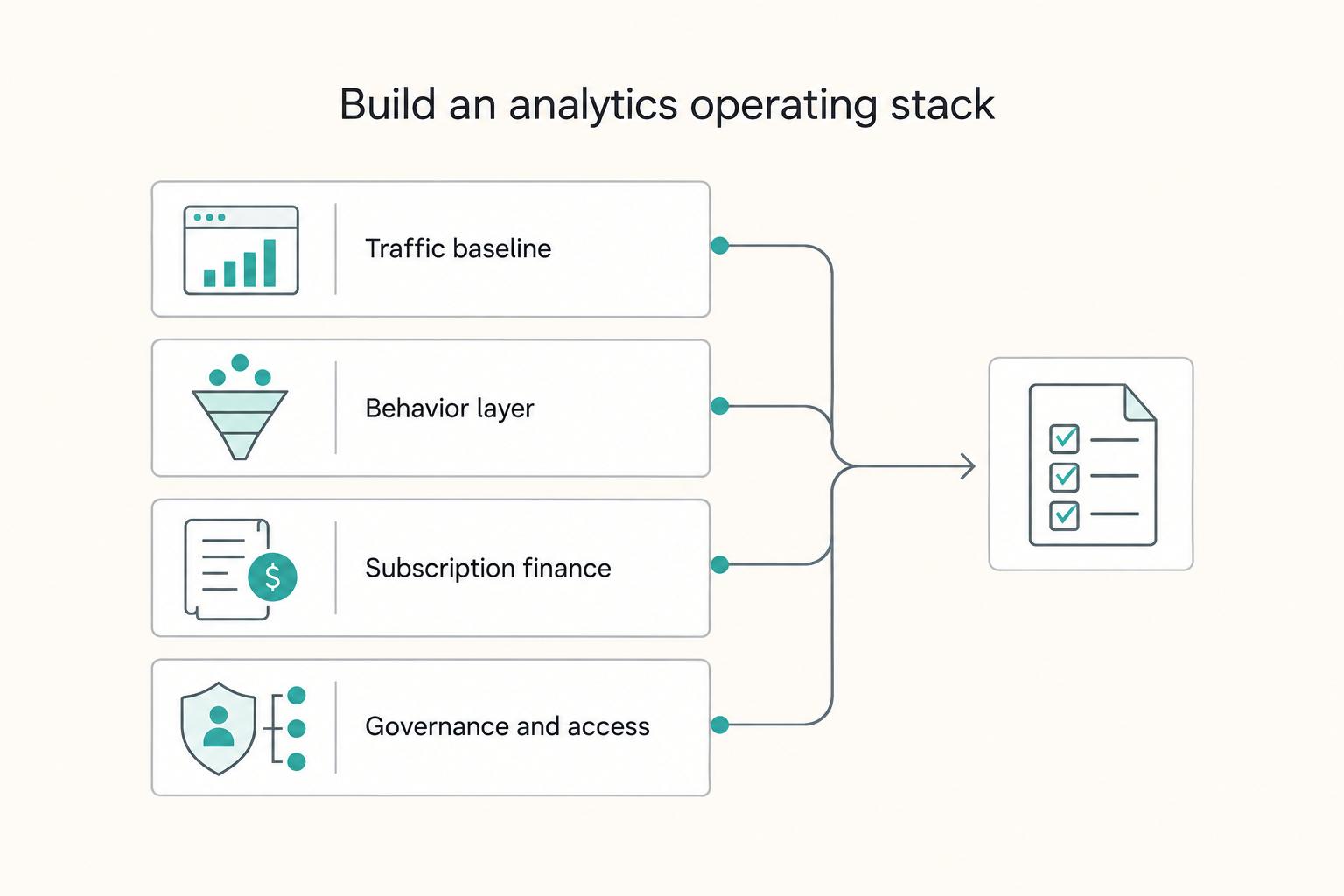
Build your analytics stack like an operating system not a shopping list#
Build a layered system with explicit ownership, then grow it only when a real decision gap appears. The win is not finding a perfect platform. The win is a stack that stays coherent as your product, channels, and billing get more complex.
- Traffic baseline. Use Google Analytics to collect website and app data and monitor traffic plus user activity in one reporting layer. Start here when channel efficiency drives your next move. Key differentiator: this layer answers acquisition questions fast, so you avoid pulling subscription tools into top-of-funnel debates.
- Behavior layer. Use event analysis or session replay for the product question you need to answer. Check identity continuity, missing events and consent-related coverage gaps before treating a trend as complete. For replay, configure masking and access controls before collecting sensitive user interactions.
- Subscription finance layer. Evaluate ChartMogul or Baremetrics for billing-derived recurring-revenue analysis. Document MRR scope, customer versus revenue churn, and whether LTV estimates revenue or gross profit. Different provider conventions need an explained bridge rather than forced numerical equality.
- Governance and access layer. Apply least privilege, assign metric owners and review access on a defined cadence. Configure consent, sensitive-data exclusion and replay masking where relevant before collection; retain enough source evidence to explain metric corrections.
If you want a lighter website-first setup to complement this stack, see The Best Analytics Tools for Your Freelance Website.
If you want help pressure-testing your shortlist, Talk to Gruv.
Frequently Asked Questions
What is the difference between SaaS analytics and ecommerce analytics?
SaaS analytics focuses on recurring-revenue decisions, especially MRR, LTV, and churn rate. Ecommerce analytics focuses on online store data and sales decisions. Both use behavior data, but they answer different operator questions. The key differentiator is business model, not dashboard style.
Is Google Analytics enough for a SaaS business?
Google Analytics gives strong visibility into traffic and user activity across your site or app. It does not cover the full subscription-finance layer on its own. If you need decision-grade SaaS metrics, pair it with a subscription analytics layer so you can connect acquisition, activation, and revenue with consistent definitions.
Which metric should I prioritize first between MRR LTV and churn rate?
Do not force a universal first metric because no single order fits every SaaS model. Pick the first metric by your current bottleneck: revenue predictability, retention risk, or payback confidence. Then lock one owner and one definition before you optimize anything else. Keep the other two visible so tradeoffs stay explicit.
How do I choose between Baremetrics ProfitWell Metrics and ChartMogul?
Choose based on the finance decision you run every month, not brand preference. ProfitWell Metrics can benchmark against a dataset of 30,000+ companies, while ChartMogul centers recurring KPI reporting and publishes benchmark research from a large SaaS sample. For any option, validate fit against your workflow, KPI definitions, and review cadence.
What is a safe starter analytics stack for a small SaaS team?
Start with two core layers and clear ownership per layer. Use a traffic and user-activity analytics tool for acquisition patterns, then add a subscription analytics layer for recurring KPI reporting. Keep one KPI dictionary so MRR, LTV, and churn mean the same thing across tools. Add extra behavior tools only when specific product questions justify them.
How can I avoid tool sprawl while still getting practical insights?
Tie every tool to one recurring decision and one owner. If two tools answer the same weekly decision, remove one and keep the cleaner workflow. When you have overlap, keep the tool that consistently drives action and retire the rest.
What should I do when platform comparisons lack verified benchmark data?
Treat external benchmarks as directional, then validate against your own definitions and trend history. Cross-platform comparisons require caution because vendors do not calculate MRR the same way. Apply the same caution to churn benchmarks because acceptable churn varies by business context. Run a short evaluation window with fixed definitions, then choose the platform that improves decision speed and consistency.
Try a related tool
Researched and edited by the Gruv editorial team. Gruv builds cross-border billing, payouts, and finance-operations software for global businesses.
Sources
Includes 6 external sources outside the trusted-domain allowlist.
- csrc.nist.gov/pubs/sp/800/137/finaltrusted
- csrc.nist.gov/glossary/term/least_privilegetrusted
- baremetrics.com/academy/saas-churnexternal
- baremetrics.com/blog/saas-metrics-dashboards-examples-templatesexternal
- chartmogul.com/subscription-analyticsexternal
- developer.paddle.com/concepts/retain/metricsexternal
- fullstory.com/platform/session-replayexternal
- marketingplatform.google.com/about/analytics/featuresexternal
Educational content only. Not legal, tax, or financial advice.
Related Posts

The Best Analytics Tools for Your Freelance Website
Start with one sequence and keep it boring. Decide the business question. Choose one primary reporting source. Verify tracking against the origin. Then review it on the same day each week. That order matters more than which tool wins your shortlist.

The Freelance Payment Penalty: A Modeled Audit of Platform Fees, FX Spreads, and Payout Delays
The money rarely disappears through a single, easy-to-spot fee. The real loss is stacked. A marketplace takes its commission, a processor adds a charge for international cards, a bank or payment company converts the currency at a spread, a platform holds the funds before release, and a wire sheds a little to intermediaries on the way in. Each layer looks defensible on its own, but the worker feels the combined result as a smaller deposit and a later payday.

How to Respond to a Subpoena for Business Records
Move fast, but do not produce records on instinct. If you need to **respond to a subpoena for business records**, your immediate job is to control deadlines, preserve records, and make any later production defensible.