
Quick Answer
Choose the alliance that protects your real corridors, then standardize it as your default policy. The best airline alliances are the ones that give you workable one-ticket options, credible backup routes, and manageable transfers at the airports you actually use. Treat Star Alliance, Oneworld, and SkyTeam as candidates, not winners by reputation. Confirm operating carrier details, test redemption on your usual city pairs, and keep a written exception rule for trips where the default creates worse outcomes.
Pick the best airline alliance in 10 minutes: a scorecard for global operators#
Choose a default fast. Pick one alliance that fits most of your real trips, reduces connection friction, and gives you a written exception rule for the trips where it does not. The goal is not to crown a universal winner. It is to make your booking behavior repeatable, easier to hand off, and less likely to break your work calendar.
One starting fact matters. The three major alliances, Star Alliance, Oneworld, and SkyTeam, together include over 50 airlines. That matters because alliance travel can make a multi-carrier trip feel more like one journey, with coordinated schedules, codeshare flights, and, on same-ticket itineraries, a single confirmation number you can track. It does not mean one alliance is automatically better, or that alliance-only thinking is enough. Some major airlines sit outside alliances, and membership can change.
Fill out this 10 minute intake#
Fill this out before you compare anything. If you skip it, you will end up scoring brand reputation instead of operational fit.
| Input | What to record | Why it matters |
|---|---|---|
| Recurring corridors | Top 5 to 10 city pairs from the last 6 to 12 months; use actual travel, not aspirational routes | Those corridors should drive your default |
| Real connection hubs | The airports where you actually connect, not just your origin and destination | Connection complexity shows up first in those middle airports |
| Disruption patterns | Trips that fail badly when a delay hits, plus whether you check bags, need long laptop blocks, or make last minute changes | Alliance choice is often won or lost when disruption hits |
| Points and transfer constraints | Programs you already collect, plus any card currencies you can transfer into airline partners, where available | Redemption flexibility depends on whether your current points can reach the programs you would use |
- Recurring corridors
Write down your top 5 to 10 city pairs from the last 6 to 12 months. Use actual travel, not aspirational routes. If most of your revenue comes from Dubai to London, Singapore to Sydney, or New York to São Paulo, those corridors should drive your default.
- Real connection hubs
Note the airports where you actually connect, not just your origin and destination. Your alliance choice is often won or lost in those middle airports, where connection complexity shows up first.
- Disruption patterns
Mark the trips that fail badly when a delay hits: same-day client meetings, event setups, speaker slots, or legal appointments. Also flag whether you usually check bags, need long laptop blocks, or make last minute changes.
- Points and transfer constraints
List the programs you already collect, plus any card currencies you can transfer into airline partners, where available. If redemption flexibility matters, test whether your current points can actually reach the programs you would use. If needed, cross-check with The best business credit cards for earning airline miles.
Score the four factors that actually matter#
Use a simple 1 to 5 score for each alliance across the same four factors. Do not use reader-voted awards as the deciding metric. They are sentiment signals, not operational data, even when the vote count is large.
| Factor | Validation action | Pass cue | Fail cue |
|---|---|---|---|
| Route fit and backup options | Search your top corridors for 2 to 3 dates each, including one tight business trip and one flexible trip | You find multiple workable itineraries on your key routes, with acceptable connection patterns through your real hubs | You keep forcing awkward routings, long layovers, or single-point dependence on one poor connection airport |
| Lounge utility for work | Check your actual layover airports, terminal locations, and access rules for the cabin or status you will realistically hold | You can expect usable workspace, power, and enough time to use it on your normal connections | Access depends on edge cases, different terminals, or status you do not yet have |
| Redemption practicality | Test real award searches on your usual corridors and confirm your transferable points can reach the relevant programs | You can find bookable options that match how you travel, especially on short notice | Seats exist mainly in theory, or your points are trapped in programs that do not connect well |
| Partner consistency | Look at the operating carrier on likely itineraries, not just the marketing carrier, and check whether same-ticket trips stay unified under one booking reference | The partners you actually fly feel reasonably consistent, and you can track one journey cleanly | You keep landing on weak operating carriers, confusing split bookings, or mixed experiences that make handoffs messy |
Two other signal types are worth checking while you score. First, current on-time performance data for the airlines and airports you rely on, where available. Second, carrier financial stability signals from investor releases or annual filings.
For example, one October 9, 2025 investor release disclosed $16.7 billion in quarterly operating revenue, a 10.1 percent operating margin, and $14.9 billion in total debt and finance lease obligations. You are not trying to compare alliances from one filing. You are checking whether your most-used carriers look steady enough to trust with repeated business travel.
Record the default and the exception rule#
Once one alliance clearly fits most of your routes, make it your primary choice and write that down in one sentence. Example: "Default to Alliance X for all trips unless it adds an overnight, a high-risk connection, or blocks a same-day meeting." Then name who can override it. If you travel solo, that is you. If a teammate or VA books, require a short note in the booking record stating the reason for the exception.
| Policy element | What to document | When to revisit |
|---|---|---|
| Default | Write one sentence naming the primary alliance and the exception rule | Use it once one alliance clearly fits most of your routes |
| Override authority | Name who can override the default; if a teammate or VA books, require a short note in the booking record stating the reason | Use when the default does not fit the real trip |
| Review cycle | Recheck the decision quarterly | Revisit sooner if client geography shifts, a key carrier changes alliance membership, or your usual hubs start performing worse |
Recheck the decision quarterly, or sooner if your client geography shifts, a key carrier changes alliance membership, or your usual hubs start performing worse. That is how to use an alliance decision as an operator, not as a fan.
If you want a deeper dive, read The Best Pet-Friendly Airlines for International Travel.
What does "best airline alliance" actually mean for a cross-border work calendar?#
For a cross-border work calendar, "best" means the alliance that protects your actual trips with the least operational friction. Start with route fit, then confirm whether that alliance gives you reliable coverage, time protection, usable redemptions, and consistent partner execution on the routes you book most.
A common heuristic is "pick the alliance that flies where you go." Use that as a starting prompt, not proof. The decision should come from checks you can verify in booking flow and in program/carrier records.
Also keep categories separate: an alliance is the partner network; a frequent-flyer program is where you earn, hold status, and redeem. Strong route fit at alliance level does not automatically mean the program fit is strong for you.
| Alliance | What you are really testing | Booking-flow validation prompt | Program-rule validation prompt | Operating-carrier validation prompt |
|---|---|---|---|---|
| Star Alliance | Repeat-corridor coverage with workable timings | Search your top city pairs on 2 to 3 real dates and confirm the trip can be booked as one journey | Check whether your likely points/card transfers reach a program you would actually use | Open flight details and confirm which airline operates each leg |
| Oneworld | Calendar protection on time-sensitive trips | Check layover practicality and return options if plans move | Read earning/redemption rules in the exact program you plan to credit | Verify where partner-operated legs change seat, service, or rebooking experience |
| SkyTeam | Backup depth on your real hubs | Compare one tight trip and one flexible trip in the same corridor | Run a sample redemption search before committing your earning strategy | Confirm you are comfortable with the likely operating carriers if disruption hits |
The four checks that matter before you book#
| Check | What to validate | Failure cue |
|---|---|---|
| Coverage | Look for multiple workable options on your top routes | One disruption collapses the trip |
| Time protection | Validate layover and terminal flow against how you actually work | Layover or terminal flow makes the trip fragile |
| Redemption usability | Test real redemptions before choosing where to earn | Your points setup is still loose or untested |
| Partner execution consistency | Check likely operating carriers on your most common itineraries | Handoffs stop being manageable under stress |
- Coverage
Look for multiple workable options on your top routes, so one disruption does not collapse the trip.
- Time protection
Validate layover and terminal flow against how you actually work, not against prestige signals.
- Redemption usability
Test real redemptions before choosing where to earn; if your points setup is still loose, use The best business credit cards for earning airline miles.
- Partner execution consistency
Check likely operating carriers on your most common itineraries and decide whether those handoffs stay manageable under stress.
One common failure mode is relying on stale or secondhand summaries. The FederalRegister.gov record explicitly notes informational limits, points readers to official verification, and includes a "View printed version (PDF)" checkpoint. Use the same discipline here: verify in current booking flow, program rules, and carrier/alliance pages.
Alliance details can be time-sensitive. A dated Royal Air Maroc announcement showed member-elect status before full oneworld entry, with an effective date of 1 April 2020 after a 15-month implementation period, so recheck status and timing before turning them into policy.
For a small team, document the operating rule in plain language:
- Default behavior: Book within one primary alliance unless it creates a worse outcome on the real route.
- Override trigger: Use a non-default option when the default adds fragile connections, removes a workable same-day plan, or forces an operating carrier you would not choose knowingly.
- Review trigger: Recheck quarterly; verify current membership status, route mix, and repeated service issues before changing your risk profile rule.
Related: The Best Tools for Monitoring Application Performance (APM).
The signal hierarchy: Skytrax awards vs traveler sentiment vs network scale - what should you trust?#
Trust your route reality first. Use awards, sentiment, and network summaries as secondary filters, then validate them against the trips you actually book.
Use each signal for orientation, not proof. In transport policy documents, even strong-looking claims are often framed as conditional ("would be possible") or as long-horizon vision (for example, 2026-2036). That is useful context, but not enough to set booking policy on its own.
| Signal | Good for | Where it fails | Validation action |
|---|---|---|---|
| Awards and rankings | Quick orientation on reputation themes | Can blur alliance brand, program experience, operating carrier, and airport conditions | Test-book your key routes and check the operating carrier on each leg |
| Traveler sentiment | Spotting practical pain points and edge cases | Reports are inconsistent across routes, cabins, and time periods | Recreate the scenario in your booking flow, then confirm rules in the program you will use |
| Network and scale summaries | Seeing broad partner and coverage patterns | "Big network" does not guarantee workable timings or fallback options on your corridor | Compare your normal itinerary and a backup scenario on the same route |
Keep entity boundaries clear: the alliance is the network label, the frequent-flyer program is where you earn and redeem, the operating carrier runs the flight, and airport experience depends on the specific airport and terminal context.
When signals conflict, use this tie-breaker:
- Run a route-level test on your priority corridors.
- Compare fallback options if the first plan breaks.
- Pick the option that protects your calendar, not the one with the strongest reputation signal.
Use that result in the next section's weighted scorecard so you are scoring validated options, not headline signals. We covered this in detail in The Best International Bank Accounts for Global Citizens.
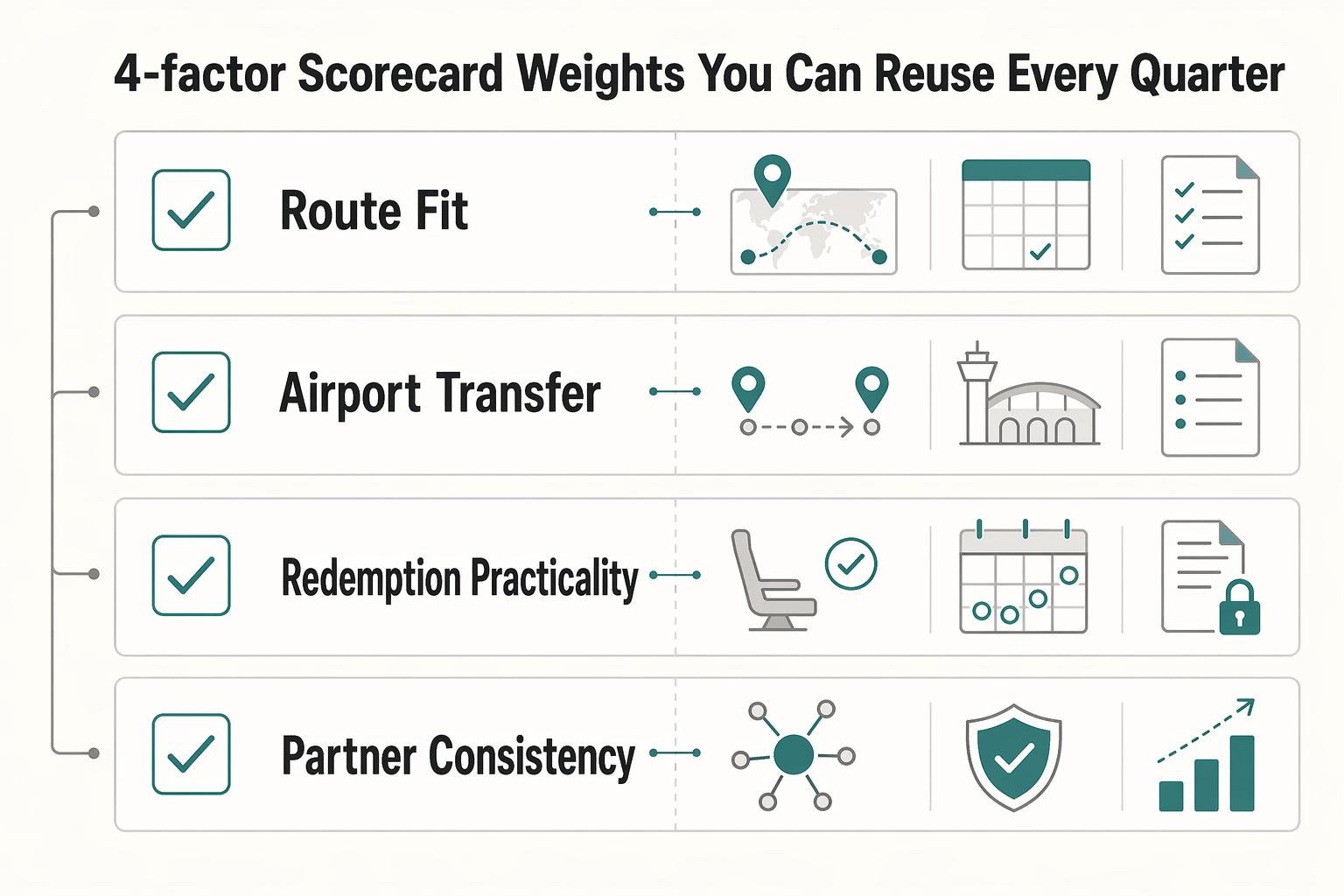
The 4-factor scorecard (with weights) you can reuse every quarter#
Use one scorecard, keep the same factors each quarter, and change weights only when your travel pattern changes. The point is accountability: a repeat review helps you see whether your last decision held up instead of repeating optimistic assumptions.
Score only what you can verify in your own workflow: current booking flows, operating-carrier details, your real connection path, and current program terms.
| Factor | What to collect | How to score | Red flag that forces a downgrade |
|---|---|---|---|
| Route fit | Your top city pairs, sample booking paths, same-day backup options | Score higher when your common trips are straightforward to book and repeat | The option depends on a routing you would not normally take |
| Airport transfer flow | Your usual connection airport flow, terminal changes, gate-to-gate reality, work-break practicality | Score higher when transfer steps stay manageable under time pressure | The itinerary looks workable until transfer complexity appears |
| Redemption practicality | Current award search behavior, transfer options, and current program terms | Score higher when your earn-and-redeem path is explicit and testable | You are relying on vague future value or unverified terms |
| Partner consistency | Operating-carrier details across likely itineraries | Score higher when likely operating carriers match your repeat-travel standards | Frequent carrier swaps create uncertainty on key legs |
Set the weights after verification#
Use this note in your sheet: "Current weight split pending route, connection, and program verification." After your checks, assign weights that total 100. Keep that split stable unless your route mix, connection reality, or intended program changes.
Make the decision in one pass#
Score each alliance, apply your weights, and pick a default only if it also works on your highest-frequency corridor. If the weighted score and the real-world corridor test conflict, pause and recheck the inputs.
For redemption planning, align your points path with The best business credit cards for earning airline miles.
Write the result as policy output:
- Chosen default alliance
- Designated primary frequent-flyer program
- Documented exception trigger
- Review trigger for next quarter
Quick comparison table: Star Alliance vs Oneworld vs SkyTeam (and when to go free-agent)#
Shortlist first, verify on real routes second, then set one default. Compare the right layer each time: alliance (network), operating carrier (who actually flies each leg), and frequent-flyer program (where earning, redemption, and status rules live).
If you skip that layer check, the branding can look strong while trip quality, lounge access, or mileage value changes underneath you.
| Option | Best for | Strengths you'll feel weekly | Tradeoffs to accept | Verify before you set a default | When to avoid |
|---|---|---|---|---|---|
| Star Alliance | Your repeat corridors often map cleanly to this network. | Multi-leg backups can be easier to find when plans change. | Network breadth does not guarantee clean timing on your actual trips. Program rules still decide earning and redemption outcomes. | Route fit: test top repeat corridors from destination backward. Operating carrier consistency: open flight details for every leg. Airport connection friction: check terminal changes and re-clear steps. Program-rule reliability: save current earning terms and one redemption search you can reproduce. | Avoid if the "best" option depends on carriers or connections you would not repeat under pressure. |
| Oneworld | The same partner set keeps winning your must-not-miss trips. | Standardization gets easier when the same carriers and transfer airports keep appearing. | One new market can force awkward transfers or off-pattern itineraries. | Route fit: retest core corridors plus one urgent same-day variant. Operating carrier consistency: confirm each segment. Airport connection friction: verify arrival/departure flow is workable. Program-rule reliability: confirm earning on the fare classes you actually buy. | Avoid if it looks good only on future redemption hopes, not on tickets you are booking now. |
| SkyTeam | Your recurring routes are stable enough to buy similar itineraries each cycle. | Consistency can beat theory when your calendar repeats. | Stability can drift if partner mix, schedules, or terms change and you do not re-check. | Route fit: validate recurring city pairs. Operating carrier consistency: watch for hidden carrier swaps. Airport connection friction: confirm repeatable transfer flow. Program-rule reliability: treat miles as useful only after you can turn them into a confirmed ticket. | Avoid if the routing works only when multiple untested assumptions hold. |
| Free-agent | Your trips are still scattered, price-led, or client-driven. | Maximum flexibility to buy the cleanest itinerary each time. | Progress toward one program gets diluted, and benefits become less predictable. | Audit your last 6-10 trips for repeating corridor, carrier, and airport patterns. Current repeat-route trigger pending route/status/source verification. | Avoid staying free-agent when "exceptions" become your normal pattern. |
Turn this into policy, not preference: choose one default program, define exception criteria, and log exceptions for the next review cycle. Keep the criteria concrete: worse same-day arrival, unacceptable carrier swap, high-friction connection, or unverified program terms. If exceptions keep stacking, re-open the default choice.
Best airline alliances (ranked by use case, not ego): 4 picks#
There is no universal winner. Choose the option that fits your repeat routes, disruption tolerance, and team booking behavior, then run one primary frequent-flyer program with documented exceptions.
Use the same operational checks every time: operating carrier by leg, airport work/lounging reality, current earning and redemption rules in your program, and fallback options you would actually accept when plans change. Alliances can be exclusive, so some useful partners will sit outside your default.
| Pick | Best fit profile | Where it breaks | Operational upside | Operational risk | Choose an exception when |
|---|---|---|---|---|---|
| Star Alliance | Your repeat long-haul or multi-leg trips often sit inside Star partners, and you want more in-network fallback paths. | The route looks good at alliance level, but the operating carrier, airport flow, or fare-class outcome is weak. | Easier to keep planning inside one alliance pattern when schedules shift. | Carrier-level variance and program-rule complexity still control real outcomes. | A non-Star option gives a clearly cleaner arrival or avoids a connection you would not repeat. |
| Oneworld | Your high-stakes routes keep landing on the same Oneworld carriers and hubs, and your team benefits from standardization. | A new market or awkward transfer pushes you off-network. | More consistent team booking behavior when the same carriers keep winning. | Program-specific limits on earning, lounge access, or redemption can undercut the alliance-level plan. | Your itinerary depends on a benefit you cannot confirm in current program terms and on the current operating flight. |
| SkyTeam | Your travel calendar repeats enough that similar itineraries keep returning and consistency matters most. | A stable routine drifts as schedules, partners, or airport conditions change. | Lower decision fatigue on recurring trips. | Quiet degradation: the route exists, but the usable version keeps getting weaker. | An operating-carrier swap, terminal change, or poor fallback makes the trip fragile. |
| Free-agent | Your next quarter is scattered, client-led, or price-led, and no alliance clearly dominates. | You keep treating every trip as unique after clear route patterns emerge. | Maximum routing flexibility. | Partner-by-partner setups can create complex rules for earning, redemption, status, and lounge access. | Repeating corridors show that one default alliance would now reduce friction. |
- Star Alliance
Choose this when your recurring corridors need flexible multi-leg recovery and Star partners keep appearing in workable itineraries. Stop using it as the default when acceptable trips depend on a carrier, airport transfer, or fare condition your team keeps avoiding.
- Oneworld
Choose this when your important routes are concentrated and team consistency is more valuable than constant re-shopping. Stop using it as the default when your result relies on earning, redemption, or lounge assumptions you cannot reproduce in current program terms.
- SkyTeam
Choose this when repeatability is your main goal and your core trips keep booking in a stable pattern. Stop using it as the default when exceptions pile up just to protect arrival reliability or workable connection conditions.
- Free-agent
Choose this when committing to one alliance would force low-quality itinerary decisions right now. Stop staying free-agent once your exception log shows repeat patterns; then standardize one primary program and set up earning execution with The best business credit cards for earning airline miles.
For a step-by-step walkthrough, see The Best Digital Nomad Cities for LGBTQ+ Travelers.
Is Star Alliance better than Oneworld?#
Neither is universally better for you. Choose based on your repeat corridors and how much disruption risk you can tolerate on real travel days.
Run this quick tiebreaker on your top two corridors before you decide:
- Can you book a workable one-stop itinerary on your actual dates?
- Is the layover long enough to be usable without making the trip fragile?
- If the first plan breaks, can you find a credible same-day reroute through your usual connection airports?
| Operational field | Star Alliance | Oneworld |
|---|---|---|
| Route fit | Can work well when you need multi-carrier connections on one ticket. Check for possible gaps in smaller markets and some U.S. domestic connections. | Can work well when your routes stay concentrated around its carriers and hubs. Check for weaker coverage in Africa and South America if those regions matter to your schedule. |
| Backup routing resilience | Compare fallback options on the same travel dates, not alliance reputation. | Use the same test: judge it by bookable fallback paths on your routes. |
| Lounge work utility | Do not assume access from the alliance badge alone. Verify by operating carrier, airport, fare, and status mapping. | Same verification standard: alliance, operating carrier, and airport all need to line up. |
| Redemption usability | Value depends on the member program you pick, not the alliance label. Test one paid earning case and one partner award search. | Same rule: program terms drive earning and redemption outcomes. |
| Policy fit | Better when your policy prioritizes recovery options on complex itineraries. | Better when your policy prioritizes a tighter, more standardized carrier pattern. |
One checkpoint is non-negotiable: alliance recognition comes from status earned in a member airline program, not from the alliance directly. Verify your status mapping before you standardize; for example, British Airways Silver maps to Oneworld Sapphire, and BA Gold maps to Oneworld Emerald.
Execution rule: pick one primary alliance, keep one frequent-flyer program inside it as your default, and document exception triggers such as a worse one-stop option, an unworkable layover, or no credible same-day reroute. Recheck that choice when your client geography or trip pattern changes.
Related reading: The Best Portable Mice for Travelers.
Confidence & caveats: what varies by carrier, airport, and award methodology#
Treat your alliance pick as a shortcut, not a guarantee. Before you standardize it in policy, verify three layers on real itineraries: alliance terms, operating-carrier rules, and airport transfer reality.
Use this rule: if you cannot confirm a benefit in a few minutes on current terms, do not treat it as dependable. In practice, "smooth travel" is not something you should assume.
| Layer | What can break | Fast verification | Pass/fail rule | Fallback if confidence is low |
|---|---|---|---|---|
| Alliance | Expected reciprocity or lounge/status benefits do not apply the way you assumed | Check current alliance-level terms and the member-airline terms for your exact benefit | Pass only if both levels support the benefit for your route/fare context | De-prioritize alliance branding and choose the clearer itinerary outcome |
| Carrier | Marketing carrier and operating carrier differ, and operating rules drive your real experience | Confirm operating carrier in booking details, then review that carrier's applicable rules | Fail if your repeat corridor regularly lands on an operator/rule set you would not accept directly | Change preferred routing or add an exception for that city pair |
| Airport | Valid connection on paper becomes fragile because of transfer complexity and hub/resource constraints | Check terminal flow, transfer steps, and timing on your actual dates | Fail if the transfer depends on steps you cannot control or leaves no usable buffer | Use longer connections or a different hub |
Status-based decisions need extra caution. Status match/challenge terms vary by airline and year, can be paused, may exclude promotional/complimentary status, and may require proof of current status plus activity in a short window. Some offers are limited to once per account lifetime or every few years, so do not assume repeatability.
Awards are input, not a verdict.
- Rank your criteria first: route fit, recovery, lounge utility, redemption, and status utility.
- Test one real corridor on real dates.
- Verify bookability and total fees in the exact program you will use.
- Write down unresolved unknowns, especially operating-carrier and transfer risks.
- Recheck time-sensitive guidance before finalizing policy, because published guides can lag current operations.
Conclusion: lock your alliance choice into a repeatable travel policy (and revisit it)#
Once you have a winner and a runner-up, stop treating the decision like a loyalty identity. Write it as a booking policy that still holds up when a meeting moves, a connection breaks, or the operating carrier changes at the last minute.
1) Publish one short policy doc#
Keep the document to one page and make it the reference your team actually uses at booking time.
| Field | What to maintain |
|---|---|
| Repeat corridors | Your highest-volume city pairs or regions |
| Acceptable connection hubs | Airports your team will tolerate for transfers |
| Default booking rule | Book inside your chosen alliance when timing and fare are workable |
| Exception trigger | Allow outside-alliance booking for materially better nonstop timing or lower transfer risk |
| Pre-book verification rule | Confirm operating carrier and fare conditions before purchase |
The key point is that this turns the alliance question into an execution rule. Write one red flag explicitly: do not build policy around complimentary upgrades. Upgrade outcomes are unreliable, and route context can make elite benefits inconsistent. If your traveler needs first class, buy it, or use a predictable paid buy-up when available.
2) Assign ownership before the first exception#
Name one person who approves exceptions and one place where trip notes live. A shared doc or booking log is enough, as long as people record what failed: bad transfer airport, broken through-check, or an alliance redemption that looked good on paper but was not usable in practice.
3) Revisit only on concrete triggers#
Review the policy when your route mix shifts, when the same connection problem shows up repeatedly, or when loyalty value becomes less usable in practice. If redemption usability is part of your policy, pair the review with your earning setup in The best business credit cards for earning airline miles. If the default keeps losing those checks, switch it.
Frequently Asked Questions
Which airline alliance is best overall?
Start with the alliance that serves your top two or three corridors cleanly, then try to disprove it on real dates. There is no universal winner. If the “winner” fails on operating carrier, airport transfer, or bookable timing when you test an actual itinerary, use your runner-up instead.
What are the three main airline alliances?
The big three are Star Alliance, Oneworld, and SkyTeam. Star Alliance launched in 1997, Oneworld in 1999, and SkyTeam was founded on June 22, 2000. Use those three names as your first filter, not as proof that every member combination will work the same way.
Is Star Alliance better than Oneworld?
Pick between them by comparing your real city pairs, not by reputation. If one keeps giving you cleaner one-ticket itineraries, more workable connection airports, or operating carriers you would actually choose directly, that is the better fit for you. A practical rule is to test the same two or three repeat routes in both and keep the one that wins at least two without introducing a bad transfer.
How do I choose an airline alliance for international travel?
Choose one primary alliance because no single airline covers the world end to end, and alliances exist partly to extend that reach. An alliance is just a partnership model that helps different airlines simplify connected travel. Before you commit, verify whether your likely multi-airline trip can be issued on one ticket and whether check-in or bag handling can be handled once at departure on that exact itinerary.
Are airline alliance rankings objective?
No. Rankings are shorthand, not evidence for your travel calendar. Use them to build a shortlist, then pressure-test that shortlist against real fares, real operating carriers, and your actual connection airports. If the ranked option loses on schedule or transfer friction on your repeat route, ignore the ranking.
Does choosing an alliance affect lounge access and upgrades?
It can, but only after you verify the exact fare, the operating carrier, your status, and the airport setup. Same-alliance booking does not guarantee lounge access, upgrades, through-checked bags, or easier disruption handling on every ticket. Check the fare rules, confirm who operates each segment, verify your status eligibility, and make sure the airport can support the connection you are counting on.
Can a small team standardize on one alliance without overpaying?
It can, if you write it as a default with exceptions instead of a rigid rule. Set one primary alliance for repeat client travel, document an exception trigger such as materially better nonstop timing or a connection airport your team will not accept, and review that policy whenever your travel pattern changes. If you also want the rewards side to compound, connect it to The best business credit cards for earning airline miles.
Try a related tool
Researched and edited by the Gruv editorial team. Gruv builds cross-border billing, payouts, and finance-operations software for global businesses.
Sources
- dspace.mit.edu/bitstream/handle/1721.1/75853/821869736-MIT.pdftrusted
- faa.gov/newsroom/BVLOS_NPRM_website_version.pdftrusted
- faa.gov/documentLibrary/media/Order/7340.2N_Bsc_w_Ch...trusted
- faculty.haas.berkeley.edu/borenste/AirReg2013Jan.pdftrusted
- federalregister.gov/documents/2025/12/08/2025-22289/federal-trav...trusted
- house.mn.gov/cco/journals/2011-12/J0507116.pdftrusted
- ntrs.nasa.gov/api/citations/20170007238/downloads/20170007...trusted
- oecd.org/content/dam/oecd/en/publications/reports/201...trusted
Educational content only. Not legal, tax, or financial advice.
Related Posts

The Best Pet-Friendly Airlines for International Travel
If you want a move that stands up to airport, veterinary, and border checks, stop thinking in terms of airline marketing and start thinking in terms of reliable handling. The decision lens is simple: compliance readiness, carrier handling capability, and handoff risk.
Best Business Credit Cards for Airline Miles for Global Freelancers Freelancers
If you run a solo business across borders, a business credit card is not just another piece of plastic. It shapes your costs, support, protections, rewards, and how much admin you create for yourself. Most advice still misses that. It assumes a domestic business with predictable categories like office supplies and shipping. It is not built for a Business-of-One paying SaaS vendors in euros, taking clients to dinner in Singapore, and booking multi-leg trips across regions.
Best APM Tools for Small Teams That Need Reliable Incident Triage
If you are comparing the **best apm tools**, pause the generic rankings and ask a harder question: what can you operate cleanly with the time and attention you actually have? The right choice depends less on who won a roundup and more on your incident pattern, your operator bandwidth, the onboarding effort you can absorb, and how costs behave as telemetry grows.