
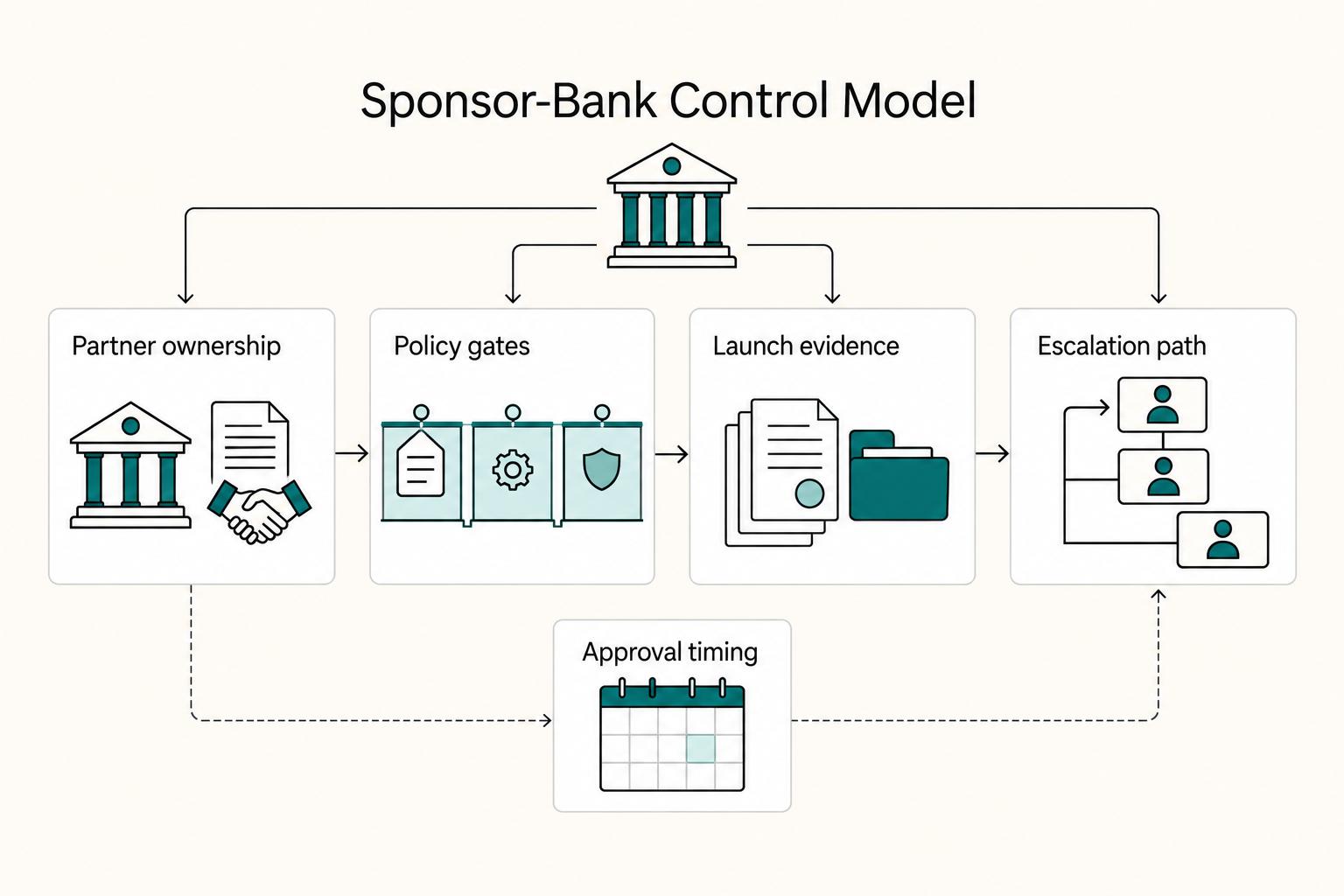
Quick Answer
A fintech’s direct BSA duties depend on its activities, not its sponsor-bank label. Classify the funds flow first, then assign each institution’s controls and reporting. Covered money transmitters have their own MSB duties. Separate cash CTRs from SARs, government 314(a) requests from voluntary 314(b) sharing, and payment receipt from availability. Protect SAR information and track the applicable filing clocks.
Start Here and Pick the Right BSA Path for Your Fintech#
Start by classifying the activity your company actually performs. A sponsor-bank contract can assign operational tasks, but it cannot decide whether your fintech independently has Bank Secrecy Act duties. Once that scope is clear, choose a control model with named owners for onboarding, monitoring, investigations and reporting.
This guide covers U.S.-linked fintech payment operations. The Bank Secrecy Act, or BSA, imposes different requirements on different covered financial institutions. A money transmitter can have direct duties as a money services business (MSB); a software provider does not become an MSB merely because its customers make payments. Product labels, corporate form and a bank partnership alone do not settle the classification.
- Choose your path before requirements harden.
The four setups below describe who performs the work. They are operating arrangements, not regulatory exemptions. First map acceptance and transmission of funds, account ownership and customer relationships. Then identify each entity’s applicable duties and any genuinely available exclusion before choosing vendors or assigning tasks.
- Treat partner review as a gap test.
Ask the partner to test the actual workflow: one onboarding file, one suspicious-activity escalation and one unresolved payment. Record who can access the evidence, who makes the decision and who meets the deadline. A policy memo alone does not show whether those handoffs work.
- Build an evidence pack that answers questions fast.
Keep retrievable records of control ownership and decisions. Separate ordinary operational evidence from restricted SAR records and information that reveals a SAR exists. For information sharing, establish whether you are responding to a government request under Section 314(a) or voluntarily sharing with another eligible institution under Section 314(b).
Use the control map to expose gaps before launch. If the proposed model leaves a legally required task without a qualified owner or usable evidence, repair that gap. Choosing a different internal model does not remove the underlying duty.
Use These Selection Criteria Before You Build Anything#
For a fintech applying the Bank Secrecy Act, the first selection criterion is regulatory scope. Under 31 CFR 1010.100, money transmission generally involves accepting funds or value and transmitting them to another person or location. Facts and circumstances matter. The payment-processor and integral-service exclusions have specific conditions; calling a flow a marketplace payout is insufficient. Pure communication or network services are treated differently. Obtain a product-specific classification before relying on an exclusion.
| Criterion | What to confirm | Evidence to produce |
|---|---|---|
| Regulatory classification | Who accepts and transmits funds; whether an exclusion applies | Flow diagram, contracts, account ownership and reasoned classification |
| Customer type | Whose customer each person or entity is; applicable identification and risk requirements | Customer definitions, onboarding fields and risk profiles |
| Money movement | Funding, cash exposure, payout, restrictions, returns and unknown results | Event history with responsible entity and authoritative payment references |
| Partner requirements | Each party’s duties and the operational tasks it delegates | Control matrix, deadlines, access permissions and escalation contacts |
Rank these criteria before finalizing requirements, vendors, or partner contracts. The upside is less early overbuild. The tradeoff is that choosing a model that is too light can force rushed rework later. A simple red, yellow, green score per criterion keeps disagreements visible and helps teams make a clear call before build work starts.
-
Customer type: Distinguish account holders, platform customers and payout recipients. Apply the relevant institution’s identification rules to the right customer relationship rather than collecting identical information from everyone.
-
Money movement: Map acceptance, custody and transmission, then locate monitoring and reconciliation responsibilities. Include cash if the product accepts it; ordinary electronic transfers do not become cash transactions because they exceed $10,000.
-
Partner requirements: Obtain the bank’s evidence list and distinguish a legal requirement, a contractual requirement and a discretionary internal review. Name the accountable institution even when another party performs the task.
-
Regulatory scope: If the fintech is a covered MSB, a partner-run workflow does not erase its own duties. Federal MSB registration and state licensing are separate questions; do not treat a bank contract as a licensing determination.
Concrete use case: a contractor platform records whose name is on the collection account and who instructs each transfer. If the fintech accepts and transmits customer funds, it evaluates its own money-transmitter status. If it supplies software while a bank performs the financial service, it documents that arrangement and its contractual support duties. The same user-facing payout screen can sit over very different legal flows.
Compare the Four Common Fintech Compliance Setups#
After classification, compare these four operating arrangements. A directly covered MSB needs its applicable BSA program whichever staffing model it chooses. A software provider supporting a bank may instead perform contracted controls while the bank remains responsible for its own obligations.
| Setup | Best for | Primary owner | Speed | Operational burden | Main advantage | Main tradeoff |
|---|---|---|---|---|---|---|
| Sponsor-bank-led | Early-stage launches | Partner bank + fintech ops | Program-dependent | Program-dependent | A single partner can centralize parts of control operations | Fintech has less direct control over policy changes |
| Shared-control | Growing fintechs | Bank + fintech split | Program-dependent | Program-dependent | Explicit split ownership can make evidence responsibilities clearer | Requires tighter coordination and escalation paths |
| Fintech-heavy control stack | Mature operators | Fintech compliance team | Program-dependent | Program-dependent | Strong internal control ownership, including written CDD procedures where applicable | Requires sustained internal ownership for evidence and exception handling |
| Credit-union-aligned program | Programs with credit union partners | Credit union + fintech | Program-dependent | Program-dependent | Can work well when control and evidence ownership are clearly documented | Flexibility depends on partner program design |
Decision rule: if a bank asks for deep control evidence, pick the model with explicit owners and review-ready artifacts, not policy statements alone. If two setups look similar on launch speed, break the tie using evidence burden and clarity of escalation ownership.
For institutions covered by the CDD rule, identify the owner of customer identification, beneficial-owner verification, relationship-purpose assessment and ongoing risk monitoring. The February 2026 exceptive relief permits beneficial-owner identification and verification at the legal entity’s first account, then when facts reasonably question earlier information’s reliability or risk-based ongoing due diligence requires it. It is not a blanket requirement to repeat the process at every subsequent account, nor an exemption from other CDD duties. Document when prior information can be used and confirmed.
Avoid a blanket restriction whenever a file is incomplete. Identify the actual risk, legal or contractual basis, affected activity, decision owner and next review time. A missing optional document should not silently postpone a due supplier payment, customer return or regulatory filing. If a genuine restriction prevents payment, escalate the resulting obligation rather than mark it complete.
Concrete use case: a payout platform and bank agree that the platform collects onboarding records and flags discrepancies, while the bank applies its customer rules and decides its filings. If the platform is also a covered MSB, it separately assigns its own program and reporting duties. Shared evidence helps both parties; one party’s filing does not automatically discharge the other’s responsibilities.
Use Sponsor-Bank-Led Operations When the Division of Work Fits#
This arrangement can fit a team with limited internal capacity when the bank’s program supports the actual product. Confirm what the bank performs and what your company must still do. Launch speed depends on the partner, product risk and integration quality.
Evaluate the partner’s actual control operations rather than infer quality from its charter. Ask which onboarding, monitoring and reporting tasks it performs, what information it needs from you and which approvals are required before launch. Separate those approvals from follow-up improvements that can safely have a later date.
- Fit signal: limited in-house compliance capacity.
Limited staffing is a reason to obtain qualified support, not to omit a required program. A covered MSB’s written AML program must be proportionate to its risks and include controls, a designated compliance person, training and independent review under 31 CFR 1022.210. The review’s scope and frequency are risk-based; the compliance officer cannot perform that independent review. Outsourcing work does not remove the MSB’s responsibility.
- Speed signal: partner maturity is proven.
Sponsor banks differ in maturity, compliance rigor, and collaboration style. Launch speed depends on partner execution quality, not your plan alone.
- Risk signal: policy-gate dependency is acceptable.
If slower policy changes or approval windows would block core priorities, this model may not hold and shared-control can be safer.
- Evidence signal: pre-launch proof is ready.
If a partner requests proof, provide process maps for onboarding, monitoring, and escalation with named owners and clear escalation paths aligned to partner reporting expectations.
Test a difficult case before accepting the arrangement: an alert arrives shortly before a filing deadline, the usual bank contact is unavailable and the fintech holds the supporting transactions. Can the backup contact retrieve the facts and make the required decision in time? Record the result and fix missing access or ownership before live volume adds pressure.
Concrete use case: a new marketplace launches with partner-owned monitoring while the fintech owns case intake quality and response handling.
Move to a Shared-Control Model Before Volume Creates Blind Spots#
Move to shared-control when growth makes escalation and filing-support handoffs unclear. The upside is cleaner accountability. The risk is gaps when ownership is not written step by step.
Shared-control works when each handoff has an accountable institution, a task owner, a delivery time and a fallback contact. For example, the fintech supplies transaction facts, the bank evaluates its SAR obligation, and a directly covered fintech evaluates its own obligation. A joint filing may be possible under applicable rules, but that must be established rather than assumed.
-
Map escalation ownership: Define who receives, triages, and responds to escalations, and who handles agency-facing communication points. If you use a RACI, keep one owner per step.
-
Separate cash reporting from transfer monitoring: For covered financial institutions, CTR rules generally concern currency transactions exceeding $10,000. Known transactions by or on behalf of the same person aggregate separately for cash in or cash out within a business day. Two nonexempt cash deposits of $6,000 and $5,000 total $11,000; an $11,000 electronic wire is not itself a cash CTR trigger. Assign aggregation and exemption review to the correct institution.
-
Keep FBAR on its own calendar where applicable: This annual foreign-account report is separate from customer transaction monitoring and SAR decisions. Confirm whether the U.S. person has a reportable financial interest or signature authority and whether aggregate foreign-account value exceeds $10,000 during the year. FinCEN’s maximum-value instructions round reported dollar amounts upward: $15,265.25 becomes $15,266.
-
Assign filing deadlines by report and filer: The ordinary 2025 FBAR deadline is April 15, 2026, with an automatic extension to October 15, 2026. FIN-2025-NTC3 extends specified previously covered signature-authority filings to April 15, 2027; it does not extend every filer. Keep those annual dates separate from SAR detection and filing clocks.
If alert backlogs grow or escalation ownership is unclear, formalize the RACI immediately and map each line to your Anti-Money Laundering Program requirements and agency interfaces. A short weekly handoff review between product, compliance, and partner contacts can catch ownership drift before it becomes a filing risk.
Concrete use case: as payout volume increases, one team can own risk instrumentation and alert routing while another owns triage and case quality. Final filing authority and agency-facing responsibilities should be explicitly documented with the partner bank.
Build a Payout-Focused Control Stack for Marketplace and Contractor Flows#
For marketplace and contractor payout flows, a payout-focused control stack can make exception decisions easier to trace. The exact gains and operating load depend on your workflow and exception volume.
Design the payout workflow around the applicable rules and actual payment states. Risk checks, financial accounting, recipient availability and provider submission are separate events. A review hold needs an authorized basis and owner; it does not establish that a payment has settled or that an obligation has disappeared.
- Identity and destination checks: Apply the identification requirements appropriate to the customer relationship and the agreed payout controls. Record discrepancies and the decision owner.
- One payout record: Keep an authoritative obligation, amount, recipient and provider reference across retries. A request timeout is an unknown result until traced, not proof of failure.
- Restriction decision: Record the legal, contractual or risk basis, scope, approver and next review time. Restrict the affected activity where justified rather than automatically stopping all unrelated payouts.
- Provider response: Distinguish submitted, pending, confirmed failed, settled and returned. Map events to the same record rather than create another payout when status changes.
- Reconciliation: Compare the payable, provider execution, fees and recipient settlement. A debit from your account alone does not prove the contractor received the money.
- Suspicion escalation: Assemble the underlying facts for authorized reviewers. Keep SAR decisions and existence-revealing information out of recipient-facing messages and broad support tools.
Illustrative use case: a $2,000 contractor payout times out after submission. Operations queries the provider using the original reference before authorizing a replacement. If a separate risk concern justifies a restriction, the reviewer records its scope and review time. Finance keeps the contractor payable outstanding until payment is established; neither a timeout nor an investigation closes that debt.
Use Virtual Account Flows Carefully in Cross-Border Collection#
A fiat virtual account is collection or routing infrastructure; it is not convertible virtual currency merely because its name includes “virtual.” Record funds actually received even when customer allocation or withdrawal availability needs review. Use separate states for receipt, allocation, availability, restriction and return.
The account structure matters: identify the account holder, the bank or payment provider holding the funds, the intended beneficiary and the fintech’s role. If the product also handles convertible virtual currency, evaluate that activity separately. Cryptocurrency risk guidance does not by itself establish the rules for an ordinary fiat virtual account.
- Receipt record: Capture the amount, currency, receiving account, provider reference and receipt time. Keep an unmatched receipt visible in the books while allocation is investigated.
- Risk-based review: Apply the relevant customer and transaction checks. A sender-name difference may have a legitimate explanation; request necessary evidence and assign a decision owner rather than impose a universal source-of-funds gate.
- Allocation and availability: Match funds to the intended customer obligation separately from permission to withdraw. Record an actual restriction with its basis and review time.
- Returns and status: Reconcile provider events, original receipt and any return. A return instruction is not confirmation that the sender has received the refund.
- Pattern escalation: Combine repeated anomalies into a case for authorized compliance review, preserving underlying facts without exposing SAR information in ordinary payment records.
Concrete use case: $5,000 arrives under a reference that cannot yet be matched. Record the receipt and its custody location; keep customer allocation unresolved. After verifying the invoice and sender explanation, allocate it and determine availability under the actual rules. If a return is required, track that return to confirmation rather than erase the original receipt.
Prepare the Evidence Pack Your Bank and Examiners Actually Read#
Build an evidence pack that allows an authorized reviewer to trace the relevant facts without reconstructing the case. Use access tiers: operational control records, confidential customer investigation records and restricted SAR information. A convenient single folder is not a reason to give every partner or support agent the same permissions.
| Evidence item | What to keep | Grounded detail |
|---|---|---|
| Control ownership matrix | Primary owner, backup owner, evidence location, and review cadence | Use one control ID across policy text, tickets, and archived proof |
| Escalation SOPs | How alerts move from intake to escalation to closure | Include override authority, required evidence at each step, and key timestamps so timeliness is auditable |
| Alert QA samples | Risk-based samples with context, reasoning and disposition | Concise internal QA records; do not describe no-SAR memoranda as universally required |
| Training logs | Role-based training completion, timing, and scenarios covered | Tie each record to the controls each person runs |
| Restricted reporting evidence | Detection date, applicable rule, deadline, approvals, filing and support records | Permission-controlled SAR storage and separately shareable underlying facts |
A SAR and information revealing its existence are confidential under the applicable SAR rule. Do not tell the subject that a SAR was filed. Underlying transaction facts can be distinct from SAR information, but sharing still needs a lawful purpose and authorized recipient. For bank and covered MSB SARs, preserve the report and supporting records for five years from filing. Restrict access and use the correct retention clock rather than delete them when an ordinary support case closes.
- Control ownership matrix: Map each control to a primary owner, backup owner, evidence location, and review cadence. Use one control ID across policy text, tickets, and archived proof.
- Escalation SOPs: Document how alerts move from intake to escalation to closure, including override authority and required evidence at each step. Keep key timestamps so timeliness is auditable.
- Alert QA samples: Keep risk-based samples of escalated and closed cases for internal quality review. Concise reasoning can help your team, but the October 2025 guidance does not impose documentation of every decision not to file a SAR.
- Training logs: Track role-based training completion, timing, and scenarios covered, and tie each record to the controls each person runs.
- Restricted reporting evidence: Link the case, detection date, rule, deadline, approval and filing in authorized systems. Share underlying facts separately where permitted; ordinary partner evidence requests do not authorize disclosure of SARs or their existence.
Keep this pack current through regular checkpoints, not quarter-end cleanup. Periodic control attestations, gap reviews, and incident postmortems with remediation dates help keep records ready for review. A practical internal test is whether a reviewer can open one sampled case and follow ownership, timeline, and decision logic without asking for missing context.
Prevent AML and Privacy Collisions in Data Sharing#
Start with minimum necessary data sharing for BSA/AML, then test each sharing path against documented CIP, control, and privacy expectations before release.
- Set a minimum CIP data set before engineering ships fields
For a bank’s covered customer relationship, 31 CFR 1020.220 generally requires name, an individual’s date of birth, address and an appropriate identification number before account opening, with risk-based identity verification. Its customer definitions, exceptions and permitted verification timing matter. Do not apply bank CIP automatically to every marketplace payee or confuse it with each MSB’s risk-based program. Map fields to the actual rule and purpose before building the form.
- Separate compliance evidence from broad product telemetry
CIP alone does not satisfy all BSA obligations, so copying full product logs into compliance tools is not a substitute for sound controls. Keep case files focused on escalation and decision support. Consider masking direct identifiers in engineering logs while preserving case-level context needed for compliance review.
- Treat third-party onboarding and screening as controlled relationships
If a vendor performs bank onboarding tasks, document the bank’s oversight, evidence access and exception handling. A vendor contract is not automatically the rule’s specific permitted-reliance arrangement. Establish any reliance conditions separately; otherwise make the delegated work retrievable and subject to the bank’s controls.
- Run a data-sharing boundary check before every new integration
Before a new integration, document the data, purpose, recipient, legal basis, security, retention and owner. Check SAR confidentiality separately from customer privacy. Section 314(b) is not blanket permission to share all customer information, SARs or the fact that a SAR exists. Limit access to the approved purpose and preserve any records that the applicable law requires.
If a partner requests full raw logs, identify what it actually needs and is authorized to receive. Provide sufficient underlying evidence through an approved channel. Remove unrelated telemetry, protect confidential reporting information and resolve unclear authority before disclosure.
Set the Oversight Map So Everyone Knows Who Enforces What#
Make ownership explicit: map each issue by legal function first, then by agency touchpoint. That avoids duplicate routing and missed deadlines.
| Lane | Brief description | Key differentiator |
|---|---|---|
| Treasury and FinCEN administration lane | Keep BSA rule administration in one lane tied to the Department of the Treasury and the Financial Crimes Enforcement Network | Keep a decision log with policy owner, decision date, and affected control IDs |
| SAR duties | Apply the reporting rule to the accountable institution | Track initial detection, deadline, authorized filing and protected records |
| Section 314(a) and 314(b) | Government requests and voluntary institution sharing are different processes | Separate confidential request-response tracking from eligibility, notice and sharing records |
| Supervisory and enforcement coordination lane | In some cases, states primarily oversee fintech firms while federal regulators can still take enforcement action | Use one escalation matrix naming first responder, legal reviewer, and final approver for each authority path |
Use this map when roles overlap. The benefit is faster issue routing and cleaner regulator communication. The maintenance cost is real because partners, products, and jurisdictions change.
- Treasury and FinCEN administration lane
FinCEN administers the BSA; the relevant regulators and authorities depend on the institution and activity. Maintain a scope record that links each applicable rule to the legal entity, responsible officer and operational control. Route uncertain interpretations through that officer and appropriate legal or partner contacts rather than send every routine operational issue directly to an agency.
- SAR execution and quality lane
For a covered money transmitter, 31 CFR 1022.320 generally requires a SAR for conducted or attempted suspicious transactions involving at least $2,000 when the specified suspicion conditions are met. The deadline is 30 calendar days after initial detection of facts forming a filing basis. The bank rule has a $5,000 threshold under 31 CFR 1020.320 and permits up to 60 days only when no suspect was identified at detection; do not import that extension into the MSB rule. Other institution-specific rules can also apply. Record the correct detection date, suspicious facts and deadline; an internal sign-off queue cannot extend it.
- Section 314 information-sharing lane
Keep the two Section 314 processes separate. Under 314(a), a recipient institution searches the requested scope and responds within the request’s timeframe, protecting the request’s confidentiality. Under 314(b), eligible financial institutions may voluntarily share for permitted money-laundering or terrorist-activity purposes after notice to FinCEN, reasonable verification of the other participant and security controls. Notice is effective for one year and requires renewal. A software vendor is not eligible simply because it supports a bank. Keep a request-response register for 314(a) and a separate participation and disclosure register for 314(b). Neither process supplies unrestricted sharing authority.
- Supervisory and enforcement coordination lane
Map authority by activity: direct federal BSA obligations, the bank or credit union’s supervisory obligations, and any relevant state licensing duties. Name first responders and backup contacts for each entity. A state-regulated payment business can still have federal BSA duties; its sponsor’s supervision is not a substitute for that scope analysis.
Use a quarterly tabletop as an optional operating cadence: rehearse a confidential 314(a) request, a 314(b) eligibility question and a SAR deadline. Confirm that each goes to the right owner and system. This rehearsal schedule is not a new statutory quarterly reporting requirement. Related: What Is FinCEN?.
Run a Quarterly Readiness Check Before Regulators or Partners Ask#
A quarterly readiness check can catch operating drift; choose a cadence appropriate to the risk and workload. Keep this management review separate from legally required independent program review and actual report deadlines. Neither a quarterly meeting nor annual policy approval alone proves that controls work.
- CIP effectiveness snapshot
Sample new or changed onboarding paths. Confirm customer definitions, required fields, verification exceptions and evidence access. If the fintech changed who accepts or transmits funds, revisit classification rather than simply copy the old bank form. Record gaps with owners and completion dates.
- Case closure and reporting quality check
Sample cases for detection-date accuracy, applicable filing deadlines, protected records and useful narratives. The October 2025 SAR FAQs clarify that near-$10,000 transactions alone do not justify a structuring SAR without information suggesting evasion. They do not require a separate follow-up review after filing or documentation of every no-SAR decision. The 90-day continuing-activity review described in earlier guidance is optional, not a universal mandatory cycle. Ongoing risk-based monitoring and applicable reporting duties continue.
- Change-control and privacy governance check
For each material release, identify changes to customer data, payment flows, access permissions and monitoring. Check that vendors can provide the required records and that cross-border data transfers have an appropriate basis. Record the actual privacy obligations for the jurisdictions and entities involved rather than attach an unrelated regulatory acronym or fine ceiling to every release.
- Known-unknowns register and corridor pre-mortem
Keep a standing register of unresolved interpretation questions, partner dependencies, and evidence gaps that public guidance alone cannot close. Confirm what still needs counsel or partner validation, and before entering a new payout corridor run a pre-mortem on monitoring coverage, privacy constraints, and evidence completeness.
Close each quarterly check by documenting what changed since the prior review, who approved the change, and which evidence items need refresh before the next partner check-in.
Take the Next Step Without Overbuilding#
Finish with a duty map that matches your real funds flow, an operating model with accountable owners and evidence that authorized reviewers can retrieve. Resolve the missing controls that affect launch, while giving nonblocking improvements a realistic owner and date.
- Confirm scope and assign ownership: Record the relevant legal entities, funds flow, customer relationships, rules and any supported exclusions. Name primary and backup owners for each required task.
- Test the workflow and evidence: Rehearse an onboarding exception, an unknown payout and a suspicious-activity escalation. Confirm decision authority, filing clocks, protected records and access before live launch.
- Validate data-sharing boundaries: Record the purpose, recipient, legal basis, security, retention and owner for each sharing path. Separate 314(a), 314(b), ordinary partner evidence and restricted SAR information.
- Schedule risk-based reviews: Set a management check cadence and an independent program review where required. Track unresolved gaps and actual deadlines separately; an internal review date cannot postpone a legal filing.
If coverage varies by market or partner program, confirm requirements early and document decisions before launch.
Frequently Asked Questions
What is BSA in fintech in one sentence?
The Bank Secrecy Act requires covered financial institutions to run applicable anti-money-laundering controls, keep records and make required reports; a fintech’s duties depend on the financial activity it performs.
Does the Bank Secrecy Act apply directly to fintech platforms or only to banks?
It can apply directly. A fintech operating as a covered money transmitter has its own MSB duties even if a bank performs some operations. A software-only provider may instead support the bank under contract. Classify the actual activity and any exclusion; the fintech label and sponsor relationship do not decide the answer.
Who enforces BSA requirements across banks, credit unions, and fintech partnerships?
FinCEN administers the BSA, with supervision and enforcement roles varying by institution and activity. The October 2025 SAR FAQs were issued jointly with the Federal Reserve, FDIC, NCUA and OCC. Map the fintech’s own duties separately from its bank or credit-union partner’s obligations and relevant state licensing responsibilities.
What are the table-stakes controls every fintech should have before launch?
Start with product-specific classification and a duty map. A covered MSB needs its required written AML program, responsible person, training and independent review, plus applicable records and reporting. A bank-supporting vendor needs the agreed operational controls and evidence access. Section 314(a) response procedures and voluntary 314(b) participation apply according to scope and eligibility, not automatically to every fintech.
How do Suspicious Activity Report and Currency Transaction Report obligations affect product operations?
Separate cash CTR logic from suspicious-activity evaluation. CTRs generally concern qualifying cash transactions above $10,000, including required daily aggregation; ordinary wires are not cash. Applicable SAR rules have different thresholds and clocks for banks and MSBs. Build reliable detection dates, case evidence, filing authority and restricted record access rather than encode one universal reporting threshold.
Where do BSA duties and privacy rules conflict in bank-fintech data sharing?
Share only authorized information for the defined purpose. Customer facts, ordinary payment records and confidential SAR information need different handling. A partner request or 314(b) participation does not override SAR confidentiality. Document the recipient, basis, access controls and retention requirements while preserving evidence needed for lawful reporting.
What changed recently in BSA scope that operators should track?
The October 2025 SAR FAQs clarify existing requirements without creating new ones. February 2026 CDD relief permits covered institutions to perform beneficial-owner identification and verification at the first account, then on reliability or risk-based ongoing-due-diligence triggers. It does not remove other CDD or reporting duties. Review these updates against the institution-specific controls they actually affect.
Watch
Bank Secrecy Act Guide for Fintech Platforms
Researched and edited by the Gruv editorial team. Gruv builds cross-border billing, payouts, and finance-operations software for global businesses.
Sources
Educational content only. Not legal, tax, or financial advice.
Related Posts

What Is FinCEN for Freelancers and FinTech Users
If you are asking **what is fincen**, focus first on the decision in front of you. FinCEN, the Financial Crimes Enforcement Network, is tied to FBAR filing through FinCEN Form 114 when foreign financial accounts create reporting duties. By the end, you should know whether to act now, gather records, or escalate.

The Freelance Payment Penalty: A Modeled Audit of Platform Fees, FX Spreads, and Payout Delays
The money rarely disappears through a single, easy-to-spot fee. The real loss is stacked. A marketplace takes its commission, a processor adds a charge for international cards, a bank or payment company converts the currency at a spread, a platform holds the funds before release, and a wire sheds a little to intermediaries on the way in. Each layer looks defensible on its own, but the worker feels the combined result as a smaller deposit and a later payday.

How to Respond to a Subpoena for Business Records
Move fast, but do not produce records on instinct. If you need to **respond to a subpoena for business records**, your immediate job is to control deadlines, preserve records, and make any later production defensible.