
Quick Answer
Start by treating autonomy premium freelancing as a control test, not an income target. Use profile truth, scope clarity, and a recurring control cadence, then run a go/no-go review across niche clarity, pipeline, contract baseline, and payment process before scaling. Protect margins with written pricing and change rules, and verify operations with explicit invoice and payout statuses. Move into the 90-day execution sequence only after those controls hold consistently.
Why Autonomy Matters More as Earnings Rise#
Freedom only pays off when control keeps pace. Freelancing happens project by project outside a single employer structure, so you need explicit rules for scope, pacing, and follow-through. Freedom without structure turns into chaos. Durable independence comes from controls you can repeat, not motivation spikes.
One warning sign is a gap between what your profile promises and what clients ask for. That gap can push you into improvised delivery terms just to keep work moving, leading to rework, weaker boundaries, and disputes that are harder to prevent.
Use three checkpoints before you push for growth:
- Profile truth: Confirm your public positioning matches what you can deliver now. Credibility depends on accurate representation.
- Scope clarity: Set expectations in writing before work starts so key decisions are explicit instead of improvised.
- Control cadence: Review core delivery, payment, and documentation habits regularly so scaling is not driven by firefighting.
This article gives you decision checkpoints, a setup sequence, and a practical checklist to protect autonomy as workload grows.
Define the autonomy premium in concrete terms#
Treat the autonomy premium as the value you keep when control over your work improves, not when billing rises alone. Higher revenue with weaker control is not progress.
A January 2004 study across 23 countries found self-employed people reported higher work satisfaction and linked part of that gap to autonomy itself, not only pay. Use that as directional context, not timeless proof or a quantified income effect.
A January 21, 2026 piece on independent work lands on the same practical point: once external structure disappears, you need internal architecture to protect momentum. Without it, decision fatigue can erode consistency. Use it as a working check, not a validated formula:
- Client selection control: You can decline poor-fit work without panic acceptance.
- Pricing and scope control: Projects start with written scope and terms before delivery begins.
- Work intensity control: Your schedule protects focused work and recovery, not only reactive requests.
To make this usable, score those three controls once a month on one page of notes. Mark each one as stable, slipping, or improving, and write one concrete reason for the score. You are not trying to build a scientific index. You are trying to catch drift early, before a weak period hardens into a pattern.
Keep signal separate from story. Anecdotal examples can prompt reflection, but they are not universal benchmarks. If one of the three controls stays weak for a sustained stretch, treat the premium as fragile and fix that gap before you scale. Related: A Deep Dive into the UAE's Golden Visa Program for Freelancers.
Compare freelancing and stable employment on controllable risk#
In practice, the choice often comes down to downside ownership. Stable employment can externalize more controls, while freelancing can require you to own more of them. Traditional employment is usually tied to steadier pay, benefits, and structured hours such as a 9-to-5 schedule. Freelancing can raise upside, but income may vary with project availability, client demand, and self-marketing consistency.
| Factor | Stable employment | Freelancing |
|---|---|---|
| Control ownership | Can externalize more controls | Can require you to own more of them |
| Income pattern | Usually tied to steadier pay | Income may vary with project availability, client demand, and self-marketing consistency |
| Weak quarter | Some guardrails may remain in place by default | May need reserve discipline, contract discipline, and follow-up discipline to absorb the same shock |
When you compare the two, headline income is only one signal. Check whether your controls still hold through a bad quarter, especially around tax handling, contract terms, collections, and documentation follow-through.
Run a simple thought experiment. Imagine the same weak quarter under both paths. In stable employment, some guardrails may remain in place by default. In freelancing, you may need your own reserve discipline, contract discipline, and follow-up discipline to absorb the same shock.
Compliance exposure can shift too. In the U.S., the Wage and Hour Division published an independent-contractor rule under the Fair Labor Standards Act on 01/07/2021 (86 FR 1168, pages 1168-1248). FederalRegister.gov is useful for access, but its postings are informational, so legal conclusions should still be verified against an official edition before you lock policy language.
Use a simple monthly check to keep the decision grounded:
- Cash resilience: Confirm you still maintain a basic operating reserve after recurring business costs.
- Documentation discipline: Confirm active clients have signed scope terms, current invoices, and clear collection records when payments slip.
- Recovery readiness: Define what you pause and what you execute first after a bad quarter.
If you cannot sustain basic reserve and documentation discipline, stable employment may be the better near-term choice while you rebuild control.
Run a go or no-go readiness check before you commit#
Run a go or no-go check before you scale. Move forward only when most of these controls pass. If multiple fail, pause growth and fix the setup first.
| Control | Pass test | What to verify |
|---|---|---|
| Niche clarity | Your offer is specific enough that buyers quickly understand fit. | Your headline, proposals, and recent outreach describe the same offer. |
| Client pipeline | You can show active opportunities with clear next steps. | A basic tracker includes stage, next action, and date for each lead. |
| Contract baseline | You use reusable agreement language before work starts. | Active clients have signed scope and payment terms. |
| Payment process | Billing and follow-up are defined before delivery begins. | You track invoice dates, due dates, status, and follow-ups. |
Run this check in one sitting, not across scattered notes. Open your profile, one recent proposal, your lead tracker, and your current invoice list at the same time. If your answers rely on memory rather than visible records, count that as a fail. Fix the record first.
If you have EU exposure, choose your VAT path before recurring cross-border invoicing. Where eligible, OSS allows registration in one Member State of identification. For the cross-border SME scheme, Union turnover in the current and previous calendar year must not exceed EUR 100 000, and applicable national conditions may still apply. Prior notification must be filed in your Member State of establishment, and the process should not take longer than 35 working days. For complex transactions, a VAT Cross-border Ruling may be requested where available under the national ruling conditions of the country handling the request.
Build demand with niche clarity and visible proof#
Demand improves when buyers can quickly understand and trust your offer. Think of Niche Dominance as discoverability plus trust, not a specialization slogan.
Set one promise for one buyer with one clear outcome. Narrower positioning can reduce audience size, and it can improve fit with the buyers you want most. If prospects cannot repeat your value in one sentence after reading your profile, your niche is still too vague. Turn authority signals into assets a buyer can audit in five minutes, not generic services copy.
| Asset | What it should prove | Weekly checkpoint | Common failure mode |
|---|---|---|---|
| Problem-solution page | You understand one painful, high-cost problem and your method to fix it | The page names audience, trigger problem, and expected business result in plain language | Broad claims that sound impressive but do not map to a concrete buying decision |
| Scoped case example | You can execute inside constraints, not just talk strategy | Each example includes scope, boundaries, and what changed after delivery | Storytelling without scope or limits, which attracts mismatched projects |
| Decision guide | You help qualified buyers decide quickly | Guide includes fit criteria, disqualifiers, and next-step action | Content attracts attention but does not filter low-fit inquiries |
Give each channel one job so effort stays aligned. Use one channel to establish depth, one to distribute key points, and one to start conversations with qualified buyers. Keep your message and offer language consistent across channels so trust builds in the same direction. Repeating the same vague message in three places creates activity, not demand.
Do not confuse attention with demand. A European Parliament study published in February 2022 describes influencer marketing as popular and effective, while also flagging consumer-risk and regulatory challenges in a fast-growing market. Visibility without clear claims, boundaries, or context can pull in weak-fit leads and raise credibility risk.
Use The Autonomous Freelancer narrative as a reference point, not proof. Make your differentiation concrete: the client types you accept, the scope you decline, and how pricing changes with complexity. A recruiting-focused guide dated January 22, 2026 also includes branding and pricing advice, which supports keeping those decisions paired.
Decision rule: if recent inbound messages ask only about price and not outcome, pause content volume briefly and rewrite your core assets before posting more.
Set pricing and scope rules that prevent autonomy erosion#
As freelancing accelerated with COVID-19 and remote-work shifts, one operating rule stayed simple: get price, scope, and payment terms in writing before work starts. If those terms are still vague, the project may not be ready to begin.
A systematic literature review covering 2001 to 2024 describes freelancing as a digital, innovation-driven form of self-employment. A May 2019 future-of-jobs perspective also describes economic volatility. In that environment, unclear terms make it easier for both margin and control to slip.
| Control | What to define before proposal is sent | Verification checkpoint |
|---|---|---|
| Pricing guardrail | Your internal fee boundary for accepting the project | Review open deals weekly and explicitly approve or decline work outside that boundary |
| Scope boundaries | What is included, what is excluded, and any revision or response expectations you choose to set | Confirm each active client file has agreed scope language before work begins |
| Change handling | How scope, timeline, or stakeholder changes will be documented and approved | Check each scope change has dated written approval before extra work starts |
| Payment clarity | When payment is due and how delays will be handled | Reconcile invoices against due dates each week and follow your escalation rule |
A practical review method is to compare your last five proposals line by line. If scope terms and payment terms vary widely without a clear reason, you may be negotiating from scratch every time. That can lead to rushed pricing decisions and conflict when deliverables expand.
Keep your pricing guardrail as an internal acceptance rule, not a public slogan. If you accept a lower-fee project for strategic proof, define that proof in advance and set the point where standard pricing returns.
Keep scope language plain enough that both sides can repeat it. State what is covered, what is not, and, if you use change orders, when they apply. That keeps negotiation tied to facts when pressure increases.
Use The Autonomous Freelancer narrative for positioning, but keep your commercial rules tied to real capacity. If a client resists both scope boundaries and payment clarity, consider declining early to protect your autonomy premium.
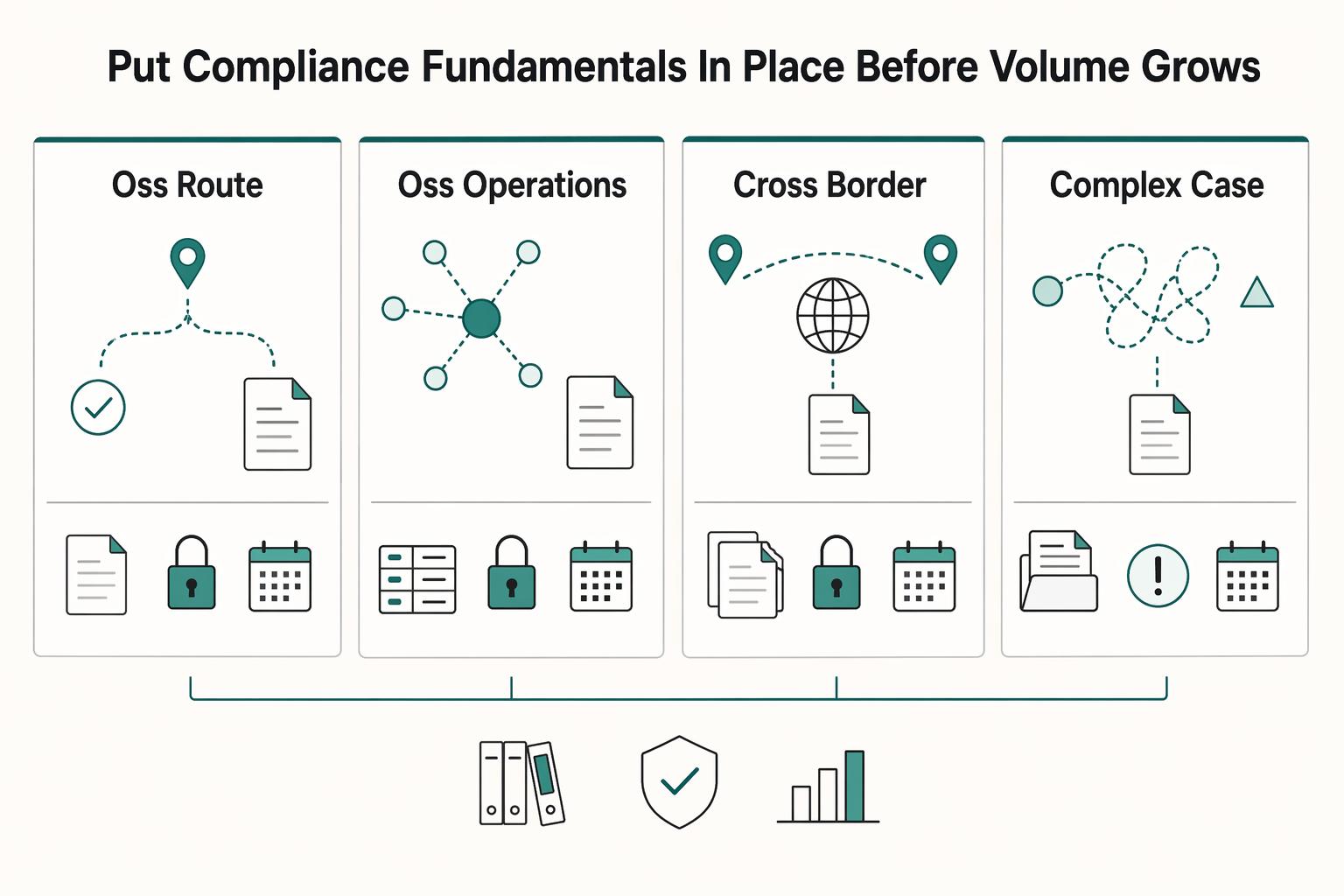
Put compliance fundamentals in place before volume grows#
Before volume grows, lock the VAT basics: clear invoicing rails and a documented EU VAT path for each relevant client.
| Minimum VAT setup pack | What it must lock before delivery | Verification checkpoint | Failure mode if missing |
|---|---|---|---|
| OSS route decision | Whether OSS is the right route and your Member State of identification | Confirm OSS registration in one Member State of identification | Unclear cross-border VAT administration path |
| OSS operations checklist | How VAT is declared and paid in OSS, plus record-keeping and audit readiness | Confirm declaration, payment, record-keeping, and audit steps are defined | Filing and record gaps as volume grows |
| Cross-border SME scheme file (if applicable) | Scheme-condition check, including Union turnover in the current and previous calendar year within EUR 100,000 | Confirm one prior notification filed in the Member State of establishment (MSEST) | Delays or ineligible use of the SME route |
| CBR request plan (for complex transactions) | Whether advance VAT treatment clarification is needed | Confirm the request is filed where you are VAT-registered and that the country participates in CBR | Cross-border VAT treatment uncertainty remains |
Assign ownership for each VAT document group, even if you work alone. Ownership means you know where the latest version lives, who can approve edits, and when each file was last reviewed.
For EU VAT posture, choose the route that fits your activity and jurisdiction. OSS can allow registration in one Member State of identification, but declaration, payment, record-keeping, and audit responsibilities still apply. MOSS was put in place on 1 January 2015 and expanded into OSS from 1 July 2021. Previous distance-sales thresholds were replaced by an EU-wide EUR 10,000 threshold.
If you are considering the cross-border SME scheme, confirm the scheme conditions first. Then verify whether your Union turnover in the current and previous calendar year stays within EUR 100,000, and file one prior notification in your Member State of establishment. After receipt, the registration process should not take longer than 35 working days. For complex cross-border transactions, a VAT Cross-border Ruling may be available in participating countries only. Requests are submitted where you are VAT-registered and under that country's national ruling conditions.
Country variation is the key risk. If you cannot clearly state your VAT route and show a complete VAT setup pack for a new EU client, pause scaling until those gaps are closed.
Design payment operations that stay audit-ready#
Use one traceable flow from invoice to payout, or reconciliation becomes a recurring drag.
Keep invoice and payout states explicit, then map each paid invoice to a payout record and provider reference. One practical baseline is the five invoice states (draft, open, paid, uncollectible, void) and payout states such as processing, posted, failed, returned, or canceled. If payment and payout records do not align, investigate promptly.
Where supported, Gruv Virtual Accounts and Payouts can make the flow easier to explain because virtual accounts use unique identifiers, and payout handling can include policy gates and audit trails. The operating test is simple: can you trace one payout end to end without manual patching? On Stripe rails, each funds movement creates a BalanceTransaction, and filtering by payout ID helps you verify what funded that payout.
Build failure handling into normal operations:
- Reject stale FX quotes before execution. Expiry behavior differs by provider, and some rates are indicative until execution.
- Investigate unmatched deposits using standard reconciliation buckets: deposits in transit, outstanding checks, and bank errors or corrections.
- Use idempotent payout creation and retry paths so repeated requests do not create repeated side effects, then still verify downstream settlement.
A clean monthly close is easier when you follow the same order each time. First lock the statement period. Next match paid invoices to payout records. Then resolve exceptions and document the resolution path. Finally, export one archive package for the same period so future checks do not depend on memory.
Run a monthly reconciliation cycle, often aligned to a 30-day statement period. Compare bank statement cash balance against general ledger cash. Confirm transaction states, provider references, and exports align for the same period. Treat reconciliation as an irregularity detector, not just a reporting task. If totals only match after manual edits, fix the root cause before scaling.
Install monthly controls that keep autonomy durable#
Once workload grows, a monthly control review helps you catch drift before it turns into process debt.
| Area | What to track | Note |
|---|---|---|
| Client concentration | Top-client revenue share against your internal limit | If concentration is rising, set one concrete sales target |
| Overdue receivables | Aging and count items past agreed terms | If receivables are aging, tighten follow-up timing and escalation language |
| Scope creep incidents | Out-of-scope requests that bypassed pricing or change approval | If scope creep is rising, tighten change-order triggers and proposal wording |
| Admin time share | Non-billable operations time compared to delivery time | One 2026 freelance guide claims admin and operational work can consume 40-60% of working hours, which is a useful warning signal to monitor |
Run the review on one fixed date each month, and treat a missed review as a control failure. Review the same four areas in the same order each cycle, then record notes and corrective actions so changes are visible over time.
Close each review with one decision for the next month, not a broad wish list. If concentration is rising, set one concrete sales target. If receivables are aging, tighten follow-up timing and escalation language. If scope creep is rising, tighten change-order triggers and proposal wording.
Keep a separate red-flag log by lead source. If inbound spikes after a single-channel push or interview mention, tag those leads and monitor late payment patterns, revision pressure, and discount requests by channel.
Keep a compliance calendar with real dates for tax artifacts, jurisdiction checks, and GDPR policy reviews. For U.S. exposure, track worker-classification policy updates. A Wage and Hour Division proposed rule was published on 02/27/2026, with a 44-day comment period ending 04/28/2026. Treat it as a proposal, not final law.
For policy tracking, verify source status before acting: the FederalRegister.gov XML rendition is informational and not legal notice. Apply the same caution to automation claims, since reviews note many automated tools still require ongoing human oversight.
If the same control fails for two consecutive monthly cycles, slow growth and clear process debt before you take on new workload.
Spot fake autonomy before it becomes expensive#
Fake autonomy starts when revenue or visibility rises while your real control over schedule, scope, and payment quality gets weaker. Treat that pattern as a risk signal, not proof that growth is healthy.
- Warning sign one: high billed revenue with constant availability pressure. If you are billing more but still responding outside agreed boundaries to protect the account, availability is driving the result.
- Warning sign two: autopilot claims without operational controls. Hands-off messaging can sound persuasive, but a 2025 simulated AI-agent test showed a basic task failure without supervision. Use automation with human oversight.
- Warning sign three: reach rising while operations slip. If your visibility grows while overdue invoices or documentation quality worsens, your personal brand is outpacing your control discipline.
A common pattern is easy to miss in real time. Marketing activity rises, new leads come in, and accepted work grows. At the same time, delivery windows blur, approvals arrive late, and collections take longer. That is not healthy growth. It is a control gap hidden by top-line momentum.
A useful comparison is the 2025 reporting on Uber drivers and false autonomy: promised control did not always materialize, and platform rules shaped pay, assignments, evaluation, and timing. That finding is not universal for all freelancers or platforms, but it is a practical stress test for your own model.
Recovery should be decisive: cut low-fit clients, tighten acceptance criteria, and re-baseline compliance and cash controls before the next growth push. If a lead asks for unusual upfront payment patterns such as a security deposit, treat it as a potential scam signal and walk away.
Execute a focused first 90 days#
Prioritize control over speed in your first 90 days. Use this as a disciplined starter plan, not a proven formula. The grounded examples support the value of control, but they do not prove any single 30/60/90 structure.
| Phase | Focus | Actions |
|---|---|---|
| Days 1-30 | Set the commercial baseline | Define your niche promise, set a pricing floor, finalize your contract and invoicing baseline, and align public profiles with what you actually sell |
| Days 31-60 | Standardize delivery and proof | Document delivery steps, track payments weekly, and publish proof assets tied to real client problems so your positioning is supported by visible execution |
| Days 61-90 | Run one full control cycle and lock decisions | Complete a monthly review, fix repeated failures, and write clear rules for client acceptance and renewals |
One freelancer account describes nearly 10 years since starting, with six years full time, and reports control over schedule and work style while making a comfortable living. Another account, published on Nov 26, 2025, describes spending six months chasing online income before progress. Use both as directional anecdotes, not universal benchmarks; the takeaway is to sequence your setup carefully and avoid shortcut thinking.
Keep a weekly rhythm inside each phase. In month one, review message and scope quality at the end of each week. In month two, review delivery consistency and invoice follow-up in the same weekly slot. In month three, review the control metrics you will keep using after day 90. Repetition is what turns setup into reliable practice.
Use one combined checkpoint at day 90: aim for control, predictability, and recovery speed to improve together. If revenue rises while boundaries or collections slip, pause intake and fix the weak point first.
Conclusion#
The point is simple: Freelance Autonomy lasts when your controls are stronger than your appetite for more work. Treat Autonomy Premium as something you verify, not a slogan.
Freelancing is a mainstream path, not a niche one. An estimated 64 million Americans, about 38% of the workforce, did freelance work in the prior year. That was up by 4 million from 2022, with nearly $1.3 trillion in annual earnings contribution. Professionals commonly choose it for flexibility, autonomy, and career control. That scale shows demand, not guaranteed execution quality.
The main failure mode is structural. Without deliberate internal architecture, momentum drops even when effort stays high. Keep one practical weekly checkpoint: assign work types to specific days, protect at least one 90-minute focus block, and close unrelated apps during that block.
From here, keep the sequence intact: set your structure first, then execute and review it regularly. When one control slips, fix it before chasing the next growth target. Independence can pay off, but it stays durable only when your controls protect momentum and consistent execution.
Frequently Asked Questions
What is the autonomy premium in freelancing?
In this article, it is a working lens, not a universal formula. One practical way to assess it is whether control over client selection, pricing and scope, and workload is getting stronger or weaker over time. If one area keeps slipping, treat the premium as unstable until that area is corrected.
Why do high earners choose freelancing over stable employment?
A common reason some freelancers cite is getting paid for outcomes and expertise, not just available hours. One freelancer example describes similar work shifting from two full days to about three hours over time, which shows why hourly billing can cap experienced professionals. Public rate ranges exist, but they are market snapshots, not guarantees. The reliable choice depends on whether your controls can carry risk through weak demand periods.
Is freelancing less stable or just differently managed?
It is often differently managed. Without clear controls, freedom can turn into chaos. A useful way to judge stability is to track earnings, happiness, productivity, pipeline, and work-life balance together. Looking at only one metric can hide a slow breakdown in the rest.
What must be in place to earn more without overworking?
Use project-based pricing so value is tied to outcomes rather than time alone. Build clear scope boundaries and operating systems so freedom does not become chaos. If proposals are accepted instantly every time with no pushback, treat that as a possible underpricing signal.
Which risks destroy freelance autonomy fastest?
A common breakdown pattern is weak systems and controls: freedom starts feeling chaotic as volume rises. If that pattern appears, tighten controls before adding more work. Growth without those fixes can increase stress faster than it increases durable income.
How do GDPR and cross-border rules affect independent professionals?
If you serve EU clients, treat this as a multi-law area rather than one simple checkbox. The AI Act is Regulation (EU) 2024/1689, and official guidance notes interplay with other Union law. For GDPR and cross-border specifics, confirm what applies with qualified local advice.
What should I set up in my first 90 days to avoid expensive mistakes?
Sequence the basics: define your niche promise and pricing approach, then put simple delivery systems in place so freedom does not become chaos. Run a monthly review across earnings, happiness, productivity, pipeline, and work-life balance. Treat day 90 as a decision point, not a finish line.
Try a related tool
Researched and edited by the Gruv editorial team. Gruv builds cross-border billing, payouts, and finance-operations software for global businesses.
Sources
- ca1.uscourts.gov/sites/ca1/files/citations/International%20Na...trusted
- mtc.ca.gov/sites/default/files/Horizon_FutureofJobs_May...trusted
- sme-vat-rules.ec.europa.eu/sme-scheme/cross-border-sme-scheme_entrusted
- taxation-customs.ec.europa.eu/archives/taxable-persons/vat-cross-border-ru...trusted
- vat-one-stop-shop.ec.europa.eu/one-stop-shop_entrusted
Educational content only. Not legal, tax, or financial advice.
Related Posts

GDPR Compliance Checklist for Freelancers Working With EU Clients
Start by separating the decisions you are actually making. For a workable **GDPR setup**, run three distinct tracks and record each one in writing before the first invoice goes out: VAT treatment, GDPR scope and role, and daily privacy operations.

Digital Nomad Health Insurance Comparison for Long-Stay Moves
Use focused time now to avoid expensive mistakes later. Start with a practical `digital nomad health insurance comparison`, then map your route in [Gruv's visa planner](/tools/visa-for-digital-nomads) so we anchor policy checks to your real plan before pricing pages pull you off course.

UAE Golden Visa for Freelancers and the Green Visa Decision Guide
Choose the route your documents can support now, not the visa label with the most search volume. If you searched for `uae golden visa for freelancers`, use that as a starting query, then choose between Golden Residency and the Green route based on the evidence you can actually file.