
Quick Answer
Start with a 4-week trial, then commit only after legal-stay proof and day-to-day work stability are both verified. For an athens digital nomad guide that avoids guesswork, separate immigration files from VAT items, keep one evidence folder with identity, income, booking, and host records, and test listing blocks in daytime and at night before signing. If names or dates do not match across documents, or week-4 costs are still unstable, keep housing flexible and delay longer terms.
Athens is a strong base if you plan it like a relocation project#
Athens can work well for remote professionals, but only when three things line up at the same time: the city fits your day-to-day life, your stay basis is workable, and your budget has enough room for the way you actually live. The useful mindset here is relocation, not an extended vacation. That shift changes what you optimize for in the first month and how much certainty you need before you pay for the next one.
Public content is useful for building a shortlist, but it should not drive your legal or money decisions. Some reporting describes Athens as gaining traction with digital nomads and ties that appeal to climate, quality of life, and cost of living. One first-person account says that staying in one base for at least two months supported productivity. That is enough to justify a closer look. It is not enough to skip verification or lock yourself into terms you cannot easily unwind.
Before you book longer housing, split the move into three stages and treat each stage as a separate decision:
- Trial month (about 4 weeks): optimize for flexibility, low fixed costs, and real-world testing.
- Medium stay (about 2 to 3 months): start only when your stay basis is clear and your documents are consistent across names, dates, and addresses.
- Long stay: keep visa planning on its own track and confirm current requirements before any non-refundable deposit.
Set up one evidence folder on day one and keep your identity records, income proof, booking records, and landlord or host documents there. That sounds simple, but it prevents the most common form of self-inflicted chaos: moving fast on housing while your paperwork is still messy. The tradeoff is speed versus certainty. Fast booking can secure a place you like. It can also trap you in terms that do not match the kind of stay you are actually allowed to make.
The biggest red flag is mixing lifestyle anecdotes with immigration requirements. Use public articles to generate options, then confirm official requirements before medium or long commitments. Once you separate those tracks, the next question becomes practical: can the city support your real workweek once you land?
Decide whether Athens matches your work and life constraints#
The right test is not whether Athens sounds appealing. It is whether an ordinary workweek feels dependable after you have tried it on the ground. A neighborhood can look perfect in photos and still fail once you factor in live call quality, evening returns, and the way a specific unit sounds with the windows open.
Use public guides to build a shortlist, but do not treat them as proof of block-level commute, noise, or walkability around Ermou Street or Psirri/Psyri. If deep work matters, the exact unit and the exact street usually matter more than a neighborhood's general reputation. In practice, that means being willing to walk away from a popular area if the listing itself does not support focused work.
Before you commit to longer housing, run a simple pass or fail check against your real week:
- Test your actual route at work start time and again later in the evening.
- Request a unit-specific video with windows open and closed.
- Track commute time, noise, and call quality in one notes sheet.
- Keep legal-stay checks separate, and confirm current visa requirements before signing hard-to-reverse terms.
Do not let a low headline rent talk you out of this process. Cheap can become expensive very quickly if the place fails on calls, forces you into daily workarounds, or pushes you into a coworking setup you did not budget for. If your workload has low tolerance for disruption, add backup planning to the same decision and lean toward flexibility until the results are consistently stable. If a condition keeps failing, treat it as a signal, not bad luck.
Once you know what your week has to clear, neighborhood choice gets much simpler. You are not chasing the "best" area. You are narrowing down blocks that can support the way you actually live and work.
Choose the right neighborhood with clear tradeoffs#
Neighborhood choice in Athens is a tradeoff call, not a vibe call, and the district name tells you less than the exact block. Only Plaka has partial support here. Everything else should be treated as unverified until you test it yourself in daylight and after dark.
Use the table below as a starting hypothesis, not a verdict.
| Neighborhood | Noise | Nightlife | Coworking access | Tourist density | Walking convenience |
|---|---|---|---|---|---|
| Psirri | Verify locally | Verify locally | Verify locally | Verify locally | Verify locally |
| Keramikos/Gazi | Verify locally | Verify locally | Verify locally | Verify locally | Verify locally |
| Plaka | Reported risk of crowd-related noise | Verify locally | Verify locally | Reported as touristy/crowded | Reported as walkable and central, under the Acropolis |
| Thiseio | Verify locally | Verify locally | Verify locally | Verify locally | Verify locally |
Plaka is a good example of why tradeoffs matter. Centrality and walkability may be real advantages, but tourist density and crowd-related noise can come with them. That does not make the area good or bad. It means the upside and the downside arrive together, and the balance only makes sense in relation to your own workload and routine.
For the other areas, avoid confident assumptions. If you are building a first-pass shortlist, compare Plaka or Thiseio when landmark proximity matters most. Test Psirri or Keramikos/Gazi if you want to explore a more social setup or possible coworking access. Just keep the shortlist provisional until the block, the route, and the unit all clear your requirements.
The red flags repeat from area to area. Watch for listing photos that hide street context, videos that skip street-level noise, and vague "good location" claims with no exact walking routes. When the real issue is outside the front door, polished interior shots tell you very little.
Use this checkpoint before any longer stay: test the exact block in daytime and at night, keep pass or fail notes for each listing, and reject anything that fails your non-negotiables in either time window. After that, the next gate is not location at all. It is whether your paperwork can support the kind of stay you are trying to book.
Build your visa and paperwork stack before booking long stays#
Paperwork problems are much easier to prevent than to unwind, so build the file set before you book long stays. The goal is straightforward: verify the immigration path, keep the document set internally consistent, and avoid mixing immigration requirements with unrelated tax rules.
Start with the official side. Confirm current eligibility and required evidence through official Greek immigration channels before you pay deposits. Keep VAT and immigration on separate tracks unless an authority explicitly links them. That separation matters because the documents, deadlines, and decision criteria are not the same. When people combine them into one messy checklist, they usually end up solving the wrong problem first.
The cleanest order looks like this:
- Assign one owner for immigration files and one for tax files.
- Collect identity and civil records first, then income evidence, then accommodation evidence.
- Add appointment-dependent items only after names, passport number, and address format match across documents.
- Store ready-to-upload files in one folder with clear versions, and put issue and expiry dates in filenames.
- Run one final consistency check before any non-refundable booking.
That sequence is boring, but it saves time. In practice, most late stress comes from files that look complete until you compare them line by line. A passport number is right in one place and wrong in another. A name format shifts. An address appears in two versions. A document exists, but not in the format you actually need. Those are small errors until a deadline turns them into expensive ones.
Common failure modes include:
- Incomplete files that look complete at first pass.
- Name or format mismatches across documents.
- Late-stage missing evidence discovered only when booking deadlines are close.
- Treating VAT thresholds as visa thresholds. Items like OSS changes from 1 July 2021, the EUR 10,000 B2C threshold, and the EUR 100,000 SME cap are tax rules, not visa criteria.
Rules differ for EU and non-EU nationals, so do not borrow someone else's checklist without checking the jurisdiction behind it. A friend can be right about their own situation and completely wrong for yours. If key immigration evidence is still unverified, keep housing flexible and delay long commitments. That is exactly what the trial month is for. It buys you time without forcing the wrong kind of commitment.
If you want more context while you organize the file set, see Greece Digital Nomad Visa: Your Gateway to the Greek Isles, our digital nomad visa index for 50+ countries, and Tax Incentives for Digital Nomads in Greece. Once the paperwork is coherent, you can lock the physical setup in the right order instead of guessing your way into a longer stay.
Lock housing and workspace in the right order#
The safest sequence is simple: shortlist neighborhoods first, take a flexible short stay next, and move to a longer lease only after your work setup feels reliable in Athens. That order matters more than the platform you use because it keeps an early guess from turning into a long obligation.
Choose housing channels by flexibility and fit, not by listing polish. Airbnb, hotels, and coliving options such as Selina can all work at the start if they let you test real conditions before you lock in.
| Option | Best early use | Main early risk | Verify before committing |
|---|---|---|---|
| Airbnb | Fast, flexible landing | Listing quality may not match lived experience | Workspace comfort, noise, and connection stability |
| Hotel | Simple arrival setup | Can be hard to sustain for focused work | Desk practicality, call privacy, and routine fit |
| Coliving (for example Selina) | Built-in community and short commitments | Social setup may not match deep-work needs | Room quietness and workspace fit |
The common mistake is treating early housing as the final answer. Early housing is a test tool. Its job is to give you a workable landing while you confirm block conditions, routine fit, and how the unit performs during actual work hours. If it passes, great. If it does not, you learned something before taking on a harder-to-reverse commitment.
Keep a simple work-ready checklist and validate it in person. You need actual work-hour internet performance, a usable desk and chair setup, a backup connection plan, and a day and night noise read. Nice decor does not make up for a bad chair, weak connection, or a room that fails on calls. Before you sign anything longer, sit in the space and imagine an ordinary Tuesday, not a photogenic arrival day.
Apply the same logic to coworking. Impact Hub Athens and alternatives are only useful if the commute, call conditions, meeting setup, and contract flexibility fit your routine. A great space that takes too long to reach, does not work for meetings, or locks you into the wrong term is still the wrong space. Compare options against your own work pattern, then confirm terms directly before making longer commitments.
The main operational detail here is order. Do not solve for community before you solve for output. Do not solve for aesthetics before you solve for reliability. If you stage housing and workspace that way, the first month stops feeling like chaos and starts acting like a structured test. That is what the next section is for.
Execute your first 30 days with checkpoints#
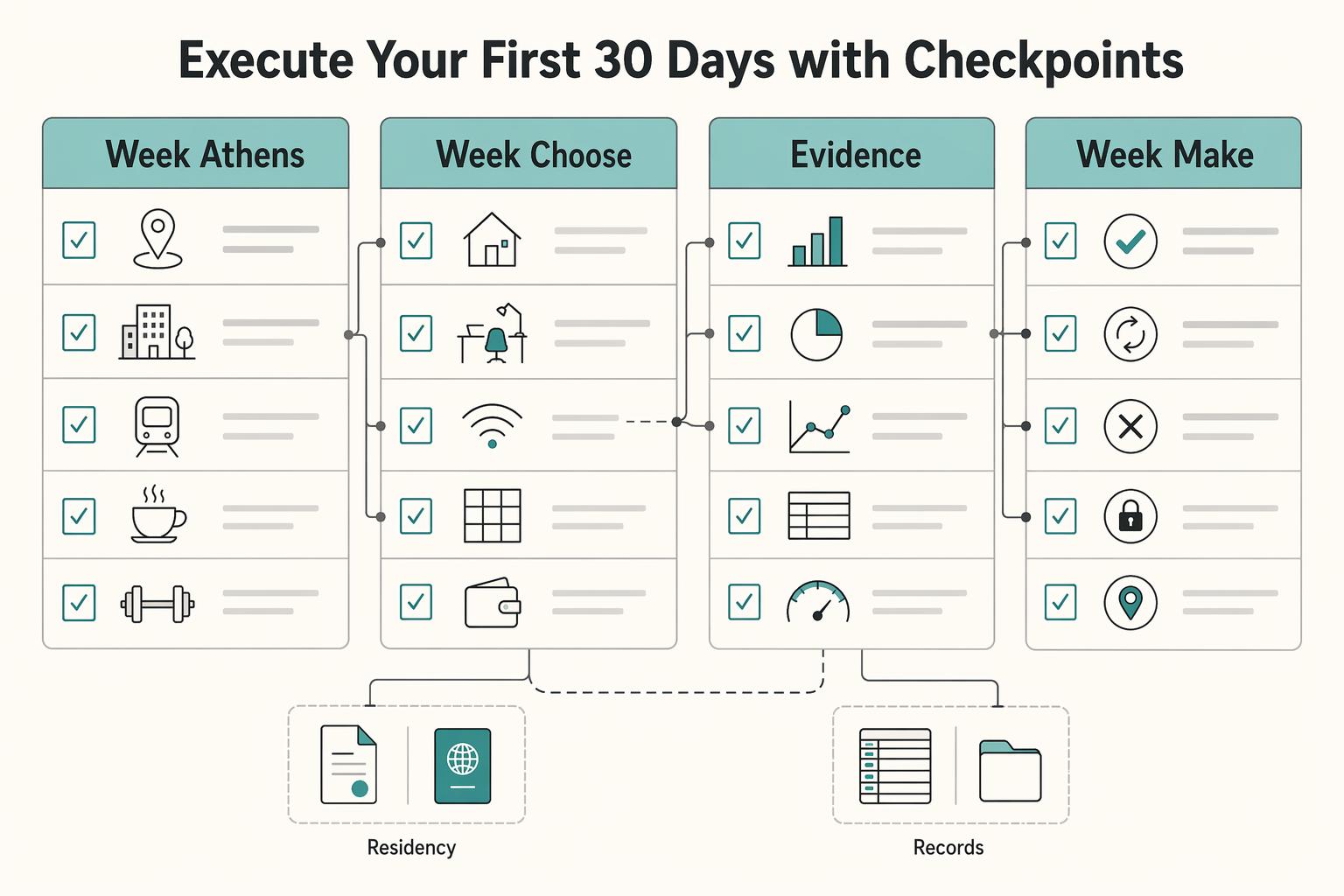
Your first 30 days are not just about settling in. They tell you whether the city works for your routine or only feels good because everything is new. If you do not set checkpoints, it is easy to confuse movement with progress.
Run the month as a trial with weekly reviews, then make a deliberate choice: commit, retest, or move. This is not a universal city scorecard. It is a way to keep your decision honest by using observed data instead of mood.
- Week 1 in Athens: test whether your housing setup, daily transport routine, and backup workspace or internet support normal workdays without constant workarounds.
- Week 2: choose your neighborhood by output, not vibe. Compare Psirri/Psyri with alternatives like Keramikos/Gazi using the same criteria each day.
- Week 3: close remaining admin tasks and secure records. Keep one organized folder for visa, lease, and tax documents in Greece.
- Week 4: make the call using objective signals from your month so far: stay and commit, stay and retest, or relocate.
A common failure mode is mistaking busy logistics for real stability. Running errands, collecting keys, and learning transit can make a shaky setup feel more settled than it is. Put a day-30 review on the calendar now, not later, and decide from evidence instead of momentum.
That review also needs numbers. Once the first month gives you lived data, the next job is to turn scattered spending into a budget range you can actually trust.
Build a cost baseline with confidence bands, not wishful averages#
Budget planning usually goes wrong when people force a single monthly number too early. A better approach is to build a baseline with confidence bands and let the first month show you what your real range looks like. That keeps you honest about uncertainty instead of hiding it under one tidy but fragile total.
This section's available material is not Athens budget data. It includes a healthcare decision-coaching paper, a cookie notice, a history podcast page, and an opinion post. None of that gives you a usable city budget, so every line item should start as to be validated until you have quotes, receipts, or transactions of your own.
What matters in month one is not perfect forecasting. It is learning which costs are fixed, which drift, and which change with your location and work setup.
| Budget bucket | What to track weekly | Validation evidence | Initial status |
|---|---|---|---|
| Housing (Greece) | Rent, deposits, utilities, cleaning, building fees | Signed agreement, payment confirmations, utility bills | To be validated |
| Workspace | Coworking passes, day fees, meeting rooms, cafe overflow spend | Invoices, receipts, membership terms | To be validated |
| Transport | Metro, bus, or taxi mix, airport runs, late-night alternatives | Card or app history, ride receipts | To be validated |
| Food | Grocery versus eating out split | Grocery receipts, card statements | To be validated |
| Setup costs | SIM, adapter, or furniture buys, admin and onboarding costs | One-time purchase receipts | To be validated |
Use those buckets to build a range you can trust. A range forces you to deal with uncertainty instead of pretending it is gone. Do not commit to longer housing until first-month spend sits inside your target band based on transactions, not estimates. If housing or workspace is still unstable by week 4, keep the terms flexible and keep testing. A baseline is only useful when it reflects repeatable conditions.
Before you decide, run one sensitivity check: Plaka with a coworking-heavy routine versus Keramikos or Gazi with a home-office-first routine plus occasional coworking. Do not force exact totals. The point is to see which setup moves your biggest cost drivers and which costs stay stable no matter what.
A common failure mode is treating one quiet week as the baseline. Instead, do a mid-month drift check and a day-28 reconciliation against bank and receipt records. If the result is still volatile, the baseline is not ready. Once the budget range is grounded, the last filter is straightforward: make sure the setup also clears basic safety and reliability tests.
Handle safety and reliability risks with practical safeguards#
A place that looks good on arrival can still fail in normal use. If the return route feels wrong, the building access is weak, or the backup internet is missing, the setup is not solid enough yet. Safety and reliability checks need the same pass or fail discipline as budget and paperwork.
Use a checklist for every listing, and reject any option that fails safety or work-readiness basics, even if the location is appealing. Broad safety guidance is useful for context, but it is not definitive. Published material can leave out the details that matter most to you, so confirm your exact routine in Athens before you commit. Citywide statements tell you very little about the building you actually enter or the route you actually take home.
Start with the parts of the day that are hardest to improvise:
- Late-night route test: walk your real return path at your real return hour, including areas near Ermou Street or Psirri when relevant.
- Building entry controls: test front-door access, floor access, and guest access in practice.
- Night transport fallback: test at least two return options and log observed waits.
- Device security in work spots: check table spacing, sightlines, and whether your bag and screen stay in view.
Before longer commitments, add a few continuity controls as well: one backup internet path, one tested secondary workspace, and one emergency contact sheet saved on your phone and offline. That sheet should include local emergency numbers, your building address in copy-paste format, and two personal contacts who know your schedule. Keep it simple enough that you will actually use it.
The common failure mode is making a multi-month decision after one daytime viewing. Do not confuse a pleasant afternoon with a stable setup. Use two checkpoints, one in week 1 and another around day 21, then decide. By that point, most of the remaining questions are no longer about impressions. They are about what the evidence can and cannot support.
Make the move decision with a clear go or no-go test#
When you get to the end of the process, strip the decision back to the essentials. Move forward only when your legal stay basis is clear and your housing and first-month budget are stable. If either piece is still uncertain, keep the plan in trial mode in Greece instead of forcing a long commitment.
For legal clarity, keep only what the material actually supports. One source says Greece introduced a digital nomad visa in 2021. Another says non-EU, non-EEA, or Swiss nationals planning to stay longer than 90 days within any 180-day period need a Greek residence permit, while EU/EEA citizens register after 90 days and receive a Registration Certificate.
Treat fees, income thresholds, and processing timelines as unknown here. If you cannot confirm current official requirements for your nationality and stay length, the outcome is no-go. That is not pessimism. It is just good sequencing.
Use this final checkpoint:
- Go: legal basis is verified, and your housing setup and first-month budget are repeatable.
- No-go: any piece is incomplete, contradictory, or unverified.
- If no-go: extend trial mode, keep commitments flexible, and close evidence gaps before you switch out of it.
That test is intentionally strict. A move like this works best when the paperwork, housing, and budget all point in the same direction. If you need program-level confirmation for your case, Talk to Gruv.
Frequently Asked Questions
Is Athens a good city for digital nomads planning a long stay?
Treat Athens as a local due-diligence decision and verify legal and housing details before committing.
Which Athens neighborhoods are best for remote work and day-to-day life?
Supported neighborhood guidance for Athens is not established. Use local, current information and your own trial checks before signing a lease.
What should a digital nomad apartment in Athens include before I book?
This guide does not define apartment standards for Athens. Confirm unit-specific terms directly (internet reliability, noise conditions, access rules, and contract details) before booking.
How safe is Athens for digital nomads, and how should I evaluate areas?
Evaluate safety using current local authority guidance and your own route- and time-specific checks.
How much does it cost to live in Athens as a digital nomad?
Supported Athens cost benchmarks are not established. Build a budget from current local quotes and your own tracked spending before committing to long-term housing.
What paperwork should I prepare before moving to Greece?
Prepare identity, income, accommodation, and appointment records according to the relevant immigration process, and keep file names consistent. Keep immigration paperwork separate from EU VAT administration so requirements do not get mixed. If you bill cross-border B2C clients, check whether OSS, VAT Cross-border Rulings, or the cross-border SME scheme applies.
How should EU and non-EU readers confirm visa and stay rules safely?
Use official EU pages on the europa.eu domain and the competent national immigration authority pages. Keep a dated evidence folder with form versions and submission confirmations. For VAT-specific work, keep these checkpoints visible: the EUR 100,000 Union turnover condition, the EUR 10,000 cross-border B2C e-commerce threshold context, and the 35 working day registration-process target for the cross-border SME process.
Try a related tool
Researched and edited by the Gruv editorial team. Gruv builds cross-border billing, payouts, and finance-operations software for global businesses.
Sources
Educational content only. Not legal, tax, or financial advice.
Related Posts
Greece Digital Nomad Visa Steps for a Safer 2026 Move
Applying for the Greece Digital Nomad Visa is much easier when you solve the right problems in the right order. Start with fit. Then build one evidence pack you can reuse. Then file. Then handle the post-arrival steps. That sequence sounds simple, but it cuts a lot of avoidable rework because it keeps you from mixing immigration, documents, housing, taxes, and family planning into one messy project.

The 2026 Global Digital Nomad Visa Index for 50+ Countries
Start with legal fit, not lifestyle filters. The practical order is simple: choose a route you can actually document, then decide where you want to live. That single change cuts a lot of wasted comparison work and stops you from falling in love with places that were never a real filing option.
Tax Incentives for Digital Nomads in Greece
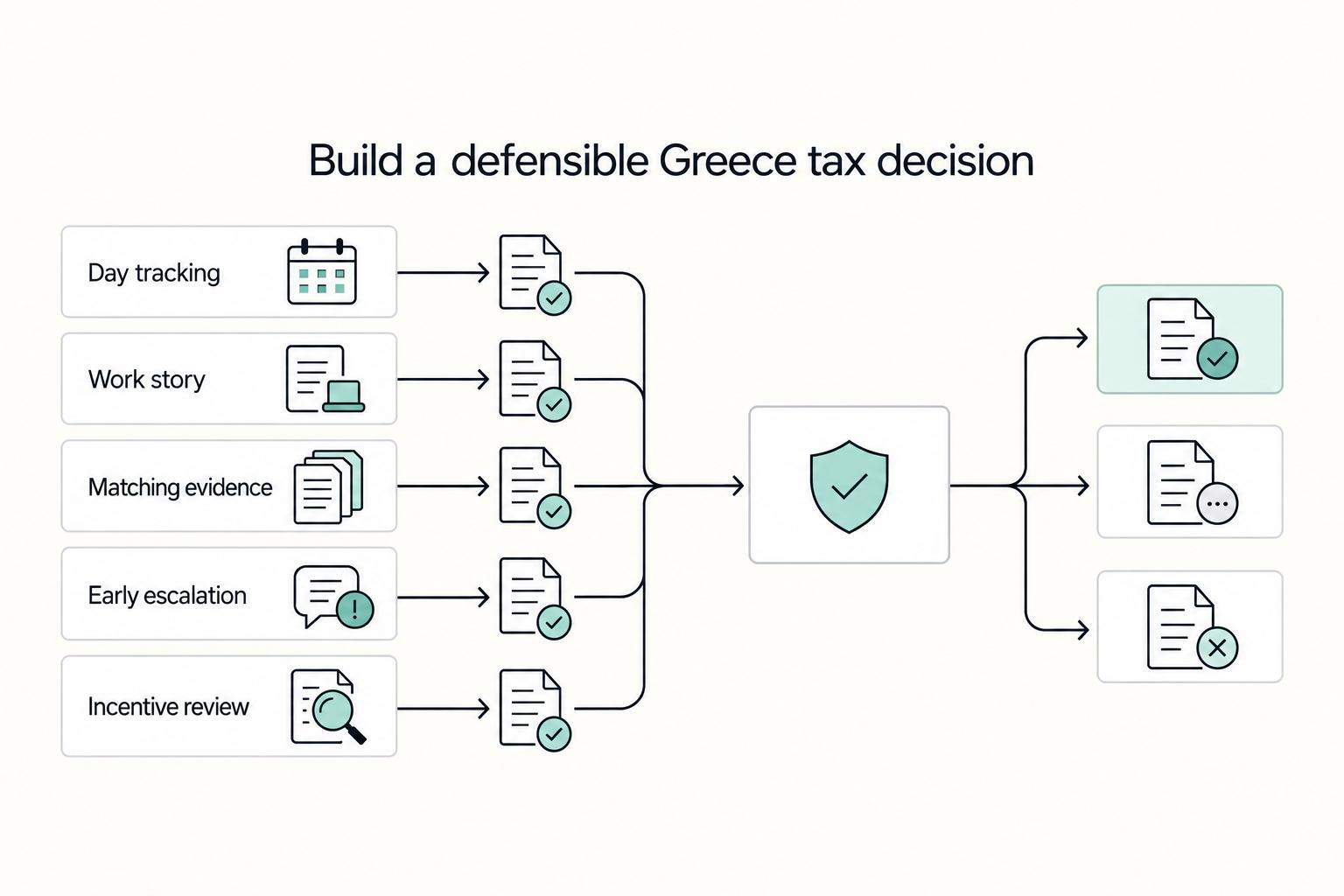
If you searched **greece tax incentives nomads**, take that search as a warning, not a plan. Your real job is to choose a tax position you can explain with evidence, then run your operations so that position stays consistent. The goal is not to find one attractive rule. It is to avoid a year-end scramble where your days, contracts, and filings all point in different directions.