
Quick Answer
Build your fintech pitch deck as a decision document, not a design showcase: start from a 10-slide baseline, attach one proof checkpoint to each major claim, and mark what is active versus still in progress. Match depth to meeting context by keeping first conversations concise and adding pages only when diligence questions require them. Show compliance scope with concrete controls such as KYC, KYB, AML, and VAT validation. Before outreach, use a one-page yes/no gate to catch unclear claims early.
Start Here With the Investor Test#
A fintech pitch deck should help an investor make a fast, defensible decision under uncertainty, not admire slide design. Investors screen quickly, so if your core claim is unclear in the opening, you can lose confidence before your best evidence appears.
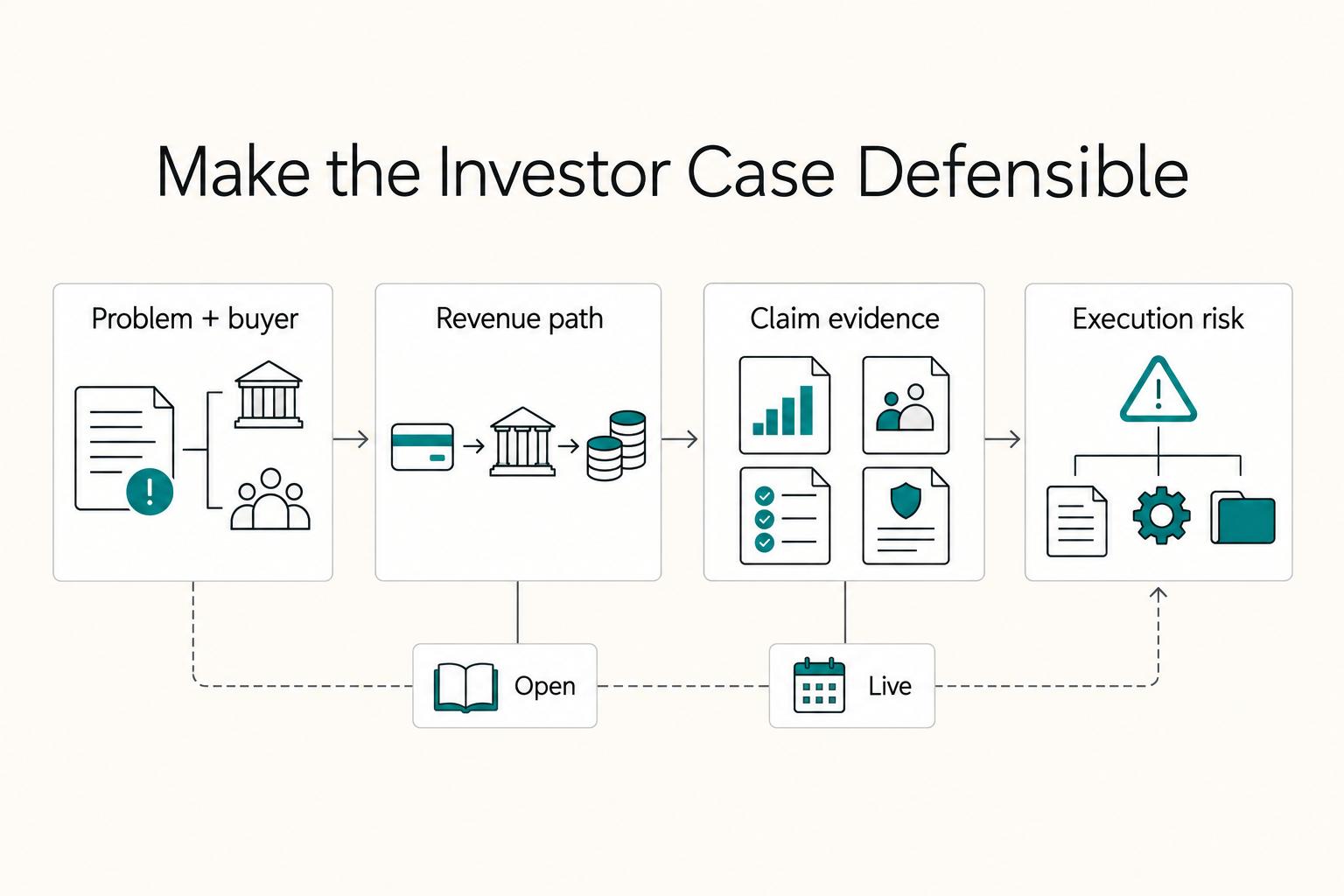
Your main promise is simple: you can grow revenue while keeping compliance and operations under control. Pair each major claim with proof so the narrative holds up in live questioning.
Use this investor test before you spend more time on visuals:
- Can a first-time reader explain the problem, buyer, and revenue path after one pass?
- Does each major claim include support such as a defined metric, customer evidence, or a control summary?
- Is the deck concise enough to scan, usually in a 10 to 20 slide range depending on meeting depth, without hiding key risk?
- Do you address fintech constraints directly, especially regulation and competition, instead of relying on broad promises?
Copying gallery aesthetics can be a trap. Visual polish can improve readability, but it cannot replace evidence.
The balance is practical. Too much legal detail too early can bury the business case, while skipping compliance can create concern. Keep scope explicit by showing what is live now, what is open, and what closes next.
Use one fast internal drill before you circulate the deck. Give it to someone outside the core drafting group and ask them to explain your buyer, revenue path, and biggest execution risk in plain words. If they cannot do that without help, the problem is not design quality. It is decision clarity.
Define the Terms Investors Use Before You Build Slides#
Before you design slides, lock the language your team will use on every page. Investor materials need to communicate fast, and inconsistent wording slows comprehension.
Use these working lines as team shorthand, not universal definitions:
- Problem statement: the buyer pain you are addressing.
- Solution statement: what your product does about that pain.
- Market opportunity: the first segment you can credibly target now.
- Business model: how revenue is expected to come in over time.
Keep problem and solution separate. If a teammate cannot restate both in one sentence after one read, tighten the wording before you add more content.
For market opportunity, show why your first segment is reachable now. For business model, connect revenue logic to margin and risk questions so assumptions stay visible.
Because this is fintech, keep growth claims and compliance status aligned in the same draft cycle.
A practical way to avoid drift is to keep a one-page term sheet next to the deck draft. When someone edits a slide, they should check whether the edit changed one of the four term lines. If it did, either update the shared wording or revert the slide wording. That small discipline helps prevent late-stage contradictions.
Use these term lines as a quick quality gate during rehearsal. Ask one reviewer to challenge only the problem statement and another reviewer to challenge only the business model. If both reviewers interpret those lines differently than your team does, tighten the wording before you expand section depth.
Related: A Guide to Transaction Monitoring for High-Risk Payments.
Build the 10-Slide Minimum Credible Deck#
Use a tight 10-slide baseline so investors can evaluate the story quickly, then expand only when extra evidence is necessary. The goal is faster evaluation with fewer gaps.
| No. | Slide | Focus |
|---|---|---|
| 1 | Problem | urgent buyer pain and current cost |
| 2 | Solution | how you remove that pain better than alternatives |
| 3 | Market opportunity | the first segment you can realistically win |
| 4 | Product | what is live now versus planned next |
| 5 | Business model | how revenue enters and expands |
| 6 | Traction | measurable progress with clear metric definitions |
| 7 | Competition | where you win today and where gaps remain |
| 8 | Compliance and risk | key constraints and current controls |
| 9 | Team | who owns the next milestones |
| 10 | Ask | funding request and what it unlocks |
Use that sequence and require one proof checkpoint on each slide.
Keep traction concrete, not implied. Confidence rises when regulation, competition, and profit path appear in one narrative.
If you study strong decks, borrow claim-to-proof pacing, not wording or style. Use one cut rule to protect quality: if a slide cannot support why now, why you, and why this market, remove it or merge it.
Define what a proof checkpoint looks like before you draft slide copy. It can be a metric definition, a short customer artifact, a model tab reference, or a policy summary tied to the claim on that page. Without that anchor, the slide becomes pure assertion.
Use one consistency pass after the first complete draft. Read slides 1 through 10 as a single argument and mark every place where a claim appears before the underlying context. Then reorder or trim. This pass often removes the hidden friction that causes Q and A to stall.
Match Slide Depth to Pre-seed Seed and Series A#
Match slide depth to meeting type and fundraising context. In first meetings, optimize for clarity and the next step. In follow-up diligence, add depth only where investors need more proof.
| Context | Depth guidance | What to emphasize |
|---|---|---|
| First meeting | 10 to 12 slide version is usually easier to evaluate | make the problem, solution path, and team capability easy to understand |
| Follow-up | keep the narrative tight | show traction clearly |
| Diligence | expand toward 15 to 20 slides when each added page resolves a specific risk | add deeper evidence where investors need confidence in how the business scales |
Use that calibration as guidance, not a rigid formula.
If your deck complexity outpaces your evidence, simplify. Proving fewer claims clearly is stronger than presenting a longer story with avoidable contradictions.
Treat deck depth as versioning, not a one-time choice. Keep a concise first-meeting deck and a deeper follow-up deck in parallel, with shared definitions and shared numbers. That keeps your message stable while still matching different review contexts.
Avoid adding pages just because questions feel uncomfortable. Add depth only when it resolves a concrete objection from rehearsal or meetings. If the new page does not reduce ambiguity, it is usually better as backup material.
Show Compliance Without Sounding Defensive#
Your compliance slide should read like an execution brief: what is controlled now, what is open, and when open items close. When the scope is explicit, investors can test readiness faster and you lower the risk of overclaiming.
Use a simple structure: current controls, known gaps, and target dates to close.
Include concrete control labels and pair each with one proof item that can be checked quickly. Examples in Gruv workflows, where enabled, include:
- KYC
- KYB
- AML
- VAT validation
- Payout gating policy
Be explicit about scope. Requirements vary by country and program, so avoid implying one global standard. State where controls are live, what is pending, and what still needs confirmation before meetings.
Do not present unresolved work as complete. If a claim lacks backup evidence, mark it in progress, assign an owner, and set a target date. Then prepare concise backup slides and contingency responses for finance, market, and execution questions.
If reviewers keep pushing on the same compliance point, your slide is often missing one of three things: scope, ownership, or timeline. Add the missing element on the page instead of leaving it for verbal explanation.
Keep the language plain. Replace broad phrases with concrete status statements, such as live now, pilot only, or pending confirmation. Clear wording helps investor confidence more than vague status language.
Prove Operational Control in Money Movement#
Operational control has to be visible on the page. Design quality or automation language does not prove that risk is controlled, and smart-contract framing does not remove regulatory expectations.
Show the process in plain sequence, then show how exceptions are identified, escalated, and closed.
Use at least one failure-mode example. The checkpoint is straightforward: can a reviewer trace who owns the issue, what happens next, and how resolution is recorded?
Public deck galleries can teach storytelling pace, but they do not validate operations. Your records do.
If operational reliability is central to the business model, place operational evidence before growth claims. That order helps reviewers evaluate traceability and exception handling before valuation discussion starts.
A useful test is to walk one case through normal flow and one through exception flow. If the normal path is clear but exception ownership is vague, investors may assume hidden risk. Show who receives the alert, who approves the action, and where closure is documented.
Keep this section tied to real execution, not architecture labels. You do not need to describe every internal component. You need to show that controls hold when operations are busy and that exception handling has clear accountability.
Make Unit Economics and GTM Survive Investor Pushback#
Your unit economics should survive pressure testing, not just look clean in a summary chart. Tie CAC, payback logic, and gross margin assumptions to the same market opportunity segment used in your narrative. Tailor the level of detail to your audience and funding stage.
Use one segment definition across market, GTM, and model assumptions. Keep it practical by naming buyer type, purchase motion, and onboarding effort, then tie each to channel cost, pricing behavior, retention, and service cost.
A simple scenario contrast can make investor questioning more concrete:
| Scenario | Adoption shape | What can break first | What to show |
|---|---|---|---|
| Conservative | Slower conversion and longer cycles | Pipeline coverage and payback pressure | Verifiable pricing and channel-mix evidence that acquisition spend can be recovered without optimistic assumptions |
| Aggressive | Faster top-of-funnel and logo growth | Onboarding capacity, support quality, and control checks under load | Verifiable evidence that operations can absorb volume without margin erosion |
Use one verification checkpoint before sharing: have a reviewer trace one cohort assumption end to end from channel source to margin output. If that chain is unclear, the deck is not ready.
If traction is limited, replace vanity metrics with stronger proof:
- Pipeline quality by stage with explicit entry criteria.
- Pricing proof from signed pilots, renewal terms, or documented procurement feedback.
- Win-loss notes that explain why deals move, stall, or fail.
With economics grounded, competitor positioning can stay factual instead of defensive.
Investor pushback often focuses on linkage across assumptions, not just isolated numbers. Reviewers may ask whether acquisition cost assumptions fit your target buyer, whether pricing aligns with delivery effort, and whether margin logic still holds if cycles slow. Build answers around those linkages so the story stays coherent under pressure.
Keep one assumptions log that separates observed data from estimates. Update it whenever slide metrics change. This helps avoid a common failure mode where slide math improves on paper while model assumptions stay stale.
Position Against Named Competitors Without Hand-Waving#
Positioning builds trust when you compare named alternatives on clear decision criteria and include tradeoffs, including where you lose today. This slide should read like a buyer decision memo, not a logo wall.
Use three criteria for this slide: buyer outcome, control depth, and implementation friction. Keep each row tied to your target segment and business model.
| Comparison row | How to frame Klarna, Revolut, N26, Square, Carta, and your offer | Quick verification check |
|---|---|---|
| Buyer outcome | Name the segment and job first, then compare who solves that job most clearly | One recent customer or pilot note tied to that job |
| Control depth | Describe which controls are visible to customers and internal teams | One current product artifact or policy excerpt |
| Implementation friction | Compare onboarding effort, required integrations, and path to first value | One implementation checklist from a real prospect flow |
| Where we lose today | Name one segment or use case where a competitor is stronger now | One loss note with reason and re-entry condition |
The highest-trust row is often Where we lose today. It can signal disciplined positioning and sharper execution priorities.
Back this section with a short evidence pack to reduce pushback in the meeting:
- A one-page criteria sheet with row definitions.
- Three recent deal notes: win, loss, and no decision.
- A dated assumptions log that separates observed facts from inference.
- A brief change log showing what changed since the last deck and why.
Use gallery sites for layout ideas only, not as proof of segment fit.
Keep comparisons fair by holding every vendor to the same buyer job and the same evaluation lens. If one row compares features and another compares outcomes, the table stops being useful. Consistency makes tradeoffs easier to trust.
If you cannot evidence a claimed advantage, downgrade the claim. A smaller, provable edge is stronger than a broad statement that invites immediate challenge.
Remove Red Flags That Kill Trust Fast#
Trust breaks fast when claims cannot be verified. Every material statement should map to a document you can produce in due diligence.
Fundraising is often a long filter, not a single meeting. Small contradictions can compound as multiple investors review the same story.
| Red flag | Why trust drops fast | What to show instead |
|---|---|---|
| Unrealistic financial projections | Big revenue targets without credible assumptions read as narrative, not planning | Transparent projections with clear assumptions and real data points |
| Inconsistent numbers across slides | Mismatches suggest weak controls or possible misstatement | One reconciled source sheet where model, deck, and reporting totals match |
| Unclear fundraising ask | Over-asking can dilute too early, under-asking can leave milestones unfunded | A detailed use-of-funds breakdown tied to milestones over the next 18 to 24 months |
| Undisclosed significant ongoing litigation | Major unresolved legal issues can become a deal-killer risk | Complete legal and risk disclosures, including significant ongoing litigation |
Use scoped language for controls and forecasts. State what is live now, what assumptions drive the forecast, what is pending, and when pending items close.
Treat valuation and round-size benchmarks as calibration, not entitlement. Your ask still has to tie back to milestone cost and runway logic.
Decision rule: if a claim cannot survive document review, rewrite it or remove it.
Run one final contradiction scrub before sending:
- Confirm projections are backed by assumptions and real data points.
- Confirm business model math in slides matches model tabs and reconciled reporting numbers.
- Confirm use-of-funds logic ties directly to milestones over the next 18 to 24 months.
- Confirm legal and risk disclosures are complete, including significant ongoing litigation.
This pass does more than reduce errors. It signals that your team can separate ambition from evidence.
Assign this scrub to one owner and one reviewer. The owner checks every claim-to-document link. The reviewer challenges unclear wording and missing status labels. That two-person pass can catch factual and communication gaps before investors do.
When a red flag appears, fix it in the source file first, then update deck copy. Editing slide wording without reconciling source material can recreate the same contradiction in the next revision.
Prepare the Investor Evidence Pack Before the Meeting#
Lock the evidence pack before the meeting so investors can verify your story with less extra narration. Credibility improves when each material claim has a supporting document, a named owner, and a current status.
Use a working order like this:
| Artifact | What it should support | Quick check |
|---|---|---|
| Deck | Coherent narrative from problem to ask | Each material claim points to a source file or model tab |
| Financial model | Revenue, cost, runway, and use-of-funds logic | Slide numbers match model outputs |
| Compliance summary | Regulatory statements in scope | Each jurisdiction statement has status, owner, and next date |
| Product demo script | Product claims you can show live | Script reflects current behavior, not roadmap-only promises |
| Data room index | Complete and searchable review path | Each cited item has one canonical location |
Keep regulatory constraints, competition, and profit potential aligned in one narrative. If definitions differ across deck and model, fix the definitions first.
Stage fit still matters. At pre-seed, evidence is often thinner, so emphasize vision, possibilities, and team credibility. As you move into early-stage and Series A fundraising, reduce assumption-only claims and tighten operating proof.
Run one dry diligence pass with someone outside the founding team:
- Trace a few major claims from slide statement to source document.
- Flag undefined terms, missing owners, and missing dates.
- Check whether the core story is clear after one read.
- Mark any line that overstates what is live today.
Keep one version-controlled source of truth for deck numbers, model assumptions, and evidence links. If files conflict, reconcile the source first, then regenerate meeting copies.
Treat pack maintenance as a recurring pre-meeting task. Every time the deck changes, check whether the referenced model tab, policy excerpt, or note still matches the claim. This helps prevent stale links that make simple questions feel harder than they should.
A strong evidence pack also reduces meeting drift. When each major claim has an obvious reference, conversations can stay focused on decisions instead of document hunting.
Run a One-Page Yes or No Readiness Check#
Use a one-page gate before outreach. If this check is not a clear yes, pause and fix gaps first.
This page should let a fresh reader quickly judge clarity, evidence quality, and readiness for hard diligence questions. Use a single-page grid with four pass or fail checks:
| Check | Pass test | Evidence pointer | Fail signal |
|---|---|---|---|
| One-minute model clarity | A reviewer can explain the business model after one read | One plain-language summary linked to the model tab and ask slide | Reviewer can repeat features but not explain how the business works |
| Claim-to-proof match | Every major claim has one matching artifact in the investor pack | Artifact ID beside each major claim | Claim has no file, or multiple files conflict |
| Current-stage fit label | Current stage fit is explicit on title and ask slides | Stage tag plus why this proof level fits now | Stage language and evidence do not match |
| Live versus planned controls | Operational controls are marked as live now or planned | Two columns: Live now and Planned, with owner and status/date | Planned items read as if already live |
Run this with someone outside the founding team and ask them to pressure-test finance, market logic, and execution risk. Prepare backup slides and contingency material for likely follow-ups. If they cannot trace answers quickly, readiness is not yet a yes.
Apply these fixes before sending:
- If the business model is unclear after one read, rewrite the opening narrative and cut slide noise.
- If a claim has no matching artifact, add proof or remove the claim.
- If stage fit is unclear, restate ask and milestones in stage-appropriate language.
- If live and planned controls are blurred, split them clearly and add ownership and status details.
Decision rule: no one-page yes, no meeting.
Keep the gate visible during revisions, not only at the end. Each time you update the deck, rerun the four checks quickly. Frequent small checks are easier than a full rewrite the day before investor outreach.
Turn This Into Your Next Draft This Week#
The FAQ answers point to one move: get a cleaner draft out this week. Center it on one clear promise and make that promise obvious in the first three minutes. If the opening does not explain the business model and why now, rewrite it before you polish visuals.
| Day | Focus | Specific action |
|---|---|---|
| Day 1 | Lock the one-line story | Write a tweet-length overview that states the pain, your response, and the outcome in one sentence |
| Day 2 | Set the slide budget and sequence | Use 10 to 11 slides as a working target, then cut if clarity improves |
| Day 3 | Build problem-first before product detail | If the deck opens with features and no pain context, reorder it |
| Day 4 | Scrub red flags and strengthen trust signals | Add quick verification notes on key slides so answers do not depend on improvisation |
| Day 5 | Rehearse with transparent metrics, then revise by pattern | Show real revenue, churn, or growth figures when available, and label estimates clearly |
Use this five-day sprint:
- Day 1: Lock the one-line story.
Write a tweet-length overview that states the pain, your response, and the outcome in one sentence. If someone cannot repeat it after one read, tighten it. Use this line as the filter for every slide.
- Day 2: Set the slide budget and sequence.
Use 10 to 11 slides as a working target, then cut if clarity improves. Lean decks can work, including 8-slide examples, so treat slide count as a constraint, not a rule.
- Day 3: Build problem-first before product detail.
Make the investor feel the problem before showing product visuals. If the deck opens with features and no pain context, reorder it.
- Day 4: Scrub red flags and strengthen trust signals.
Remove overloaded slides, mixed messages, and metrics no one can act on. Add quick verification notes on key slides so answers do not depend on improvisation.
- Day 5: Rehearse with transparent metrics, then revise by pattern.
Show real revenue, churn, or growth figures when available, and label estimates clearly. Track repeated objections during practice and revise those weak points first.
Set a clear output for each day so progress is visible. By the end of Day 2, you should have a stable sequence and a draft that matches the chosen stage depth. By the end of Day 4, each major claim should point to supporting evidence or be marked in progress with ownership.
Before sharing, confirm that your first three minutes communicate the investor promise clearly. Keep the evidence pack in the same order as the narrative so handoffs stay clean. For pressure-testing operational and compliance claims, read the docs or book a Gruv demo to confirm coverage where supported.
If you need one final rule, use this one: no claim without proof. No promise without ownership. No meeting without a clear yes on readiness.
Frequently Asked Questions
What slides must a fintech pitch deck include to be considered credible?
There is no universal mandatory slide list, so no template should be treated as law. A credible deck still needs a clear business model plus market opportunity, growth potential, regulatory constraints, competition, and profit potential. If major claims lack support, investor confidence can drop. Use a clear sequence as a baseline, then add or merge slides only when it improves proof quality.
How is a FinTech pitch deck different from a SaaS pitch deck?
A FinTech story has to show how regulatory constraints shape execution and timing, alongside competition and profit potential. If those constraints are missing, the deck reads as generic software positioning. The practical difference is that risk handling and supporting proof sit in the core narrative, not in an appendix.
How much regulatory compliance detail do VCs expect at Seed?
There is no fixed Seed depth that applies across firms and jurisdictions. The key is clarity on what is live, what is planned, and what remains open. Keep language plain enough that investors can judge execution risk. If a point is still uncertain, label it clearly instead of implying completion.
What are the most common fintech pitch deck mistakes that cause investor drop-off?
Drop-off can start when claims and financial logic fail basic questioning. Unclear assumptions and inconsistent numbers are common pressure points. Showing up without backup slides or contingency responses also weakens credibility fast. Iterating the pitch with recurring investor feedback helps fix these issues.
How do you present regulatory risk without scaring investors away?
Present risk as a managed execution topic, not a disclaimer and not a promise. Name the constraint, current status, and next step. Pair each risk with a concrete mitigation action so downside is easier to evaluate. This approach keeps the discussion specific and avoids broad claims that are hard to defend.
What evidence should I bring beyond the deck for a first partner meeting?
Bring materials that let you defend claims under pressure. Useful items include backup slides, contingency plans, and valuation support such as DCF analysis when relevant. Be ready for direct questions on return logic, since that is a common investor test. Keep materials aligned with the deck flow so reviewers can verify quickly.
Try a related tool
Researched and edited by the Gruv editorial team. Gruv builds cross-border billing, payouts, and finance-operations software for global businesses.
Sources
Includes 4 external sources outside the trusted-domain allowlist.
Educational content only. Not legal, tax, or financial advice.
Related Posts

Digital Nomad Health Insurance Comparison for Long-Stay Moves
Use focused time now to avoid expensive mistakes later. Start with a practical `digital nomad health insurance comparison`, then map your route in [Gruv's visa planner](/tools/visa-for-digital-nomads) so we anchor policy checks to your real plan before pricing pages pull you off course.

Transaction Monitoring for High-Risk Payments That Protects Cashflow
A freelancer-ready transaction monitoring setup should protect cashflow and support compliance at the same time. The goal is not maximum speed or maximum friction, but risk-based oversight that keeps routine payouts moving and routes unusual activity to review.

How to Price AI-Assisted Freelance Services
Protect cashflow first, then optimize upside. Late-payment risk rises when scope is unclear, approval ownership is loose, and payment terms are left until late in the process.