
Quick Answer
Choose one Netherlands residence path first, then build your move plan around it: DAFT is the first triage branch for eligible US citizens, while others typically start with the self-employed route. Confirm what your chosen path permits, assemble a route-matched document set, and fix name or date mismatches before flights or long leases. Run go/no-go checks from 90 days out through day 30 after arrival, and pause any non-refundable booking if a critical legal item is still unresolved.
Amsterdam in 2026 for Remote Professionals#
The smartest way to plan this move is simple: get legal clarity first, then start spending. That habit saves more money and stress than any packing checklist or neighborhood deep dive. If you cannot clearly name the legal basis for your stay and the documents that support it, hold off on flights and long housing commitments.
Plenty of city content uses "digital nomad visa" as a lifestyle label. That is fine for broad orientation, but it is not precise enough for a permit decision. The practical question is not whether Amsterdam fits the image. It is whether your actual residence route fits your work, your nationality, and the evidence you can produce cleanly.
That is why the order matters. The most common failure is not laziness or bad research. It is doing solid work in the wrong sequence. People compare neighborhoods, shortlist apartments, and pencil in dates, then find out later that they still have unresolved questions about the route itself. Once money is tied up, every uncertainty gets more expensive.
Before any non-refundable spend, use this order:
- Pick one legal route to evaluate first.
- Confirm what that route allows you to do.
- Build a matching evidence pack and check name and date consistency.
- Book major travel only after those checks are complete.
If you cannot explain your legal basis in one sentence today, pause and fix that first. Put that sentence at the top of your planning notes and make every later choice answer to it. Once that sentence is solid, the move stops feeling vague. It becomes a series of operational decisions: route, documents, timing, housing, and budget.
Start with the legal reality in the Netherlands#
Do not approach this as a search for one official digital nomad visa. In practice, this is a residence-route decision, and the label can blur differences that matter once you start checking requirements.
That distinction is not just semantic. In the public summaries reviewed here, one source says there is no official Netherlands digital nomad visa, while another presents the self-employed residence permit as the practical equivalent. Those statements are not identical, and the gap between them is exactly why loose labels create trouble. If you start from the lifestyle term instead of the legal route, you can end up comparing the wrong rules, collecting the wrong documents, or assuming work rights that still need verification.
The Dutch freelance visa is commonly framed here as the self-employed residence path. The Netherlands DAFT Visa is a separate branch in planning, not a synonym, and its specific eligibility details are outside this section. Your nationality also changes what needs to be checked, including EU/EEA distinctions. That wording shift may sound small, but it changes the whole planning file: what you verify, what evidence you prepare, and what questions remain open.
Use summary pages as orientation, not as final authority. They are useful for getting your bearings, but they are a poor substitute for a route-specific decision. A simple way to handle that is to keep a one-page note with two columns: verified points and open questions. If that page still looks messy, your plan is still messy.
Answer these before flights or long housing commitments:
- What is my exact legal stay basis in the Netherlands?
- Does that basis allow my type of remote work?
- Which core documents prove eligibility?
- Which points are still unverified?
This is a good early checkpoint: if your notes still say only "digital nomad visa," you are not ready to spend. Replace the label with the route. Then compare the route against your work setup, your nationality, and the evidence you can actually gather. If DAFT is on your shortlist, review The Netherlands DAFT Visa for American Entrepreneurs. For downstream obligations, see Taxes in the Netherlands for Expats and Freelancers.
Once the label becomes a real route, the next decision gets much easier. You are no longer browsing general advice. You are choosing which legal branch deserves your first serious verification pass.
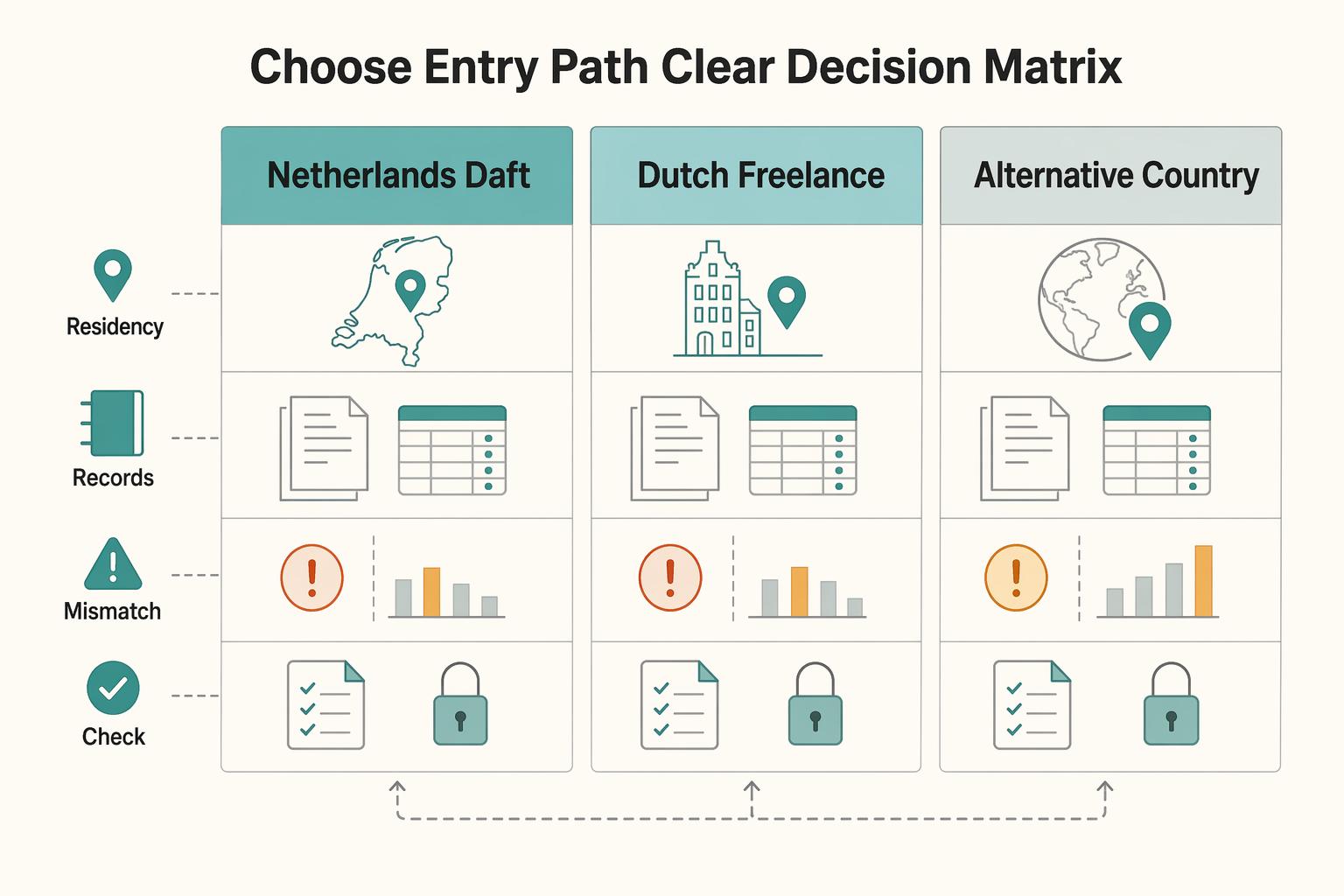
Choose your entry path with a clear decision matrix#
Do not try to keep every possible route alive at the same time. Pick the branch that is most likely to fit, pressure-test that one first, and keep alternatives as backup until there is a reason to switch. That gives you cleaner documents, clearer stop points, and fewer false starts.
There is also a limit to the evidence base here. One referenced PDF was inaccessible, and the readable excerpt is generic nomad content rather than Netherlands immigration guidance. So the matrix below is a planning tool, not legal confirmation. Its job is to help you decide where to spend verification effort first.
| Path to evaluate | Who to check first | Who it may not fit | Admin burden now | Delay risk now |
|---|---|---|---|---|
| Netherlands DAFT Visa branch | US citizens triaging DAFT first | Anyone treating this section as proof of DAFT rules | High, because core legal details still need direct verification | High if you proceed on summaries alone |
| Dutch freelance visa branch | Non-US readers or anyone triaging the self-employed route first | Anyone expecting confirmed eligibility criteria from this section | High, for the same reason | High until primary requirements are verified |
| Alternative country branch via index | Readers who need a backup if Netherlands routes stay unclear | Readers committed to Amsterdam regardless of legal fit | Medium, mostly comparison work | Medium, lower if done before bookings |
What matters here is fit, not completeness. Many people lose time by building three partial files at once. It feels thorough, but in practice it creates a pile of overlapping notes, mixed requirements, and weak documentation for all of them. A single primary route forces sharper questions. It also makes it obvious when a route is not working, which is useful. A fast "no" is often better than a vague "maybe" spread across too many branches.
Use this working rule:
- If you are a US citizen, triage the DAFT branch first.
- If you are not, start with the Dutch self-employed branch.
- If neither path becomes clear, compare alternatives in the 2026 Global Digital Nomad Visa Index before committing to Amsterdam.
That is not a promise of eligibility. It is a way to avoid wasting your best planning time. The first pass should tell you whether your route is legible enough to keep going. Can you name the legal basis? Can you state what kind of work it covers? Can you identify the core documents without leaving major blanks?
Decision checkpoint: "Choose one path now; don't run multiple applications blindly."
Set a stop point before bookings: your legal stay basis is named, your work permission is clarified, and the core documents are identified without unresolved gaps. If you need broader comparison support while you sort that out, use Browse Gruv tools. Once the branch is chosen, the next job is straightforward: build the paperwork to match that route and ignore generic advice that does not.
Build your document pack before you book flights#
Your paperwork should match the route, not your anxiety. The goal is a clean submission pack for one exact path, not a giant folder of loosely related files that you hope will cover every scenario.
That difference matters more than most people expect. A generic pile of records feels productive, but it usually creates extra review time, naming inconsistencies, and last-minute rework. A route-specific pack is smaller, clearer, and easier to audit. It also makes it easier to spot what is actually missing.
Build the pack before you book, but only treat documents as required after you confirm the official checklist for your exact path, whether that is the Dutch freelance visa or the Netherlands DAFT Visa. This guide is mostly about mobility and packing discipline, not Netherlands legal submission rules. Use it to stay organized, not to decide what the law requires.
A practical way to think about this is in two buckets: items the checklist explicitly requires, and items that are simply smart to pre-collect so you can respond quickly if asked.
| Purpose | Required to submit | Smart to pre-collect |
|---|---|---|
| Identity | Only what your confirmed route checklist explicitly asks for | Current identity records you already hold |
| Legal basis | Only route-specific forms and supporting items listed for your case | Your chosen-path summary and unresolved-question tracker |
| Work evidence | Only evidence explicitly requested for your route | Existing work records you may need to reference |
| Funds evidence | Only the exact proof types requested for your route | Current financial records you already have available |
| Housing evidence | Only documents explicitly requested for your case | Available address and booking records you can quickly provide |
A strong pack is boring in the best possible way. Current copies. Readable scans. Consistent names. No mystery files whose purpose you cannot explain two weeks later. File labels should be obvious enough that someone else could understand the pack without opening everything one by one.
Use this order before paying for flights:
- Gather documents.
- Verify names are consistent across files.
- Fix mismatches and obvious gaps.
- Translate only if your confirmed checklist requires it.
- Create a dated evidence snapshot folder.
That dated snapshot matters because planning changes quickly. If you have to revisit a decision, you want to know exactly what you were relying on at the time, not what your folder looks like after three rounds of edits. In practice, small defects cause outsized delay. A name mismatch, an outdated copy, or an incomplete record often surfaces late, when the fix is slower and more expensive.
Book only after your legal path is confirmed and your required_submit folder is complete with current copies. When the pack is clean, dates become much easier to set with confidence because you are no longer guessing whether the paperwork can catch up.
Plan the move timeline from 90 days out to day 30#
A phased plan beats a long to-do list every time. Each phase should end with a real proceed, pause, or delay decision, not just another stack of half-finished tasks.
Relocation planning tends to reward motion even when the sequence is wrong. It is easy to feel productive while still carrying unresolved issues from an earlier phase. The timeline below works better because every stage has a verification checkpoint. If the checkpoint fails, the calendar does not win.
Relocation guidance consistently shows that residence and employment setup in the Netherlands require careful planning. Older Amsterdam nomad guides are still circulating, so treat every checklist as date-sensitive and re-check requirements before any irreversible decision. The timeline is not there to create urgency. It is there to keep you from importing uncertainty into later steps.
| Phase | Must-do legal task | Housing task | Money/Admin task | Verification checkpoint |
|---|---|---|---|---|
| 90 to 60 days before departure | Lock your legal route and list open legal questions | Define first-month housing criteria and one backup option | Build a relocation budget file and reserve contingency | You can state your legal basis in one sentence and map each required document to it |
| 30 days before departure | Re-check current requirements and freeze your final submission set | Book only flexible housing if any legal item is unresolved | Prepare payment access for first-month costs | Every critical document is current, readable, and consistent on name and date |
| Arrival week | Complete first post-arrival legal steps for your route | Move into temporary housing and confirm it supports your work week | Activate local essentials for payments and records | You can produce copies of completed registrations and receipts |
| First 30 days after arrival | Close remaining permit-related actions and appointments | Decide whether to extend a short stay or move to longer housing | Reconcile actual spend against plan and adjust runway | No open legal item is missing an owner and next action date |
The logic across those phases is simple. Early planning is for reducing ambiguity. The 30-day mark is for freezing decisions, not inventing new ones. Arrival week is for completing the first local tasks that the rest of your setup depends on. The first month after arrival is where you decide what deserves to become permanent and what still needs to stay flexible.
Hard rule: if any critical document is still unresolved at the 30-day mark, delay departure instead of trying to fix it on arrival.
That can feel conservative, especially if flights or housing are tempting, but it is usually the cheaper choice. Trying to solve a core documentation issue after arrival turns a planning problem into a live operational problem. It also complicates housing, payments, and basic work stability at exactly the moment you need those things to be dependable.
Keep the tracker simple enough that you'll actually maintain it. A one-page done/not done tracker is enough:
Phaseand target dateLegal,Housing,Money/Admin,Verificationmarked done or not doneBlocker,Owner, andNext check dateGo/No-Gobefore each irreversible spend
Owner is mandatory. Unowned tasks are the ones most likely to slip because everyone assumes they are already handled. A useful side effect of this tracker is that it exposes false progress. If a task has no owner, no next check date, and no clear dependency, it is probably not moving.
Every phase should lower uncertainty. If a task does not do that, it probably belongs later. Once the route, documents, and dates are under control, the next big variable is how you will actually live and work during the first month.
Set up housing and work life for reliable weekdays#
For month one, flexibility beats perfection. The right place is not the one that photographs well or sounds good in a guide. It is the one that lets you work a normal week without constant friction.
That is why neighborhood choice should be treated as an operating decision, not a lifestyle fantasy. One workation guide frames it as a practical planning step, and that is the right lens. Weekend impressions can be badly misleading. A lively area can feel great for two nights and still be the wrong fit for early calls, focused work blocks, or a repeatable commute.
Evaluate areas by weekday performance, not aesthetics. Before you sign anything, test the boring details that make remote work dependable:
- Transit access: test your real door-to-door path to and from an
M52stop during work hours. - Walking load: check whether the daily walk to transit and essentials is sustainable on busy weekdays.
- Focus quality: assess indoor noise in the hours you actually work.
- Backup continuity: identify a second nearby place where you can work if your primary setup fails.
- Meeting reliability: run a full video-call workday from the space before deciding.
A short stay is the safer default for month one, including options such as Wittenberg by Cove Apartments, because it lowers the cost of correction while you test reality. That is the real advantage: you are buying room to learn, not just a bed for a few weeks. If the noise is wrong, the walk is longer than it looked, or your backup setup is weak, you want a clean way to adjust.
| Option | What you gain | What you risk | Verification checkpoint |
|---|---|---|---|
| Month-one short stay | Faster start and easier course correction | Higher short-term spend | Two full workweeks completed with stable focus and workable daily transit/walking load |
| Longer lease after month one | More stability once routine is proven | Harder to exit if setup fails | You can document a repeatable weekday routine before signing |
A practical test is to treat the first two weeks like a rehearsal for normal life. Work full days. Take calls. Do the real commute. Buy groceries at normal times. Check how the apartment feels when you are tired, under deadline, or trying to focus. If the space only works when you are in exploration mode, it does not really work.
Common failure mode: choosing based on a weekend impression, then discovering that weekday noise or commute friction breaks your schedule. By the time you notice, the costs of fixing it are much higher. Keep month-one flexibility on purpose. It gives you a better housing decision and a more honest budget.
Budget your first 90 days with operating ranges, not wishful math#
A single neat budget number is usually a trap. Use operating ranges with confidence labels so you can see the difference between what is confirmed, what is directional, and what is still unknown.
This matters most in the first 90 days because the move has moving parts on both sides of the ledger. Some costs are visible early, like short-stay housing or known admin items. Others only become clear once you are actually working from the city, testing transit patterns, or extending housing while paperwork or timing settles. If you force all of that into one optimistic number, you lose the signal you most need: which line items are real and which ones are still assumptions.
Hard budget figures for an Amsterdam move are not available here, and broad travel estimates vary widely, so treat this as a control system, not a prediction. The goal is not perfect forecasting. The goal is to know which numbers are backed by quotes or receipts and which ones still rely on hope. Confidence labels make that visible. They force you to separate the written quote from the number you would prefer to be true.
Track six categories: housing, transport, workspace, food, admin fees, and contingency. Split month one from months two and three, and separate fixed from variable spend so you can adjust weekly instead of waiting for a bad surprise.
| Category | Month 1 band | Months 2-3 band | Confidence label | What upgrades confidence |
|---|---|---|---|---|
| Housing | Your actual short-stay quote range | Your likely post-test lease range | Confirmed or Directional | Signed terms or written quote |
| Transport | Transit plus walking-related extras you can verify | Repeatable weekly pattern | Directional | Two-week spend log |
| Workspace | Backup desk or coworking need if home setup fails | Ongoing usage pattern | Unknown to Confirmed | Trial-week receipts |
| Food | Core groceries plus weekday meal pattern | Stabilized routine | Directional | Four-week card history |
| Admin fees | Required legal and admin items you can name | Residual follow-up costs | Unknown | Official invoice or receipt |
| Contingency | Buffer for timing slips | Buffer for extensions | Directional | Written trigger rules |
The key is not the labels themselves. It is the discipline behind them. If a number is unknown, treat it like risk. If it is directional, keep room around it. If it is confirmed, anchor decisions to that and build outward. That way, you are not pretending certainty where you do not have it.
Use world-travel figures like $20,000/year, $50/day, or low-end $12,000/year only as directional context, not as Amsterdam-specific 90-day targets.
Those numbers can still be useful as rough framing, but they are not precise enough to carry a move decision by themselves. The only numbers that really matter for your first 90 days are the ones tied to your actual housing plan, your work setup, and your legal path.
Decision rules:
- Pay more in month one when it reduces operational risk.
- Cut convenience spend only after two stable workweeks.
- If housing is shared, avoid doubling costs that are actually shared.
That first rule is especially important. Month one is where cheap decisions often become expensive. Flexible housing, a backup workspace, or extra buffer can look inefficient on paper and still be the smarter choice if they prevent disruption while you settle your route and routine.
Use a Friday checkpoint to keep the budget honest: record what moved from unknown to confirmed. If nothing moved, pick one blocked line item and assign one specific next check. That keeps the budget tied to evidence rather than mood.
The question worth asking early is blunt: can this budget survive a delayed approval or a housing extension? If the answer is no, better verification is usually more useful than better optimism. And once you can see the weak spots clearly, the next task is to avoid the planning errors that tend to make those weak spots worse.
Avoid the mistakes that cause delays and expensive rework#
Most expensive rework starts with bad sequencing, not bad intent. People use lifestyle content to make legal decisions before the legal basis is actually verified.
That is the pattern to watch because it feels harmless at first. Personal nomad updates, city guides, and experience-based posts can be very helpful for understanding pace, neighborhood tradeoffs, or day-to-day fit. But they are not legal decision authority, and some of them say so directly by framing themselves as personal updates, practical tips, or ad-supported content rather than formal guidance. Use them for fit and feel. Do not use them to settle filing decisions, work permission questions, or route eligibility.
When people get into trouble, the sequence is usually the same: vague route, incomplete records, then money committed too early. By the time the uncertainty becomes obvious, flights are booked, housing is locked, and the cost of correcting a wrong assumption has gone up.
Pause before any irreversible booking if any of these are true:
- You cannot explain your legal route in one clear sentence.
- You heard about requirement changes but cannot verify them through official channels.
- Core records are missing, inconsistent, or not ready.
- You do not have a dated record of what you checked and when.
If anything feels fuzzy, slow down and verify in a way you can point back to later. That does not mean hoarding screenshots without context. It means recording what question you were answering, where you checked it, and when. Use this protocol:
- Write the decision question in plain language.
- Confirm the answer through official channels.
- Date-stamp the result in your decision log.
- Save the notice or page you relied on.
- Re-check before each non-refundable commitment.
That process can feel overly careful until the first time sources conflict. Then it becomes the only sane way to move. A dated decision log gives you a clean trail back to what you relied on. It also makes repeat checks faster because you are not starting from zero every time.
| Input type | Good for | Not good for | Required checkpoint |
|---|---|---|---|
| Lifestyle blogs and social narratives | Daily-life expectations and tradeoffs | Legal requirements or filing decisions | Match each legal claim to official guidance before acting |
| Official authority guidance | Rules, requirements, and process updates | Personal comfort or neighborhood fit | Record the check date and version used |
If sources conflict, follow official authority and postpone non-refundable commitments until the conflict is resolved clearly. That single habit prevents a large share of avoidable rework. It also clears the way for the practical questions that usually remain once the route, file, and timing are under control.
Your next move#
If you take one idea from this guide, make it the sequence. Legal clarity first. Then documents. Then timing. Then housing and cash flow. That order removes a surprising amount of stress because each decision gives the next one a firmer base.
Use lifestyle content to judge daily fit, and use official, secure channels for decisions that affect legal status, sensitive data, or non-refundable spend. Then follow this order:
- Choose one legal path and define it in one sentence.
- Complete your core document pack and date-stamp each file.
- Run a 90-day checkpoint and set a Go/No-Go before any non-refundable payment.
- Re-check sensitive requirements on official, secure sources before sharing personal data or booking travel.
If a critical requirement still cannot be verified, pause commitments and stick to reversible tasks. That can feel slower in the moment, but it is usually faster than repairing a bad assumption after money is committed. And once the route is clear, the rest of the move gets much easier to manage because you are no longer planning around guesswork. If you need cross-border payment operations after relocation, review tools with compliance checks and traceable records where supported, or Talk to Gruv.
Frequently Asked Questions
Does Amsterdam have a digital nomad visa?
Not as a standalone national program. The Netherlands does not have a generic digital nomad visa, so most non-EU remote professionals use either the Dutch self-employed route or, for eligible US citizens, the DAFT path.
What is the most practical legal path for a US citizen moving to Amsterdam for remote work?
Assess DAFT first because it is US-specific under the Dutch-American Friendship Treaty. A commonly cited checkpoint is maintaining at least EUR 4,500 in a Dutch business bank account during residency. Treat that as one eligibility screen, not an approval guarantee. For a deeper breakdown, see The Netherlands DAFT Visa for American Entrepreneurs.
How do I choose between the Dutch freelance visa and the Netherlands DAFT Visa?
If you are a US citizen, test DAFT eligibility first. If you are not, the self-employed route is typically the relevant branch. It is described as points-based around experience, business plan, and added value to the Netherlands. Pick one primary route and build documents to that route.
What documents should I prepare before I book flights?
Start with documents tied to your legal route and business activity, then add evidence matched to that path. For freelance registration, expect to prepare a business plan and evidence your work benefits the Dutch economy. Keep dated files and re-check requirements before non-refundable bookings.
What should I do in my first week in the Netherlands?
Many applicants enter on a 90-day Schengen window and begin local setup during that period. Register your address at the municipality to obtain your BSN, since that enables key admin tasks. If you will operate as a freelancer, prepare for KVK registration with your business documents.
How should I choose where to stay if I need stable workdays?
Make reliability the first filter, lifestyle the second. Amsterdam internet is often described as fast, including averages above 100 Mbps, but building-level performance can vary. Test weekday conditions before signing longer terms.
What costs are commonly underestimated in the first 90 days?
Currency conversion friction is often missed when income is not in euros. Repeated conversion spreads of up to 3% can increase monthly burn. For DAFT applicants, remember the EUR 4,500 business-bank balance is capital you must maintain, so liquidity planning matters.
Try a related tool
Researched and edited by the Gruv editorial team. Gruv builds cross-border billing, payouts, and finance-operations software for global businesses.
Sources
Includes 2 external sources outside the trusted-domain allowlist.
Educational content only. Not legal, tax, or financial advice.
Related Posts
The Netherlands DAFT Visa for American Entrepreneurs
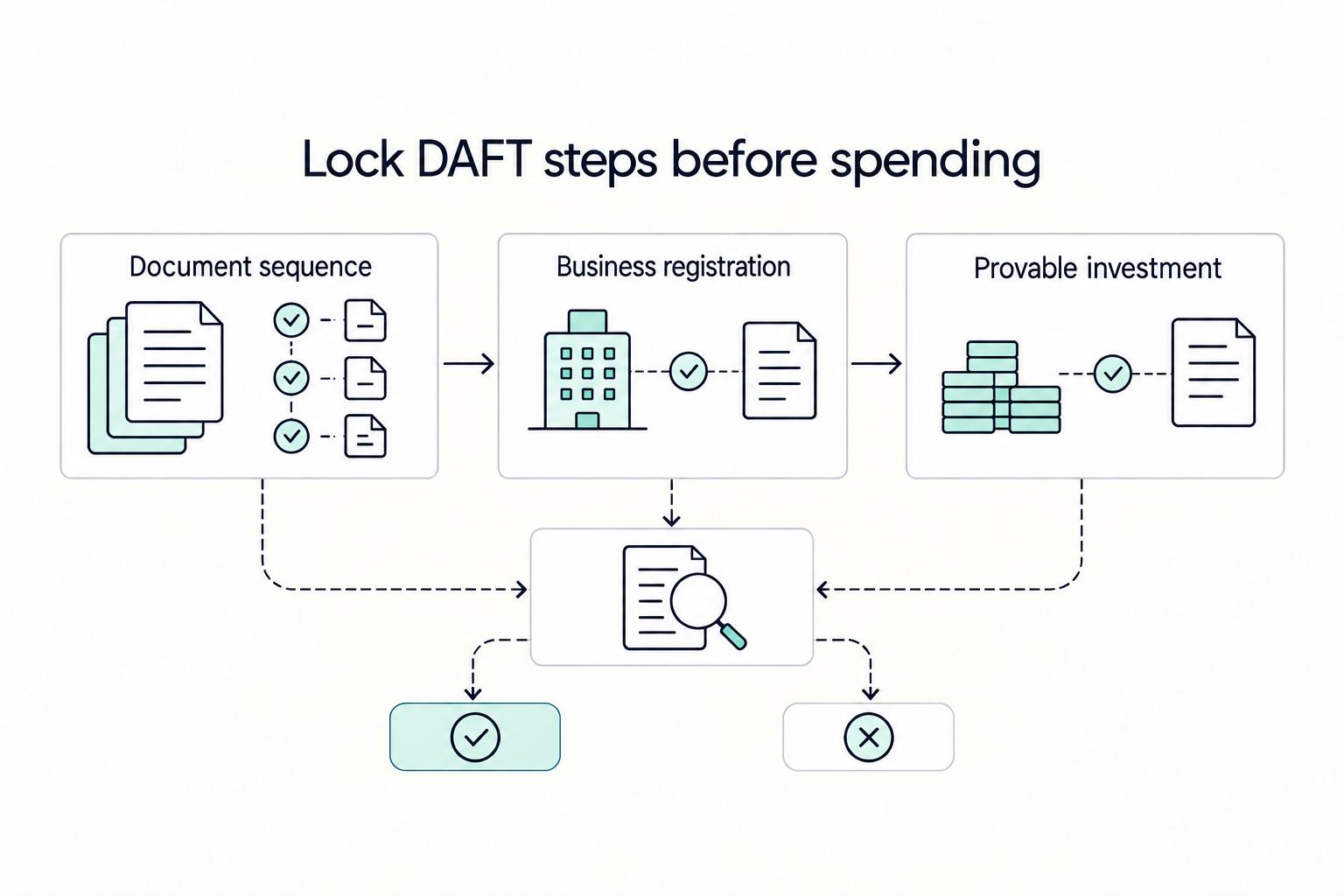
**The Netherlands DAFT visa is a residence permit path for U.S. citizens under the Dutch-American Friendship Treaty. It works best when you treat it like an execution problem, not a research hobby.** Your job is not to "learn DAFT." It is to run a sequence that ends in an IND-ready file and a business that already looks real on paper.

The 2026 Global Digital Nomad Visa Index for 50+ Countries
Start with legal fit, not lifestyle filters. The practical order is simple: choose a route you can actually document, then decide where you want to live. That single change cuts a lot of wasted comparison work and stops you from falling in love with places that were never a real filing option.
Taxes in the Netherlands for Expats and Freelancers
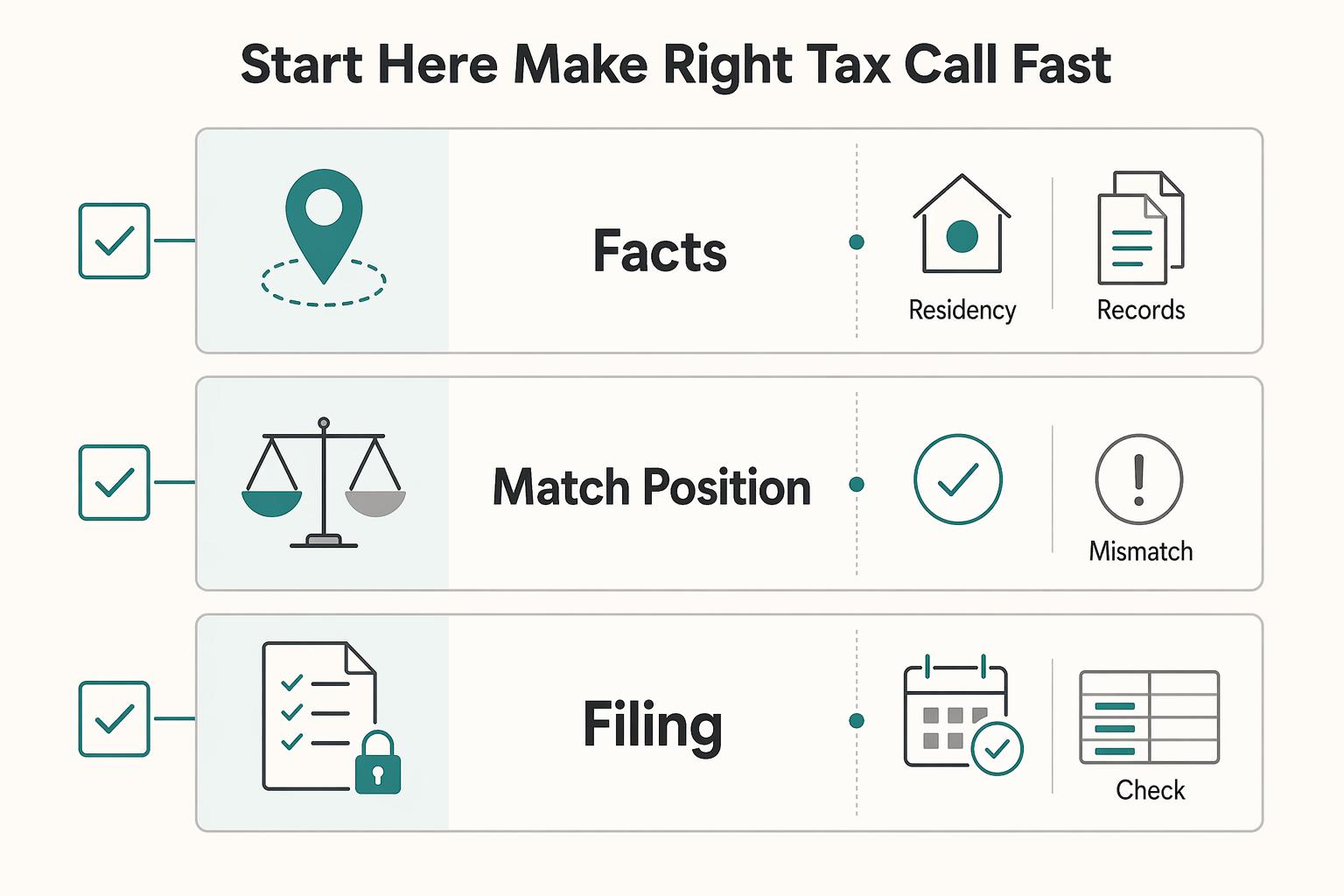
Make one decision first: are you filing on a Dutch resident track, or a non-resident track with Dutch income. Once that call is provisional, everything else gets simpler: choose the likely return path and gather the records that support it.